Intellisell Pricing, Reviews, Pros and Cons (2026 Guide)
Intellisell keeps its price list behind a sales call, which makes budgeting hard. Here's how the tiers, seat minimums and credit overages actually work in 2026, what reviewers praise, and where a cheaper stack wins.
TL;DR
- Intellisell does not publish a full price list. Every number you'll see quoted comes from buyers, procurement docs and review-site threads, so treat published figures as ranges rather than facts and confirm in writing before you sign.
- The real cost driver is not the platform fee. It's the seat minimum, the annual-only commitment, and credit overages that bill at a higher unit rate than your contracted pool.
- Reviewers consistently praise intent signals, account scoring and CRM sync. They consistently complain about contact-level data decay, opaque renewal increases and slow credit rollovers.
- If you need buying signals and account orchestration, a platform like Intellisell can earn its price. If you mostly need accurate emails and phone numbers, you're overpaying by a wide margin.
- A lean alternative stack — a dedicated email finder plus verification — starts at $49/mo and covers 80% of what most small outbound teams actually use.
What is Intellisell, and who is it for?#
Intellisell sits in the sales intelligence category: a platform that combines a B2B contact database, firmographic and technographic enrichment, intent or engagement signals, and account scoring, then pushes the result into your CRM and sequencer.
Think of it like a hotel concierge versus a corner store. The concierge knows which restaurants are busy tonight, books your table, and remembers you like a window seat — but you pay for the whole hotel. The corner store sells you exactly the one thing you came for, fast and cheap. Sales intelligence platforms are the concierge. Point tools are the corner store. Neither is wrong; they're priced for different problems.
The realistic buyer profile for a platform in this class:
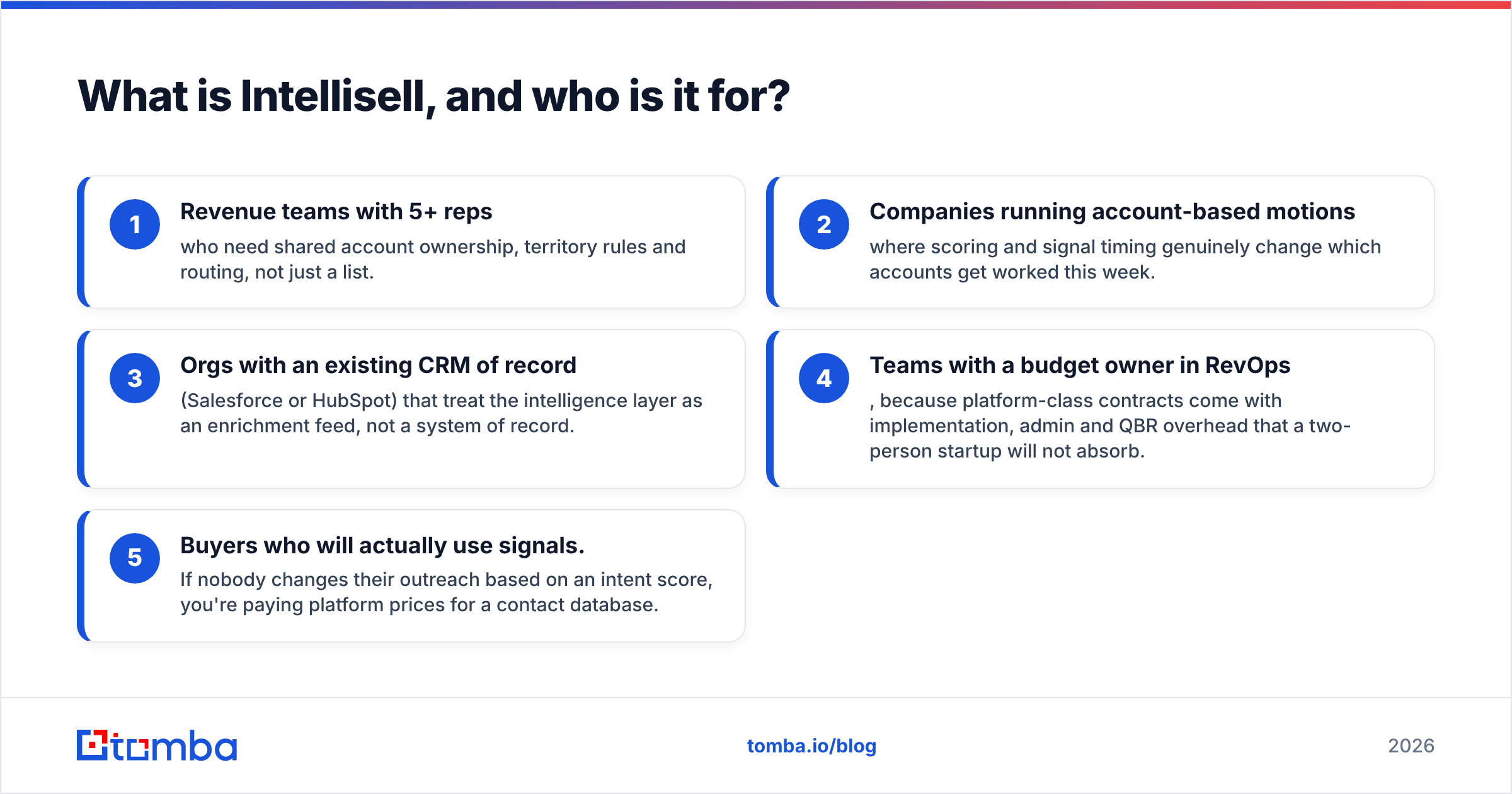
- Revenue teams with 5+ reps who need shared account ownership, territory rules and routing, not just a list.
- Companies running account-based motions where scoring and signal timing genuinely change which accounts get worked this week.
- Orgs with an existing CRM of record (Salesforce or HubSpot) that treat the intelligence layer as an enrichment feed, not a system of record.
- Teams with a budget owner in RevOps, because platform-class contracts come with implementation, admin and QBR overhead that a two-person startup will not absorb.
- Buyers who will actually use signals. If nobody changes their outreach based on an intent score, you're paying platform prices for a contact database.
If you don't recognize your team in at least three of those five, the pricing conversation below will not end well for you.

How does Intellisell pricing actually work in 2026?#
Conclusion first: the sticker price is the least important number in the contract.
Intellisell, like most platform-class sales intelligence vendors, gates its pricing behind a demo and a quote. That is a deliberate commercial choice — it lets the vendor price by company size, data volume and perceived willingness to pay. It also means two companies with identical seat counts can pay meaningfully different amounts for the same product.
What you should expect to negotiate, based on how this category prices generally:
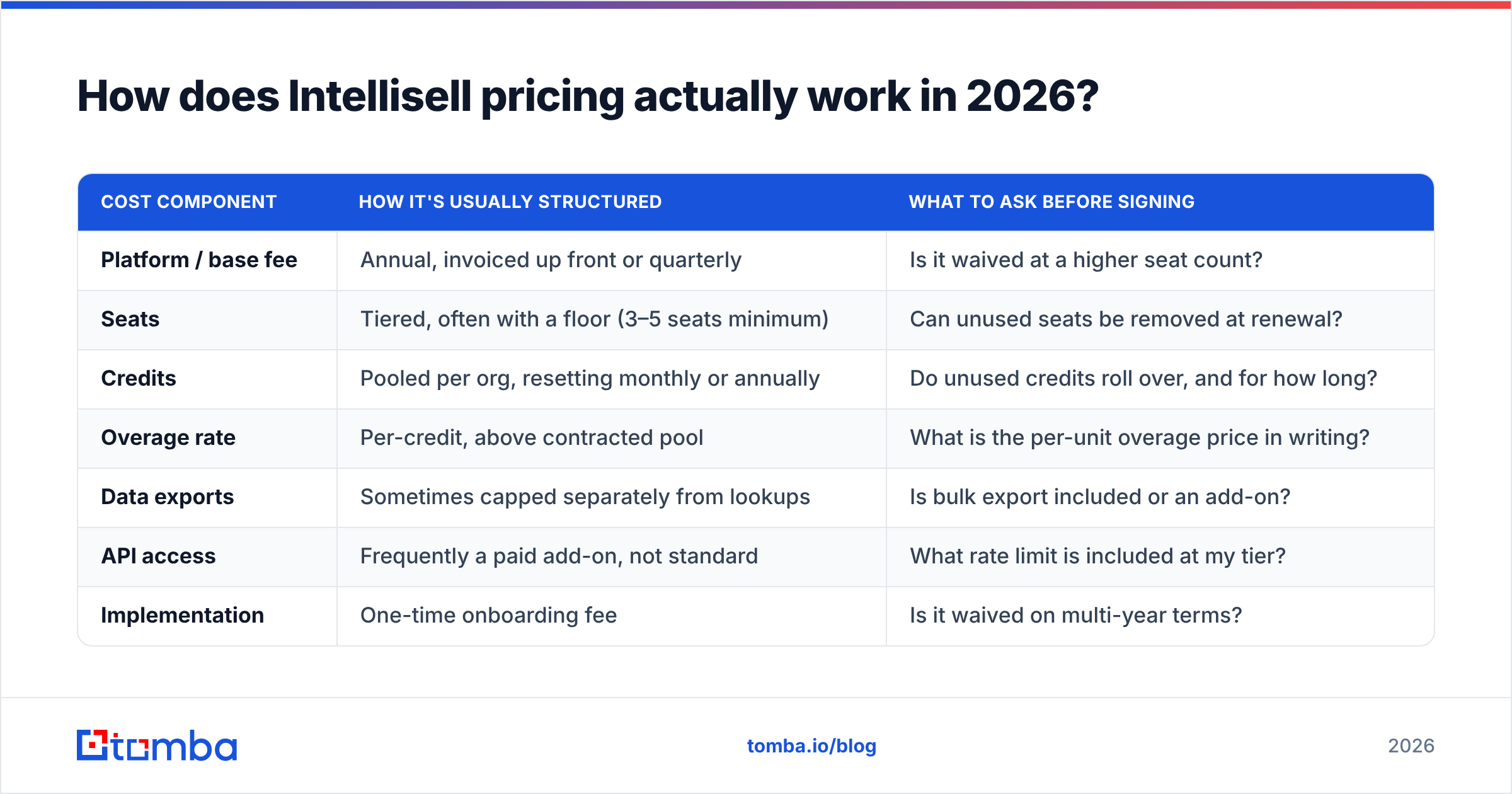
| Cost component | How it's usually structured | What to ask before signing |
|---|---|---|
| Platform / base fee | Annual, invoiced up front or quarterly | Is it waived at a higher seat count? |
| Seats | Tiered, often with a floor (3–5 seats minimum) | Can unused seats be removed at renewal? |
| Credits | Pooled per org, resetting monthly or annually | Do unused credits roll over, and for how long? |
| Overage rate | Per-credit, above contracted pool | What is the per-unit overage price in writing? |
| Data exports | Sometimes capped separately from lookups | Is bulk export included or an add-on? |
| API access | Frequently a paid add-on, not standard | What rate limit is included at my tier? |
| Implementation | One-time onboarding fee | Is it waived on multi-year terms? |
| Renewal uplift | Contractual annual increase (5–10% is common) | Cap the uplift in the MSA, not the order form. |
That table is the entire negotiation. Two clauses matter most: the overage rate and the renewal uplift cap. A team that blows through its credit pool in month four on an uncapped overage rate can pay 30–40% more than its contracted annual number without anyone approving a new PO.
What about the free trial?#
Category norm is a short guided trial or a limited sandbox rather than a self-serve free tier. That's a real difference from tools that publish pricing openly — with a transparent pricing page you can model your cost in five minutes. With quote-based pricing you cannot model anything until you've spent 45 minutes on a call and a week waiting for a proposal.
Neither model is dishonest. But for a team evaluating four tools in a two-week window, quote-gating is a real tax on your time, and you should weigh it.
What do Intellisell reviews say?#
Review sentiment for platforms in this class clusters into a predictable shape, and Intellisell's public feedback on sites like G2 and Capterra follows it.
What reviewers consistently like:
- Signal quality over raw volume. Reps report that account prioritization saves real time versus working an alphabetical list.
- CRM hygiene. Automatic enrichment of stale records is the feature managers name most often when justifying renewal.
- Onboarding support. Platform vendors staff implementation properly because churn in year one is expensive for them.
- Admin controls. Territory rules, credit allocation per team and usage reporting are genuinely better than what point tools offer.
What reviewers consistently criticize:
- Contact-level decay. Firmographics age slowly; direct emails and mobile numbers age fast. This is the single most common complaint across the entire category, not a flaw unique to any one vendor.
- Credit math. Users describe burning credits on records they'd have skipped if the preview showed data quality first.
- Renewal surprises. Uncapped uplifts and seat-count ratchets show up in year-two reviews far more than year-one reviews.
- Time to value. Six to ten weeks before the intelligence layer actually changes rep behavior is normal, and teams that don't budget for that feel burned.
When you read reviews, weight them by company size. A 200-person org's "worth every penny" and a 6-person org's "we never used half of it" are both accurate — they bought different products at the same price.
What are the pros and cons of Intellisell?#
Pros
- Signal-driven prioritization that a flat contact database cannot replicate.
- Single pane for account research, which cuts tab-switching for reps working 40+ accounts.
- Strong native CRM sync, including field mapping and dedupe rules that survive bulk updates.
- Enterprise controls — SSO, audit trails, per-team credit pools, usage dashboards.
- Vendor accountability. A named CSM and a QBR cadence are worth more than teams expect when data quality slips.
Cons
- Quote-only pricing makes budgeting and comparison slow.
- Annual commitment removes your ability to leave when quality drops mid-year.
- Seat minimums punish small teams that only need two power users.
- Contact accuracy is the weakest link — as it is for every all-in-one platform, because breadth and freshness trade against each other.
- Feature sprawl. Most teams use a fraction of what they pay for, and the unused fraction never shows up on an invoice line you can cut.
How does Intellisell compare to other options?#
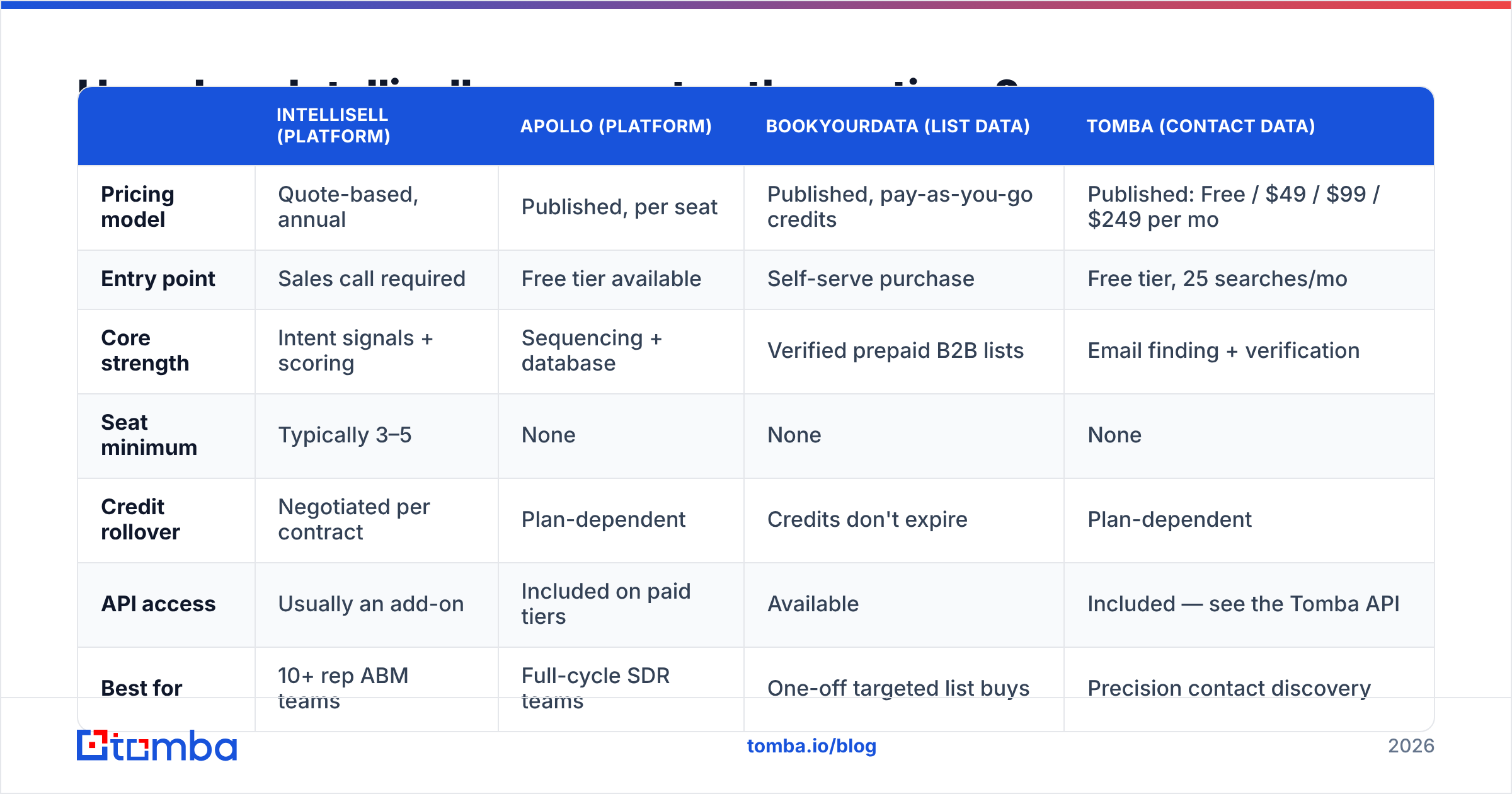
The honest comparison is not "which tool is best" but "which layer are you actually buying." Here's how the categories line up.
| Intellisell (platform) | Apollo (platform) | BookYourData (list data) | Tomba (contact data) | |
|---|---|---|---|---|
| Pricing model | Quote-based, annual | Published, per seat | Published, pay-as-you-go credits | Published: Free / $49 / $99 / $249 per mo |
| Entry point | Sales call required | Free tier available | Self-serve purchase | Free tier, 25 searches/mo |
| Core strength | Intent signals + scoring | Sequencing + database | Verified prepaid B2B lists | Email finding + verification |
| Seat minimum | Typically 3–5 | None | None | None |
| Credit rollover | Negotiated per contract | Plan-dependent | Credits don't expire | Plan-dependent |
| API access | Usually an add-on | Included on paid tiers | Available | Included — see the Tomba API |
| Best for | 10+ rep ABM teams | Full-cycle SDR teams | One-off targeted list buys | Precision contact discovery |
| Worst for | 2-person startups | Teams wanting deep intent | Ongoing real-time enrichment | Teams needing intent data |
Two things to take from that table.
First, BookYourData solves a genuinely different problem well: if you need a clean, verified list for a specific campaign and you don't want a subscription, prepaid list data is a rational purchase and often the cheapest path to a first campaign. It is not competing with an intelligence platform; it's competing with the hours you'd spend building the list yourself.
Second, if your honest answer to "what do we use it for?" is finding and verifying contact details, you are buying a Ferrari to do grocery runs. A dedicated stack — domain search to map an account, an email finder for the named contacts, and a verifier before send — does that job at a fraction of platform pricing, with published prices you can approve without a procurement cycle.
Is Intellisell worth it for your team?#
Use a simple test. Take your quoted annual number, divide by the number of reps who will log in weekly, then divide by 12. That's your per-rep monthly cost.
Now ask: does the intelligence layer produce at least one extra qualified meeting per rep per month? According to HubSpot's sales research, pipeline efficiency gains come overwhelmingly from better targeting and timing rather than more activity — which is exactly what a signal platform claims to deliver. If your average deal size makes one extra meeting per rep per month clearly worth the per-rep cost, the platform is defensible. If it doesn't, no feature list will save the math.
Three scenarios where the answer is usually yes:
- Enterprise ACV above $25k — one saved cycle pays for the year.
- Account-based teams with defined territories where routing and scoring reduce internal conflict.
- Orgs where RevOps owns data quality and can actually operationalize enrichment into CRM workflows.
Three where it's usually no:
- Founder-led sales under 10 deals a quarter — you know your accounts better than a score does.
- Agencies running client campaigns — you need portable data, not a locked platform.
- Teams whose top complaint is bounce rate — that's a contact accuracy problem, and platforms are not where accuracy is strongest.
What's the cheaper alternative if you mostly need contact data?#
Build the lean stack. It costs less than one platform seat and it's transparent:
- Map the account. Use domain search to pull every known email pattern and public contact for a company in one call.
- Find the named people. Run the specific decision-makers through an email finder rather than guessing a pattern.
- Verify before you send. Push every address through an email verifier so bounces don't damage your sending domain.
- Enrich what matters. Add firmographics with data enrichment only for accounts that reached your shortlist, instead of enriching everything on principle.
- Automate it. Wire the whole thing through the API or a CRM integration so reps never manually copy a single address.
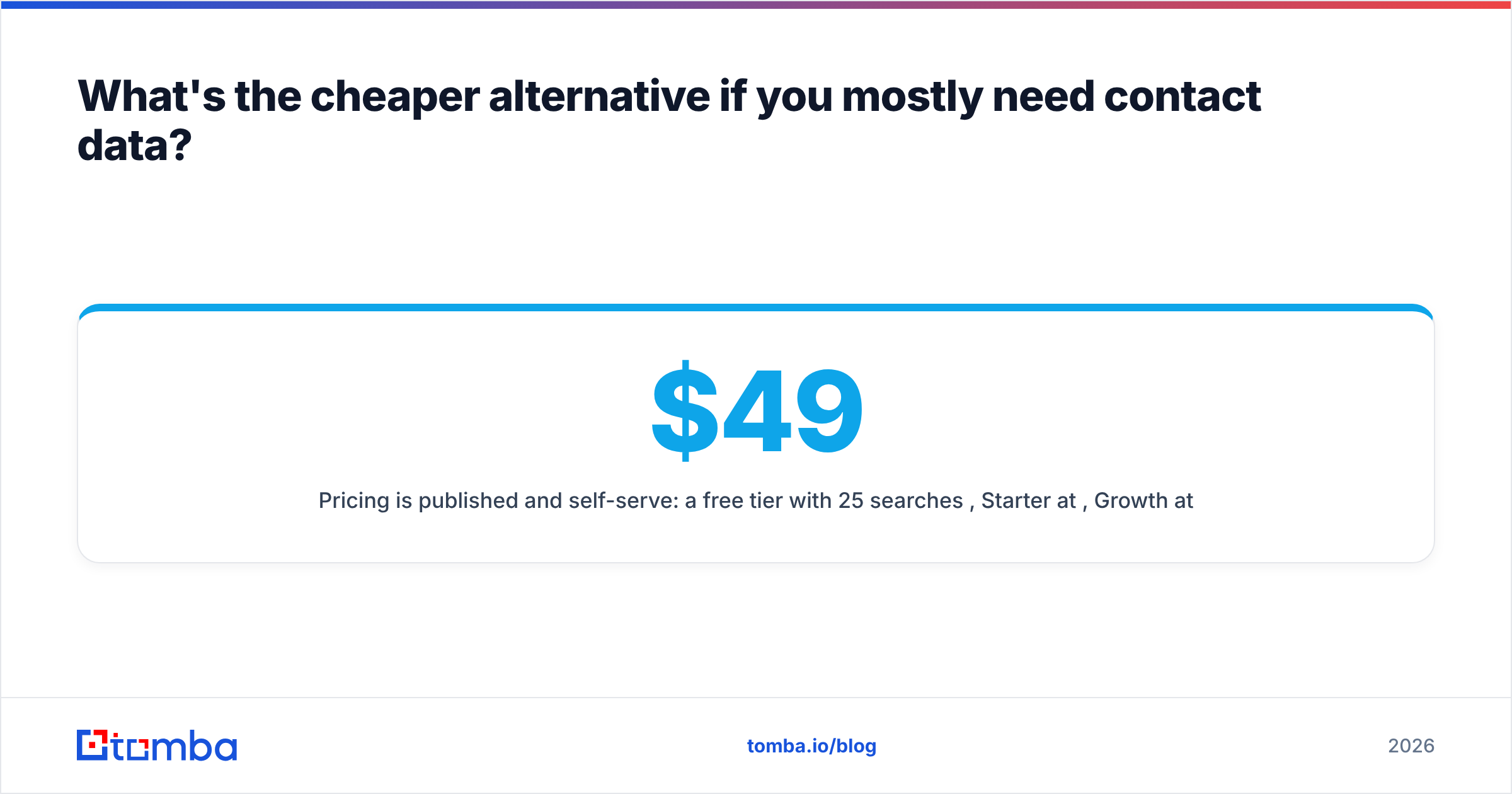
Pricing is published and self-serve: a free tier with 25 searches per month, Starter at $49/mo, Growth at $99/mo, Pro at $249/mo, and custom Enterprise terms. No seat minimum, no demo gate, no annual lock to evaluate whether it works. For a comparison of how analysts frame the broader category, Gartner's sales technology coverage is a useful neutral reference point when you're building the business case internally.
The point isn't that platforms are bad. It's that most teams buy a platform to solve a data problem, then discover the data problem is still there at 10x the price.
The bottom line#
Intellisell is a reasonable purchase for a mid-market or enterprise revenue team that will genuinely act on signals, has RevOps to own it, and can negotiate a capped renewal and a written overage rate. It's a poor purchase for a small team that mainly needs reliable emails and phone numbers, because seat minimums and annual terms convert a $600/year problem into a five-figure one.
Before you take the demo, write down the three jobs you need done. If all three are "find the person, get their email, make sure it lands," skip the sales call.
Start with the layer you actually use. Try the Tomba Email Finder free — 25 searches a month, no card, no seat minimum, and published pricing you can approve without procurement. If you outgrow it, you'll have real usage data to take into your next platform negotiation instead of a guess.
Related guides#
Ready to find emails that actually work?
Join 150,000+ professionals who stopped guessing and started sending. Free credits on signup — no credit card required.
Get the Tomba newsletter
Practical outbound tactics and product updates — once every two weeks.
About the author