Intellizence Pricing, Reviews, Pros and Cons (2026 Review)
Intellizence sells sales signals — funding rounds, layoffs, exec hires, M&A — on a quote-based plan. Here is what it actually costs, where reviewers say it wins, and where it leaves gaps you still have to fill.
TL;DR
- Intellizence is a sales-signal and risk-intelligence platform — funding rounds, layoffs, leadership changes, M&A, expansions, lawsuits — delivered as dashboards, alerts, and an API. It is not a contact database.
- Intellizence pricing is quote-based. There is no public self-serve price card in 2026, which means your cost depends on signal types, company coverage, seat count, and whether you need API/bulk delivery.
- Reviewers consistently praise signal breadth and responsiveness of the team; the recurring complaints are onboarding friction, opaque pricing, and signal noise that needs filtering.
- The biggest hidden cost is not the license. It is that signals alone do not give you a person to email — you still need contact discovery and verification on top.
- For lean teams, a practical stack is one signal source plus a cheap, accurate email layer. Tomba starts at $49/mo with a free tier, so the contact half of the stack costs a fraction of the intelligence half.
What is Intellizence and who is it actually for?#
Think of Intellizence as a police scanner for the B2B market. It does not tell you who to call. It tells you which buildings just had something happen — a company raised a Series B, cut 12% of staff, hired a new CRO, opened a second facility, or got named in a lawsuit. What you do with that alert is your job.
Technically, Intellizence is a signals and alternative-data provider. It scrapes and structures public sources — news, filings, job boards, press releases, regulatory disclosures — into machine-readable events, then pushes them into dashboards, email digests, an API, or your CRM.
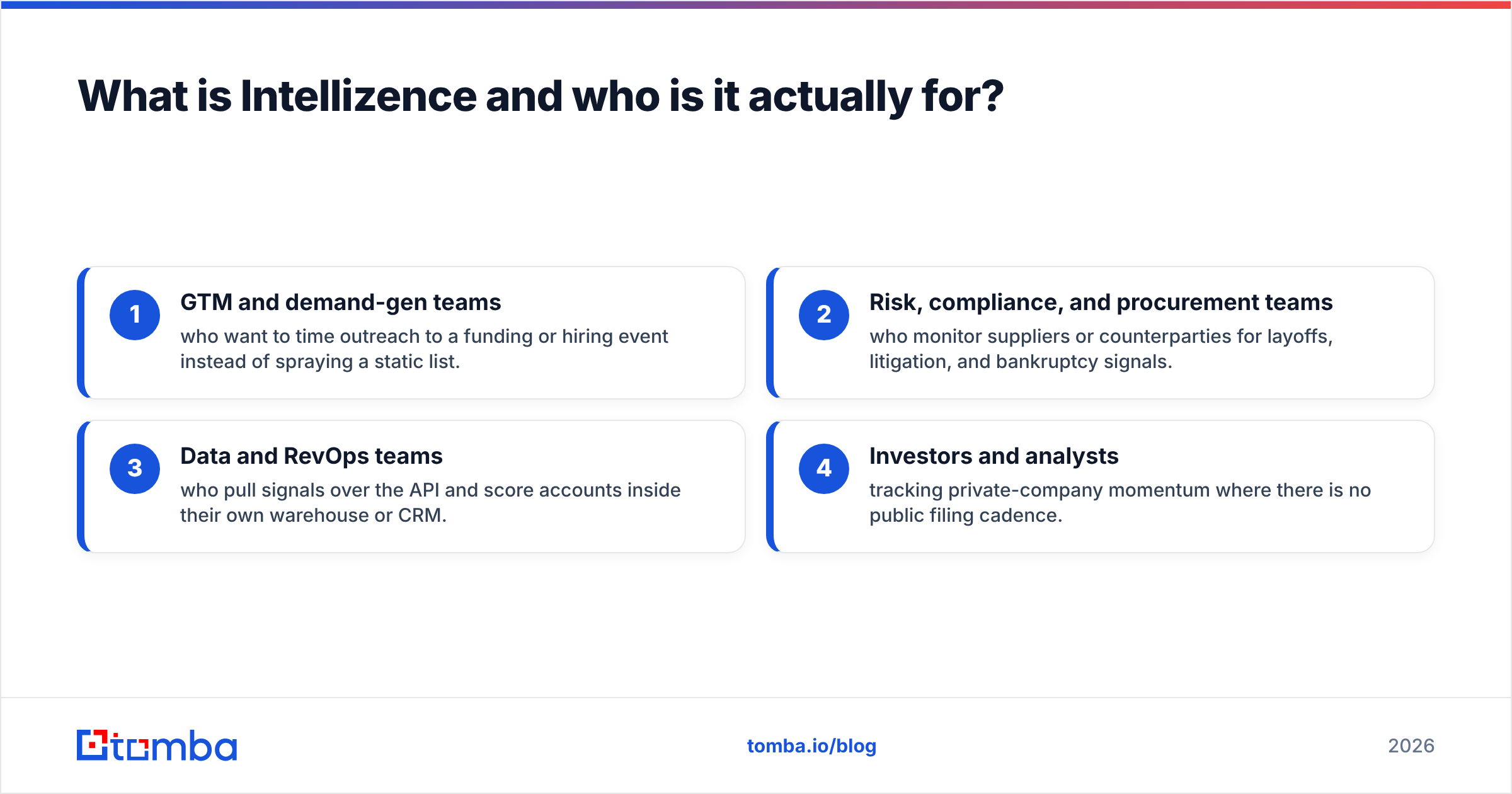
The buyers usually fall into four groups:
- GTM and demand-gen teams who want to time outreach to a funding or hiring event instead of spraying a static list.
- Risk, compliance, and procurement teams who monitor suppliers or counterparties for layoffs, litigation, and bankruptcy signals.
- Data and RevOps teams who pull signals over the API and score accounts inside their own warehouse or CRM.
- Investors and analysts tracking private-company momentum where there is no public filing cadence.
That mix matters for pricing. A platform sold to both a three-person SDR team and a bank's risk desk will not have a single published price, and Intellizence does not pretend otherwise.

How does Intellizence pricing actually work in 2026?#
Short answer: you request a quote, and the number is assembled from four levers. As of 2026 Intellizence does not publish a standard self-serve price list, so treat any specific dollar figure you read on a third-party blog — including this one — as unverified. Confirm directly with the vendor.
Here is what determines the number, based on how signal vendors in this category structure deals and what buyers report in public reviews:
- Signal modules. Funding, M&A, leadership change, layoffs, expansion, partnership, litigation, and ESG/risk events are often licensed as separate feeds. Buying three modules costs materially less than buying all of them.
- Company universe. Monitoring 5,000 named accounts is cheaper than monitoring "all US companies above 50 employees." Most contracts cap or tier this.
- Delivery method. Dashboard and email alerts sit at the bottom. API access, bulk historical backfill, and warehouse delivery sit at the top and usually trigger a higher tier.
- Seats and contract term. Annual prepay is the norm. Month-to-month, where offered, carries a premium.
- Historical depth. Live alerts from today forward are one price. Two to five years of backfilled events for model training is another conversation entirely.
The practical consequence: two companies can both say "we use Intellizence" and be paying an order of magnitude apart. When you ask for a quote, pin down the company universe and the module list first — those two levers move the price more than seats do.
What should you budget, realistically?#
Signal-intelligence platforms in this bracket generally land in the low-to-mid four figures per month for a team-sized deployment with API access, and low three figures per month for a narrow, dashboard-only use case. Enterprise risk deployments go well past that. Intellizence positions itself as a mid-market-friendly option relative to Bombora, ZoomInfo, or Demandbase, which is consistent with what buyers say — but "friendlier than ZoomInfo" is not the same as cheap.
Budget for the annual commit, not the monthly headline. Almost every deal in this space is a 12-month contract.
What do Intellizence reviews say?#
Public review volume for Intellizence is thin compared with the giants — you will find a modest number of entries on G2 and similar directories rather than thousands. That is normal for a focused data vendor, but it means you should weight reference calls more heavily than star ratings.
The recurring themes across reviews and buyer commentary:
What reviewers like
- Signal breadth per dollar. Covering funding, layoffs, exec moves, and litigation in one subscription is unusual; most competitors specialize in one or two.
- Responsive support. Small-vendor advantage. Buyers repeatedly mention getting a human quickly, including custom signal requests being entertained.
- API quality. Teams that want to pipe events into their own scoring model rather than live in another dashboard generally report a clean experience.
- Risk coverage. The compliance-flavored signals (litigation, bankruptcy, regulatory) are a genuine differentiator versus pure GTM signal tools.
What reviewers criticize
- Opaque pricing. The number-one friction point. No public tiers means a sales cycle just to find out if you can afford it.
- Noise and false positives. Any news-derived signal set produces duplicates and near-misses. Expect to spend the first month building filters.
- Entity resolution gaps. Matching a news mention to the exact legal entity and domain in your CRM is the hard part of this category, and it is not perfect anywhere.
- UI polish. Functional, not beautiful. Reviewers who come from a ZoomInfo or Apollo interface notice.
- No contact data. This is the one that surprises people. A layoff signal at Acme Corp does not come with the VP of Ops' email address.
What are the real pros and cons?#
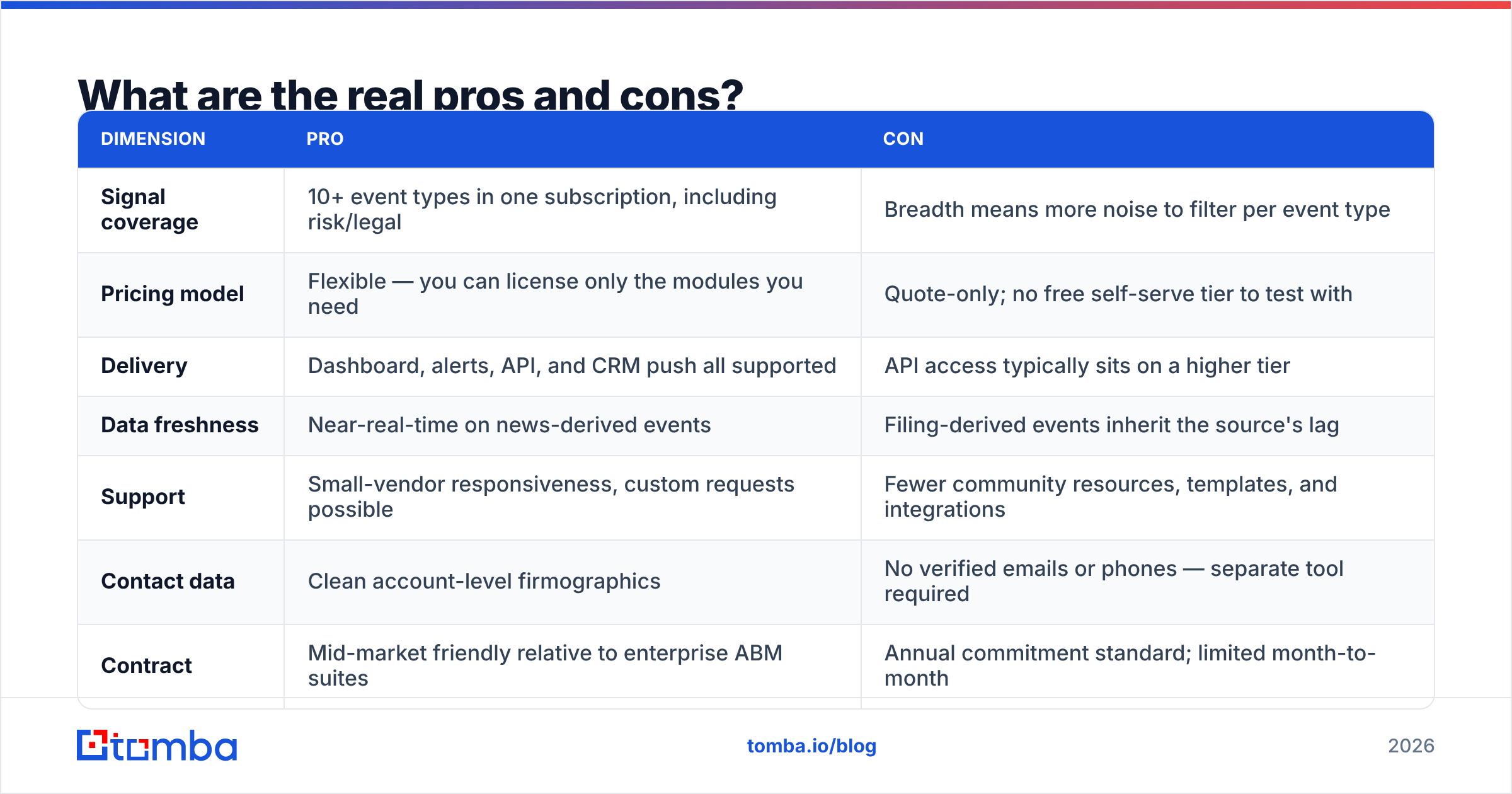
| Dimension | Pro | Con |
|---|---|---|
| Signal coverage | 10+ event types in one subscription, including risk/legal | Breadth means more noise to filter per event type |
| Pricing model | Flexible — you can license only the modules you need | Quote-only; no free self-serve tier to test with |
| Delivery | Dashboard, alerts, API, and CRM push all supported | API access typically sits on a higher tier |
| Data freshness | Near-real-time on news-derived events | Filing-derived events inherit the source's lag |
| Support | Small-vendor responsiveness, custom requests possible | Fewer community resources, templates, and integrations |
| Contact data | Clean account-level firmographics | No verified emails or phones — separate tool required |
| Contract | Mid-market friendly relative to enterprise ABM suites | Annual commitment standard; limited month-to-month |
How does Intellizence compare to the alternatives?#
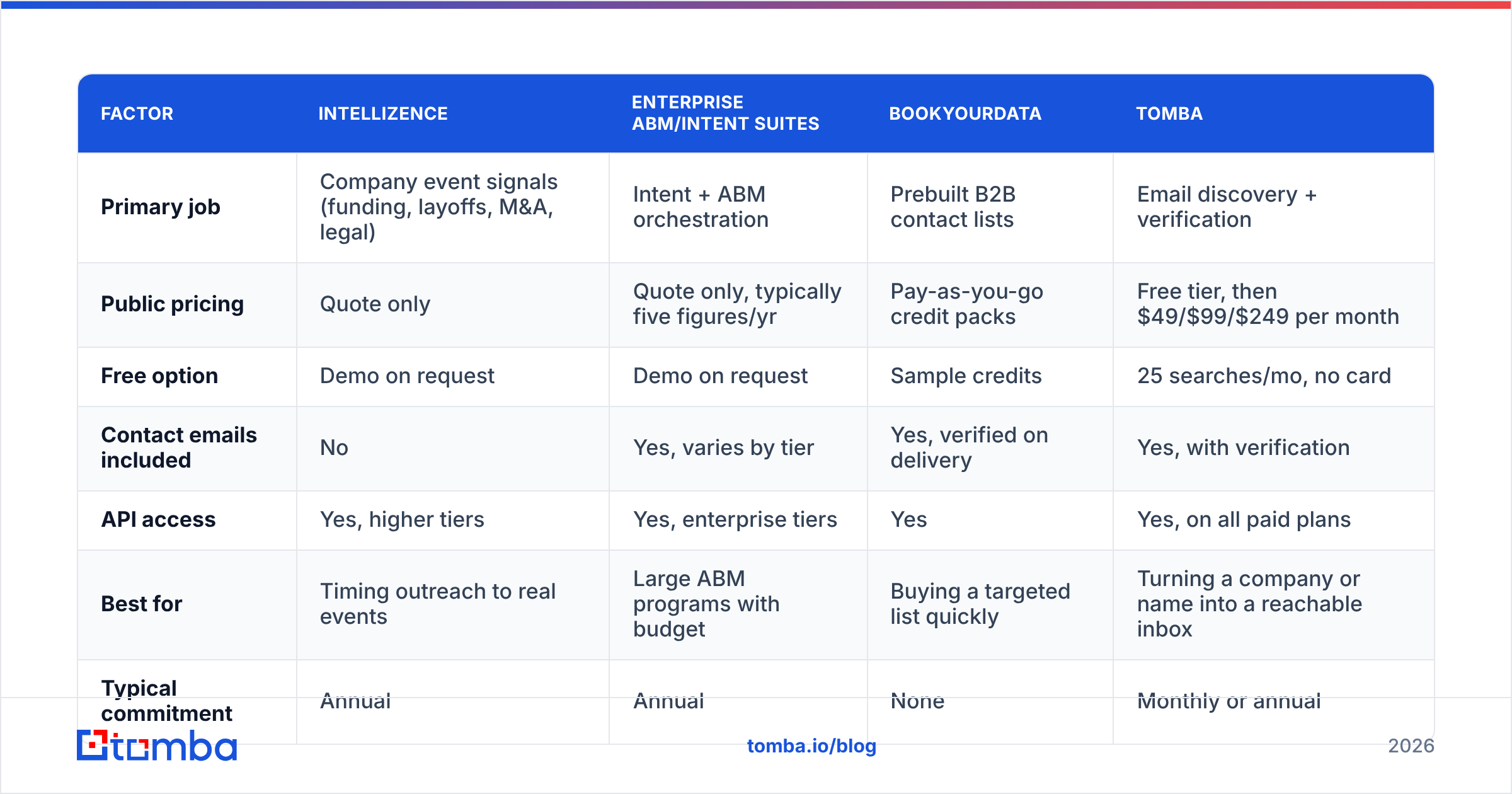
The honest framing: Intellizence competes on event data, not contact data. Comparing it head-to-head with an email finder is a category error — but most buyers are assembling a stack, so the price comparison still matters.
| Factor | Intellizence | Enterprise ABM/intent suites | BookYourData | Tomba |
|---|---|---|---|---|
| Primary job | Company event signals (funding, layoffs, M&A, legal) | Intent + ABM orchestration | Prebuilt B2B contact lists | Email discovery + verification |
| Public pricing | Quote only | Quote only, typically five figures/yr | Pay-as-you-go credit packs | Free tier, then $49/$99/$249 per month |
| Free option | Demo on request | Demo on request | Sample credits | 25 searches/mo, no card |
| Contact emails included | No | Yes, varies by tier | Yes, verified on delivery | Yes, with verification |
| API access | Yes, higher tiers | Yes, enterprise tiers | Yes | Yes, on all paid plans |
| Best for | Timing outreach to real events | Large ABM programs with budget | Buying a targeted list quickly | Turning a company or name into a reachable inbox |
| Typical commitment | Annual | Annual | None | Monthly or annual |
BookYourData is worth a separate mention here because it solves a different problem well: if you already know the segment you want and just need a clean, verified list without a subscription, a pay-as-you-go list vendor is the shortest path. Signals tell you when; a list or finder tells you who.
What is the hidden cost most buyers miss?#
The license is rarely the expensive part. Three costs show up after signature:
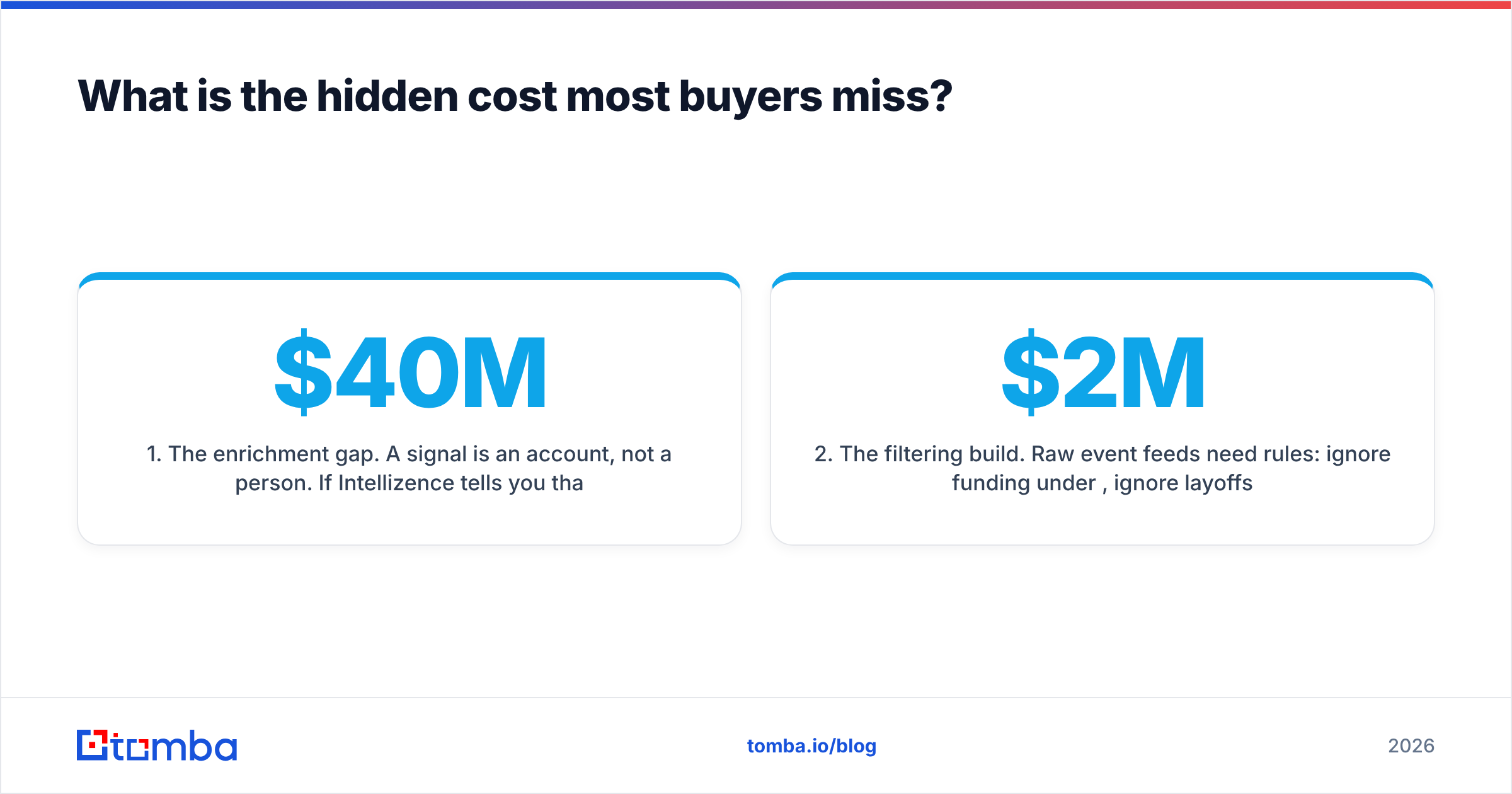
1. The enrichment gap. A signal is an account, not a person. If Intellizence tells you that Acme raised $40M, you still need the name and verified email of the right buyer there. That is a second line item. This is where a dedicated email finder or data enrichment layer earns its keep — and at $49/mo for the Starter plan, it is usually the cheapest component in the stack. Compare it against the signal quote and you will see the asymmetry immediately.
2. The filtering build. Raw event feeds need rules: ignore funding under $2M, ignore layoffs outside your ICP geography, dedupe the same event reported by four outlets. Budget 10–20 RevOps hours in month one. Teams that skip this stage conclude "the data is noisy" when the real problem is that nobody wrote the filter.
3. The routing and playbook cost. A signal with no assigned play is a notification nobody acts on. Each event type needs an owner, an SLA, and a message template. Without that, you are paying for a very expensive news reader.
Run the math honestly: signal license + enrichment + engineering time + playbook design. If the total exceeds the pipeline you can realistically attribute to event-triggered outreach in a year, the answer is no — regardless of how good the platform is.
Is Intellizence worth it for your team?#
Use these five tests. Three or more yes answers means it is worth a serious quote conversation.
- Do your deals have a trigger? If your product sells noticeably better after a funding round, a new exec, an office opening, or a layoff, signals compound. If it sells evenly regardless of company events, they do not.
- Do you have someone to act on alerts within 48 hours? Event-based outreach decays fast. A funding signal acted on in week three is just a cold email with a stale reference.
- Do you need risk signals as well as growth signals? This is Intellizence's clearest edge. If litigation, bankruptcy, and regulatory events matter to you, the field of competitors narrows sharply.
- Can you consume an API? The highest ROI configuration is signals into your own scoring model, not another tab your reps ignore.
- Is your contact layer already solved? If you do not yet have reliable emails, fix that first. Signals on top of unreachable contacts produce nothing.
If you answered no to most of these — particularly the last one — spend the budget on contact discovery and outreach quality first. A verified list you actually email beats a perfect signal feed you cannot act on.
How do you build a signal-plus-contact stack cheaply?#
The pattern most lean teams converge on:
- Pick one signal source, narrow. Two or three event types tied to your strongest trigger. Not all ten.
- Pipe it into one place. Your CRM or a warehouse table — not a separate dashboard. HubSpot and similar CRMs accept webhook or workflow-based enrichment cleanly.
- Enrich the account into people. Resolve domain to decision-makers, then verify. This is where the Tomba API does the heavy lifting: domain in, verified contacts out, on a per-request basis.
- Verify before send. Event-triggered emails hit inboxes that changed recently, especially after layoffs or exec moves. Re-verify at send time, not at list-build time.
- Measure per trigger, not in aggregate. Funding signals and layoff signals convert at completely different rates. Reporting them as one number hides which module is worth renewing.
Compare the line items on Tomba pricing against your signal quote before you sign. In most stacks we see, the intelligence layer is 80–90% of the spend and the contact layer is the part that actually determines whether anything gets sent.
FAQ#
Does Intellizence publish pricing? No. As of 2026 it is quote-based. Ask specifically about module count, monitored company universe, and API access — those three drive the number.
Is there a free trial? Demos and evaluation access are arranged through sales rather than self-serve signup. Ask for a sample feed on your actual target accounts, not a canned demo.
Does Intellizence give you email addresses? No. It is an account-level signal platform. Contact discovery and verification are separate.
Who competes with it? Broadly: intent and ABM platforms on the GTM side, and alternative-data/risk vendors on the compliance side. Few competitors cover both in one subscription, which is the main reason it stays on shortlists.
Is it better than buying a list? Different job. A list answers "who." Signals answer "when." Strong outbound programs use both.
Start with the half you can price today. Signals are worth buying once your outreach actually lands — and that depends on whether the addresses are real. The Tomba Email Finder turns any company domain or contact name into a verified, deliverable email, free for your first 25 searches a month and $49/mo when you scale. Fix the contact layer, prove the plays convert, then go get that signal quote with a number you can defend.
Related guides#
// get started
Find, verify and enrich your first contacts today
Start on the free plan with 25 searches a month, then scale when your team is ready.
Free plan · No credit card required · GDPR & CCPA
// about the author