Intent Based Lead Generation: How to Find Buyers in 2026
Intent data tells you who is researching. It does not tell you who to email, when, or what to say. Here is how to turn raw intent signals into booked meetings without burning $40k on a platform you never operationalize.
TL;DR
- Intent based lead generation means prioritizing accounts that are already researching your category, instead of working an alphabetical list of ICP-fit companies.
- First-party intent (your site, your pricing page, your docs) converts far better than third-party topic surges — and it costs almost nothing to collect.
- Third-party intent platforms start around $20k–$60k/year. They are worth it only if you have the headcount and routing discipline to act on signals within 48 hours.
- The failure point is almost never the signal. It is the gap between "Acme is surging on 'email verification API'" and "here is the VP of RevOps, her verified email, and a reason to reply."
- A lean stack — site visitor reveal + G2/review signals + a contact finder — gets you 70% of the outcome for under 5% of the cost.
What is intent based lead generation?#
Intent based lead generation is the practice of scoring and sequencing prospects by observed research behavior rather than by static firmographics alone.
The everyday version: a normal lead list is a phone book. You call everyone in it, in order, and hope. Intent data is the equivalent of knowing which houses just had a "for sale" sign go up in the yard. Same neighborhood, wildly different odds.
Technically, you are joining three datasets:
- Firmographic fit — industry, headcount, tech stack, region. Answers should we sell to them?
- Behavioral signal — content consumption, review-site browsing, competitor comparison, job postings, funding events. Answers are they looking right now?
- Contact resolution — the specific humans at that account, with a reachable email or phone. Answers who do we contact and how?
Most teams buy #2, already have #1, and completely under-invest in #3. That is why intent programs stall. A surging account with no deliverable contact is a rumor, not a lead.
What are the three types of intent data?#
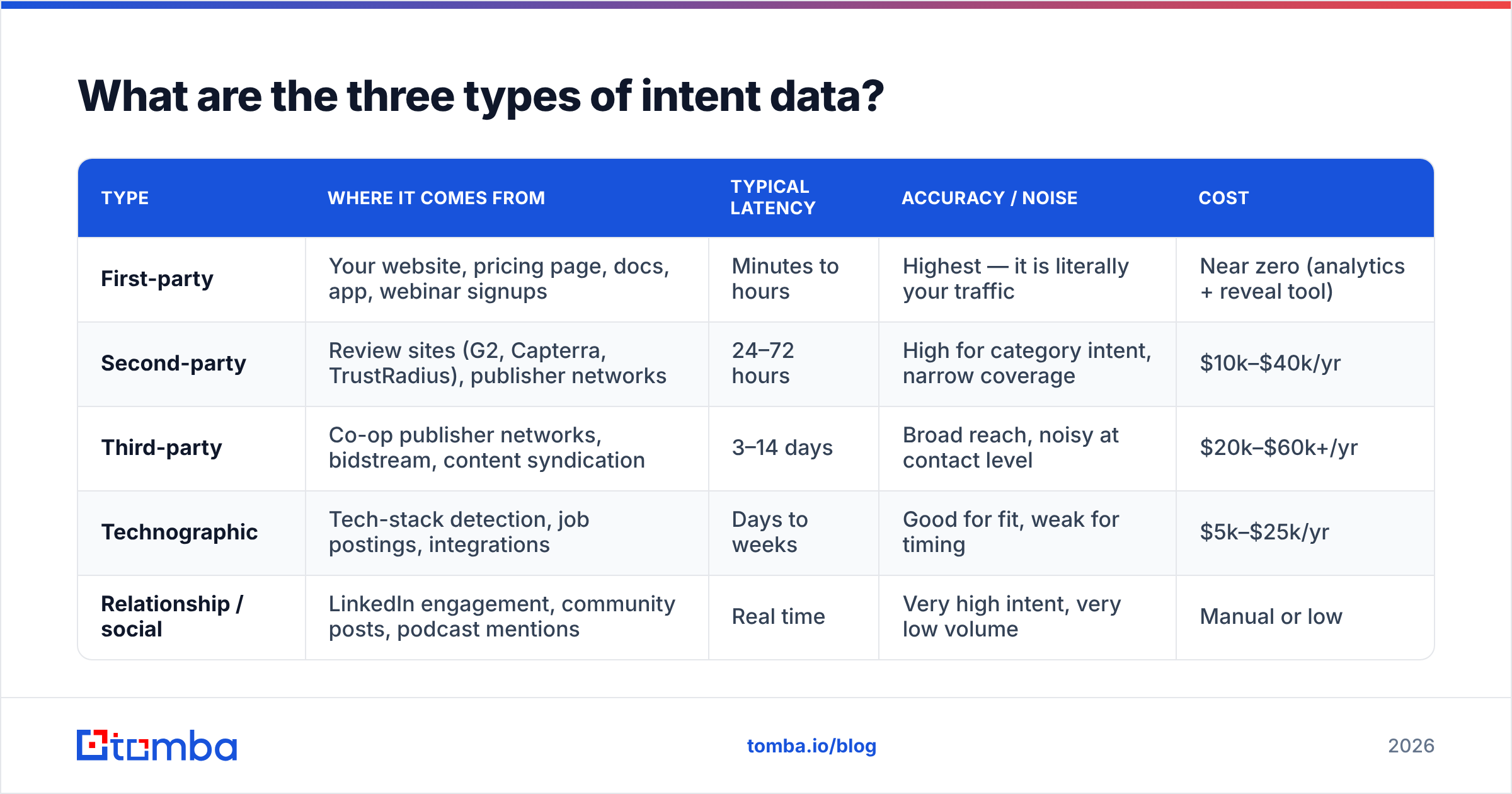
The categories matter more than the vendor logos, because they have different accuracy, latency, and cost profiles.
| Type | Where it comes from | Typical latency | Accuracy / noise | Cost |
|---|---|---|---|---|
| First-party | Your website, pricing page, docs, app, webinar signups | Minutes to hours | Highest — it is literally your traffic | Near zero (analytics + reveal tool) |
| Second-party | Review sites (G2, Capterra, TrustRadius), publisher networks | 24–72 hours | High for category intent, narrow coverage | $10k–$40k/yr |
| Third-party | Co-op publisher networks, bidstream, content syndication | 3–14 days | Broad reach, noisy at contact level | $20k–$60k+/yr |
| Technographic | Tech-stack detection, job postings, integrations | Days to weeks | Good for fit, weak for timing | $5k–$25k/yr |
| Relationship / social | LinkedIn engagement, community posts, podcast mentions | Real time | Very high intent, very low volume | Manual or low |
Read that table as a ladder, not a menu. Start at the top. Teams that buy third-party intent before they have first-party reveal wired up are paying a premium to learn things their own server logs already knew.
Here is what each type is actually good for:
- First-party intent — highest-conviction plays. Someone hit
/pricingthree times this week. That is a same-day call, not a nurture email. - Second-party intent — competitive displacement. A prospect comparing you against two rivals on G2 is in an active evaluation with a shortlist.
- Third-party intent — top-of-funnel account discovery. Useful for finding accounts you have never touched, not for timing a close.
- Technographic intent — trigger-based fit. They just installed a CRM you integrate with, or posted a "Marketing Ops Manager" req.
- Relationship intent — the best converting and least scalable. A reply to your LinkedIn post beats any surge score.

How does an intent signal become an actual lead?#
There are five steps, and most stacks break at step four.
Step 1 — Capture. A signal lands: Acme Corp shows a surge on "catch-all email verification," or an anonymous visitor from Acme's IP range reads your API docs.
Step 2 — Resolve the account. Map the IP, cookie, or company name to a canonical record in your CRM. Dedupe against existing open opportunities — nothing torches trust faster than an SDR cold-calling an account your AE is already in cycle with.
Step 3 — Score and threshold. Not every surge deserves outbound. Combine fit score × signal strength × recency. A perfect-fit account with a medium signal from yesterday beats a mediocre-fit account with a huge signal from three weeks ago.
Step 4 — Resolve the people. This is the gap. Intent platforms tell you Acme is in-market. They rarely tell you that Priya Raman runs RevOps there, or give you a mailbox that accepts mail. You need a domain search to enumerate the right roles at the account, then an email verifier to confirm the address is live before it enters a sequence.
Step 5 — Act inside the window. Research from Gartner and most vendor-side studies agree on the same uncomfortable point: B2B buying committees complete a large share of their evaluation before contacting any vendor. A signal that is two weeks old is a signal you missed.
The practical SLA most teams land on: first-party signals get touched in under 4 business hours. Second-party in under 24. Third-party in under 72.
Which intent data providers should you compare in 2026?#
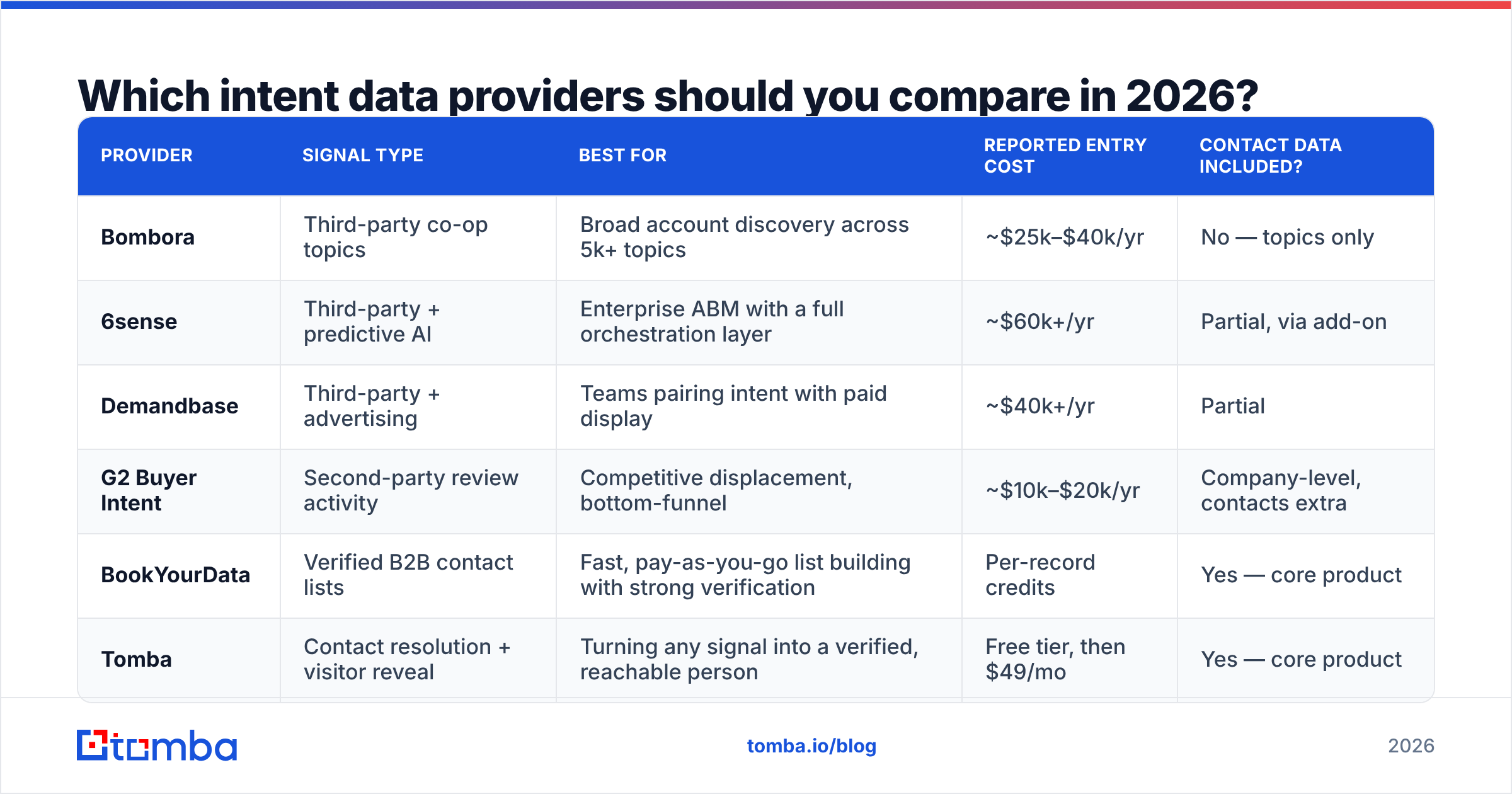
Pricing in this category is deliberately opaque — almost everything is annual, seat-based, and quoted. The ranges below reflect what buyers commonly report on review sites, not published rate cards. Treat them as a negotiating baseline, not a quote.
| Provider | Signal type | Best for | Reported entry cost | Contact data included? |
|---|---|---|---|---|
| Bombora | Third-party co-op topics | Broad account discovery across 5k+ topics | ~$25k–$40k/yr | No — topics only |
| 6sense | Third-party + predictive AI | Enterprise ABM with a full orchestration layer | ~$60k+/yr | Partial, via add-on |
| Demandbase | Third-party + advertising | Teams pairing intent with paid display | ~$40k+/yr | Partial |
| G2 Buyer Intent | Second-party review activity | Competitive displacement, bottom-funnel | ~$10k–$20k/yr | Company-level, contacts extra |
| BookYourData | Verified B2B contact lists | Fast, pay-as-you-go list building with strong verification | Per-record credits | Yes — core product |
| Tomba | Contact resolution + visitor reveal | Turning any signal into a verified, reachable person | Free tier, then $49/mo | Yes — core product |
Two honest notes on that table.
First, the big three intent platforms and the contact-data tools are not really competitors. They solve adjacent problems. 6sense will happily tell you Acme is in the "decision" stage; it will not reliably hand you seven verified mailboxes at Acme. Pairing is the correct mental model, not substitution.
Second, if your ACV is under roughly $15k, a $40k/year third-party intent subscription needs to generate a lot of net-new closed-won just to break even. Run that math before the demo, not after the contract.
Is third-party intent data actually accurate?#
Partially — and the honest answer depends on what you mean by "accurate."
Third-party intent is accurate at the account level and unreliable at the person level. The co-op networks observe content consumption across thousands of publisher sites and attribute it back to a company by IP. That attribution works reasonably well for a 500-person company with a stable office IP range. It works far worse for a distributed startup where everyone is on residential broadband and a VPN.
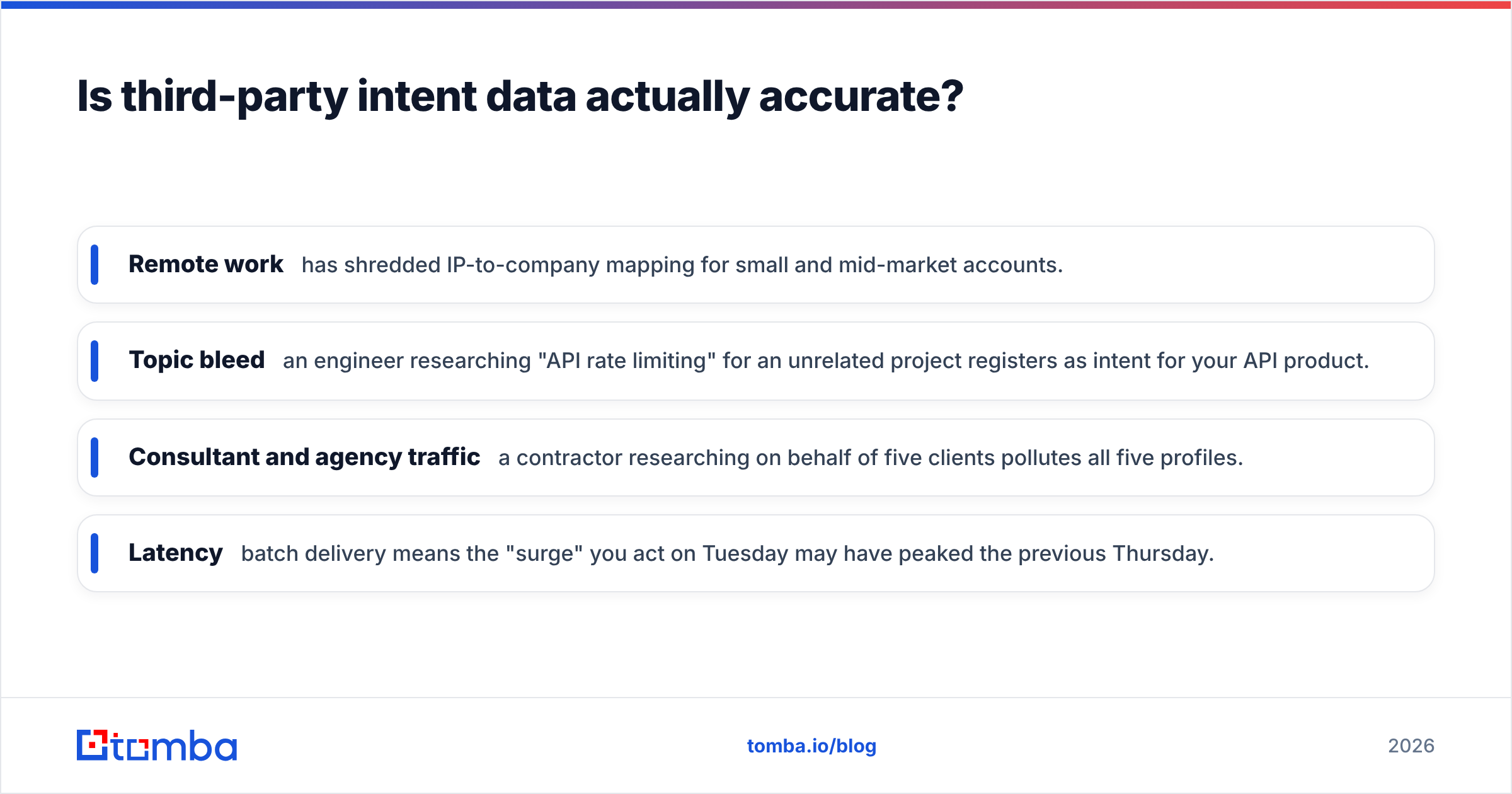
What degrades the signal in practice:
- Remote work has shredded IP-to-company mapping for small and mid-market accounts.
- Topic bleed — an engineer researching "API rate limiting" for an unrelated project registers as intent for your API product.
- Consultant and agency traffic — a contractor researching on behalf of five clients pollutes all five profiles.
- Latency — batch delivery means the "surge" you act on Tuesday may have peaked the previous Thursday.
None of this makes third-party intent useless. It makes it a prioritization input rather than a trigger. Use it to decide which 200 accounts your SDRs work this quarter. Do not use it to decide who gets a "I saw you were researching X" email — that phrasing is both creepy and frequently wrong.
First-party signals do not have this problem. When someone reads your pricing page, they read your pricing page. That is why website visitor reveal tends to out-convert purchased intent by a wide margin on a per-signal basis, even though the volume is much smaller.

How do you build an intent stack without a $60k contract?#
You assemble the layers yourself. This is the setup most 5–20 person revenue teams should run before they ever take an enterprise intent demo.
Layer 1 — First-party capture (cost: near zero). Put visitor identification on your site. Reveal which companies read pricing, docs, comparison pages, and case studies. Weight pages by commercial depth: /pricing is worth 10x /blog.
Layer 2 — Trigger monitoring (cost: near zero). Watch job boards for roles that imply your problem. Watch funding announcements. Watch technology changes on target domains. A company that just posted three "Sales Development Representative" reqs is about to need outbound tooling.
Layer 3 — Review-site intent (cost: moderate). If you have direct competitors with meaningful review-site presence, second-party intent from a category leader is the highest-ROI paid signal available. It is the only data that tells you someone is comparing you right now.
Layer 4 — Contact resolution (cost: low). This is the layer that converts signal into pipeline. For each flagged account you need: the 2–4 relevant titles, verified emails, and ideally a direct dial. A bulk email finder run against your flagged-account list turns a spreadsheet of domains into a sequence-ready contact set in minutes.
Layer 5 — Enrichment and routing (cost: low). Push resolved contacts into the CRM with the signal attached, so the rep opening the record sees why this account surfaced. Contact enrichment fills the firmographic and role context the intent feed does not carry.
Layer 6 — Measurement. Track signal-to-meeting rate by signal type. Within one quarter you will know which layers earn their keep and which are theater. Kill the theater.
What does a good intent-triggered sequence look like?#
The mistake is writing outbound that references the signal. Do not do that. The signal is for you, not for the prospect.
Compare:
Bad: "Hi Priya — I noticed Acme has been researching email verification tools this week..."
That reveals surveillance, invites a "how do you know that," and is wrong maybe 30% of the time.
Better: "Hi Priya — most RevOps leads scaling past 50k sends/month hit the same wall: bounce rate creeps over 4% and domain reputation tanks. Curious how Acme is handling catch-all domains today — we published a breakdown of the three approaches if useful."
Same trigger, zero creepiness, and the message stands on its own if the signal was noise. That is the test for every intent-triggered message: would this email still make sense if the signal were false? If no, rewrite it.
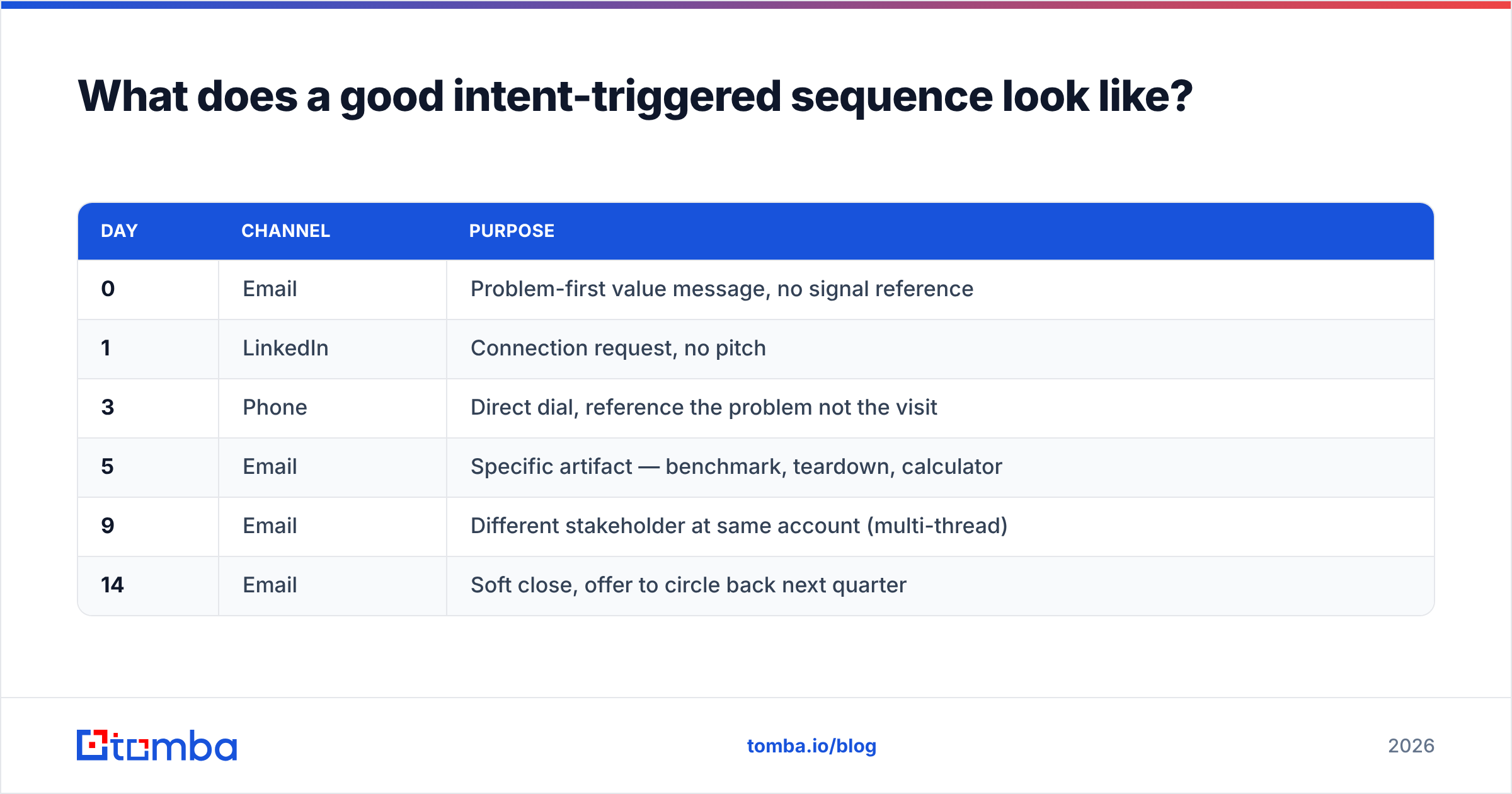
Cadence that works for a high-confidence first-party signal:
| Day | Channel | Purpose |
|---|---|---|
| 0 | Problem-first value message, no signal reference | |
| 1 | Connection request, no pitch | |
| 3 | Phone | Direct dial, reference the problem not the visit |
| 5 | Specific artifact — benchmark, teardown, calculator | |
| 9 | Different stakeholder at same account (multi-thread) | |
| 14 | Soft close, offer to circle back next quarter |
Multi-threading at step five matters more than any other element. Buying committees average 6–10 people. Resolving one contact per surging account and stopping there is the single most common way intent programs underperform.
What are the most common intent based lead generation mistakes?#
- Buying signal before fixing deliverability. A surge means nothing if your emails land in spam. Check your SPF record and warm your domain before you scale sends.
- No SLA on signal age. If your process routes a signal in nine days, you have bought a history book.
- Scoring everything, prioritizing nothing. A model that flags 4,000 accounts as "in-market" is a model that flags none.
- One contact per account. See above. Resolve the committee.
- Skipping verification. Intent lists are frequently stale. Pushing unverified addresses into a sequence off a bought list is how you get a 12% bounce rate and a burned domain.
- Measuring signal volume instead of meetings. Vendors love to report surge counts. Report meetings booked per 100 signals, by signal type, or you are flying blind.
Should you buy intent data or build the workflow first?#
Build the workflow first. Every time.
The reason is boring: intent data is abundant and cheap relative to the operational capacity to act on it. Most teams that "fail with intent data" did not buy bad data. They bought good data and then discovered they had no routing rules, no contact resolution, no message framework, and no SLA. The contract renewed once and got cancelled.
Run this sequence:
- Instrument first-party signals. Free.
- Build the routing, scoring, and SLA against that small, high-quality signal volume.
- Solve contact resolution so any flagged domain becomes 3–5 verified, reachable humans within an hour.
- Prove a signal-to-meeting rate you are happy with.
- Then buy third-party intent to increase volume through a machine that already works.
If steps 1–4 do not produce meetings, step 5 will just produce them at a higher cost per meeting. Volume amplifies whatever process you already have, including a broken one.
Turn intent signals into contacts you can actually reach#
Signals are the easy part. The expensive gap is the one between a surging domain and a verified inbox belonging to the person who owns the budget.
That is exactly what the Tomba Email Finder is for: give it a domain from your intent feed and it returns the right roles with verified, deliverable addresses — individually, in bulk, or straight through the API into your CRM. The free tier gives you 25 searches a month to test against your own flagged-account list, and paid plans start at $49/mo. See Tomba pricing for the full breakdown, or check where Tomba gets its data if accuracy is your first question — it should be.
Prioritize with intent. Convert with contacts that actually exist.
Related guides#
// get started
Find, verify and enrich your first contacts today
Start on the free plan with 25 searches a month, then scale when your team is ready.
Free plan · No credit card required · GDPR & CCPA
// about the author