Intent Based Sales in 2026: How to Find Buyers Who Are Ready
Intent data promises to tell you who is shopping right now. Most teams buy the signal and skip the plumbing — here is how intent based sales actually works, what it costs, and when it beats plain old ICP filtering.
TL;DR
- Intent based sales means prioritizing accounts that are showing buying behavior right now — research spikes, competitor page visits, hiring patterns, tech changes — instead of working a static ICP list top to bottom.
- The signal is the easy part. Most programs fail on the last mile: an account lights up, and nobody has a verified contact, a routing rule, or a message tied to the trigger.
- Third-party intent (Bombora-style topic surges) is noisy and account-level. First-party intent (your site, your pricing page, your docs) converts 3-8x better but covers far fewer accounts.
- Budget realistically: intent data runs $1,000-$5,000/mo at the low end, and you still need contact data, enrichment, and routing on top.
- A cheap, honest starting stack: first-party website reveal + a contact-data layer + one tight play per signal. You can run that for under $150/mo before you ever touch a six-figure intent contract.
What is intent based sales, really?#
Intent based sales is prospecting triggered by observed behavior rather than by a list position.
Think of it like a fishing guide versus a fisherman with a calendar. The calendar guy goes out every Saturday at 6 a.m. because that's the plan. The guide watches the water temperature, the bird activity, and where the bait schools moved overnight, then goes where the fish actually are. Same rods, same boat, wildly different catch rate.
Technically: you ingest behavioral signals (content consumption, site visits, job postings, technographic changes, funding events, review-site activity), score them against your ICP, and route the accounts that cross a threshold to a rep with a play attached. The account was always in your TAM. Intent tells you when to touch it.
The distinction that matters more than any vendor pitch:
- First-party intent — behavior on assets you own. Pricing page views, docs traffic, a demo form abandoned halfway, a trial that stalled at step three. Highest conversion, smallest volume.
- Second-party intent — behavior on a marketplace or review site you partner with. G2, TrustRadius, Capterra category pages. Strong signal because the person is explicitly comparing, but you only see what the vendor sells you.
- Third-party intent — aggregated content consumption across a publisher co-op. Bombora, 6sense, Demandbase. Huge coverage, account-level only, and prone to false positives when an intern reads three blog posts.
- Operational intent — public facts that imply a project. New VP of Engineering hired, SOC 2 badge added, a competitor's script removed from the site, a Series B announced. Free to collect, criminally underused.
- Relationship intent — a champion changed jobs, a past user showed up at a new logo, an old opportunity's blocker left. The highest-converting signal on this list and the one almost nobody instruments.
Most teams buy #3, ignore #4 and #5, and then wonder why their reply rate didn't move.
Why do most intent based sales programs fail?#
Because the signal arrives and then sits in a dashboard.
Here's the sequence that kills these programs. Marketing signs a third-party intent contract. A weekly CSV lands in a shared drive. An ops person cross-references it against Salesforce on Thursday. Reps get a list on Monday. By then the "surge" is eleven days old, the researcher has already shortlisted three vendors, and your rep is opening with "I saw you were researching data warehouses" to someone who signed with Snowflake last week.
Speed of response is the whole ballgame. The classic Harvard Business Review lead-response study found firms that contacted a prospect within an hour were roughly seven times more likely to have a meaningful conversation than those who waited just one more hour — and sixty times more likely than firms waiting 24 hours or more. Intent signals decay on the same curve, only worse, because nobody raised their hand to expect your call.
The other three failure modes, in descending order of how often I see them:
- No contact data at the moment of the signal. The account lights up. Your CRM has one stale contact who left in 2024. The rep spends 20 minutes hunting for a current director of ops, and the play never fires.
- Generic messaging bolted onto a specific trigger. If your email would read identically without the signal, the signal bought you nothing.
- Threshold set by vibes. Everybody scores "high intent" until 400 accounts per week qualify and the team defaults back to the alphabetical list.
How does intent based sales compare to traditional outbound?#
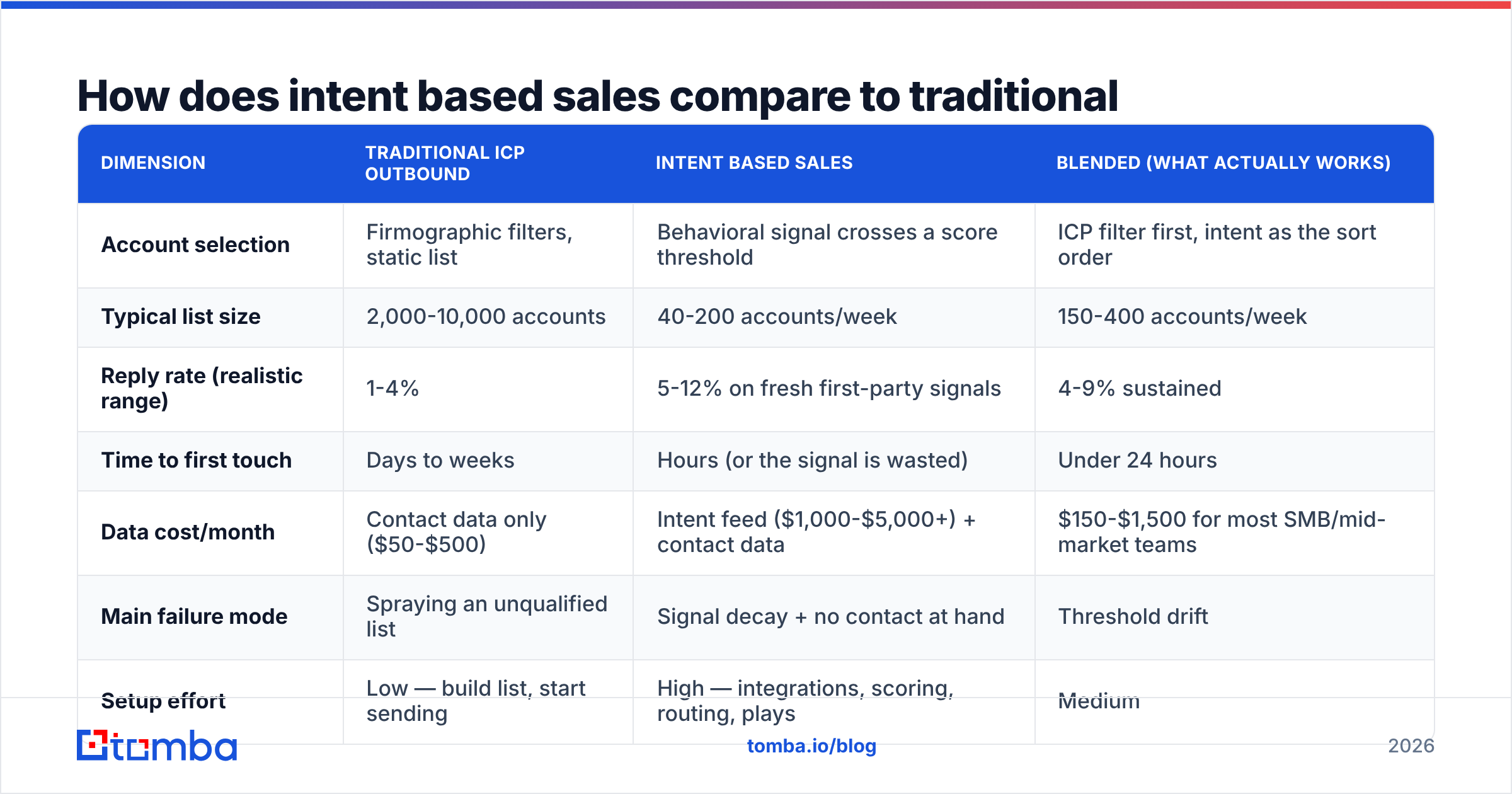
The honest answer: intent doesn't replace ICP-based outbound, it re-sorts it. You still need a defensible ICP. Intent tells you which 8% of it to work this week.
| Dimension | Traditional ICP outbound | Intent based sales | Blended (what actually works) |
|---|---|---|---|
| Account selection | Firmographic filters, static list | Behavioral signal crosses a score threshold | ICP filter first, intent as the sort order |
| Typical list size | 2,000-10,000 accounts | 40-200 accounts/week | 150-400 accounts/week |
| Reply rate (realistic range) | 1-4% | 5-12% on fresh first-party signals | 4-9% sustained |
| Time to first touch | Days to weeks | Hours (or the signal is wasted) | Under 24 hours |
| Data cost/month | Contact data only ($50-$500) | Intent feed ($1,000-$5,000+) + contact data | $150-$1,500 for most SMB/mid-market teams |
| Main failure mode | Spraying an unqualified list | Signal decay + no contact at hand | Threshold drift |
| Setup effort | Low — build list, start sending | High — integrations, scoring, routing, plays | Medium |
| Works without a big budget? | Yes | Rarely | Yes |
The blended column is not a compromise for the timid. It's what most teams that report real lift from intent are actually running: a tight ICP, three or four signals they trust, and one specific play per signal.
Which intent signals are actually worth acting on?#
Rank signals by two things: how close the behavior sits to a purchase decision, and how few competitors can see it.
Tier 1 — act within hours. Pricing page visited twice in a week by an anonymous company in your ICP. Demo form abandoned. Docs or API reference visited by a non-customer. A named champion from a closed-won account appearing at a new employer. These are yours alone and they are near the money.
Tier 2 — act within days. Review-site category page activity. A competitor's integration listed on their site. A job posting that names the problem your product solves ("we're hiring an SDR manager to build outbound from scratch" is a gift). Funding rounds tied to a stated expansion plan.
Tier 3 — use as a tiebreaker, never as a trigger. Third-party topic surges. Webinar attendance. A whitepaper download from a syndication partner. Treat these as a reason to move an account up the queue, not as a reason to claim you know what they're doing.

A useful test before you act on any signal: could you write the first line of the email in a way that would be wrong if the signal were false? If yes, it's a real trigger. If your opener works regardless, you're just doing regular outbound with extra steps.
What does an intent based sales stack actually look like?#
Four layers. Most vendors want to sell you all four and be your platform; you can assemble it cheaper and keep the pieces swappable.
1. Signal capture. For first-party, that's a deanonymization script on your site — this is where a website visitor reveal layer earns its keep, because it turns anonymous sessions into named companies you can route. For operational signals, it's monitoring job boards, funding feeds, and tech stacks. Tools like a website tech stack checker let you watch for a competitor's script appearing or disappearing on a target's site.
2. Account resolution + enrichment. Turning "someone from a company on a /15 IP block" into a firmographically scored account row. This is where data enrichment sits — company size, industry, funding, headcount trend, plus the firmographic filters your ICP depends on.
3. Contact data. The layer that quietly kills more programs than any other. When an account fires, you need a current, verified, role-matched human in under two minutes. That means domain search to pull the relevant people at the account, then verification so you don't burn the domain reputation you spent months building. Skipping verification on intent-sourced contacts is especially costly because you're sending at speed — a bad list compounds fast.

4. Routing + plays. A rule that says this signal goes to this rep with this template inside this SLA. Without the SLA, everything above is a hobby. Most teams use their CRM's assignment rules plus a Slack alert; a HubSpot integration or Salesforce integration that writes the enriched contact straight into the record removes the copy-paste step that eats the response window.
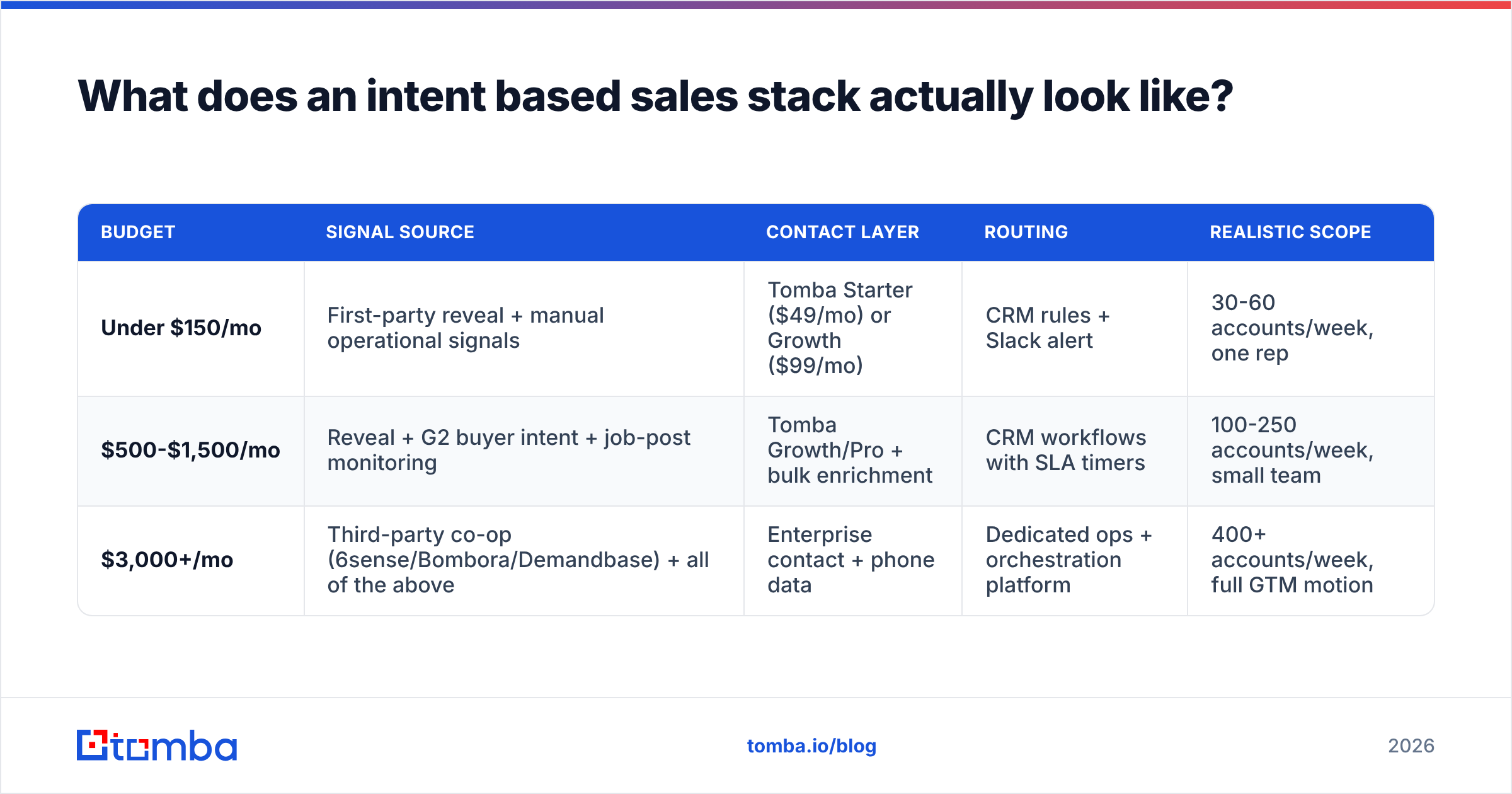
A minimum viable stack, by budget#
| Budget | Signal source | Contact layer | Routing | Realistic scope |
|---|---|---|---|---|
| Under $150/mo | First-party reveal + manual operational signals | Tomba Starter ($49/mo) or Growth ($99/mo) | CRM rules + Slack alert | 30-60 accounts/week, one rep |
| $500-$1,500/mo | Reveal + G2 buyer intent + job-post monitoring | Tomba Growth/Pro + bulk enrichment | CRM workflows with SLA timers | 100-250 accounts/week, small team |
| $3,000+/mo | Third-party co-op (6sense/Bombora/Demandbase) + all of the above | Enterprise contact + phone data | Dedicated ops + orchestration platform | 400+ accounts/week, full GTM motion |
Start at the top row even if you can afford the bottom one. If the play doesn't convert on 30 high-signal accounts a week, adding 400 noisy ones won't fix it.
How do you write outreach that uses the signal without being creepy?#
There's a line, and everyone has met someone who crossed it. "I noticed you spent four minutes and eleven seconds on our pricing page" is a great way to get blocked.
The rule: reference the inference, never the surveillance. You're not reporting what you observed; you're showing you understand the situation the observation implies.
Bad (surveillance): "Saw you were on our pricing page yesterday at 3pm."
Good (inference): "Most teams that come to us in Q3 are trying to lock in seat pricing before the fiscal year turns. If that's the shape of it for you, I can send the 12-month view — it's not on the site."
Bad (generic bolt-on): "I saw your company is researching sales intelligence. Tomba helps companies like yours find emails."
Good (specific to the trigger): "You posted for two SDRs last week with 'build outbound from scratch' in the JD. The thing that breaks first in that setup is usually list hygiene, not sequencing — happy to send the checklist we give new teams."
Three practical constraints:
- One signal per email. Stacking three triggers reads like a dossier.
- Lead with the implication, not the tool. The signal earns you the right to a relevant opener, not to a longer pitch.
- Have a version that works if you're wrong. Roughly a third of the time the inference is off. Write so that a miss reads as a reasonable guess about their situation, not as a failed stalking attempt.
If you're building these from scratch, the cold email templates library is a reasonable starting point — just rewrite the opener per signal type rather than per account. Ten signal-specific templates beat a thousand "personalized" ones.
Is third-party intent data worth the money?#
Sometimes. It depends almost entirely on your ACV and your sales cycle.
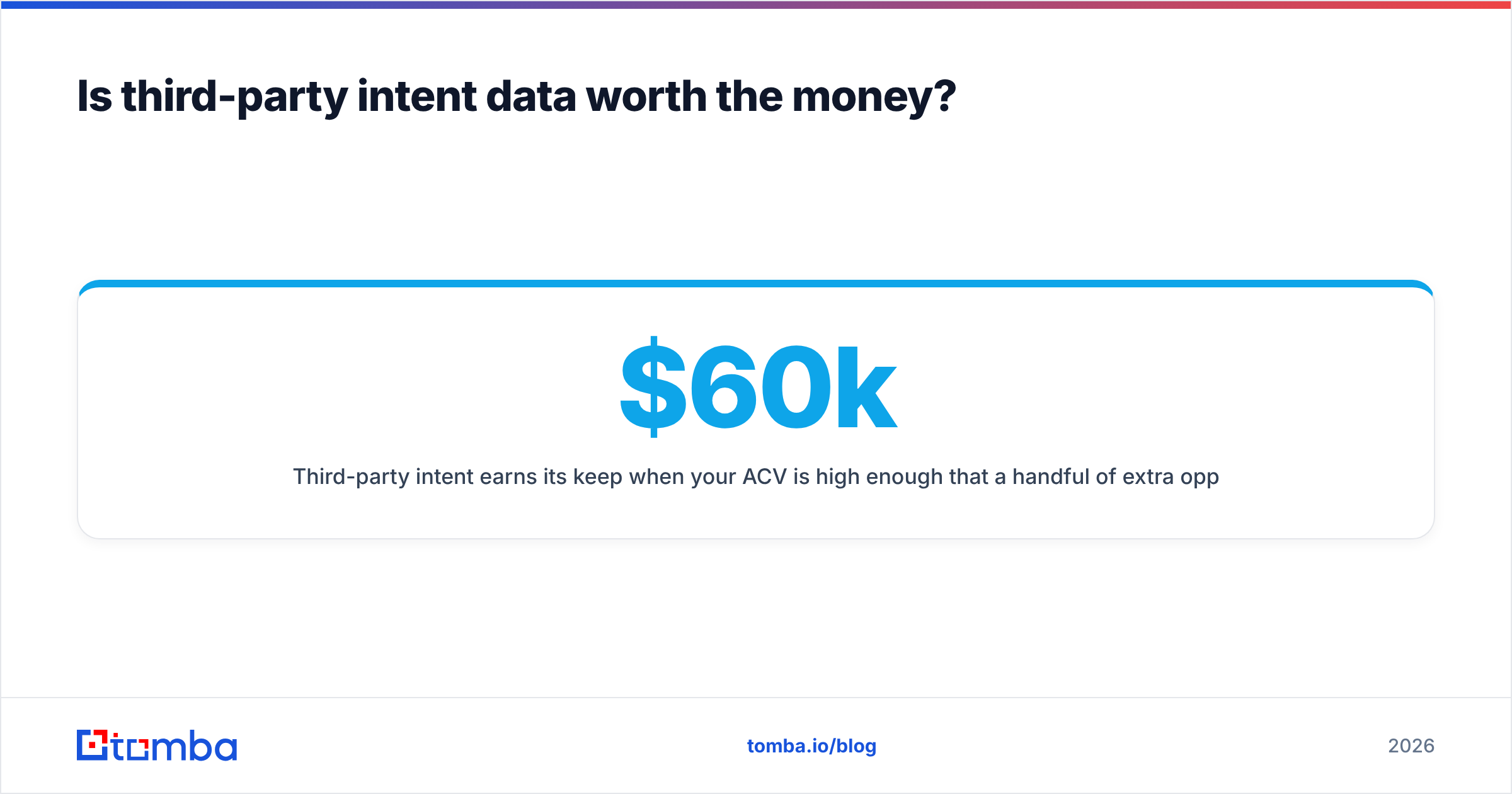
Third-party intent earns its keep when your ACV is high enough that a handful of extra opportunities pays the contract, and your cycle is long enough that catching the research phase actually matters. At a $60k ACV with a five-month cycle, two extra closed deals a year covers a $3k/mo feed. At a $400 ACV with a two-week cycle, the buyer researches and buys before the co-op data even refreshes.
What you're actually buying — and this is rarely said plainly — is earlier notice, not better notice. Third-party surges typically surface accounts weeks before they'd fill in a form. That's valuable if you can nurture. It's worthless if your motion is "signal → email → meeting" and nothing else.
Things to verify before signing, straight from the buyer's side of the table:
- Refresh cadence. Weekly batch files are a red flag for anything outside enterprise ABM. Ask for daily or API.
- Account-level vs. contact-level. Almost all co-op data is account-level. Any vendor implying they know which person is researching is either using their own site data or overselling.
- Baseline methodology. A "surge" is a deviation from an account's own baseline. Ask how long the baseline window is and what happens with low-traffic accounts — small companies generate spurious surges constantly.
- Overlap with your ICP. Run a sample against your actual target list before you sign. Coverage claims are measured against the whole B2B universe, not your slice of it.
- Attribution honesty. If the vendor's ROI case study can't separate intent-sourced pipeline from pipeline the reps would have built anyway, treat the number as marketing.
For a sanity check on any vendor's claims, the review corpus on G2's buyer intent category is more useful than analyst summaries, mostly because the one-star reviews describe implementation reality in detail.
Where do email-finder tools fit into an intent motion?#
They're the conversion step between "account is interested" and "a human reads your message."
This is the part the intent vendors gloss over. Their product ends at the account. Your quota starts at the person. Everything in between — finding the right role, getting a current address, confirming it's deliverable, pushing it to the CRM — is contact data work, and its accuracy caps the performance of everything upstream.

Two things to get right here:
- Verify before you send, always. Intent motions send fast and in bursts, which is exactly the pattern that trips spam filters when bounce rates climb. Run the list through an email verifier and check catch-all verification on domains that don't give a clean SMTP answer. Protecting email deliverability matters more here than in slow-drip outbound, not less.
- Automate the lookup, don't queue it. If a rep has to manually search for a contact when the alert fires, the SLA is dead. Wire the email finder API into your routing so the enriched contact arrives with the alert. Anthropic's Model Context Protocol has also made it practical to hang lookup tools directly off an AI agent, so the enrichment step can run without a human in the loop at all.
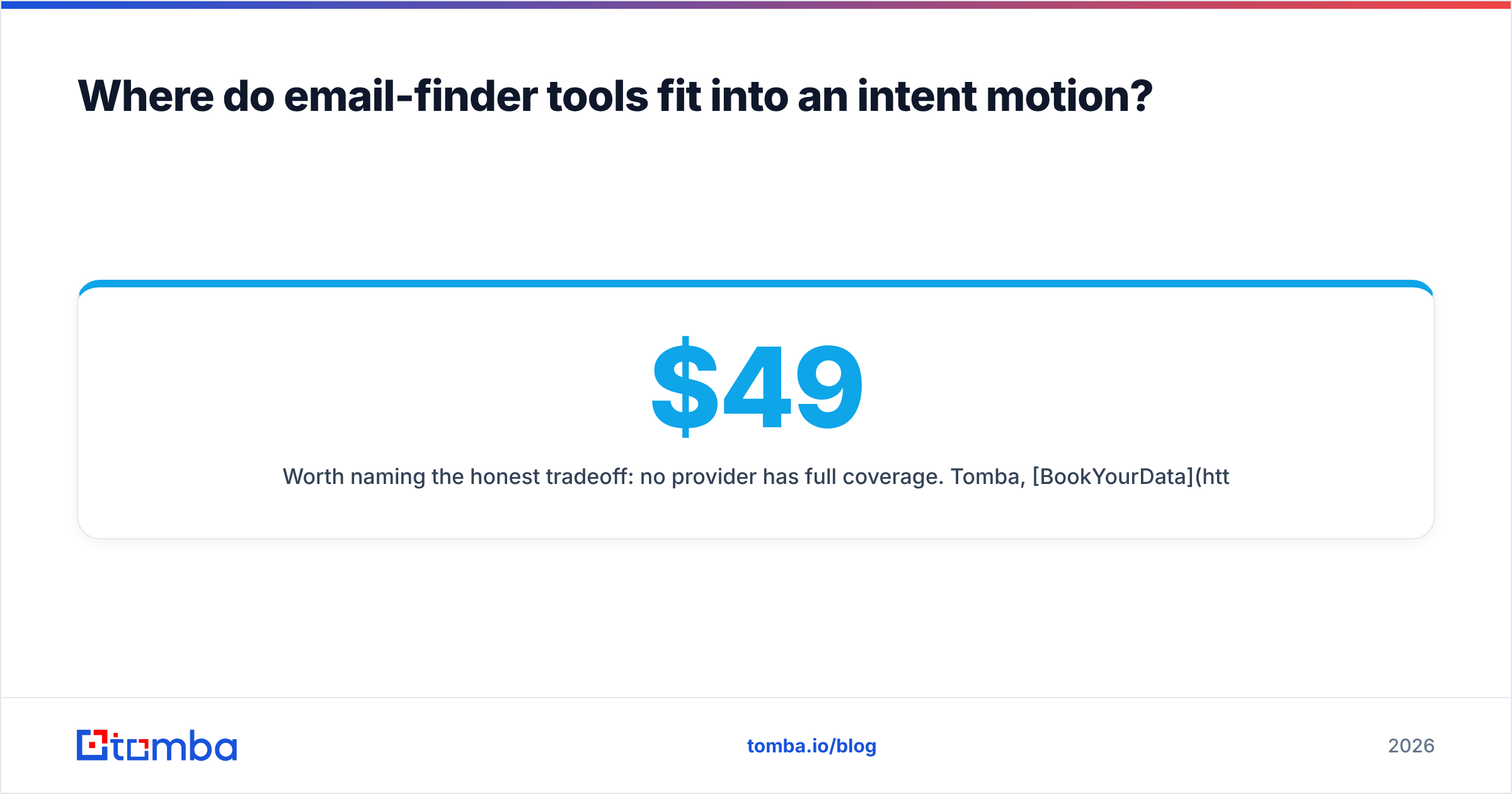
Worth naming the honest tradeoff: no provider has full coverage. Tomba, BookYourData, and the other serious players each have regions and segments where they're strongest — BookYourData's pay-as-you-go model, for instance, suits teams that want a verified list without a subscription, while a search-and-verify API suits teams enriching signals continuously. If your intent motion depends on hitting a specific vertical, test two sources on a sample of 200 target accounts and measure hit rate plus bounce rate before you commit either way. See Tomba pricing for how the credit math works at Starter ($49/mo), Growth ($99/mo), and Pro ($249/mo) — the free tier's 25 searches is enough to run that sample test.
How do you measure whether intent based sales is working?#
Not by "intent-sourced pipeline." That number is trivially gamed by tagging any account that ever appeared in a feed.
Measure these four instead:
- Signal-to-touch latency (median hours). The single best predictor of whether the program works. If your median is above 24 hours, fix that before touching anything else.
- Reply rate on signal-triggered sends vs. your control cohort. Run a real holdout — same ICP, no signal, same reps, same month. If the delta is under 2 percentage points, your signals aren't signals.
- Meeting-to-opportunity conversion on signal-sourced meetings. Intent should improve meeting quality, not just volume. If conversion drops, your threshold is too loose.
- Cost per signal-sourced opportunity. Total data spend (intent + contact + enrichment) divided by opportunities attributable to the holdout-adjusted lift. This is the number that tells you whether to renew.
Review these monthly and expect to retire signals. The job-posting trigger that worked all spring goes quiet when hiring freezes. The competitor-churn signal stops firing when they fix their product. A healthy intent program rotates its signal portfolio two or three times a year — the teams that treat their scoring model as permanent are the ones whose reply rates quietly decay to baseline.
Get the contact layer right first#
Intent tells you which door to knock on. It doesn't tell you who's home, and it definitely doesn't open the door.
Before you sign a five-figure intent contract, prove the motion on signals you can collect for free: first-party page views, job postings, champion job changes, tech-stack shifts. Attach one specific play to each. Measure latency and reply rate against a holdout. If that works on 40 accounts a week, scale the signal volume. If it doesn't, more data will only make the failure more expensive.
When you do fire, fire fast and hit a real inbox. Start with the Tomba Email Finder to turn a signaled account into a verified, role-matched contact in seconds — free tier is 25 searches a month, Starter is $49/mo, and the API drops straight into whatever routing you've already built.
Related guides#
// get started
Find, verify and enrich your first contacts today
Start on the free plan with 25 searches a month, then scale when your team is ready.
Free plan · No credit card required · GDPR & CCPA
// about the author