Intent Based Segmentation: How to Segment B2B Leads by Buying Signals
Most B2B teams segment by industry and headcount, then wonder why reply rates sag. Intent based segmentation sorts your list by what buyers are doing right now — here is how to build it without a six-figure platform.
TL;DR
- Intent based segmentation groups prospects by observed buying behavior — research, site visits, hiring, tech changes — instead of static traits like industry or headcount.
- Signals are not equal. First-party signals (your site, your product, your emails) convert far better than anonymous third-party topic surges, but you get fewer of them.
- The segment is worthless without contact data. A "surging" account with no verified email is a dashboard decoration, not a pipeline.
- You can run a credible intent program for under $150/month using site visitor reveal, review-site alerts, job posting monitors, and a contact finder — no six-figure ABM platform required.
- Measure segments on reply rate and meeting rate per 100 contacts, not on how many accounts light up green.
What is intent based segmentation?#
Intent based segmentation is the practice of sorting your addressable market by what prospects are doing, not by what they are.
Traditional segmentation asks: is this a 200-person fintech in Germany? Intent based segmentation asks: did this 200-person fintech read three comparison articles about payment reconciliation last week, visit your pricing page twice, and post a job for a Revenue Operations manager?
The second question predicts a reply. The first one predicts almost nothing on its own.
Think of it like a bookstore. Firmographic segmentation is the shelf label — "Business / Finance." Intent data is watching which customer picked up a book, flipped to the index, checked the price, and put it back. Both matter, but only one tells you when to walk over.
Gartner's research on the B2B buying journey makes the case plainly: buyers spend the majority of their evaluation time researching independently, and only a small slice of it with any sales rep. By the time someone raises their hand, most of the decision has already happened off your radar. Intent segmentation is the attempt to see that invisible period and get in front of it.
Why do firmographic segments stop working?#
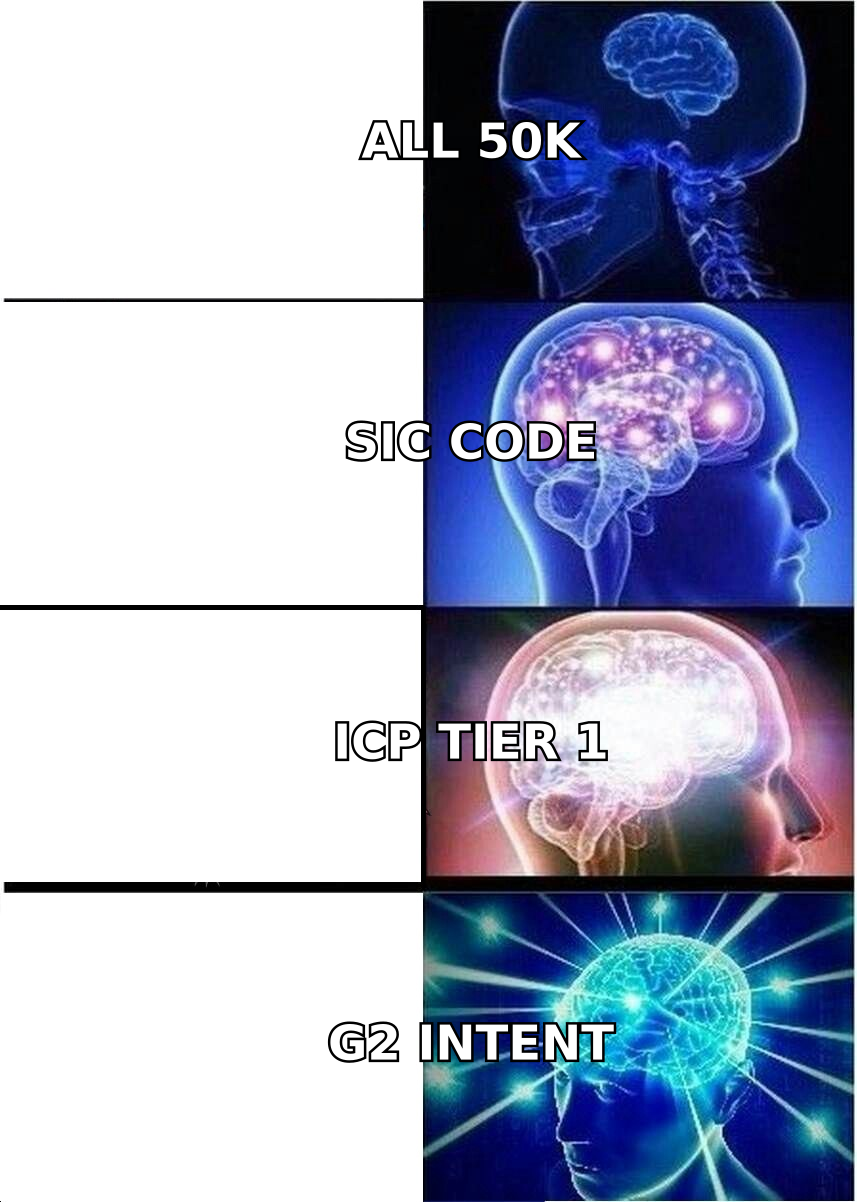
Because everyone has them, and they describe a permanent state rather than a moment.
Three specific failure modes show up in nearly every outbound program:
The segment is too large to personalize. "US SaaS companies, 50–500 employees" is 40,000 accounts. You cannot write anything specific to 40,000 accounts, so you write something generic, and generic gets ignored.
The segment is always "on." A company is in the healthcare vertical permanently. That tells your rep nothing about whether to call today, next quarter, or never. Timing is most of the game in outbound, and firmographics carry zero timing information.
The segment rewards volume, not relevance. When your only filter is "fits the ICP," the rational move is to send more. More sending on a flat list means more spam complaints, worse sender reputation, and a slow decay in deliverability that nobody attributes to the segmentation strategy — but that is exactly where it started.
Intent segmentation does not replace firmographics. It layers a time dimension on top of them. Fit tells you who. Intent tells you when.
What signals actually count as intent?#
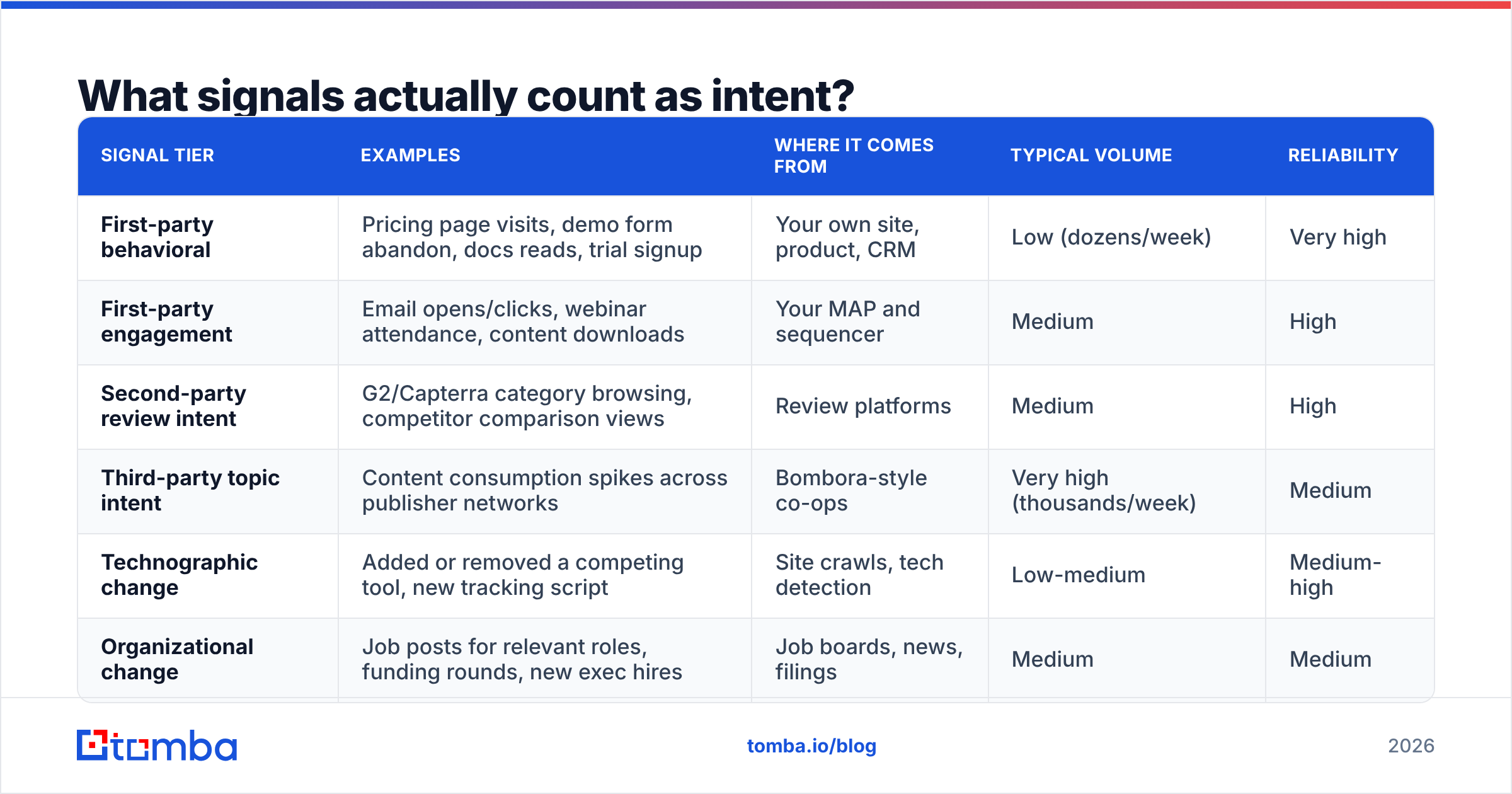
Signals fall into tiers, and the tiers differ enormously in cost, volume, and reliability. Here is how they stack up.
| Signal tier | Examples | Where it comes from | Typical volume | Reliability |
|---|---|---|---|---|
| First-party behavioral | Pricing page visits, demo form abandon, docs reads, trial signup | Your own site, product, CRM | Low (dozens/week) | Very high |
| First-party engagement | Email opens/clicks, webinar attendance, content downloads | Your MAP and sequencer | Medium | High |
| Second-party review intent | G2/Capterra category browsing, competitor comparison views | Review platforms | Medium | High |
| Third-party topic intent | Content consumption spikes across publisher networks | Bombora-style co-ops | Very high (thousands/week) | Medium |
| Technographic change | Added or removed a competing tool, new tracking script | Site crawls, tech detection | Low-medium | Medium-high |
| Organizational change | Job posts for relevant roles, funding rounds, new exec hires | Job boards, news, filings | Medium | Medium |
The pattern worth internalizing: reliability falls as volume rises. Third-party topic intent will give you thousands of "surging" accounts a month. Most of them are noise — an intern doing research, a competitor benchmarking, a consultant writing a report. A pricing page visit from a director at a target account is one signal, and it is worth more than a hundred topic surges.
G2's buyer intent data sits in a useful middle ground, because category browsing on a review site is a much narrower behavior than "read an article tagged with your topic." Someone comparing two vendors in your category is unambiguously in-market. Bombora and similar co-ops go wider and shallower.
How do the main intent data approaches compare?#
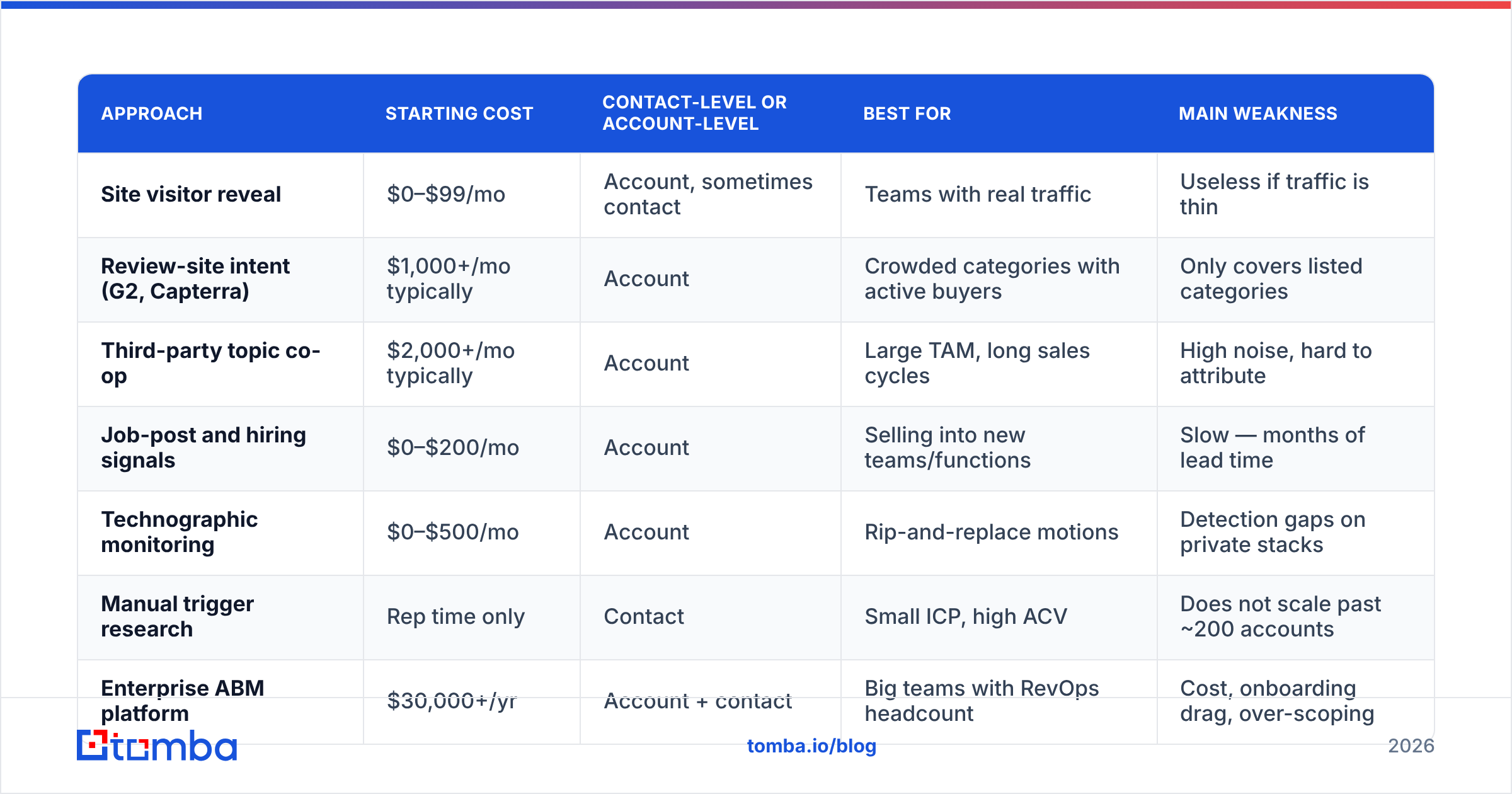
Most teams end up choosing between a handful of models. The honest comparison:
| Approach | Starting cost | Contact-level or account-level | Best for | Main weakness |
|---|---|---|---|---|
| Site visitor reveal | $0–$99/mo | Account, sometimes contact | Teams with real traffic | Useless if traffic is thin |
| Review-site intent (G2, Capterra) | $1,000+/mo typically | Account | Crowded categories with active buyers | Only covers listed categories |
| Third-party topic co-op | $2,000+/mo typically | Account | Large TAM, long sales cycles | High noise, hard to attribute |
| Job-post and hiring signals | $0–$200/mo | Account | Selling into new teams/functions | Slow — months of lead time |
| Technographic monitoring | $0–$500/mo | Account | Rip-and-replace motions | Detection gaps on private stacks |
| Manual trigger research | Rep time only | Contact | Small ICP, high ACV | Does not scale past ~200 accounts |
| Enterprise ABM platform | $30,000+/yr | Account + contact | Big teams with RevOps headcount | Cost, onboarding drag, over-scoping |
A two-person team does not need the bottom row. Site visitor reveal plus job-post monitoring plus a good contact finder will cover 80% of the value at about 2% of the cost. Tomba's website visitor reveal turns anonymous traffic into named companies, which is the cheapest first-party intent signal most teams have sitting unused.
How do you build intent segments in six steps?#
Define your fit floor first. Intent on a bad-fit account is a distraction. Write the hard filters — company size, geography, required tech, excluded industries — and treat anything below that floor as invisible, no matter how loudly it surges.
Pick three to five signals you can actually collect. Not fifteen. Pricing page visit, competitor comparison view, relevant job post, funding event, and tool removal is a complete starting set. Each one must have a source you can query weekly without a human copy-pasting.
Score signals by proximity to a buying decision. Assign weights: pricing page visit = 30, demo abandon = 40, job post for a related role = 15, third-party topic surge = 5. The numbers are arbitrary at first; you calibrate them after 90 days of outcome data.
Set decay windows. Intent rots. A pricing visit is hot for 7 days, warm for 21, dead at 45. A funding round is relevant for a quarter. Without decay, your "hot" segment fills up with stale accounts and reps stop trusting it.
Resolve accounts to people. This is where most intent programs quietly die. You know Acme is in-market; you do not know who to email. Run the account through a domain search to pull the relevant roles, then verify emails before anything enters a sequence. An intent-triggered send to a bounced address is worse than no send at all.
Route to a message that references the signal category, not the signal itself. "I saw you visited our pricing page" is creepy and often wrong. "Most teams evaluating reconciliation tooling this quarter are hitting the same two-system problem" is the same information, delivered as relevance rather than surveillance.

What does an intent segment look like in practice?#
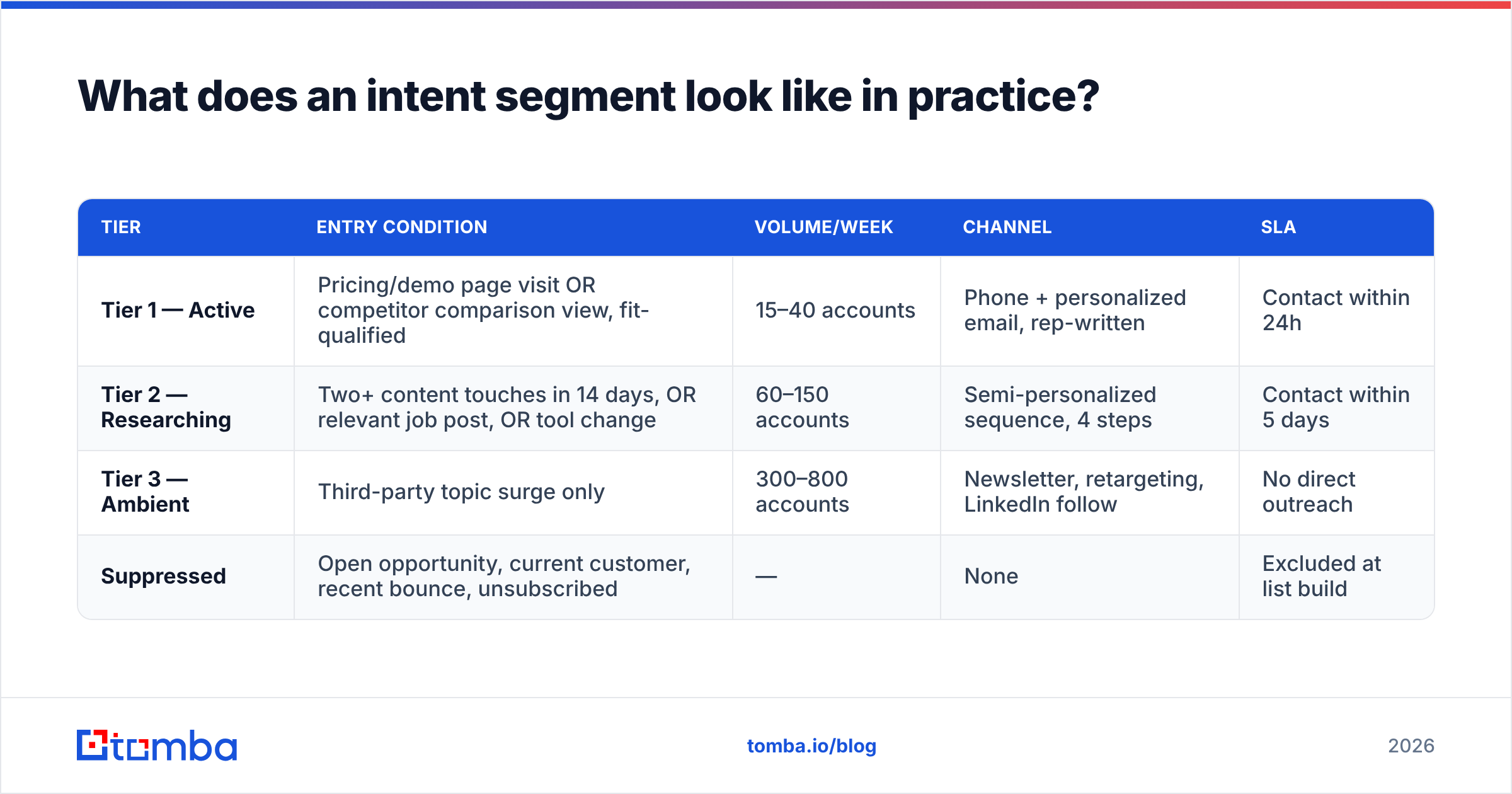
Here is a working three-tier structure you can copy. It assumes an ICP of roughly 4,000 accounts.
| Tier | Entry condition | Volume/week | Channel | SLA |
|---|---|---|---|---|
| Tier 1 — Active | Pricing/demo page visit OR competitor comparison view, fit-qualified | 15–40 accounts | Phone + personalized email, rep-written | Contact within 24h |
| Tier 2 — Researching | Two+ content touches in 14 days, OR relevant job post, OR tool change | 60–150 accounts | Semi-personalized sequence, 4 steps | Contact within 5 days |
| Tier 3 — Ambient | Third-party topic surge only | 300–800 accounts | Newsletter, retargeting, LinkedIn follow | No direct outreach |
| Suppressed | Open opportunity, current customer, recent bounce, unsubscribed | — | None | Excluded at list build |
Two things make this structure work. First, Tier 3 gets no cold email — resisting that is the discipline that keeps deliverability intact. Second, the suppression tier is enforced at list-build time, not at send time, so you never burn a sequence slot on someone who was never eligible.
For Tier 1 and Tier 2, contact enrichment should run automatically when an account enters the tier, not in a weekly batch. The whole point of intent is speed; a four-day lag on finding the email erases the advantage you paid for.
What mistakes kill intent based segmentation?#
Treating account intent as person intent. A surge at a 3,000-person company tells you almost nothing about which of the 40 people in your buying committee cares. The larger the account, the weaker the account-level signal. Pair it with role-based targeting and recent job changes.
Buying intent data before fixing list hygiene. If 18% of your contacts bounce, adding intent data just means you bounce faster on better-timed sends. Verification is the prerequisite, not the upgrade.
Over-personalizing the signal. Referencing specific page visits reads as surveillance to most buyers and triggers defensive replies. Reference the category of problem, not the browsing history.
Letting the scoring model calcify. The weights you guessed in month one are wrong. After a quarter, pull every meeting booked and back out which signals actually preceded them. Most teams find that one or two signals do nearly all the work and the rest are decoration.
Measuring the wrong thing. "Number of in-market accounts identified" is a vanity metric — it goes up when you loosen thresholds. Measure meetings booked per 100 contacts touched, by tier. If Tier 1 is not beating Tier 2 by a wide margin, your tiering is broken.
Ignoring the copy. Intent gets you the right door at the right time. It does not write the message. A well-timed generic email still underperforms a poorly-timed specific one. If your sequences need work, start from proven cold email templates and rewrite for the signal category.
How do you measure whether it is working?#
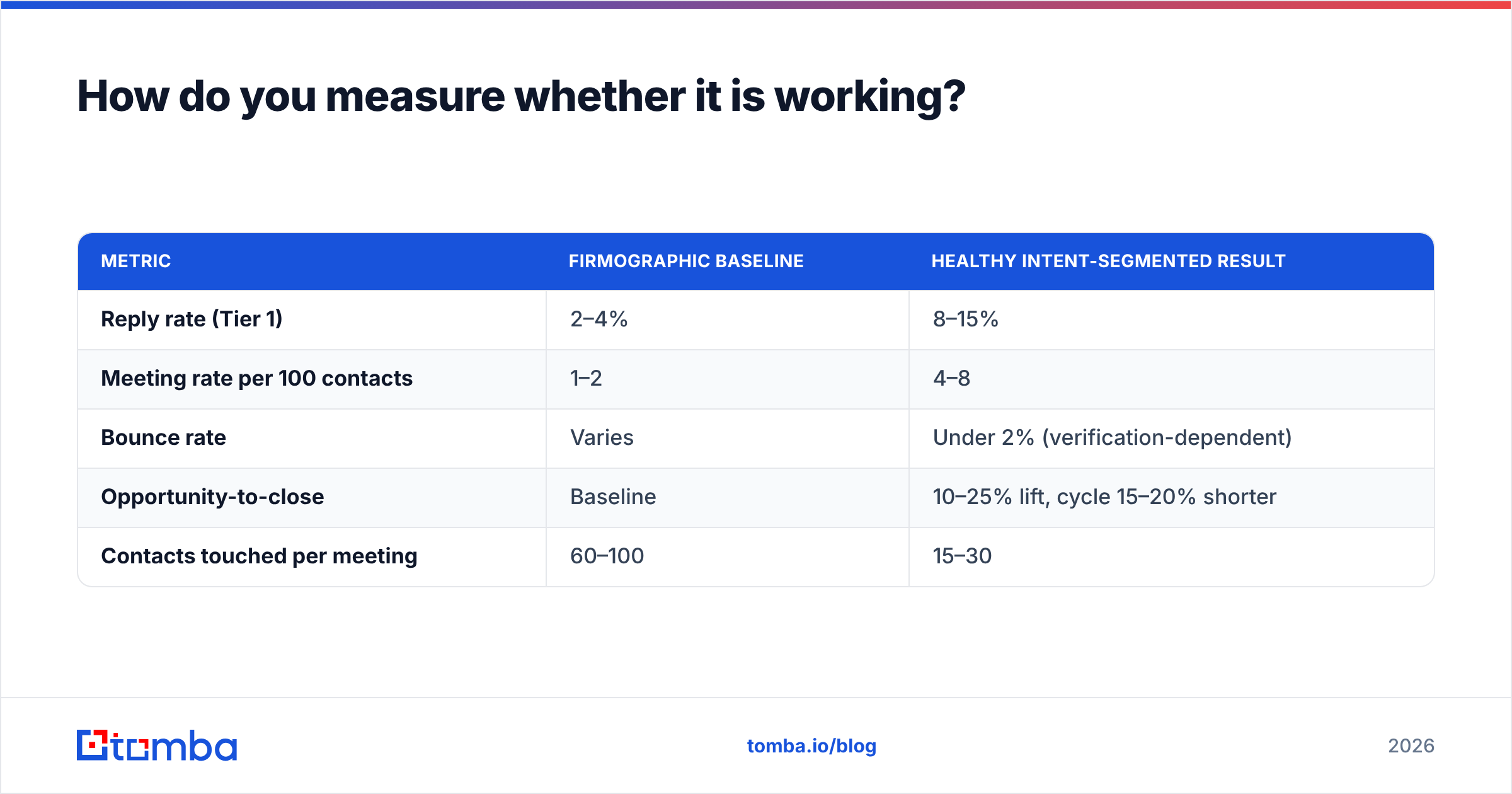
Run intent segments against a holdout of the same accounts contacted on your old firmographic logic. Compare over a full sales cycle, not a month.
| Metric | Firmographic baseline | Healthy intent-segmented result |
|---|---|---|
| Reply rate (Tier 1) | 2–4% | 8–15% |
| Meeting rate per 100 contacts | 1–2 | 4–8 |
| Bounce rate | Varies | Under 2% (verification-dependent) |
| Opportunity-to-close | Baseline | 10–25% lift, cycle 15–20% shorter |
| Contacts touched per meeting | 60–100 | 15–30 |
That last row is the honest headline. Intent segmentation rarely doubles your reply rate on day one. What it reliably does is cut the number of people you have to email to get the same number of meetings — which protects your domain, saves rep hours, and makes every downstream number look better.
HubSpot's own inbound and sales research has documented the same directional pattern for years: relevance and timing beat volume, and the gap widens as inboxes get more crowded. Intent segmentation is just the operational form of that finding.
Where should you start if you have no intent data today?#
Start with what you already own. Turn on visitor identification and watch which companies read your pricing page. Set up job-board alerts for the three roles that signal your problem. Check which of your churned and closed-lost accounts are hiring again. That is a real Tier 1 segment, built in an afternoon, at zero data cost.
Then solve the part that actually blocks execution: turning those company names into people you can reach. Intent identifies the account; you still need a verified inbox for the right director.
Ready to close that gap? Tomba's Email Finder turns an intent-flagged domain and a name into a verified professional email in seconds, with bulk and API access for automated routing straight from your signal source. The free tier gives you 25 searches a month to test the workflow; paid plans start at $49/month, with Growth at $99/month for teams running intent-triggered outbound at scale. See Tomba pricing for the full breakdown — then point your best signals at contacts that actually exist.
Related guides#
// get started
Find, verify and enrich your first contacts today
Start on the free plan with 25 searches a month, then scale when your team is ready.
Free plan · No credit card required · GDPR & CCPA
// about the author