Intent Data in 2026: What It Is and How to Actually Use It
Intent data tells you who is researching your category right now. It does not tell you who to email. Here is how the signals are collected, what they cost in 2026, and how to turn a spike into a booked meeting.
TL;DR
- Intent data is behavioral evidence that an account is researching a problem you solve — content consumption, review-site browsing, search activity, or visits to your own site.
- Third-party intent is account-level and probabilistic. It tells you Acme Corp is in market, not Dana in RevOps needs a demo. That gap is where most programs die.
- Budget realistically: usable third-party intent starts around $12k–$25k/year for a mid-market seat count, and platform-grade ABM intent runs $40k–$100k+.
- A signal is worthless until it becomes a named contact with a verified email or phone. Enrichment is the conversion step, not an afterthought.
- Measure intent by pipeline created per surfaced account, not by "signals delivered." Vendors love volume metrics because volume is easy to sell.
What is intent data, actually?#
Intent data is a record of what buyers do before they talk to you.
Think of it like a bookstore owner watching the aisles. Nobody has bought anything yet, but you can see that three people from the same office keep circling the accounting section, picking up the same two titles, and reading the back covers. You do not know their names. You do know something has changed in that office.
That is the entire premise. Instead of aisles, the observation points are B2B publisher networks, software review sites, search engines, ad exchanges, and your own web properties. Instead of a person, the unit of observation is usually a company — resolved from an IP address, a cookie, a hashed email, or a logged-in account profile.
Three properties define any intent feed, and every vendor conversation should start here:
- Subject — is the signal resolved to an account, a buying group, or an individual? Account-level is the default. Person-level exists but is narrower and more regulated.
- Source — did the vendor observe the behavior directly (first-party, review sites, their own publisher co-op) or buy it from a chain of resellers? Directly observed beats syndicated every time.
- Freshness — is the signal from the last 48 hours or a rolling 30-day average? Weekly batches are still common and still useless for anything time-sensitive.
Get those three answers and you can evaluate any intent product in ten minutes. Skip them and you will spend six months arguing about "signal quality" with no shared definition of the term.
Where does intent data come from?#
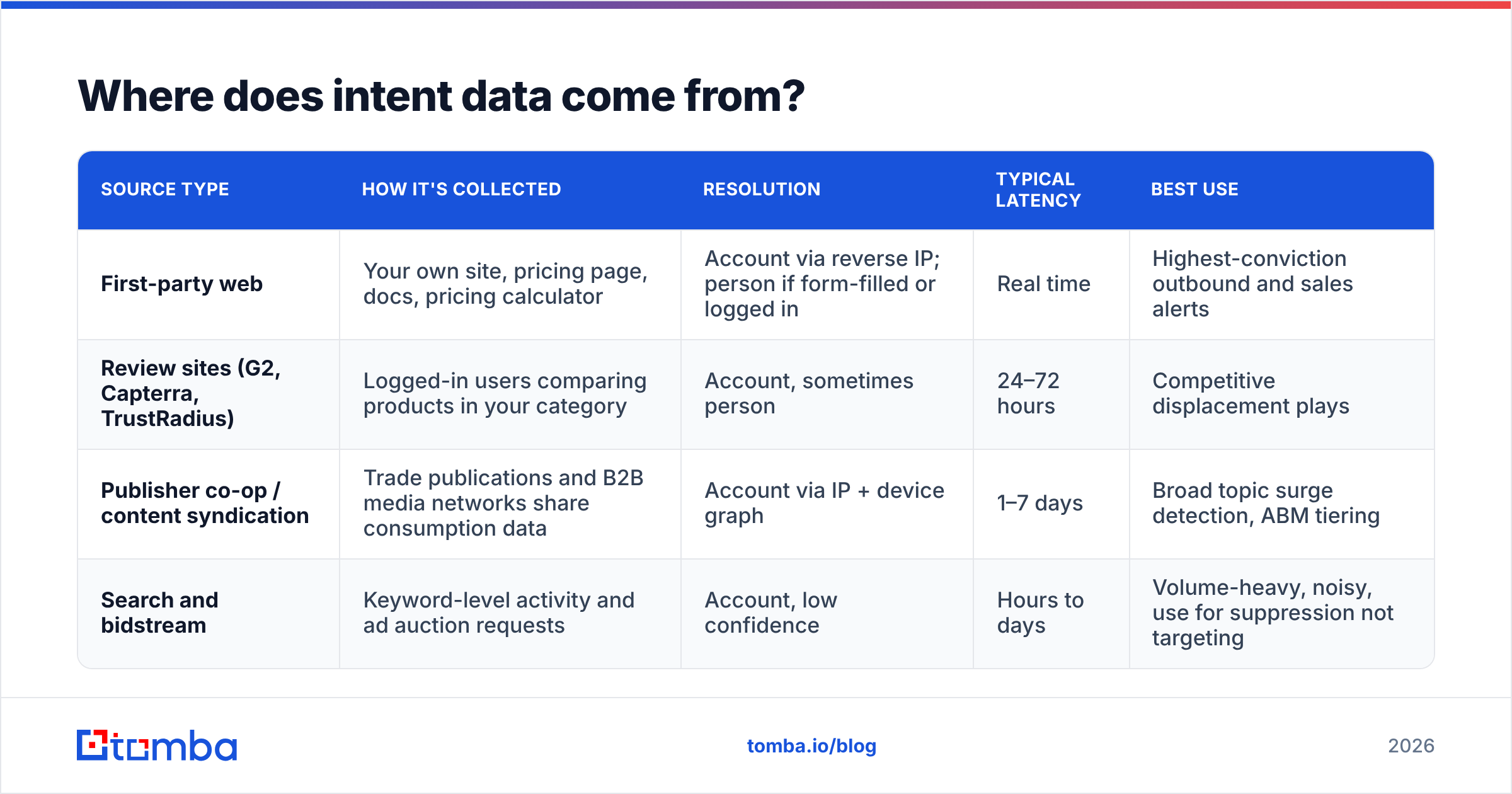
There are four collection models, and they behave differently enough that mixing them without labeling them is a reporting disaster.
| Source type | How it's collected | Resolution | Typical latency | Best use |
|---|---|---|---|---|
| First-party web | Your own site, pricing page, docs, pricing calculator | Account via reverse IP; person if form-filled or logged in | Real time | Highest-conviction outbound and sales alerts |
| Review sites (G2, Capterra, TrustRadius) | Logged-in users comparing products in your category | Account, sometimes person | 24–72 hours | Competitive displacement plays |
| Publisher co-op / content syndication | Trade publications and B2B media networks share consumption data | Account via IP + device graph | 1–7 days | Broad topic surge detection, ABM tiering |
| Search and bidstream | Keyword-level activity and ad auction requests | Account, low confidence | Hours to days | Volume-heavy, noisy, use for suppression not targeting |
First-party is the strongest signal and the one most teams under-exploit. Someone reading your integration docs at 11pm on a Tuesday is telling you more than any $50k feed will. The problem is that reverse-IP resolution only gets you the company name — you still need a way to turn "someone at Acme" into "Dana Whitfield, RevOps lead." Tools like website visitor reveal exist specifically to close that gap.
Third-party surge data from co-ops — Bombora is the best-known operator of this model — works on a different logic. It compares an account's current consumption of a topic against that account's own historical baseline. A surge means "unusually interested for them," not "interested in absolute terms." A company that reads about data privacy constantly will rarely surge on it, even if they are actively buying.

Review-site intent is the most literal of the four. When a buyer opens the G2 buyer intent comparison page for you versus a competitor, there is almost no interpretive work left to do. It is also the smallest volume and the most expensive per account, which is the usual trade.
Is third-party intent better than first-party intent?#
No — and the framing is wrong. They answer different questions.
First-party tells you who is already aware of you. Third-party tells you who is in market but has not found you yet. If you only run first-party, you are harvesting demand you already created. If you only run third-party, you are guessing at accounts with no relationship signal.
The practical sequencing most teams land on after a year:
- Tier 1 — First-party high-intent. Pricing page, demo abandonment, docs, repeat visits. Route to sales within the hour.
- Tier 2 — Review-site category activity. Competitor comparison views, category page browsing. Route to sales with a competitive angle within 48 hours.
- Tier 3 — Third-party topic surge. Two or more related topics surging at once. Route to marketing for ads and nurture; only surface to sales when it stacks with a Tier 1 or Tier 2 event.
- Tier 4 — Single-topic surge with no other signal. Suppress. This is where the false positives live, and working it teaches reps that intent data is noise.
That last tier is the one nobody wants to build, and it is the one that determines whether your reps trust the system in month three.
What does intent data cost in 2026?#
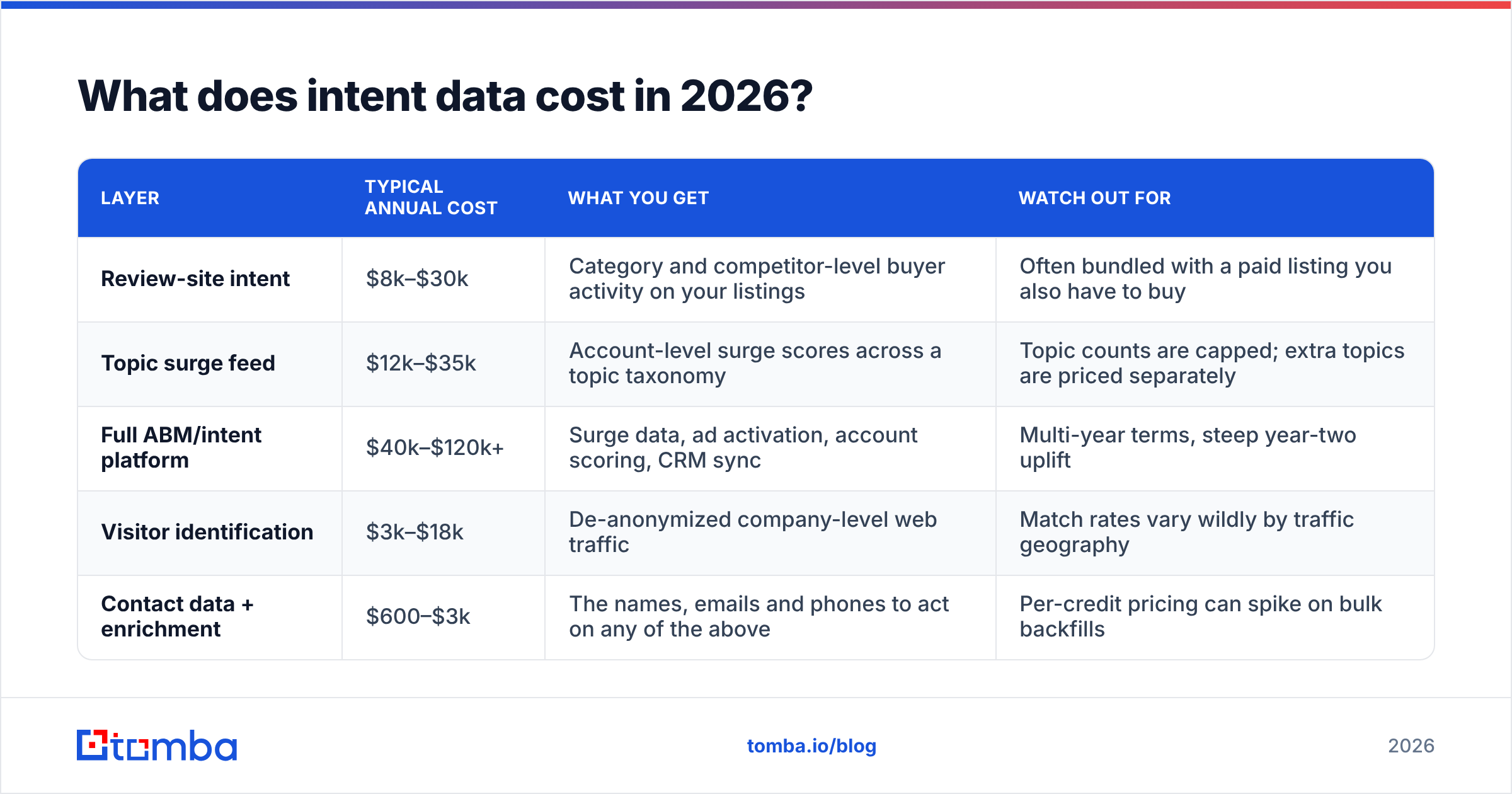
Pricing is opaque by design, but the bands below reflect what mid-market and enterprise teams commonly report. Treat these as negotiation anchors, not quotes.
| Layer | Typical annual cost | What you get | Watch out for |
|---|---|---|---|
| Review-site intent | $8k–$30k | Category and competitor-level buyer activity on your listings | Often bundled with a paid listing you also have to buy |
| Topic surge feed | $12k–$35k | Account-level surge scores across a topic taxonomy | Topic counts are capped; extra topics are priced separately |
| Full ABM/intent platform | $40k–$120k+ | Surge data, ad activation, account scoring, CRM sync | Multi-year terms, steep year-two uplift |
| Visitor identification | $3k–$18k | De-anonymized company-level web traffic | Match rates vary wildly by traffic geography |
| Contact data + enrichment | $600–$3k | The names, emails and phones to act on any of the above | Per-credit pricing can spike on bulk backfills |
The last row is the one that gets budgeted last and matters most. You can spend $60k surfacing 400 in-market accounts and still send zero emails if you have no contact layer. Tools in this band are comparatively cheap — Tomba pricing runs a free tier at 25 searches a month, Starter at $49/mo, Growth at $99/mo, and Pro at $249/mo — which means the activation layer is usually 2–5% of what the signal layer costs.
Put differently: teams routinely overspend by 20x on the part that tells them who and underspend on the part that tells them how to reach them.
Why do most intent data programs fail?#
Five failure modes, in rough order of frequency.
- No contact activation path. The account list arrives. Nobody owns turning it into contacts. Within two months the feed is a dashboard nobody opens. This is the single most common outcome.
- Signals routed without context. A rep gets an alert that says "Acme surged on 'data warehouse'." That is not a reason to call. A rep needs the topic, the trend direction, the competing vendors involved, and a named human.
- Baseline confusion. Teams read surge scores as absolute interest, target the loudest accounts, and end up calling the same ten enterprises every quarter.
- Latency mismatch. Weekly-batch third-party data routed into a same-day SDR cadence produces calls about research the buyer finished eight days ago.
- No suppression logic. Existing customers, open opportunities, and closed-lost-in-90-days accounts flood the feed. Reps lose confidence fast when a third of their "new intent" accounts are already in the CRM.
None of these are data-quality problems. They are operations problems, which is why the fix belongs to revenue operations rather than to whoever signed the contract.

How do you turn an intent signal into a real conversation?#
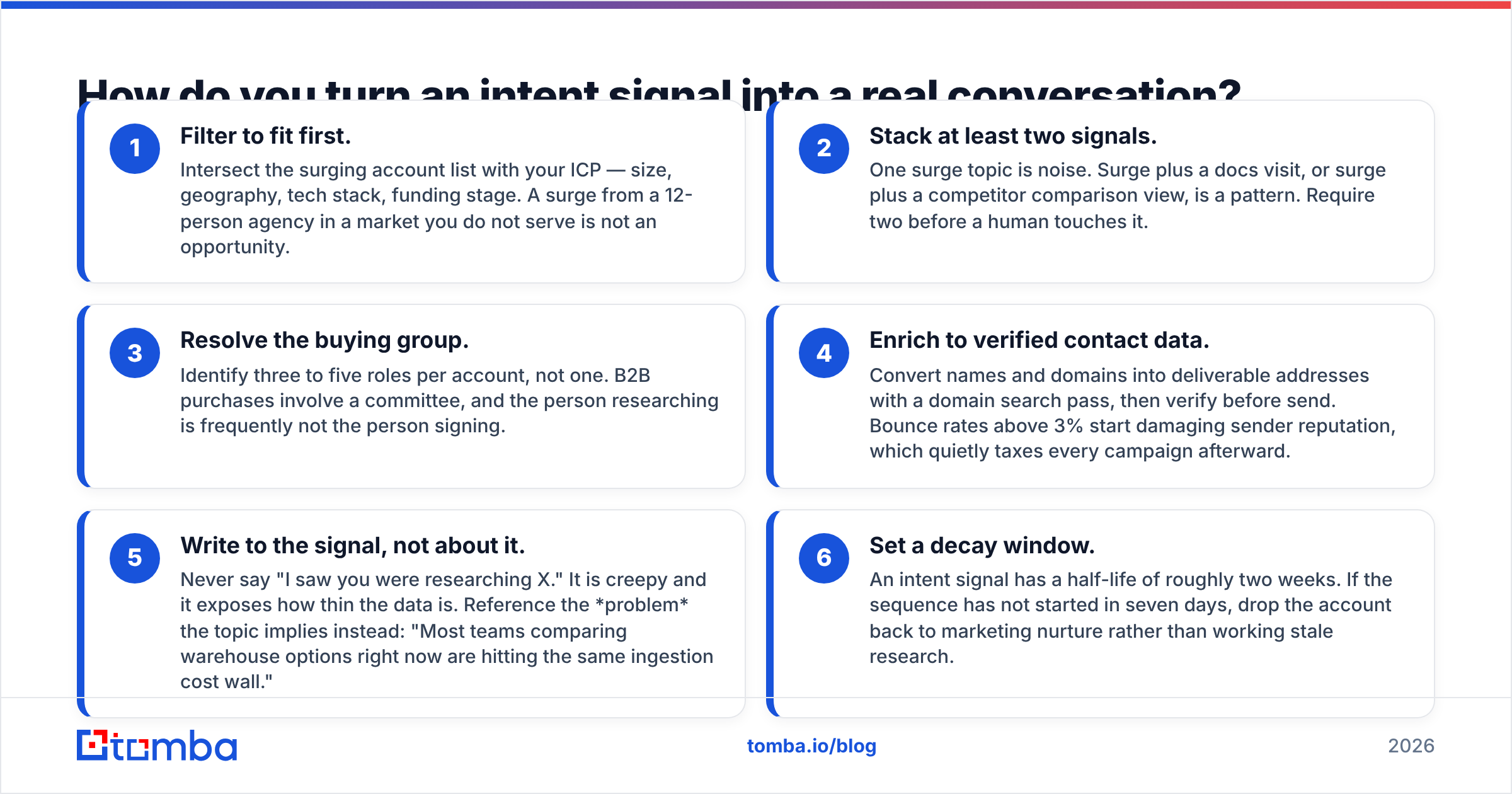
Here is the pipeline that actually converts, step by step.
- Filter to fit first. Intersect the surging account list with your ICP — size, geography, tech stack, funding stage. A surge from a 12-person agency in a market you do not serve is not an opportunity.
- Stack at least two signals. One surge topic is noise. Surge plus a docs visit, or surge plus a competitor comparison view, is a pattern. Require two before a human touches it.
- Resolve the buying group. Identify three to five roles per account, not one. B2B purchases involve a committee, and the person researching is frequently not the person signing.
- Enrich to verified contact data. Convert names and domains into deliverable addresses with a domain search pass, then verify before send. Bounce rates above 3% start damaging sender reputation, which quietly taxes every campaign afterward.
- Write to the signal, not about it. Never say "I saw you were researching X." It is creepy and it exposes how thin the data is. Reference the problem the topic implies instead: "Most teams comparing warehouse options right now are hitting the same ingestion cost wall."
- Set a decay window. An intent signal has a half-life of roughly two weeks. If the sequence has not started in seven days, drop the account back to marketing nurture rather than working stale research.
Step four is where programs quietly succeed or fail, and it is the cheapest step in the chain. Pushing enrichment through the Tomba API or a scheduled bulk email finder job means the gap between "signal appeared" and "sequence started" is measured in minutes rather than in someone's to-do list.
How does intent data compare to the alternatives?#
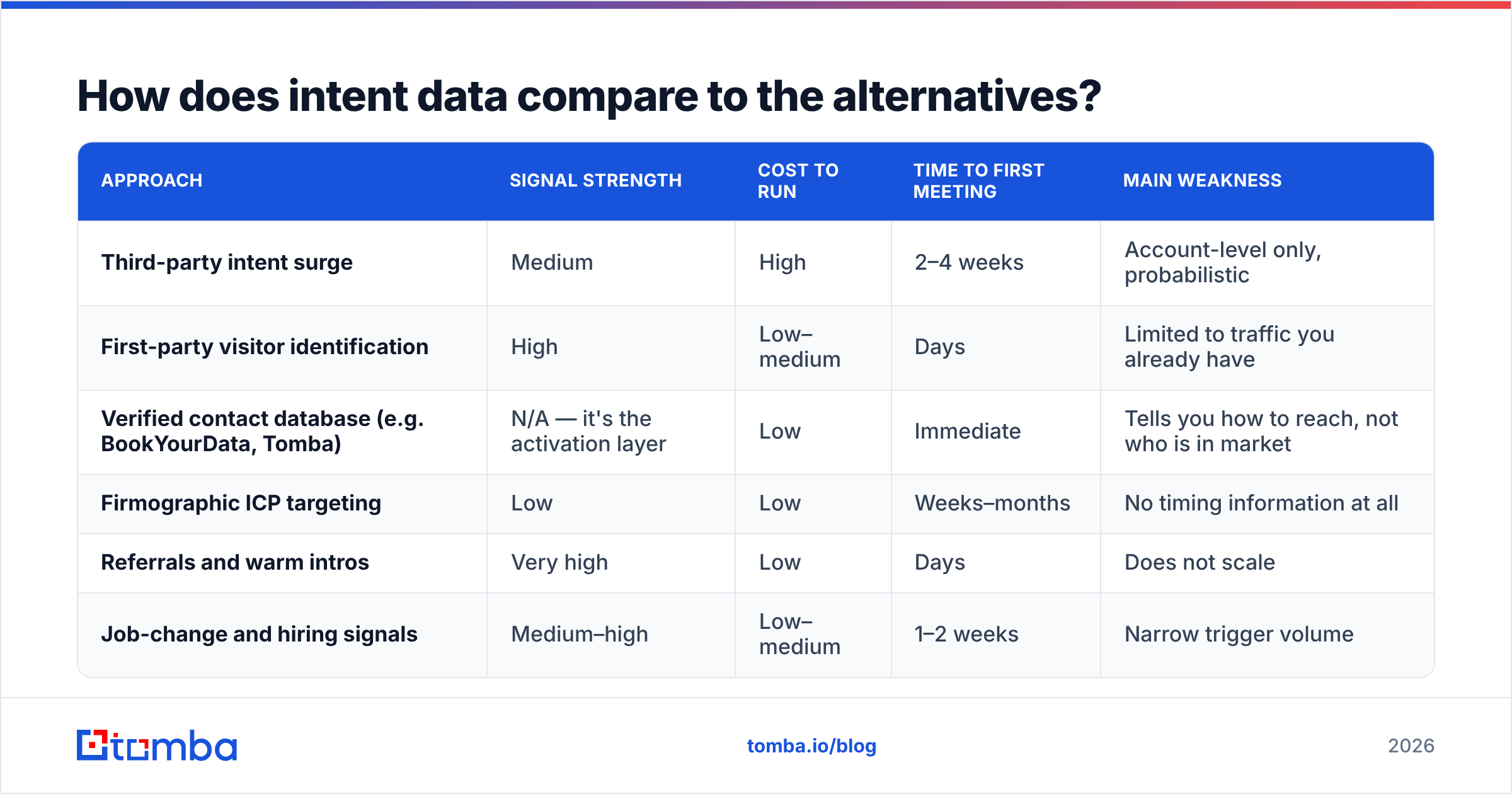
Intent data is one input among several. Here is how it stacks against the other ways teams pick accounts.
| Approach | Signal strength | Cost to run | Time to first meeting | Main weakness |
|---|---|---|---|---|
| Third-party intent surge | Medium | High | 2–4 weeks | Account-level only, probabilistic |
| First-party visitor identification | High | Low–medium | Days | Limited to traffic you already have |
| Verified contact database (e.g. BookYourData, Tomba) | N/A — it's the activation layer | Low | Immediate | Tells you how to reach, not who is in market |
| Firmographic ICP targeting | Low | Low | Weeks–months | No timing information at all |
| Referrals and warm intros | Very high | Low | Days | Does not scale |
| Job-change and hiring signals | Medium–high | Low–medium | 1–2 weeks | Narrow trigger volume |
Read that table as a stack, not a menu. Firmographics define the universe, intent narrows it to the in-market slice, and contact data makes any of it actionable. A team with excellent intent and no contact layer performs worse than a team with mediocre intent and clean, verified emails — because only one of them can actually send.
Hiring and job-change triggers deserve more attention than they get. They are cheap, precise, and mostly ignored. HubSpot's sales research has consistently found that new executives reshape their vendor stack within their first two quarters, which makes a role change a stronger buying signal than most topic surges — and it costs nothing beyond a LinkedIn monitor and an enrichment call.
How do you measure whether intent data is working?#
Four metrics. Ignore everything else the vendor dashboard offers.
- Surfaced-to-contacted rate. Of accounts flagged in-market, what percentage received a real outbound touch within seven days? Below 50% means your activation layer is broken, not your data.
- Contacted-to-meeting rate versus control. Run a holdout. Work a matched set of ICP accounts with no intent signal. If the intent cohort does not book at least 1.5x the control, you are paying for a random number generator.
- Pipeline per surfaced account. Total pipeline created divided by accounts flagged. This is the number that goes in the renewal conversation.
- Signal decay curve. Meeting rate by days-since-signal. Most teams find a cliff between day 10 and day 14. That cliff should set your SLA.
Give it two full quarters before judging. One quarter is not enough to separate a bad feed from bad routing, and those two problems have opposite fixes.
Is intent data worth buying in 2026?#
Yes — if you have already exhausted your first-party signals and your contact activation layer works.
It is a poor first purchase. A team without reliable email verification, without visitor identification, and without a routing SLA will convert a six-figure intent contract into a dashboard. The same team spending a few hundred dollars a month on contact enrichment against its existing website traffic will usually book more meetings in the first 90 days.
The honest sequencing is: fix activation, harvest first-party, layer in review-site intent, then buy topic surge data once you can prove you act on signals within 48 hours. Vendors will tell you to do it in reverse. They are selling the expensive layer.
Ready to make your intent signals actionable? Tomba Email Finder turns a surging account list into verified, deliverable contacts — by domain, by name, or in bulk through the API. Start on the free tier with 25 searches a month and see how many of your flagged accounts you can actually reach before the signal decays.
Related guides#
// get started
Find, verify and enrich your first contacts today
Start on the free plan with 25 searches a month, then scale when your team is ready.
Free plan · No credit card required · GDPR & CCPA
// about the author