Intent Data for Demand Generation: A Practical 2026 Guide
Intent data doesn't create demand — it tells you where demand already exists. Here's how to turn surge signals into routed, contacted, booked pipeline in 2026 without buying a platform you can't staff.
TL;DR
- Intent data doesn't create demand. It ranks accounts by how likely they already are to be shopping, so you stop spending equal effort on unequal accounts.
- Most intent programs fail at the last mile: a surge fires, nobody has contact data for that account, and the signal decays before anyone reaches out.
- Third-party intent (Bombora, G2, 6sense) is directional at the account level. First-party intent — your own site, pricing page, docs — is the sharper signal and it's free.
- The metric that matters is signal-to-conversation time. If it's over 72 hours, your provider isn't the problem.
- A small team can run a credible intent program with first-party signals plus a contact-resolution layer for under $100/month, long before a six-figure platform makes sense.
What is intent data in demand generation?#
Intent data is a record of research behavior that suggests a company is evaluating something. Somebody at Acme Corp read four articles about workflow automation this week, compared two vendors on a review site, and hit your pricing page twice. None of those actions is a purchase. Together they're a pattern, and the pattern is the product.
Think of it like a bookstore owner watching which shelves customers linger at. No one announces "I'm buying a cookbook today." But if the same person circles the cooking section three visits in a row, you know which table to walk them to. Intent data is that observation, industrialized across millions of B2B research sessions.
In demand generation specifically, intent data does one job: it changes how you allocate finite attention. Your team can run maybe 400 genuinely personalized touches a month. Intent data's entire value proposition is deciding which 400 accounts those go to, instead of spreading effort evenly across a 12,000-row list where roughly 3% are in-market at any given moment.
That's the honest framing. Intent data is a prioritization tool, not a lead source. Vendors who sell it as a lead source are selling you a ranked list and calling it pipeline.

Where does intent data actually come from?#
Understanding the plumbing matters, because the source determines how much you should trust the signal.
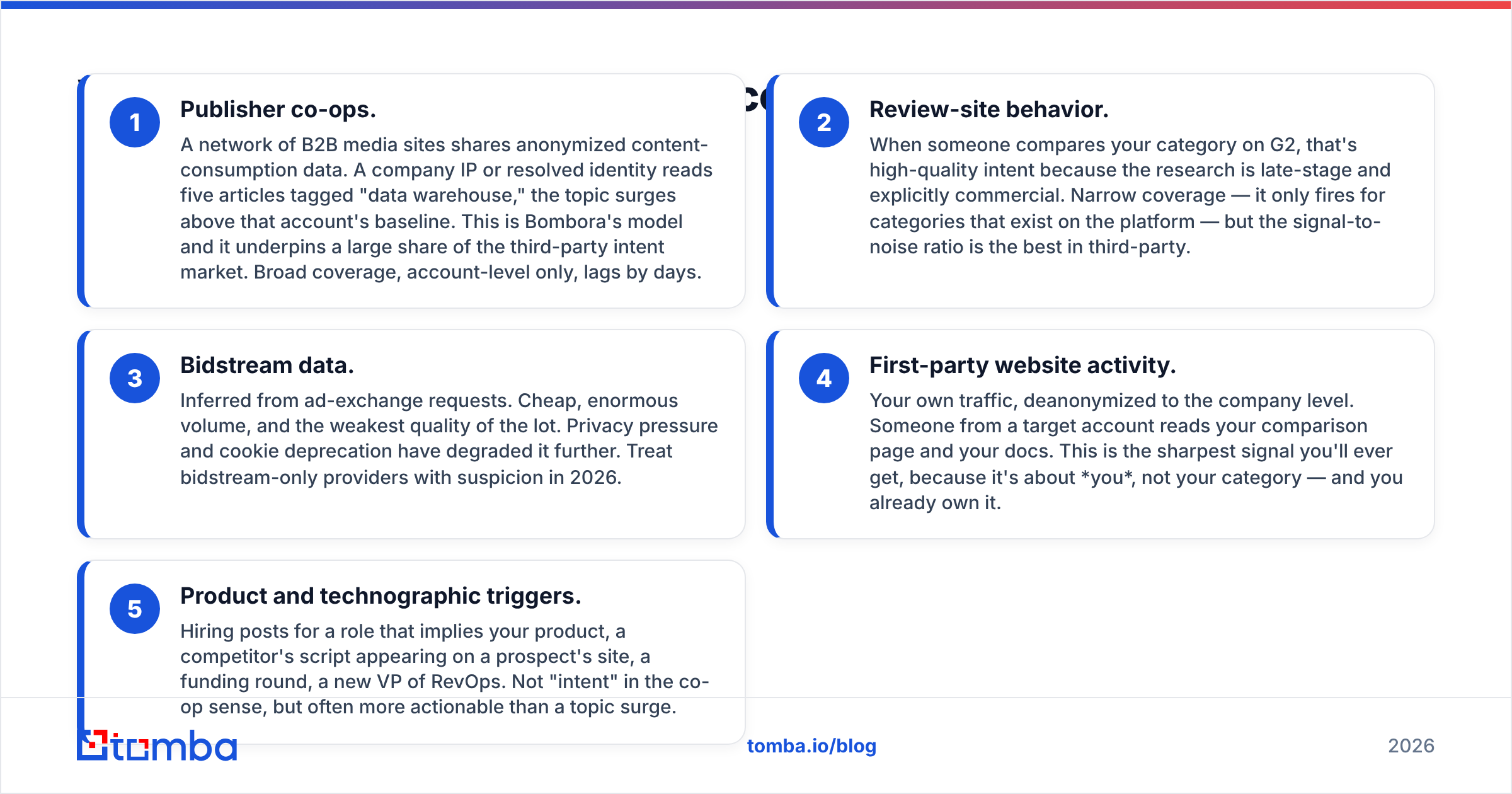
Publisher co-ops. A network of B2B media sites shares anonymized content-consumption data. A company IP or resolved identity reads five articles tagged "data warehouse," the topic surges above that account's baseline. This is Bombora's model and it underpins a large share of the third-party intent market. Broad coverage, account-level only, lags by days.
Review-site behavior. When someone compares your category on G2, that's high-quality intent because the research is late-stage and explicitly commercial. Narrow coverage — it only fires for categories that exist on the platform — but the signal-to-noise ratio is the best in third-party.
Bidstream data. Inferred from ad-exchange requests. Cheap, enormous volume, and the weakest quality of the lot. Privacy pressure and cookie deprecation have degraded it further. Treat bidstream-only providers with suspicion in 2026.
First-party website activity. Your own traffic, deanonymized to the company level. Someone from a target account reads your comparison page and your docs. This is the sharpest signal you'll ever get, because it's about you, not your category — and you already own it.
Product and technographic triggers. Hiring posts for a role that implies your product, a competitor's script appearing on a prospect's site, a funding round, a new VP of RevOps. Not "intent" in the co-op sense, but often more actionable than a topic surge.
The practical hierarchy: first-party beats review-site beats co-op beats bidstream. Most teams invert this, paying five figures for co-op data while their own website visitor reveal sits unconfigured.
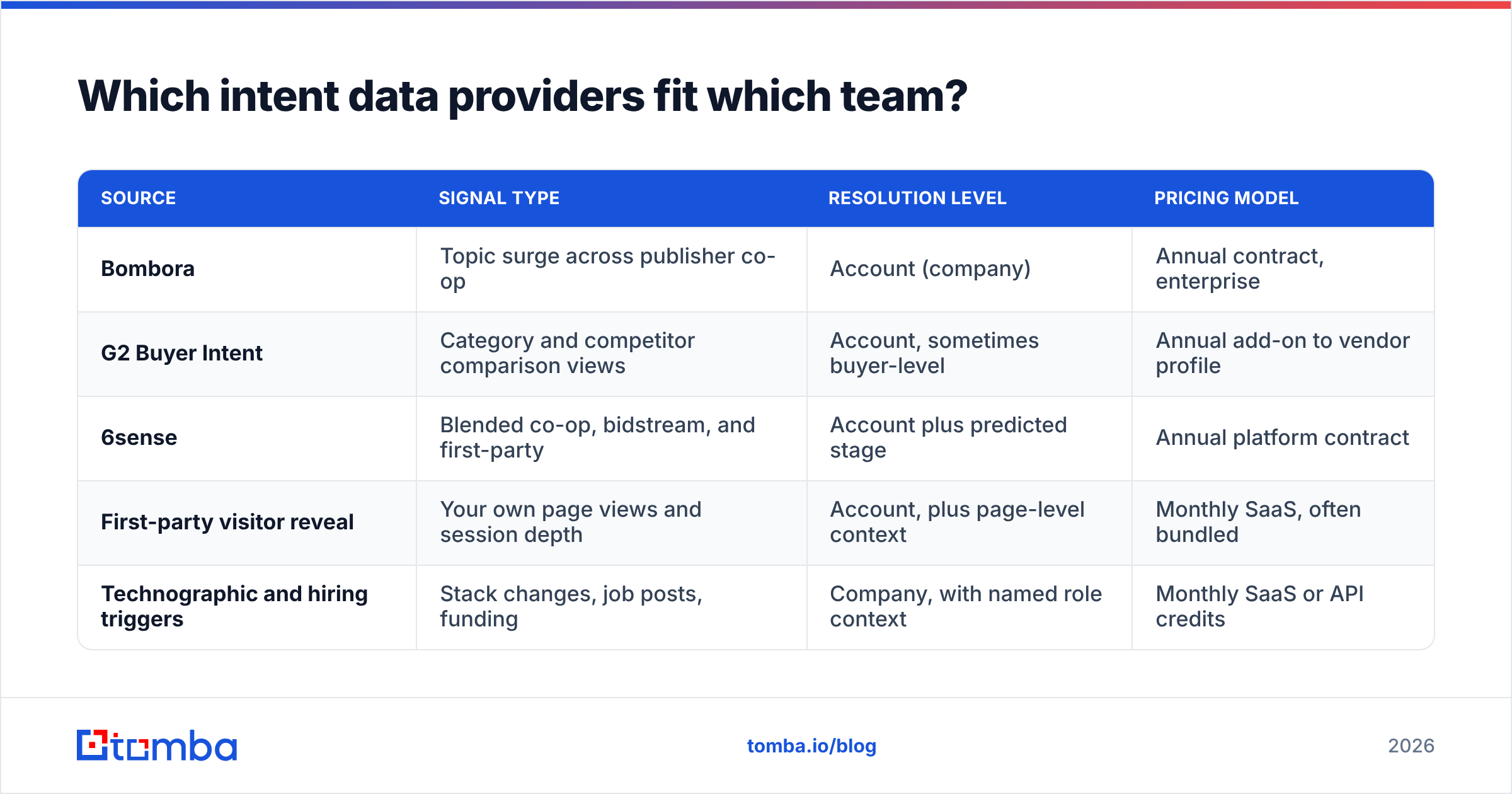
Which intent data providers fit which team?#
| Source | Signal type | Resolution level | Pricing model |
|---|---|---|---|
| Bombora | Topic surge across publisher co-op | Account (company) | Annual contract, enterprise |
| G2 Buyer Intent | Category and competitor comparison views | Account, sometimes buyer-level | Annual add-on to vendor profile |
| 6sense | Blended co-op, bidstream, and first-party | Account plus predicted stage | Annual platform contract |
| First-party visitor reveal | Your own page views and session depth | Account, plus page-level context | Monthly SaaS, often bundled |
| Technographic and hiring triggers | Stack changes, job posts, funding | Company, with named role context | Monthly SaaS or API credits |
Read that table as a sequence, not a menu. Teams that start at the bottom row and work up almost always outperform teams that start at the top, because the bottom rows produce signals you can act on tomorrow with the headcount you already have.
A useful gut-check before any intent purchase: if a perfect signal arrived right now, could you contact the right human at that account within 24 hours? If the answer is no, buying better signals is the wrong purchase order.
Why do most intent data programs fail?#
They fail in the gap between signal and conversation. Four failure modes account for nearly all of it.
The account-to-person gap. Intent data resolves to a company. Your outreach needs a person. "Acme Corp is surging on data quality" tells you nothing about whether to email the VP of RevOps, the Head of Data, or the analytics manager who actually feels the pain. Somebody has to close that gap, and if that somebody is a rep doing manual research, the signal is already three days old by the time an email goes out.
No baseline. A surge is only meaningful relative to normal. Large enterprises read a lot of everything; they surge on dozens of topics constantly. Without baseline normalization, your "hot accounts" list quietly becomes a list of big companies. Any provider worth paying already normalizes — confirm it in the demo, not after.
The decay problem. Third-party intent typically reaches you with a lag of several days to two weeks, depending on the refresh cadence. Add a weekly enrichment batch, a routing rule that waits for a Monday review, and a rep who works the list on Thursday. You're now contacting a buyer three weeks after they were researching. Gartner and others have documented how much of the B2B buying cycle happens before any vendor contact — arriving late means arriving after the shortlist is set.
Treating intent as permission to be generic. The worst outcome of intent data is an email that says "I noticed your team has been researching data quality solutions." It's vague, slightly creepy, and signals that a tool wrote it. Intent should change who you contact and what problem you lead with — not appear as a line in the email.
How do you turn an intent signal into a real conversation?#
Here's the operating sequence that separates programs that produce meetings from programs that produce dashboards.
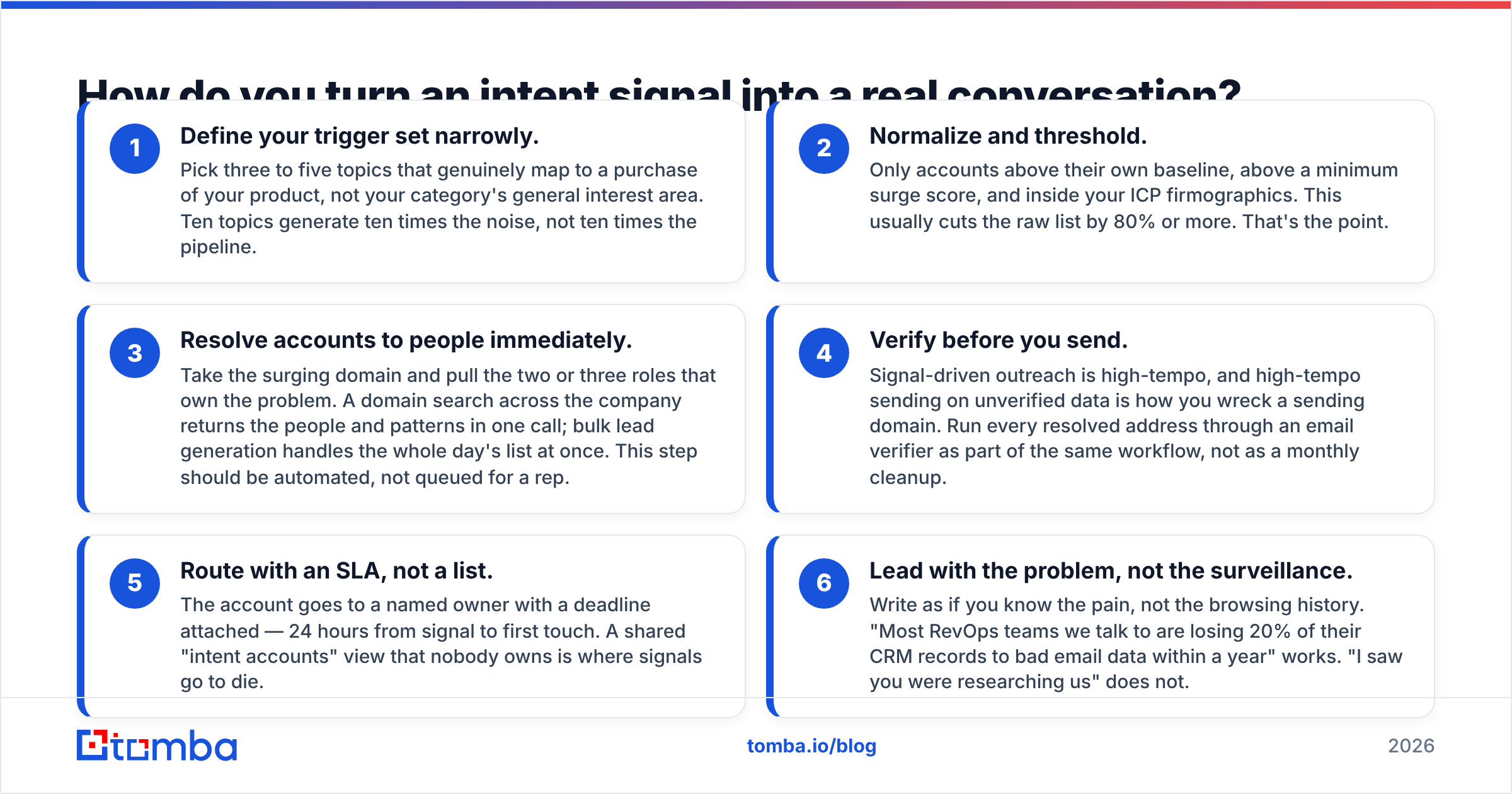
Define your trigger set narrowly. Pick three to five topics that genuinely map to a purchase of your product, not your category's general interest area. Ten topics generate ten times the noise, not ten times the pipeline.
Normalize and threshold. Only accounts above their own baseline, above a minimum surge score, and inside your ICP firmographics. This usually cuts the raw list by 80% or more. That's the point.
Resolve accounts to people immediately. Take the surging domain and pull the two or three roles that own the problem. A domain search across the company returns the people and patterns in one call; bulk lead generation handles the whole day's list at once. This step should be automated, not queued for a rep.
Verify before you send. Signal-driven outreach is high-tempo, and high-tempo sending on unverified data is how you wreck a sending domain. Run every resolved address through an email verifier as part of the same workflow, not as a monthly cleanup.
Route with an SLA, not a list. The account goes to a named owner with a deadline attached — 24 hours from signal to first touch. A shared "intent accounts" view that nobody owns is where signals go to die.
Lead with the problem, not the surveillance. Write as if you know the pain, not the browsing history. "Most RevOps teams we talk to are losing 20% of their CRM records to bad email data within a year" works. "I saw you were researching us" does not.

What does an intent-triggered play look like in practice?#
Concrete example. You sell an analytics platform. Your trigger set is three topics: "data warehouse migration," "BI tool comparison," and "analytics engineering."
Monday morning, your intent feed surfaces 31 accounts above threshold. Firmographic filters — 200 to 2,000 employees, North America, using a competing BI tool per technographic data — cut that to nine.
An automated job takes those nine domains and resolves each to a Head of Data, a VP of Engineering, and an analytics lead, verifying each address and pushing the result into your CRM with the surging topic attached as a field. That's a Tomba API call in a workflow, not an afternoon of manual research.
Each account lands with an owner and a 24-hour clock. The rep writes three emails — different message per role — anchored on the specific problem implied by the topic. The engineering lead hears about migration cost. The analytics lead hears about query latency. The VP hears about the total bill.
Nine accounts, 27 contacts, three distinct messages, all inside a day of the signal firing. That's a program. Thirty-one accounts dumped into a spreadsheet with a "high intent" tag is not.
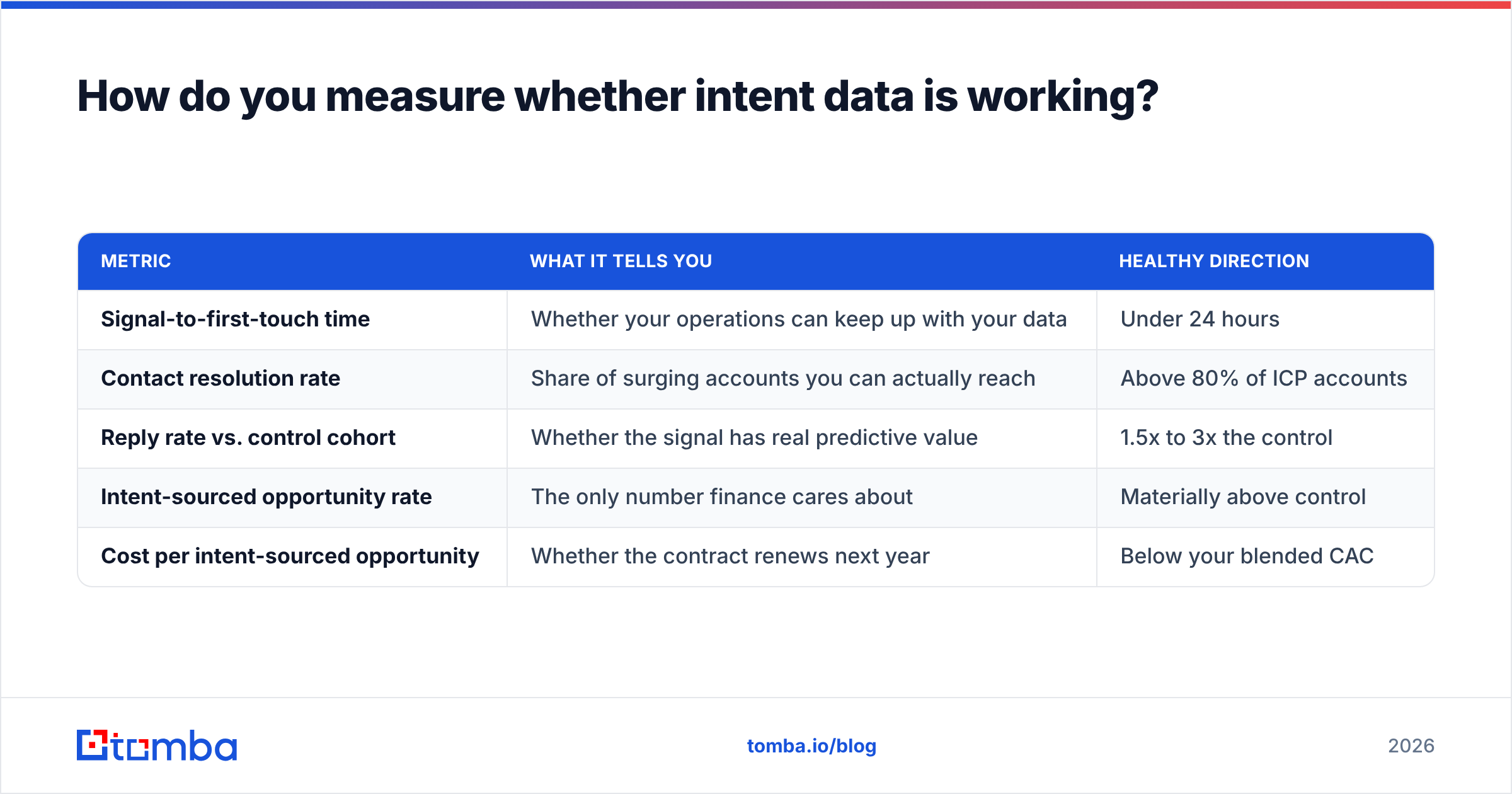
How do you measure whether intent data is working?#
Stop measuring intent programs on open rates. Measure them on the four numbers below, always against a non-intent control group running the same messaging.
| Metric | What it tells you | Healthy direction |
|---|---|---|
| Signal-to-first-touch time | Whether your operations can keep up with your data | Under 24 hours |
| Contact resolution rate | Share of surging accounts you can actually reach | Above 80% of ICP accounts |
| Reply rate vs. control cohort | Whether the signal has real predictive value | 1.5x to 3x the control |
| Intent-sourced opportunity rate | The only number finance cares about | Materially above control |
| Cost per intent-sourced opportunity | Whether the contract renews next year | Below your blended CAC |
If your reply rate against the control group is flat, one of two things is true: the signal is noise, or your messaging didn't change when the signal did. Both are fixable, and neither is fixed by buying more data.
Run the control group for at least a full quarter. B2B cycles are long enough that a six-week read on opportunity rate is a coin flip dressed as analysis.
Is intent data worth it for a small team?#
Third-party intent platforms, yes eventually — but almost never first.
If you're under roughly 20 reps, the sequence that works is: instrument first-party signals, build the contact-resolution pipeline, prove you can move from signal to conversation in a day, then buy third-party coverage to widen the top of the funnel. Buying in the reverse order is how teams end up with an expensive contract and a Slack channel full of alerts nobody works.
The cheap version of this program is genuinely cheap. Visitor reveal on your own site, a technographic or hiring trigger feed, and a resolution layer that turns domains into verified contacts. On Tomba pricing, that resolution layer starts at $49/month on Starter and $99/month on Growth — a rounding error against an enterprise intent contract, and it's the component you'd need regardless of which signal provider you eventually choose.
The strategic point: intent signals are increasingly commoditized. Multiple vendors see overlapping co-op data, and your competitors are being alerted to the same surging accounts on the same day. The durable advantage isn't knowing who's in-market. It's being the first vendor to reach the right human with something worth reading — which is an execution problem, powered by contact data and routing discipline, not a data-purchasing problem.
What should you do this quarter?#
Pick the smallest version that produces evidence.
Instrument first-party intent this week. Define three trigger topics, not ten. Build one automated path from surging domain to verified contacts in your CRM. Set a 24-hour SLA with a named owner. Run a control cohort. Read the results in 90 days, and only then decide whether a six-figure platform earns its slot in the budget.
The teams that win with intent data in 2026 aren't the ones with the best signals. They're the ones whose last mile — domain to person to verified address to a relevant first line — takes minutes instead of weeks.
That last mile is exactly what Tomba Email Finder is built for: hand it a surging domain and the role you need, get back verified, deliverable contacts you can act on the same day the signal fires. Start free with 25 searches a month, wire it into your intent workflow through the API, and find out whether your signals were ever the bottleneck.
Related guides#
// get started
Find, verify and enrich your first contacts today
Start on the free plan with 25 searches a month, then scale when your team is ready.
Free plan · No credit card required · GDPR & CCPA
Get the Tomba newsletter
Product and data updates
// about the author