Intent Data for Mid Market Companies: A 2026 Buyer's Guide
Intent data vendors pitch enterprise budgets at mid-market teams. Here is what actually works at 50-500 employees, what it costs, and when signals are just noise.
Intent data for mid market companies is a prioritization tool, not a discovery tool. It sorts a list you were already going to work. It does not build the list for you. This guide covers what the signals cost, which ones predict a reply, and how to test them in 90 days.
TL;DR
- Intent data for mid market companies works, but only if you already have a repeatable outbound motion. If your reps still guess at messaging, buying signals will not save you.
- Enterprise intent platforms start around $25k-$60k a year. Mid-market teams get 70% of the value from signals they already own: web visits, product usage, hiring pages, tech installs, and review-site traffic.
- The most common failure is simple. You surface a hot account, then find no contact data for the buying committee. A signal without a verified email is a dashboard, not a pipeline.
- Score signals by decay. A pricing-page visit is worth acting on for 72 hours. A third-party topic surge is worth about two weeks, if that.
- Budget rule of thumb: keep intent under 15% of your outbound tooling spend until you can prove a lift in reply rate. Spend the rest on contact accuracy and sequencing.
What Is Intent Data, Really?#
Intent data is any behavioral signal that an account is researching a problem you solve. Think of a bookstore owner watching which shelves customers linger at. You do not know who they are or whether they will buy. The lingering is still information.
There are three tiers, and vendors blur them on purpose:
- First-party intent — behavior on assets you own. Website sessions, pricing-page views, demo-form abandons, docs reads, free-trial activity. Highest accuracy, lowest volume.
- Second-party intent — behavior on a review site or publisher you partner with. G2 category views, TrustRadius comparisons, industry reads. Medium accuracy, medium volume. Usually sold per category.
- Third-party intent — aggregated bidstream and co-op data. A vendor says Acme Corp had a "surge" around "data warehouse migration." Highest volume, lowest proof.
A fourth type has grown fast since 2024: inferred firmographic intent. Hiring three SDRs. Opening an office. Installing a rival tool. Closing a funding round. These are not clicks, but they predict budget release better than most topic surges do. For intent data for mid market companies, this tier is often the cheapest win.
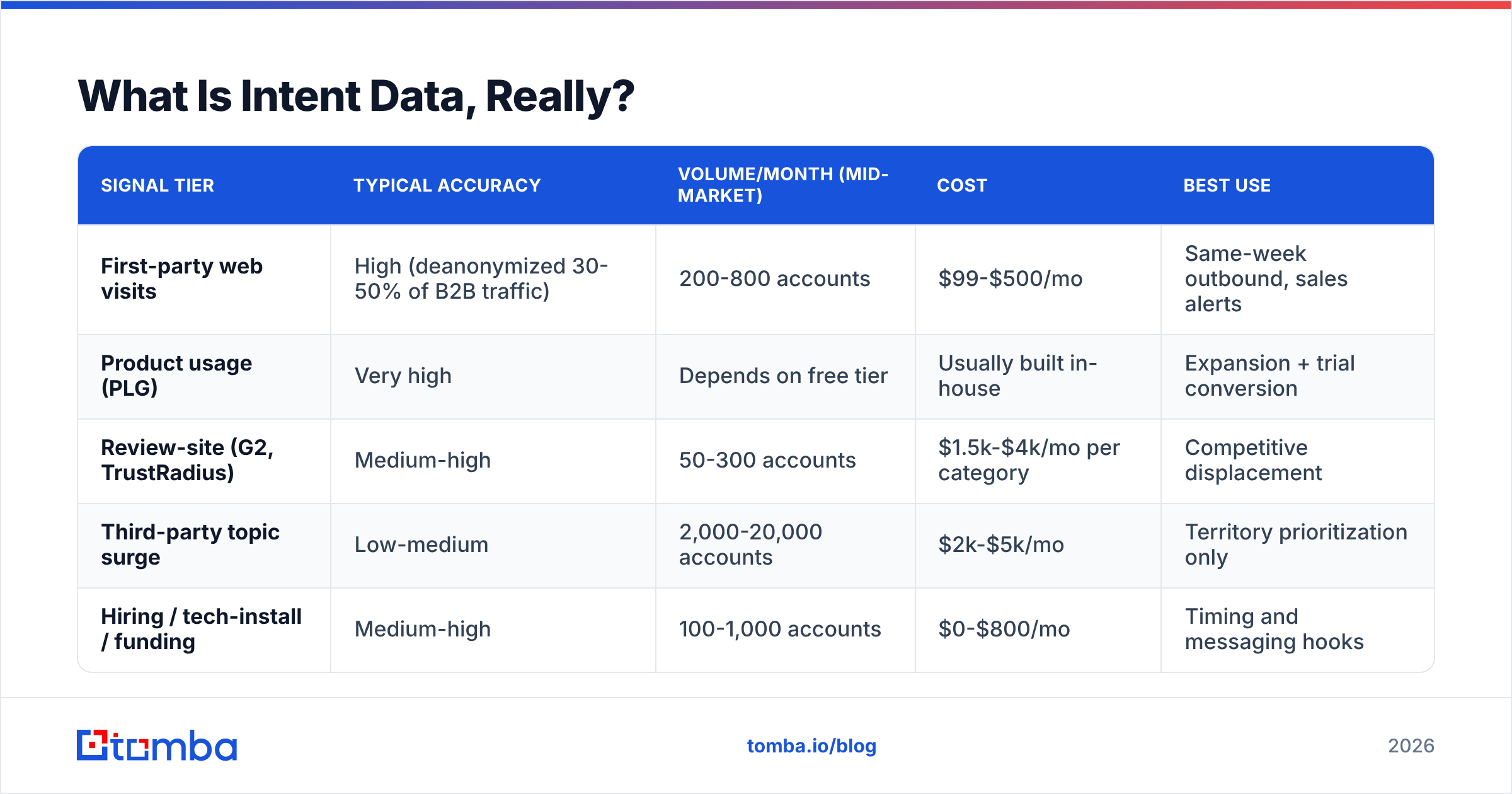
| Signal tier | Typical accuracy | Volume/month (mid-market) | Cost | Best use |
|---|---|---|---|---|
| First-party web visits | High (deanonymized 30-50% of B2B traffic) | 200-800 accounts | $99-$500/mo | Same-week outbound, sales alerts |
| Product usage (PLG) | Very high | Depends on free tier | Usually built in-house | Expansion + trial conversion |
| Review-site (G2, TrustRadius) | Medium-high | 50-300 accounts | $1.5k-$4k/mo per category | Competitive displacement |
| Third-party topic surge | Low-medium | 2,000-20,000 accounts | $2k-$5k/mo | Territory prioritization only |
| Hiring / tech-install / funding | Medium-high | 100-1,000 accounts | $0-$800/mo | Timing and messaging hooks |

Why Does Intent Data for Mid Market Companies Break Differently?#
Enterprise teams buy intent to point a large field org at the right accounts. They have 2,000 named accounts and 40 reps. Intent tells them where to aim. That is a routing problem.
Mid-market teams are different. Call it 50 to 500 employees, with four to fifteen people carrying quota. They do not have a routing problem. They have a coverage problem. Your TAM is ten times your capacity, your reps are generalists, and nobody has time to babysit a scoring model.
That gap changes three things:
- You cannot absorb false positives. A large BDR team can burn 200 bad "surging" accounts a month and never notice. A four-person team burns a week.
- You cannot wait for the model to learn. Most vendors need one or two quarters of closed-won data to calibrate. Your deal volume may never reach that bar inside the contract term.
- You cannot staff an intent analyst. Enterprise buyers hire someone to own the signal taxonomy. Here, the signal has to land in a rep's inbox already interpreted. Otherwise it goes unused.
So the practical rule is clear. Weight first-party and inferred signals far above what the pitch decks suggest. Treat third-party topic surges as a tiebreaker, not a trigger.
Which Signals Actually Predict a Reply?#
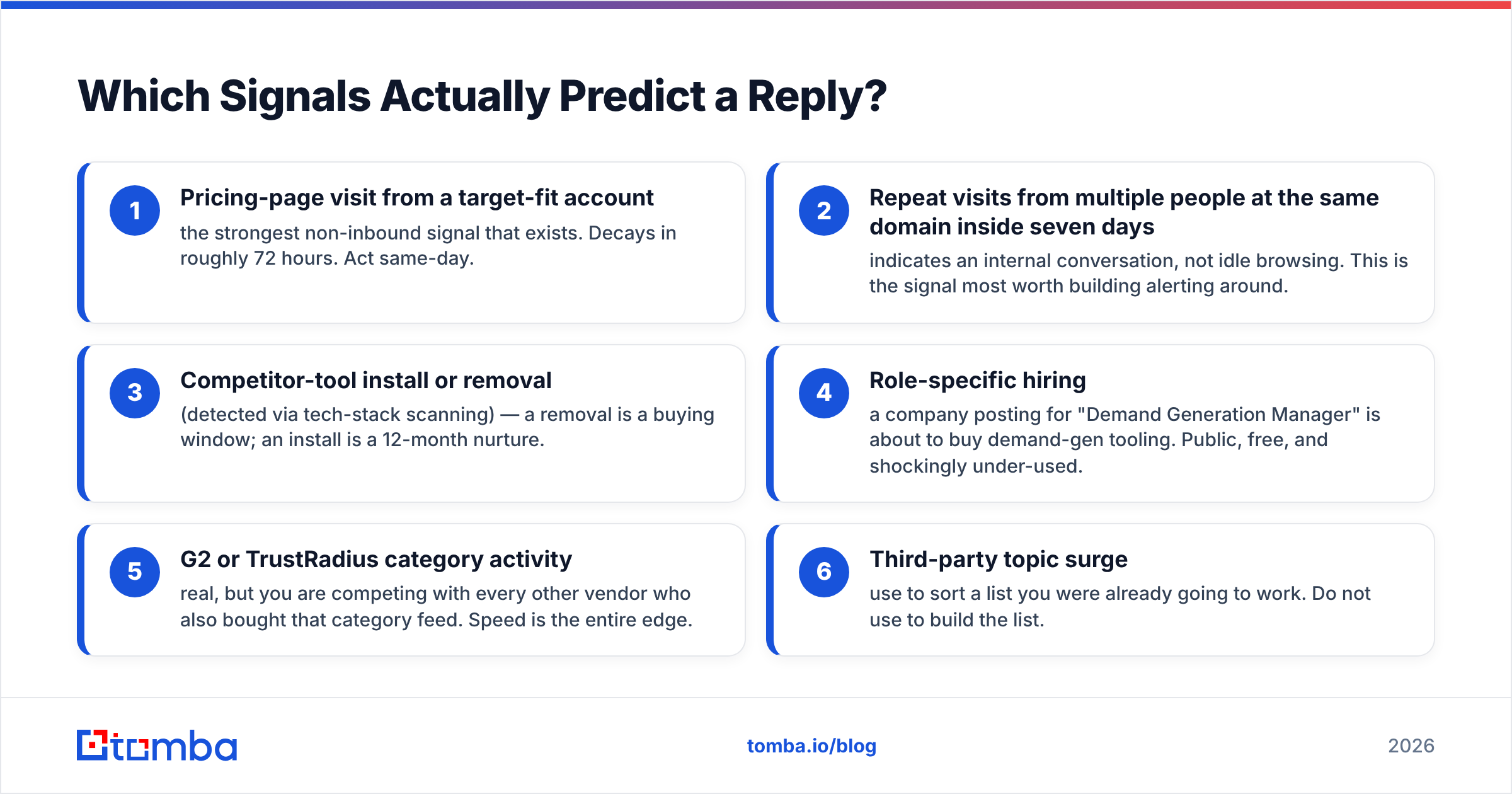
Here is the ranking most teams land on after a year of running signals. It is ordered by observed lift in reply rate, not by vendor marketing.
- Pricing-page visit from a target-fit account — the strongest non-inbound signal there is. It decays in about 72 hours. Act the same day.
- Repeat visits from several people at one domain inside seven days — that means an internal conversation, not idle browsing. Build your alerting around this one.
- Competitor-tool install or removal, caught by tech-stack scanning. A removal is a buying window. An install is a 12-month nurture.
- Role-specific hiring — a company posting for a "Demand Generation Manager" is about to buy demand-gen tooling. Public, free, and badly under-used.
- G2 or TrustRadius category activity — real, but every rival vendor bought the same feed. Speed is the entire edge.
- Third-party topic surge — use it to sort a list you were already going to work. Do not use it to build the list.
Notice that the top four are free or cheap. Three of the four need no five-figure contract at all. A website visitor reveal tool plus a hiring-page monitor covers more ground than a full platform does for most buyers of intent data for mid market companies.
How Much Should You Actually Pay?#
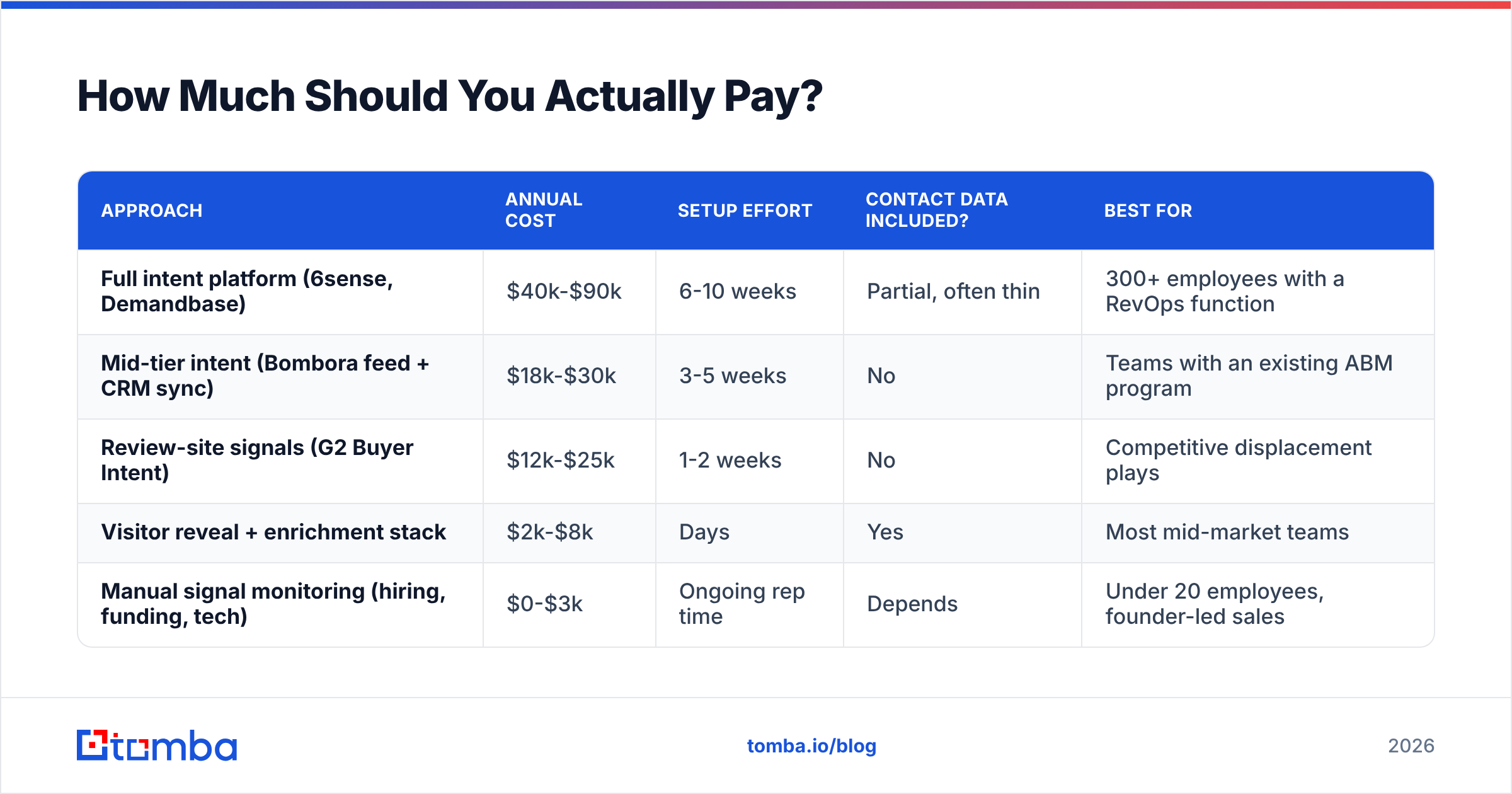
Pricing here is opaque by design. Most vendors will not publish a number, which tells you it is negotiable and anchored high. Below is the realistic landscape for a company doing $5M-$50M ARR.
| Approach | Annual cost | Setup effort | Contact data included? | Best for |
|---|---|---|---|---|
| Full intent platform (6sense, Demandbase) | $40k-$90k | 6-10 weeks | Partial, often thin | 300+ employees with a RevOps function |
| Mid-tier intent (Bombora feed + CRM sync) | $18k-$30k | 3-5 weeks | No | Teams with an existing ABM program |
| Review-site signals (G2 Buyer Intent) | $12k-$25k | 1-2 weeks | No | Competitive displacement plays |
| Visitor reveal + enrichment stack | $2k-$8k | Days | Yes | Most mid-market teams |
| Manual signal monitoring (hiring, funding, tech) | $0-$3k | Ongoing rep time | Depends | Under 20 employees, founder-led sales |
The fourth row surprises people. A visitor-identification tool, a B2B database for firmographics, and a reliable email verifier cost a fraction of a platform contract. Reps also trust those signals more, because they can see where each one came from. For most budgets, that stack is what intent data for mid market companies should look like in year one.
If you are weighing the big platforms, read the 6sense alternative and Demandbase alternative breakdowns before the demo. Knowing which pieces you can unbundle is the whole negotiation.
What Does a Working Mid-Market Intent Stack Look Like?#
Four layers. Each one has to hand a usable object to the next, or the chain breaks.
- Layer 1 — Capture. Deanonymize web traffic, watch hiring boards, track tech-stack changes, pull review-site activity if you pay for it. Output: a domain plus a reason.
- Layer 2 — Qualify. Filter against ICP firmographics. Employee count, industry, geography, funding stage, current stack. Kill 60-80% of the raw signal here. Output: a domain worth a rep's time.
- Layer 3 — Resolve. Turn the domain into named humans with verified contact details. Most stacks fail here, and a signal you cannot act on is pure overhead. Output: 2-5 verified contacts per account.
- Layer 4 — Act. Route to the right rep with the signal attached, inside a window short enough that it still means something. Output: a sent, relevant message.
Layer 3 deserves a second look. Intent platforms are built by people who think the hard part is knowing which account. In intent data for mid market companies, the hard part is knowing who to email and whether the address will bounce. Run a domain search against a surging account. Push the results through verification before they hit a sequence. That step is the gap between a 9% reply rate and a blocked sending domain.
One more warning about layer 3: catch-all domains. Many companies run catch-all mail servers that accept every address. Naive verification then returns "valid" for mailboxes that do not exist. If a lot of your surging accounts are catch-alls, add a catch-all verifier to the pipeline. Skip it and your bounce rate climbs until your email deliverability craters.
How Do You Test Intent Data Without Wasting a Year?#
Run a holdout. Not a vibes check. An actual holdout. It is the only honest way to price intent data for mid market companies.
The 90-day protocol:
- Weeks 1-2 — Baseline. Record your current reply rate, meeting rate, and pipeline per rep. Without this number the test proves nothing.
- Weeks 3-4 — Split. Take 400 ICP-matched accounts. Work 200 with intent prioritization and 200 in your normal order. Same reps, same messaging, same cadence. Only the order changes.
- Weeks 5-10 — Run. Do not change messaging mid-test. The urge to "personalize on the signal" is strong. Change two variables and you learn nothing.
- Weeks 11-12 — Read. Compare reply rate and meetings booked across the two arms. A real lift shows up as 1.4x to 2.5x more meetings per 100 contacts. Under 1.2x, the signal is not paying for itself.
- Decide. Renew, renegotiate, or rebuild the capture layer yourself.
Most teams skip step 1, then argue about attribution for two quarters. G2's buyer behavior research and HubSpot's sales statistics help you sanity-check baselines against category norms. Still, your own pre-test numbers are the only benchmark that counts at renewal.
What Are the Honest Limitations?#
Four things vendors will not lead with.
Account-level, not person-level. Third-party intent rarely tells you who researched. You get "someone at Acme, probably in the Chicago office." You still have to guess the persona. Privacy law has pushed the whole category toward coarser resolution, not finer.
Bidstream data is getting thinner. Cookie deprecation and privacy-safe ad tech have degraded the raw material behind many co-op feeds. Ask each vendor what share of their signal comes from bidstream versus first-party publisher deals. Ask how that mix has moved since 2023. The answer tells you a lot.
Surge thresholds are tunable marketing. A "surge" means topic consumption beat a baseline by some multiple. Vendors set both the baseline and the multiple. A looser threshold yields more surging accounts. That looks like value on a QBR slide. It is not.
Signal without speed is worthless. If a Monday pricing-page visit reaches a rep on Thursday, you bought a history book. Latency is a fair evaluation criterion, and almost nobody asks about it in the demo.
None of this makes the category useless. It makes intent data for mid market companies a prioritization tool rather than a discovery tool. That is exactly how the teams getting real lift describe it in private.
Is Intent Data for Mid Market Companies Worth It?#
Use these thresholds:
| Your situation | Recommendation |
|---|---|
| Under 20 employees, founder-led sales | Skip platforms. Monitor hiring pages and web visitors manually. |
| 20-100 employees, 2-5 reps, outbound working | Visitor reveal + enrichment + verification. Budget under $10k/yr. |
| 100-300 employees, defined ICP, ABM starting | Add review-site intent for your top 2 categories. Test with a holdout. |
| 300-500 employees, RevOps function exists | A full platform can pencil out — negotiate hard, demand latency SLAs. |
| Any size, no repeatable message | Fix messaging first. Intent amplifies whatever you already do. |
The last row matters most. Intent multiplies your existing conversion rate. Multiply a bad rate by a bigger number and you get a bigger bad number.
Where Do You Go From Here?#
Start at layer 3, not layer 1. Before you buy a feed, prove you can reach the humans at accounts you already know are a fit. Pull ten target domains. Find the four buying-committee members at each. Verify the addresses and send. If that motion books meetings, adding intent prioritization will book more. If it does not, no signal will fix it.
The Tomba Email Finder is built for that layer. It turns a surging domain into named, verified contacts with role and seniority attached, in bulk or by API, before the signal decays. The free tier gives you 25 searches a month. Paid plans start at $49/mo on Tomba pricing, with bulk processing and verification included. Find the people first. Then decide what a signal is worth to you.
Related guides#
// get started
Find, verify and enrich your first contacts today
Start on the free plan with 25 searches a month, then scale when your team is ready.
Free plan · No credit card required · GDPR & CCPA
// about the author