Intent Data for SDRs: How to Turn Signals Into Meetings
Intent data promises to tell you who is in-market. Most SDR teams still miss the meeting. Here is which signals actually convert, what vendors cost, and the 24-hour workflow that turns a surge score into a reply.
TL;DR
- Intent data tells you which accounts are researching your category. It almost never tells you who to email, which is why most SDR teams see no lift from it.
- Third-party topic surges are the weakest signal and the most expensive. First-party signals (pricing page, docs, demo abandon) convert 5-10x better and cost nothing.
- Budget realistically: a serious third-party intent subscription runs $25,000-$120,000+ per year. A contact-data layer to make it actionable runs $49-$249 per month.
- The whole value sits in speed. A signal worked inside 24 hours behaves like a warm inbound; the same signal worked on day nine behaves like cold outbound.
- If you have fewer than five SDRs, start with first-party signals plus a reliable email finder. Buy third-party intent when you have a team big enough to work the alerts.
What is intent data for SDRs, actually?#
Intent data is behavioral evidence that an account is researching a problem you solve, collected before that account ever raises a hand with you.
Think of it like a bookstore owner watching which aisles people linger in. You cannot hear their conversations, and you do not know their names. You just know that four people from the same company spent twenty minutes in the "warehouse automation" section this week. That is useful. It is also nowhere near a sale.
The distinction that matters for an SDR is account-level versus person-level. Almost all third-party intent data is account-level: it resolves a cluster of anonymous IP traffic to a company domain and reports a topic spike. It does not hand you a name, a title, or an inbox. That gap — between "Acme is researching this" and "email Sarah Chen, VP Ops at Acme" — is where intent programs die.
Gartner has been flagging this for years in its buying-group research: the average B2B purchase now involves six to ten stakeholders, and a surge signal gives you zero visibility into which of them triggered it. You still have to build the contact set yourself.
What are the three types of intent signals?#
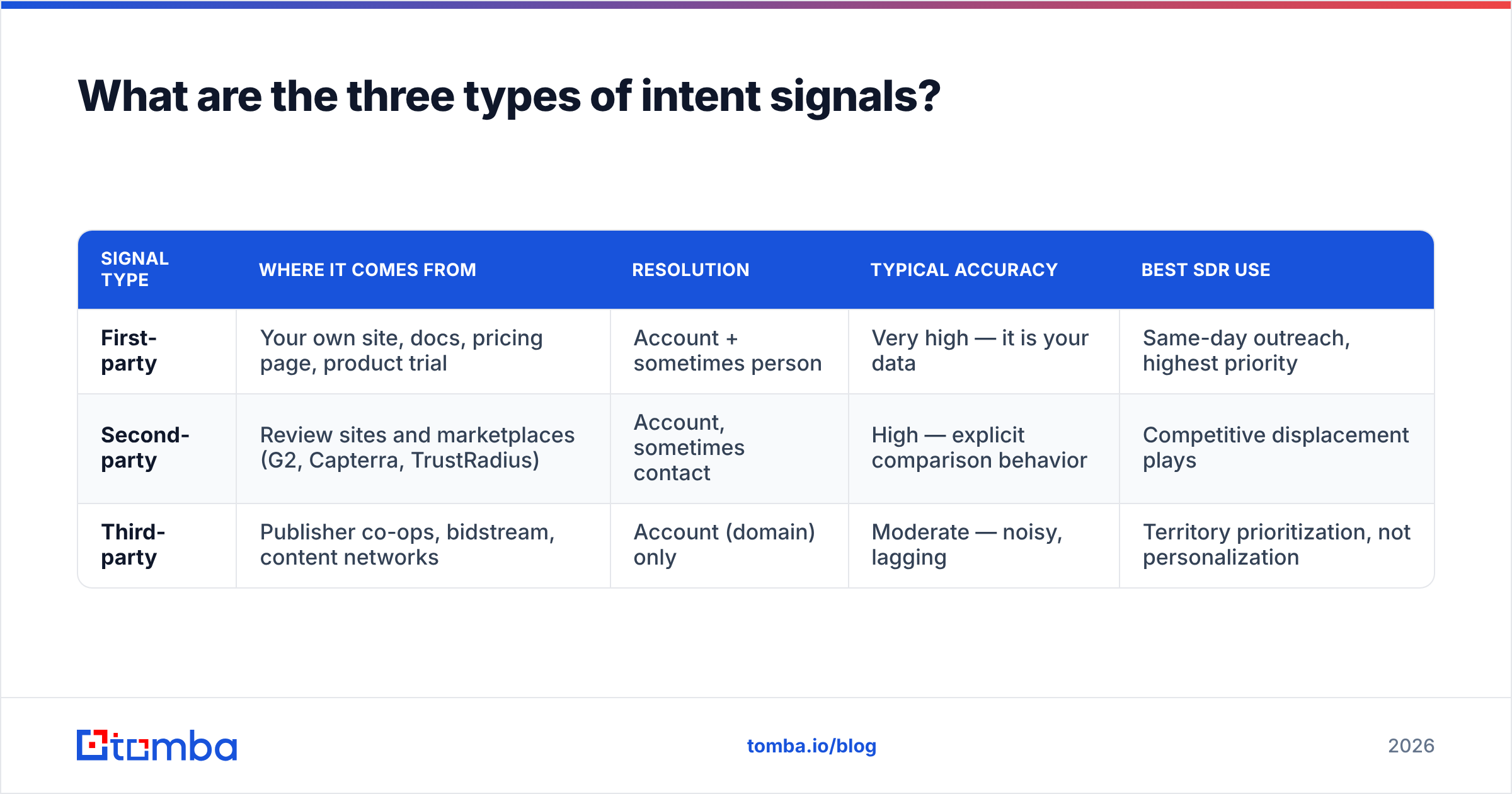
Not all intent is the same quality, and treating it that way is the most common mistake in SDR workflows. Here is how the three tiers compare.
| Signal type | Where it comes from | Resolution | Typical accuracy | Best SDR use |
|---|---|---|---|---|
| First-party | Your own site, docs, pricing page, product trial | Account + sometimes person | Very high — it is your data | Same-day outreach, highest priority |
| Second-party | Review sites and marketplaces (G2, Capterra, TrustRadius) | Account, sometimes contact | High — explicit comparison behavior | Competitive displacement plays |
| Third-party | Publisher co-ops, bidstream, content networks | Account (domain) only | Moderate — noisy, lagging | Territory prioritization, not personalization |
Third-party data gets the marketing budget because it promises scale. It is also the tier where a "surge" can mean one intern reading a blog post, or a bot. Treat it as a tiebreaker between two accounts you were already going to call, not as a reason to call an account you otherwise would not.
Second-party data from G2 Buyer Intent is the underrated middle ground. Somebody actively comparing you against a named competitor is a materially different prospect from somebody who skimmed a category explainer.
Which intent signals actually predict a booked meeting?#
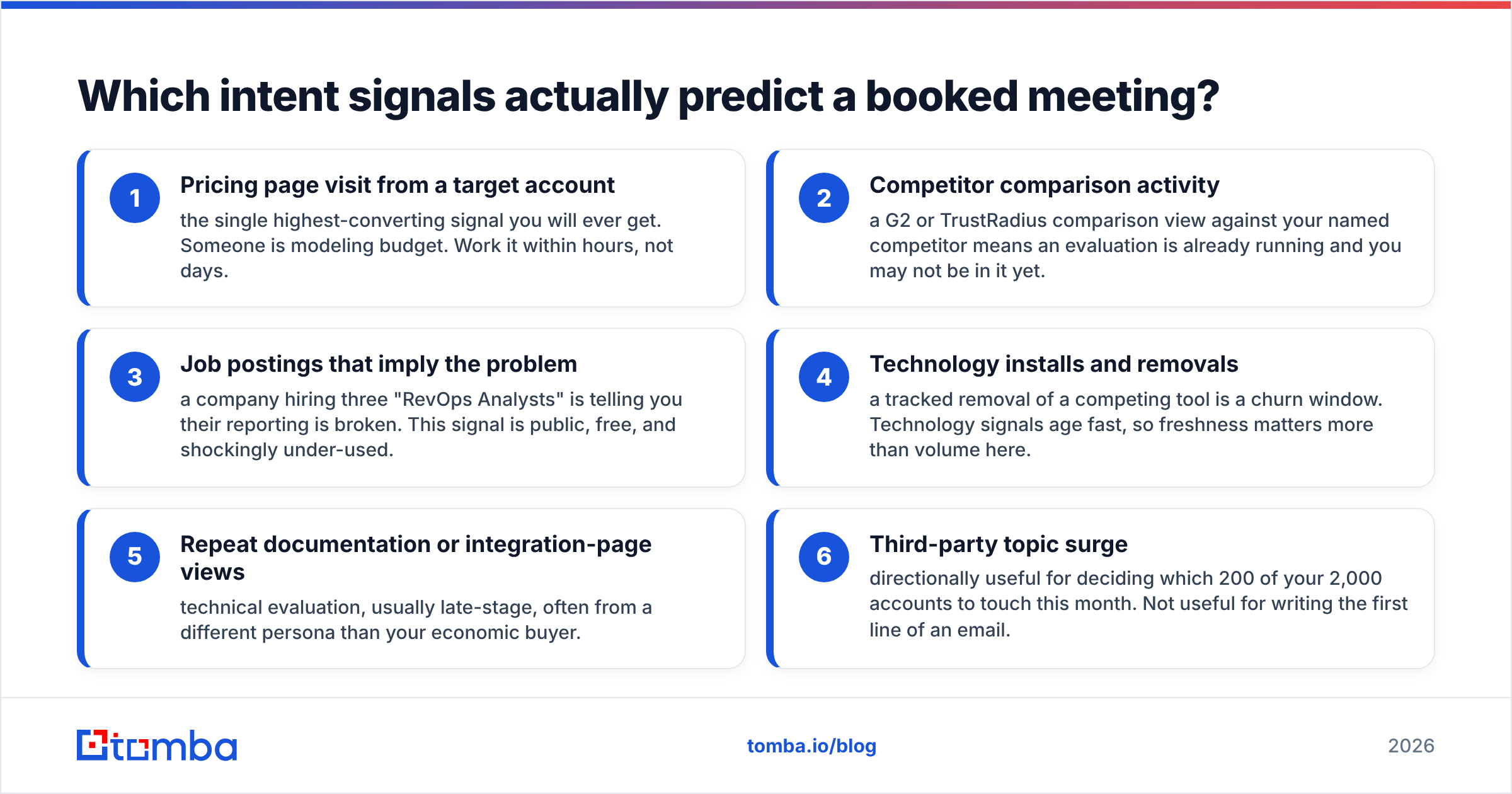
Rank your signals by how close the behavior sits to a purchase decision. In practice, this ordering holds across most B2B motions:
- Pricing page visit from a target account — the single highest-converting signal you will ever get. Someone is modeling budget. Work it within hours, not days.
- Competitor comparison activity — a G2 or TrustRadius comparison view against your named competitor means an evaluation is already running and you may not be in it yet.
- Job postings that imply the problem — a company hiring three "RevOps Analysts" is telling you their reporting is broken. This signal is public, free, and shockingly under-used.
- Technology installs and removals — a tracked removal of a competing tool is a churn window. Technology signals age fast, so freshness matters more than volume here.
- Repeat documentation or integration-page views — technical evaluation, usually late-stage, often from a different persona than your economic buyer.
- Third-party topic surge — directionally useful for deciding which 200 of your 2,000 accounts to touch this month. Not useful for writing the first line of an email.
Notice that four of the six cost you nothing beyond the effort to instrument them. Before you sign a five-figure intent contract, confirm you are actually working the free signals. Most teams are not.
What do intent data vendors cost in 2026?#
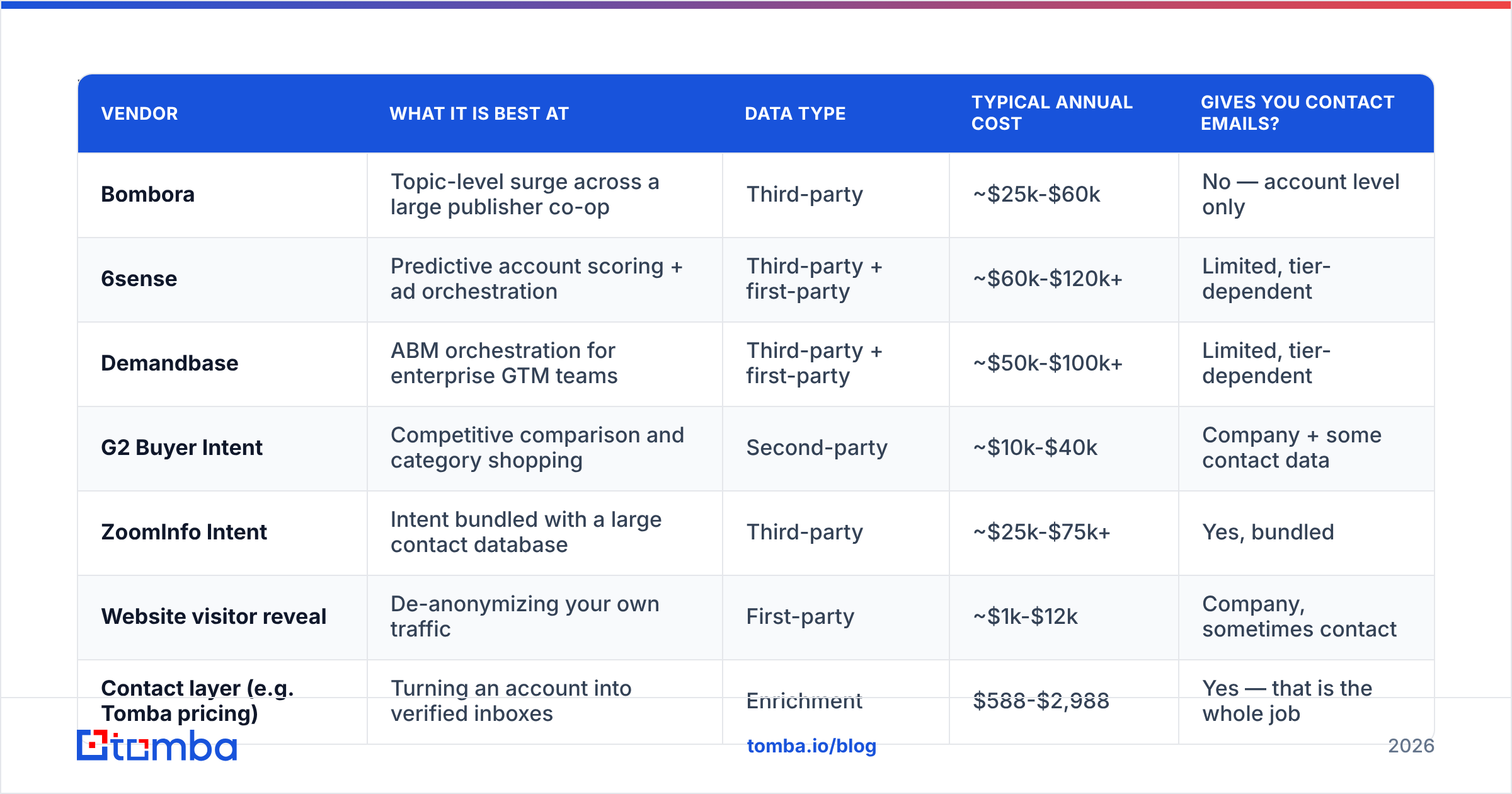
Intent pricing is opaque by design — nearly every vendor quotes custom annual contracts based on your account universe, topic count, and seat count. The ranges below reflect what buyers commonly report on review sites and procurement marketplaces, not published rate cards. Get your own quote.
| Vendor | What it is best at | Data type | Typical annual cost | Gives you contact emails? |
|---|---|---|---|---|
| Bombora | Topic-level surge across a large publisher co-op | Third-party | ~$25k-$60k | No — account level only |
| 6sense | Predictive account scoring + ad orchestration | Third-party + first-party | ~$60k-$120k+ | Limited, tier-dependent |
| Demandbase | ABM orchestration for enterprise GTM teams | Third-party + first-party | ~$50k-$100k+ | Limited, tier-dependent |
| G2 Buyer Intent | Competitive comparison and category shopping | Second-party | ~$10k-$40k | Company + some contact data |
| ZoomInfo Intent | Intent bundled with a large contact database | Third-party | ~$25k-$75k+ | Yes, bundled |
| Website visitor reveal | De-anonymizing your own traffic | First-party | ~$1k-$12k | Company, sometimes contact |
| Contact layer (e.g. Tomba pricing) | Turning an account into verified inboxes | Enrichment | $588-$2,988 | Yes — that is the whole job |
Two things jump out. First, the price gap between the signal and the contact layer is roughly an order of magnitude. Second, most of the expensive tools in that table return a domain, not a person. If you buy intent without budgeting for contact discovery, you have bought a list of doors with no keys.
A practical sequencing rule: solve contact coverage first. A domain search that reliably returns the right five people at an account makes every signal source more valuable, including the free ones. Buying surge data before you can act on it just adds a dashboard nobody opens.
Why does intent data fail for most SDR teams?#
Four failure modes account for nearly all of it.
Nobody owns the alert. Intent lands in a marketing dashboard, gets reviewed in a Monday meeting, and reaches an SDR on Wednesday. By then the buyer has booked two demos with competitors. If a signal does not route to a named human with an SLA, it is decoration.
The signal gets quoted back to the prospect. "I noticed your team was researching workflow automation" is the intent-data equivalent of admitting you read their diary. It is creepy, it is often wrong, and it invites a "we weren't" reply. Use the signal to decide who and when. Use normal research to decide what to say.
Contact data is stale or missing. You get a surge on a 400-person company and your CRM has one contact from 2023 who left. Without fresh enrichment, the alert converts to nothing. This is the most fixable failure and the most common one.
Volume replaces judgment. Once you have surge scores on 2,000 accounts, the temptation is to blast all 2,000. Deliverability collapses, reply rates fall, and the post-mortem blames the intent vendor rather than the sending behavior. Keep list hygiene tight — run new contacts through an email verifier before they touch a sequence, and watch your sender reputation the same way you would on any cold campaign.

How do you turn an intent signal into a booked meeting?#
Speed and contact depth do the work. Here is a workflow that holds up in practice, with the timings that matter.
Hour 0 — Signal fires. The alert routes automatically to the account owner in Slack or your CRM, not to a shared inbox. Include the account, the topic, the score, and the change versus baseline. A score of 78 means nothing without knowing it was 12 last week.
Hour 0-2 — Qualify the account, not the signal. Does this company fit ICP on size, geography, and tech stack? Roughly a third of surges come from accounts you should never work. Killing those fast is what keeps the program credible.
Hour 2-4 — Build the buying group. Do not settle for one contact. Identify three to five people: the likely economic buyer, the functional owner, and one technical evaluator. Run the domain, pull verified addresses, and enrich titles. Tools that combine finding and verification in one pass — contact enrichment plus verification — save you the bounce cycle entirely.
Hour 4-24 — First touch, multi-threaded. Send to two or three contacts with differentiated angles rather than the same template three times. Reference a public, verifiable trigger: a job posting, a funding round, a product launch. Never reference the intent score.
Day 2-5 — Layer channels. Add a call and a LinkedIn touch. Intent accounts pick up the phone at meaningfully higher rates than cold ones, which is the clearest ROI most teams can actually measure. Pull direct dials with a phone finder so the call attempt is not a switchboard lottery.
Day 7 — Decay the signal. Third-party intent has a short half-life. If the account has not engaged in a week, drop it back to your normal nurture cadence instead of burning ten more touches on a stale spike.
The single biggest lever in that whole sequence is hour 2-4. Teams that can reliably produce five verified inboxes per surging account convert intent programs. Teams that cannot, do not — regardless of which vendor they bought.
What should an intent-triggered email actually say?#
Short, specific, and silent about the signal. Something like:
Subject: warehouse headcount
Hi Sarah — saw you're hiring two more ops analysts in Rotterdam. Usually that means the reporting layer is doing work a system should be doing.
We cut manual reconciliation time at [similar company] by about 60%. Worth 15 minutes to see if the same pattern applies?
That email is triggered by intent but justified by a public fact. The prospect never has to wonder how you know what you know. If you need a starting point, the cold email templates library is a faster path than writing from scratch, but rewrite the first line every time — that is the line that decides whether the rest gets read.
How do you measure whether intent data is working?#
Run it as a holdout test, not a vibe. Split your target accounts: half worked with intent prioritization, half worked with your normal territory logic. Compare over one full sales cycle.
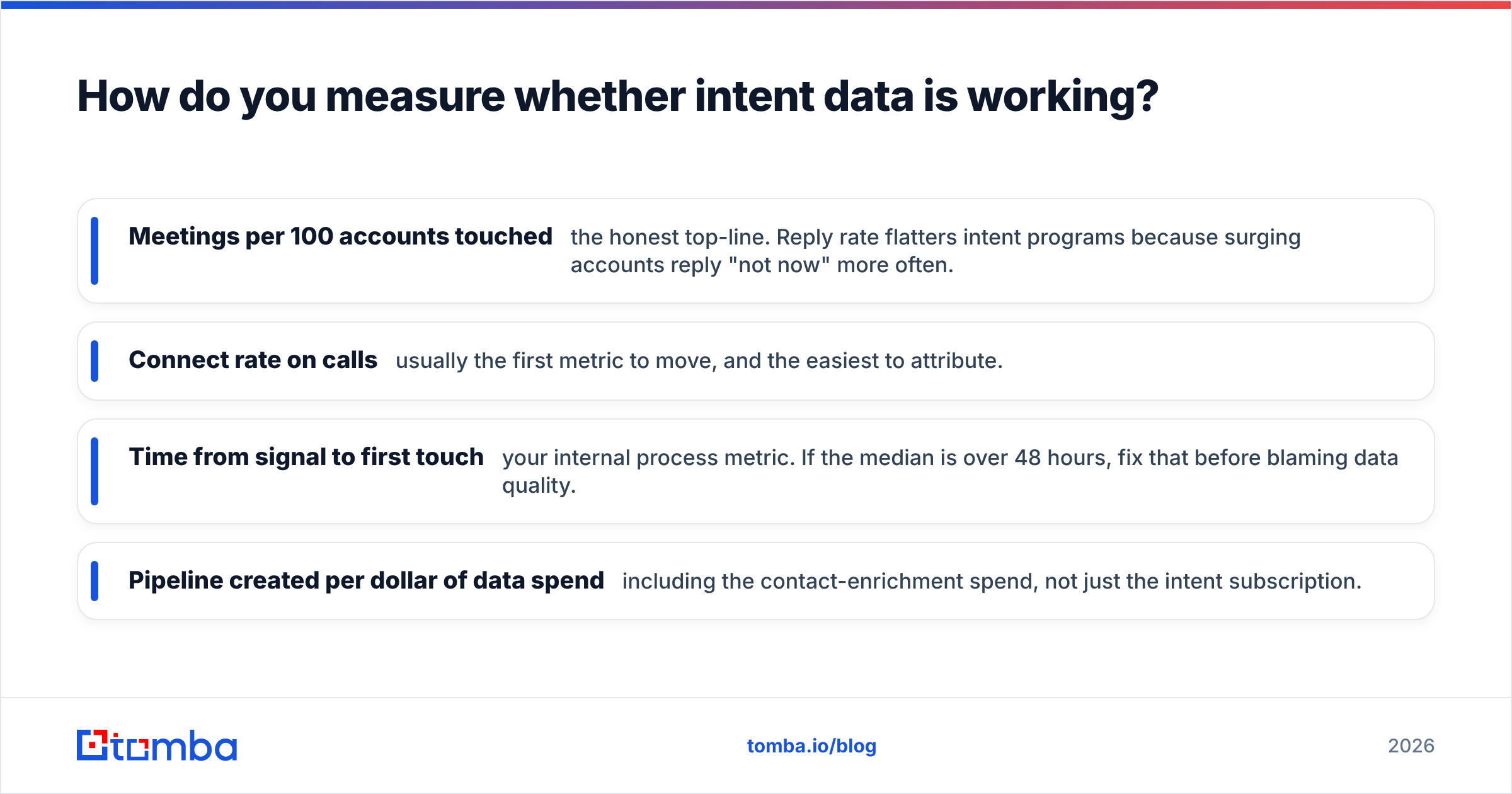
The metrics that matter, in order:
- Meetings per 100 accounts touched — the honest top-line. Reply rate flatters intent programs because surging accounts reply "not now" more often.
- Connect rate on calls — usually the first metric to move, and the easiest to attribute.
- Time from signal to first touch — your internal process metric. If the median is over 48 hours, fix that before blaming data quality.
- Pipeline created per dollar of data spend — including the contact-enrichment spend, not just the intent subscription.
If the intent cohort is not producing at least 1.5x the meetings of the control cohort by the end of one cycle, the problem is almost always workflow, not the vendor. Check your response rate by segment before you renew anything.
Is intent data worth it for a small SDR team?#
Not yet, in most cases. Below roughly five SDRs you do not have the capacity to work alerts inside 24 hours, and an intent program you work slowly is worse than no intent program because it consumes budget that should have gone to headcount or contact coverage.
What a small team should do instead: instrument first-party signals (pricing page, docs, demo abandon), watch job boards in your ICP, track competitor tool removals, and invest the saved budget in making every one of those signals immediately actionable with accurate contact data. That stack costs a few hundred dollars a month and outperforms a $50,000 surge subscription that nobody has time to open.
Scale into third-party intent when two things are true: your SDRs are consistently at capacity on inbound plus first-party signals, and your account universe is large enough that prioritization is a real problem. Until then, the constraint is not knowing which accounts are in-market — it is reaching the right person at the accounts you already know about.
Where should you start?#
Start with the layer that makes every other signal usable. Whatever intent source you eventually buy, it will hand you a domain and leave you to find the humans behind it.
The Tomba Email Finder turns a surging domain into verified, deliverable inboxes for the full buying group — name plus company in, confidence-scored address out, with verification built in so your bounce rate does not tank a sequence you just paid five figures to trigger. The free tier gives you 25 searches a month to test it against your own account list; Starter is $49/month and Growth is $99/month when you are ready to run it at volume across a territory. Point it at the last ten accounts that surged and see how many complete buying groups you can build in an hour.
Related guides#
// get started
Find, verify and enrich your first contacts today
Start on the free plan with 25 searches a month, then scale when your team is ready.
Free plan · No credit card required · GDPR & CCPA
// about the author