Intent Data Platforms in 2026: A Complete Buyer's Guide
Intent data platforms promise pipeline you can see forming before a form fill. Most teams buy the signal and skip the plumbing. Here is what the categories actually do, what they cost, and when a cheaper stack beats a six-figure contract.
TL;DR
- Intent data platforms sell you probability, not people. They tell you an account is researching a topic; they rarely tell you who to email, and almost never give you a verified address.
- There are three distinct signal types — first-party (your site), second-party (review sites, publisher networks), and third-party co-op/bidstream. They have wildly different accuracy and price, and vendors blur the lines on purpose.
- Enterprise platforms like 6sense and Demandbase start in the mid five figures annually. Bombora topic feeds and G2 Buyer Intent sit lower. A first-party visitor reveal plus enrichment stack costs a fraction of either.
- The failure mode is never "we didn't have signals." It's that nobody built the contact layer, the routing rules, or the message that references the signal without being creepy.
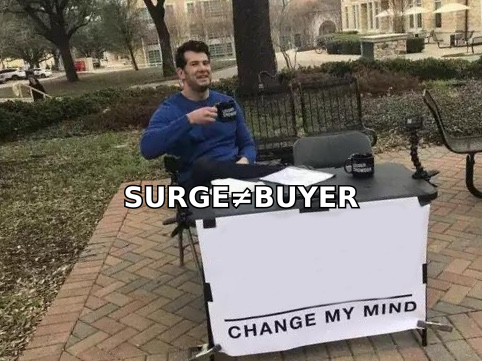
- Buy intent last. Buy contact accuracy first. A surging account you can't reach is a dashboard, not pipeline.
What is intent data, exactly?#
Intent data is behavioral evidence that a company is actively researching a problem you solve — before they fill out a form, request a demo, or answer a cold call.
Think of it like a bookstore owner watching which aisles get traffic. She can't read minds, but if six people from the same office keep circling the tax-software shelf in March, she can make a good guess. Intent data platforms are that observation layer, industrialized: they watch content consumption across millions of B2B sessions, resolve those sessions to companies, and flag when consumption spikes above an account's own baseline.
That last part matters more than most buyers realize. "Surge" is not raw volume — it's deviation from a rolling baseline for that specific account. A 500-person company reading two articles about data warehouses is noise. A 40-person company reading eleven in a week is a signal.
Here's what a platform is actually assembling under the hood:
- Content taxonomy — a list of thousands of topics ("customer data platform", "SOC 2 compliance") that consumed content gets classified against. The taxonomy's granularity determines whether you get useful targeting or a bucket labeled "software."
- Identity resolution — mapping an IP address, cookie, or hashed email to a company record. This is the weakest link in the chain and the one vendors demo least.
- Baselining and surge scoring — comparing this week's consumption against the account's normal, then scoring the deviation.
- Account matching — reconciling the flagged company against your CRM so it lands as an existing account, an open opportunity, or net-new.
- Activation — pushing the scored account into an ad audience, a Slack alert, a sequence, or a CRM field where someone will actually see it.
Steps 1 through 3 are what you're paying for. Steps 4 and 5 are where deals are won or lost, and they're almost always your responsibility.
Where does intent data actually come from?#
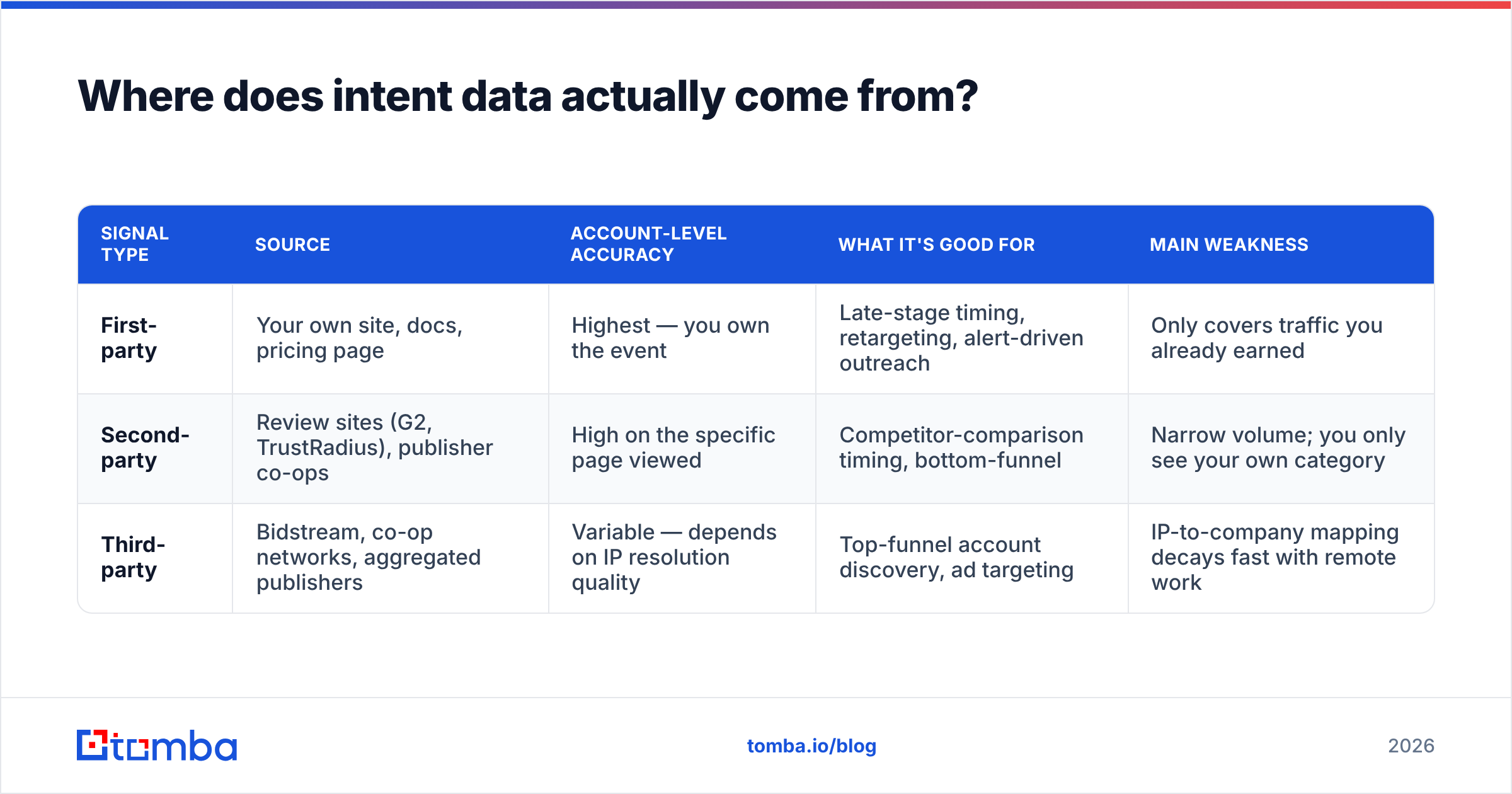
Three sources, three very different reliability profiles. Vendors rarely label which one they're selling you.
| Signal type | Source | Account-level accuracy | What it's good for | Main weakness |
|---|---|---|---|---|
| First-party | Your own site, docs, pricing page | Highest — you own the event | Late-stage timing, retargeting, alert-driven outreach | Only covers traffic you already earned |
| Second-party | Review sites (G2, TrustRadius), publisher co-ops | High on the specific page viewed | Competitor-comparison timing, bottom-funnel | Narrow volume; you only see your own category |
| Third-party | Bidstream, co-op networks, aggregated publishers | Variable — depends on IP resolution quality | Top-funnel account discovery, ad targeting | IP-to-company mapping decays fast with remote work |
Third-party intent has the worst reputation and the biggest market. The reason is structural: resolving a residential IP to an employer was already imperfect in 2019, and distributed work made it worse. Vendors have compensated with cookie and hashed-email matching, which helps, but a "surging" account in a third-party feed is a probabilistic claim, not an observation.
That doesn't make it useless. It makes it a prioritization input, not a trigger. Use it to decide which 200 accounts of your 2,000-account TAM get worked this quarter. Do not use it to decide who gets an email that says "I saw you were researching data pipelines."
Which intent data platforms matter in 2026?#
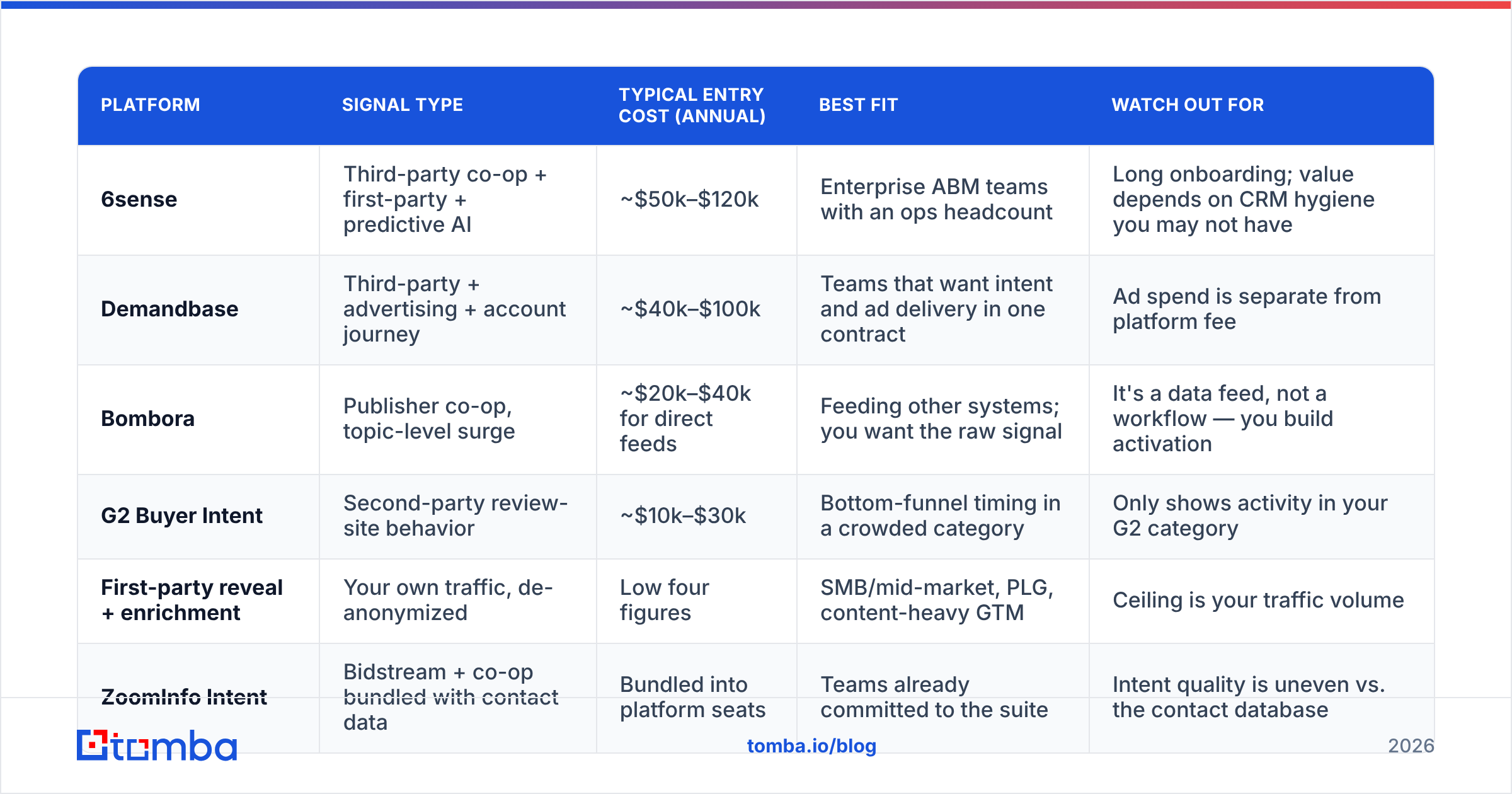
The category has consolidated hard. Point solutions got absorbed into ABM suites, and the ABM suites got absorbed into revenue platforms. What's left splits into four tiers.
| Platform | Signal type | Typical entry cost (annual) | Best fit | Watch out for |
|---|---|---|---|---|
| 6sense | Third-party co-op + first-party + predictive AI | ~$50k–$120k | Enterprise ABM teams with an ops headcount | Long onboarding; value depends on CRM hygiene you may not have |
| Demandbase | Third-party + advertising + account journey | ~$40k–$100k | Teams that want intent and ad delivery in one contract | Ad spend is separate from platform fee |
| Bombora | Publisher co-op, topic-level surge | ~$20k–$40k for direct feeds | Feeding other systems; you want the raw signal | It's a data feed, not a workflow — you build activation |
| G2 Buyer Intent | Second-party review-site behavior | ~$10k–$30k | Bottom-funnel timing in a crowded category | Only shows activity in your G2 category |
| First-party reveal + enrichment | Your own traffic, de-anonymized | Low four figures | SMB/mid-market, PLG, content-heavy GTM | Ceiling is your traffic volume |
| ZoomInfo Intent | Bidstream + co-op bundled with contact data | Bundled into platform seats | Teams already committed to the suite | Intent quality is uneven vs. the contact database |
Cost figures are directional ranges drawn from public procurement marketplaces and buyer reports — every deal is negotiated, and seat count, TAM size, and topic count all move the number. Treat them as a starting bracket, not a quote.
A note on the tier most people skip: first-party. If you publish content and rank for anything, you already generate the highest-quality intent signal that exists, and you're throwing away roughly 97% of it because visitors don't convert. Website visitor reveal turns that anonymous traffic into named accounts without a co-op contract. It doesn't scale past your traffic, which is exactly why it's a complement to — not a replacement for — a third-party feed if you're genuinely enterprise. For everyone else, it's the cheapest real intent you will ever buy.
Is intent data accurate enough to act on?#
Depends entirely on what "act" means.
Independent analysis from Gartner and practitioner surveys have consistently landed on the same uncomfortable finding: intent platforms are directionally useful and individually unreliable. Account-level match rates in third-party feeds commonly land in the 50–70% band, meaning a meaningful slice of your "surging accounts" list is either the wrong company or a company whose surge came from an intern writing a term paper.
Three accuracy traps worth naming:
- The ISP problem. A large share of bidstream traffic resolves to consumer ISPs. Vendors either drop it (losing volume) or model it (introducing error). Ask which one they do.
- Topic bleed. Broad taxonomies fire on adjacent topics. If you sell payroll software, you will get surge alerts from companies researching HR generally, and half of them are hiring, not buying.
- The competitor's team. Your competitor's SDRs, analysts, and job applicants research your category constantly. Good platforms suppress known competitor domains. Many don't by default.
The practical test before signing: ask the vendor to run your last two quarters of closed-won accounts through their historical feed. Did those accounts show surge in the 60–90 days before the opportunity opened? If the lift over random is under 2x, you're buying a dashboard.
Do intent data platforms give you contacts?#
Mostly no, and this is the gap that kills intent programs.
An intent platform tells you Acme Corp is researching "vendor risk management." It does not tell you that the person who cares is the Director of Third-Party Risk, that her name is on a compliance blog post from last year, or what her work email is. Suites like 6sense and ZoomInfo bundle a contact database, but bundled contact data is usually the weaker half of the product — priced as an add-on, refreshed less often, and thin outside North America.
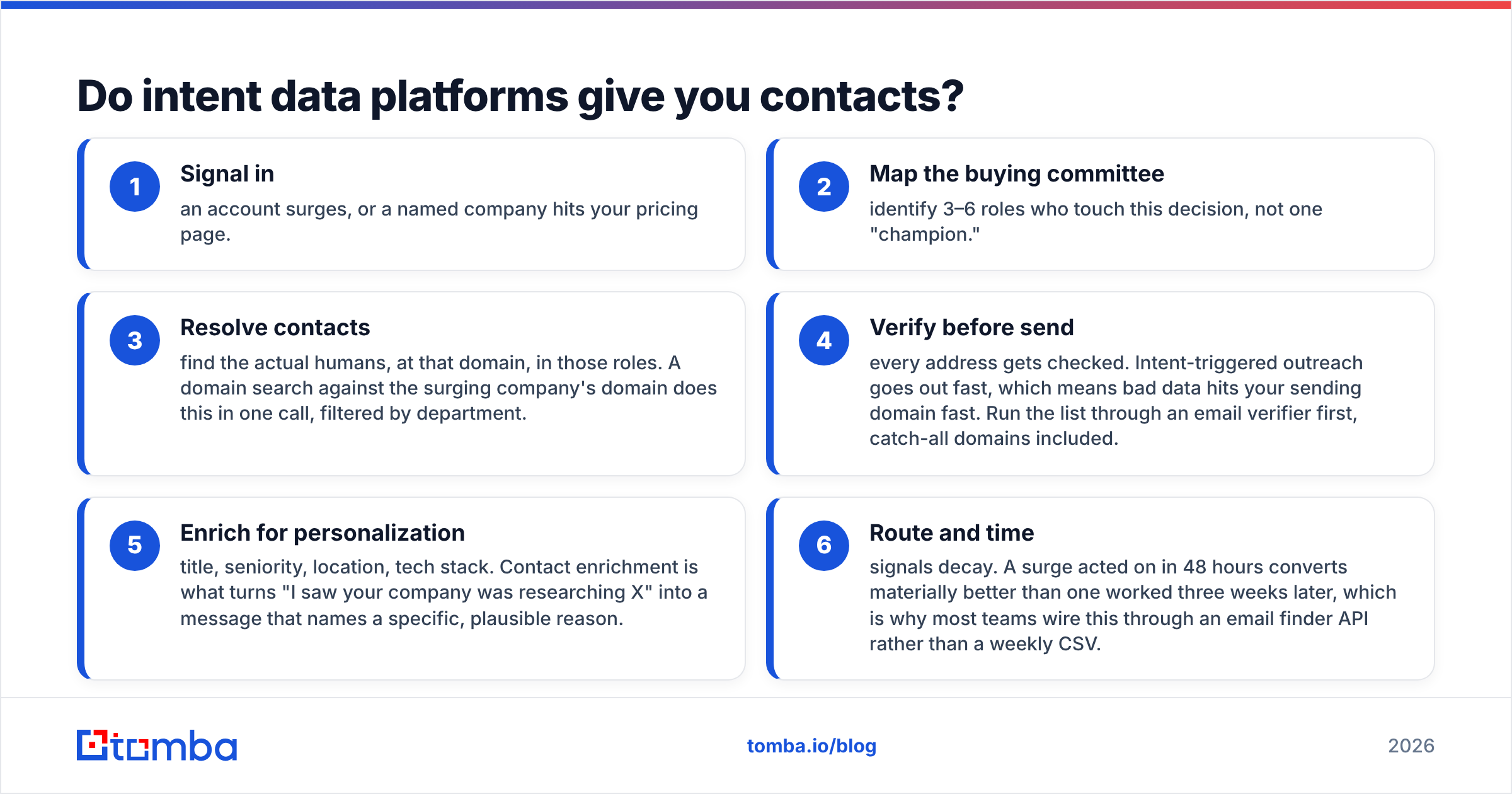
The sequence that actually works:
- Signal in — an account surges, or a named company hits your pricing page.
- Map the buying committee — identify 3–6 roles who touch this decision, not one "champion."
- Resolve contacts — find the actual humans, at that domain, in those roles. A domain search against the surging company's domain does this in one call, filtered by department.
- Verify before send — every address gets checked. Intent-triggered outreach goes out fast, which means bad data hits your sending domain fast. Run the list through an email verifier first, catch-all domains included.
- Enrich for personalization — title, seniority, location, tech stack. Contact enrichment is what turns "I saw your company was researching X" into a message that names a specific, plausible reason.
- Route and time — signals decay. A surge acted on in 48 hours converts materially better than one worked three weeks later, which is why most teams wire this through an email finder API rather than a weekly CSV.
Miss step 4 and the whole program degrades. Intent-triggered campaigns are high-volume and bursty by nature — exactly the pattern that trips spam filters when bounce rates climb. A 4% bounce rate on a 2,000-address intent campaign will do more damage to your sending reputation than the campaign returns in meetings.

How should you act on an intent signal without being creepy?#
Never reference the signal directly. "I noticed you were researching CDPs" is the fastest way to sound like surveillance, and it's also frequently wrong, which compounds the damage.
Use the signal to change timing and topic, not to change the opening line.
- Wrong: "I saw your team was looking into SOC 2 compliance tools this week."
- Right: "Most Series B teams hit the SOC 2 wall right after their first enterprise deal stalls in security review. If that's on your roadmap for Q1, here's how three similar companies sequenced it."
The second version is useful whether or not the signal was accurate. That's the test: write the message so it still lands if the intent data was wrong. Since 30–50% of the time it will be, this isn't pessimism — it's the base rate.
Two more rules that separate programs that work from programs that get cancelled at renewal:
- Suppress aggressively. Open opportunities, current customers, competitors, and anyone contacted in the last 45 days. Intent feeds will happily surface accounts your AE is already in conversation with, and nothing burns internal credibility faster.
- Give reps fewer accounts, not more. A rep working 25 surging accounts properly beats a rep spraying 400. If the platform's main output is volume, you bought the wrong thing.
Is an intent data platform worth it for a small team?#
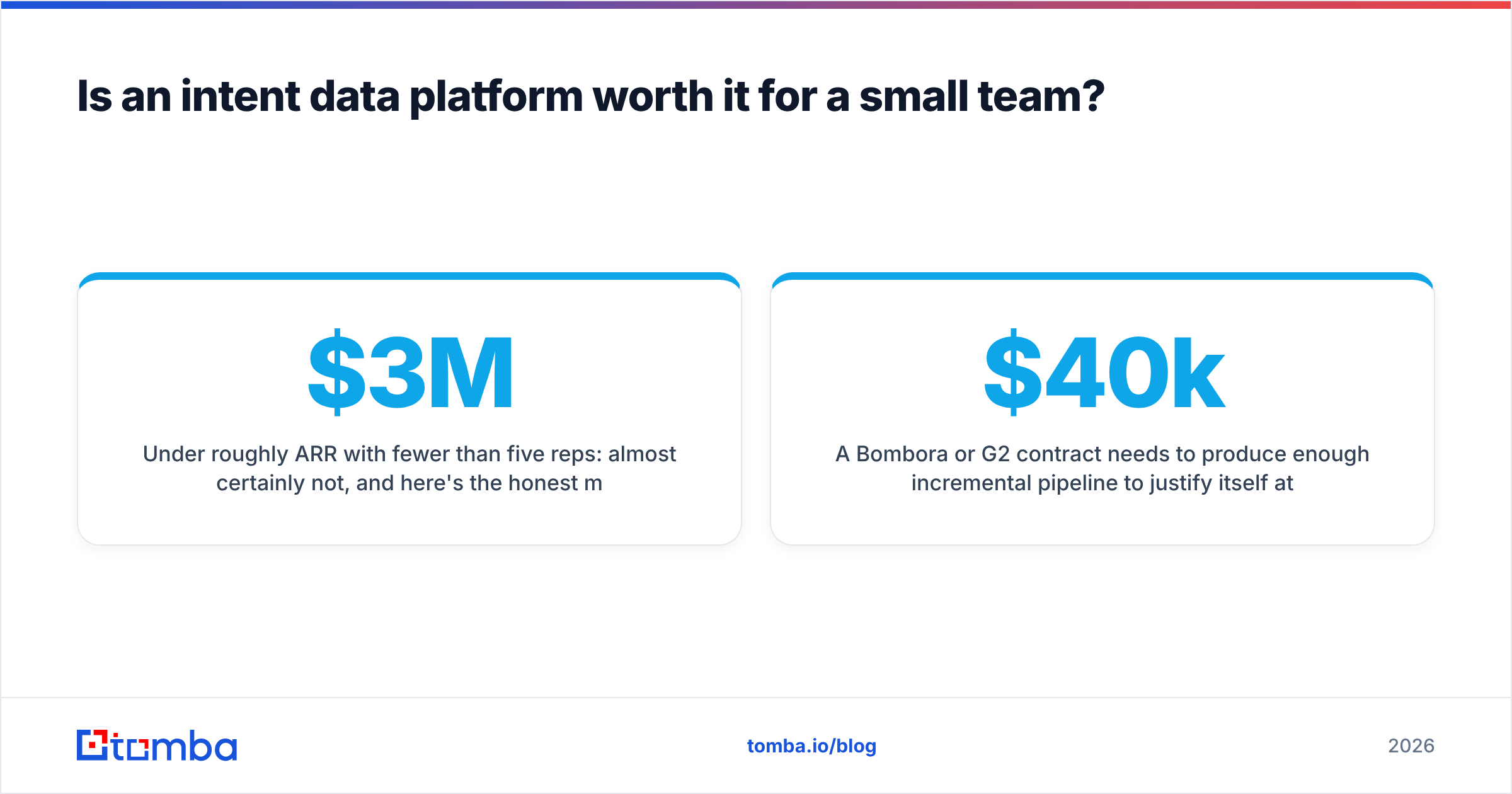
Under roughly $3M ARR with fewer than five reps: almost certainly not, and here's the honest math.
A $40k Bombora or G2 contract needs to produce enough incremental pipeline to justify itself at a 3–5x return, so call it $150k of net-new pipeline attributable to intent. At a 25% win rate and a $20k ACV, that's around eight closed deals traced to signals you wouldn't otherwise have had. Small teams rarely have the outbound throughput to work enough surging accounts to hit that number, and they almost never have the ops capacity to build the routing that makes signals actionable.
What works better at that stage:
- First-party reveal on the traffic you already have — highest-quality signal, lowest cost.
- Manual second-party monitoring — G2 category alerts, competitor changelog and job-board watching, funding announcements. Unglamorous, free, and often more precise than a co-op feed.
- Spending the budget on contact accuracy instead. A smaller list of accounts with verified, enriched, correctly-routed contacts outperforms a larger list of surging accounts you can't reach. Vendors in the verified-contact space — from purpose-built databases like BookYourData to API-first finders — solve a problem you definitely have, whereas intent solves a problem you might have.
Revisit intent when two things are true: your TAM is too large to work exhaustively, and you have someone whose job includes maintaining the routing logic. Before that, it's a subscription to a feeling of sophistication.
What should you ask before you sign?#
Bring these five to the demo, in this order, and watch which ones get deflected:
- What percentage of your signal is bidstream? If they won't break it out, assume most of it.
- What's your account match rate against a sample of our CRM? Ask for the test on your data, not their case study.
- How do you suppress competitor and non-buyer traffic? Default-on or manual?
- What's the median lag between the behavior and the alert? Anything over five days makes "timing" claims hollow.
- What does renewal pricing look like at 2x topics? Topic-count expansion is the standard upsell lever.
The vendor that answers all five plainly is rare, and worth paying more for.
Where to start#
If you take one thing from this: intent data platforms sell you the when. They do not sell you the who, and the who is where outreach actually breaks. A surging account with three unverified guesses at an email address produces bounces, not meetings.
Build the contact layer first. Use the Tomba Email Finder to resolve real, verified contacts at the accounts your signals surface — by domain, by name, or by role, with verification built into the same call so nothing unchecked reaches your sending domain. The free tier covers 25 searches a month if you want to test the workflow against a handful of surging accounts before committing to anything; paid plans start at $49/mo and scale to bulk and API use when the program proves out.
Get the who right, and intent data becomes a genuine advantage. Get it wrong, and it's the most expensive dashboard in your stack.
Related guides#
// get started
Find, verify and enrich your first contacts today
Start on the free plan with 25 searches a month, then scale when your team is ready.
Free plan · No credit card required · GDPR & CCPA
// about the author