Intent Data Pricing in 2026: Real Costs, Tiers, and Traps
Intent data vendors don't publish list prices — and that's the point. Here's what topic-level, platform, and bidstream intent actually cost in 2026, which line items get hidden in the order form, and when a $49 contact stack beats a $60K contract.
TL;DR
- Almost no intent data vendor publishes a price. Expect quote-only contracts, annual commitments, and a 12-month minimum term as the default.
- Realistic 2026 bands: roughly $20K–$40K/year for topic-level intent feeds, $60K–$120K+/year for full intent platforms with orchestration, and $0–$15K for narrow, single-source signals like review-site intent.
- The sticker price is never the real price. Onboarding fees, seat minimums, CRM connector add-ons, topic-count caps, and "activation" credits routinely add 20–40% on top.
- Intent data only pays for itself if you already have (a) enough accounts to prioritize, (b) contact data to act on the signal, and (c) reps who follow up within days, not weeks.
- If any of those three are missing, spend the money on contact coverage and first-party signal first. A Tomba plan at $49–$249/month plus website visitor reveal covers the "who do I email" problem for a rounding error of an intent contract.
What is intent data, and why is its pricing so opaque?#
Intent data is a record of buying-related behavior happening somewhere other than your own website — an account researching "data warehouse migration" across a publisher network, comparing two vendors on a review site, or spiking on a keyword cluster in a content co-op. It answers "who is in market right now," which is a genuinely different question from "who fits our ICP."
Pricing is opaque for a simple reason: intent is sold as a value-based enterprise contract, not as a commodity. The vendor's cost to serve you barely changes whether you monitor 500 accounts or 50,000, so the price is set by how much the signal is worth to your revenue team. That's why two companies can pay $28K and $95K for products that look nearly identical on the feature matrix.
The practical effect on you as a buyer: you cannot comparison-shop from public pages. You have to reverse-engineer intent data pricing from peer benchmarks, review-site disclosures, and the structure of the quote itself.
What pricing models does intent data actually use?#
Every quote you receive will be some combination of these five structures. Knowing which one you're being sold is more useful than knowing the number.
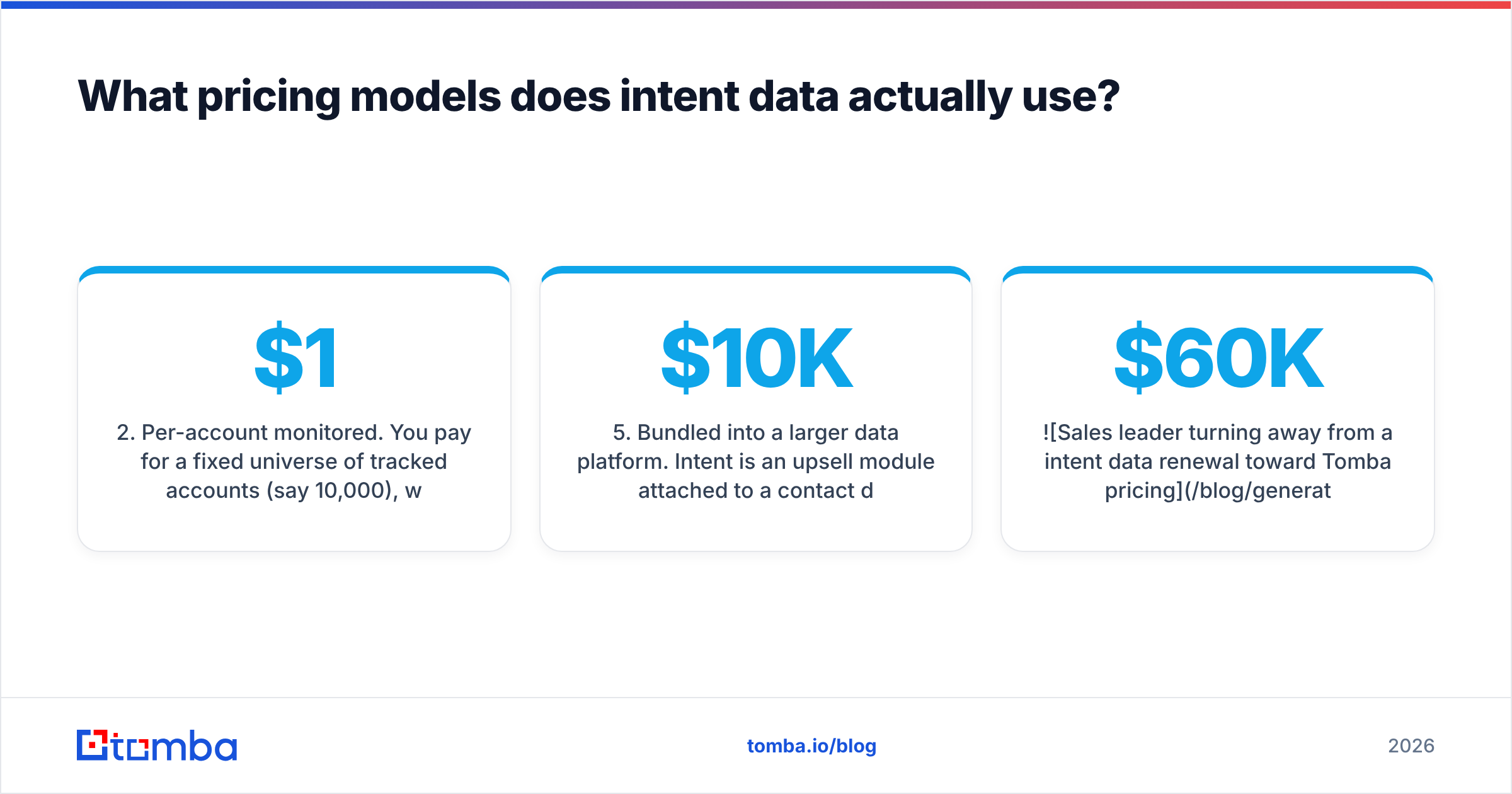
- Flat annual platform fee. A single yearly number covering the whole account base, usually tiered by company revenue or employee count. Most common at the enterprise end. Predictable, but the tier jump between bands can be brutal — crossing from "mid-market" to "enterprise" has been known to double a renewal.
- Per-account monitored. You pay for a fixed universe of tracked accounts (say 10,000), with overage pricing beyond it. Typical effective rate lands somewhere between $1 and $6 per account per year. Good when your ICP is genuinely small; expensive when you don't know your ICP yet.
- Per-topic or per-keyword. You license a set number of intent topics — commonly 5, 10, or 25 — and pay to add more. This is where budgets quietly inflate, because most teams discover they need 20+ topics to cover a product line after they've signed for 10.
- Credit or record-based. You buy a pool of credits and burn them on surging-account exports, contact reveals, or enrichment calls. Feels flexible, behaves like metered billing, and almost always comes with an annual minimum spend.
- Bundled into a larger data platform. Intent is an upsell module attached to a contact database or ABM platform. The headline add-on price looks small ($10K–$25K) because it assumes you're already paying for the base platform.
A sixth pattern worth naming: co-op participation. Some networks discount your feed if you contribute your own site's behavioral data back into the pool. It's a real lever — just read what you're contributing before you agree.
What does intent data cost in 2026?#
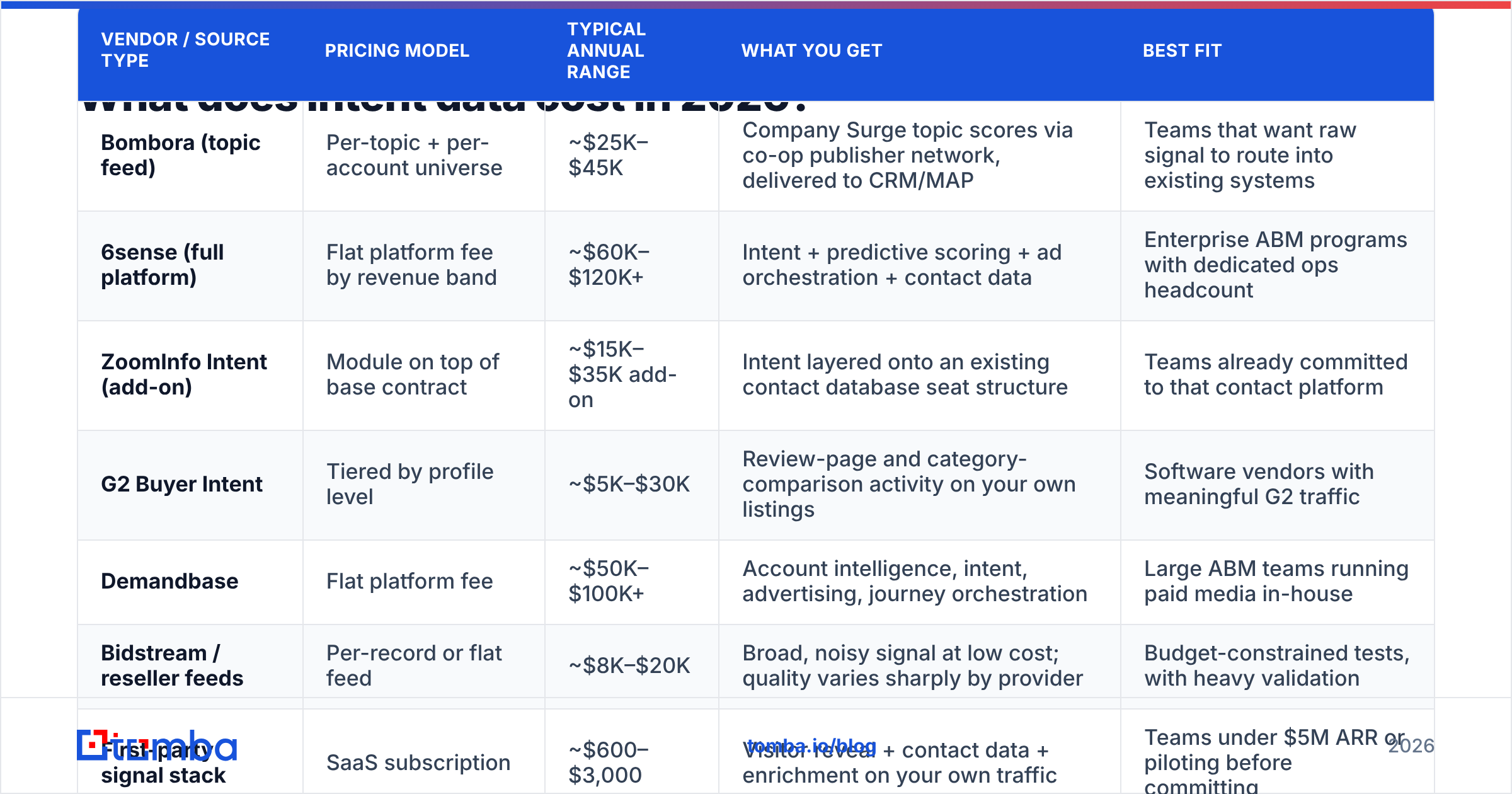
Vendors don't publish list prices, so the table below reflects commonly reported buyer ranges from review-site disclosures, procurement chatter, and public case studies — not official rate cards. Treat these as negotiation anchors, not quotes.
| Vendor / source type | Pricing model | Typical annual range | What you get | Best fit |
|---|---|---|---|---|
| Bombora (topic feed) | Per-topic + per-account universe | ~$25K–$45K | Company Surge topic scores via co-op publisher network, delivered to CRM/MAP | Teams that want raw signal to route into existing systems |
| 6sense (full platform) | Flat platform fee by revenue band | ~$60K–$120K+ | Intent + predictive scoring + ad orchestration + contact data | Enterprise ABM programs with dedicated ops headcount |
| ZoomInfo Intent (add-on) | Module on top of base contract | ~$15K–$35K add-on | Intent layered onto an existing contact database seat structure | Teams already committed to that contact platform |
| G2 Buyer Intent | Tiered by profile level | ~$5K–$30K | Review-page and category-comparison activity on your own listings | Software vendors with meaningful G2 traffic |
| Demandbase | Flat platform fee | ~$50K–$100K+ | Account intelligence, intent, advertising, journey orchestration | Large ABM teams running paid media in-house |
| Bidstream / reseller feeds | Per-record or flat feed | ~$8K–$20K | Broad, noisy signal at low cost; quality varies sharply by provider | Budget-constrained tests, with heavy validation |
| First-party signal stack | SaaS subscription | ~$600–$3,000 | Visitor reveal + contact data + enrichment on your own traffic | Teams under $5M ARR or piloting before committing |
Two things jump out of that table. First, the gap between the cheapest credible option and the most expensive is roughly 15x — and the underlying behavioral data often originates from overlapping sources. Second, everything above $50K is buying workflow, not signal. You're paying for orchestration, scoring models, and ad activation, and those are only valuable if you have someone whose job is to run them.
Why is the quoted price never the final price?#
Budget the quote, then budget the tail. In practice, the line items that show up after the headline number include:
- Implementation and onboarding. Often $5K–$15K one-time, sometimes waived on multi-year deals. Always ask.
- Seat minimums. Some platforms price by user seat above a threshold. Adding five SDRs mid-year is not free.
- Connector fees. Native CRM or marketing-automation sync is sometimes a paid module. The CSV export is free; the thing that makes the data usable at 8am every Monday is not.
- Topic expansion. The single most common overage. Ten topics sounds generous until legal, security, and a second product line each need their own.
- Contact reveal credits. Intent tells you the account is surging. Turning that into a person with an email address is usually a separate metered product — either from the same vendor, or from a dedicated email finder.
- The human cost. A realistic intent program needs about 0.25–0.5 FTE of RevOps time to maintain scoring thresholds, suppression lists, and routing rules. At a loaded salary, that's $30K–$70K of internal cost that never appears on the order form.
Add it up honestly. A $45K quote is frequently a $70K program in year one.
Is intent data worth it at your company size?#
Run the break-even, not the vibe check. The arithmetic is simple:
(contract cost + internal cost) ÷ (average deal size × close rate) = incremental deals needed
A $60K all-in program against a $25K average deal at a 22% close rate needs roughly 11 extra qualified opportunities per year just to break even — and those opportunities have to be genuinely incremental, not ones your team would have sourced anyway. That attribution question is where most intent business cases quietly collapse at renewal.
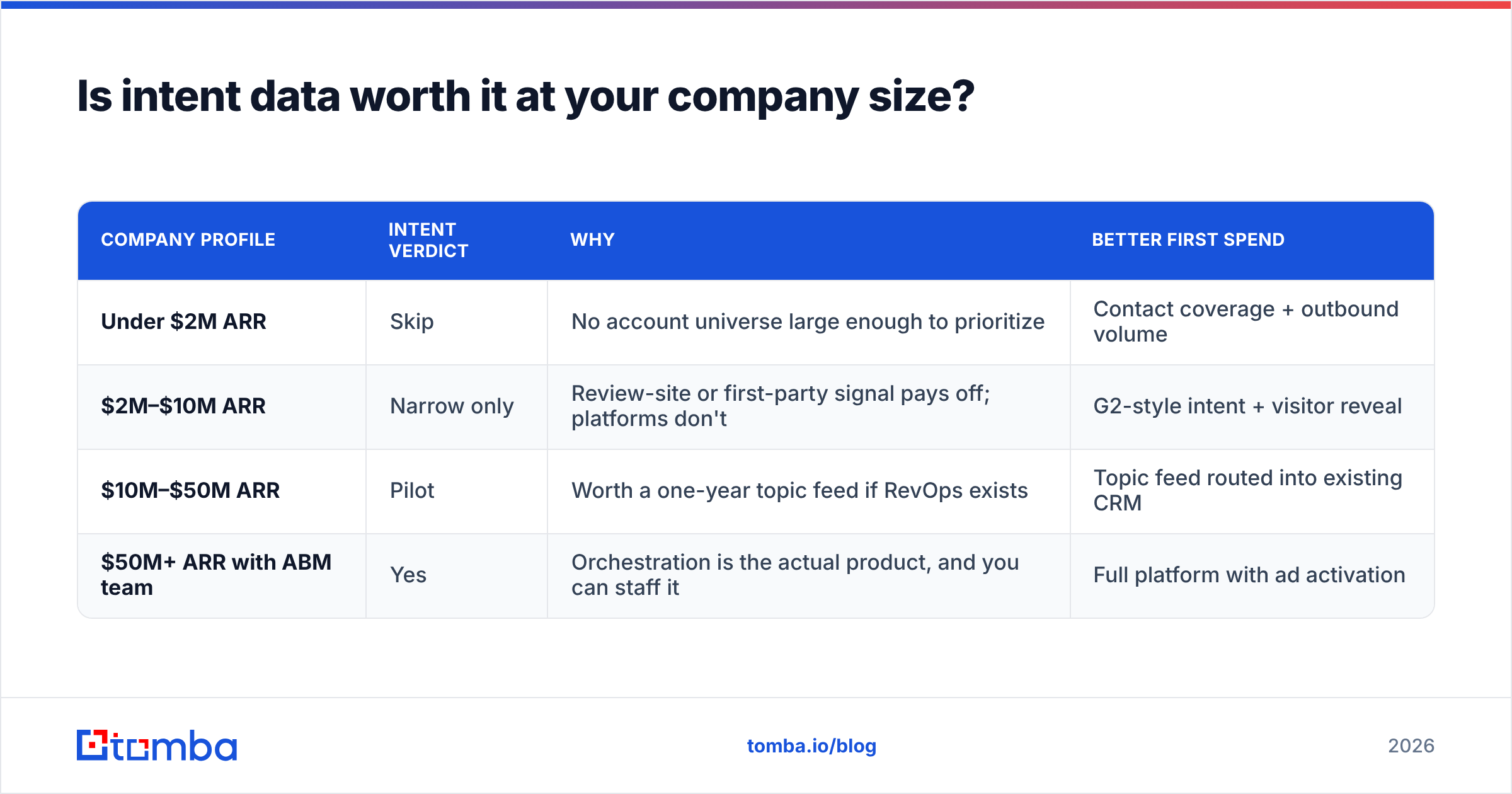
Some rough guidance by stage:
| Company profile | Intent verdict | Why | Better first spend |
|---|---|---|---|
| Under $2M ARR | Skip | No account universe large enough to prioritize | Contact coverage + outbound volume |
| $2M–$10M ARR | Narrow only | Review-site or first-party signal pays off; platforms don't | G2-style intent + visitor reveal |
| $10M–$50M ARR | Pilot | Worth a one-year topic feed if RevOps exists | Topic feed routed into existing CRM |
| $50M+ ARR with ABM team | Yes | Orchestration is the actual product, and you can staff it | Full platform with ad activation |
The dividing line isn't budget. It's whether you have someone who will act on a surging-account list within 72 hours. Intent decays fast — industry analysts have been consistent for years that speed of follow-up dominates almost every other variable in converting a research signal into a conversation. A $100K feed feeding a queue nobody works is $100K of latency.
How do you get intent-like signal without a five-figure contract?#
Before you sign anything, exhaust the signal you already own. Most teams have three underused sources:
- Your own website traffic. The majority of B2B visitors never fill out a form. Website visitor reveal turns anonymous sessions into company names — and unlike third-party intent, it's unambiguously about your product, not a topic cluster that correlates with it. This is the highest-quality intent signal most companies never activate.
- Product and content behavior. Pricing-page visits, docs traffic, repeated demo-video views, and trial activity are first-party intent with zero licensing cost. Pipe them into your CRM before you buy a model that guesses at the same thing.
- Public hiring and tech-stack changes. A company posting three roles in a function you sell into, or swapping a competitor's script out of their site, is a stronger buying signal than most topic surges — and you can capture it with data enrichment rather than a subscription to a co-op.
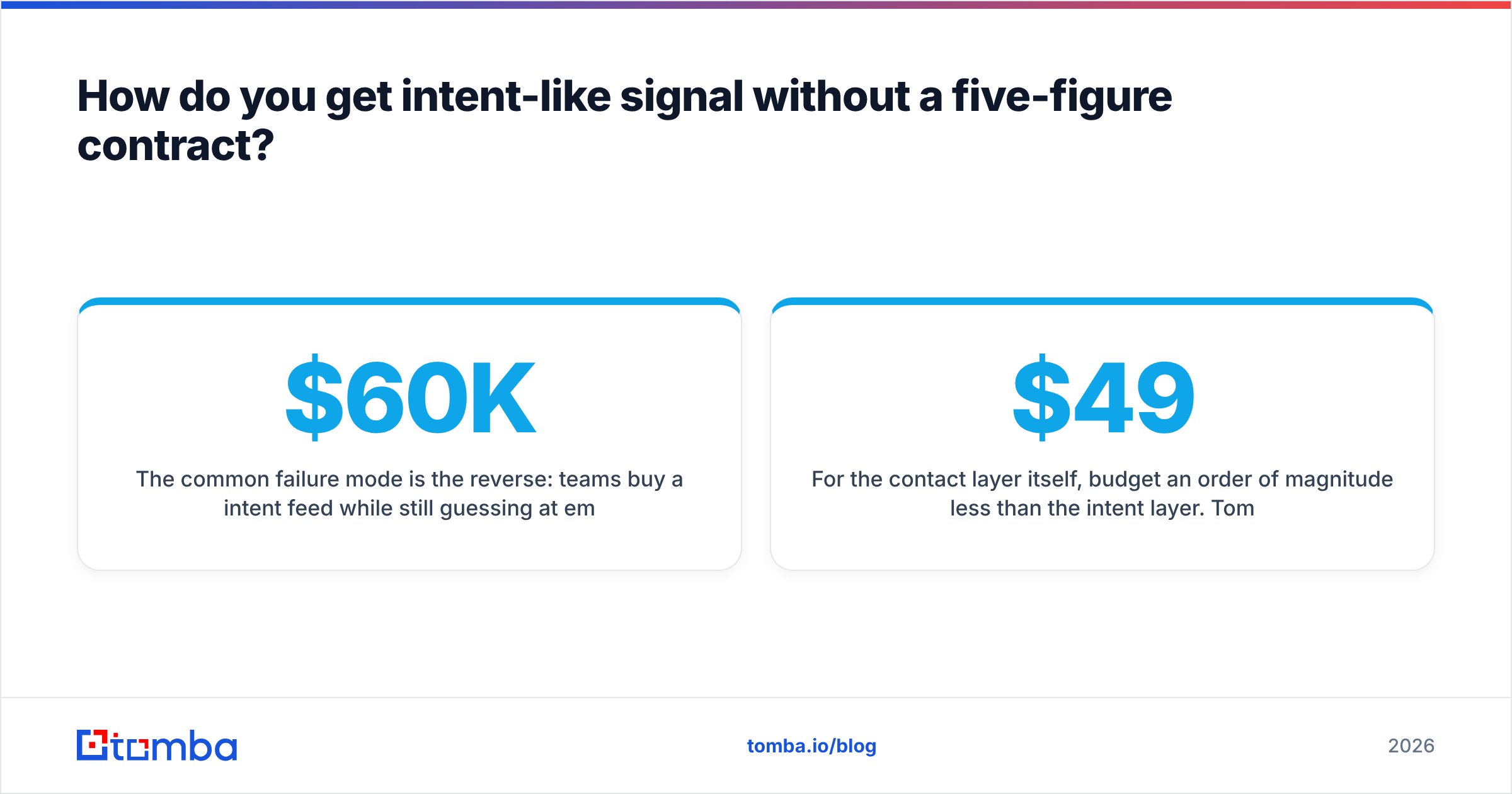
The common failure mode is the reverse: teams buy a $60K intent feed while still guessing at email addresses. A surging account you can't contact is trivia. Coverage first, signal second.

For the contact layer itself, budget an order of magnitude less than the intent layer. Tomba runs a free tier at 25 searches per month, Starter at $49/month, Growth at $99/month, and Pro at $249/month, and a bulk email finder run turns a list of surging domains into verified, deliverable contacts in a single upload. Providers like BookYourData serve a similar need with a prepaid-list model, which suits teams that prefer to buy a defined dataset outright rather than subscribe. Either way, the contact line item on your GTM budget should be a small fraction of the intent line item — not the other way around.
What should you ask before signing an intent data contract?#
Take this list into the second call, not the first.
- Where does the data originate? Co-op publisher network, bidstream, first-party review activity, or resold? Each has a different accuracy and privacy profile, and "proprietary blend" is not an answer.
- What's the account-match rate for my ICP specifically? Ask them to run your top 200 target accounts and report coverage. If they won't, that's information.
- What's the topic cap and the overage rate? Get the price of topic 11 in writing before you sign for ten.
- Is contact-level data included or metered separately? Most intent is account-level. Budget the person layer separately.
- What's the uplift clause on renewal? Cap it at signing. Uncapped renewals on quote-only products are how a $40K contract becomes $72K in year three.
- Can I get a 90-day pilot with an out? Rare, but more available in Q4 than vendors admit.
- How is the signal delivered? Daily CRM sync, weekly CSV, or dashboard-only? Dashboard-only means nobody will use it.
One negotiation note: intent vendors carry enormous gross margin and highly seasonal quota pressure. Discounts of 20–35% off first quote are routine at quarter-end, and multi-year commitments buy more than logo-swap case studies do. Never accept the first number.
Where should intent data sit in your 2026 GTM budget?#
Treat intent as the prioritization layer, not the foundation. The stack that works, in build order: reliable contact data → first-party signal capture → CRM routing that actually fires → then third-party intent on top to rank what's already working. Buying layer four before layers one through three is the single most common way six-figure intent contracts end up churned at renewal with a post-mortem titled "adoption."
If you're at the stage where the honest answer is "we don't have enough verified contacts to act on the signals we already have," fix that first — it costs about 1% of an intent contract. Start with the Tomba Email Finder on the free tier, run your current target list through it, and see how much of your pipeline problem was actually a signal problem. Most teams find out it wasn't.
Related guides#
// get started
Find, verify and enrich your first contacts today
Start on the free plan with 25 searches a month, then scale when your team is ready.
Free plan · No credit card required · GDPR & CCPA
// about the author