Intent Data Provider Guide 2026: How to Pick the Right One
Most intent data is noise dressed up as a signal. Here's how intent data providers actually source their data, what the pricing really looks like, and how to test a vendor before you sign a year-long contract.
TL;DR
- An intent data provider sells you a guess about which companies are researching a problem you solve. The guess is only as good as the source behind it — and most vendors won't tell you the source in plain language.
- Third-party intent (bidstream, co-op publisher networks, review-site activity) is broad but noisy. First-party intent (your own site, docs, pricing page) is narrow but far more predictive.
- Expect $20,000–$100,000+/year for enterprise platforms like 6sense, Demandbase, or Bombora. Mid-market options run $1,000–$3,000/month. Budget for the contact data layer separately.
- Intent signals are account-level. They tell you which company is in-market, not who to email — you still need a contact layer to turn an account into a person with a verified inbox.
- Run a 30-day back-test against closed-won deals before you sign anything longer than a quarter. If the provider won't support a pilot, that's your answer.
What is an intent data provider?#
An intent data provider is a vendor that monitors online research behavior and tells you which companies are actively investigating a topic — "cloud cost management," "payroll software," "SOC 2 compliance" — so you can reach them while they're shopping instead of while they're indifferent.
Think of it like a hardware-store owner who notices the same neighbor walking past the paint aisle four times in two weeks. The neighbor hasn't asked for anything. But the pattern says something. Intent data is that pattern, industrialized: billions of content interactions resolved back to company identities, scored against a topic taxonomy, and pushed into your CRM.
The core promise is timing. Gartner research on B2B buying consistently shows buyers complete most of their research before contacting a vendor. If you only hear from a prospect when they fill out a demo form, you're arriving at the end of a process you never influenced. Intent data is a bet that you can arrive earlier.
The catch nobody puts on the pricing page: intent data is probabilistic, account-level, and frequently wrong at the individual level. Treating it as a list of people to call is the fastest way to burn $60,000 and conclude the whole category is snake oil.
Where does intent data actually come from?#
Four sourcing methods dominate the market, and they are not interchangeable. When a vendor says "we have the largest intent dataset," ask which of these they mean.
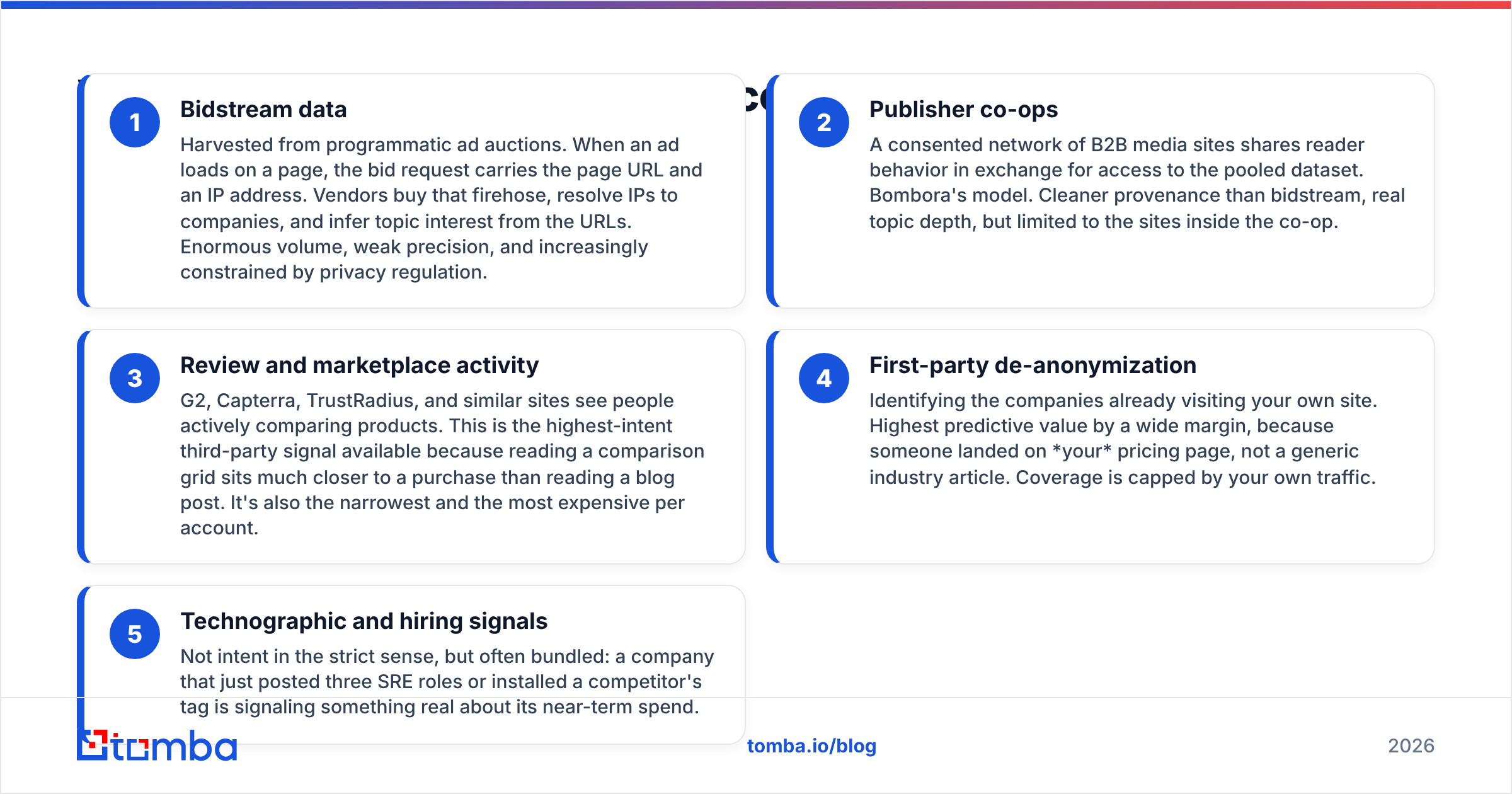
Bidstream data — Harvested from programmatic ad auctions. When an ad loads on a page, the bid request carries the page URL and an IP address. Vendors buy that firehose, resolve IPs to companies, and infer topic interest from the URLs. Enormous volume, weak precision, and increasingly constrained by privacy regulation.
Publisher co-ops — A consented network of B2B media sites shares reader behavior in exchange for access to the pooled dataset. Bombora's model. Cleaner provenance than bidstream, real topic depth, but limited to the sites inside the co-op.
Review and marketplace activity — G2, Capterra, TrustRadius, and similar sites see people actively comparing products. This is the highest-intent third-party signal available because reading a comparison grid sits much closer to a purchase than reading a blog post. It's also the narrowest and the most expensive per account.
First-party de-anonymization — Identifying the companies already visiting your own site. Highest predictive value by a wide margin, because someone landed on your pricing page, not a generic industry article. Coverage is capped by your own traffic.
Technographic and hiring signals — Not intent in the strict sense, but often bundled: a company that just posted three SRE roles or installed a competitor's tag is signaling something real about its near-term spend.
The practical read: third-party intent tells you a market is warming. First-party intent tells you a specific company is shopping. Most teams that succeed with intent data run both and weight the first-party signal far higher.
How do the major intent data providers compare?#
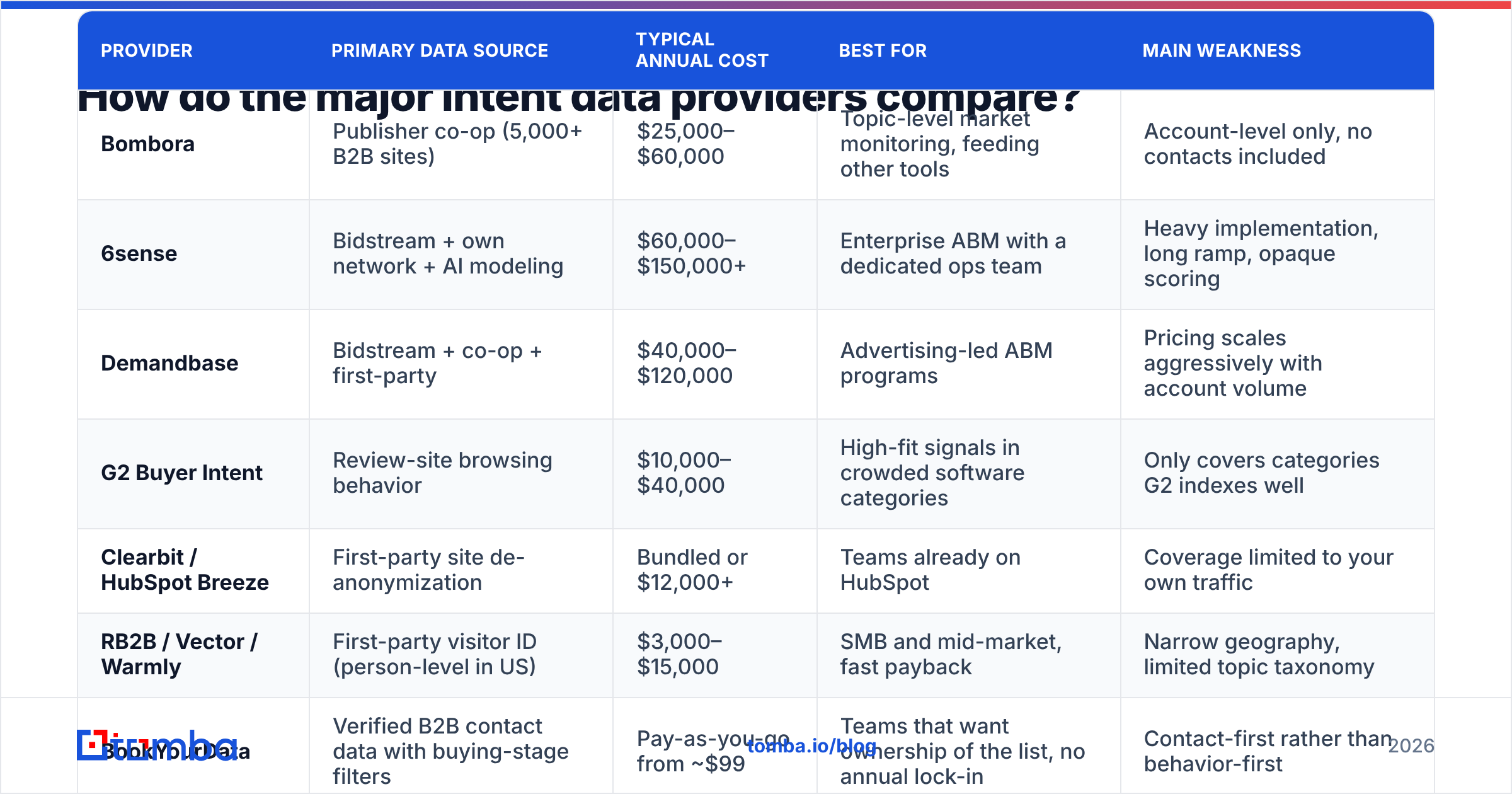
Here's how the main categories stack up in 2026. Prices are typical annual contract ranges reported by buyers on review sites; every vendor negotiates, and none of them publish rate cards.
| Provider | Primary data source | Typical annual cost | Best for | Main weakness |
|---|---|---|---|---|
| Bombora | Publisher co-op (5,000+ B2B sites) | $25,000–$60,000 | Topic-level market monitoring, feeding other tools | Account-level only, no contacts included |
| 6sense | Bidstream + own network + AI modeling | $60,000–$150,000+ | Enterprise ABM with a dedicated ops team | Heavy implementation, long ramp, opaque scoring |
| Demandbase | Bidstream + co-op + first-party | $40,000–$120,000 | Advertising-led ABM programs | Pricing scales aggressively with account volume |
| G2 Buyer Intent | Review-site browsing behavior | $10,000–$40,000 | High-fit signals in crowded software categories | Only covers categories G2 indexes well |
| Clearbit / HubSpot Breeze | First-party site de-anonymization | Bundled or $12,000+ | Teams already on HubSpot | Coverage limited to your own traffic |
| RB2B / Vector / Warmly | First-party visitor ID (person-level in US) | $3,000–$15,000 | SMB and mid-market, fast payback | Narrow geography, limited topic taxonomy |
| BookYourData | Verified B2B contact data with buying-stage filters | Pay-as-you-go from ~$99 | Teams that want ownership of the list, no annual lock-in | Contact-first rather than behavior-first |
| Tomba | Verified contacts + enrichment via API | Free (25/mo), $49–$249/mo | Turning an intent account into a reachable person | Not an intent signal provider itself |
Two honest notes on that table. First, Tomba is not an intent data provider and doesn't pretend to be — it sits downstream, in the layer where an account name becomes a verified email address. Second, BookYourData solves a different shape of the problem: if you already know your ICP and don't need behavioral scoring, a pay-as-you-go verified list is often a better use of budget than a six-figure intent platform.
Is intent data actually worth the money?#
It depends almost entirely on your deal size and your list exhaustion.
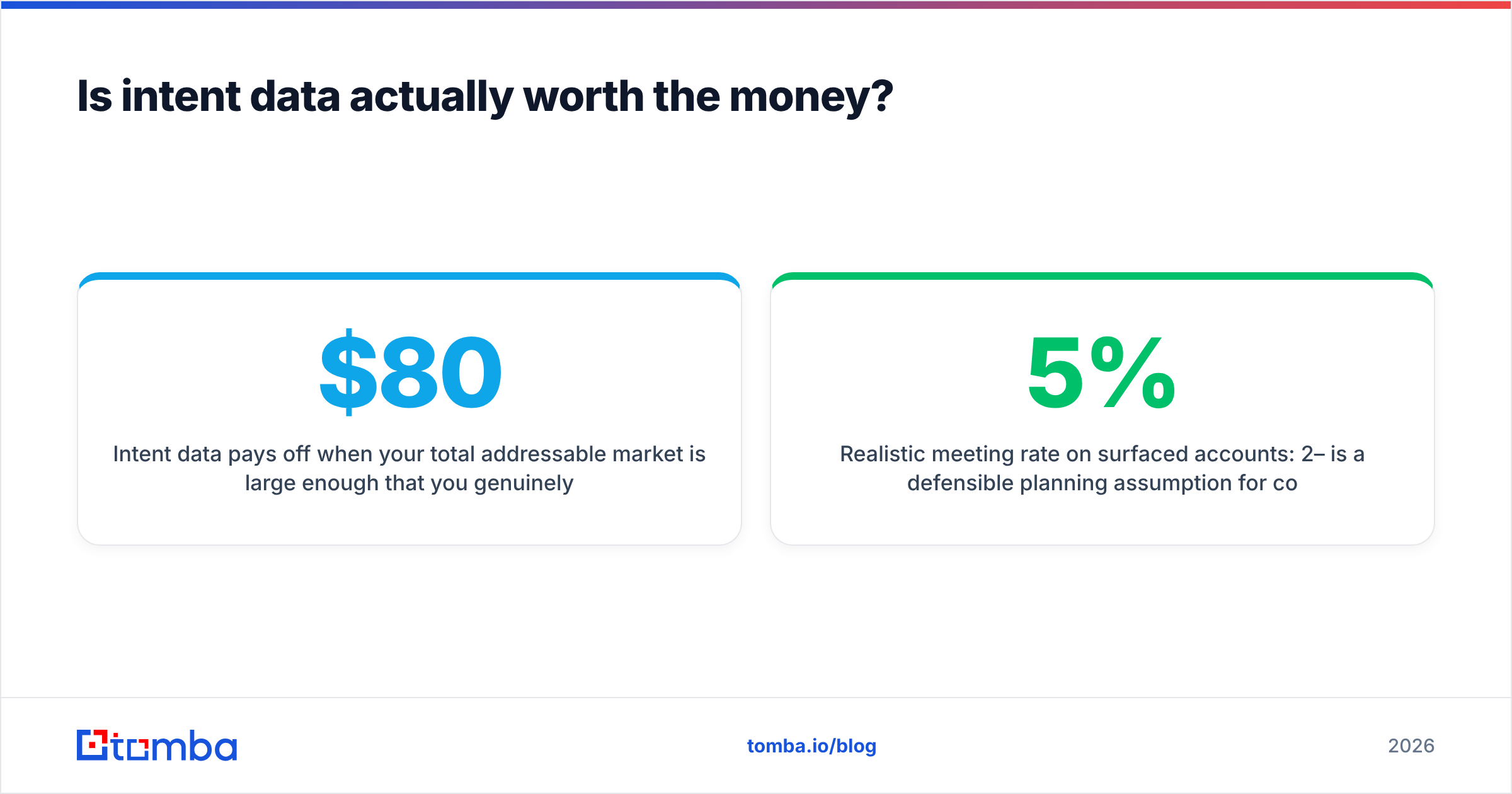
Intent data pays off when your total addressable market is large enough that you genuinely cannot work all of it, and your ACV is high enough to absorb the platform cost. A team selling $80,000 contracts into 40,000 possible accounts has a real prioritization problem, and buying a ranking for that list is rational. A team selling $6,000 contracts into 600 accounts should just work all 600. No signal will beat full coverage of a small market.
Run the arithmetic before the demo:
- Platform cost: what you'll actually pay, including the contact data you'll need on top.
- Accounts surfaced per month: ask for a real number from a comparable customer, not a TAM figure.
- Realistic meeting rate on surfaced accounts: 2–5% is a defensible planning assumption for cold outbound to a warm-ish account.
- Your close rate and ACV: apply your actuals, not the vendor's case study.
- Break-even deals needed: platform cost divided by gross profit per deal. If that number is more than about a third of your current annual new logos, the math is fragile.
The most common failure isn't bad data. It's buying a signal layer while the execution layer underneath is broken — unverified emails, no sequencing discipline, reps who treat an intent alert as a reason to send the same template faster. Fix the email deliverability and contact-accuracy problems first. Intent data amplifies whatever system you already have, including a bad one.
How do you turn an intent signal into an actual conversation?#
This is the step where most intent programs quietly die. The platform flags 200 in-market accounts. The rep opens one, sees a company name and a topic score, and has no idea who to contact.
A working handoff looks like this:
1. Filter to fit before you filter to intent. An account surging on "data warehouse migration" is worthless if it has 12 employees and you sell to enterprises. Fit first, intent second. Always.
2. Resolve the account to real people. Take the domain and pull the relevant roles. A domain search returns the email patterns and named contacts at a company, which is what converts "Acme Corp is surging" into "Priya Raman, VP Engineering at Acme." For a broader list, feed the surging domains through a bulk email finder in one pass rather than researching accounts one at a time.
3. Verify before you send. Intent-surfaced accounts often come from datasets refreshed on a lag, and role churn in B2B is relentless. Running contacts through an email verifier before the first send protects the sender reputation you'll need for every campaign after this one.
4. Reference the category, never the surveillance. "I saw your team researching SOC 2 tools last Tuesday" is unsettling and frequently wrong. "Most Series B teams we work with hit a SOC 2 wall right after their first enterprise deal — is that on your roadmap?" uses the same signal without the creep factor.
5. Set a decay window. Intent signals go stale fast. A surge older than 21 days should drop out of the priority queue. Treating a two-month-old signal as live is how reps lose trust in the system.
6. Measure separately. Track intent-sourced pipeline against a control group of non-intent outbound. Without a control, you will never know whether the platform worked or your reps simply got better that quarter.
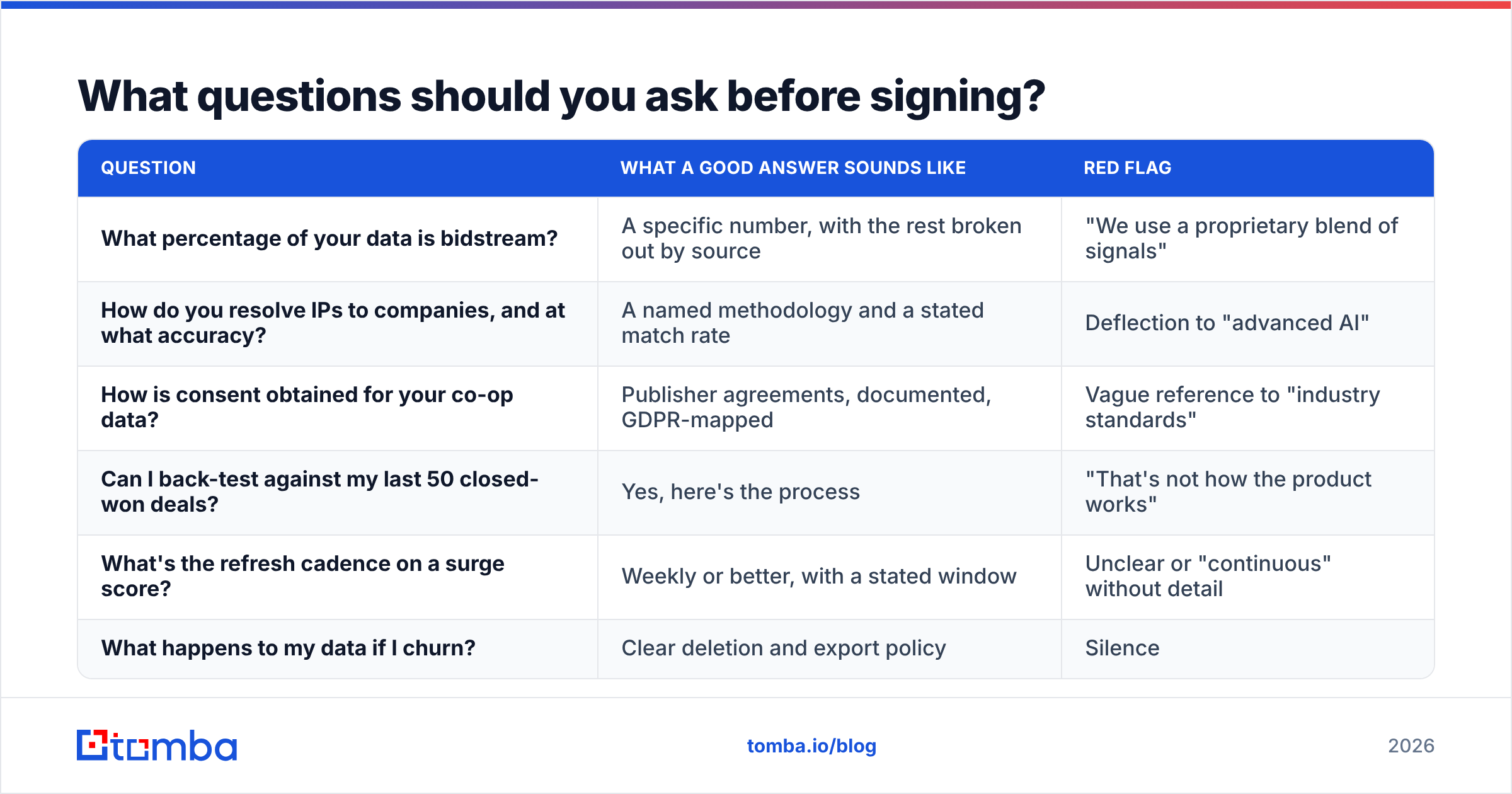
What questions should you ask before signing?#
Vendor demos are engineered to avoid these. Ask them anyway, in writing.
| Question | What a good answer sounds like | Red flag |
|---|---|---|
| What percentage of your data is bidstream? | A specific number, with the rest broken out by source | "We use a proprietary blend of signals" |
| How do you resolve IPs to companies, and at what accuracy? | A named methodology and a stated match rate | Deflection to "advanced AI" |
| How is consent obtained for your co-op data? | Publisher agreements, documented, GDPR-mapped | Vague reference to "industry standards" |
| Can I back-test against my last 50 closed-won deals? | Yes, here's the process | "That's not how the product works" |
| What's the refresh cadence on a surge score? | Weekly or better, with a stated window | Unclear or "continuous" without detail |
| What happens to my data if I churn? | Clear deletion and export policy | Silence |
The back-test is the one that matters most. Take your last 50 closed-won accounts, hand the domains to the vendor, and ask whether their platform would have surged those accounts in the 90 days before the deal closed. If it flagged 30 of them, you have a real signal. If it flagged 8, you're buying an expensive random number generator. A vendor confident in its data will run this. A vendor that isn't will explain why back-testing is methodologically unfair.
Cross-check whatever they tell you against independent buyer reviews on G2 — pay particular attention to reviews mentioning renewal and implementation, not the initial-impression ones.
What are the privacy and compliance constraints in 2026?#
Real ones, and they've tightened.
Third-party cookie deprecation gutted a chunk of the classic bidstream supply, which is why more vendors now emphasize co-op and first-party sourcing. Under GDPR, IP addresses are personal data, so an EU-targeted program needs a documented lawful basis — legitimate interest, assessed and recorded, not assumed. US state privacy laws increasingly grant opt-out rights that a vendor's supply chain must honor, and that obligation flows to you as the controller of the outreach.
Two practical guardrails:
- Ask for the vendor's Data Processing Agreement and sub-processor list before signing, not after legal escalates it in month three.
- Keep person-level identification out of your EU and UK motions unless your counsel has explicitly cleared it. Account-level intent carries meaningfully less exposure than person-level de-anonymization.
HubSpot's guidance on GDPR-compliant marketing is a reasonable starting point for the non-lawyers on your team, but it isn't a substitute for review by someone who owns the risk.
What's the pragmatic setup for most teams?#
If you're under roughly $5M ARR, skip the enterprise intent platform. The sequence that actually works:
- Instrument first-party intent. Identify the companies already on your site. Highest signal, lowest cost, and it's yours permanently.
- Add one narrow third-party source. Review-site intent in your specific category usually beats a broad topic taxonomy for a fraction of the price.
- Build the contact layer properly. Accurate, verified contacts with good enrichment. This is the layer that determines whether any of the above produces a conversation.
- Only then consider a platform. Once you can prove a signal-to-meeting path manually, buying a system to scale it is a sound decision. Buying it to discover the path is not.
Most teams invert this — they buy the expensive signal layer first and discover their contact data was the bottleneck all along.
Where does Tomba fit?#
Tomba isn't an intent data provider, and we'd rather say that plainly than stretch the label. What Tomba does is the step immediately after the signal: taking a surging domain and returning verified, deliverable contacts for the people who actually make the decision.
Feed your intent-surfaced account list into the Tomba Email Finder to convert company names into verified professional email addresses, then run the results through verification before the first touch. The free tier covers 25 searches a month for testing the workflow; paid plans start at $49/month, with full Tomba pricing published rather than quoted on a call. If you're already paying five figures for intent signals, the contact layer that makes them actionable shouldn't be the thing you improvise.
Related guides#
// get started
Find, verify and enrich your first contacts today
Start on the free plan with 25 searches a month, then scale when your team is ready.
Free plan · No credit card required · GDPR & CCPA
// about the author