Intent Data ROI: How to Measure It (and What It Really Costs)
Intent data vendors sell signals, not pipeline. Here's the honest math on intent data ROI in 2026 — real all-in costs, the payback formula, break-even benchmarks, and when buying signals is a waste of budget.
TL;DR
- Intent data ROI is not "signals bought vs. pipeline closed." It's incremental pipeline minus the full cost of acting on signals — subscription, contact data, rep hours, and ops time.
- The subscription is usually 40-60% of the real cost. The rest is contact discovery, enrichment, routing, and the SDR capacity you burn chasing accounts that were never in-market.
- Break-even for a $40K/year intent subscription at a $25K ACV and 20% win rate needs roughly 8 extra closed deals' worth of pipeline — about $400K in incremental pipeline at a 3x coverage ratio.
- Signals without contacts are worthless. An account showing surge means nothing until you have a verified email for the two or three humans who matter.
- Skip intent data entirely if your TAM is under ~2,000 accounts, your ACV is under $5K, or your team doesn't already act on inbound within 24 hours.
Intent data is one of the easiest line items in the GTM stack to justify on a slide and one of the hardest to justify in a board meeting. The vendor deck shows a surging account that closed six weeks later. Your CFO asks whether that account would have closed anyway. Nobody has a clean answer.
This guide gives you the answer — or at least a defensible model for getting one. We'll break down what intent data actually costs all-in, how to calculate intent data ROI without fooling yourself, what payback looks like at different ACVs, and the specific conditions under which buying signals is a bad trade.
What is intent data ROI, actually?#
Intent data ROI is the incremental revenue produced by acting on third-party or first-party buying signals, divided by the total cost of producing that revenue.
The word doing all the work is incremental. Standard return on investment math is simple; the hard part in GTM is the counterfactual. If an account was already on your target list, already getting sequenced, and already had a champion who'd used your product at their last company — the intent signal didn't create that deal. It just happened to be nearby when the deal closed.
Most vendor-supplied ROI dashboards use signal attribution: any closed-won account that showed surge in the preceding 90 days counts as intent-influenced. On a target list of 3,000 accounts with a typical surge rate of 8-12% per month, you'll have flagged most of your ICP at some point in a quarter. The attribution rate approaches 100% and the number becomes meaningless.
A defensible intent data ROI model has three components:
- Incremental pipeline — pipeline from accounts you would not have prioritized, in the window you wouldn't have prioritized them. Measured against a holdout, not against the whole funnel.
- All-in cost — subscription plus contact data plus activation labor plus the opportunity cost of rep time spent on false positives.
- Cycle compression — deals that closed faster because you arrived earlier. This is real value and it's usually under-counted, because it shows up as improved velocity rather than new logos.
Get those three right and the number you produce will survive a CFO conversation. Skip any of them and you're presenting vendor marketing back to your own leadership.
Why do most intent data ROI calculations lie?#
Four failure modes, in order of how often they show up.
Attribution inflation. Counting every closed deal that ever showed a signal. If your signal provider flags 10% of your list monthly, a 9-month sales cycle means nearly every account gets flagged. Correlation dressed as causation.
Hidden activation cost. The subscription is the visible number. Invisible: the analyst who builds the surge-to-CRM routing, the SDR hours spent on accounts where "surge" meant a competitor's employee reading a comparison page, the enrichment credits to find contacts at accounts you'd never researched, and the sequencing tool seats. In most audits, the subscription is 40-60% of total cost.
No holdout. Without a control group of accounts you deliberately don't work with intent, you cannot separate signal value from list quality. A holdout costs you a quarter of patience and is the only thing that makes the number real.
Ignoring the contact gap. An account-level signal tells you a company is researching. It doesn't tell you who. If it takes your team 20 minutes per account to find and verify the right three contacts, and you're processing 200 surging accounts a month, that's 66 hours — most of a full-time headcount — before a single email goes out.
What does intent data actually cost in 2026?#
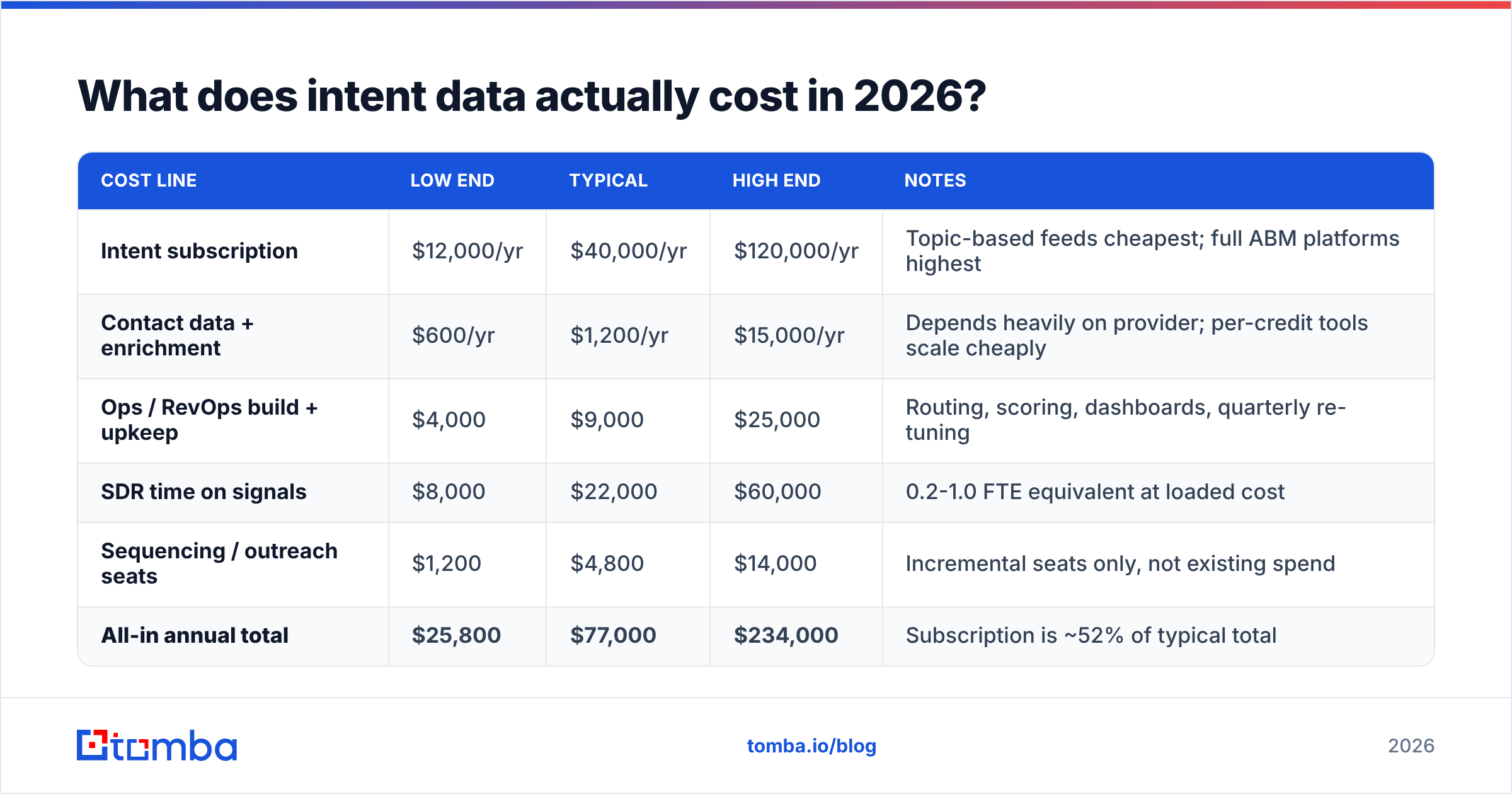
Below is the realistic cost structure for a mid-market B2B team working roughly 3,000 target accounts. Subscription ranges reflect publicly quoted list pricing bands and typical negotiated mid-market contracts; your mileage varies with topic count and account volume.
| Cost line | Low end | Typical | High end | Notes |
|---|---|---|---|---|
| Intent subscription | $12,000/yr | $40,000/yr | $120,000/yr | Topic-based feeds cheapest; full ABM platforms highest |
| Contact data + enrichment | $600/yr | $1,200/yr | $15,000/yr | Depends heavily on provider; per-credit tools scale cheaply |
| Ops / RevOps build + upkeep | $4,000 | $9,000 | $25,000 | Routing, scoring, dashboards, quarterly re-tuning |
| SDR time on signals | $8,000 | $22,000 | $60,000 | 0.2-1.0 FTE equivalent at loaded cost |
| Sequencing / outreach seats | $1,200 | $4,800 | $14,000 | Incremental seats only, not existing spend |
| All-in annual total | $25,800 | $77,000 | $234,000 | Subscription is ~52% of typical total |
The number that surprises people is the SDR line. Intent data doesn't reduce prospecting work — it redirects it. If your reps were at capacity before, signals don't create hours. They create a new queue competing for the same hours, and if you don't retire something else, the intent program cannibalizes outbound that was already working.
The contact-data line is where the spread is widest and where the cheapest wins live. Account-level surge is useless without person-level contacts, but you don't need a $30K/year contact platform to get them. A credit-based email finder at $49-$99/month covers a few thousand lookups, which is more than most surge queues generate in a quarter.
How do you calculate intent data ROI?#
Use this sequence. It takes about two hours to build the first time and 20 minutes per quarter after that.
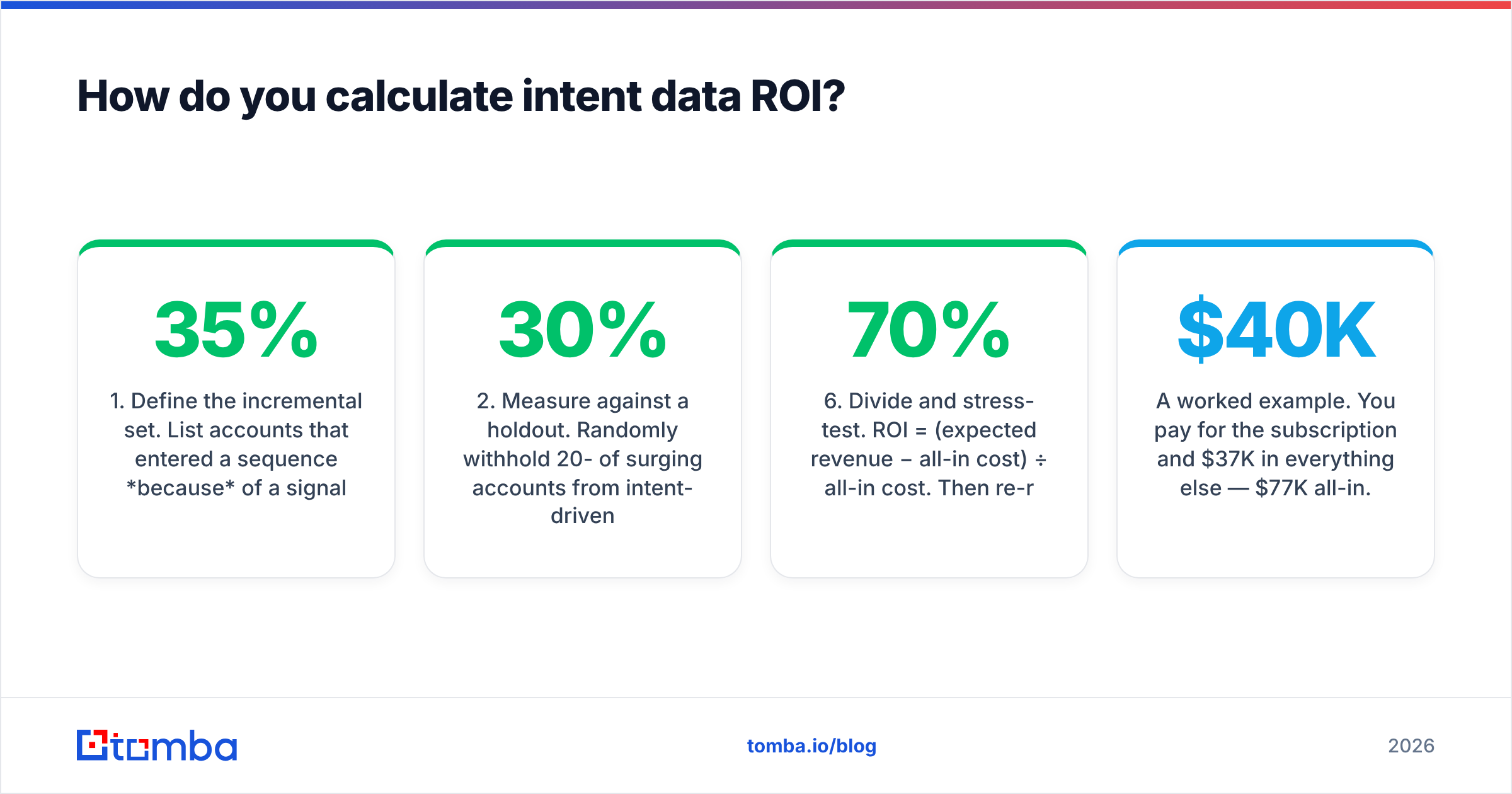
- Define the incremental set. List accounts that entered a sequence because of a signal and were not already in an active play. That's your numerator population — typically 15-35% of all flagged accounts, not 100%.
- Measure against a holdout. Randomly withhold 20-30% of surging accounts from intent-driven prioritization for one full sales cycle. Compare pipeline creation rates. The delta is your true signal lift.
- Sum the all-in cost. Subscription + contact data + ops build (amortized over 12 months) + loaded SDR hours on the intent queue + incremental tool seats. Use the table above as a checklist.
- Convert pipeline to expected revenue. Incremental pipeline × historical win rate for that segment. Don't use blended win rate if intent accounts skew toward a different tier.
- Add velocity value separately. If intent-sourced deals close 18 days faster, quantify that as carrying-cost savings or as additional deals per rep per year — but label it clearly so it isn't double-counted.
- Divide and stress-test. ROI = (expected revenue − all-in cost) ÷ all-in cost. Then re-run with win rate at 70% of your assumption. If it's still positive, the program is real.
A worked example. You pay $40K for the subscription and $37K in everything else — $77K all-in. Your holdout test shows intent-prioritized accounts create pipeline at 1.4x the rate of the control. Over the year that's $520K of incremental pipeline. At a 20% win rate, that's $104K of expected revenue against $77K of cost: a 1.35x return, or 35% ROI. Positive, but not the 8x the deck promised — and thin enough that a win-rate miss flips it negative.
Now run it at a $60K ACV instead of $25K. The same lift produces $250K of expected revenue on the same cost base. That's 3.2x. Intent data ROI is primarily a function of ACV, not signal quality. This is the single most useful thing to know before you sign.
What ROI should you expect at your ACV?#
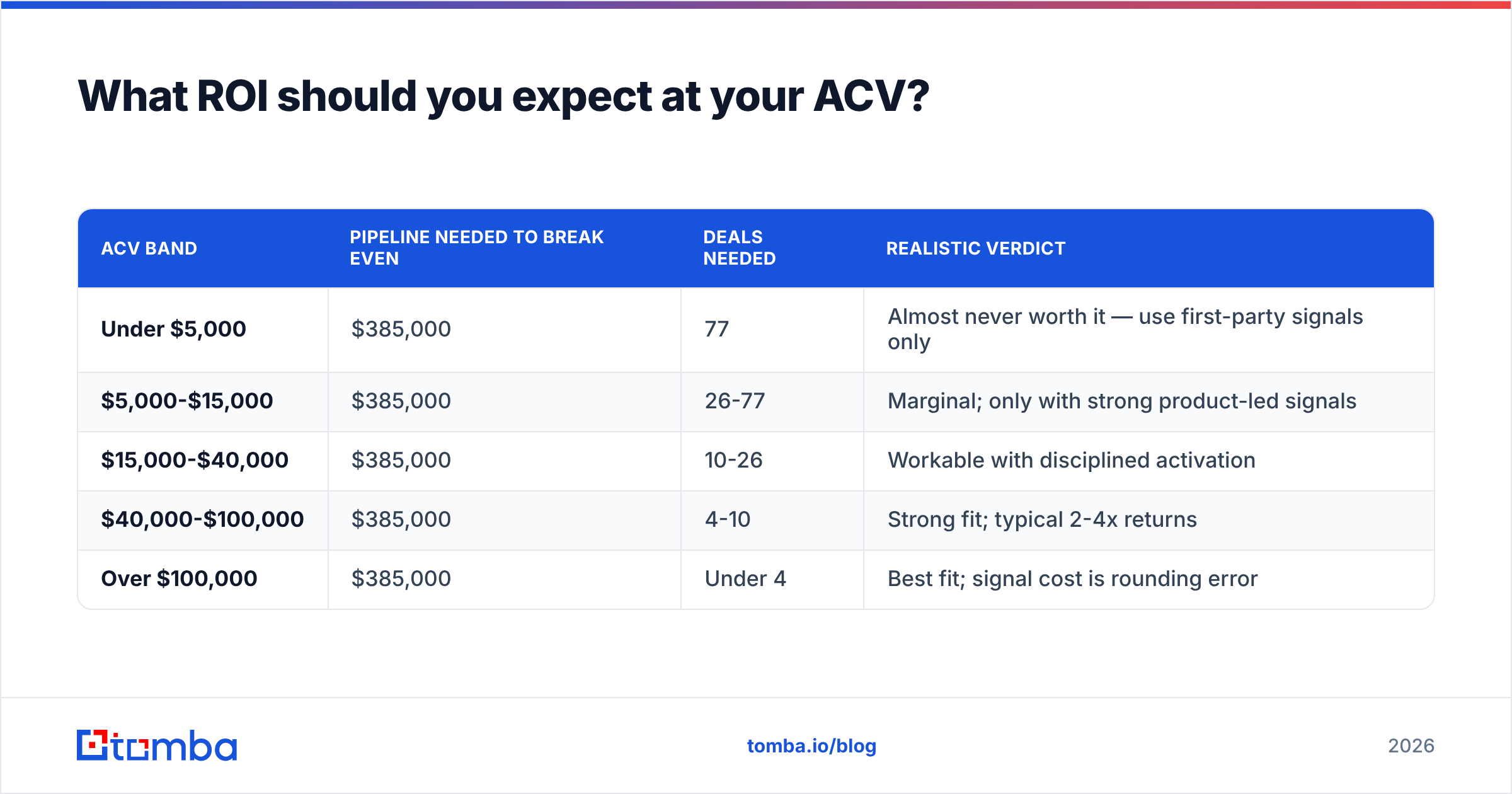
Modeled break-even at $77K all-in annual cost, 20% win rate, with the incremental pipeline required to justify the spend.
| ACV band | Pipeline needed to break even | Deals needed | Realistic verdict |
|---|---|---|---|
| Under $5,000 | $385,000 | 77 | Almost never worth it — use first-party signals only |
| $5,000-$15,000 | $385,000 | 26-77 | Marginal; only with strong product-led signals |
| $15,000-$40,000 | $385,000 | 10-26 | Workable with disciplined activation |
| $40,000-$100,000 | $385,000 | 4-10 | Strong fit; typical 2-4x returns |
| Over $100,000 | $385,000 | Under 4 | Best fit; signal cost is rounding error |
The pattern is blunt. Below roughly $15K ACV, the volume of incremental deals you need is larger than most mid-market teams can physically work. Above $40K, you only need a handful of extra deals and the program pays for itself on one good quarter.
This is why the same intent vendor produces glowing case studies and quiet churn at the same time. Both are true — they're just describing different ACV bands.
Which intent signals pay back fastest?#
Not all signals are equal. Ranked by observed signal-to-opportunity efficiency:
- First-party website behavior on pricing/comparison pages — highest intent density, zero subscription cost if you already have analytics. Pair it with website visitor reveal to convert anonymous sessions into named accounts you can actually work.
- Review-site category activity (G2, Capterra, TrustRadius) — strong because the buyer is explicitly comparing vendors. G2 sells this directly and it's usually the highest-conviction third-party feed you can buy.
- Job postings and hiring signals — cheap, public, and predictive for tools tied to headcount or new function builds. Often free via scraping public boards.
- Technographic change — a company adding or dropping an adjacent tool. High precision, low volume.
- Topic-based content consumption (co-op bidstream) — the biggest category by spend and the noisiest. Useful for prioritization, weak as a trigger on its own.
- Funding and M&A events — not intent, but excellent timing triggers with near-zero cost.
Notice that three of the six cost you nothing beyond the labor to operationalize them. Before you sign a $40K contract, exhaust the free tier of intent: your own site, your own product usage, public hiring data, and funding news. Teams that skip this step routinely pay for signals they were already generating.
Analysts at Forrester and Gartner have made the same point for years — buying groups leave traces across many surfaces, and the cheapest traces are usually the ones on your own property.
Does intent data work without good contact data?#
No. This is the most common reason intent programs underperform their model.
A surge signal is account-level. Your rep needs a person-level entry point: the VP of Engineering who owns the budget, the ops manager who'll run the evaluation, maybe a director who's been vocal about the problem on LinkedIn. If the handoff from "account is surging" to "here are three verified contacts in a sequence" takes more than a few minutes per account, the program dies of friction regardless of signal quality.
Three things fix the gap:
- Automated contact discovery on signal fire. When an account crosses your surge threshold, trigger a domain search against it to pull the relevant roles and email patterns automatically. This turns a 20-minute manual task into an API call.
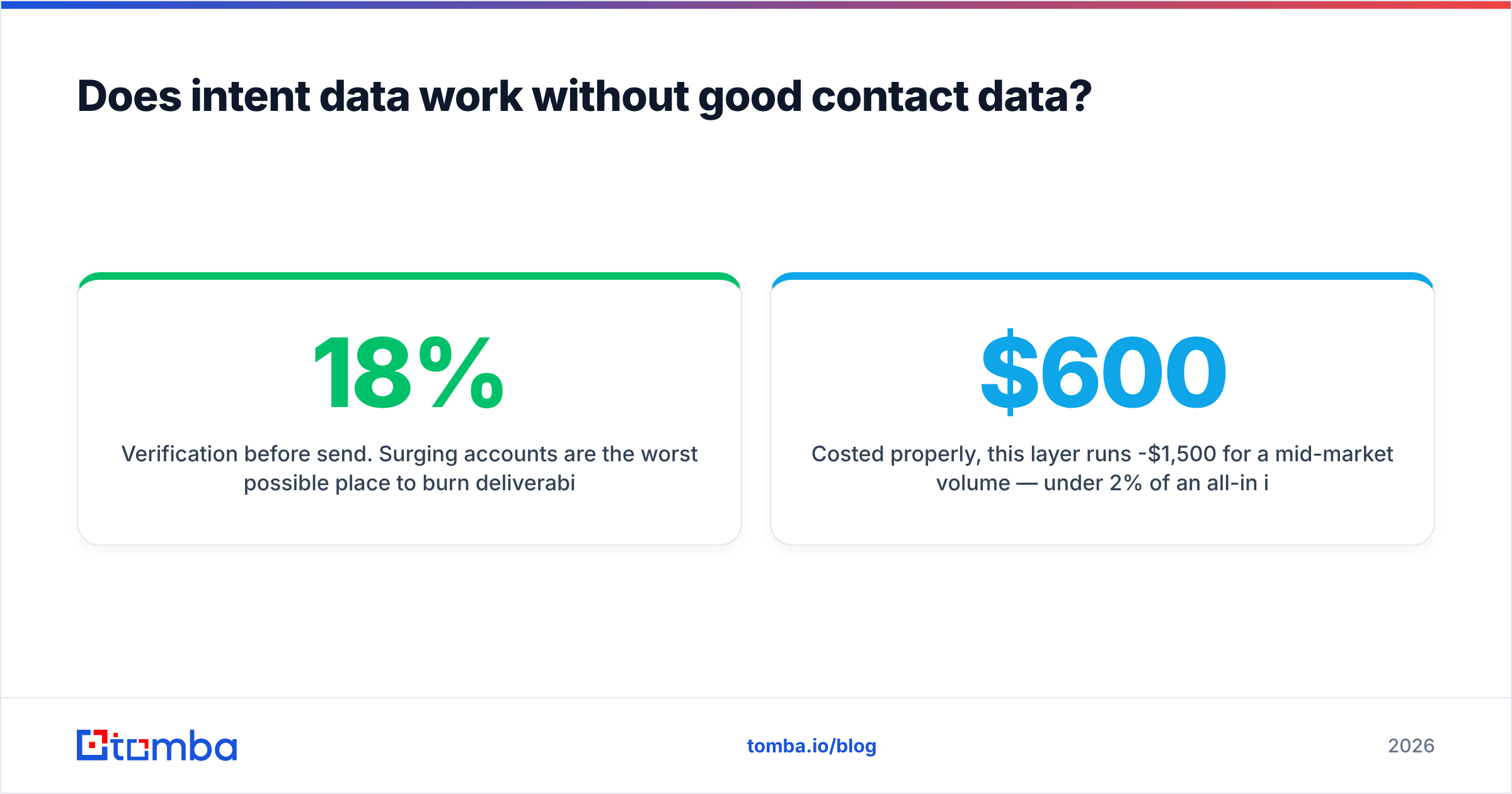
- Verification before send. Surging accounts are the worst possible place to burn deliverability. Run every address through an email verifier before it enters a sequence — bounce rates on stale enriched data routinely hit 12-18%, which will damage your domain right when it matters.
- Enrichment for routing. Firmographic and role data on the contacts determines whether the account goes to SDR outbound, AE direct, or a nurture track. Contact enrichment at the moment of signal keeps routing rules honest.
Costed properly, this layer runs $600-$1,500/year for a mid-market volume — under 2% of an all-in intent program. It's the highest-leverage 2% in the stack, because it's what converts a dashboard into an email in someone's inbox.
When should you skip intent data entirely?#
Skip it — or delay it — if any of these are true:
- Your TAM is under 2,000 accounts. You can afford to work all of them. Prioritization software solves a problem you don't have.
- Your ACV is under $5,000. The break-even deal count exceeds realistic capacity, as the table above shows.
- Your inbound response time is over 24 hours. Fix that first. Inbound is the highest-intent signal in existence and it's free. Buying more signals while ignoring the ones already raising their hand is spending money to create a longer queue.
- You don't have a working outbound motion. Intent data amplifies an existing process; it does not create one. If your sequences convert at 0.5%, better targeting gets you to 0.8% — on a base that doesn't matter.
- Nobody owns activation. If there's no named person responsible for turning signals into plays, the feed becomes a dashboard nobody opens by month three. This is the most common quiet failure.
The honest framing: intent data is a prioritization tool for teams with more accounts than capacity. If capacity isn't your constraint, you're buying a solution to someone else's problem. Get your revenue operations foundation and contact data layer solid first — those compound regardless of whether you ever buy a signal feed.
How do you run a 90-day intent data ROI pilot?#
Don't sign an annual contract to find out. Structure a pilot that produces a number.
- Week 0 — baseline. Record current pipeline creation rate per 100 target accounts, current SDR hours per opportunity, and current win rate by segment. Without a baseline there is no ROI, only anecdotes.
- Week 1 — build the holdout. Randomly split surging accounts 70/30. The 30% gets your normal treatment. Do not let reps see which is which.
- Weeks 1-2 — wire the contact layer. Signal fires, contacts get found and verified automatically, sequence enrolls. If this is manual, your pilot measures your ops team's stamina, not the data.
- Weeks 2-12 — track the cost side daily. Log SDR hours spent on the intent queue. This is the number everyone forgets and it decides the outcome.
- Week 13 — compute and stress-test. Run the six-step formula. Then re-run with win rate at 70% and lift at 70%. If both scenarios stay positive, negotiate the annual.
- Negotiate from evidence. A pilot with real numbers is the strongest pricing leverage you'll ever have. Vendors discount hard against a documented marginal ROI.
Ninety days and a spreadsheet is a cheap price for not guessing on a $77K annual decision.
Where should you start?#
Start with the layer that pays back regardless of what you decide about signals: the contact data underneath them.
Every intent program, every ABM play, and every account-based sequence eventually bottoms out at the same question — who do I email at this company, and is the address real? Tomba's Email Finder answers it at the account level via domain search, verifies before send, and plugs into your CRM or routing workflow through the API so signal-to-sequence happens without a human in the loop. The free tier covers 25 searches a month to test the workflow; paid plans start at $49/month, which is roughly 0.06% of a typical all-in intent budget. See Tomba pricing for the full breakdown.
Build that layer first. Then, if your ACV justifies it, buy the signals — and measure them honestly.
Related guides#
// get started
Find, verify and enrich your first contacts today
Start on the free plan with 25 searches a month, then scale when your team is ready.
Free plan · No credit card required · GDPR & CCPA
// about the author