Intent Data Tools in 2026: What They Do and Which to Pick
Intent data tools promise to show you who is in-market before they ever fill out a form. Here's what the 2026 vendors actually detect, what they really cost, and how to turn a surge signal into a sent email.
TL;DR
- Intent data tools tell you which accounts are researching your category right now. They do not tell you who to email, and that gap is where most programs die.
- There are three usable sources: first-party (your own site and product), second-party (review sites like G2 and Capterra), and third-party co-op networks (Bombora and its resellers). Their accuracy and price differ by an order of magnitude.
- Expect $12k–$60k/year for a serious third-party intent subscription, and effectively $0 for first-party signals you already own but probably aren't using.
- Account-level intent is the norm. Contact-level intent is mostly marketing language — you still need to resolve the account into named humans with valid inboxes.
- The highest-ROI setup for most teams under 50 reps: first-party visitor identification + a review-site feed + a contact layer that turns the account into verified emails.
What is intent data, exactly?#
Intent data is behavioral evidence that an account is researching a problem you solve, collected before that account raises its hand.
Think of it like a bookstore owner watching which shelf a customer lingers at. The customer hasn't bought anything and hasn't spoken to you. But they've read three chapters of the same book on four separate visits, and that's a better predictor of a sale than anything on their business card.
In practice, "intent" is a score attached to an account (a domain), derived from content consumption: articles read, keywords searched, competitor pages visited, review-site comparisons opened, ad interactions. A vendor watches a network of publisher sites, resolves visitor IPs and cookieless identifiers to companies, baselines each company's normal reading volume, and flags a surge when consumption on a topic jumps above that baseline.
The important structural fact: almost everything sold as intent data is account-level, not person-level. A vendor tells you that acme.com surged on "data warehouse migration" this week. It rarely tells you that Priya in platform engineering read the article — and when it claims to, you should ask hard questions about consent and source.
What are the three types of intent data?#
Every tool on the market is a packaging of one or more of these. Knowing which you're buying stops you from paying enterprise prices for something you already generate.
- First-party intent — behavior on properties you control: pricing page visits, docs traffic, repeat sessions, in-product feature usage, support searches. It's the most accurate signal you will ever get and it costs nothing beyond the tooling to identify anonymous traffic. Most companies leave 95% of it on the floor because they only act on form fills.
- Second-party intent — behavior on a third party's property that they sell you directly, most commonly review marketplaces. When someone compares you against a competitor on G2 or Capterra, that platform knows the company and will sell you the alert. Small volume, very high quality, and the buying stage is late.
- Third-party co-op intent — behavior across a large publisher network, aggregated and anonymized. Bombora runs the dominant data co-op; a large share of "intent" features inside other platforms is Bombora under the hood, resold. Huge coverage, weekly cadence, noisier, and the same signal is sold to your competitors.
- Technographic and hiring signals — not intent in the strict sense, but often bundled and frequently more actionable: a new job posting for a "Salesforce admin," a tracker appearing or disappearing from a site, a funding round. These are events with clear timing, which is exactly what intent scores usually lack.
- Bidstream intent — derived from programmatic ad auction logs. Cheap, enormous volume, and legally uncomfortable in several jurisdictions. Several vendors quietly stopped using it; ask directly whether it's in the mix.
Which intent data tools matter in 2026?#
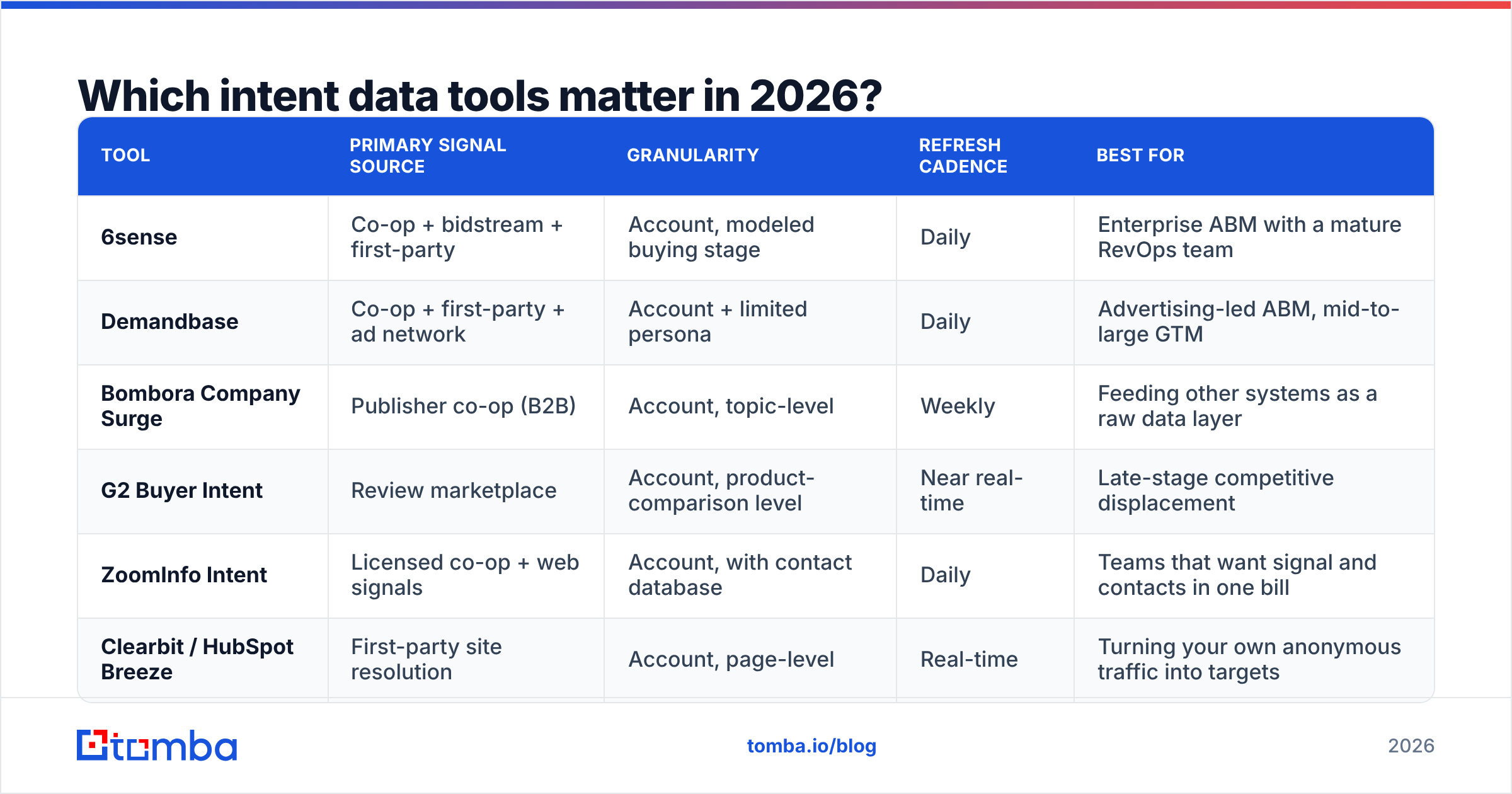
The market has consolidated into three shapes: big ABM platforms that bundle intent into orchestration, pure data providers that sell the feed, and lightweight tools that surface first-party signals. Here's how the main options compare on the attributes that actually change your workflow.
| Tool | Primary signal source | Granularity | Refresh cadence | Best for |
|---|---|---|---|---|
| 6sense | Co-op + bidstream + first-party | Account, modeled buying stage | Daily | Enterprise ABM with a mature RevOps team |
| Demandbase | Co-op + first-party + ad network | Account + limited persona | Daily | Advertising-led ABM, mid-to-large GTM |
| Bombora Company Surge | Publisher co-op (B2B) | Account, topic-level | Weekly | Feeding other systems as a raw data layer |
| G2 Buyer Intent | Review marketplace | Account, product-comparison level | Near real-time | Late-stage competitive displacement |
| ZoomInfo Intent | Licensed co-op + web signals | Account, with contact database | Daily | Teams that want signal and contacts in one bill |
| Clearbit / HubSpot Breeze | First-party site resolution | Account, page-level | Real-time | Turning your own anonymous traffic into targets |
Two honest caveats. First, several of these resell the same underlying co-op, so running two of them side by side often produces correlated "confirmation" rather than independent validation. Second, topic taxonomies differ wildly — one vendor's "cybersecurity" bucket may contain 40 subtopics, another's may contain 400. Ask for the taxonomy file before you sign, not after.
How much do intent data tools cost?#
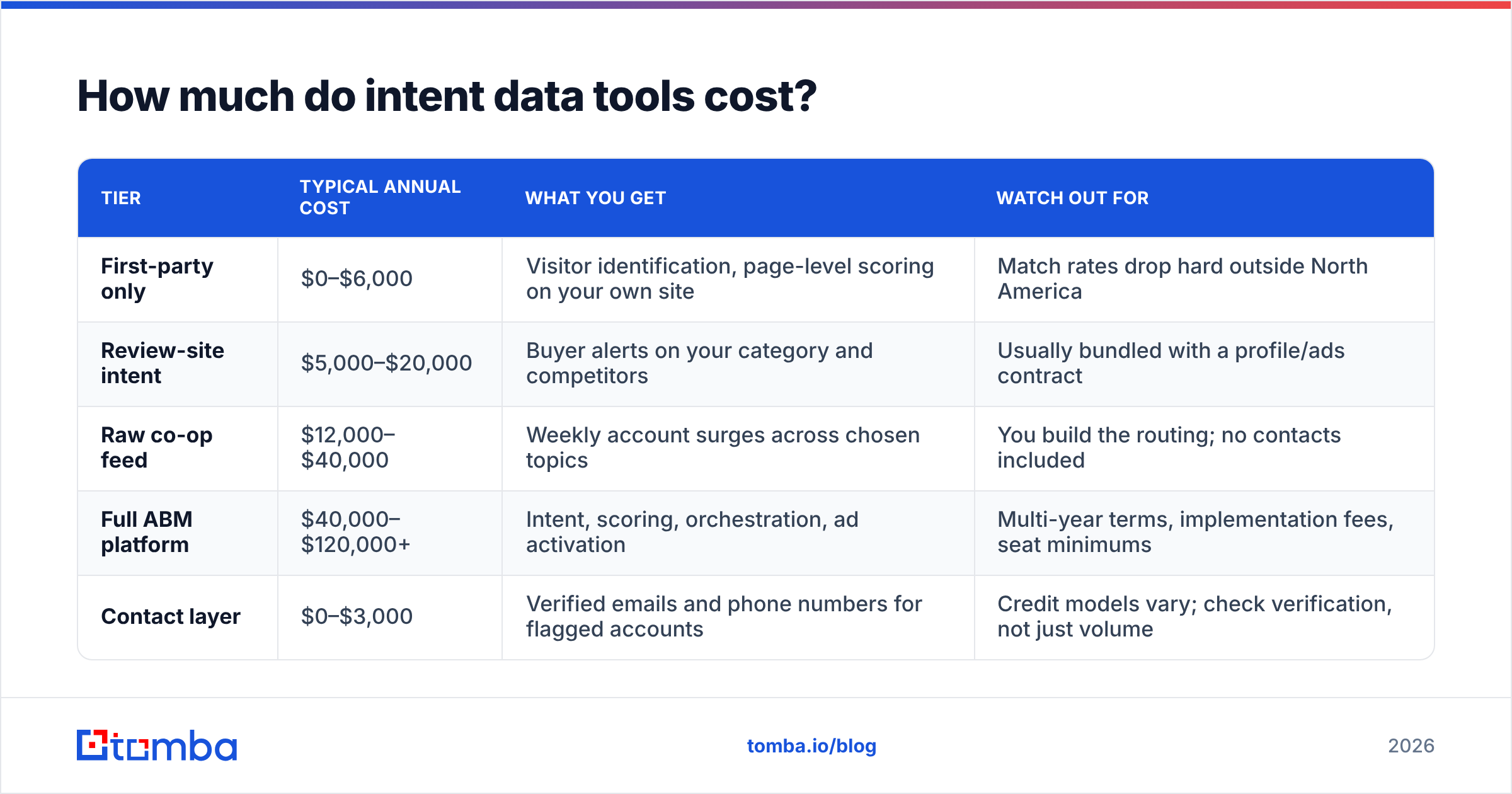
Public pricing is rare in this category, and that's deliberate. Based on publicly reported ranges and marketplace listings, here's the realistic shape of the market. Treat these as negotiating anchors, not quotes.
| Tier | Typical annual cost | What you get | Watch out for |
|---|---|---|---|
| First-party only | $0–$6,000 | Visitor identification, page-level scoring on your own site | Match rates drop hard outside North America |
| Review-site intent | $5,000–$20,000 | Buyer alerts on your category and competitors | Usually bundled with a profile/ads contract |
| Raw co-op feed | $12,000–$40,000 | Weekly account surges across chosen topics | You build the routing; no contacts included |
| Full ABM platform | $40,000–$120,000+ | Intent, scoring, orchestration, ad activation | Multi-year terms, implementation fees, seat minimums |
| Contact layer | $0–$3,000 | Verified emails and phone numbers for flagged accounts | Credit models vary; check verification, not just volume |
The line item most teams underestimate is the last one. A surge alert on acme.com has zero cash value until someone opens an email. If you spend $40k on signals and nothing on resolving those accounts into deliverable inboxes, you've bought a very expensive spreadsheet.
Does intent data actually work?#
Yes, conditionally — and the condition is that you already have a tight ICP.
Intent data is a prioritization tool, not a discovery tool. Applied to a well-defined list of 3,000 accounts you'd happily sell to, it tells you which 120 to work this month, and that's genuinely valuable: teams that sequence intent-flagged accounts first typically report meaningfully higher connect and meeting rates than round-robin territory work. Analyst coverage from Gartner has consistently placed intent and buying-group identification among the higher-impact ABM investments, while also flagging that outcomes depend on process maturity rather than the feed itself.
Applied to the open market with no ICP filter, intent data mostly surfaces large enterprises. Big companies have more employees reading more content, so naive surge scoring rewards headcount. If your flagged-account list is suspiciously full of Fortune 500 logos you've never sold to, your baseline normalization is doing nothing and you're paying to be told that IBM has a lot of employees.
Three tests before you renew:
- Lift test. Split your target list. Work half by intent priority, half by your existing method. Compare meetings booked per 100 accounts after one quarter.
- Precision test. Take last quarter's closed-won deals. How many were flagged by the tool before the first meeting? If the answer is under a third, the feed is trailing your pipeline, not leading it.
- Latency test. For a weekly-cadence co-op feed, ask when the underlying behavior occurred. A signal delivered 11 days after the research happened arrives after the shortlist is set.
What breaks when you buy intent data?#
The tool rarely fails. The handoff does. Four failure patterns account for most wasted spend.
The signal has no owner. Intent lands in a marketing dashboard, reps never see it, and by the time it appears in a QBR the surge is three weeks cold. Fix: route surges into the CRM as tasks with an SLA, not as a score field nobody sorts by.
The account is flagged but nobody is named. This is the single most common gap. You know acme.com is researching your category; you have one stale contact from 2023 who has since left. Account-level intent is only as good as your contact coverage, which is why an email finder and a fresh data enrichment step belong in the same workflow as the intent feed, not in a separate quarter's project.
The messaging ignores the signal. A rep receives "surging on SOC 2 automation" and sends the same generic intro they send everyone. The entire value of intent is that it licenses a specific opening line. If the sequence doesn't reference the topic, you've paid for personalization you didn't use.
Bounce rates eat the experiment. Intent programs push reps to email accounts they've never touched, using contact records of unknown age. Bounce rates spike, domain reputation drops, and the program gets blamed for the deliverability damage. Verify before send, every time — a scored surge list run through a proper email verifier protects the sending infrastructure the whole program depends on.
How do you turn an intent signal into a sent email?#
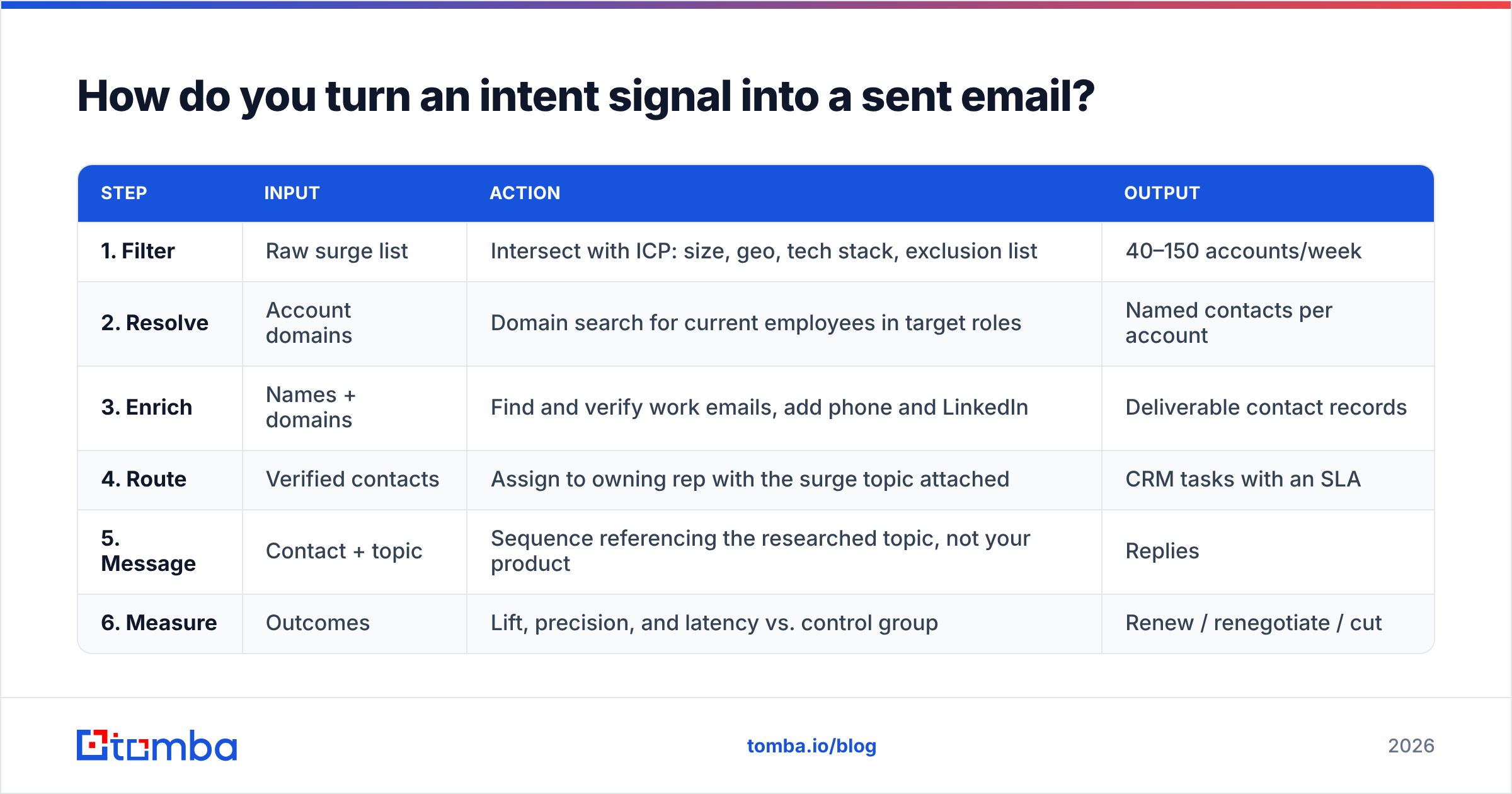
Here's the pipeline that works, end to end. Each step is boring, which is the point.
| Step | Input | Action | Output |
|---|---|---|---|
| 1. Filter | Raw surge list | Intersect with ICP: size, geo, tech stack, exclusion list | 40–150 accounts/week |
| 2. Resolve | Account domains | Domain search for current employees in target roles | Named contacts per account |
| 3. Enrich | Names + domains | Find and verify work emails, add phone and LinkedIn | Deliverable contact records |
| 4. Route | Verified contacts | Assign to owning rep with the surge topic attached | CRM tasks with an SLA |
| 5. Message | Contact + topic | Sequence referencing the researched topic, not your product | Replies |
| 6. Measure | Outcomes | Lift, precision, and latency vs. control group | Renew / renegotiate / cut |
Steps 2 and 3 are where most stacks have a hole. Once you have a domain, a domain search returns the people currently listed at that company with the roles you care about, and a verification pass confirms the mailbox exists before anything sends. If you're operating at volume, doing this through the Tomba API inside the same job that ingests the intent feed means a surge never sits in a queue waiting for someone to manually look up addresses.
Worth noting on the contact side: if your ICP skews toward industries with thin public web presence, a curated database purchase can outperform discovery-based lookup. Providers like BookYourData are a reasonable fit there, and pairing a curated list with live verification gives you both coverage and freshness. The two approaches complement each other more than they compete.
For first-party intent specifically, the resolution step happens earlier — website visitor reveal turns anonymous sessions on your pricing page into named companies, which is the highest-intent signal in the entire stack and the one you're least likely to be paying for.
Which intent data tool should you pick?#
Match the tool to your stage, not to the analyst quadrant.
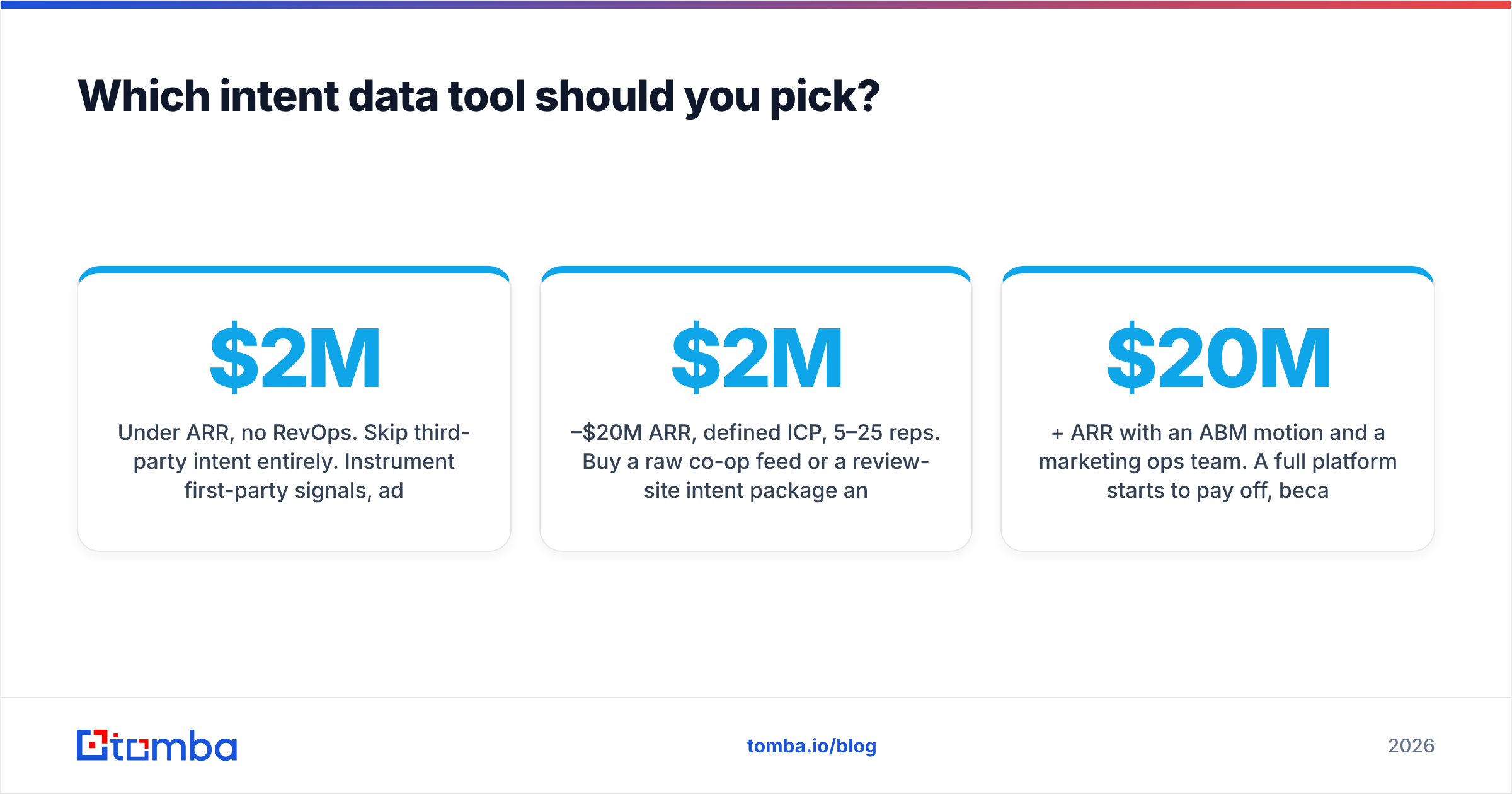
- Under $2M ARR, no RevOps. Skip third-party intent entirely. Instrument first-party signals, add a review-site alert feed if you have profiles, and spend the saved budget on contact data and sequencing. You do not have enough account volume to justify a co-op subscription.
- $2M–$20M ARR, defined ICP, 5–25 reps. Buy a raw co-op feed or a review-site intent package and wire it yourself. You want the signal, not the orchestration layer. Budget roughly 20% of the spend for the contact-resolution step.
- $20M+ ARR with an ABM motion and a marketing ops team. A full platform starts to pay off, because the value shifts from the signal to the orchestration — ad activation, buying-group modeling, and CRM-native scoring. Negotiate the taxonomy and the data-export rights, not just the price.
- Product-led with heavy traffic. Your product and docs generate better intent than anything you can buy. Prioritize identity resolution and in-product signals; third-party feeds will mostly duplicate what you already know.
One rule regardless of tier: never let the intent contract exceed the budget for acting on it. Signals with no sequencing capacity, no verified contacts, and no rep ownership are a subscription to regret.
Ready to turn surging accounts into real conversations?#
Intent tells you which company is in-market. It won't tell you who to email, and it won't guarantee the address you have still works. That last mile is what decides whether your intent investment shows up in pipeline or in a dashboard nobody opens.
Tomba Email Finder closes it: feed it a surging domain and the roles you're targeting, and get back current, verified work emails ready to sequence — with bulk processing and an API for teams automating the whole loop. Start on the free tier with 25 searches a month to test it against your own intent feed, then scale on Starter at $49/mo or Growth at $99/mo. Full Tomba pricing is public, so you can budget the contact layer before you sign the signal contract.
Related guides#
// get started
Find, verify and enrich your first contacts today
Start on the free plan with 25 searches a month, then scale when your team is ready.
Free plan · No credit card required · GDPR & CCPA
// about the author