How to Use Intent Data for Upsell and Cross-Sell in 2026
Expansion revenue is mostly a timing problem, not a persuasion problem. Here is how to turn first-party and third-party intent signals into upsell and cross-sell plays your reps will actually run.
Good intent data upsell cross sell plays hinge on timing, not on a better pitch. This guide covers which signals to trust, who should own each one, and how to keep the contact data clean enough to act on.
TL;DR
- Upsell and cross-sell fail on timing far more than on pitch. Intent data fixes timing, not wording.
- First-party signals beat bought third-party surges. Start with product use, support tickets, and pricing-page visits from a customer.
- Third-party intent earns its cost in big accounts, where many buyers never touch your product.
- Every signal needs three fields before it is a play: who to call, which email still works, and what the next step is.
- Budget for the dull part. A hot account routed to a dead inbox books nothing.
What Is Intent Data Upsell Cross Sell Targeting?#
Intent data is proof that an account is reading up on, testing, or about to buy something. Point it at cold accounts and it tells you who is in market. Point it at your current customers and it does something better. It tells you who is about to spend more, with you or with a rival.
That second part matters. Say a customer starts reading about data enrichment, workflow tools, or whatever nearby thing you happen to sell. One of two things is about to happen. They buy it from you, or they buy it elsewhere and you find out at renewal. Intent data is what turns that coin flip into a process.
The mental model: intent data is the check-engine light on your install base. It does not tell you what is wrong, and it is sometimes wrong itself. But ignoring it because "the car seems fine" is how you end up with a churn post-mortem instead of a bigger deal. In technical terms, it is a stream of scored, account-level behavior events. The check-engine framing is the one that gets budget.
What Types of Intent Signals Matter for Existing Customers?#
Not all signals deserve the same response. Rank them by how close they sit to a purchase, and by how cheaply you can see them.
- Product usage signals. Seats above 85% used, API rate-limit hits, repeat tries at a locked feature. These are the strongest growth signals there are, and they are free. Send your feature-gate events to your CRM.
- Commercial-surface signals. A logged-in customer on your pricing page, your enterprise tier, or your security docs. That is not idle browsing. It is budget planning.
- Support and success signals. Tickets that describe a workaround your paid tier solves. New job titles in your queue mean the product spread before the contract did.
- Third-party topic surges. Anonymous research across publisher networks, tied back to a company. Weakest per signal, but the only view of buyers who never log in.
- Org-change signals. New hires in your category, a new VP, funding, M&A. These reset the buying group.
The first three are first-party. You own them already, and you are probably wasting them. Signals four and five are the ones you buy.

Is First-Party or Third-Party Intent Data Better for Expansion?#
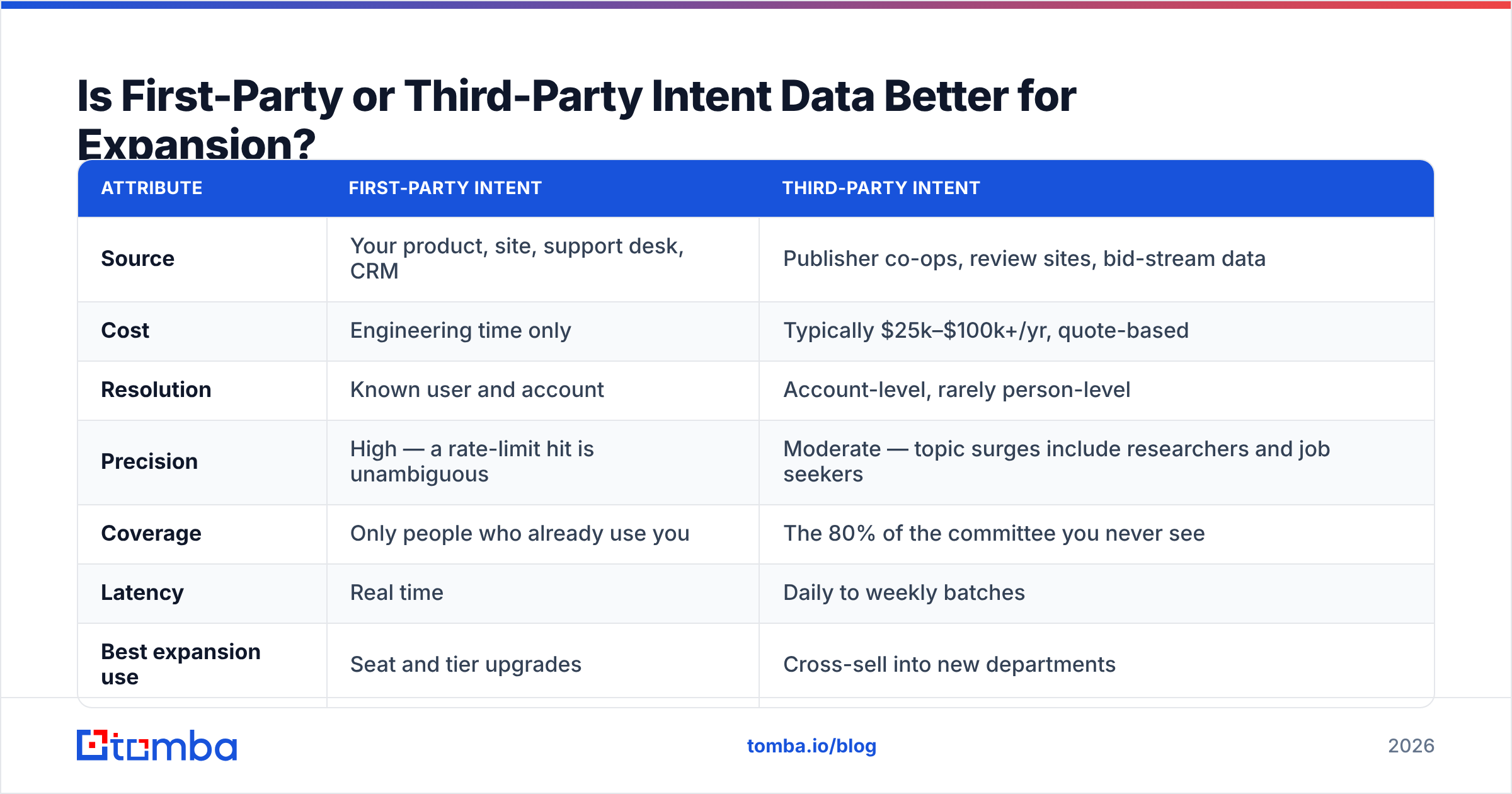
For current customers, first-party wins on accuracy and third-party wins on reach. You need both in the end. You need first-party first.
| Attribute | First-party intent | Third-party intent |
|---|---|---|
| Source | Your product, site, support desk, CRM | Publisher co-ops, review sites, bid-stream data |
| Cost | Engineering time only | Typically $25k–$100k+/yr, quote-based |
| Resolution | Known user and account | Account-level, rarely person-level |
| Precision | High — a rate-limit hit is unambiguous | Moderate — topic surges include researchers and job seekers |
| Coverage | Only people who already use you | The 80% of the committee you never see |
| Latency | Real time | Daily to weekly batches |
| Best expansion use | Seat and tier upgrades | Cross-sell into new departments |
The common mistake is buying third-party intent to make up for never wiring up the first-party kind. That means paying a vendor to tell you an account likes a topic, while your own logs show that account hitting a feature gate forty times a week. Wire up what you own. Then buy reach for what you truly cannot see.
Worth noting: third-party quality varies a lot by vendor and by how the data is picked up. Bombora built the first publisher co-op. 6sense adds scoring on top of several sources. G2 sells intent from real category and comparison-page views on its own review site. G2 data is narrower but very literal. Someone weighing you against a rival on a review page is a different animal from someone reading a blog post.
How Do You Turn an Intent Signal Into an Actual Play?#
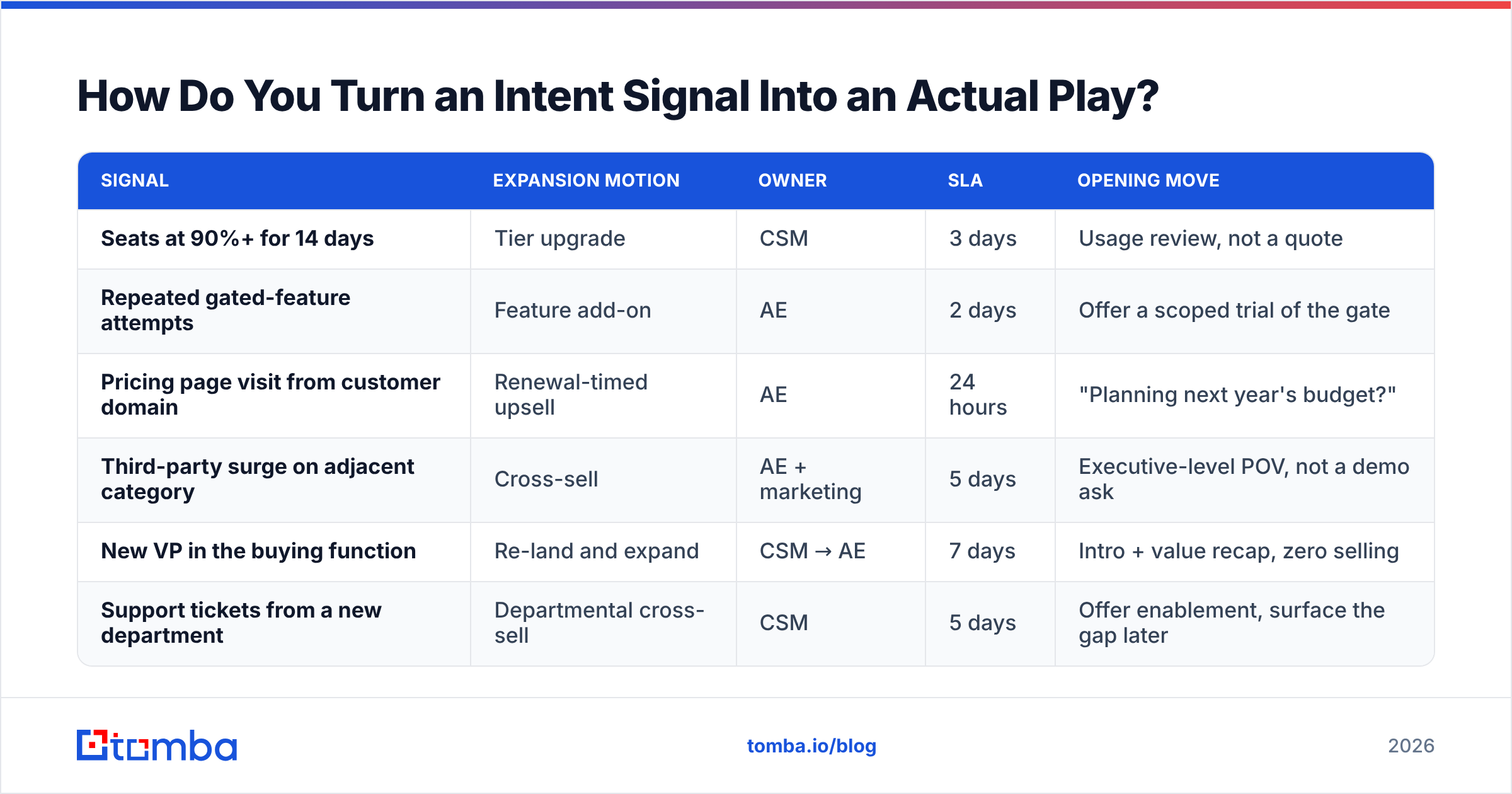
A signal with no owner, no deadline, and no message is just a dashboard widget. The mapping below is what an intent data upsell cross sell program looks like once it is real work.
| Signal | Expansion motion | Owner | SLA | Opening move |
|---|---|---|---|---|
| Seats at 90%+ for 14 days | Tier upgrade | CSM | 3 days | Usage review, not a quote |
| Repeated gated-feature attempts | Feature add-on | AE | 2 days | Offer a scoped trial of the gate |
| Pricing page visit from customer domain | Renewal-timed upsell | AE | 24 hours | "Planning next year's budget?" |
| Third-party surge on adjacent category | Cross-sell | AE + marketing | 5 days | Executive-level POV, not a demo ask |
| New VP in the buying function | Re-land and expand | CSM → AE | 7 days | Intro + value recap, zero selling |
| Support tickets from a new department | Departmental cross-sell | CSM | 5 days | Offer enablement, surface the gap later |
Two things make this table work. First, the SLA column. Intent decays fast, and a surge you act on three weeks late is just a cold call. Second, the opening move. Note how few of them are "send a quote." Plays aimed at current customers fail when they feel like the vendor got an alert. They work when they feel like someone noticed a problem.
Gartner has said for years that B2B buyers spend little of their buying time with vendors at all. That holds for growth deals as much as new ones. Intent data does not get you in the room sooner. It tells you the room exists.
Why Does Contact Data Quality Decide Whether Intent Data Pays Off?#
Because an account-level signal ends in a person-level action. That is where most intent programs quietly bleed out.
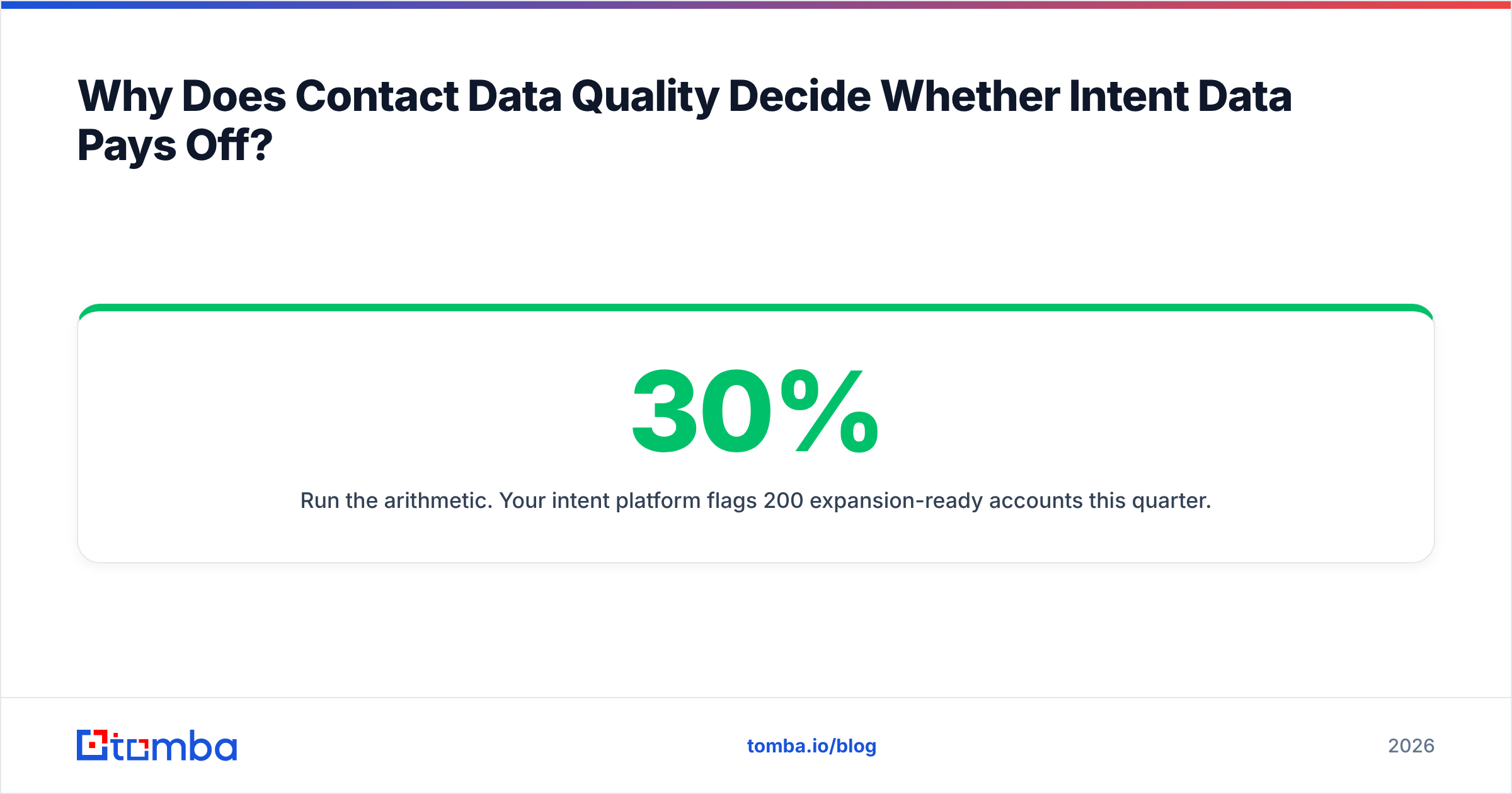
Run the math. Your platform flags 200 ready accounts this quarter. Roughly a quarter of your saved contacts there changed jobs in the past year. B2B contact lists rot at 2% to 3% a month, and that adds up fast. More emails bounce because the person stayed but the format changed after a merger. You send 200 sequences. Sixty land in dead mailboxes. Your bounce rate spikes past the spam-filter line, and the 140 good ones now land worse, because your sender score took the hit.
The intent data was fine. The last mile killed it.

Three fixes, in order of impact:
- Re-verify before every send, not once a quarter. An email verifier pass over the flagged accounts costs a sliver of a credit per record, and it guards every other email you send.
- Find the new buyers, do not just mail the old ones. When a surge fires, the person doing the reading is often not your champion. A domain search across the account surfaces the roles that own that budget.
- Add role and seniority, not just email. A signal sent to the wrong level converts far worse. Contact enrichment returns title, team, and LinkedIn profile, so you can route by role instead of by whoever sits in the CRM.
At volume, wire this into the workflow instead of doing it by hand. The Tomba API can verify and enrich the contacts for a flagged account in the same job that creates the task. Then a rep never opens a record with a stale email in it.
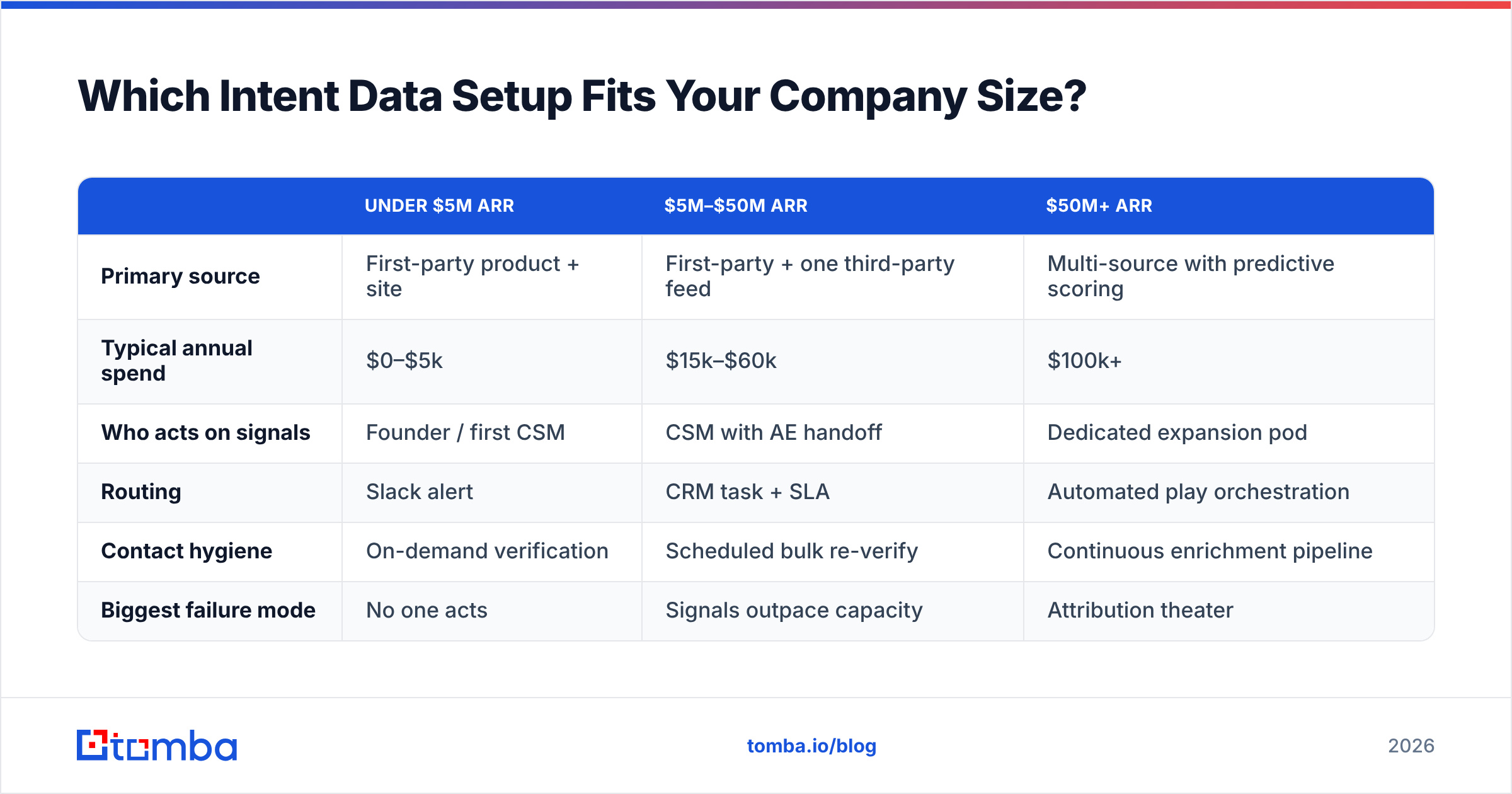
Which Intent Data Setup Fits Your Company Size?#
There is no one right answer here, and vendors will tell you otherwise. Match the spend to the shape of your install base.
| Under $5M ARR | $5M–$50M ARR | $50M+ ARR | |
|---|---|---|---|
| Primary source | First-party product + site | First-party + one third-party feed | Multi-source with predictive scoring |
| Typical annual spend | $0–$5k | $15k–$60k | $100k+ |
| Who acts on signals | Founder / first CSM | CSM with AE handoff | Dedicated expansion pod |
| Routing | Slack alert | CRM task + SLA | Automated play orchestration |
| Contact hygiene | On-demand verification | Scheduled bulk re-verify | Continuous enrichment pipeline |
| Biggest failure mode | No one acts | Signals outpace capacity | Attribution theater |
Under $5M ARR, buying a third-party feed is almost always too early. You do not have enough accounts for topic surges to mean much, and you have not wired up the first-party signals that would be stronger anyway. Spend that money on contact accuracy, and on reading your own product logs.
At the top end, the failure mode flips. Big teams buy great data, then spend two quarters arguing about whether intent won the deal. Pick your credit rule before the pilot starts, and stop reopening it.
For contact data, the market splits into prospecting tools that bundle intent, plain databases, and specialist finders. BookYourData does well with verified, pay-as-you-go lists when you know which accounts you want. That is a fair match for a feed that tells you which accounts to pull. Tomba sits on the accuracy and API side: Tomba pricing starts free at 25 searches a month, then $49, $99, and $249 a month. Cheap enough to verify every flagged account instead of rationing it.
How Do You Measure Whether Intent Data Is Working?#
Measure the machine, not just the outcome. Outcome-only measures take a year and end in an argument.
Track these four, every week:
- Signal-to-touch rate. Of the signals that fired, how many got a human action in time? Under 70% means you have a routing problem, not a data problem.
- Touch-to-meeting rate versus a control. Hold back a random 10% of flagged accounts and work them as usual. It is the only honest read you will get.
- Bounce rate on intent-triggered sends. Your canary. A rising bounce rate here means your contact list is rotting faster than you clean it.
- Deal cycle length. The real win from intent data is usually speed, not volume. Deals you would have won, closed a month sooner.
What not to track as a headline number: raw surge volume. Vendors love it, it predicts nothing, and it climbs when you add topics.
What Are the Most Common Intent Data Mistakes?#
Treating a surge as a buying signal. A topic surge means someone at the account is reading. It could be a consultant, a job seeker, or a rival's analyst. Trust comes from stacking signals, not from any one of them.
Selling the signal back to the customer. Never open with "I saw your team has been reading about X." It sounds like spying, and it puts the buyer on guard. Use the signal to pick the timing and the topic. Then lead with a normal, useful reason to talk.
Routing to the champion by default. Growth budget often sits with someone your CSM has never met. If the surge is about a nearby category, find the person who owns it.
Ignoring the bad news. Falling usage, a champion who left, tickets about a rival's integration — the same pipe that catches growth catches churn risk. Teams that score only the upside throw away half of what they paid for. HubSpot and most modern CRMs let you build both scores off one event stream.
Buying before you wire up. Said it above, saying it again, because it is the costliest mistake on this list.
Where Should You Start This Quarter?#
Pick one motion. Wire up the first-party signal behind it. Give it an owner and a deadline. Verify the contacts before the first send. Run that intent data upsell cross sell play for a quarter against a holdout. Only then decide whether a paid feed adds reach you truly lack.
The part teams underfund is the last mile. It turns an account signal into a real person, with a live inbox and the power to spend. That is where intent programs go to die, and it is the cheapest thing on the list to fix.
Start there. Use the Tomba Email Finder to find and verify the right contact at every account your intent data flags, so the signal you paid for ends in a delivered email instead of a bounce. The free tier covers 25 searches a month if you want to test the flow on one play first.
Related guides#
// get started
Find, verify and enrich your first contacts today
Start on the free plan with 25 searches a month, then scale when your team is ready.
Free plan · No credit card required · GDPR & CCPA
// about the author