What Is an Intent Database? A Practical 2026 Buyer's Guide
An intent database promises to tell you which accounts are in-market right now. Here is how the signal types differ, what the data actually costs, where accuracy breaks down, and how to turn a spike into a sent email.
TL;DR
- An intent database is a store of behavioral signals — content consumption, review-site activity, ad engagement, website visits — mapped to companies so you can guess who is shopping before they fill in a form.
- Third-party intent (Bombora-style co-op data) is broad but fuzzy. First-party intent (your own site, your own product) is narrow but far more reliable. Most teams need both.
- Expect account-level accuracy, not person-level. Almost no intent database tells you who at Acme read the buying guide — you still have to find that person and their email.
- Budget realistically: intent is usually a $15k–$60k/year line item on top of your CRM and data stack, and it only pays back if you have the outbound motion to act on it within days.
- The signal is worthless without a deliverable contact. Pairing intent with an accurate email finder is what turns "Acme is researching" into a booked meeting.
What is an intent database?#
An intent database is a repository of behavioral events — page views, content downloads, search queries, review-site comparisons, ad clicks — that have been resolved to a company (and occasionally a person), scored, and made queryable so revenue teams can prioritize accounts showing buying behavior.
Think of it like a hardware store owner watching the parking lot. She can't read minds, but she notices the same contractor's truck has circled three times this week and lingered by the lumber section. That's not a purchase order. It's a reason to walk outside and say hello. An intent database is that parking-lot view, industrialized across millions of companies.
The mechanics are less magical than the marketing suggests. A vendor gets access to a publisher network — trade sites, B2B media, review platforms, ad exchanges — and observes anonymous traffic. It resolves IP addresses, cookies, and hashed emails back to company records. It compares this week's consumption of a topic like "data warehouse migration" against that company's own 12-week baseline. When consumption spikes above baseline, the account is flagged as "surging."
Three words matter in that sentence: company, baseline, and surging. Intent data is almost always account-level, always relative to a rolling historical average, and always probabilistic. Nobody is telling you a VP signed a requisition. They're telling you the noise floor at that company went up.
What kinds of intent signals actually exist?#
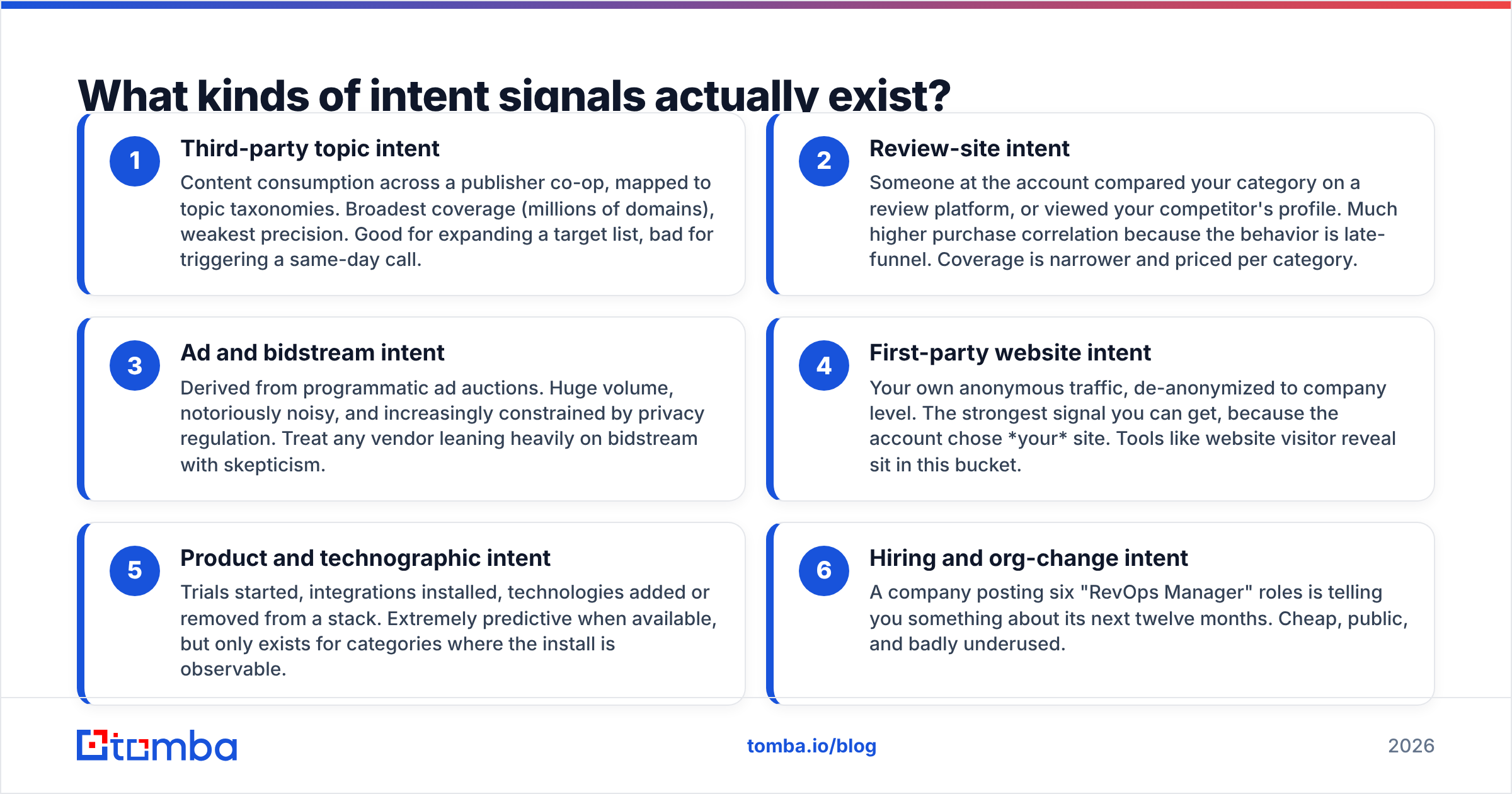
Not all intent is the same, and vendors deliberately blur the categories. Sort them by how close the signal sits to an actual purchase decision:
- Third-party topic intent — Content consumption across a publisher co-op, mapped to topic taxonomies. Broadest coverage (millions of domains), weakest precision. Good for expanding a target list, bad for triggering a same-day call.
- Review-site intent — Someone at the account compared your category on a review platform, or viewed your competitor's profile. Much higher purchase correlation because the behavior is late-funnel. Coverage is narrower and priced per category.
- Ad and bidstream intent — Derived from programmatic ad auctions. Huge volume, notoriously noisy, and increasingly constrained by privacy regulation. Treat any vendor leaning heavily on bidstream with skepticism.
- First-party website intent — Your own anonymous traffic, de-anonymized to company level. The strongest signal you can get, because the account chose your site. Tools like website visitor reveal sit in this bucket.
- Product and technographic intent — Trials started, integrations installed, technologies added or removed from a stack. Extremely predictive when available, but only exists for categories where the install is observable.
- Hiring and org-change intent — A company posting six "RevOps Manager" roles is telling you something about its next twelve months. Cheap, public, and badly underused.
Most teams that get burned by intent data bought category 1 and expected category 4 behavior. The expectation gap, not the data quality, is usually what kills the renewal.
How accurate is an intent database, really?#
Honest answer: accuracy is unmeasurable in the way vendors imply, and you should distrust anyone quoting a single percentage.
Here's why. If an intent database flags Acme as surging on "email deliverability" and Acme buys nothing, was the data wrong? Maybe an intern was writing a blog post. Maybe a buying committee researched for four months and picked an incumbent. Maybe the signal was right and your outreach was bad. There's no clean ground truth, which is precisely why the category tolerates so much hand-waving.
What you can measure is lift. Run a controlled test: take 400 accounts flagged as surging and 400 matched control accounts from the same ICP, run identical sequences, and compare meeting rates over 60 days. Good intent data produces a 1.5x–3x lift in reply and meeting rate. Weak intent data produces noise indistinguishable from random. Gartner and other analysts have pushed vendors toward this kind of measurement for years, and the better ones will now run the test with you during a pilot. If a vendor refuses, that's your answer.
Two structural accuracy problems are worth knowing before you sign:
IP resolution decay. Remote and hybrid work destroyed the clean office-IP-to-company mapping that intent resolution was built on. Coverage for companies under 200 employees is meaningfully worse than the demos suggest. Ask for match-rate data segmented by company size, not a blended number.
Topic taxonomy mismatch. Vendors ship thousands of predefined topics. Your actual category may map to three of them badly. Spend the pilot mapping topics to your real buying triggers — this is the single highest-leverage configuration work and almost nobody does it properly.
Which intent database should you choose in 2026?#
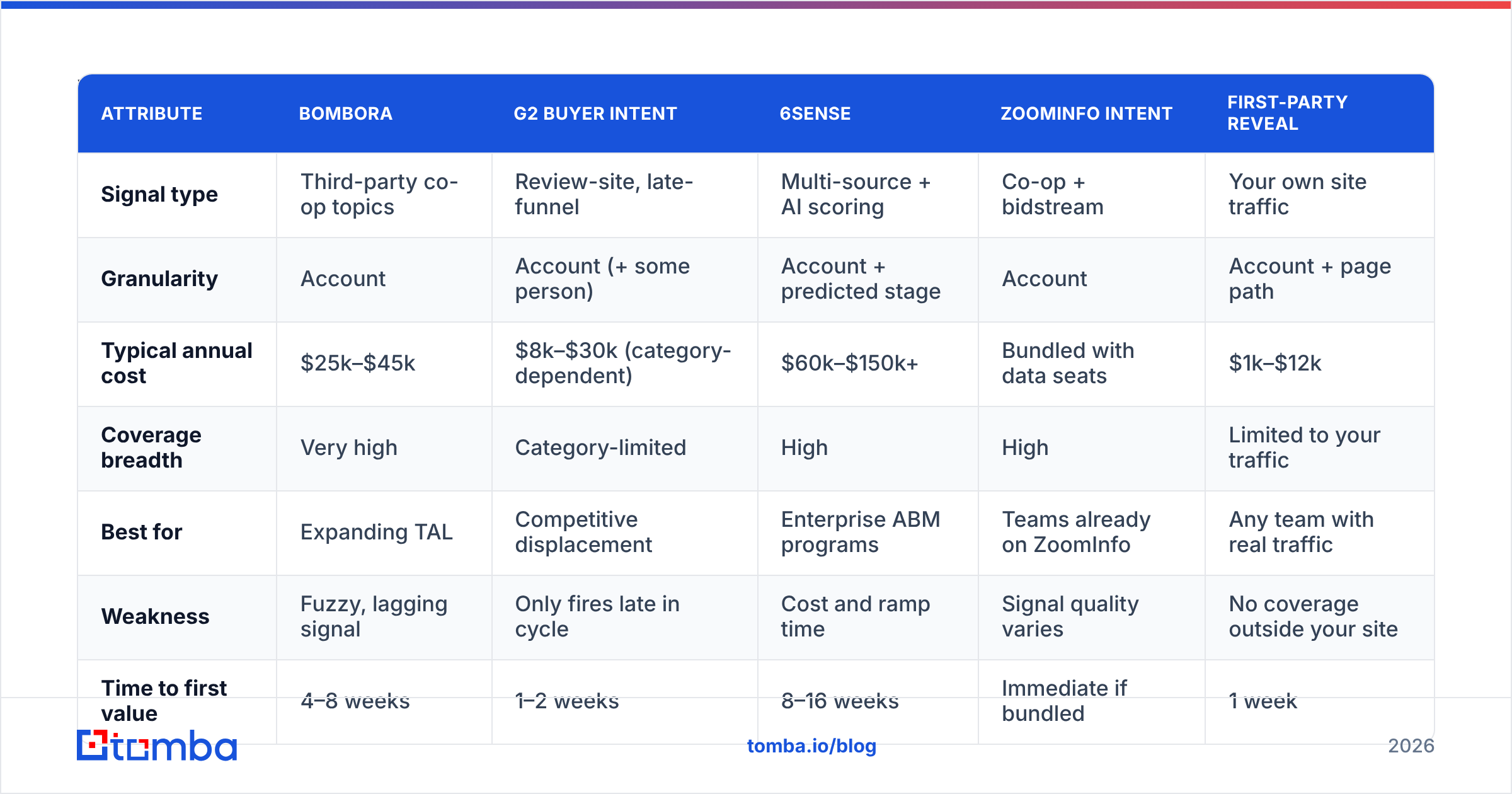
There's no universal winner. The right choice depends on whether you need breadth, late-funnel precision, or a full orchestration platform. Pricing below reflects commonly reported ranges for mid-market contracts — every one of these is negotiable and list pricing is rarely published.
| Attribute | Bombora | G2 Buyer Intent | 6sense | ZoomInfo Intent | First-party reveal |
|---|---|---|---|---|---|
| Signal type | Third-party co-op topics | Review-site, late-funnel | Multi-source + AI scoring | Co-op + bidstream | Your own site traffic |
| Granularity | Account | Account (+ some person) | Account + predicted stage | Account | Account + page path |
| Typical annual cost | $25k–$45k | $8k–$30k (category-dependent) | $60k–$150k+ | Bundled with data seats | $1k–$12k |
| Coverage breadth | Very high | Category-limited | High | High | Limited to your traffic |
| Best for | Expanding TAL | Competitive displacement | Enterprise ABM programs | Teams already on ZoomInfo | Any team with real traffic |
| Weakness | Fuzzy, lagging signal | Only fires late in cycle | Cost and ramp time | Signal quality varies | No coverage outside your site |
| Time to first value | 4–8 weeks | 1–2 weeks | 8–16 weeks | Immediate if bundled | 1 week |
A few notes that don't fit in a table. G2 intent is the most consistently defensible purchase for teams doing competitive displacement, because the behavior it captures — someone actively comparing vendors — is unambiguous. Bombora is the underlying data source for a surprising number of other products, so check whether you're about to buy the same co-op data twice through two different vendors. And 6sense-class platforms are less "intent databases" than orchestration suites; if you only want signal, you'll overpay for the parts you won't configure.
For contact data itself — the names and emails at the accounts intent flags — the market is separate. Providers like BookYourData and Tomba's own B2B database operate on a different axis: they answer who works there and how do I reach them, not are they shopping. You need both halves.
What does an intent database actually cost to run?#
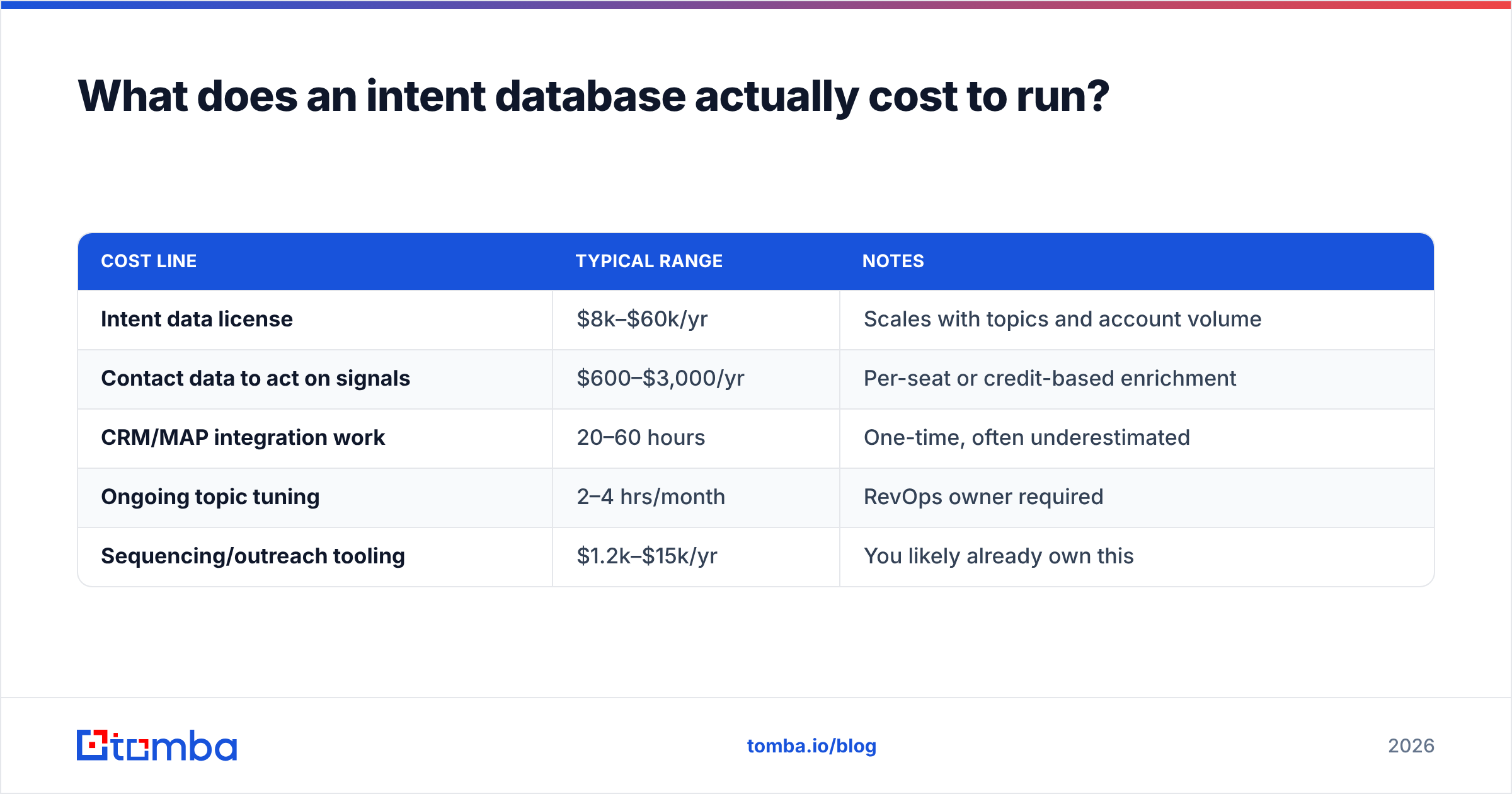
The license fee is the smallest line item. Build the real number before you approve the spend:
| Cost line | Typical range | Notes |
|---|---|---|
| Intent data license | $8k–$60k/yr | Scales with topics and account volume |
| Contact data to act on signals | $600–$3,000/yr | Per-seat or credit-based enrichment |
| CRM/MAP integration work | 20–60 hours | One-time, often underestimated |
| Ongoing topic tuning | 2–4 hrs/month | RevOps owner required |
| Sequencing/outreach tooling | $1.2k–$15k/yr | You likely already own this |
The hidden cost is attention. An intent feed that nobody triages becomes a dashboard nobody opens within about six weeks. Before buying, name the person who will look at the surging-accounts list every Monday morning and assign it. If you can't name them, don't buy the data.
How do you turn an intent signal into a sent email?#
This is where most intent programs quietly fail. The database says "Acme, surging on 'SOC 2 compliance,' score 82." That's an account. You cannot email an account.
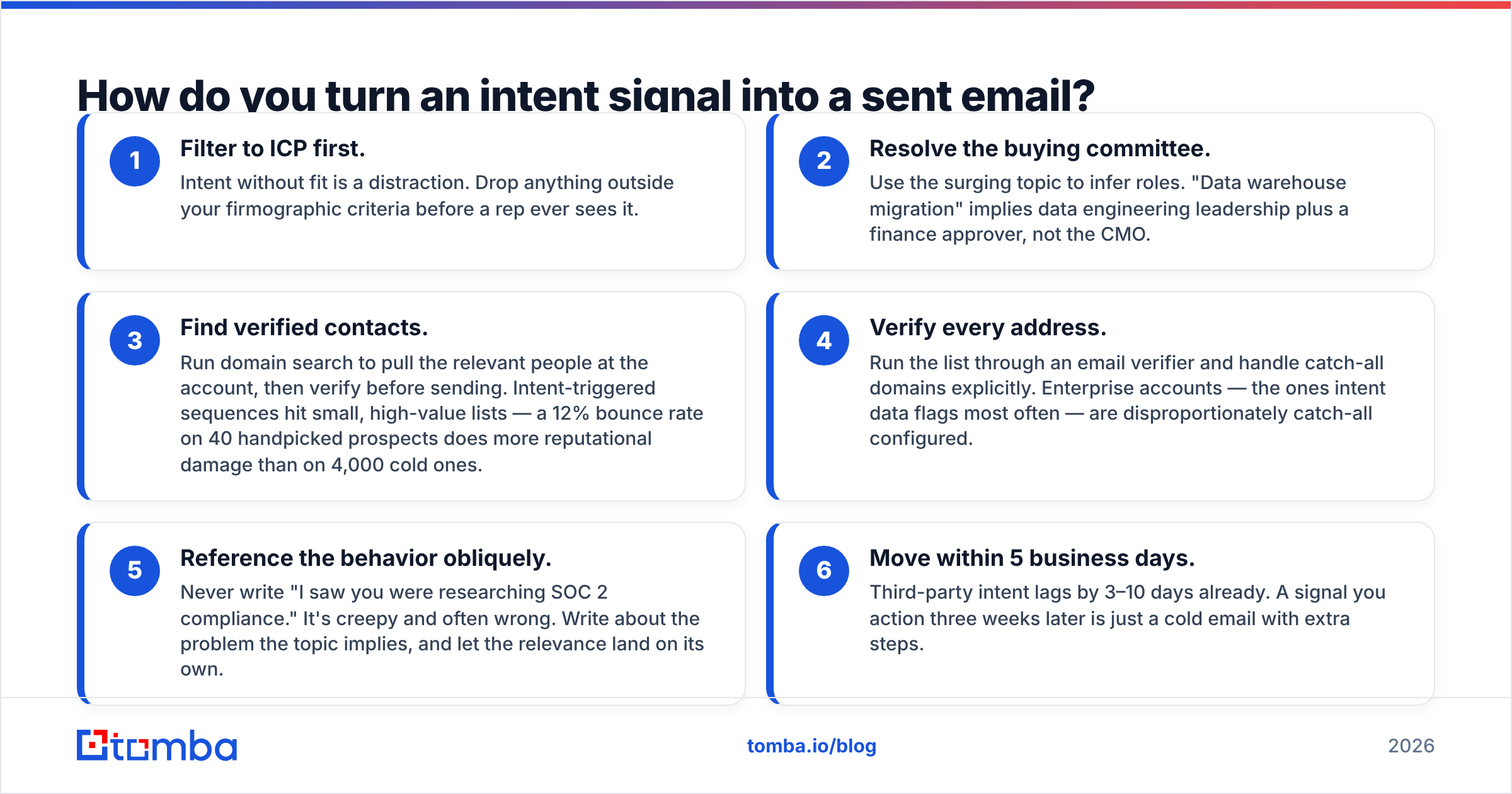
The workflow that actually closes the loop:
- Filter to ICP first. Intent without fit is a distraction. Drop anything outside your firmographic criteria before a rep ever sees it.
- Resolve the buying committee. Use the surging topic to infer roles. "Data warehouse migration" implies data engineering leadership plus a finance approver, not the CMO.
- Find verified contacts. Run domain search to pull the relevant people at the account, then verify before sending. Intent-triggered sequences hit small, high-value lists — a 12% bounce rate on 40 handpicked prospects does more reputational damage than on 4,000 cold ones.
- Verify every address. Run the list through an email verifier and handle catch-all domains explicitly. Enterprise accounts — the ones intent data flags most often — are disproportionately catch-all configured.
- Reference the behavior obliquely. Never write "I saw you were researching SOC 2 compliance." It's creepy and often wrong. Write about the problem the topic implies, and let the relevance land on its own.
- Move within 5 business days. Third-party intent lags by 3–10 days already. A signal you action three weeks later is just a cold email with extra steps.
When is an intent database the wrong purchase?#
Skip it — or defer it — in these situations:
Your outbound engine isn't working yet. Intent data amplifies an existing motion; it doesn't create one. If your cold sequences get a 0.4% reply rate on well-fit accounts, intent will move that to maybe 1%. Fix the offer and the messaging first.
Your TAM is under ~2,000 accounts. If you can name every plausible buyer, prioritization software is solving a problem you don't have. Spend the money on research and account plans instead.
Nobody owns triage. Covered above, worth repeating. Unowned signal is shelfware.
Your sales cycle is under two weeks. Third-party intent's latency eats most of your cycle. First-party reveal still works fine here; co-op topic data does not.
Conversely, intent earns its keep when you have a large addressable market, a considered purchase with a 60–180 day cycle, a functioning SDR or founder-led outbound motion, and someone in RevOps who will actually tune the topic taxonomy quarterly.
What should you ask a vendor before signing?#
Bring these to the demo and write down the answers:
- What percentage of your signal is bidstream-derived, and how has that changed since 2024?
- What's your match rate for companies with 20–200 employees, specifically?
- Will you run a 60-day controlled lift test with a matched holdout during the pilot?
- How many days of latency between the observed behavior and the flag appearing in my feed?
- Can I export the account list with domains, or am I locked into your UI?
- What happens to my historical signal data if I churn?
That last one catches people. Several platforms treat accumulated intent history as their asset, not yours. Get the export terms in writing.
Where does this leave you?#
An intent database is a prioritization tool, not a lead source. It reorders a list you already have; it doesn't hand you a pipeline. Teams that internalize that get real lift from it. Teams that expect it to replace prospecting churn out within a year and blame the data.
The practical sequence is: define ICP, build the target account list, layer intent to reorder it, then find and verify the humans you're actually going to contact. That last step is the one that gets skipped, and it's the one that determines whether the signal ever becomes revenue.
Ready to close the loop? Intent tells you which account to work. Tomba Email Finder tells you exactly who to reach and whether the address will land — with verification built in, catch-all handling, and an API that drops straight into your intent workflow. Start free with 25 searches a month, or scale from $49/mo on Starter; see full Tomba pricing for Growth and Pro tiers.
Related guides#
// get started
Find, verify and enrich your first contacts today
Start on the free plan with 25 searches a month, then scale when your team is ready.
Free plan · No credit card required · GDPR & CCPA
// about the author