Intent Driven Sales Prospecting: A Practical 2026 Playbook
Intent data promises to tell you who is buying right now. Most teams still waste it. Here is how intent driven sales prospecting actually works, what the signals are worth, and where it breaks.
TL;DR
- Intent driven sales prospecting means sequencing accounts by observed buying behavior — research spikes, job posts, tech changes, site visits — instead of static firmographics.
- The signal is worth almost nothing on its own. Value comes from the speed at which you turn "Account X is researching Y" into a named contact with a verified email in an inbox.
- Third-party intent (Bombora-style topic surges) is broad and noisy. First-party intent (your own site, docs, pricing page) is narrow and high-converting. Most teams should start with first-party.
- Budget realistically: an intent feed runs $12k–$60k/year. The contact layer that makes it actionable costs a fraction of that — Tomba's Growth plan is $99/mo.
- The failure mode is almost never "bad data." It's latency: a 9-day gap between the surge and the first touch, by which point the buyer has already shortlisted three vendors.
What is intent driven sales prospecting?#
Intent driven sales prospecting is the practice of choosing who to contact next based on evidence that an account is currently in a buying cycle, rather than on how well the account matches your ideal customer profile.
Think of it like a fire department. A static ICP list is the map of every building in the city — useful, permanent, and completely silent about which one is burning. Intent data is the smoke detector. It doesn't tell you the building is worth saving; it tells you something is happening right now. You still need the map. You just stop driving around randomly.
Technically, "intent" is an umbrella over four quite different data types:
- First-party intent — behavior on properties you own. Pricing page views, docs traffic, repeat sessions from the same company IP, demo form abandons, webinar attendance. Highest precision, lowest volume.
- Third-party intent — topic-level surges aggregated from publisher co-ops and B2B media networks. Bombora, G2 buyer intent, TrustRadius. Broad coverage, heavy noise, account-level only.
- Technographic and hiring signals — a company installs a competitor's script, drops a tool, or posts a role that implies a project ("Hiring: RevOps Manager, Salesforce migration"). Slow-moving but extremely legible.
- Relationship and engagement intent — someone opens three emails, views your LinkedIn profile twice, or a former customer joins a new company. Cheap, underused, and often the best-converting of the four.
A real intent motion blends at least two. One signal alone produces false positives at a rate that will destroy your team's trust in the system within a quarter.

Which intent signals are actually worth paying for?#
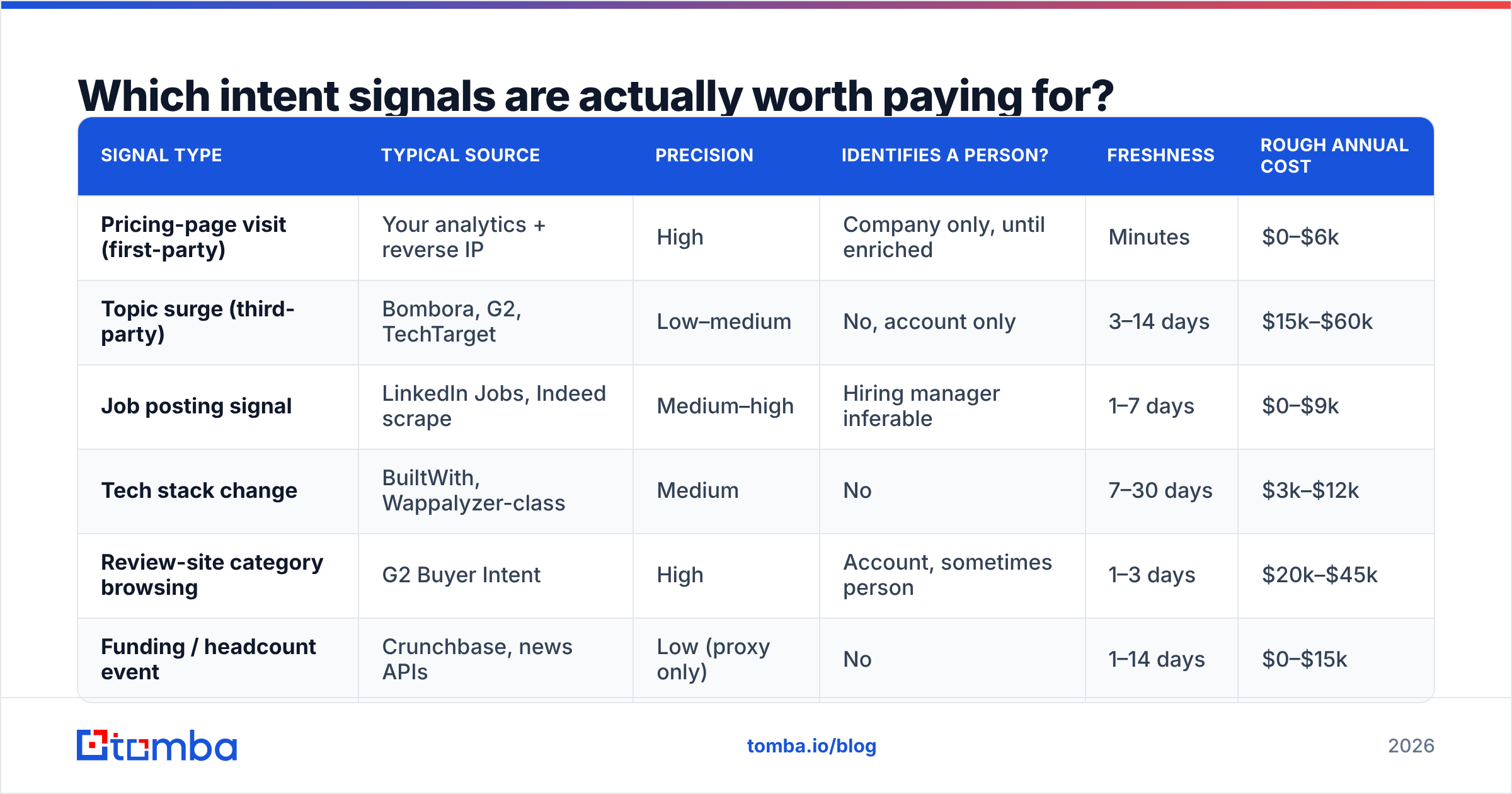
Here's the uncomfortable comparison most vendor decks omit — signal quality versus what it costs to act on it.
| Signal type | Typical source | Precision | Identifies a person? | Freshness | Rough annual cost |
|---|---|---|---|---|---|
| Pricing-page visit (first-party) | Your analytics + reverse IP | High | Company only, until enriched | Minutes | $0–$6k |
| Topic surge (third-party) | Bombora, G2, TechTarget | Low–medium | No, account only | 3–14 days | $15k–$60k |
| Job posting signal | LinkedIn Jobs, Indeed scrape | Medium–high | Hiring manager inferable | 1–7 days | $0–$9k |
| Tech stack change | BuiltWith, Wappalyzer-class | Medium | No | 7–30 days | $3k–$12k |
| Review-site category browsing | G2 Buyer Intent | High | Account, sometimes person | 1–3 days | $20k–$45k |
| Funding / headcount event | Crunchbase, news APIs | Low (proxy only) | No | 1–14 days | $0–$15k |
Two things fall out of that table.
First, precision and person-level identification are different problems. Almost every intent vendor sells you the account. Nearly none of them hands you the four humans on the buying committee with working contact details. That gap is where most intent programs quietly die — the SDR gets "Acme Corp is surging on 'data enrichment'" and then spends 25 minutes on LinkedIn trying to figure out who to write to.
Second, the cheap signals are not the worst signals. A job posting that says "we're standardizing on HubSpot this year" is more actionable than a $40k topic-surge feed telling you Acme's anonymous employees read three articles about CRM.
How do you turn an account signal into a person you can email?#
This is the operational core, and it's four steps:
- Resolve the account — map the surging domain or the reverse-IP hit to a canonical company record. Deduplicate subsidiaries and the inevitable
acme.com/acmecorp.comsplit. - Identify the committee — decide which 3–5 roles matter for this signal. A "SOC 2 compliance" surge implies security and legal; a "cold email deliverability" surge implies demand gen and RevOps.
- Find the contact details — run a domain search against the company to pull known addresses and the dominant email pattern, then use the email finder for the named people you decided on in step 2.
- Verify before sending — bounce rates on intent lists are worse than on curated lists, because you're contacting people you've never touched. Run every address through an email verifier and treat catch-all domains as a separate risk tier.
Steps 3 and 4 should take under two minutes per account. If they take twenty, your intent program has a throughput ceiling that no amount of extra signal will lift.
Is third-party intent data better than first-party?#
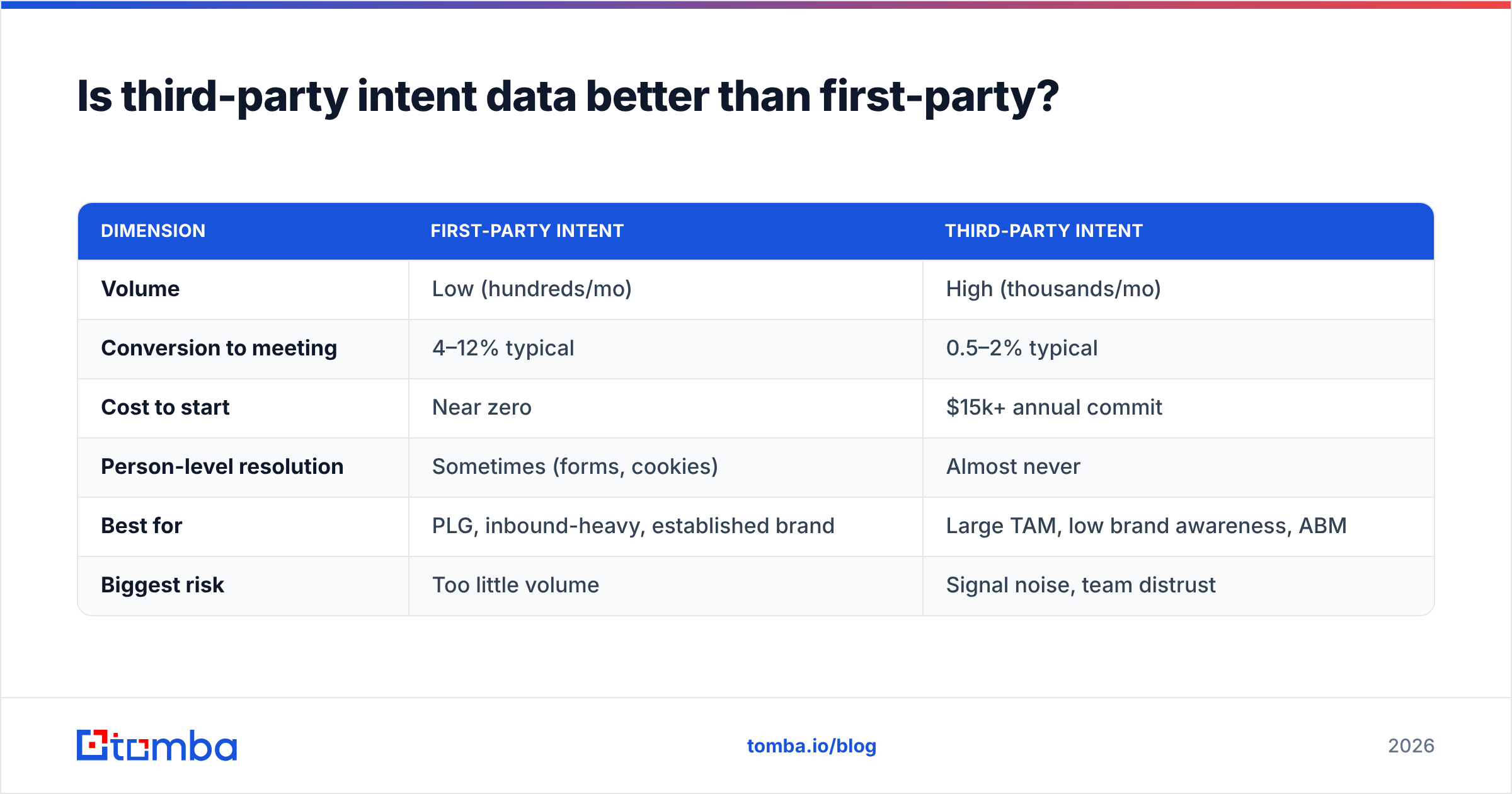
No — and framing it as a contest is the mistake. They answer different questions.
Third-party intent answers "which accounts in my market are in motion?" It's a top-of-funnel prioritization tool for a large TAM. If you sell into 40,000 possible accounts and can only work 400 a month, a topic surge feed is a reasonable way to rank them.
First-party intent answers "which specific humans already know we exist?" It's much smaller and much hotter. A repeat pricing-page visitor converts at multiples of a cold intent-sourced account — Gartner's B2B buying research has consistently shown buyers spend the overwhelming majority of their cycle in independent research before ever contacting a vendor, which means by the time they hit your pricing page they are deep in an evaluation you weren't invited to.
The practical rule: if you have fewer than 5,000 monthly unique visitors, first-party intent alone won't fill a pipeline — you don't have enough traffic. Buy third-party. If you have real traffic, exhaust first-party before you spend $30k on a topic feed, because you're almost certainly leaving identified-but-unworked visitors on the table right now. Tools like website visitor reveal exist specifically to close that gap.
| Dimension | First-party intent | Third-party intent |
|---|---|---|
| Volume | Low (hundreds/mo) | High (thousands/mo) |
| Conversion to meeting | 4–12% typical | 0.5–2% typical |
| Cost to start | Near zero | $15k+ annual commit |
| Person-level resolution | Sometimes (forms, cookies) | Almost never |
| Best for | PLG, inbound-heavy, established brand | Large TAM, low brand awareness, ABM |
| Biggest risk | Too little volume | Signal noise, team distrust |
How fast do you have to act on an intent signal?#
Faster than you think, and the decay is brutal.
Intent signals have a half-life. A pricing page visit is worth something for roughly 48 hours and close to nothing after a week. A topic surge holds value for maybe two weeks. A job posting signal is good for a month because hiring cycles are slow.
The common enterprise pattern — intent feed lands Monday, RevOps enriches Wednesday, list gets loaded into the sequencer Thursday, first send Friday, follow-up the week after — burns most of the value before the first email leaves. By the time you write, the buyer has demoed two competitors.
Three fixes, in order of impact:
- Automate enrichment, not prioritization. Humans are decent at judging which signals matter and terrible at fast, repetitive lookup. Wire your enrichment through an email finder API so contact resolution happens the moment a signal lands, not in a weekly batch.
- Pre-build the plays. Don't write a bespoke email per signal. Have five templates mapped to five signal types, with two variable slots each. A "good enough" email in 4 hours outperforms a perfect one in 6 days.
- Set a hard SLA and measure it. Track signal-to-first-touch as a first-class metric alongside response rate. If your median is above 24 hours for hot signals, fix that before buying more data.

What does an intent driven prospecting workflow look like end to end?#
Here's a workflow that a two-to-six person outbound team can actually run, without a dedicated data engineer.
Monday — signal intake. Pull the week's signals into one table: reverse-IP visits, G2 category views, job postings matching your trigger keywords, and any third-party topic surges. One row per account, one column per signal source. Accounts with two or more signals go to the top.
Monday — committee mapping. For each top account, write down 3–4 target titles. Don't overthink it; you'll reuse the same mapping every week. A "deliverability" trigger always maps to Head of Growth, Demand Gen Manager, and RevOps Lead.
Monday — enrichment. Batch-resolve contacts. This is where the bulk email finder earns its keep: paste 200 domain + name pairs, get back verified addresses, done in one pass instead of 200 manual searches. Push the output straight into your CRM via the HubSpot integration or Salesforce integration so reps see the signal and the contact on the same record.
Tuesday — first touch. Reference the signal obliquely, never explicitly. "Saw you're hiring a RevOps lead" is fine. "Our software noticed you visited our pricing page twice" is creepy and kills deals. The G2 buyer behavior research is clear that buyers dislike feeling surveilled; be useful, not omniscient.
Thursday — second touch, different channel. Phone or LinkedIn. Intent accounts justify multichannel effort in a way cold accounts do not. If you're calling, a phone finder beats guessing at the switchboard.
Following Monday — recycle or retire. Any account that showed no engagement and no new signal goes back to nurture. Intent accounts that stay silent for two weeks are not intent accounts anymore; they're just accounts.
What metrics prove the program is working?#
Track these four, and ignore vanity volume numbers:
- Signal-to-first-touch median (hours). Target: under 24 for first-party, under 72 for third-party.
- Intent-sourced reply rate vs. control cohort. If your intent list doesn't beat a matched non-intent list by at least 1.5x, your signals aren't working or your messaging doesn't reference them.
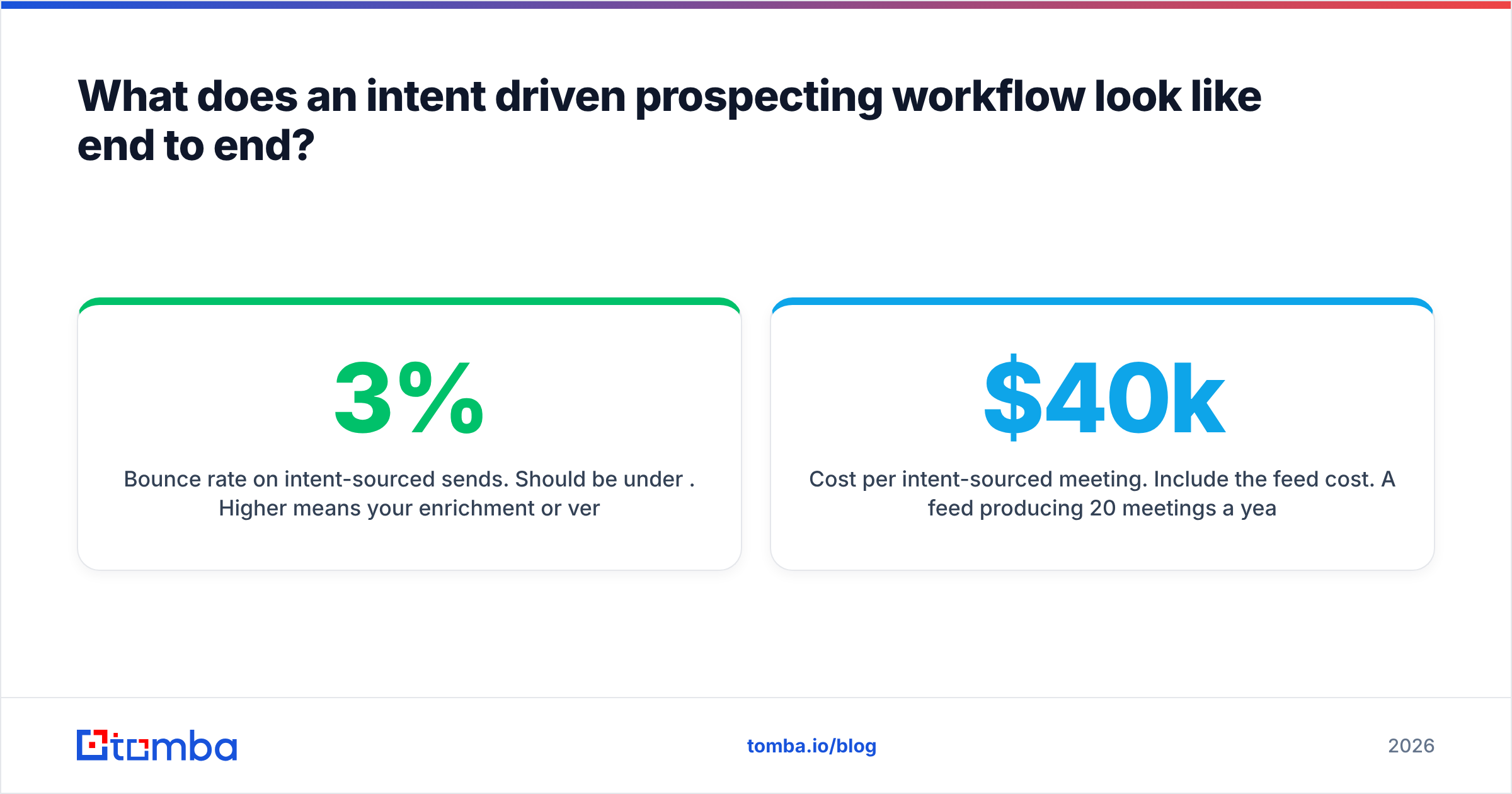
- Bounce rate on intent-sourced sends. Should be under 3%. Higher means your enrichment or verification step is broken, which also drags email deliverability for your entire domain.
- Cost per intent-sourced meeting. Include the feed cost. A $40k feed producing 20 meetings a year is $2,000 a meeting — often worse than just hiring another SDR.
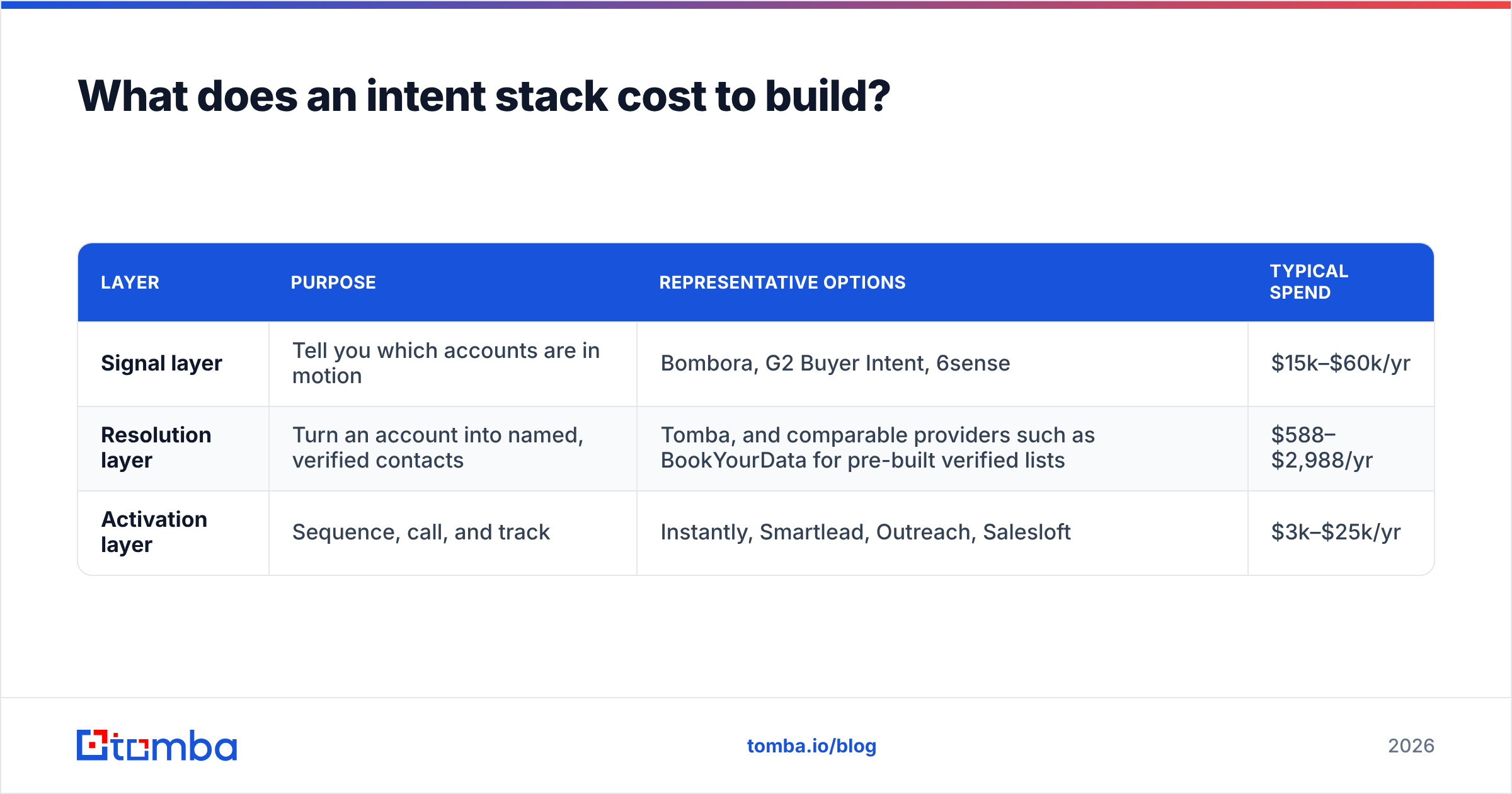
What does an intent stack cost to build?#
You need three layers, and they are priced very differently.
| Layer | Purpose | Representative options | Typical spend |
|---|---|---|---|
| Signal layer | Tell you which accounts are in motion | Bombora, G2 Buyer Intent, 6sense | $15k–$60k/yr |
| Resolution layer | Turn an account into named, verified contacts | Tomba, and comparable providers such as BookYourData for pre-built verified lists | $588–$2,988/yr |
| Activation layer | Sequence, call, and track | Instantly, Smartlead, Outreach, Salesloft | $3k–$25k/yr |
The resolution layer is where the price asymmetry is most striking. Teams routinely spend forty thousand dollars a year on signals and then try to act on them with a $0 contact-finding process built on LinkedIn tabs and guesswork.
For context on the resolution layer, Tomba pricing runs a free tier at 25 searches/month, Starter at $49/mo, Growth at $99/mo, and Pro at $249/mo, with Enterprise custom. For a team working 400 intent accounts a month with 3 contacts each, Growth or Pro covers it — roughly 2–5% of what the signal feed costs. Providers like BookYourData take a different and equally valid route, selling verified list segments outright, which suits teams that prefer a one-time purchase over a search-credit model.
If you're building this into an existing pipeline, the Tomba API and Google Sheets add-on both work fine as the resolution step in an automated intent workflow.
Where does intent driven prospecting fail?#
Five failure modes account for nearly all of the disappointment:
- Buying signal before fixing targeting. If your ICP is fuzzy, intent data amplifies the fuzziness. You'll get surges from accounts that were never going to buy. Fix the ICP first.
- Account-level signal, no person-level follow-through. Covered above. This is the single most common cause of an abandoned intent program.
- Creepy messaging. Referencing a signal too directly reads as surveillance. Use it to choose the topic, not to open the email.
- No control group. Without a matched non-intent cohort, you cannot prove the feed did anything, and you'll renew on faith for three years.
- Treating intent as a permanent state. An account that surged in March is a cold account in May. Signals expire. Build the expiry into your CRM.
There's also a quieter sixth: attribution theater. Intent vendors will happily claim credit for any closed deal where the account ever appeared in the feed. Given enough coverage, that's most of your deals. Insist on incrementality, not overlap.
How do you start if you have no intent data at all?#
Start free, this week:
- Turn on reverse-IP identification on your site and look at last month's visitors. You almost certainly have 50–200 companies you never followed up with.
- Set up job-posting alerts for 5 trigger phrases that imply your product category.
- Pull the list of accounts that opened your last three campaigns twice or more. That's engagement intent, and it's free.
- Enrich all of the above into named contacts, verify them, and run one focused sequence. Measure reply rate against your normal cold list.
If that pilot beats your baseline by a meaningful margin, you've earned the right to spend on a third-party feed. If it doesn't, buying $40k of topic surges will not save you — the problem is upstream, in your targeting or your message.
The bottom line#
Intent driven sales prospecting works, but not for the reason vendors sell it. The advantage isn't knowing something secret about the buyer. It's compressing the time between "this account is in motion" and "a relevant human received a relevant message." Everything else — the feeds, the scores, the dashboards — is in service of that compression.
The layer most teams under-invest in is the boring one in the middle: turning an account name into verified, deliverable contacts fast enough to matter. Tomba's Email Finder is built for exactly that step — domain search, pattern detection, verification, and bulk processing in one pass, starting free at 25 searches a month and $49/mo on Starter. Wire it into the moment a signal lands, and your intent data finally starts producing meetings instead of dashboards.
Related guides#
Ready to find emails that actually work?
Join 150,000+ professionals who stopped guessing and started sending. Free credits on signup — no credit card required.
Get the Tomba newsletter
Practical outbound tactics and product updates — once every two weeks.
About the author