Intent Keywords: How to Find Buyers Already Searching
Most "intent keyword" lists are just keyword research wearing a new label. This guide separates the keywords that predict a purchase from the ones that predict a browse, and shows how to turn the real signals into named contacts inside 48 hours.
TL;DR
- Intent keywords are the specific phrases a buyer uses when they are evaluating a purchase — not the phrases that get the most traffic. Volume and intent are usually inversely related.
- Only three keyword shapes reliably predict a purchase: competitor comparisons, pricing queries, and "alternative to X" searches. Everything else is research behavior.
- A keyword is worthless on its own. The value comes from attaching it to an account, then to a named person with a working email address.
- Intent decays fast. A comparison search is worth acting on for roughly 5–10 business days; after that you are just another cold email.
- Third-party intent data tells you an account is in-market. It does not tell you who to contact. That gap is where most programs die.
What are intent keywords, exactly?#
An intent keyword is a search phrase that carries a readable signal about where someone sits in a buying cycle. "What is data enrichment" and "data enrichment pricing" are the same topic, but they are not the same signal. One is a student. The other is a shopper.
Think of it like a bookstore. Someone browsing the business section might buy something eventually. Someone standing at the counter holding two books and comparing the prices on the back is going to buy in the next four minutes. Same store, same aisle, radically different odds. Intent keywords are how you spot the person at the counter.
In B2B, intent keywords show up in four places at once, and most teams only watch one of them:
- Public search — what people type into Google before they ever reach your site. Visible through Search Console query data and keyword tools.
- Your own site search and page paths — someone who hits
/pricingtwice in a week and searches "API limits" in your docs is louder than any third-party feed. - Review platforms — comparison activity on sites like G2 where a buyer is actively reading "X vs Y" pages.
- Third-party co-op networks — aggregated content consumption across publisher networks, sold by vendors such as Bombora and resold inside most ABM platforms.
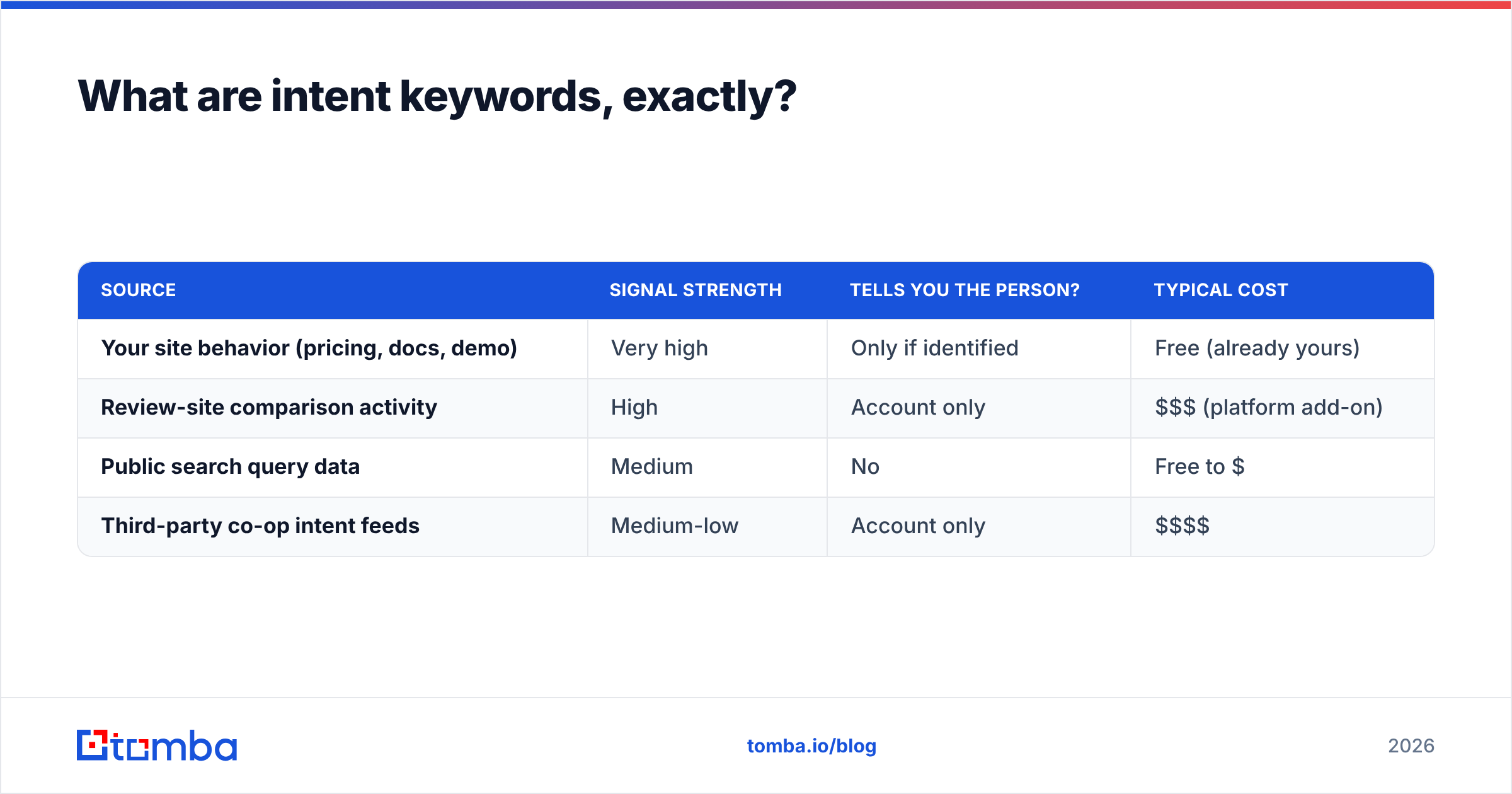
The four sources rank very differently on reliability and cost:
| Source | Signal strength | Tells you the person? | Typical cost |
|---|---|---|---|
| Your site behavior (pricing, docs, demo) | Very high | Only if identified | Free (already yours) |
| Review-site comparison activity | High | Account only | $$$ (platform add-on) |
| Public search query data | Medium | No | Free to $ |
| Third-party co-op intent feeds | Medium-low | Account only | $$$$ |
Notice the column that matters: tells you the person. Three of the four sources stop at the company. That is the structural weakness of intent data and the reason so many "intent-powered" programs quietly get switched off after two quarters.
How are intent keywords different from regular keyword research?#
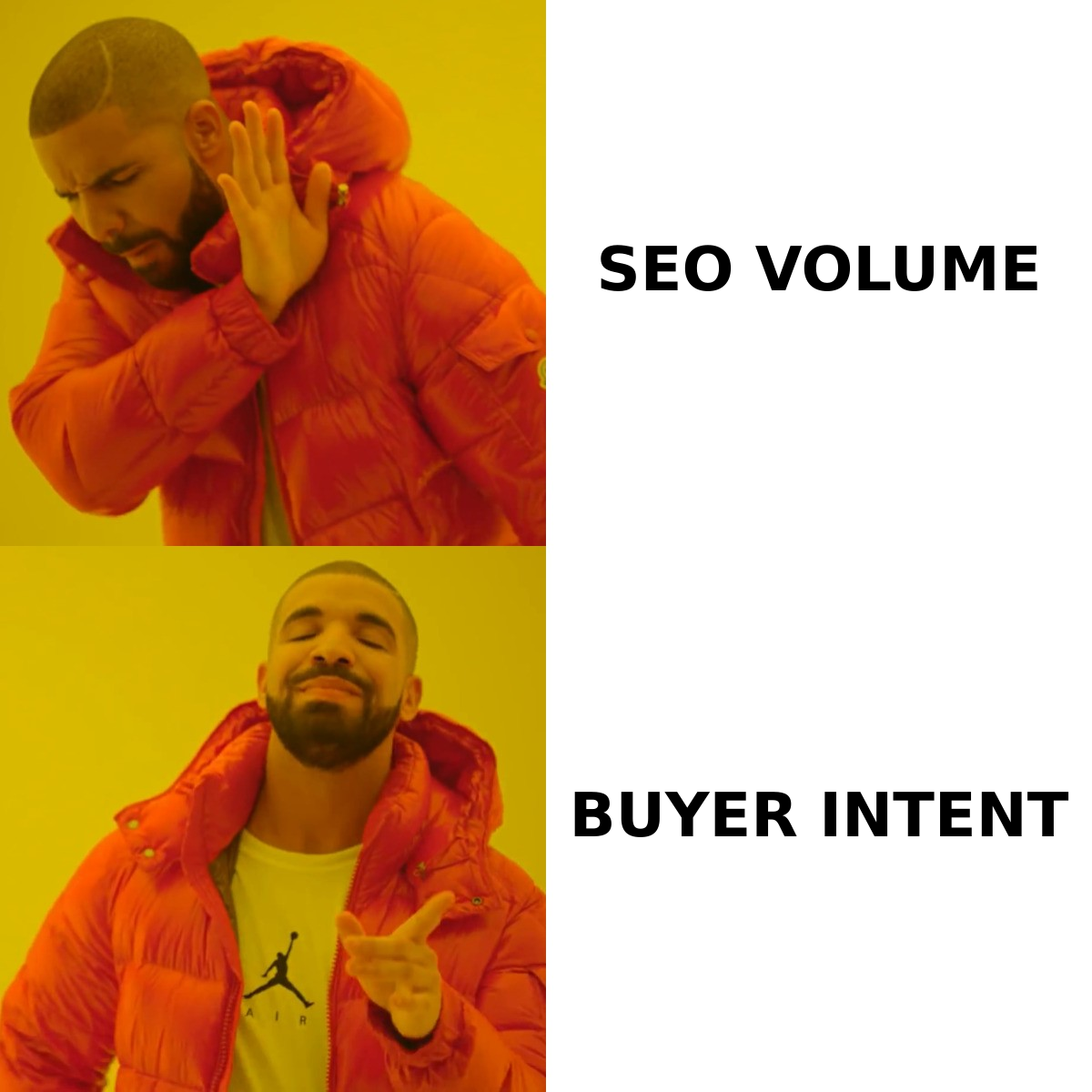
Regular keyword research optimises for traffic. Intent keyword work optimises for revenue per impression, and those two goals pull in opposite directions almost every time.
A head term like "email marketing" might carry 200,000 monthly searches and convert at 0.1%. "Mailchimp alternative for transactional email" might carry 90 searches and convert at 8%. The head term wins every SEO report. The long tail wins every pipeline report.
The practical difference is what you do with the keyword after you find it:
- SEO keyword → you write a page and wait for the algorithm.
- Intent keyword → you build a list of accounts showing that behavior, find the humans inside them, and reach out this week.
One is a publishing decision. The other is a prospecting decision. Teams get into trouble when they hand intent keywords to the content team and expect pipeline out the other end six months later.
Which intent keywords actually predict a purchase?#
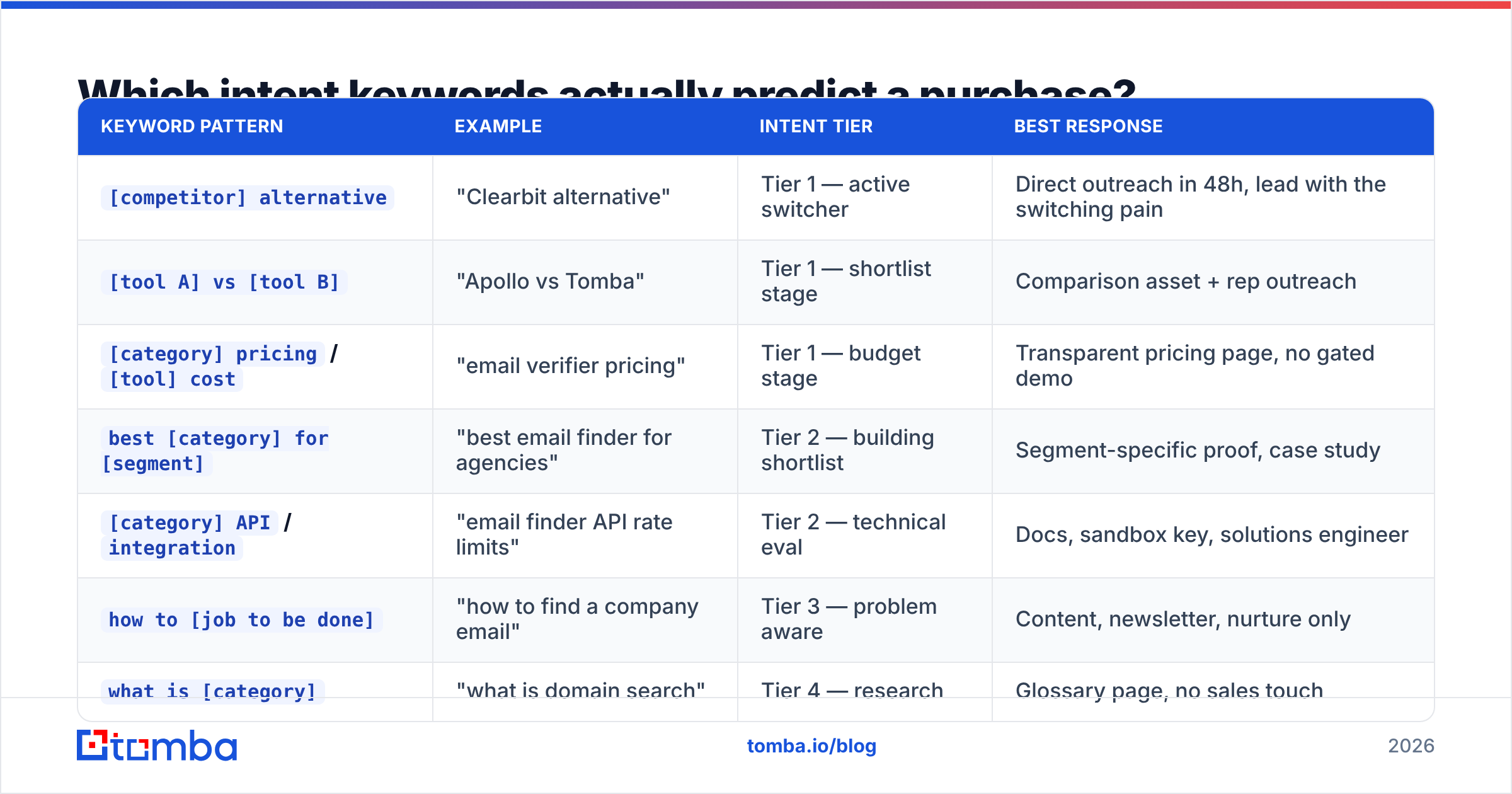
Not all "commercial" keywords are equal. After years of pattern-watching across B2B funnels, the reliable hierarchy looks like this:
| Keyword pattern | Example | Intent tier | Best response |
|---|---|---|---|
[competitor] alternative |
"Clearbit alternative" | Tier 1 — active switcher | Direct outreach in 48h, lead with the switching pain |
[tool A] vs [tool B] |
"Apollo vs Tomba" | Tier 1 — shortlist stage | Comparison asset + rep outreach |
[category] pricing / [tool] cost |
"email verifier pricing" | Tier 1 — budget stage | Transparent pricing page, no gated demo |
best [category] for [segment] |
"best email finder for agencies" | Tier 2 — building shortlist | Segment-specific proof, case study |
[category] API / integration |
"email finder API rate limits" | Tier 2 — technical eval | Docs, sandbox key, solutions engineer |
how to [job to be done] |
"how to find a company email" | Tier 3 — problem aware | Content, newsletter, nurture only |
what is [category] |
"what is domain search" | Tier 4 — research | Glossary page, no sales touch |
The tiering matters more than the list. If you send the same sequence to a Tier 1 "alternative to" searcher and a Tier 4 "what is" searcher, the Tier 4 person marks you as spam and your sender reputation pays for it.
A useful sanity check: can you name the money? If the keyword implies a budget line item exists, it is Tier 1 or 2. If it implies someone is still deciding whether the problem is worth solving, it is Tier 3 or 4.
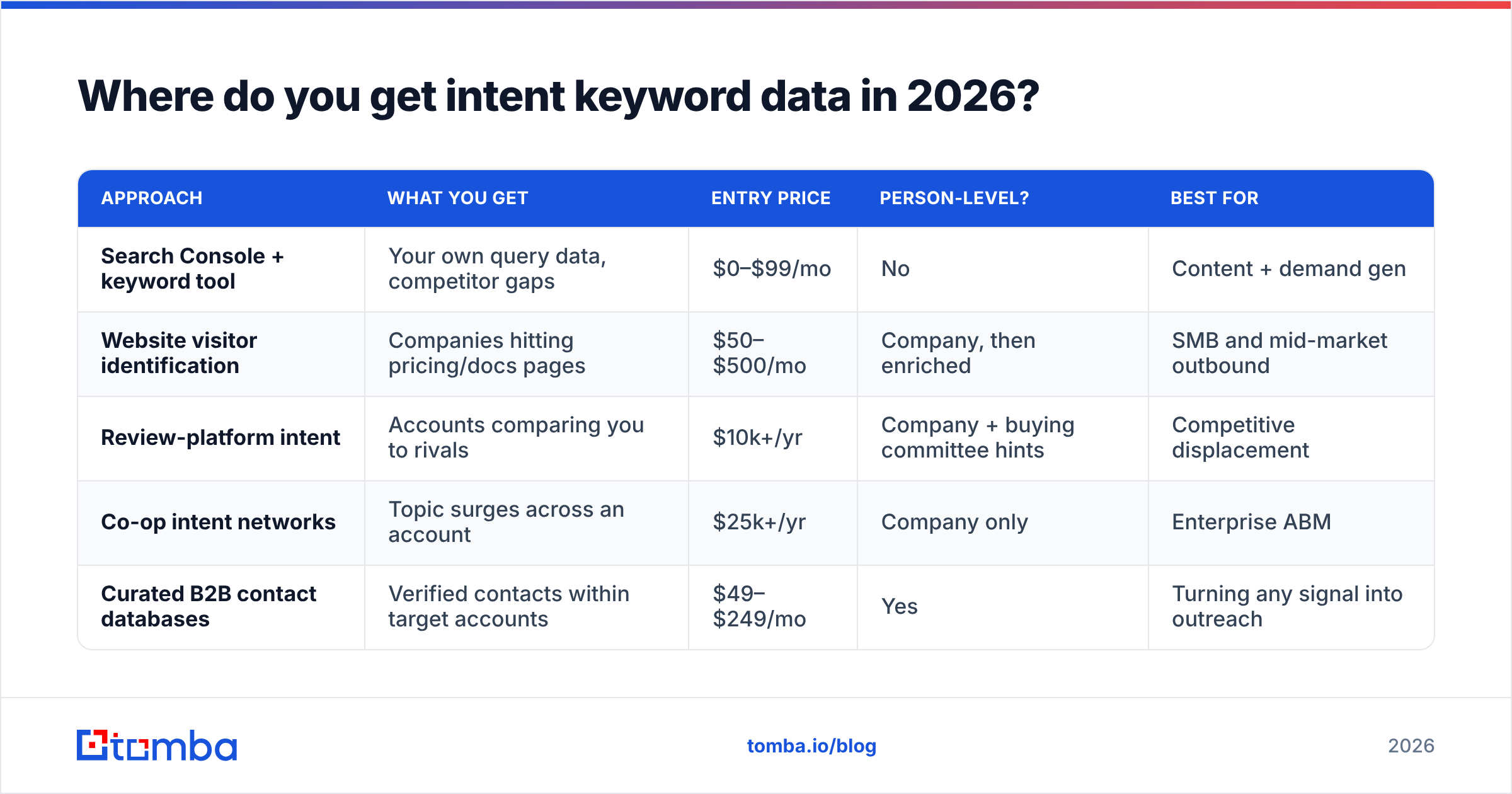
Where do you get intent keyword data in 2026?#
The vendor landscape splits into three buckets, and the pricing gap between them is enormous.
| Approach | What you get | Entry price | Person-level? | Best for |
|---|---|---|---|---|
| Search Console + keyword tool | Your own query data, competitor gaps | $0–$99/mo | No | Content + demand gen |
| Website visitor identification | Companies hitting pricing/docs pages | $50–$500/mo | Company, then enriched | SMB and mid-market outbound |
| Review-platform intent | Accounts comparing you to rivals | $10k+/yr | Company + buying committee hints | Competitive displacement |
| Co-op intent networks | Topic surges across an account | $25k+/yr | Company only | Enterprise ABM |
| Curated B2B contact databases | Verified contacts within target accounts | $49–$249/mo | Yes | Turning any signal into outreach |
That last row is where most programs are underfunded. A company like BookYourData sells clean, verified B2B contact lists, and platforms like Tomba sit in the same layer — they do not generate the intent signal, they resolve it into a person you can actually email. Free tier gives you 25 searches a month to test the workflow; Starter is $49/mo, Growth $99/mo, and Pro $249/mo when the volume justifies it.
If you only have budget for one thing, buy the resolution layer, not the signal layer. You almost certainly already have more unacted-on intent signals in your own analytics than your team can work through in a quarter.
How do you turn an intent keyword into a named contact?#
Here is the chain, step by step. Every link has to hold or the whole thing is theatre.
- Capture the signal. A keyword surge, a repeat pricing-page visit, a review-site comparison. Log the account, the keyword, and the timestamp — the timestamp is not optional.
- Resolve the account. Anonymous traffic becomes a company domain through website visitor reveal or reverse-IP matching. Third-party feeds hand you the domain directly.
- Map the buying committee. Run a domain search against the domain to pull the people and the company's email pattern, then filter by department and seniority. For an "API pricing" keyword, that's engineering plus a budget holder. For "alternative to X", it is usually the ops person who owns the current tool.
- Get a verified address. Use an email finder on the specific first/last/domain combination, then verify before you send. An unverified guess against an in-market account is the most expensive bounce you can buy.
- Enrich for context. Headcount, tech stack, funding, role tenure — contact enrichment gives the personalisation line that makes the email land as research rather than a blast.
- Send within the decay window. Which brings us to the part everyone gets wrong.
How fast do you have to act on an intent signal?#
Fast. Faster than your current process allows, probably.
Comparison and pricing searches cluster tightly around a decision. In most B2B cycles the window between "buyer starts comparing" and "buyer has a shortlist of two" is under two weeks. If your intent feed refreshes weekly, your enrichment runs monthly, and your SDR works the list on Fridays, you are arriving after the shortlist is locked.
Practical decay rules:
- Tier 1 keywords: act within 48 hours. 5 business days is the outer edge of useful.
- Tier 2 keywords: act within 10 days, with a lighter, less salesy first touch.
- Tier 3 and below: do not outbound. Put them in content and paid retargeting.

The volume instinct is the enemy here. A hundred and twenty emails sent to verified contacts at accounts that searched "alternative to [your competitor]" last week will out-produce ten thousand emails to a scraped list, and it will do it without burning your domain. If your email deliverability is already fragile, intent targeting is the cheapest fix available — fewer sends, higher engagement, better inbox placement.
What kills most intent-keyword programs?#
Five failure modes, in rough order of frequency:
- Signal without resolution. You know Acme Corp is surging on "data enrichment." You do not know a single person at Acme Corp. The signal expires unused. This is the single most common way six-figure intent contracts produce zero pipeline.
- Topic-level noise. Co-op networks report on topics, not keywords. "Data security" surging at an account might be a procurement review, a breach, or one intern reading a blog post. Topic-level data has a false-positive rate that nobody in the sales cycle will quote you.
- Treating intent as a list, not a trigger. Dumping intent accounts into a static sequence strips out the only thing that made them special — the timing.
- Ignoring your own first-party data. Your pricing page, your docs, your demo form abandonment. All free, all higher-confidence than anything you can buy.
- No message differentiation. If the email that goes to an intent account is identical to your generic sequence, the intent data changed nothing except your spend.
How do you write outreach off an intent keyword?#
Reference the problem the keyword implies, never the surveillance. "I saw you searched for X" is instantly disqualifying — it sounds like a stalker and, in most cases, it is not even accurate at the individual level.
Map keyword to angle instead:
- "[Competitor] alternative" → lead with the specific limitation people leave that competitor over. Contract terms, credit rollover, data coverage in a region. One concrete pain, not a feature list.
- "[Category] pricing" → lead with a number. Budget-stage buyers want the range, and being the one vendor who answers plainly earns the reply.
- "[Category] API" → skip the sales pitch entirely, send the docs link and a test key. Technical evaluators reply to utility, not enthusiasm.
- "Best [category] for [segment]" → lead with a customer in exactly that segment and one measurable outcome.
Four angles cover roughly 80% of Tier 1 and Tier 2 intent. Write them once, keep them sharp, and let the response rate tell you which keyword-to-angle pairs are actually working.
How do you measure whether intent keywords are working?#
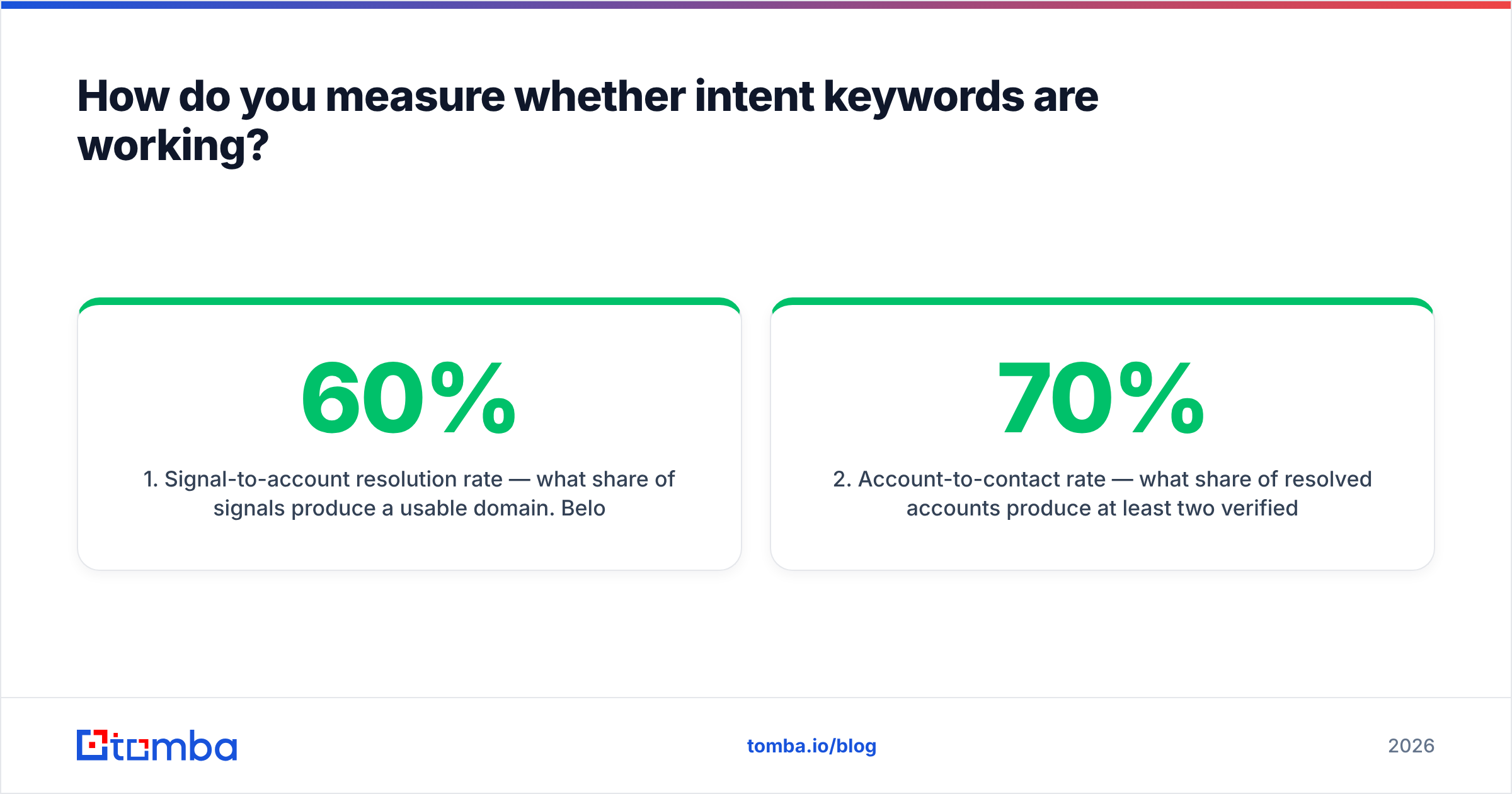
Measure the chain, not the endpoint. If you only track pipeline, you will never know which link is broken.
Track four ratios monthly:
- Signal-to-account resolution rate — what share of signals produce a usable domain. Below 60% and your identification layer is the problem.
- Account-to-contact rate — what share of resolved accounts produce at least two verified, correctly-targeted contacts. Below 70% and your data provider is the problem.
- Time-to-first-touch — median hours from signal to send. Above 120 hours and your process is the problem.
- Intent cohort reply rate vs. baseline — your intent-sourced sequences should reply at 2–4x your cold baseline. If they do not, your keyword tiering is wrong or your copy is not differentiated.
Run those four numbers for one quarter and you will know exactly whether intent keywords deserve budget at your company, rather than arguing about it from vendor case studies.
Are intent keywords worth paying for?#
Buy signal only after you can act on it. The order of investment that works: first-party behavioral tracking, then contact resolution, then paid intent feeds. Reverse that order — which is what most teams do, because the enterprise intent vendor has the better sales deck — and you end up with an expensive dashboard of companies you cannot contact.
The keyword tells you when. Resolution tells you who. Only the second one can be skipped by exactly nobody.
Start at the link in the chain that actually blocks everything else. Take your top 50 in-market accounts — from Search Console, your pricing-page logs, wherever — drop the domains into the Tomba Email Finder, and see how many named, verified contacts come back. The free tier covers 25 searches a month, which is enough to prove the workflow before you commit to a plan. Once the chain holds end to end, adding more signal is a budget decision instead of a gamble.
Related guides#
// get started
Find, verify and enrich your first contacts today
Start on the free plan with 25 searches a month, then scale when your team is ready.
Free plan · No credit card required · GDPR & CCPA
// about the author