Intent Marketing Tools: The Complete 2026 Buyer's Guide
Intent data vendors promise to tell you who is in-market before your competitors know. Here is what the 2026 tools actually deliver, what they cost, and the last-mile problem nobody puts on the pricing page.
TL;DR
- Intent marketing tools tell you which accounts are researching your category right now — they almost never tell you which human to contact.
- There are four distinct signal types (first-party, second-party review, third-party co-op, and technographic). Most vendors resell the same two or three upstream sources.
- Enterprise platforms (6sense, Demandbase, ZoomInfo) start in the five-figure annual range and are priced on account volume, not seats. Point tools start under $100/month.
- Accuracy claims are unverifiable by design. The honest benchmark is not "was the signal right" but "did it change what a rep did this week."
- The cheapest fix for a stalled intent program is usually contact-level data, not a better signal vendor.
What are intent marketing tools, actually?#
Intent marketing tools are software that watches buying-signal exhaust — content consumption, review-site browsing, job posts, tech installs, your own website traffic — and ranks accounts by how likely they are to be shopping for something you sell.
The analogy: intent data is a smoke detector, not a security camera. It tells you something is burning somewhere in a building. It does not tell you which room, who lit the match, or whether it is a kitchen fire or a candle. Teams that treat intent scores as a camera feed waste a year and a budget line. Teams that treat them as a prioritization signal — a reason to look harder at 200 accounts instead of 20,000 — get real lift.
The category has consolidated hard since 2022. What used to be a dozen independent data co-ops is now a handful of upstream providers with a long tail of resellers and UI layers on top. That matters when you evaluate: two vendors showing you a demo with "different" data may be querying the same pool.
What types of intent signals exist?#
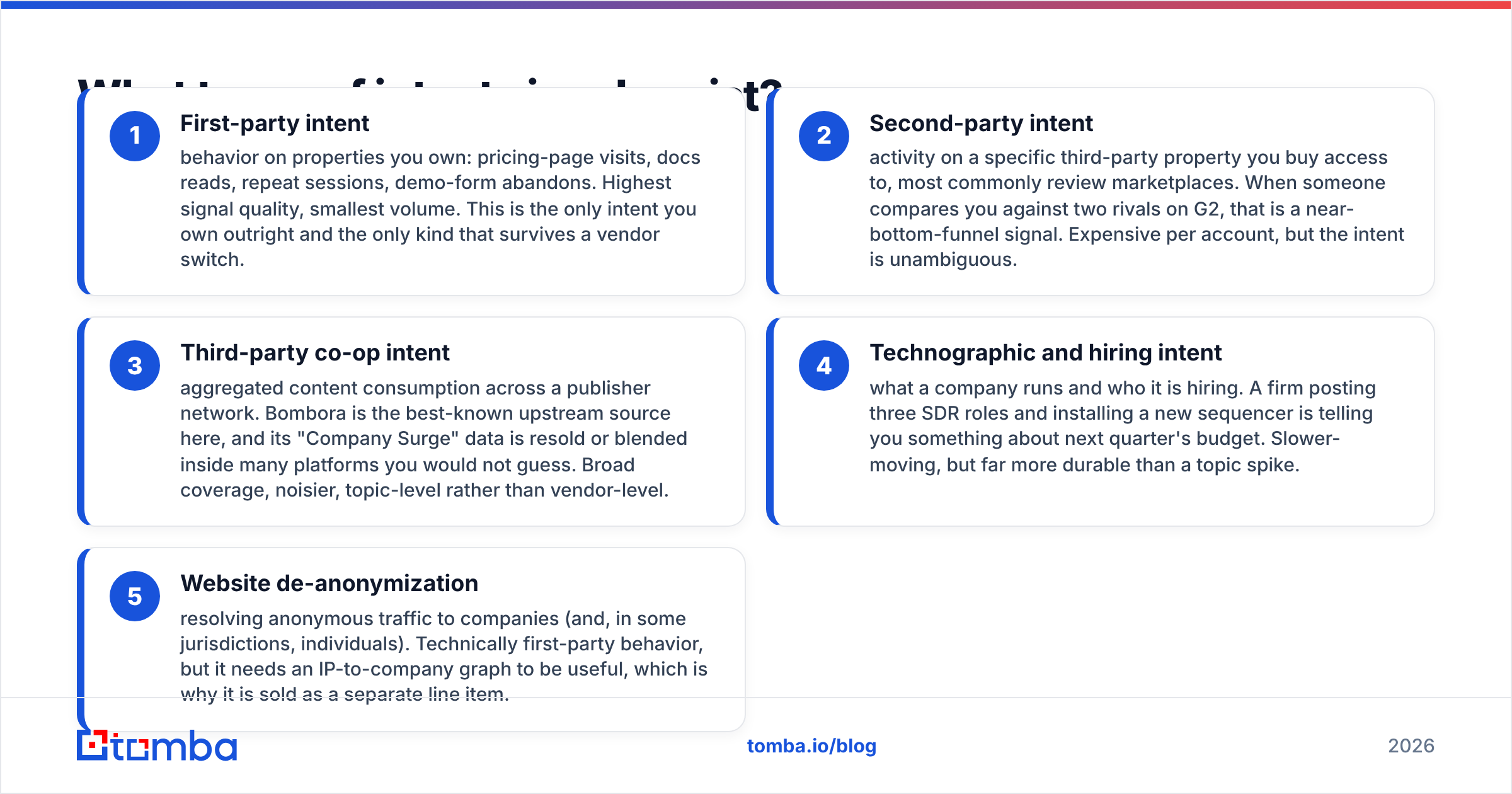
Before you compare vendors, get the taxonomy straight. Every pitch you hear is one of these four, or a blend:
- First-party intent — behavior on properties you own: pricing-page visits, docs reads, repeat sessions, demo-form abandons. Highest signal quality, smallest volume. This is the only intent you own outright and the only kind that survives a vendor switch.
- Second-party intent — activity on a specific third-party property you buy access to, most commonly review marketplaces. When someone compares you against two rivals on G2, that is a near-bottom-funnel signal. Expensive per account, but the intent is unambiguous.
- Third-party co-op intent — aggregated content consumption across a publisher network. Bombora is the best-known upstream source here, and its "Company Surge" data is resold or blended inside many platforms you would not guess. Broad coverage, noisier, topic-level rather than vendor-level.
- Technographic and hiring intent — what a company runs and who it is hiring. A firm posting three SDR roles and installing a new sequencer is telling you something about next quarter's budget. Slower-moving, but far more durable than a topic spike.
- Website de-anonymization — resolving anonymous traffic to companies (and, in some jurisdictions, individuals). Technically first-party behavior, but it needs an IP-to-company graph to be useful, which is why it is sold as a separate line item.
Most failures trace back to buying category 3 and expecting category 1 precision.
Which intent marketing tools matter in 2026?#
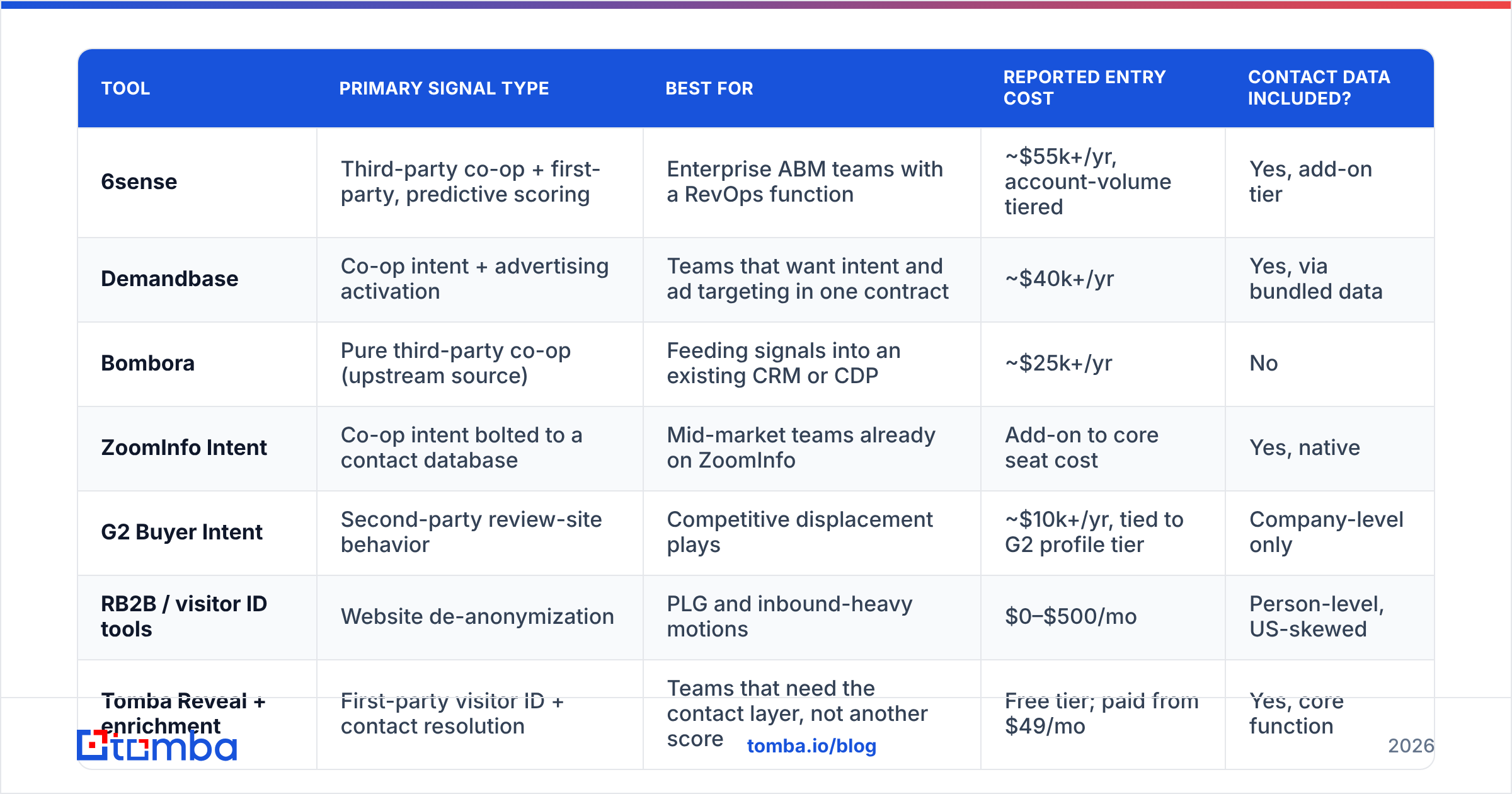
Here is the honest field map. Pricing for enterprise platforms is not published by any of these vendors; the ranges below reflect commonly reported buyer contracts and should be treated as directional, not quoted.
| Tool | Primary signal type | Best for | Reported entry cost | Contact data included? |
|---|---|---|---|---|
| 6sense | Third-party co-op + first-party, predictive scoring | Enterprise ABM teams with a RevOps function | ~$55k+/yr, account-volume tiered | Yes, add-on tier |
| Demandbase | Co-op intent + advertising activation | Teams that want intent and ad targeting in one contract | ~$40k+/yr | Yes, via bundled data |
| Bombora | Pure third-party co-op (upstream source) | Feeding signals into an existing CRM or CDP | ~$25k+/yr | No |
| ZoomInfo Intent | Co-op intent bolted to a contact database | Mid-market teams already on ZoomInfo | Add-on to core seat cost | Yes, native |
| G2 Buyer Intent | Second-party review-site behavior | Competitive displacement plays | ~$10k+/yr, tied to G2 profile tier | Company-level only |
| RB2B / visitor ID tools | Website de-anonymization | PLG and inbound-heavy motions | $0–$500/mo | Person-level, US-skewed |
| Tomba Reveal + enrichment | First-party visitor ID + contact resolution | Teams that need the contact layer, not another score | Free tier; paid from $49/mo | Yes, core function |
Two things stand out when you lay it out like this. First, the price gap between "platform" and "point tool" is roughly two orders of magnitude, and a large share of that spend buys workflow and attribution reporting rather than better signals. Second, the column that decides whether any of this works — contact data — is inconsistent across the category.
How much do intent marketing tools cost in practice?#
Sticker price is the smaller number. Budget for all four of these:
- Platform license — tiered on the number of accounts you monitor, not users. Doubling your target account list often doubles the bill.
- Activation — ads, sequences, or a sales-engagement seat to actually touch the accounts the platform flags. A signal with no outbound motion attached is a report.
- Contact acquisition — the platform tells you Acme is in-market; you still need the six people at Acme who own the decision, with deliverable addresses.
- RevOps time — scoring model tuning, CRM field mapping, and alert routing. Budget a quarter of a headcount for the first two quarters, minimum.
Gartner's buying-group research has been consistent for years: enterprise B2B purchases involve six to ten stakeholders. If your intent platform surfaces an account and you can only reach one of those people, the signal decays before the buying group ever hears from you.
Is intent data accurate enough to act on?#
Here is the uncomfortable part: you cannot audit third-party intent accuracy from the outside. The co-op does not show you which publisher pages triggered the surge, and IP-to-account resolution is probabilistic. Any vendor quoting a precise accuracy percentage for topic-level intent is quoting a number no customer can reproduce.
So change the test. Instead of asking "is this signal true," measure three things over a 90-day window:
- Lift over baseline — reply rate on intent-flagged accounts versus a matched control list from the same ICP. If the lift is under 20 percent, your topics are too broad.
- Time-to-touch — hours between signal fire and first human contact. Intent spikes have a half-life measured in days. A signal you action in three weeks is a signal you wasted.
- Coverage — what percentage of flagged accounts you could actually reach with a named, verified contact. This is where most programs quietly fail, and it is the only one of the three you can fix cheaply.
Run those three numbers before renewal and the renewal conversation gets much easier.
Why do most intent programs fail at the last mile?#
Because an account is not a person. The platform hands your SDR a row that says "Acme Corp, surging on 'email deliverability', score 91." Your SDR now has to figure out who at Acme owns that problem, find a working address, and write something relevant — in the narrow window where the signal still means anything.
That last mile is where budget goes to die. Three practical fixes, in order of cost:
Fix the routing before you fix the data. If intent alerts land in a weekly digest email, kill the digest. Route them to the owning rep in Slack or as a CRM task the same day. Most teams can double time-to-touch performance without spending a dollar.
Resolve accounts to buying groups, not single contacts. Take the flagged domain, run a domain search to pull the departmental contacts that match the roles in your buying group, then filter by title. One row becomes four to six real people. This step is what converts an account score into an actual sequence.
Verify before you send. Intent-triggered outbound is bursty by nature — you send a lot of first-touch email to cold domains in a short window. That is exactly the pattern that damages sender reputation if your list is dirty. Run every address through an email verifier before it enters a sequence, and treat catch-all domains as a separate, slower track.
There is a quieter fourth option worth naming: for some segments, buying a clean static list of the roles you care about is simply faster than resolving them one account at a time. Vendors like BookYourData occupy that niche well, and pairing a curated list with live intent signals is a legitimate strategy rather than an admission of defeat. The mistake is buying either one alone and expecting a pipeline.
How do you build an intent workflow that books meetings?#
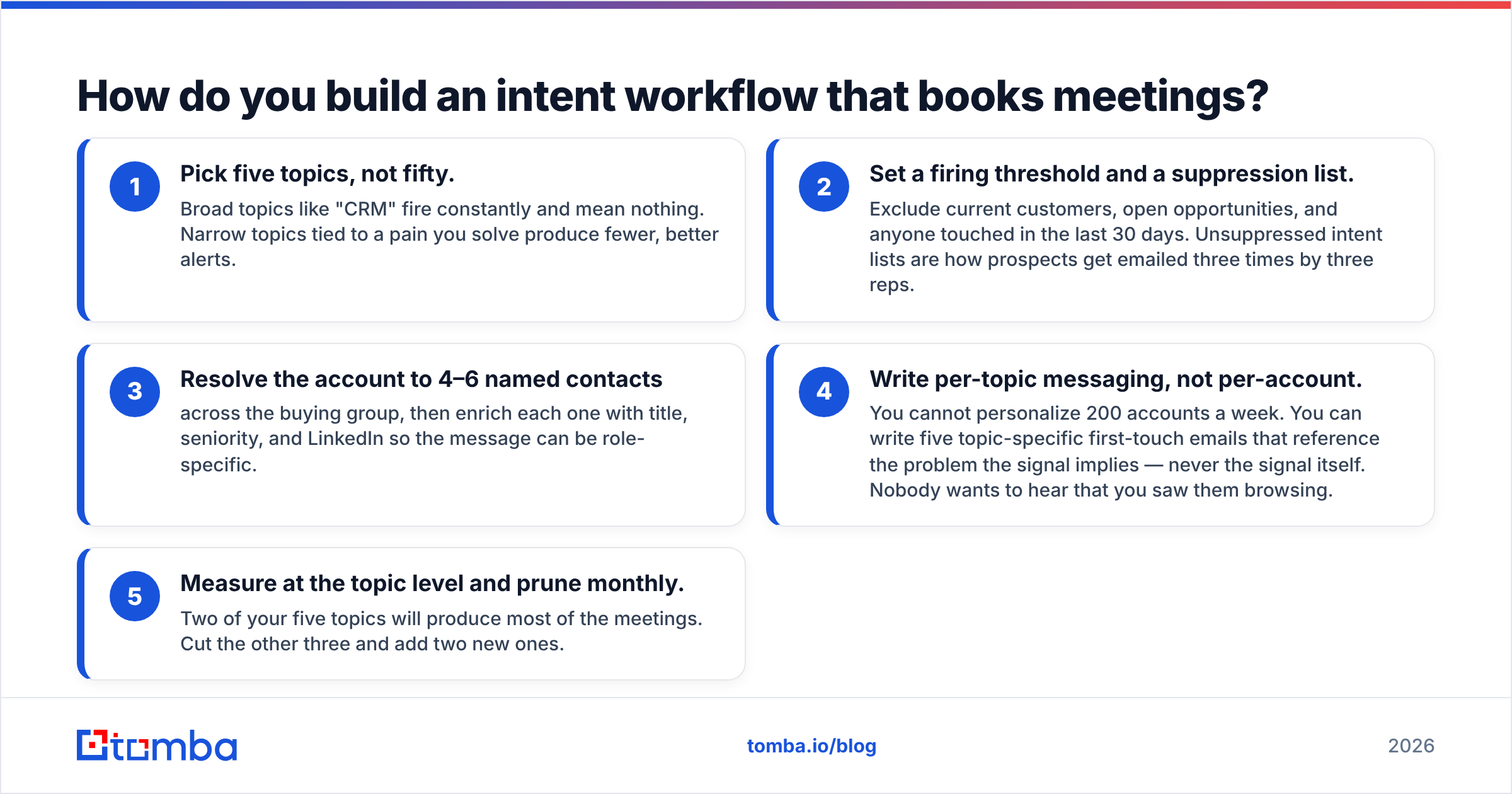
A working motion looks like this. Five steps, roughly two weeks to stand up:
- Pick five topics, not fifty. Broad topics like "CRM" fire constantly and mean nothing. Narrow topics tied to a pain you solve produce fewer, better alerts.
- Set a firing threshold and a suppression list. Exclude current customers, open opportunities, and anyone touched in the last 30 days. Unsuppressed intent lists are how prospects get emailed three times by three reps.
- Resolve the account to 4–6 named contacts across the buying group, then enrich each one with title, seniority, and LinkedIn so the message can be role-specific.
- Write per-topic messaging, not per-account. You cannot personalize 200 accounts a week. You can write five topic-specific first-touch emails that reference the problem the signal implies — never the signal itself. Nobody wants to hear that you saw them browsing.
- Measure at the topic level and prune monthly. Two of your five topics will produce most of the meetings. Cut the other three and add two new ones.
That loop is the whole program. Everything else the platform sells you is reporting on top of it.
Which intent marketing tool should you pick?#
Match the tool to the motion, not to the demo:
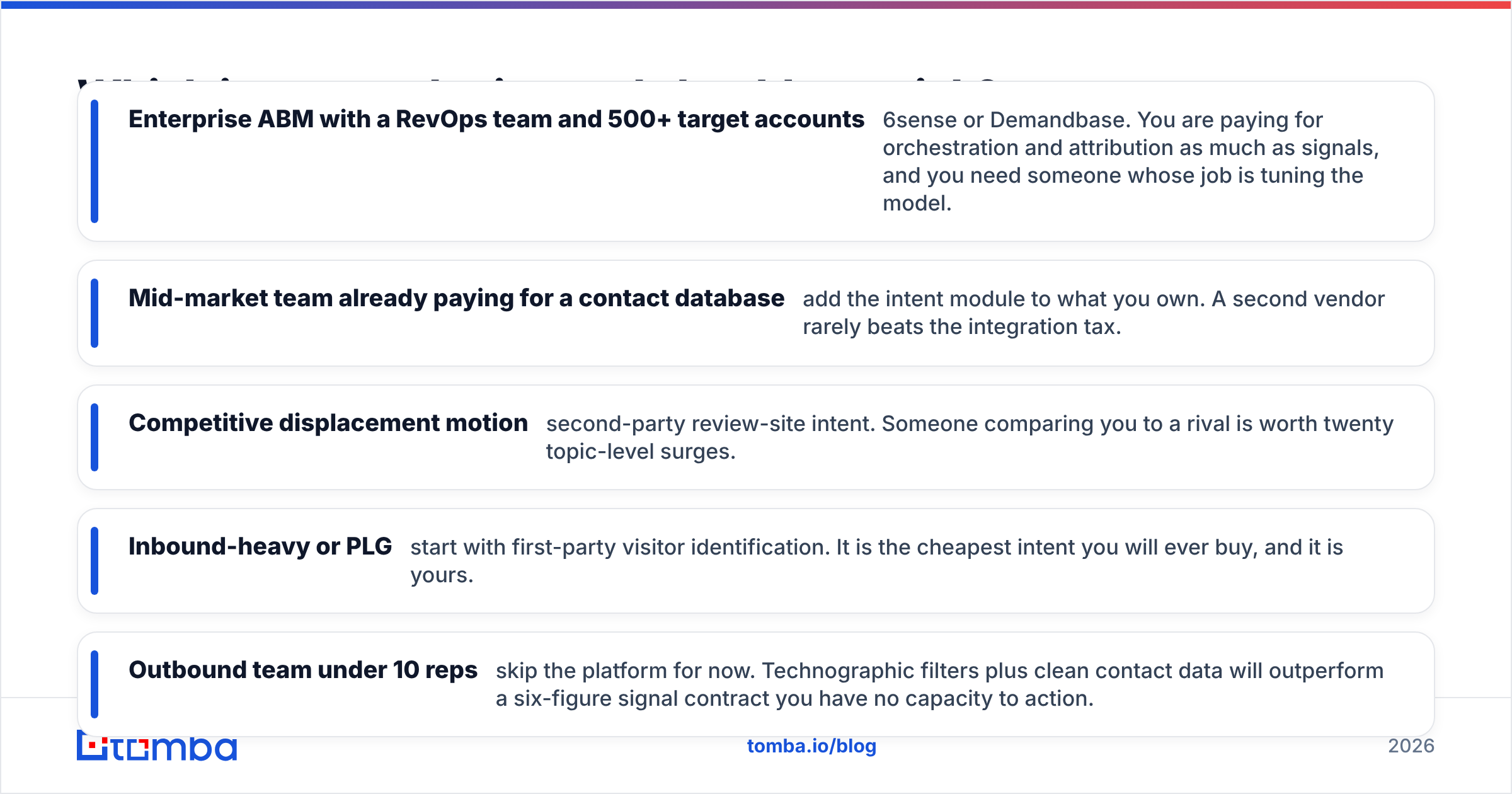
- Enterprise ABM with a RevOps team and 500+ target accounts — 6sense or Demandbase. You are paying for orchestration and attribution as much as signals, and you need someone whose job is tuning the model.
- Mid-market team already paying for a contact database — add the intent module to what you own. A second vendor rarely beats the integration tax.
- Competitive displacement motion — second-party review-site intent. Someone comparing you to a rival is worth twenty topic-level surges.
- Inbound-heavy or PLG — start with first-party visitor identification. It is the cheapest intent you will ever buy, and it is yours.
- Outbound team under 10 reps — skip the platform for now. Technographic filters plus clean contact data will outperform a six-figure signal contract you have no capacity to action.
Before you sign anything, price out the contact layer separately. Compare it against Tomba pricing — free tier at 25 searches a month, Starter at $49/mo, Growth at $99/mo — and you will often find the last mile costs a rounding error next to the signal contract. Solve the cheap problem first and you may discover your existing signals were fine all along.
The bottom line#
Intent marketing tools are a prioritization layer, not a pipeline generator. They work when three conditions hold: narrow topics, fast routing, and complete contact coverage on flagged accounts. Miss any one and you are paying enterprise money for a spreadsheet of company names.
Fix coverage first — it is the fastest and cheapest of the three. Point the Tomba Email Finder at the accounts your intent platform is already flagging, pull the full buying group instead of one contact, verify before you send, and re-measure your reply lift in 30 days. If the number moves, you did not have a signal problem. You had a reach problem, and it was solvable for less than the cost of a single seat.
Related guides#
// get started
Find, verify and enrich your first contacts today
Start on the free plan with 25 searches a month, then scale when your team is ready.
Free plan · No credit card required · GDPR & CCPA
// about the author