Intent Prediction in 2026: How to Score Buyers Before They Buy
Intent prediction is sold as a crystal ball and delivered as a noisy probability score. Here is what the signals actually tell you, which ones are worth paying for, and how to turn a spike into a booked meeting.
TL;DR
- Intent prediction is a probability estimate, not a prophecy. A good model tells you which accounts are more likely than baseline to enter a buying cycle in the next 30-90 days — that is all, and it is still worth a lot.
- First-party signals (your site, your docs, your pricing page) outperform purchased third-party topic data on precision almost every time. Third-party data wins on reach.
- Most intent programs fail at the last mile, not the model. A surging account is worthless if you cannot name and contact the three humans who are actually researching.
- Expect a 2-4x lift in reply rate over cold, non-prioritised outbound — not the 10x that vendor decks imply.
- Budget realistically: third-party intent feeds run $15k-$80k/year, while first-party reveal plus contact resolution can start under $100/month.
What is intent prediction?#
Intent prediction is the practice of estimating how likely an account or person is to buy a specific category of product in a defined time window, based on behavioural and contextual signals rather than on a form fill.
Think of it like a weather forecast for your pipeline. A meteorologist does not know it will rain on Tuesday. They know that this pressure pattern, this humidity, and this wind direction have historically preceded rain 70% of the time. Intent prediction works the same way: certain research behaviours have historically preceded a purchase, so when you see the pattern, you raise the probability and you act earlier than a competitor who waits for the demo request.
Technically, it sits inside the broader field of predictive analytics — a scoring model consuming a feature set (page views, content topics, technology installs, hiring activity, review-site behaviour, CRM history) and producing a ranked list. The output is usually one of three things:
- A binary flag — "this account is surging on topic X." Cheap to build, easy to abuse, high false-positive rate.
- A 0-100 score — a normalised probability that compresses many signals into one number for routing and prioritisation.
- A ranked queue with reasons — the score plus the top three contributing signals, so a rep knows why the account surfaced and what to say.
The third format is the only one that reliably changes rep behaviour. A number without a reason gets ignored by week three.
What signals actually predict intent?#
Not all signals carry the same weight. After stripping out the marketing language, the signals that consistently correlate with a real buying cycle fall into five buckets:
- Bottom-of-funnel first-party behaviour — pricing page visits, documentation reads, integration pages, comparison pages, and repeat sessions from multiple people at the same company. This is the highest-precision signal you will ever have, and you already own it.
- Topic surges from third-party consumption — an account reading unusual volumes of content about your category across a publisher network. Broad coverage, noisy at the account level, genuinely useful for prioritising an outbound territory.
- Technographic change — a company installing, removing, or renewing a tool adjacent to yours. A churned competitor tag is one of the strongest single predictors in B2B software.
- Hiring and org signals — a new VP of Demand Gen, a req for "RevOps Manager," or a sudden burst of SDR hiring tells you budget exists and a mandate is forming.
- Review-site and marketplace activity — category browsing on G2 or similar marketplaces is late-stage and expensive, but it is the closest thing to a shopping cart in B2B.
- Relationship signals — a champion who used your product at their last company just changed jobs. Low volume, absurdly high conversion.
Notice what is not on the list: email opens, generic blog traffic, and social engagement. They are activity, not intent. Treat them as tiebreakers at most.
How is intent prediction different from lead scoring?#
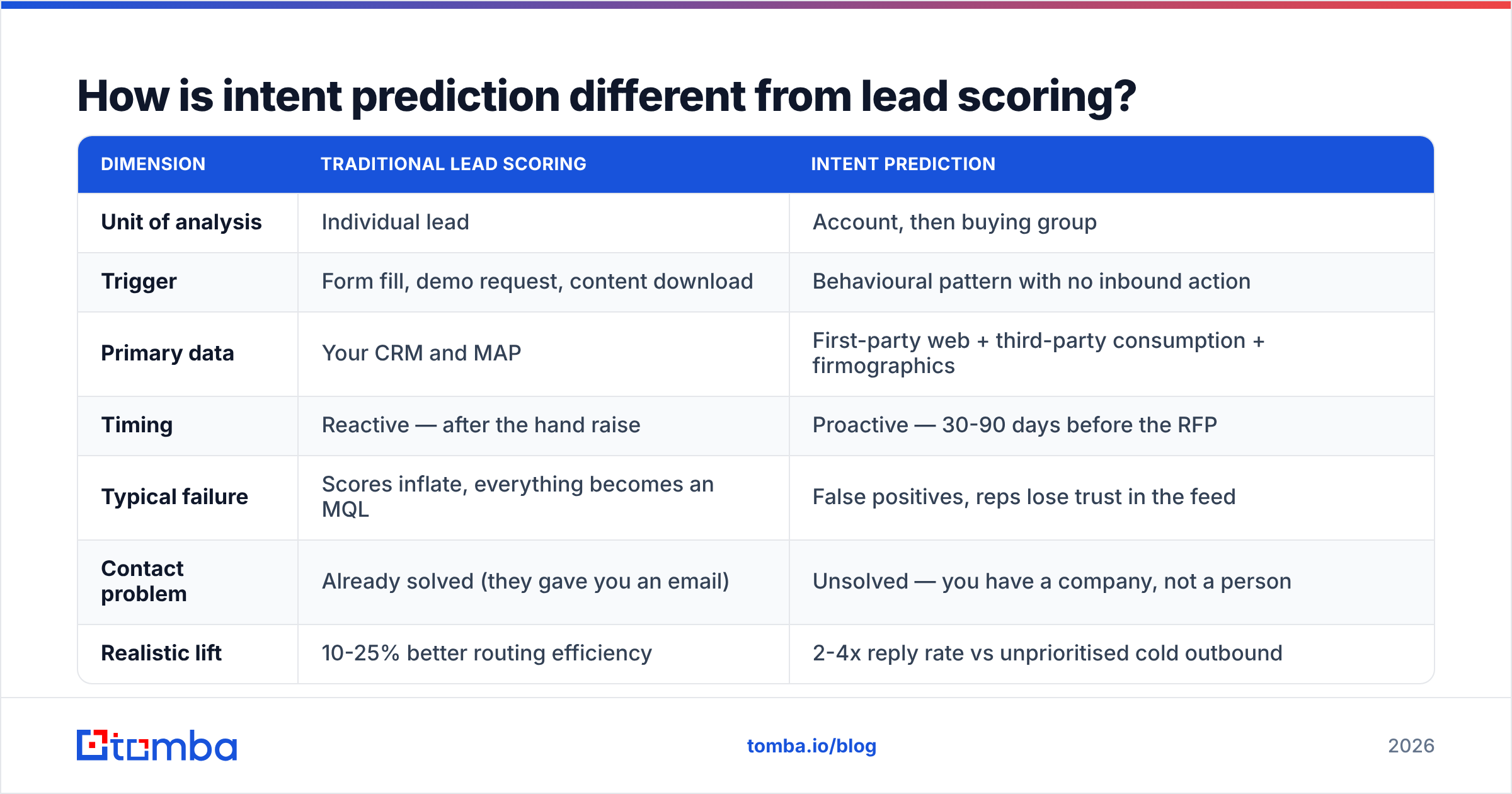
Lead scoring grades the people who already raised a hand. Intent prediction finds the accounts that have not raised a hand yet. They answer different questions, run on different data, and fail in different ways.
| Dimension | Traditional lead scoring | Intent prediction |
|---|---|---|
| Unit of analysis | Individual lead | Account, then buying group |
| Trigger | Form fill, demo request, content download | Behavioural pattern with no inbound action |
| Primary data | Your CRM and MAP | First-party web + third-party consumption + firmographics |
| Timing | Reactive — after the hand raise | Proactive — 30-90 days before the RFP |
| Typical failure | Scores inflate, everything becomes an MQL | False positives, reps lose trust in the feed |
| Contact problem | Already solved (they gave you an email) | Unsolved — you have a company, not a person |
| Realistic lift | 10-25% better routing efficiency | 2-4x reply rate vs unprioritised cold outbound |
The last two rows are where most programs die. Intent prediction hands you a domain and a topic. It does not hand you the head of engineering's inbox. That gap between "account is surging" and "here is the person and their verified address" is the single most expensive unsolved step in the stack, and it is why teams pair an intent feed with a data enrichment layer rather than buying intent alone.
Which intent data type should you actually buy?#
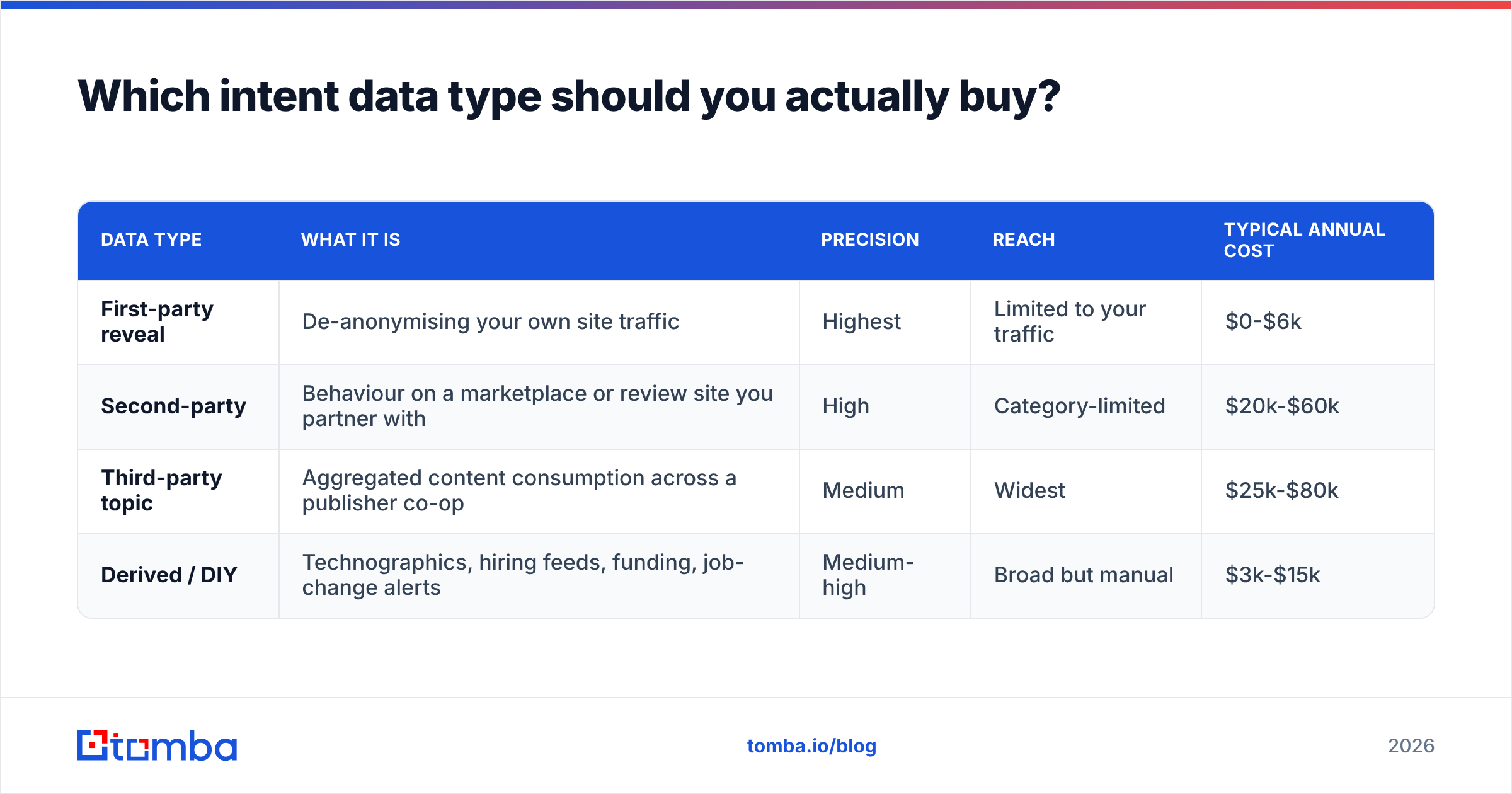
There are four practical sourcing routes, and the right answer usually combines two of them rather than betting everything on one vendor.
| Data type | What it is | Precision | Reach | Typical annual cost |
|---|---|---|---|---|
| First-party reveal | De-anonymising your own site traffic | Highest | Limited to your traffic | $0-$6k |
| Second-party | Behaviour on a marketplace or review site you partner with | High | Category-limited | $20k-$60k |
| Third-party topic | Aggregated content consumption across a publisher co-op | Medium | Widest | $25k-$80k |
| Derived / DIY | Technographics, hiring feeds, funding, job-change alerts | Medium-high | Broad but manual | $3k-$15k |
If you are under $5M ARR, start at the top and the bottom of that table. First-party reveal plus a derived-signal layer costs a fraction of a topic subscription and produces a list you can act on the same week. Website visitor reveal turns anonymous sessions into named companies; hiring and technographic triggers you can pull yourself fill the gaps.
Above $20M ARR, with a defined territory model and enough SDR capacity to work a wide account list, third-party topic data starts to pay for itself — you need the reach because your first-party traffic no longer covers your addressable market. Established providers like Bombora built the publisher co-op model that most topic feeds still rely on, and analyst coverage from Gartner is a reasonable sanity check before you sign a multi-year contract. Contact-data specialists such as BookYourData are a solid complement when your need is verified reach into a defined segment rather than behavioural signal — the two solve different halves of the same problem.
Does intent prediction actually work?#
Yes, but the honest framing matters: it improves your prior, it does not deliver certainty.
Here is the realistic accuracy picture. A third-party topic surge, taken alone, might mean an account is 3-5x more likely than a random ICP-matched account to open an evaluation in the next quarter. That sounds enormous until you remember the baseline. If 2% of your ICP enters a buying cycle in any given quarter, a 4x lift takes you to 8%. You will still be wrong about 92% of the accounts you touch — you are simply wrong far less often than the rep who works an alphabetical list.
Three specific limitations are worth internalising:
- Attribution ambiguity. A surge at a 4,000-person enterprise could be a procurement team, a competitor's analyst, or a student writing a thesis on the company's WiFi. Account-level signal does not identify the buying group.
- Latency. Most topic feeds refresh weekly. By the time you see a late-stage surge, the shortlist may already exist. First-party signals arrive in seconds, which is exactly why they convert better.
- Shared-signal decay. Every competitor in your category buys from the same three aggregators. When everyone gets the same alert on Monday, the account receives eleven near-identical emails by Wednesday and the signal's value collapses.
That third point is the strongest argument for building proprietary signals. Anything you can derive that your competitors cannot buy — your own traffic, your own product telemetry, your own champion job-change graph — compounds in value while purchased data commoditises.
How do you build an intent prediction workflow that reps trust?#
The model is maybe 20% of the work. The workflow is the rest.
- Define the event you are predicting. Not "interest." Pick something measurable: opened opportunity within 90 days. Everything downstream calibrates against this definition.
- Assemble a labelled history. Pull 12-24 months of closed-won and closed-lost accounts with timestamps. Without labels you are not predicting, you are guessing with extra steps.
- Score signals against real outcomes. Run each candidate signal against your history and keep the ones with measurable lift. Most teams discover two or three signals do 80% of the work, and half the vendor's topic taxonomy does nothing.
- Resolve the account to humans. This is the step that converts. Take the surging domain, identify the two to four roles in the buying group, and pull verified contacts via domain search or a programmatic email finder API call inside the same automation that fires the alert.
- Verify before you send. Surge-triggered lists are built fast and decay fast. Run them through an email verifier so a spike in send volume does not become a spike in bounce rate.
- Route with a reason and a deadline. Push the account, the score, the top three contributing signals, and a 48-hour SLA. Signals expire. A surge worked on day nine is a cold email with extra latency.
Step 4 is where most programs silently stall. The alert fires, the rep opens LinkedIn, spends nine minutes guessing an email format, and gives up on the third account. Automate the contact resolution or the program dies of friction, not of bad predictions.
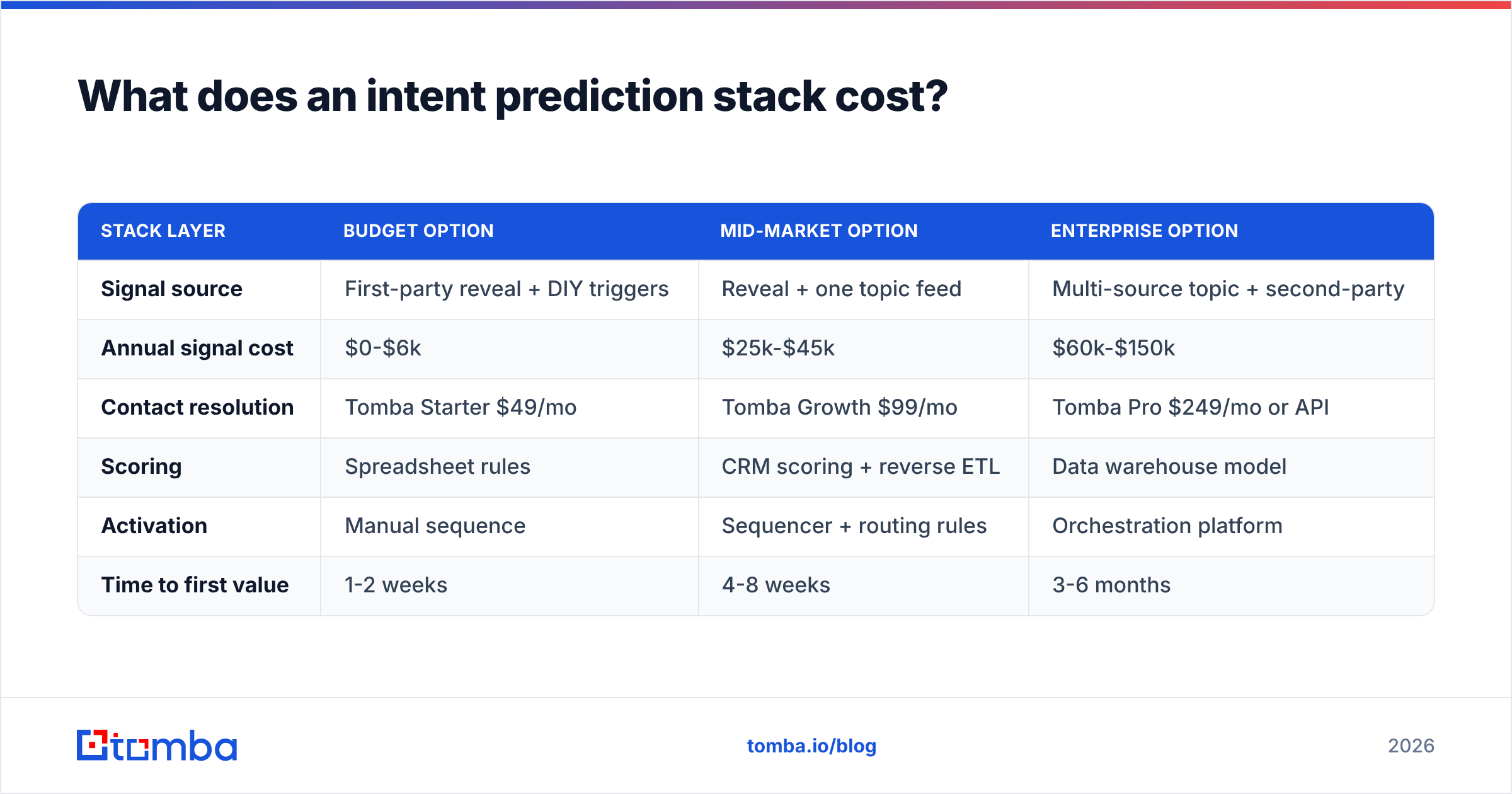
What does an intent prediction stack cost?#
| Stack layer | Budget option | Mid-market option | Enterprise option |
|---|---|---|---|
| Signal source | First-party reveal + DIY triggers | Reveal + one topic feed | Multi-source topic + second-party |
| Annual signal cost | $0-$6k | $25k-$45k | $60k-$150k |
| Contact resolution | Tomba Starter $49/mo | Tomba Growth $99/mo | Tomba Pro $249/mo or API |
| Scoring | Spreadsheet rules | CRM scoring + reverse ETL | Data warehouse model |
| Activation | Manual sequence | Sequencer + routing rules | Orchestration platform |
| Time to first value | 1-2 weeks | 4-8 weeks | 3-6 months |
The asymmetry in that table is the point. Signal costs scale into six figures; contact resolution costs tens of dollars per month. Teams routinely spend $60k on a feed that tells them which company is in-market, then leave the "which human do I email" problem to manual research. That is a budget allocation error, and it is fixable in an afternoon.
What breaks intent prediction programs?#
- Scoring everything. If 40% of your ICP is "high intent" every week, your threshold is wrong. Cap the queue at what your team can genuinely work — usually 20-40 accounts per rep per week.
- Hiding the reasoning. A bare score gets ignored. "Three people read your pricing page and your competitor's comparison page in six days" gets worked.
- No feedback loop. Reps must be able to mark an account as bad signal, and that input has to change the model. Otherwise trust erodes and the tab stops getting opened.
- Treating intent as a message. "I saw you were researching data platforms" is creepy and lazy. Use the signal to choose the timing and the angle, then write like a human who did actual homework.
- Ignoring deliverability. Surge lists spike send volume unpredictably. Sudden volume changes on a warm domain are exactly what filters look for, so pace the sends and keep list hygiene tight.
Where should you start this quarter?#
Start with the signals you already own and the contacts you are currently failing to resolve. Turn on first-party visitor identification, define one measurable outcome, pick three signals with proven lift against your closed-won history, and automate the jump from "account surged" to "here are four verified addresses in the buying group." Then, and only then, evaluate whether a six-figure topic feed adds reach you cannot generate yourself.
The prediction is the easy half. Acting on it within 48 hours, with the right person and a verified address, is the half that produces pipeline — and that is precisely the step you can fix this week. Use the Tomba Email Finder to convert every surging domain into named, verified contacts the moment the signal fires. The free tier covers 25 searches a month so you can test the workflow before you commit, and Tomba pricing starts at $49/mo when you are ready to run it at volume.
Related guides#
// get started
Find, verify and enrich your first contacts today
Start on the free plan with 25 searches a month, then scale when your team is ready.
Free plan · No credit card required · GDPR & CCPA
// about the author