Intent Signals in 2026: How to Find and Act on Buying Intent
Most intent signals are noise dressed up as pipeline. Here's how to tell first-party from third-party intent, score signals honestly, and turn a spike into a booked meeting within 48 hours.
TL;DR
- Intent signals are behavioral evidence that an account is researching a problem you solve. They are probabilistic, not prophetic — treat them as prioritization input, not proof of demand.
- First-party signals (your site, your product, your emails) outperform third-party topic surges by a wide margin because they carry account identity and context.
- The bottleneck is almost never signal collection. It's the gap between "Account X spiked" and "here is the decision-maker's verified email address."
- A signal decays fast. Most teams that win on intent act inside 48 hours; most teams that lose on intent act inside 3 weeks.
- Score signals with a weighted model you can actually explain to a rep. A black-box 0-100 score nobody trusts gets ignored on the floor.
What are intent signals, actually?#
An intent signal is any observable behavior suggesting a company is actively evaluating a purchase. Someone from Acme Corp read three comparison pages on your site. A cluster of employees at a 400-person logistics firm started consuming content about warehouse automation. A prospect opened your pricing page twice in one week after going dark for four months.
Here's the honest framing: intent data is a probability adjustment, not a buying announcement. If your baseline conversion from cold outbound is 1.5%, a strong intent signal might move a specific account to 6-9%. That's a four-to-six-times lift — genuinely valuable — and it is still a coin flip you lose most of the time. Reps who expect intent-sourced leads to close like inbound get disillusioned by week three and go back to ignoring the alerts.
Gartner's research on the B2B buying journey makes the underlying reason clear: buyers spend the majority of their evaluation time in independent research, not talking to vendors. Intent signals are the only window into that dark period. They don't tell you a deal exists. They tell you where to point finite rep hours.
What's the difference between first-party, second-party, and third-party intent?#
This distinction determines nearly everything about how you act on a signal. Most confusion about intent data comes from teams treating all three as interchangeable.
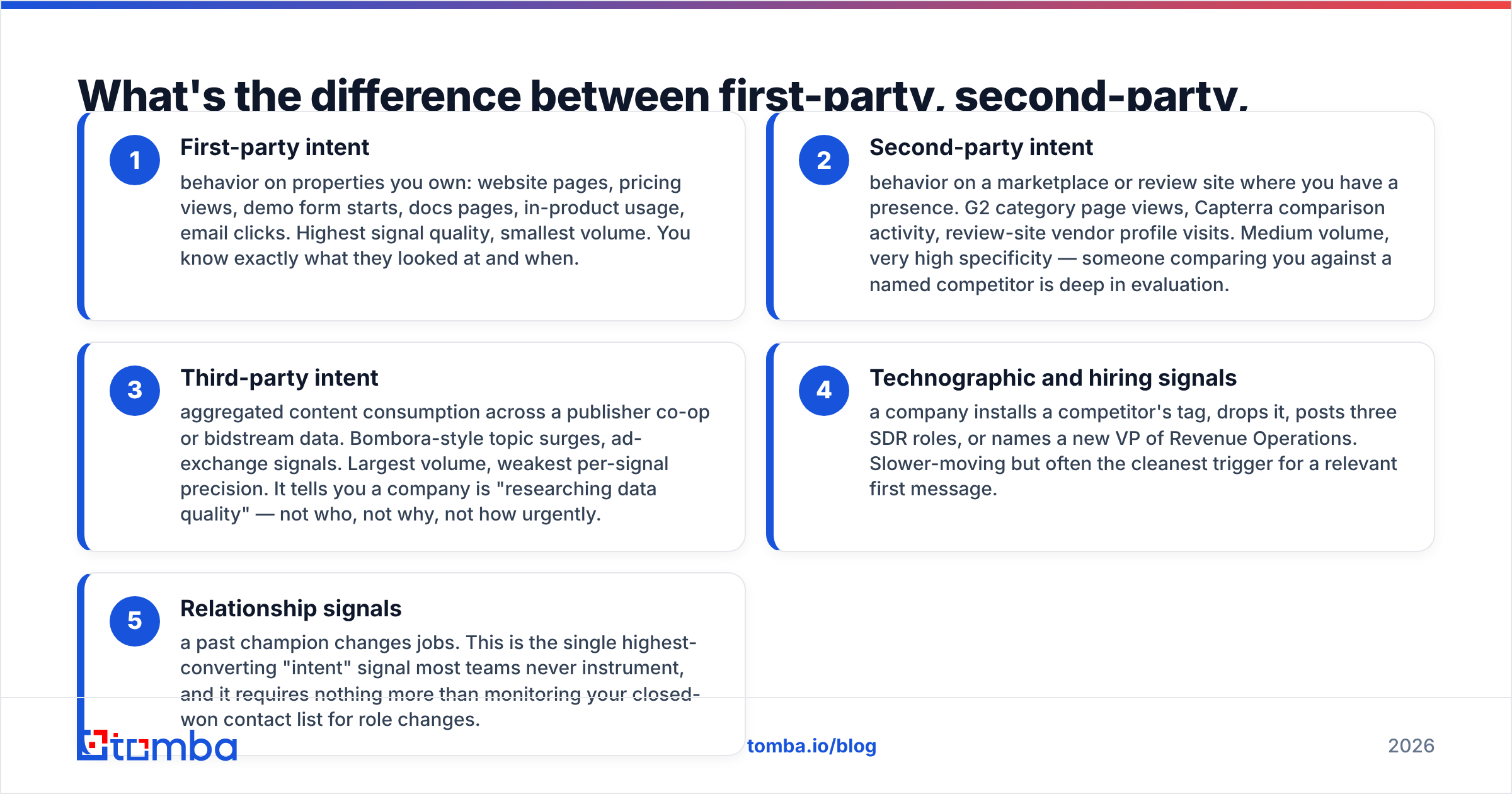
- First-party intent — behavior on properties you own: website pages, pricing views, demo form starts, docs pages, in-product usage, email clicks. Highest signal quality, smallest volume. You know exactly what they looked at and when.
- Second-party intent — behavior on a marketplace or review site where you have a presence. G2 category page views, Capterra comparison activity, review-site vendor profile visits. Medium volume, very high specificity — someone comparing you against a named competitor is deep in evaluation.
- Third-party intent — aggregated content consumption across a publisher co-op or bidstream data. Bombora-style topic surges, ad-exchange signals. Largest volume, weakest per-signal precision. It tells you a company is "researching data quality" — not who, not why, not how urgently.
- Technographic and hiring signals — a company installs a competitor's tag, drops it, posts three SDR roles, or names a new VP of Revenue Operations. Slower-moving but often the cleanest trigger for a relevant first message.
- Relationship signals — a past champion changes jobs. This is the single highest-converting "intent" signal most teams never instrument, and it requires nothing more than monitoring your closed-won contact list for role changes.
The practical rule: third-party intent tells you which accounts to look at. First- and second-party intent tells you which accounts to work today. Champion-change signals tell you who to email this afternoon.
How do intent signal sources compare?#
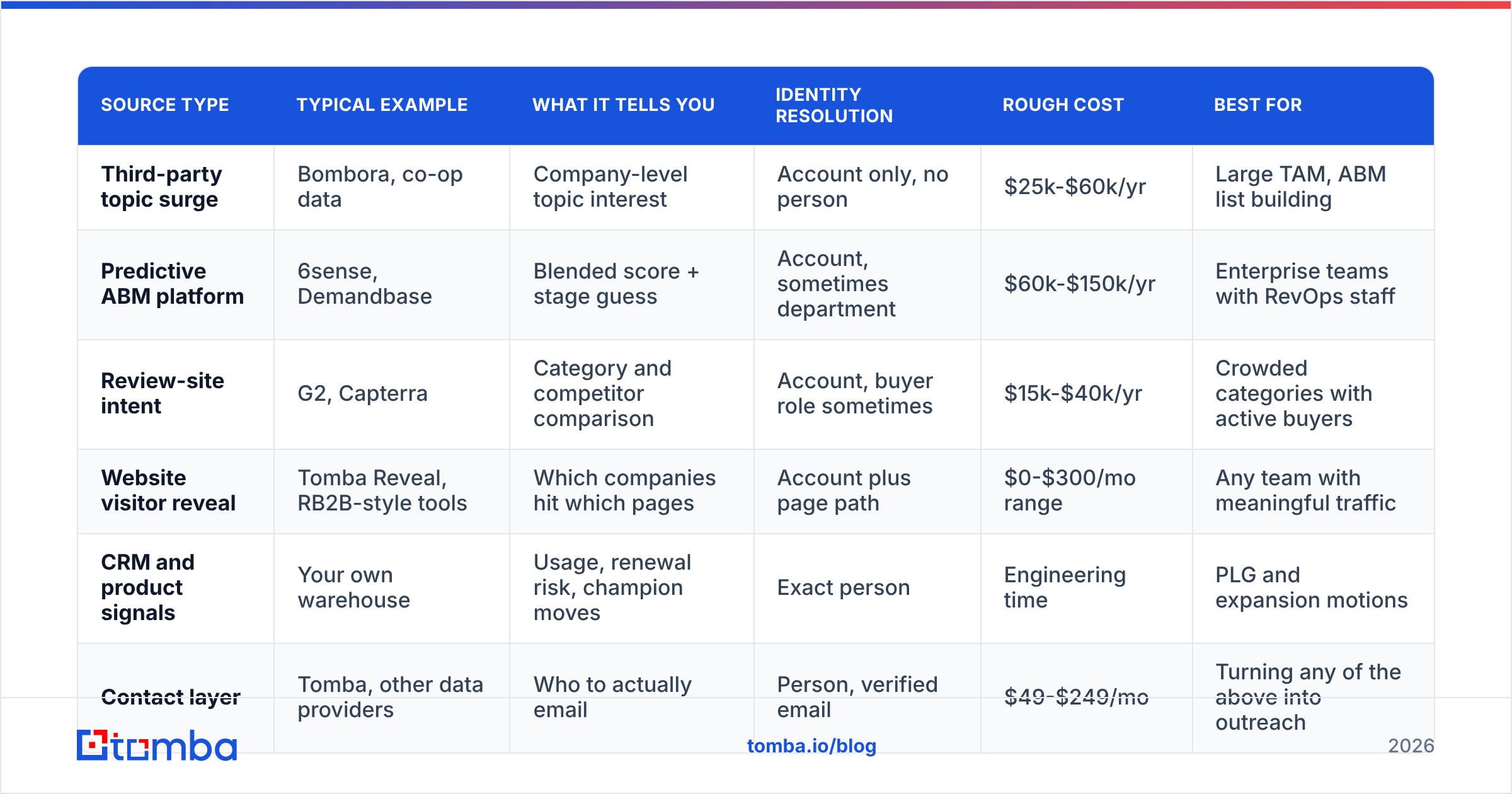
There is no single provider that covers all four signal types well, and the pricing gap between tiers is large enough that the wrong pick burns a quarter of budget. Here is how the main categories stack up in 2026.
| Source type | Typical example | What it tells you | Identity resolution | Rough cost | Best for |
|---|---|---|---|---|---|
| Third-party topic surge | Bombora, co-op data | Company-level topic interest | Account only, no person | $25k-$60k/yr | Large TAM, ABM list building |
| Predictive ABM platform | 6sense, Demandbase | Blended score + stage guess | Account, sometimes department | $60k-$150k/yr | Enterprise teams with RevOps staff |
| Review-site intent | G2, Capterra | Category and competitor comparison | Account, buyer role sometimes | $15k-$40k/yr | Crowded categories with active buyers |
| Website visitor reveal | Tomba Reveal, RB2B-style tools | Which companies hit which pages | Account plus page path | $0-$300/mo range | Any team with meaningful traffic |
| CRM and product signals | Your own warehouse | Usage, renewal risk, champion moves | Exact person | Engineering time | PLG and expansion motions |
| Contact layer | Tomba, other data providers | Who to actually email | Person, verified email | $49-$249/mo | Turning any of the above into outreach |
The last row is the one teams skip, and it's the one that determines ROI. A $60,000 intent contract that surfaces 400 surging accounts produces exactly zero revenue if your reps then spend 12 minutes per account guessing at email formats. Compare that with a Tomba pricing plan at $49/mo for the contact layer — the asymmetry is absurd, and it's the most common budget misallocation in outbound.
Why do most intent programs fail?#
Four failure modes, in rough order of frequency.
The activation gap. Signals land in a dashboard nobody opens. If an intent alert doesn't arrive in the rep's existing workflow — Slack, CRM task queue, sequence enrollment — it does not exist. The fix is plumbing, not more data.
No contact resolution. You know Acme is surging on "email deliverability." You do not know who at Acme owns that problem, and you do not have their address. This is where most programs quietly die: the signal is real, the path to a human is missing. Pairing account-level intent with a bulk email finder run against the account's likely buying committee closes this in minutes rather than hours.
Signal decay ignored. An intent spike is a perishable good. A pricing-page visit is worth acting on today, meaningfully less tomorrow, and roughly nothing in 14 days. Teams that batch intent into a weekly list-pull destroy most of the value before the first email goes out.
Over-personalization on weak evidence. "I saw you were researching data warehouses!" based on a bidstream topic surge is creepy and frequently wrong. The correct move is to write about the problem the signal implies, never to reveal the surveillance. Reference the trigger only when it's public — a funding round, a job post, a conference appearance.
How should you score intent signals?#
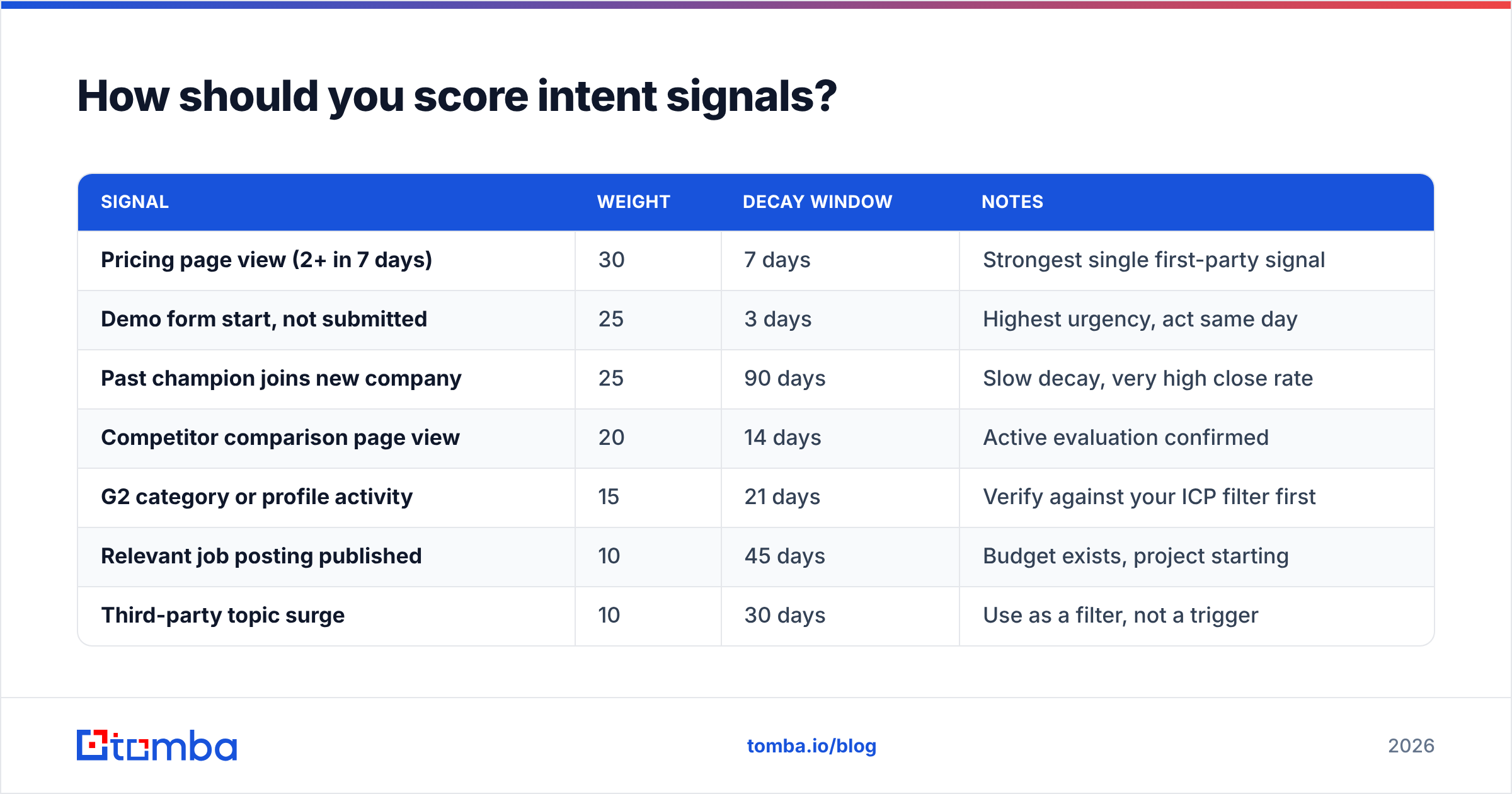
Build a weighted, additive model you can explain in one screen. Complexity here buys nothing; rep trust buys everything.
A workable starting framework:
| Signal | Weight | Decay window | Notes |
|---|---|---|---|
| Pricing page view (2+ in 7 days) | 30 | 7 days | Strongest single first-party signal |
| Demo form start, not submitted | 25 | 3 days | Highest urgency, act same day |
| Past champion joins new company | 25 | 90 days | Slow decay, very high close rate |
| Competitor comparison page view | 20 | 14 days | Active evaluation confirmed |
| G2 category or profile activity | 15 | 21 days | Verify against your ICP filter first |
| Relevant job posting published | 10 | 45 days | Budget exists, project starting |
| Third-party topic surge | 10 | 30 days | Use as a filter, not a trigger |
| Newsletter click on relevant topic | 5 | 14 days | Weak alone, useful as a tiebreaker |
Sum the active signals, apply decay, and set a threshold — say 40 — above which an account routes to a rep with an SLA. Everything below 40 goes to nurture. Review the weights quarterly against closed-won data. If pricing-page visits aren't correlating with wins in your business, lower the weight. The model is a hypothesis, not a truth.
One warning on thresholds: if your threshold produces more accounts than your team can work in a day, the threshold is wrong. Capacity sets the cutoff, not signal quality.
How do you turn a signal into a booked meeting?#
The operational loop that works, start to finish:
- Detect. Signal fires — visitor reveal, CRM trigger, third-party surge crossing threshold.
- Qualify against ICP. Kill anything outside firmographic fit immediately. Half of raw intent volume is noise from students, competitors, and irrelevant segments.
- Resolve the buying committee. Identify 3-5 likely stakeholders at the account by role, not just the one name your data provider handed you. A domain search against the account domain, filtered by department, gets you the full list in one call.
- Verify before sending. Intent-sourced lists are often stale at the contact layer. Running addresses through an email verifier before the first send protects the sender reputation you'll need for every other campaign. Bounce rates above 3% on a spiking account list will damage far more than that one play.
- Enrich for context. Title, seniority, tenure, tech stack. Data enrichment turns a name into a reason to write.
- Sequence within 48 hours. Multi-channel, problem-led, no surveillance language. Email plus LinkedIn plus a phone attempt for high-score accounts.
- Feed outcomes back. Log which signals preceded closed-won. Re-weight. This step is what separates a program that improves from one that plateaus.
Steps 3 through 5 are where the whole thing lives or dies, and they're the steps most intent vendors don't cover. G2 will tell you an account is comparing you to a competitor; it will not hand you a deliverable address for the VP who's doing the comparing. Bombora will tell you a topic surged; the same gap applies.
What does good intent-based outreach look like?#
Bad: "Hi Sarah, I noticed you've been researching email verification tools..."
Good: "Sarah — teams running 50k+ sends a month usually hit the same wall around deliverability: list decay outpaces verification cadence. Curious how you're handling it at Acme. If you've already solved it, ignore me."
The second version is informed by the signal without disclosing it. It leads with the problem, demonstrates category knowledge, and offers a clean exit. It works whether or not the signal was accurate — which matters, because a meaningful share of your signals will be wrong.
Two tactical notes. First, subject lines on intent-triggered sends should be shorter than your baseline; you're trying to look like internal mail, not a campaign. Second, resist the urge to attach a calendar link in the first message to a surging account. They're in research mode, not demo mode. Offer something readable instead.
Which signals should you instrument first?#
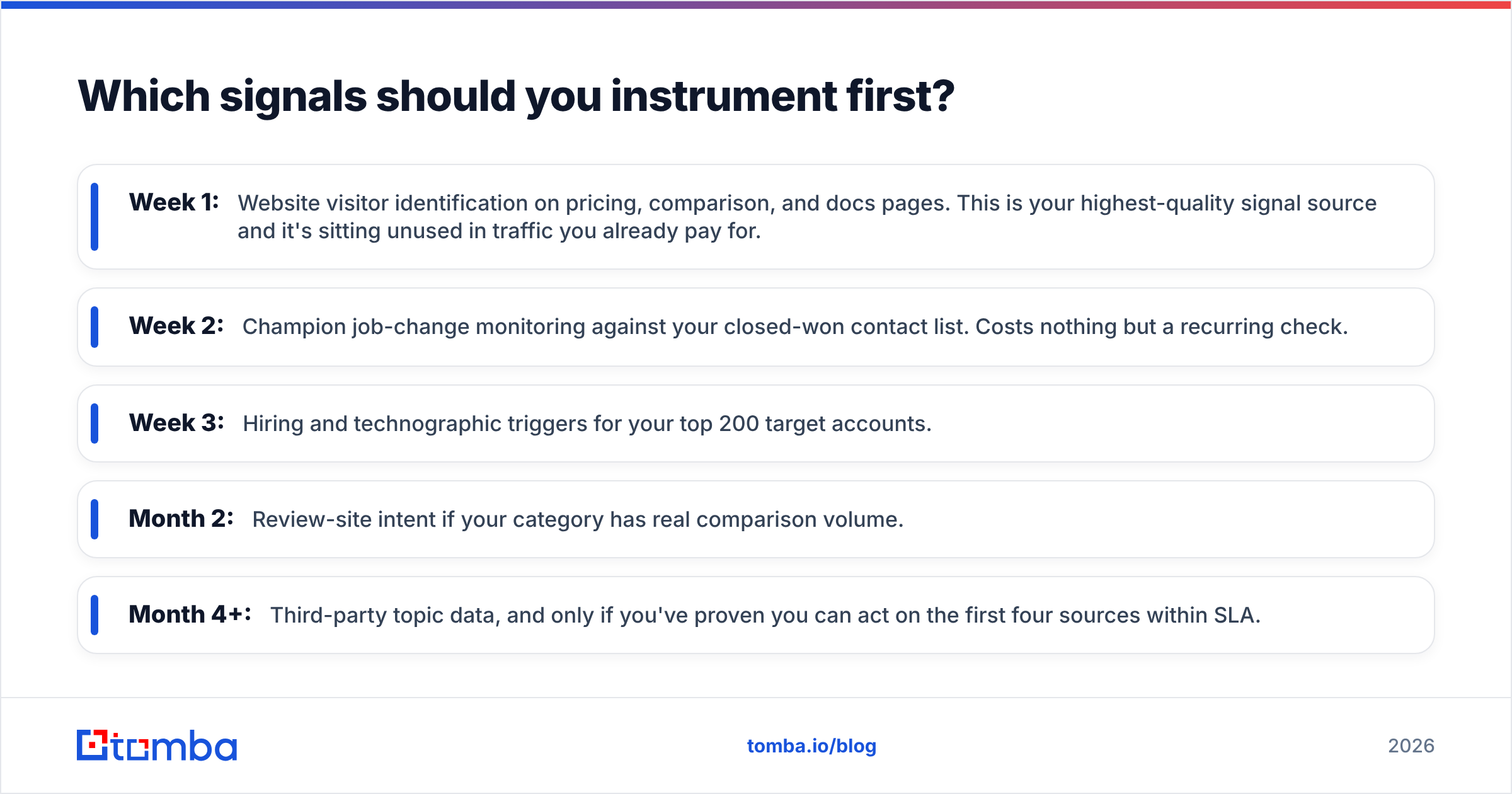
If you're starting from zero, sequence it this way — cheapest and highest-yield first:
- Week 1: Website visitor identification on pricing, comparison, and docs pages. This is your highest-quality signal source and it's sitting unused in traffic you already pay for.
- Week 2: Champion job-change monitoring against your closed-won contact list. Costs nothing but a recurring check.
- Week 3: Hiring and technographic triggers for your top 200 target accounts.
- Month 2: Review-site intent if your category has real comparison volume.
- Month 4+: Third-party topic data, and only if you've proven you can act on the first four sources within SLA.
Teams routinely invert this order — buying the $80,000 third-party contract first because it's the thing that looks like "an intent strategy" — and then discover they lack the contact data, routing, and rep discipline to use it. Build the activation muscle on free signals before you pay for volume.
Get the contact layer right before you buy more signals#
Every intent program eventually reduces to the same question: you know an account is in market, so who do you email and will it land? That's not a data-vendor problem or a RevOps-dashboard problem — it's a contact-resolution problem, and it's the cheapest part of the stack to fix.
Tomba Email Finder resolves a name and a domain into a verified, deliverable address, with a free tier at 25 searches a month to test against your own surging accounts before committing. Run it on last quarter's intent list. If the contact layer was your bottleneck, you'll see it in a week — and you'll know whether that next six-figure intent contract is worth signing.
Related guides#
// get started
Find, verify and enrich your first contacts today
Start on the free plan with 25 searches a month, then scale when your team is ready.
Free plan · No credit card required · GDPR & CCPA
// about the author