Intent Signals in B2B Marketing: How to Find and Act on Them
Most intent data is noise dressed up as a buying signal. Here's how to separate the spikes that predict pipeline from the ones that waste SDR hours — plus what a working intent stack costs in 2026.
TL;DR
- Intent signals are behavioral evidence that an account is actively researching a problem you solve — not a score, not a persona fit, not a list.
- First-party signals (your site, your docs, your pricing page) outperform third-party topic surges on almost every measure except reach.
- The bottleneck is almost never signal volume. It's the gap between "Acme Corp spiked on 'email verification'" and "here is the VP of Demand Gen's verified email."
- A functional intent stack in 2026 runs roughly $500–$4,000/mo for mid-market teams. Half of that budget goes to resolving accounts into contactable humans.
- Score on recency and depth, not breadth. A single pricing-page visit beats fourteen blog reads, every time.
What are intent signals in B2B marketing?#
An intent signal is an observed behavior suggesting a company is in-market for something. That's it. It's evidence, not a verdict.
Think of it like a real estate agent noticing the same car parked outside a listing three Saturdays in a row. The car doesn't prove anything. But it's a much better reason to knock than a cold list of everyone in the zip code.
In practice, intent signals in B2B marketing come from four places:
- Your own properties — pricing page views, documentation reads, repeat visits from the same company, demo form abandonment, feature-comparison page dwell time.
- Review and research sites — category browsing on G2, competitor-comparison page views, buyer guide downloads.
- Publisher co-ops and content networks — the model Bombora popularized, where thousands of B2B sites pool anonymized consumption data to detect topic surges at the account level.
- Public company events — new funding, a job posting for "Head of Revenue Operations," a leadership change, a technology swap detected on the company's site.
That fourth bucket gets ignored and shouldn't. A company posting three SDR roles is telling you more about its next two quarters than any topic surge will.
Which intent signals actually predict a deal?#
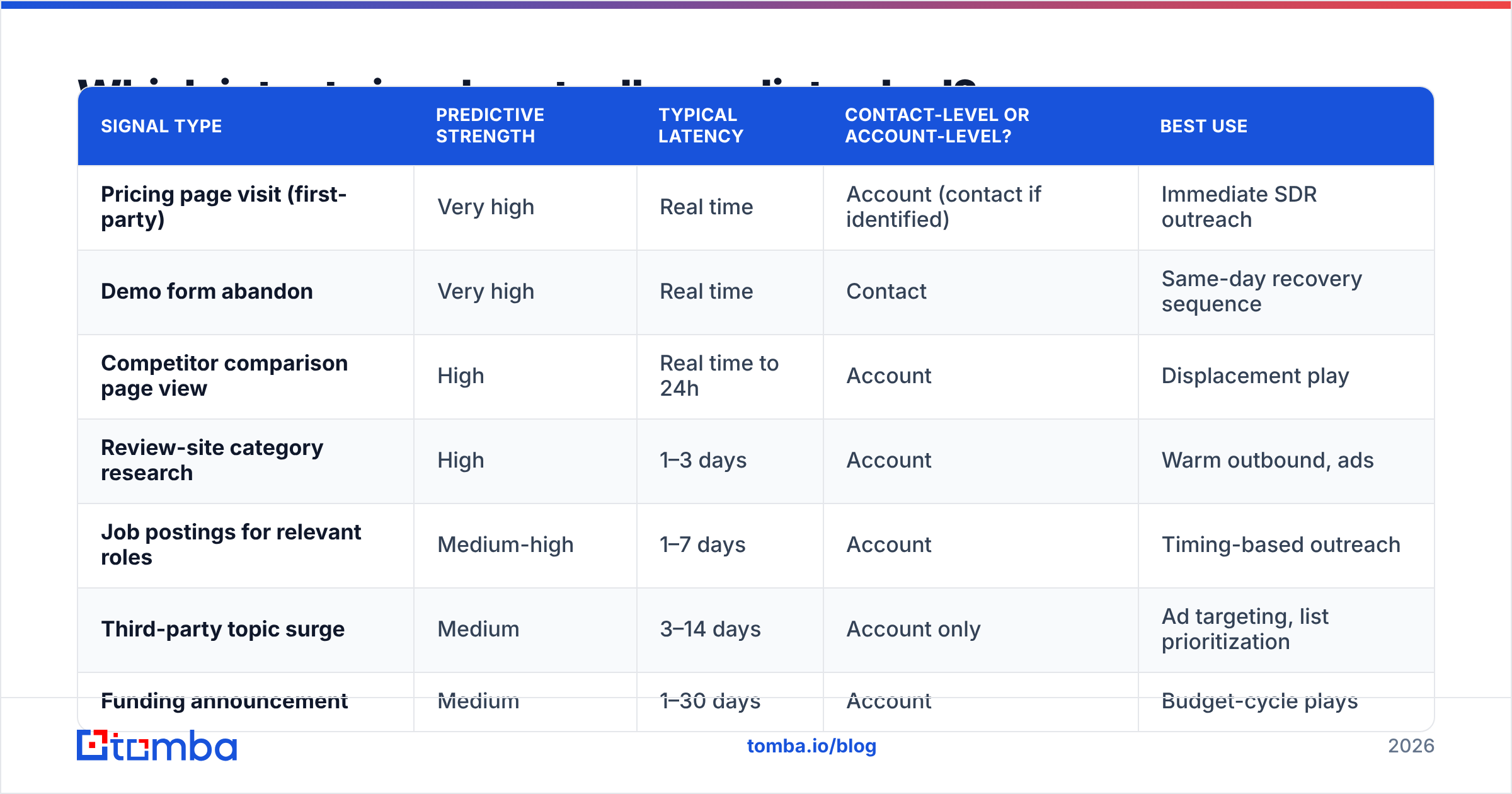
Not all signals are equal, and the gap between the best and worst is enormous. Here's how the common categories stack up on the dimensions that matter operationally.
| Signal type | Predictive strength | Typical latency | Contact-level or account-level? | Best use |
|---|---|---|---|---|
| Pricing page visit (first-party) | Very high | Real time | Account (contact if identified) | Immediate SDR outreach |
| Demo form abandon | Very high | Real time | Contact | Same-day recovery sequence |
| Competitor comparison page view | High | Real time to 24h | Account | Displacement play |
| Review-site category research | High | 1–3 days | Account | Warm outbound, ads |
| Job postings for relevant roles | Medium-high | 1–7 days | Account | Timing-based outreach |
| Third-party topic surge | Medium | 3–14 days | Account only | Ad targeting, list prioritization |
| Funding announcement | Medium | 1–30 days | Account | Budget-cycle plays |
| Generic blog content reads | Low | Real time | Account | Nurture, nothing more |
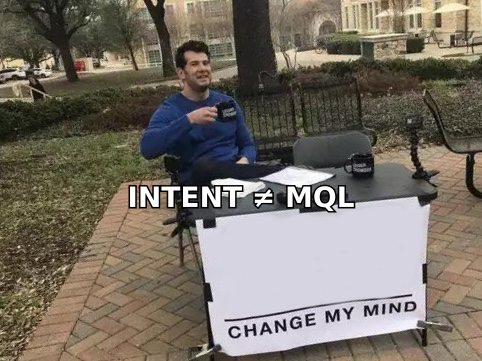
The pattern is consistent: depth of intent beats breadth of intent, and first-party beats third-party. Someone reading your pricing page has crossed a threshold that no amount of anonymous topic consumption replicates.
Third-party intent still earns its place — it sees accounts before they ever touch your domain, which is the entire point. Just stop treating a topic surge as a reason to send a "saw you were researching X" email. That message is creepy when it's right and embarrassing when it's wrong.
First-party vs third-party vs second-party intent: what's the difference?#
These three terms get used interchangeably by vendors who should know better.
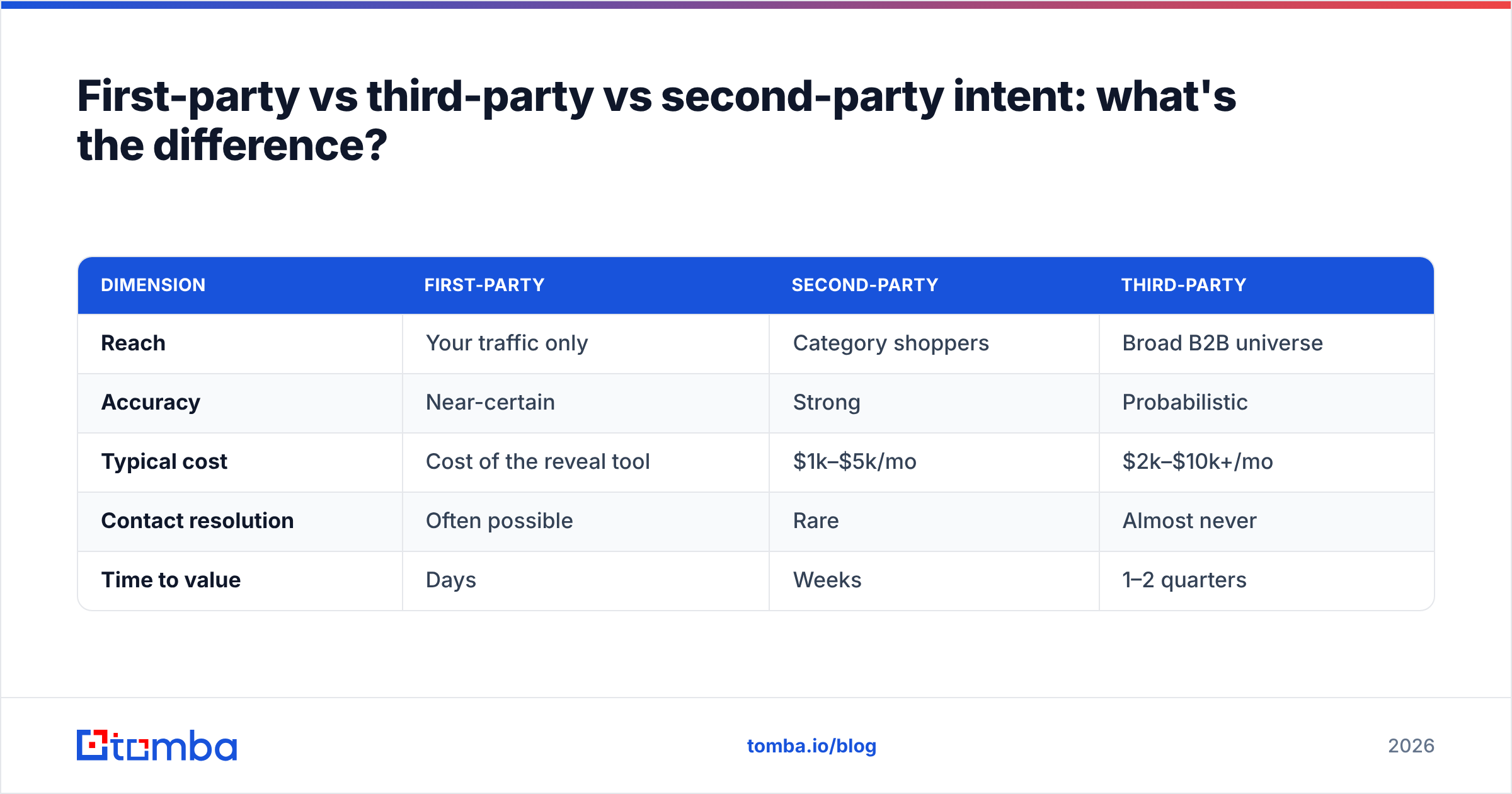
- First-party intent — behavior on assets you own. Highest fidelity, lowest reach. You only see accounts that already found you.
- Second-party intent — behavior on a partner's property that they share with you directly. Review sites selling category-level buyer activity are the classic case. Good fidelity, medium reach, usually the best price-to-value ratio in the stack.
- Third-party intent — aggregated consumption across a content co-op, resolved to a company via IP or device graph. Highest reach, lowest fidelity, longest latency.
| Dimension | First-party | Second-party | Third-party |
|---|---|---|---|
| Reach | Your traffic only | Category shoppers | Broad B2B universe |
| Accuracy | Near-certain | Strong | Probabilistic |
| Typical cost | Cost of the reveal tool | $1k–$5k/mo | $2k–$10k+/mo |
| Contact resolution | Often possible | Rare | Almost never |
| Time to value | Days | Weeks | 1–2 quarters |
If you're building this from zero, build in that order. Instrument first-party first with a website visitor reveal layer, add second-party review data once you have volume, and only buy third-party when you have the SDR capacity to work accounts that have never heard of you.
How do you turn an intent signal into a contactable lead?#
This is where most intent programs quietly die.
Your intent platform tells you that Acme Corp had a 4x surge on "sales engagement platform" and viewed two competitor comparison pages. Excellent. Now what? You have a company name and a topic. You do not have a person, a role, an email, or a phone number.
The resolution chain looks like this:
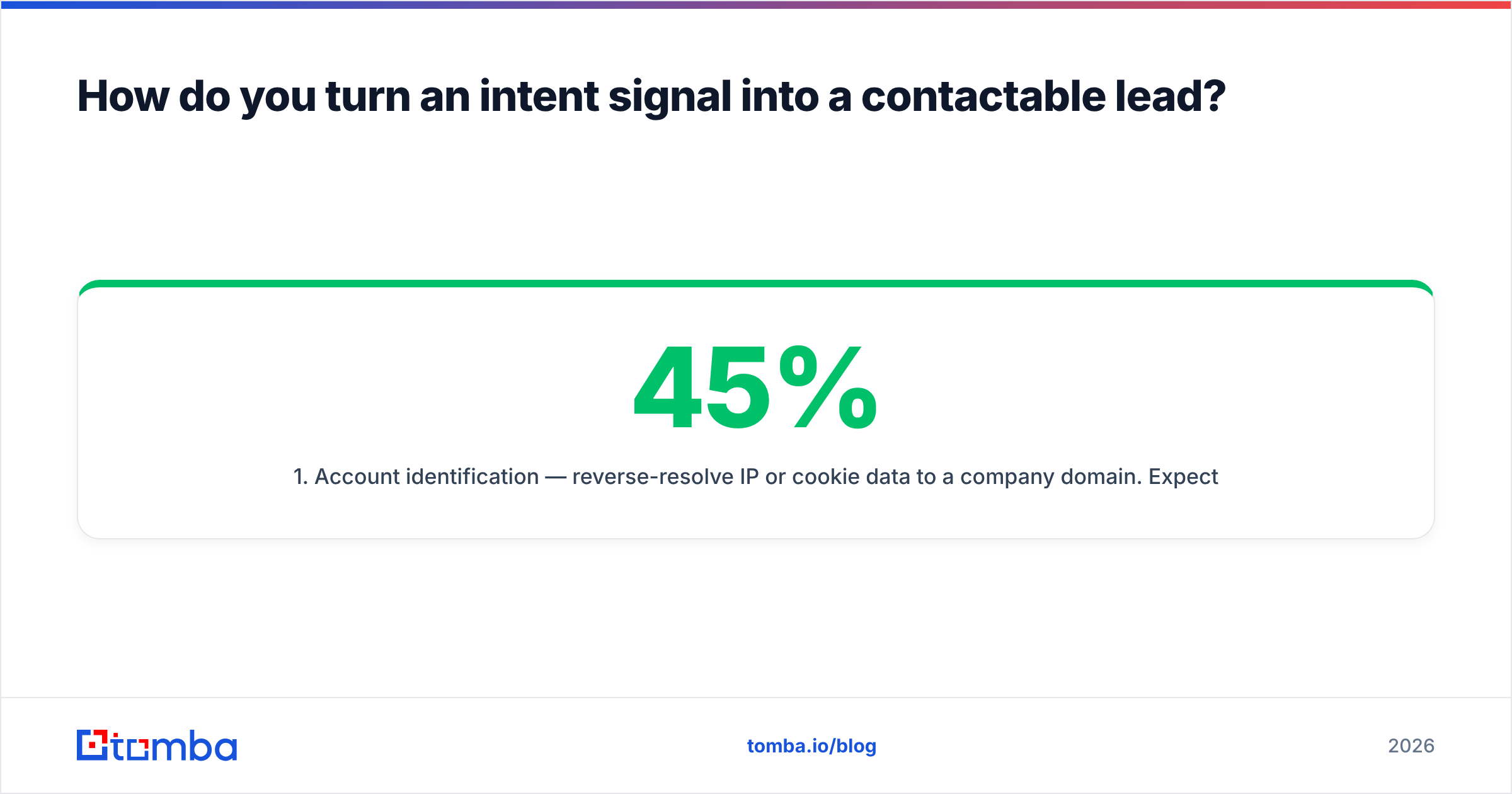
- Account identification — reverse-resolve IP or cookie data to a company domain. Expect 25–45% match rates on anonymous traffic in 2026; anything a vendor quotes above 60% deserves skepticism.
- Persona targeting — decide which 2–4 job titles actually own this problem at that company. Don't spray the whole org chart.
- Contact discovery — find the named humans in those roles. A domain search returns the addresses at a company along with the pattern they use, which is faster than guessing person by person.
- Verification — confirm the address is deliverable before it enters a sequence. Intent-triggered sends go out fast and at low volume, which means a single bounce hurts your domain more than it would in a 5,000-person blast.
- Enrichment and routing — attach firmographics, seniority, and the originating signal to the CRM record so the rep's first line isn't generic.
Steps 3 and 4 are the expensive ones if you get them wrong. A bad contact layer turns a genuinely good signal into a bounced email and a wasted week.
There's a practical nuance here worth naming: intent-triggered outreach has a short half-life. A pricing-page visit is worth acting on within 24 hours and mostly worthless after a week. That means your contact-discovery step has to be automated, not a manual research task in someone's queue. Wire it through an email finder API or a scheduled bulk email finder job so contacts are resolved before an SDR ever opens the record.
What does an intent stack cost in 2026?#
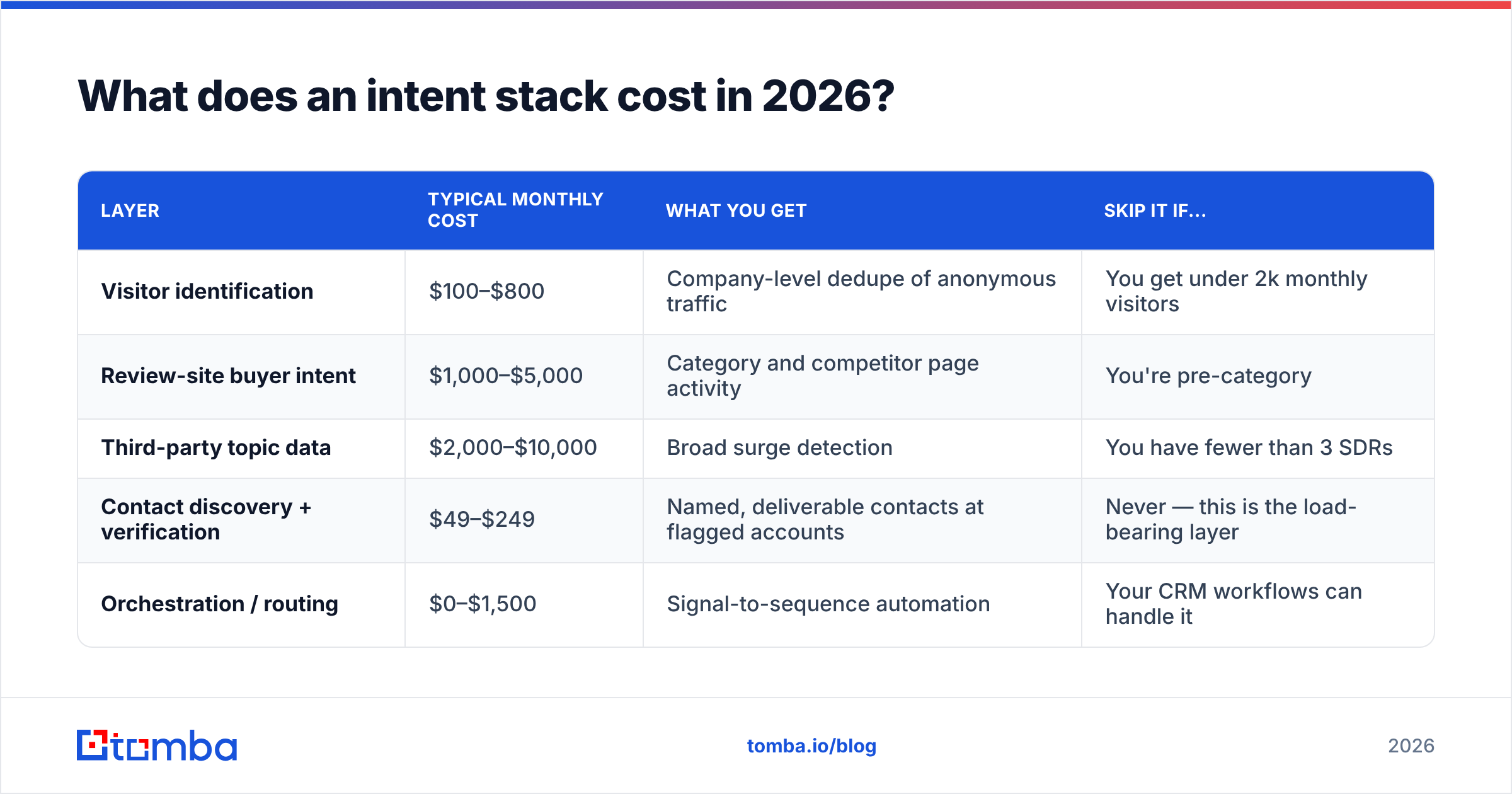
Budgets vary wildly, but the shape is fairly consistent across mid-market teams.
| Layer | Typical monthly cost | What you get | Skip it if... |
|---|---|---|---|
| Visitor identification | $100–$800 | Company-level dedupe of anonymous traffic | You get under 2k monthly visitors |
| Review-site buyer intent | $1,000–$5,000 | Category and competitor page activity | You're pre-category |
| Third-party topic data | $2,000–$10,000 | Broad surge detection | You have fewer than 3 SDRs |
| Contact discovery + verification | $49–$249 | Named, deliverable contacts at flagged accounts | Never — this is the load-bearing layer |
| Orchestration / routing | $0–$1,500 | Signal-to-sequence automation | Your CRM workflows can handle it |
That contact layer is the cheapest line item and the one that determines whether everything above it converts. Tomba pricing starts free at 25 searches a month, with Starter at $49/mo, Growth at $99/mo, and Pro at $249/mo — which, next to a $4,000 third-party intent contract, is rounding error. For teams that prefer buying static lists alongside signal-driven discovery, providers like BookYourData cover that adjacent need well; the two approaches complement each other more than they compete.
The honest math: if you're spending $5,000/mo on intent data and $0 on turning accounts into verified contacts, you've bought a very expensive list of company names.
How should you score and route intent signals?#
Score on four variables, weighted roughly in this order:
- Depth — how close is the behavior to a purchase decision? Pricing and comparison pages sit at the top. Awareness content sits at the bottom.
- Recency — decay aggressively. Half-life of 3–5 days for first-party, 10–14 for third-party. A 30-day-old signal should score near zero.
- Repetition — three visits from two different people at the same account in a week is a buying committee forming. One visit is a curiosity.
- Fit — a perfect-fit account with a medium signal beats a poor-fit account with a strong one. Apply fit as a multiplier, not an additive point value.
Then route by tier, not by a single threshold:
- Tier 1 (deep + recent + fit): SDR call within 4 hours, personalized to the specific page or topic. Pull a mobile number via phone finder so the follow-up isn't email-only.
- Tier 2 (medium depth or older): Enter a 5-touch sequence referencing the problem, never the surveillance.
- Tier 3 (broad third-party surge): Retargeting ads and account-based content. No direct outreach.
The routing discipline matters more than the scoring model. Most teams build an elegant score and then dump everything above 60 into the same sequence, which erases the distinction they just paid to create.
What are the most common intent data mistakes?#
Referencing the signal explicitly. "I noticed you were researching sales engagement platforms" gets you reported. Use the signal to choose the topic and timing, then write a normal email about the problem.
Treating account intent as person intent. A surge at a 4,000-person company tells you almost nothing about which of the 40 people in that department cares. Persona-target hard.
Ignoring signal decay. Batch-processing intent weekly is functionally the same as not having intent. If your workflow can't act inside 48 hours, buy first-party signals only and skip the third-party contract.
No verification step. Intent-triggered sends are low-volume and high-stakes for sender reputation. Run every discovered address through an email verifier, and handle catch-all domains explicitly rather than guessing — a catch-all verifier gives you a defensible send/don't-send decision instead of a coin flip.
Measuring the wrong outcome. Vendors will show you "accounts surged." That's not a metric. Measure meetings booked from intent-sourced outreach versus your baseline cold outreach, and measure it on a 90-day lag. If the lift isn't at least 2x, the data isn't working — or your resolution layer is dropping the handoff.
Is intent data worth it for small teams?#
For teams under roughly five reps, third-party intent is usually a bad buy. The contract is large, the latency is long, and you don't have the outbound capacity to work the account volume it generates.
What does work at small scale:
- Instrument your own site. Identify visiting companies, flag pricing and comparison page views, alert in Slack. This is cheap and the signal quality is the best you'll ever get.
- Track hiring. Job boards are free intent data. A company hiring for a role adjacent to your product is budgeting for the problem.
- Watch technology changes. A site that just added a new CRM or marketing automation tag is mid-migration and open to adjacent purchases.
- Resolve fast and verify. Whatever signals you catch, the win comes from being the first credible email in the inbox — which means the contact layer has to be instant.
Teams that do those four things well routinely outperform teams paying five figures a quarter for topic surges they never operationalize. For a broader view of how buying-committee behavior has shifted, the research libraries at Gartner and HubSpot's blog are reasonable starting points — just read them as directional, not as your playbook.
Where should you start this quarter?#
Pick one signal, wire it end to end, and prove the lift before adding a second. The teams that fail at intent are the ones who buy three data sources in a quarter and operationalize none of them.
A realistic first build: identify companies visiting your pricing page, resolve the two most relevant job titles at each, verify the addresses, and put them in a 24-hour SDR queue. That single loop, done properly, outperforms most enterprise intent deployments — and it costs less than one month of a topic-data contract.
The part nobody can skip is turning a company name into a verified human you can actually reach. That's what the Tomba Email Finder is built for: give it a domain and a name, get back a deliverable professional address with a confidence score and the sources behind it. Start on the free tier at 25 searches a month, wire it into your intent workflow, and only scale the plan once the signals are converting. Signals without contacts are just analytics. Signals with verified contacts are pipeline.
Related guides#
// get started
Find, verify and enrich your first contacts today
Start on the free plan with 25 searches a month, then scale when your team is ready.
Free plan · No credit card required · GDPR & CCPA
// about the author