Intent Software in 2026: How Buyer Intent Data Actually Works
Intent software claims to tell you who is in-market before they fill out a form. Here is what the signals really are, where the accuracy breaks, what the platforms cost in 2026, and how to build a usable intent stack without a six-figure contract.
TL;DR
- Intent software infers purchase readiness from behavior — content consumption, review-site browsing, job posts, tech installs, and visits to your own site — then scores accounts so you can reach out before a form gets filled.
- First-party intent (your own site, product, and email data) is the most accurate and the cheapest. Third-party intent is broader, noisier, and where most of the budget goes.
- Account-level signals are the norm. Almost no vendor can legitimately tell you which person is researching — you still have to identify and contact the right human yourself.
- Enterprise platforms run $30k–$100k+/year. A workable starter stack costs a fraction of that if you combine one intent source with reliable contact data.
- Intent software fails when there is no follow-through: no routing, no message change, no contact coverage. The signal is worthless if you cannot email a decision-maker within 48 hours.
What is intent software?#
Intent software is a category of B2B tools that watch behavioral signals across the web and inside your own properties, then tell you which companies look like they are actively evaluating something you sell.
Think of it like a bookstore owner noticing that the same customer has come in four times this month and keeps picking up books about starting a restaurant. Nobody announced anything. But the pattern says something. Intent platforms industrialize that noticing across millions of companies.
Technically, the workflow is: collect raw behavioral events → resolve those events to a company (usually via IP-to-company mapping, cookie/ID graphs, or publisher-side registration data) → compare current activity to that company's historical baseline → emit a "surge" score against a topic taxonomy.
Three things follow from that definition, and they explain most of the disappointment teams feel in year one:
- It is probabilistic, not factual. A surge score is a statistical claim about a population of employees, not a confirmed buying decision.
- It is account-level. The output is "Acme Corp is surging on data enrichment," not "Sarah in RevOps opened a pricing page."
- It is a prioritization layer, not a lead source. Intent tells you where to spend attention. It does not hand you a contact, a message, or a meeting.
Where does intent data actually come from?#
Vendors are vague about sourcing because the underlying supply is a small number of co-ops and publisher networks resold many times over. These are the five real sources:
- B2B publisher co-ops — Networks of trade publications and content syndication sites track which companies read which articles. This is the classic third-party intent supply (Bombora's Data Co-op is the best-known example) and it powers a surprising share of "proprietary" vendor datasets.
- Review and marketplace behavior — Comparison pages, category browsing, and pricing-page views on sites like G2 are the highest-conviction third-party signal available, because the behavior is unambiguous. Someone comparing you to two rivals is not doing idle research.
- Bidstream data — Ad-exchange bid requests reveal page URLs and IP addresses at enormous scale. Cheap, huge coverage, and the noisiest of the lot. Privacy scrutiny has been squeezing this source year over year.
- First-party web and product activity — Your own visitors, deanonymized to company level. Smaller volume, dramatically higher precision, and you own it outright.
- Public firmographic change signals — Job postings, funding rounds, leadership hires, and technology installs. Not "intent" in the strict sense, but often better predictors of a real budget than any surge score.

The practical takeaway: if you buy intent software without first instrumenting sources 4 and 5, you are paying premium prices for the weakest half of the picture.
How do the main types of intent software compare?#
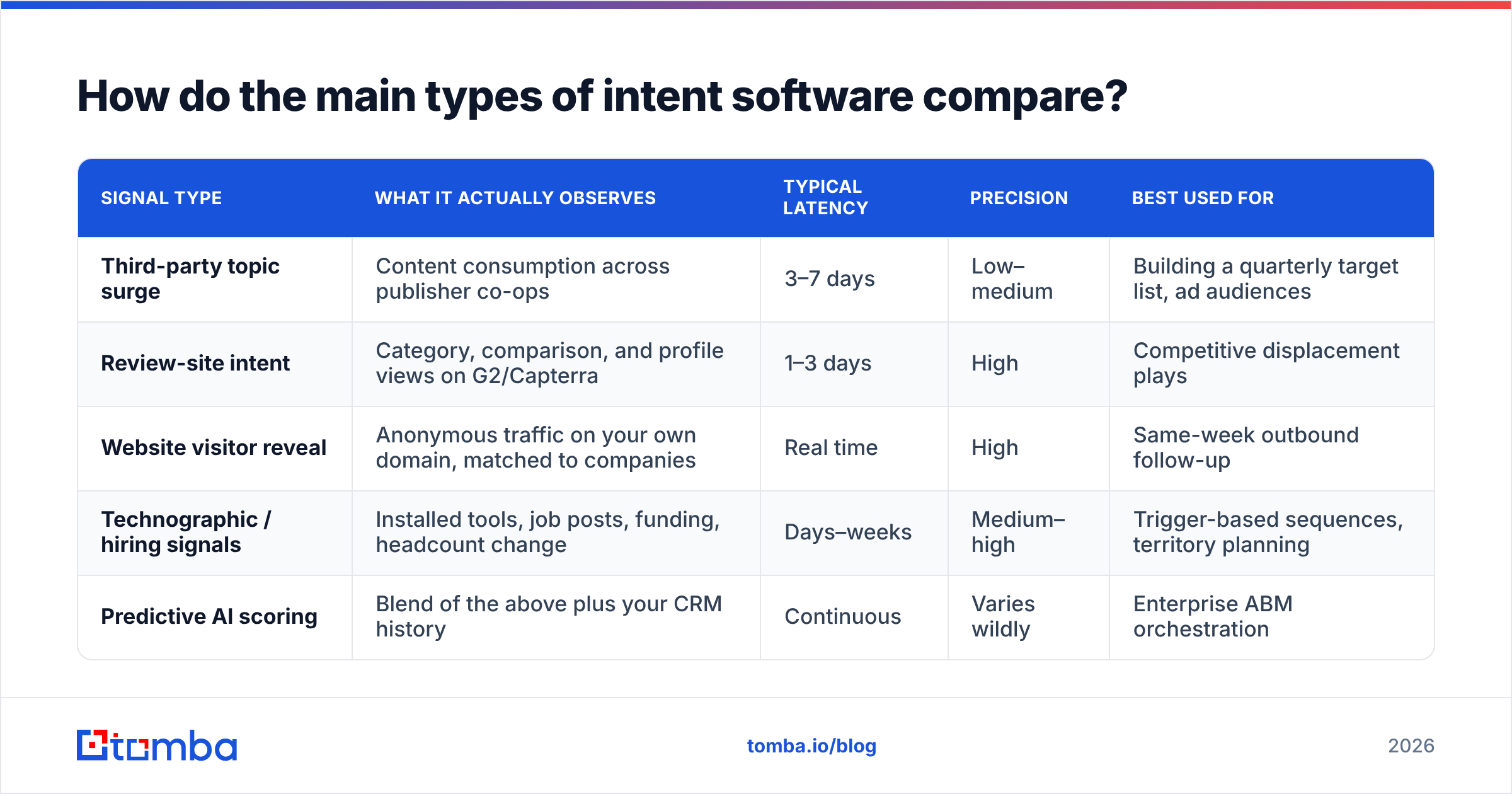
The category is not one market. It is four, and mixing them up is the most common procurement mistake.
| Signal type | What it actually observes | Typical latency | Precision | Best used for |
|---|---|---|---|---|
| Third-party topic surge | Content consumption across publisher co-ops | 3–7 days | Low–medium | Building a quarterly target list, ad audiences |
| Review-site intent | Category, comparison, and profile views on G2/Capterra | 1–3 days | High | Competitive displacement plays |
| Website visitor reveal | Anonymous traffic on your own domain, matched to companies | Real time | High | Same-week outbound follow-up |
| Technographic / hiring signals | Installed tools, job posts, funding, headcount change | Days–weeks | Medium–high | Trigger-based sequences, territory planning |
| Predictive AI scoring | Blend of the above plus your CRM history | Continuous | Varies wildly | Enterprise ABM orchestration |
Review-site intent and visitor reveal are the two that consistently earn their keep for teams under 200 employees. Topic surge and predictive scoring justify themselves mainly at enterprise scale, where there is an ABM team to operationalize them and a large enough account universe for statistical patterns to be meaningful.
If your total addressable market is 3,000 accounts, a surge model does not have much to sort. You could work the whole list in a quarter.
Is intent software accurate enough to act on?#
Honest answer: accuracy depends almost entirely on the resolution step, and the resolution step is getting harder.
Three failure modes to test for during any trial:
IP-to-company drift. Remote work shattered the assumption that an IP maps to an office. A signal attributed to a 4,000-person enterprise may be one contractor on a coworking network. Ask any vendor what percentage of their matches come from residential or shared IP ranges. The good ones will tell you. The rest will change the subject.
Topic taxonomy mismatch. Vendors sell against a fixed taxonomy of a few thousand topics. If your product sits between two of them, every score you receive is a blurry approximation. Check whether your actual category exists as a topic before signing, not after.
Baseline inflation. Surge is measured against an account's own historical baseline. Large companies with high baseline consumption rarely surge; small companies surge on almost nothing. This systematically skews lists toward mid-market noise unless you normalize it.
A reasonable internal benchmark: run intent-sourced accounts and your normal ICP list through identical outbound sequences for six weeks. If intent-sourced accounts do not produce at least a 1.5x lift in reply rate, the signal is not doing work you could not do with better segmentation. Industry analysts including Gartner have consistently found that data quality problems, not model sophistication, drive most go-to-market tooling underperformance — and intent is no exception.
What does intent software cost in 2026?#
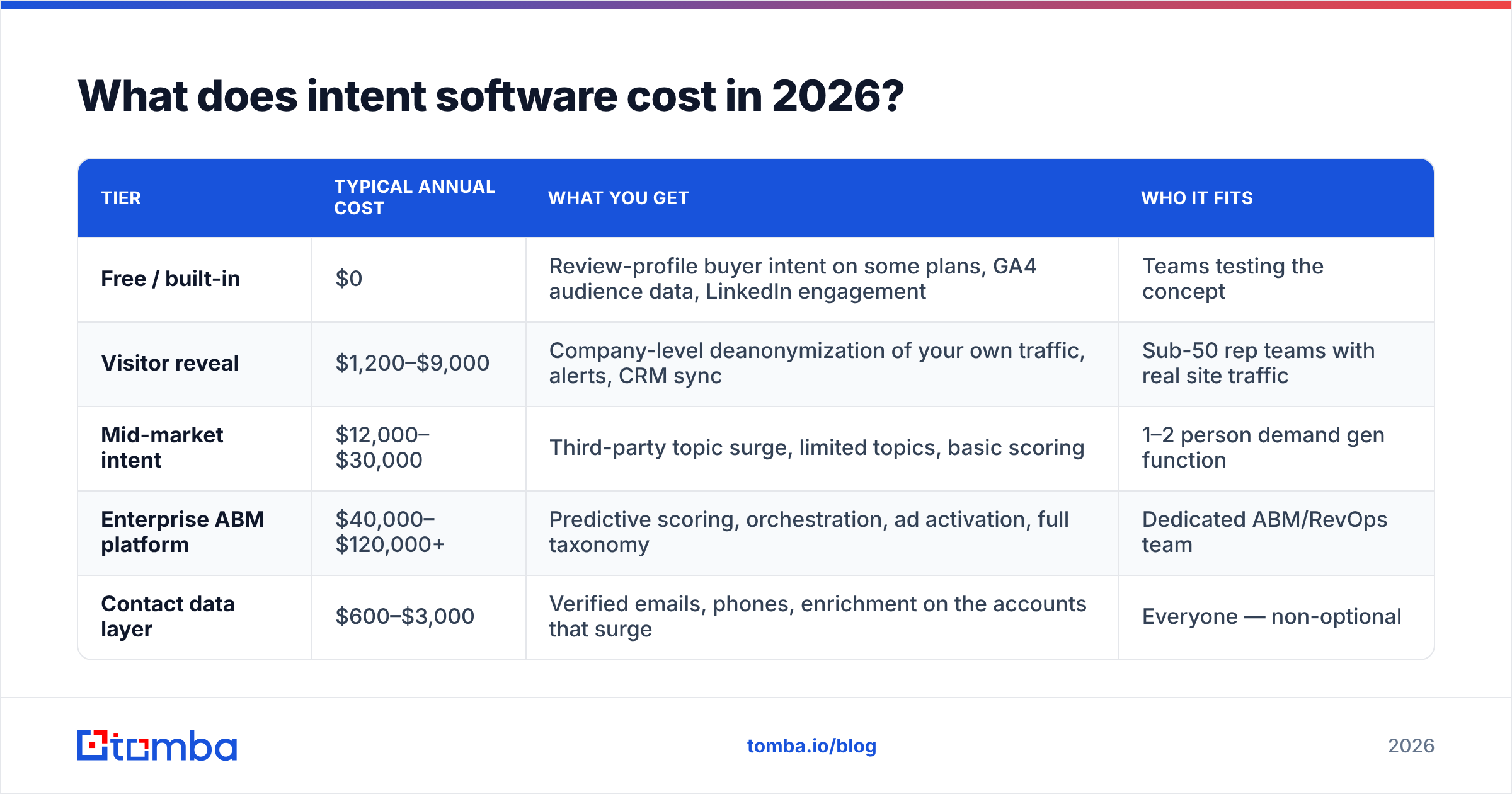
Pricing is opaque by design, but the shape of the market is consistent. Figures below are indicative annual ranges reported by buyers; every vendor negotiates by account volume, topic count, and seat count, so treat them as a planning baseline rather than a quote.
| Tier | Typical annual cost | What you get | Who it fits |
|---|---|---|---|
| Free / built-in | $0 | Review-profile buyer intent on some plans, GA4 audience data, LinkedIn engagement | Teams testing the concept |
| Visitor reveal | $1,200–$9,000 | Company-level deanonymization of your own traffic, alerts, CRM sync | Sub-50 rep teams with real site traffic |
| Mid-market intent | $12,000–$30,000 | Third-party topic surge, limited topics, basic scoring | 1–2 person demand gen function |
| Enterprise ABM platform | $40,000–$120,000+ | Predictive scoring, orchestration, ad activation, full taxonomy | Dedicated ABM/RevOps team |
| Contact data layer | $600–$3,000 | Verified emails, phones, enrichment on the accounts that surge | Everyone — non-optional |
That last row is the one teams forget to budget. Intent software gives you an account name. It does not reliably give you a reachable person at that account. Platforms that bundle contacts usually bundle stale ones, because contact data decays roughly 2–3% per month as people change jobs.
Pairing a modest intent source with a dedicated finder and verifier — the model behind Tomba pricing, which starts free at 25 searches and scales from $49/mo — costs less than the annual difference between two intent vendor quotes.
How do you turn an intent signal into a real conversation?#
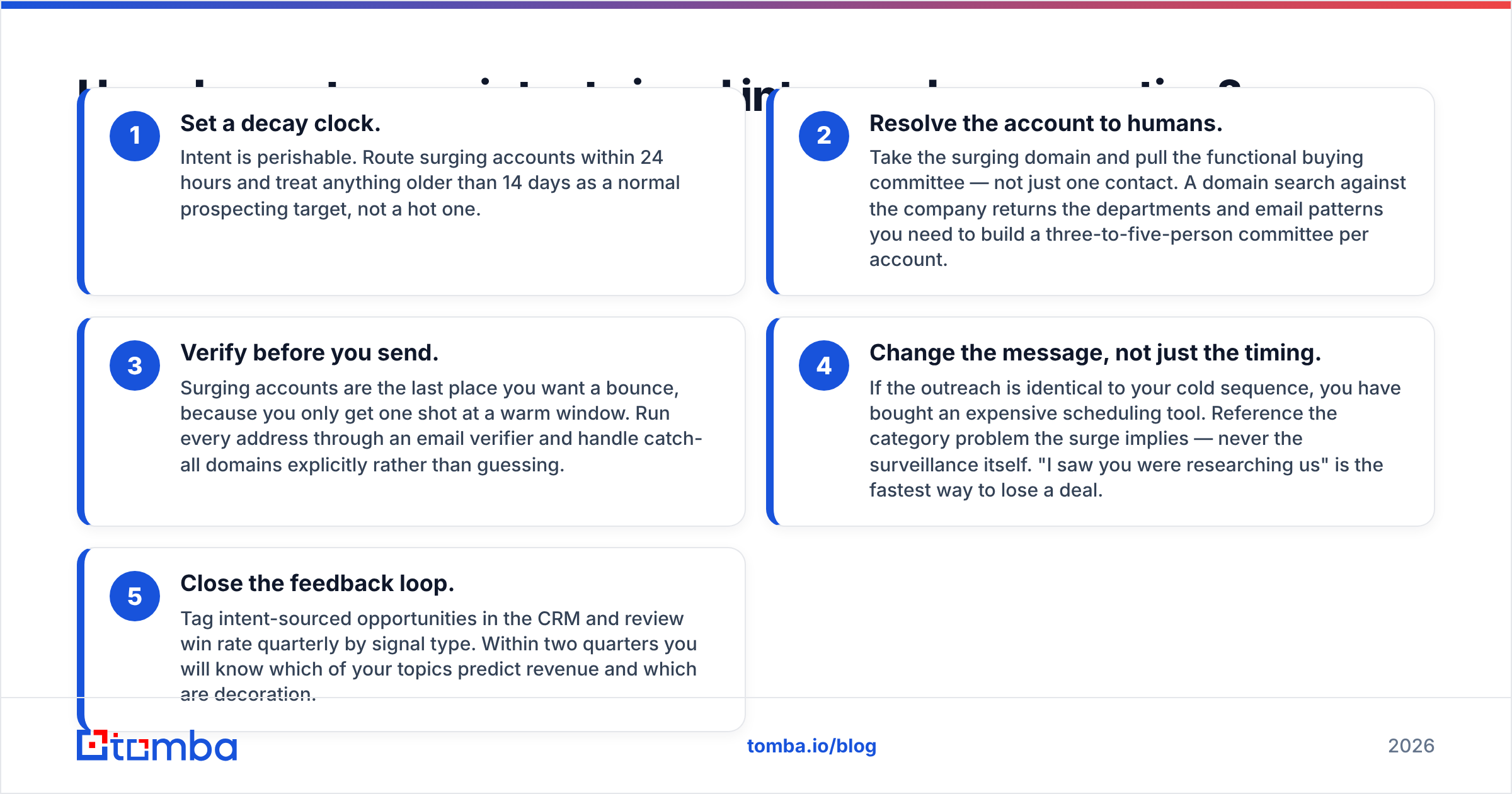
This is where most implementations die. The signal arrives, sits in a dashboard, and nobody does anything differently. A working loop has five steps:
- Set a decay clock. Intent is perishable. Route surging accounts within 24 hours and treat anything older than 14 days as a normal prospecting target, not a hot one.
- Resolve the account to humans. Take the surging domain and pull the functional buying committee — not just one contact. A domain search against the company returns the departments and email patterns you need to build a three-to-five-person committee per account.
- Verify before you send. Surging accounts are the last place you want a bounce, because you only get one shot at a warm window. Run every address through an email verifier and handle catch-all domains explicitly rather than guessing.
- Change the message, not just the timing. If the outreach is identical to your cold sequence, you have bought an expensive scheduling tool. Reference the category problem the surge implies — never the surveillance itself. "I saw you were researching us" is the fastest way to lose a deal.
- Close the feedback loop. Tag intent-sourced opportunities in the CRM and review win rate quarterly by signal type. Within two quarters you will know which of your topics predict revenue and which are decoration.
Step 4 deserves emphasis. Buyers find explicit references to tracked behavior unsettling, and major inbound-marketing guidance from firms like HubSpot has long pushed toward relevance framed as insight rather than observation. Write as if you inferred the problem from the market, because you did.
When is intent software a waste of money?#
Skip it, or delay it, if any of these are true:
- Your ICP is under ~2,000 accounts. You do not have a prioritization problem. You have a coverage problem. Work the full list.
- Your contact data is unreliable. Adding signal on top of unreachable contacts multiplies nothing. Fix the data enrichment layer first — it is cheaper and the ROI is immediate.
- Nobody owns follow-up. If there is no named person accountable for acting on alerts within 48 hours, the subscription is a report nobody reads.
- Your sales cycle is under two weeks. Transactional motions rarely leave a long enough research trail for surge detection to matter.
- You are pre-product-market-fit. Intent tells you who is shopping in a category. If your category positioning is still moving, the topic mapping will be wrong.
For teams in these situations, the higher-leverage move is a broad, well-verified contact foundation. Providers of purchased B2B contact lists such as BookYourData serve a genuine need here for teams that want coverage fast, and pairing any purchased list with independent verification is standard good practice regardless of source.
What does a lean intent stack look like?#
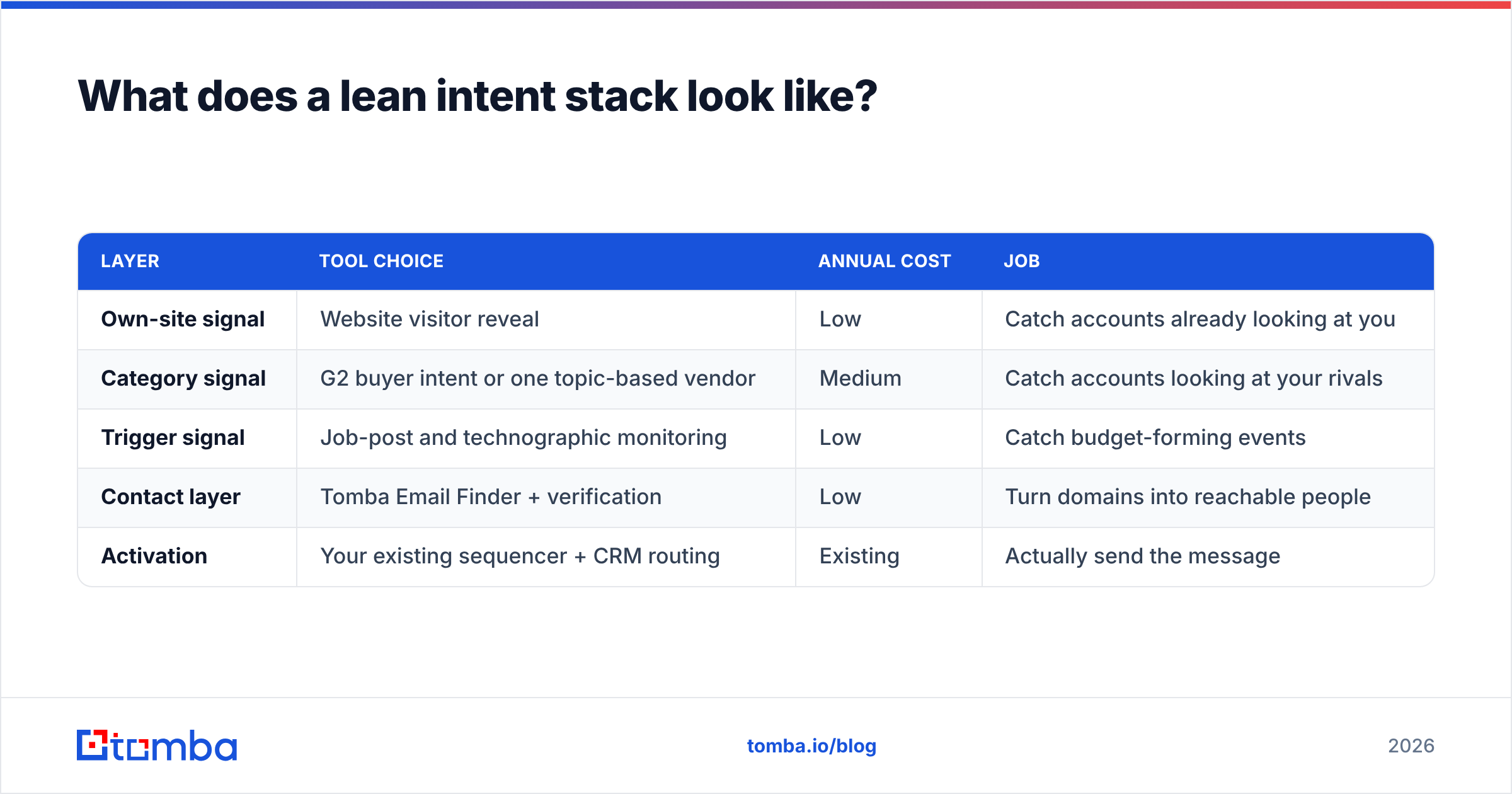
A practical 2026 configuration for a team of five to thirty reps:
| Layer | Tool choice | Annual cost | Job |
|---|---|---|---|
| Own-site signal | Website visitor reveal | Low | Catch accounts already looking at you |
| Category signal | G2 buyer intent or one topic-based vendor | Medium | Catch accounts looking at your rivals |
| Trigger signal | Job-post and technographic monitoring | Low | Catch budget-forming events |
| Contact layer | Tomba Email Finder + verification | Low | Turn domains into reachable people |
| Activation | Your existing sequencer + CRM routing | Existing | Actually send the message |
Total: usually under $15,000/year, versus $60,000+ for a single enterprise platform that still leaves the contact layer unsolved. Start here, prove the lift with real reply-rate data, then upgrade the signal layer once you have evidence about which topics predict pipeline.
Where should you start?#
Run the cheap experiment before the expensive contract. For 30 days, deanonymize your own traffic, pull the 50 highest-fit companies that visited without converting, build a three-person buying committee at each, verify the addresses, and send a sequence that speaks to the category problem. Measure reply rate against your baseline.
If that lifts, intent is real in your market and you now know exactly what to buy more of. If it does not, you just saved a five-figure renewal.
When you get to the step that actually converts a signal into a conversation, Tomba Email Finder is built for it: find verified professional addresses by domain, name, or company, check them before you send, and push the result straight into your sequencer through the Tomba API. Start on the free tier with 25 searches a month, or move to Starter at $49/mo once your intent loop is running. The signal is only worth what you can do with it.
Related guides#
// get started
Find, verify and enrich your first contacts today
Start on the free plan with 25 searches a month, then scale when your team is ready.
Free plan · No credit card required · GDPR & CCPA
// about the author