Intentrack Pricing, Reviews, Pros and Cons: 2026 Guide
Intentrack does not publish a price list, which makes budgeting guesswork. Here is how intent-platform pricing actually works, what buyers praise and complain about, and when a cheaper contact-data stack does the same job.
TL;DR
- Intentrack sells through quotes, not a public price list. Any "Intentrack pricing" number you see online is someone else's negotiated deal, not a rate card — treat it as a data point, not a benchmark.
- Intent platforms in this category price on four variables: seat count, topic/keyword count, account universe size, and whether contact-level data is bundled. Change one, and the quote can move by a five-figure amount.
- The strongest reviews praise account prioritisation and CRM surfacing. The most consistent complaints are annual-only contracts, thin contact data behind the signal, and signal noise that burns rep time.
- The realistic failure mode is not "the intent data was wrong." It is buying a $20k–$60k signal layer before you have a reliable way to reach the people at those accounts.
- If your gap is contact data rather than account prioritisation, a verified email and phone stack starting at $49/mo solves the actual bottleneck for a fraction of the spend.
What is Intentrack, and who is it actually for?#
Intentrack sits in the buyer-intent category: software that watches research behaviour across the web — content consumption, keyword surges, review-site activity, first-party site visits — and tells you which accounts are in-market right now. The output is a ranked list of companies with a score, a set of topics they are researching, and (depending on the tier) some contacts inside those companies.
That is a real problem worth solving. Most outbound fails on timing, not on copy. The catch is that intent tooling is sold to a specific buyer profile, and if you are not that profile, the economics stop working fast.
Intent platforms make sense when you have:
- A defined account universe. Intent scoring is a ranking tool. If you are selling to "any company with 10+ employees," there is nothing meaningful to rank — you need an ICP tight enough that a top-200 list is actionable.
- Enough pipeline volume to notice a lift. With 15 deals a year, a 12% improvement in account prioritisation is statistically invisible. You cannot tell the platform from the noise.
- Reps who will actually work the list. Intent data dies the moment it becomes a dashboard nobody opens. Someone has to own the daily surge list.
- A working outreach motion underneath it. Knowing an account is in-market is worthless if you cannot reach the VP of Ops there within 48 hours.
- Budget headroom above your data stack. Intent is a layer on top of contact data, not a replacement for it. Buying the top layer first is the most common sequencing mistake in this category.
If three or more of those are false, the honest answer is that no amount of Intentrack pricing negotiation makes the deal work. You are solving a problem you do not have yet.
How does Intentrack pricing actually work?#
Intentrack, like most platforms in the buyer intent category tracked on G2, does not publish a rate card. You book a call, describe your team, and receive a proposal. That is not a scandal — it is the norm for account-intelligence software — but it does mean you have to reverse-engineer the quote before you can judge it.
Four variables drive almost the entire number:
- Seats. Almost always per-user, almost always annual. The jump from a 3-seat pilot to a 12-seat rollout is usually the single biggest line-item change.
- Topics or keywords tracked. Entry tiers cap you at a handful of topics. Serious deployments need 20–50 to cover a full category plus competitor terms, and topic expansion is a standard upsell.
- Account universe / monitored domains. How many companies you can watch at once. A 2,000-account universe and a 50,000-account universe are different products at different prices.
- Contact data bundling. This is the one buyers underestimate. The signal tells you which company. Getting which person, and their working email is frequently a separate line item, a separate credit pool, or an outright separate vendor.
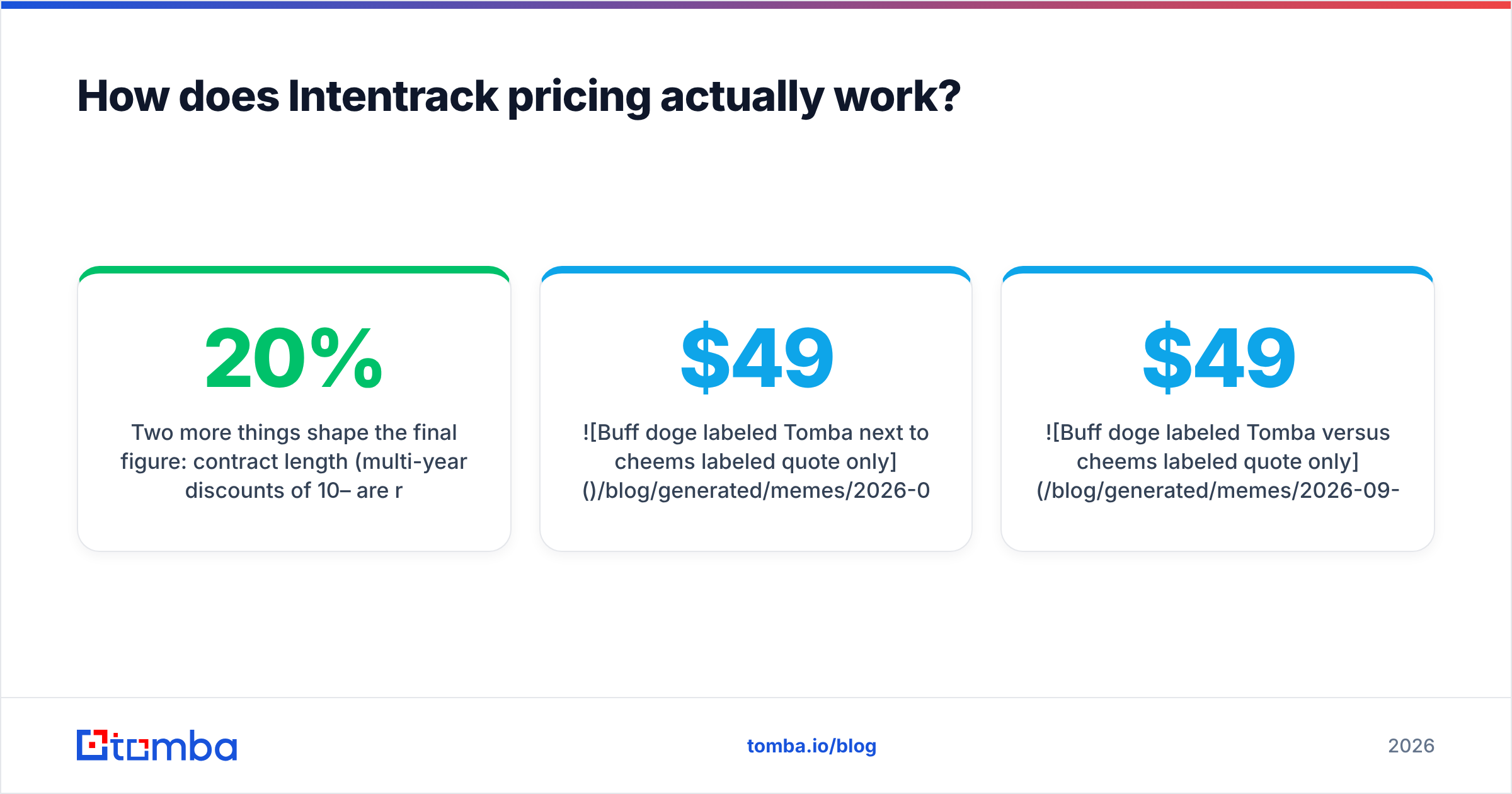
Two more things shape the final figure: contract length (multi-year discounts of 10–20% are routinely available) and timing (quarter-end and year-end quotes are meaningfully softer than mid-quarter ones).
Wait — that renders as a plain image below.

What should you ask for in writing?#
Before you sign anything, get these in the contract, not the sales deck: the exact account universe cap, what happens when you exceed it, whether contact credits roll over, the renewal uplift ceiling, and the notice period for non-renewal. Auto-renew with a 90-day notice window is the single most common source of "I'm locked in for another year" complaints across the whole category.
How does Intentrack pricing compare to other ways to buy the same outcome?#
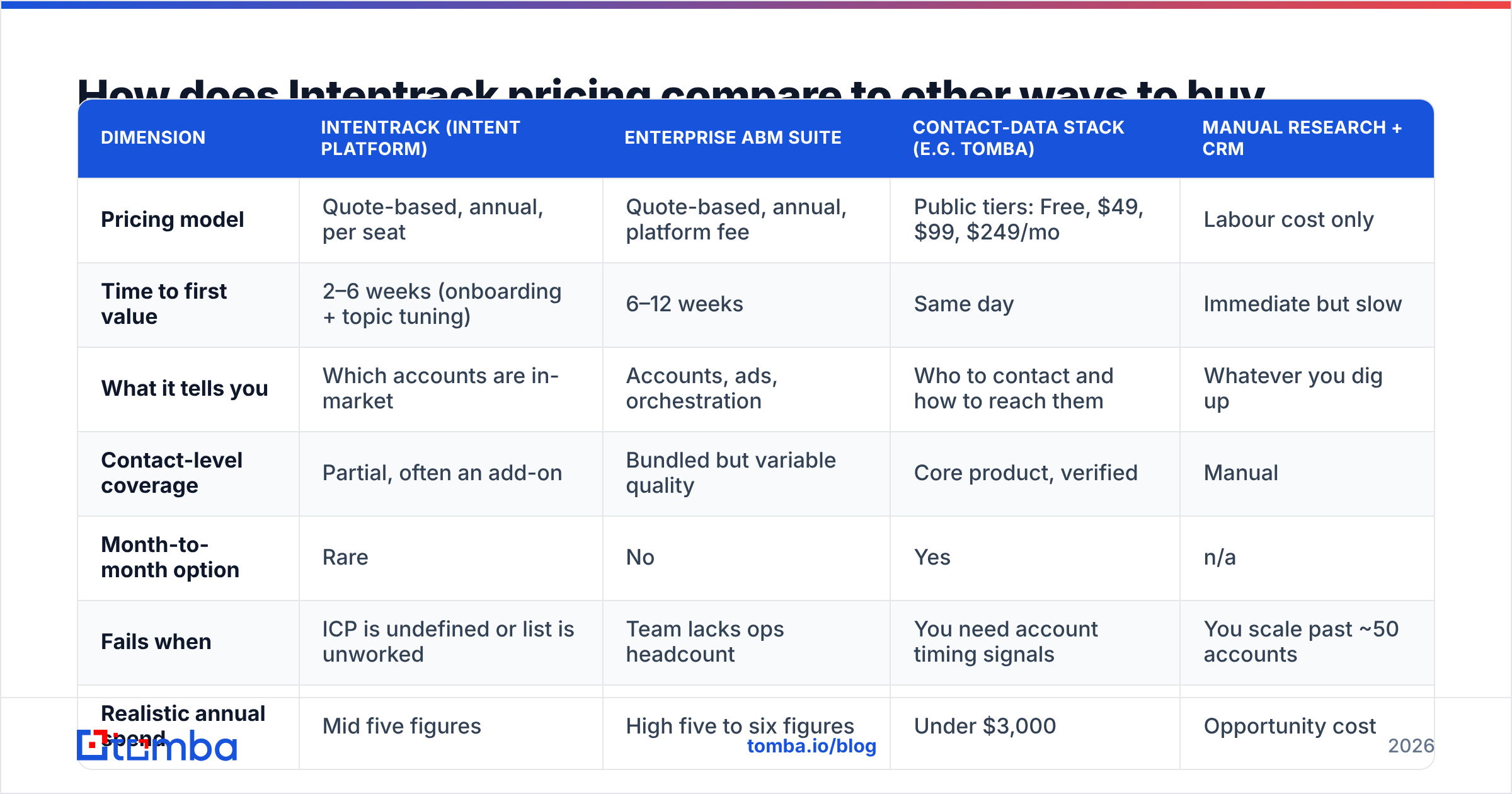
The useful comparison is not Intentrack versus one competitor. It is intent-first versus contact-first — two different bets about where your bottleneck lives.
| Dimension | Intentrack (intent platform) | Enterprise ABM suite | Contact-data stack (e.g. Tomba) | Manual research + CRM |
|---|---|---|---|---|
| Pricing model | Quote-based, annual, per seat | Quote-based, annual, platform fee | Public tiers: Free, $49, $99, $249/mo | Labour cost only |
| Time to first value | 2–6 weeks (onboarding + topic tuning) | 6–12 weeks | Same day | Immediate but slow |
| What it tells you | Which accounts are in-market | Accounts, ads, orchestration | Who to contact and how to reach them | Whatever you dig up |
| Contact-level coverage | Partial, often an add-on | Bundled but variable quality | Core product, verified | Manual |
| Month-to-month option | Rare | No | Yes | n/a |
| Fails when | ICP is undefined or list is unworked | Team lacks ops headcount | You need account timing signals | You scale past ~50 accounts |
| Realistic annual spend | Mid five figures | High five to six figures | Under $3,000 | Opportunity cost |
Read that table honestly and the sequencing becomes obvious. Intent tooling multiplies an existing motion. If the motion is broken — bounced emails, no phone coverage, stale CRM records — a multiplier on zero is still zero. Fix the denominator first with a solid email finder and email verifier layer, then buy timing signals when you have reps who run out of good accounts before they run out of hours.
What do Intentrack reviews say — and how much should you trust them?#
Review coverage for mid-market intent platforms is thin, and that itself is information. When a product has fewer than a hundred reviews on G2 or Capterra, the sample is dominated by two groups: customers incentivised during onboarding (glowing) and customers who churned angrily (scathing). The quiet middle — people who renewed once and felt fine about it — barely shows up.
Read reviews in this category with three filters:
- Check the reviewer's company size. A 40-person startup's experience with an intent platform has almost nothing in common with a 2,000-person enterprise's.
- Ignore the star rating, read the "what do you dislike" field. That is where contract terms, support responsiveness, and data-quality issues actually surface.
- Look for date clusters. A wall of 5-star reviews in one month is a review campaign, not organic sentiment.
- Discount anything about the sales process. Every vendor's pre-sale experience is excellent. The renewal experience is what you are buying.
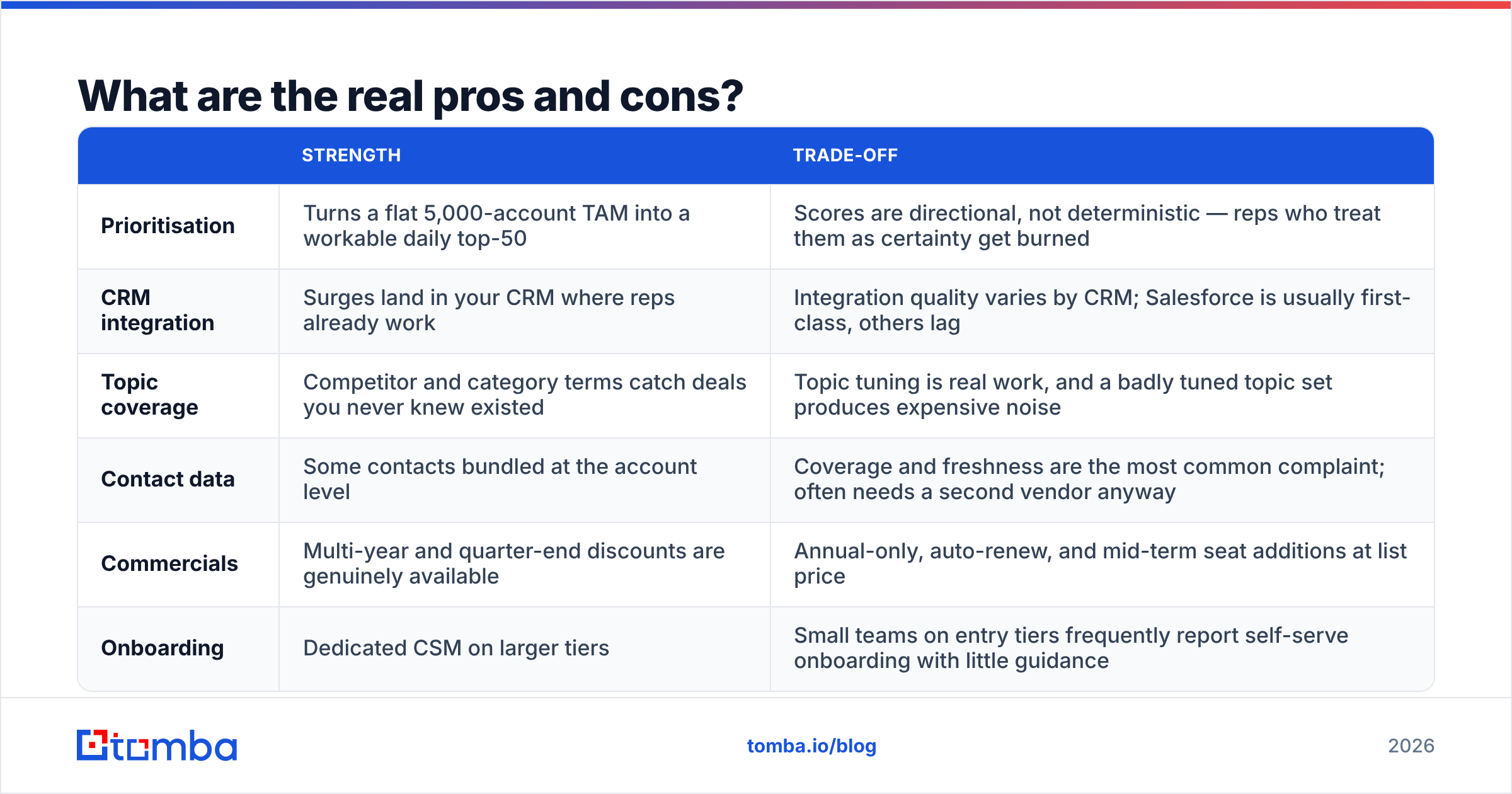
What are the real pros and cons?#
Here is the balanced version, based on the patterns that recur across this software category rather than marketing claims.
| Strength | Trade-off | |
|---|---|---|
| Prioritisation | Turns a flat 5,000-account TAM into a workable daily top-50 | Scores are directional, not deterministic — reps who treat them as certainty get burned |
| CRM integration | Surges land in your CRM where reps already work | Integration quality varies by CRM; Salesforce is usually first-class, others lag |
| Topic coverage | Competitor and category terms catch deals you never knew existed | Topic tuning is real work, and a badly tuned topic set produces expensive noise |
| Contact data | Some contacts bundled at the account level | Coverage and freshness are the most common complaint; often needs a second vendor anyway |
| Commercials | Multi-year and quarter-end discounts are genuinely available | Annual-only, auto-renew, and mid-term seat additions at list price |
| Onboarding | Dedicated CSM on larger tiers | Small teams on entry tiers frequently report self-serve onboarding with little guidance |
The pattern across nearly every negative review in this category is the same shape: the signal worked, the follow-through did not. An account surges, a rep opens it, finds two contacts — one of whom left the company eight months ago — and the moment passes. That is a contact-data failure wearing an intent-data costume.
Is Intentrack worth it in 2026?#
Conclusion first: it is worth it if intent is your only missing ingredient, and it is a poor first purchase if anything underneath it is shaky.
Buy it if:
- You have 5+ reps working a defined named-account list and they are running out of prioritisation, not out of contacts.
- Your CRM hygiene is good enough that a surge signal reaches a human within a day.
- You can commit to a full year and have someone who owns topic tuning as part of their job.
- Your ACV is high enough that one extra closed deal pays for the platform. For most teams that means $15k+ ACV.
Skip it if:
- Your bounce rate is above 5%, or you routinely cannot find a direct line into a target account. That is a data enrichment problem, and intent data will not touch it.
- You are pre-product-market-fit and your ICP is still moving. Intent tooling assumes a stable definition of "good account."
- You need month-to-month flexibility. Annual-only is a hard constraint in this category.
- Your team is under three reps. The overhead of running an intent motion exceeds the benefit at that size.
A reasonable middle path: run a quarter with tight ICP filters and a verified contact stack, measure your connect rate and reply rate honestly, and only then decide whether the missing variable is timing. If your reply rate is already healthy and your problem is choosing among 3,000 equally plausible accounts, intent is the right next purchase. If reps are still fighting bad addresses, it is not.
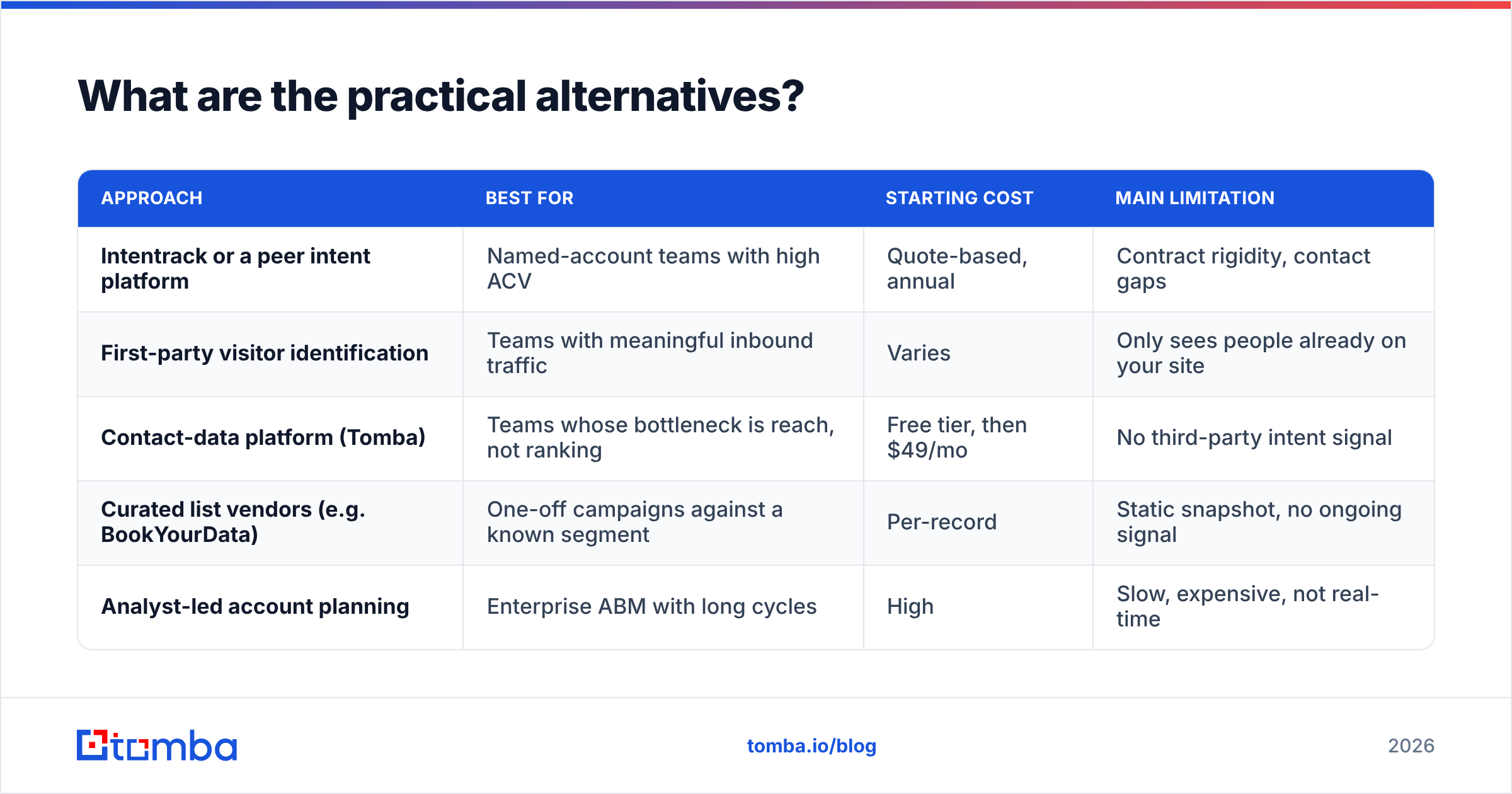
What are the practical alternatives?#
| Approach | Best for | Starting cost | Main limitation |
|---|---|---|---|
| Intentrack or a peer intent platform | Named-account teams with high ACV | Quote-based, annual | Contract rigidity, contact gaps |
| First-party visitor identification | Teams with meaningful inbound traffic | Varies | Only sees people already on your site |
| Contact-data platform (Tomba) | Teams whose bottleneck is reach, not ranking | Free tier, then $49/mo | No third-party intent signal |
| Curated list vendors (e.g. BookYourData) | One-off campaigns against a known segment | Per-record | Static snapshot, no ongoing signal |
| Analyst-led account planning | Enterprise ABM with long cycles | High | Slow, expensive, not real-time |
Each solves a genuinely different problem, and the honest answer for most mid-market teams is that they need the third row before the first. Tomba pricing is public precisely because the value is easy to test: Free (25 searches/mo), Starter $49/mo, Growth $99/mo, Pro $249/mo, Enterprise custom. You can validate coverage against your own account list in an afternoon rather than a six-week procurement cycle — which is also a fair way to pressure-test whatever intent vendor's contact claims end up in your proposal.
For background on where this whole category came from, HubSpot's research library tracks how buyer behaviour shifted toward self-directed research — the trend intent platforms exist to exploit.
How do you avoid overpaying?#
Four moves, in order of leverage:
- Ask for the unbundled quote. Request seats, topics, account universe, and contact credits as separate lines. Vendors resist this because bundling hides the expensive component. Insist anyway.
- Pilot with the smallest viable seat count. Three seats for one quarter tells you 80% of what twelve seats for a year would, at a fraction of the risk.
- Negotiate the renewal cap up front. A 5% uplift ceiling written into year one is worth more than a 10% first-year discount.
- Benchmark contact coverage before signing. Take 100 target accounts, run them through the vendor's contact data and through an independent domain search, and compare match rates and bounce rates. If the platform's contacts underperform, negotiate that module out of the deal entirely.
That last step is the one buyers skip and regret. It costs an hour and routinely removes a five-figure line item from a proposal.
Start with the layer that actually blocks you#
If your reps can name the accounts they want but cannot reliably reach the people inside them, buy the reach, not the ranking. The Tomba Email Finder gets you verified professional email addresses by name, domain, or company, with verification built in so your sequences land instead of bouncing — starting free at 25 searches a month and $49/mo when you scale. Prove your outbound motion converts first. Then, when prioritisation is genuinely your bottleneck, you will negotiate that intent contract from a much stronger position — and with real bounce-rate data to hold the vendor to.
Related guides#
// get started
Find, verify and enrich your first contacts today
Start on the free plan with 25 searches a month, then scale when your team is ready.
Free plan · No credit card required · GDPR & CCPA
// about the author