Intentsify Pricing, Reviews, Pros and Cons: 2026 Guide
Intentsify doesn't publish a price list, so buyers walk into quotes blind. Here's how the contracts are actually structured, what reviewers praise and complain about, and when a cheaper contact-data stack does the job.
TL;DR
- Intentsify does not publish pricing. Every deal is a custom annual contract, and the number you get depends on how many accounts, topics, and activation channels you buy — not on a seat count.
- Buyers consistently describe intent-data platform deals in this category as five-figure annual commitments, with display advertising and content syndication priced as separate line items on top of the data subscription.
- Reviewers like the account-level intent scoring, the "Intent Activation" reports, and the hands-on customer success team. The recurring complaints are opacity around pricing, long onboarding, and the fact that intent signals still need contact data before anyone can actually be emailed.
- Intent data tells you which accounts are researching. It almost never tells you who to email. That second half is where the budget quietly doubles.
- If your main gap is reaching the right people at known target accounts, a contact-data layer like Tomba pricing at $49/mo solves a different — and much cheaper — problem than a full intent platform.
What is Intentsify?#
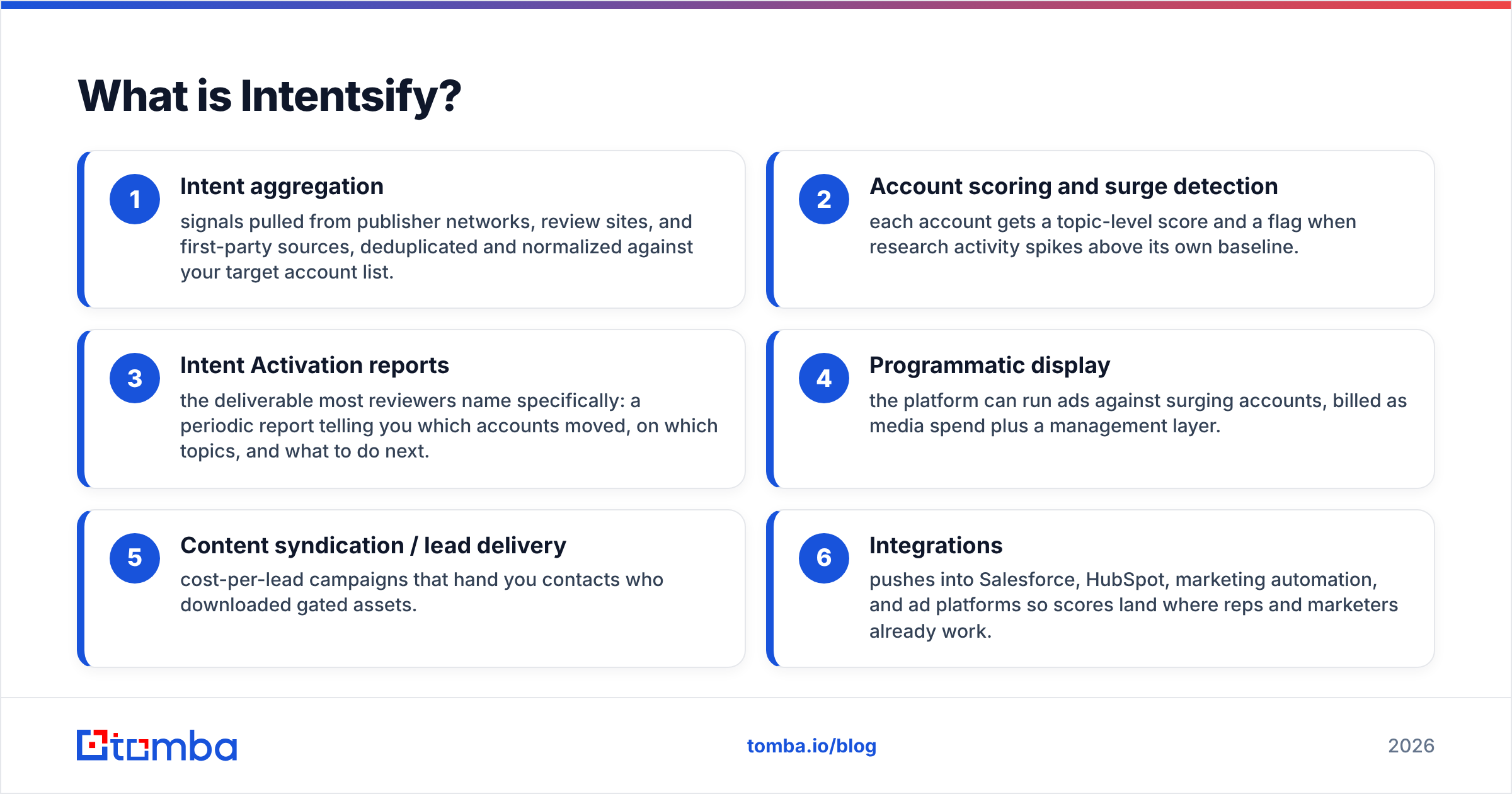
Intentsify is a B2B buyer-intent data and demand-activation platform. It aggregates intent signals from multiple sources, scores your target account list against topics you care about, and then lets you act on that scoring through display advertising, content syndication, and CRM or ad-platform syncs. The company positions the product as an "Intelligence Activation Platform" — the pitch is that raw intent data sitting in a dashboard is worthless, so the platform bundles the signal with the channels that use it.
That bundling is the single most important thing to understand before you look at a quote. You are not buying a data feed. You are buying a data feed plus an activation layer, and the activation layer is where most of the spend ends up.
Here's how the pieces break down:
- Intent aggregation — signals pulled from publisher networks, review sites, and first-party sources, deduplicated and normalized against your target account list.
- Account scoring and surge detection — each account gets a topic-level score and a flag when research activity spikes above its own baseline.
- Intent Activation reports — the deliverable most reviewers name specifically: a periodic report telling you which accounts moved, on which topics, and what to do next.
- Programmatic display — the platform can run ads against surging accounts, billed as media spend plus a management layer.
- Content syndication / lead delivery — cost-per-lead campaigns that hand you contacts who downloaded gated assets.
- Integrations — pushes into Salesforce, HubSpot, marketing automation, and ad platforms so scores land where reps and marketers already work.
How does Intentsify pricing actually work?#
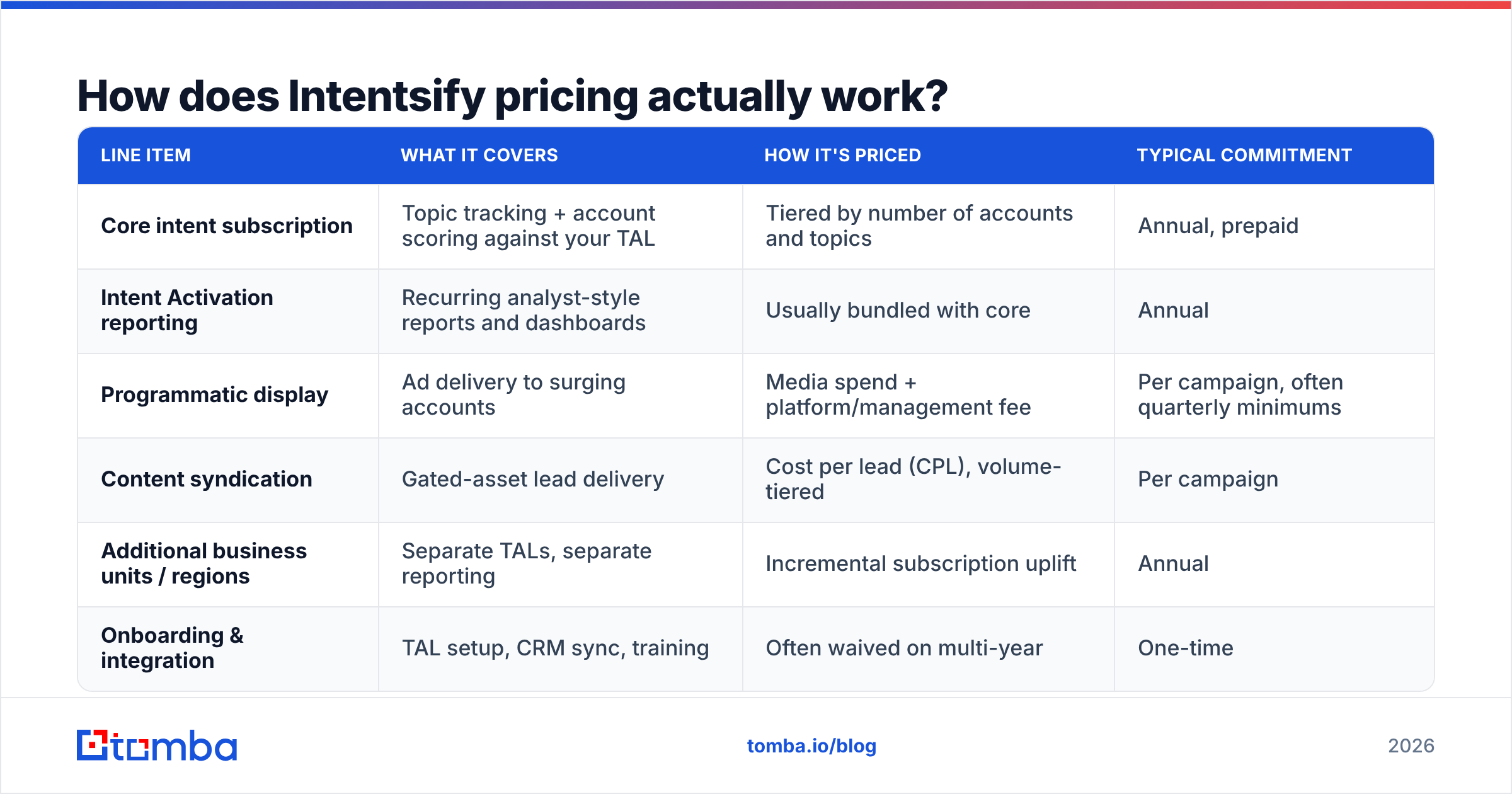
Short answer: annual contracts, custom quotes, no public price list, and a scope that expands by account volume and activation channels rather than by user seats.
Intentsify does not post rates on its website, and neither do most vendors in the buyer-intent category. That's a deliberate choice — it lets the vendor price against your company size and budget rather than against a competitor's rate card. The practical consequence for you is that you cannot benchmark the quote you receive without talking to peers who bought the same thing.

Based on how intent-data contracts in this tier are typically structured, expect a quote assembled from these components. Treat the ranges as directional buyer-reported patterns for the category, not published rates:
| Line item | What it covers | How it's priced | Typical commitment |
|---|---|---|---|
| Core intent subscription | Topic tracking + account scoring against your TAL | Tiered by number of accounts and topics | Annual, prepaid |
| Intent Activation reporting | Recurring analyst-style reports and dashboards | Usually bundled with core | Annual |
| Programmatic display | Ad delivery to surging accounts | Media spend + platform/management fee | Per campaign, often quarterly minimums |
| Content syndication | Gated-asset lead delivery | Cost per lead (CPL), volume-tiered | Per campaign |
| Additional business units / regions | Separate TALs, separate reporting | Incremental subscription uplift | Annual |
| Onboarding & integration | TAL setup, CRM sync, training | Often waived on multi-year | One-time |
Two things drive the final number more than anything else. First, target account list size — a 500-account TAL and a 25,000-account TAL are not remotely the same product. Second, activation channels — the data subscription alone is the smaller half of most deals once display or syndication is attached.
Ask for the quote broken out by line item before you negotiate. Vendors in this space frequently present a single blended annual figure, and you cannot tell whether you're overpaying for data or overpaying for media until it's itemized.
What do Intentsify reviews say?#
Reviews on G2 and similar platforms cluster around a consistent set of themes. Strip out the generic five-star noise and the signal looks like this.
What reviewers praise:
- The people, not just the platform. Customer success involvement comes up repeatedly. Buyers describe named contacts who help interpret data rather than a ticket queue.
- Intent Activation reports. Marketers who don't want to live in a dashboard get a digest that says which accounts moved and why. That reduces the "we bought intent data and nobody used it" failure mode.
- Signal breadth. Aggregating multiple sources rather than relying on a single publisher co-op produces fewer blind spots on niche topics.
- Closed-loop activation. Being able to go from surge detection to a running display campaign without stitching three vendors together saves real operational time.
What reviewers complain about:
- Pricing opacity. The most common friction point. Buyers can't self-serve a budget estimate, which slows internal approval and makes renewal negotiation harder.
- Time to value. TAL setup, topic calibration, and integration work mean the first genuinely useful output often lands weeks after signature.
- Signal-to-contact gap. Intent tells you Acme Corp is researching. It does not hand you the VP of Engineering's email address. Teams routinely discover they need a second vendor for that.
- Attribution ambiguity. As with every intent vendor, proving that a closed deal came from the intent signal rather than from existing pipeline is genuinely hard. Forrester and other analysts have written extensively about the measurement problem across the whole intent category — it is not unique to this vendor.
Is Intentsify worth it compared to the alternatives?#
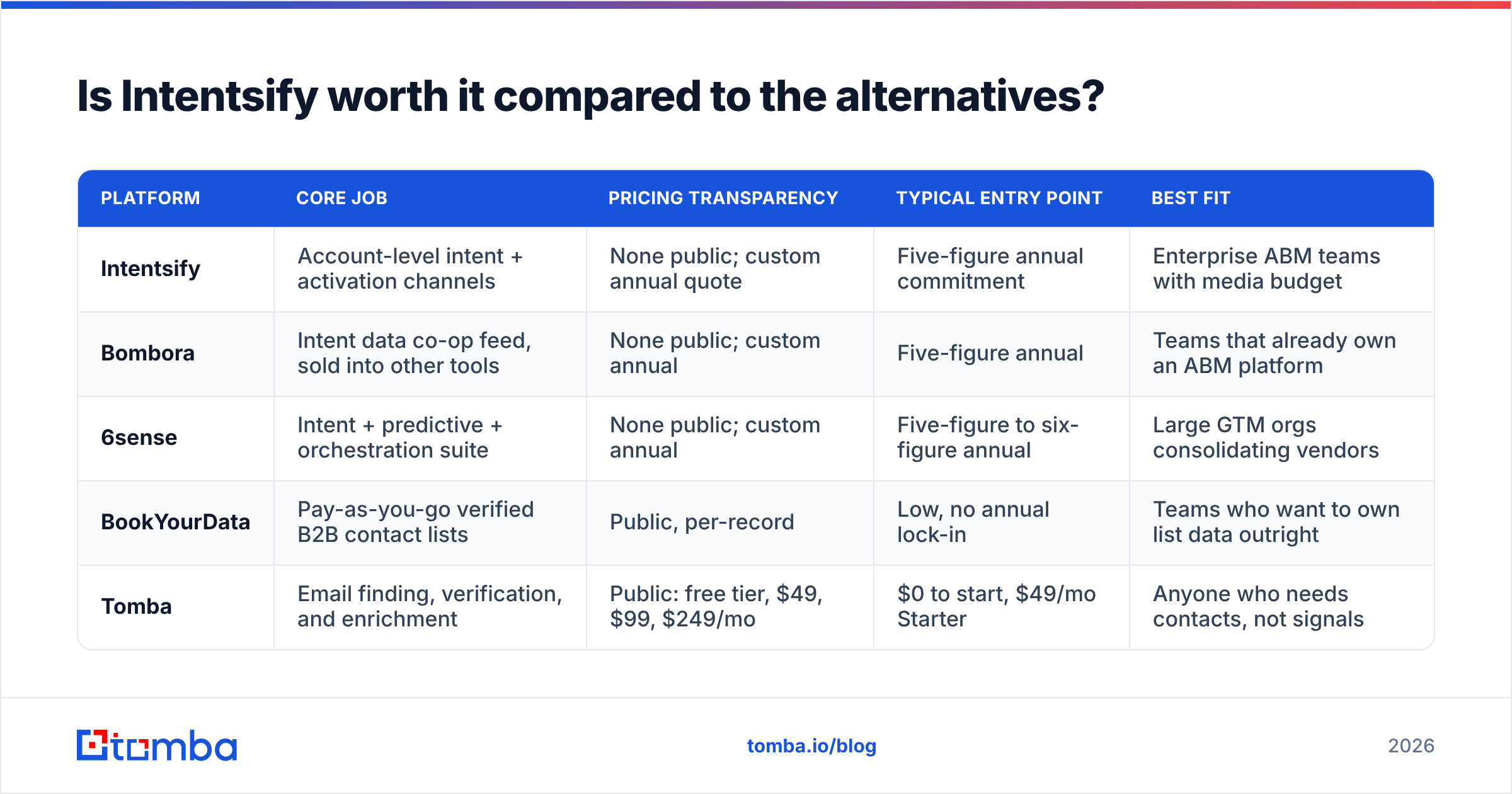
It depends entirely on which problem you're actually solving. Intent platforms, contact databases, and email-finding tools get lumped into the same "B2B data" budget line, but they do different jobs at wildly different prices.
| Platform | Core job | Pricing transparency | Typical entry point | Best fit |
|---|---|---|---|---|
| Intentsify | Account-level intent + activation channels | None public; custom annual quote | Five-figure annual commitment | Enterprise ABM teams with media budget |
| Bombora | Intent data co-op feed, sold into other tools | None public; custom annual | Five-figure annual | Teams that already own an ABM platform |
| 6sense | Intent + predictive + orchestration suite | None public; custom annual | Five-figure to six-figure annual | Large GTM orgs consolidating vendors |
| BookYourData | Pay-as-you-go verified B2B contact lists | Public, per-record | Low, no annual lock-in | Teams who want to own list data outright |
| Tomba | Email finding, verification, and enrichment | Public: free tier, $49, $99, $249/mo | $0 to start, $49/mo Starter | Anyone who needs contacts, not signals |
The honest framing: Intentsify and Tomba are not competitors. One tells you which companies are in-market. The other tells you how to reach the humans inside those companies. Teams with real ABM budgets often run both. Teams without ABM budgets discover that the second problem is the one blocking pipeline today.
BookYourData deserves a specific mention here because it occupies useful middle ground — transparent per-record pricing and no annual commitment, which makes it a reasonable way to test a segment before committing budget anywhere else.
What are the real pros and cons of Intentsify?#
Pros
- Multi-source aggregation reduces single-co-op bias in intent signals.
- Activation is built in, so you're not exporting CSVs into a separate ad platform.
- Strong human support layer — valuable if your team lacks a dedicated data analyst.
- Reporting is designed for marketers, not just for data teams.
- Integrations into Salesforce and HubSpot mean reps see scores in the CRM they already use.
Cons
- Zero pricing transparency makes budgeting and benchmarking difficult.
- Annual-only commitments with no meaningful trial tier raise the cost of being wrong.
- Onboarding takes real time before value appears.
- Intent signals are directional, not deterministic — a surging account may be a competitor's intern doing research.
- You still need a contact-data vendor to act on account-level signals at the person level.
- Measurement and attribution remain genuinely hard to defend to a CFO.
How do you cut the cost of an intent-data stack?#
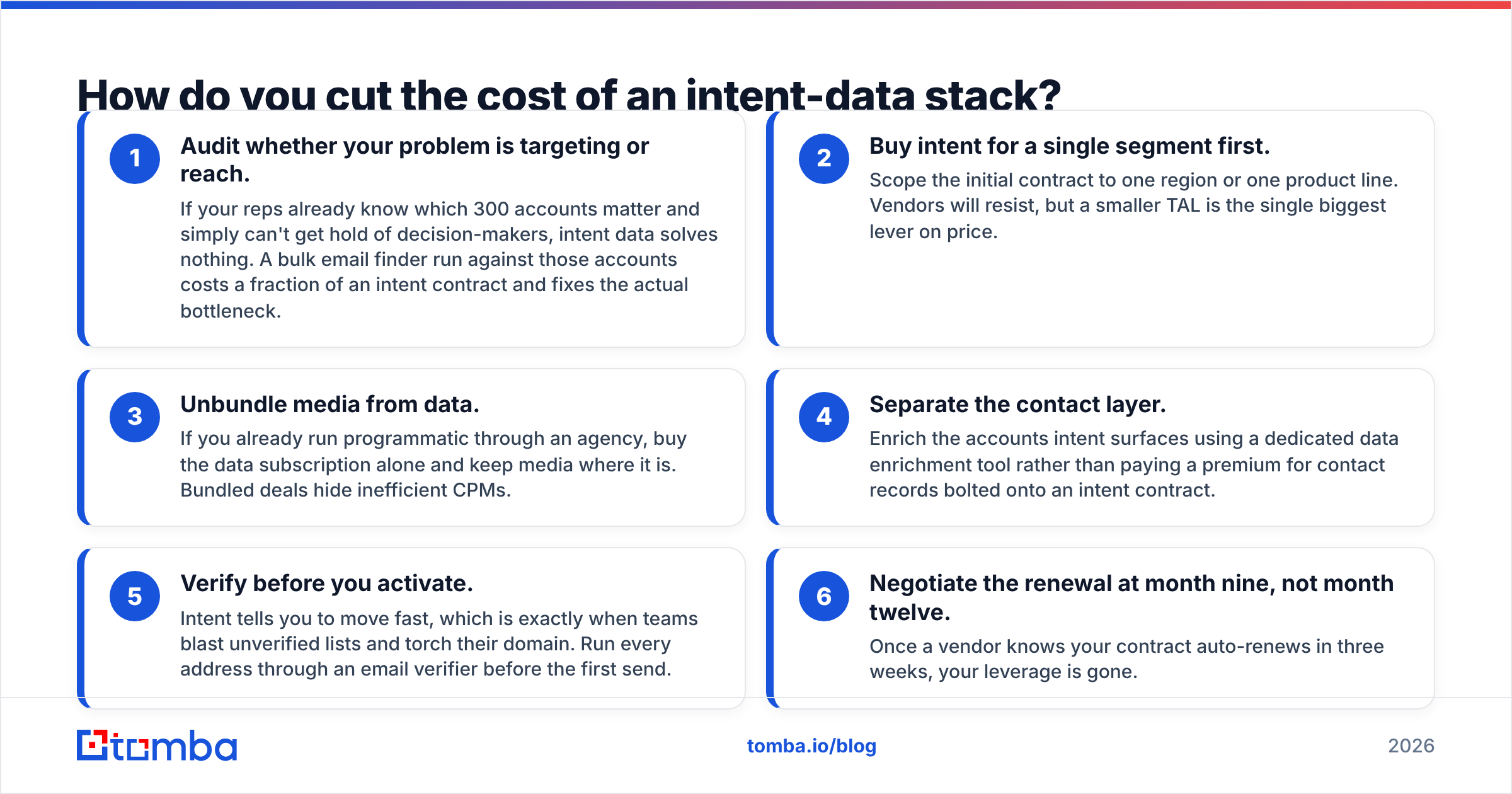
You don't cut it by negotiating harder on the intent line item. You cut it by being honest about which half of the funnel is actually broken.
- Audit whether your problem is targeting or reach. If your reps already know which 300 accounts matter and simply can't get hold of decision-makers, intent data solves nothing. A bulk email finder run against those accounts costs a fraction of an intent contract and fixes the actual bottleneck.
- Buy intent for a single segment first. Scope the initial contract to one region or one product line. Vendors will resist, but a smaller TAL is the single biggest lever on price.
- Unbundle media from data. If you already run programmatic through an agency, buy the data subscription alone and keep media where it is. Bundled deals hide inefficient CPMs.
- Separate the contact layer. Enrich the accounts intent surfaces using a dedicated data enrichment tool rather than paying a premium for contact records bolted onto an intent contract.
- Verify before you activate. Intent tells you to move fast, which is exactly when teams blast unverified lists and torch their domain. Run every address through an email verifier before the first send.
- Negotiate the renewal at month nine, not month twelve. Once a vendor knows your contract auto-renews in three weeks, your leverage is gone.
Who should actually buy Intentsify?#
Buy it if: you run formal ABM, you have media budget separate from your data budget, your sales cycle is long enough that early-stage research signals matter, and you have someone whose job includes acting on account scores weekly. Enterprise marketing teams with a defined TAL and an existing MAP/CRM stack get the most out of it.
Skip it if: you're a startup or SMB selling into a broad market, your team is under ten people, you cannot commit to an annual spend, or your pipeline problem is "we can't reach anyone" rather than "we don't know who to reach." In those cases the money is better spent on contact acquisition and outbound execution.
There's also a middle path worth naming. Run a manual version of the intent play first: identify accounts showing public buying signals — job postings, funding rounds, leadership changes, tech-stack changes — then use domain search to pull the relevant contacts at those companies. It's less elegant than an automated platform, it costs a couple of hundred dollars a month instead of tens of thousands, and it will tell you whether account-level targeting actually moves your numbers before you sign anything annual.
FAQ#
Does Intentsify publish pricing? No. All pricing is quote-based through a sales conversation, and contracts are annual.
Is there a free trial? There is no public self-serve trial tier. Evaluation typically happens through a scoped pilot or a sample intent report on your own account list — ask for one.
Does Intentsify provide contact emails? Its core output is account-level intent, plus contacts delivered through content syndication campaigns. For systematic contact coverage across a target list, most teams pair it with a dedicated email-finding tool.
How does it compare to Bombora? Bombora sells intent data that often sits inside other platforms. Intentsify bundles aggregation with activation channels. If you already own an ABM platform, a raw feed may be the cheaper route.
What's the minimum realistic budget? Plan for a five-figure annual commitment before activation spend. If that number doesn't fit, the category as a whole is probably not your next purchase.
Start with the contacts you can actually reach#
Intent data is a genuinely useful signal when you have the budget, the team, and the account list to justify it. But signals don't book meetings — emails do, and every intent platform hands you accounts rather than people.
If the gap in your pipeline is reach rather than targeting, start there. The Tomba Email Finder finds verified professional addresses by domain, name, or company, with a free tier at 25 searches a month and paid plans starting at $49/mo — no annual contract, no sales call, no custom quote. Work the accounts you already know are worth chasing, prove the motion converts, and then decide whether an intent subscription is worth the five figures.
Related guides#
// get started
Find, verify and enrich your first contacts today
Start on the free plan with 25 searches a month, then scale when your team is ready.
Free plan · No credit card required · GDPR & CCPA
// about the author