9 Best Interakt Alternatives in 2026: Pricing and Features
Interakt is a solid WhatsApp Business platform, but it is not the cheapest, the most flexible, or the best fit for every team. Here are nine alternatives compared on pricing, API access, automation depth, and the limits nobody lists on the pricing page.
TL;DR
- Interakt is a WhatsApp Business Platform (API) layer aimed at SMBs and D2C e-commerce — shared team inbox, broadcast campaigns, catalog and order flows, basic chatbot automation.
- Most teams leave for one of four reasons: per-agent seat costs that scale badly, automation that stops at the "if keyword then reply" ceiling, thin CRM sync, or support response times.
- The strongest alternatives split into three groups: SMB-friendly inboxes (WATI, AiSensy, Gallabox, DoubleTick), omnichannel platforms (Respond.io, Infobip, Bird), and raw API providers (Twilio, 360dialog).
- Every WhatsApp platform pays Meta the same conversation fees. The vendor markup and the seat pricing are where the real cost difference lives — compare those, not the sticker price.
- The platform is only half the problem. If your contact list is stale, no amount of WhatsApp automation fixes reply rates — the data layer matters more than the inbox.
What does Interakt actually do?#
Interakt is a WhatsApp Business Platform reseller and software layer. You do not talk to Meta directly; Interakt holds the Business Solution Provider relationship, provisions your WhatsApp number, and wraps the API in a dashboard your team can actually use. Owned by Jio Haptik, it leans heavily toward Indian SMBs and Shopify/WooCommerce sellers.
What you get, in practice:
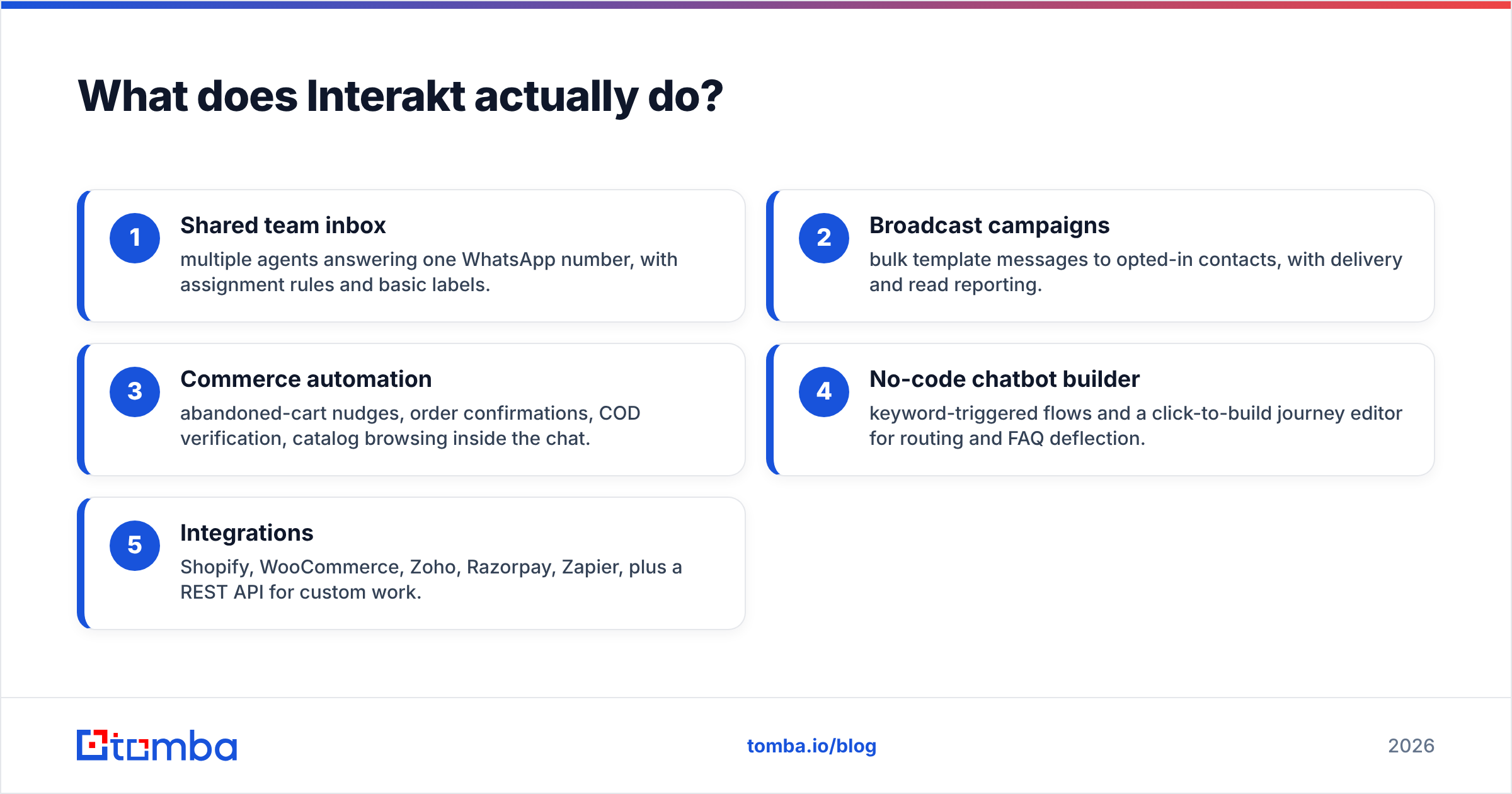
- Shared team inbox — multiple agents answering one WhatsApp number, with assignment rules and basic labels.
- Broadcast campaigns — bulk template messages to opted-in contacts, with delivery and read reporting.
- Commerce automation — abandoned-cart nudges, order confirmations, COD verification, catalog browsing inside the chat.
- No-code chatbot builder — keyword-triggered flows and a click-to-build journey editor for routing and FAQ deflection.
- Integrations — Shopify, WooCommerce, Zoho, Razorpay, Zapier, plus a REST API for custom work.
That combination is genuinely useful for a 5–20 person D2C team. The friction shows up when you grow past that, when you need real CRM writeback, or when you start running outbound at volume and the per-seat plus per-conversation math stops making sense.
Why do teams look for Interakt alternatives?#
Four complaints show up repeatedly in G2 reviews and in migration threads:
Seat-based pricing that punishes growth. Entry plans include a small number of agents. Every additional agent is an add-on. A 15-agent support team on a "cheap" plan is not cheap.
Automation ceiling. The bot builder handles FAQ deflection and linear flows well. Conditional branching on CRM data, multi-step API calls mid-conversation, or handoff logic based on deal stage — that is where teams hit the wall and start looking at Respond.io or a raw API provider.
CRM depth. Integrations exist, but many teams report one-directional sync: conversations flow out, enriched context does not flow in. If your reps need to see pipeline stage and last-touch data inside the chat window, check this carefully before you commit.
Support latency. The most common complaint on review sites. Response times vary by plan tier, and escalation paths for API-level issues can be slow — which matters a lot when your template gets rejected 20 minutes before a campaign.
None of that makes Interakt a bad product. It makes it a specific product, well suited to a specific buyer. If you are not that buyer, here is the landscape.
Which are the best Interakt alternatives in 2026?#
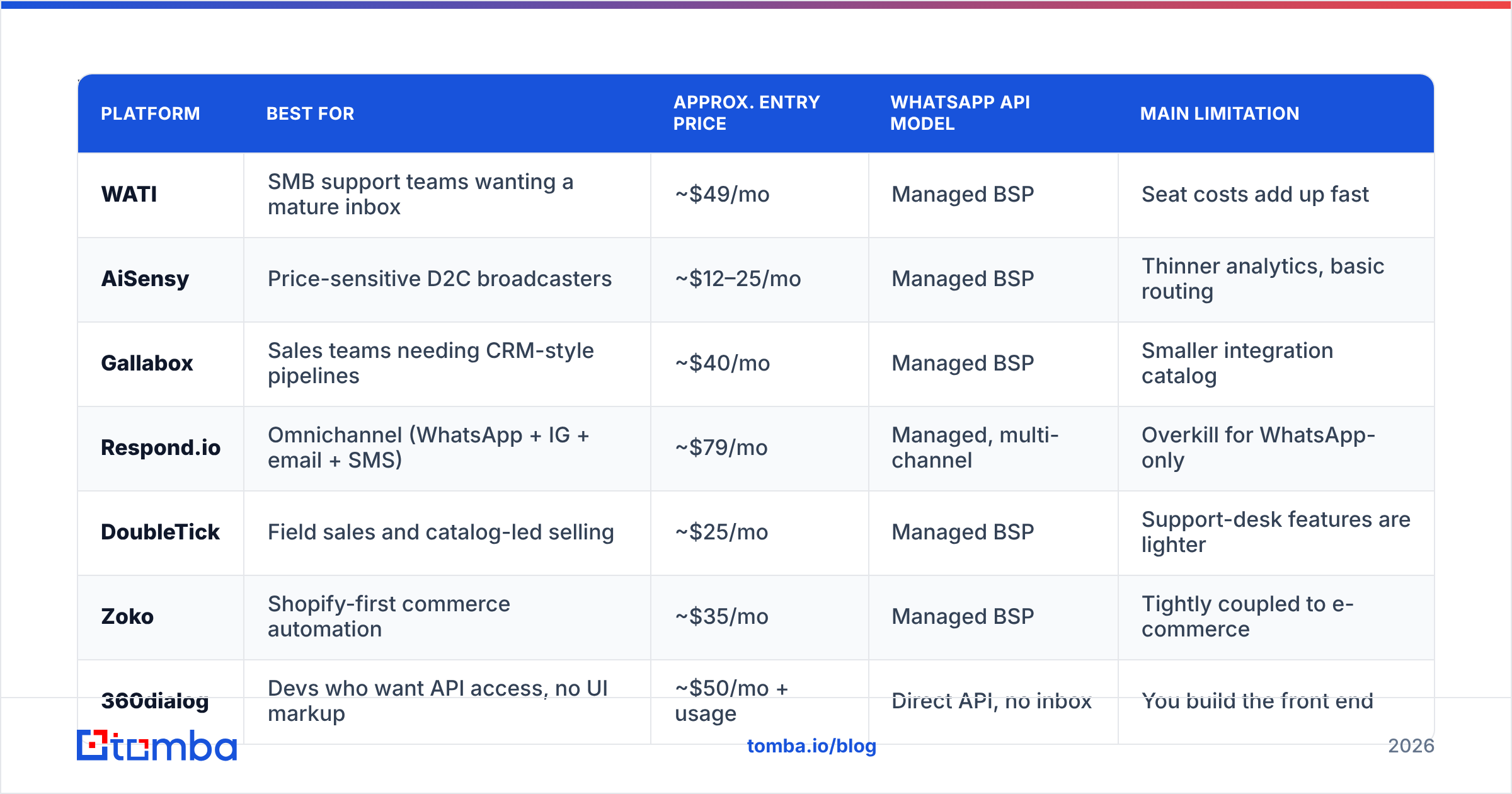
Pricing below is approximate entry-level, converted and rounded, and excludes Meta's per-conversation charges. Always verify current rates on the vendor's own site — WhatsApp pricing changed structurally in 2025 and vendors repackage plans frequently.
| Platform | Best for | Approx. entry price | WhatsApp API model | Main limitation |
|---|---|---|---|---|
| WATI | SMB support teams wanting a mature inbox | ~$49/mo | Managed BSP | Seat costs add up fast |
| AiSensy | Price-sensitive D2C broadcasters | ~$12–25/mo | Managed BSP | Thinner analytics, basic routing |
| Gallabox | Sales teams needing CRM-style pipelines | ~$40/mo | Managed BSP | Smaller integration catalog |
| Respond.io | Omnichannel (WhatsApp + IG + email + SMS) | ~$79/mo | Managed, multi-channel | Overkill for WhatsApp-only |
| DoubleTick | Field sales and catalog-led selling | ~$25/mo | Managed BSP | Support-desk features are lighter |
| Zoko | Shopify-first commerce automation | ~$35/mo | Managed BSP | Tightly coupled to e-commerce |
| 360dialog | Devs who want API access, no UI markup | ~$50/mo + usage | Direct API, no inbox | You build the front end |
| Twilio | Engineering-led, multi-channel at scale | Pay-as-you-go | Raw API | No inbox, real dev cost |
| Infobip / Bird | Enterprise, global, compliance-heavy | Custom | Enterprise CPaaS | Long sales cycle, min. spend |
Is WATI a better Interakt alternative?#
For most support-led teams, WATI is the closest like-for-like swap. The inbox is more mature, the no-code builder handles branching better, and the WATI integration catalog is broader. The trade-off is honest: it generally costs more per seat. If your bottleneck is agent productivity rather than message volume, that trade is usually worth it. If you are broadcasting to 50,000 contacts with three agents, it is not.
Is AiSensy cheaper than Interakt?#
Usually yes, at the entry tier — AiSensy's model is built around unlimited-ish broadcasting with lighter per-agent charges. The compromise shows in analytics depth and routing sophistication. It is a broadcast engine with an inbox attached, rather than a support desk with broadcasting attached. For a marketing team firing promotional campaigns, that is the right shape. For a 12-person support org, it is not.
When should you skip the UI layer entirely?#
If you have engineering capacity, 360dialog and Twilio remove the middle layer. You pay Meta's conversation fees plus a thinner platform fee, and you build (or buy separately) the agent interface. Teams doing high-volume transactional messaging — OTPs, shipping updates, appointment reminders — often find the raw API dramatically cheaper because they do not need seats at all. Teams doing conversational sales almost always regret it, because the inbox you would have to build is the actual product.
Read the official WhatsApp Business Platform docs before choosing this path. Template approval, quality ratings, and messaging limits apply identically whichever route you take — the BSP does not shield you from them.
How do the pricing models actually compare?#
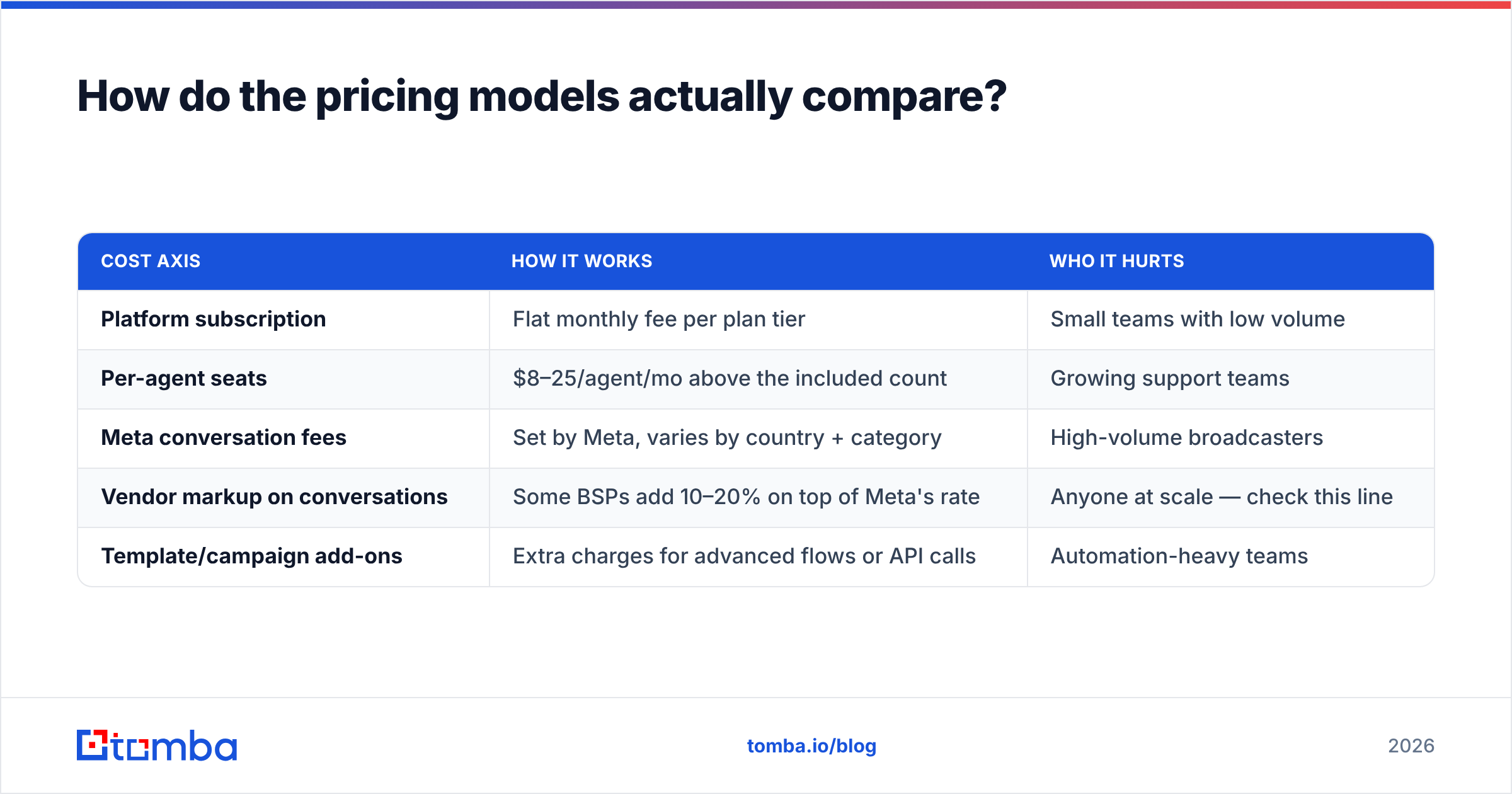
Sticker prices mislead because WhatsApp platforms bill on three axes at once. Here is the structure to model before you sign anything:
| Cost axis | How it works | Who it hurts |
|---|---|---|
| Platform subscription | Flat monthly fee per plan tier | Small teams with low volume |
| Per-agent seats | $8–25/agent/mo above the included count | Growing support teams |
| Meta conversation fees | Set by Meta, varies by country + category | High-volume broadcasters |
| Vendor markup on conversations | Some BSPs add 10–20% on top of Meta's rate | Anyone at scale — check this line |
| Template/campaign add-ons | Extra charges for advanced flows or API calls | Automation-heavy teams |
The markup line is the one buyers miss. Two platforms with identical $49 subscriptions can differ by thousands per year once you push 200,000 conversations through them. Ask every vendor directly: "Do you resell Meta conversations at cost, or with a markup?" Get it in writing.
What should you evaluate before you migrate?#
Work through this list before the demo, not after:
- Number portability. Your WhatsApp Business number is tied to your current BSP. Migration is possible but involves downtime and a Meta-side transfer request. Confirm the process and the expected outage window.
- Template migration. Approved message templates do not automatically transfer. Budget for re-approval, and re-approval can take days.
- Conversation history. Some platforms export it, some do not. If you need chat history for compliance, ask for the export format in advance.
- Quality rating carryover. Your number's quality rating and messaging tier follow the number, not the vendor. A bad rating does not get reset by switching platforms.
- CRM writeback direction. Confirm bidirectional sync explicitly. "We integrate with HubSpot" can mean anything from a full object sync to a Zapier webhook.
- Opt-in list validity. WhatsApp requires documented opt-in. If your list came from a scrape or a purchased file, changing platforms will not save you from a ban.
That last point deserves its own section, because it is the failure mode nobody sells you a fix for.
Does the platform matter more than the contact data?#
No. And this is the part that Interakt, WATI, AiSensy, and every other vendor on this list has no commercial reason to tell you.
WhatsApp platforms compete on inbox ergonomics and automation builders. None of them compete on whether the phone numbers in your database are real, current, and attached to the person you think they are. That is a separate layer — and it determines your results far more than which broadcast UI you clicked through.
Three concrete failure patterns:
- Dead numbers burn your quality rating. Messages to disconnected or wrong numbers produce no engagement, and sustained low engagement drags your WhatsApp quality rating down. Enough of that and Meta throttles your messaging tier. The platform cannot protect you.
- Wrong-person matches kill reply rates. A number that belonged to a former employee looks identical to a valid number in your CRM. It just never converts.
- Channel mismatch wastes budget. Not every B2B prospect wants WhatsApp. Some segments respond far better to email, and firing paid conversations at them is money set on fire.
The fix is upstream. Validate numbers before they enter a campaign with a phone validator, source verified mobile and direct-dial numbers using a phone finder rather than importing whatever the CRM accumulated, and use contact enrichment to fill in role, company, and email so you can route each contact to the channel they actually use.
For B2B specifically, this reframes the whole decision. WhatsApp is one channel in a sequence. The contact record — verified email, verified mobile, current role, current company — is the asset. Platforms are swappable; the data layer compounds.
Which Interakt alternative should you pick?#
Match the tool to your actual shape, not to the review-site leaderboard:
- D2C e-commerce, under 10 agents, cost-sensitive → AiSensy or Zoko. Broadcast-first, Shopify-native, cheapest path to running campaigns.
- Support-led team, 10–50 agents → WATI. Pay more per seat, get the inbox and routing that justifies it.
- Sales team running WhatsApp as a pipeline channel → Gallabox or DoubleTick. Deal-stage thinking baked into the product.
- Multi-channel (WhatsApp + Instagram + email + SMS) → Respond.io. It is the only one on this list where WhatsApp is a peer channel rather than the whole product.
- Engineering team, transactional volume → 360dialog or Twilio. Skip the seats entirely.
- Enterprise, multi-region, procurement involved → Infobip or Bird. Slow to buy, built to scale.
- Staying on Interakt → Entirely defensible if you are a Shopify SMB in India using catalog flows. Renegotiate the seat count at renewal and audit the conversation markup.
How do you build the contact layer underneath?#
Whichever platform you land on, the intake pipeline looks the same. Identify target companies, find the decision-makers, verify their contact points across channels, then push clean records into your messaging tool.
For B2B teams, that means starting from the company rather than from a purchased list. Run a domain search to map who works at a target account, verify each address before it enters a sequence, and enrich the record with a mobile number where WhatsApp is genuinely the better channel. Tools like BookYourData are a reasonable option when you need a ready-made list to start from — a solid, well-regarded source in that category. The principle holds either way: verify on ingest, re-verify on a schedule, and never let an unverified record reach a paid conversation.
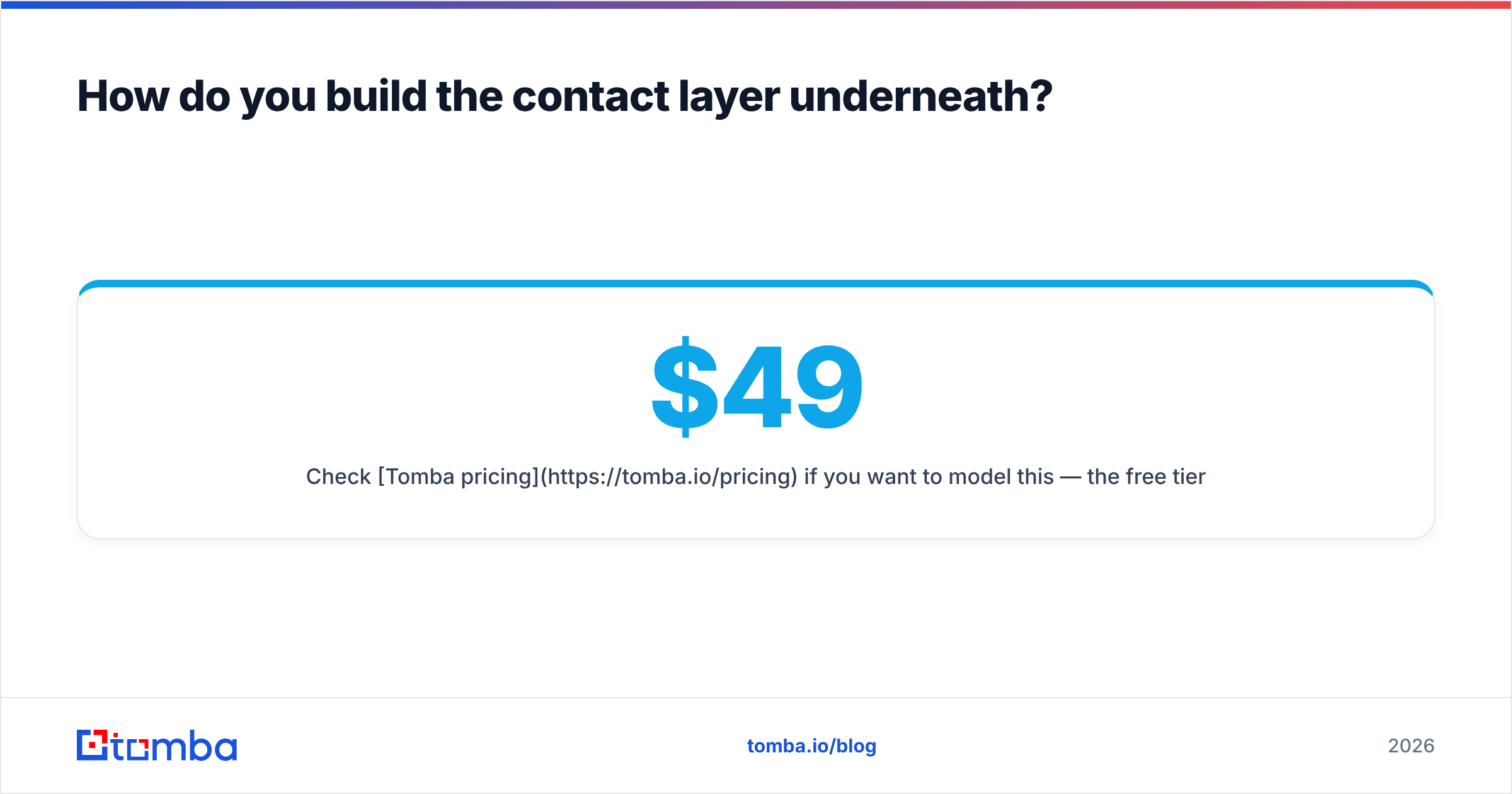
Check Tomba pricing if you want to model this — the free tier gives 25 searches per month, Starter is $49/mo, Growth $99/mo, and Pro $249/mo, which lets you run a real pilot before committing budget.
The bottom line#
Interakt is a reasonable WhatsApp Business Platform for SMB commerce teams, and the honest reason to leave is usually pricing structure or automation ceiling — not product quality. WATI wins on inbox depth, AiSensy on cost, Gallabox on sales workflow, Respond.io on omnichannel, and 360dialog or Twilio on raw economics if you have engineers. Compare the conversation markup line, not the subscription line, and confirm number portability before you sign.
Then fix the layer underneath. A perfect WhatsApp inbox pointed at a stale contact list produces the same result as a mediocre one: silence, a falling quality rating, and a channel you eventually blame for something that was never its fault.
Start with the data. Use the Tomba Email Finder to build verified, current contact records for your target accounts — then let whichever messaging platform you choose do the part it is actually good at. The free tier is enough to test the difference on your next campaign.
Related guides#
// get started
Find, verify and enrich your first contacts today
Start on the free plan with 25 searches a month, then scale when your team is ready.
Free plan · No credit card required · GDPR & CCPA
// about the author