Interim Sales Director: The Complete 2026 Hiring Guide
An interim sales director can stabilise a stalled revenue team in 90 days — or burn a quarter and leave you worse off. Here are the day rates, the trade-offs versus a full-time VP, and the scorecard that tells you which one you actually need.
TL;DR
- An interim sales director is a senior, full-time-but-temporary revenue leader hired for a fixed window — typically 3 to 12 months — to stabilise a team, fix a broken process, or bridge a permanent hire.
- Expect $800–$2,000 per day in the US and UK for a credible operator, which usually lands between $12k and $30k per month. That is often cheaper than nine months of leaderless drift.
- Interim is not the same as fractional. Interim means deep, near-full-time, and time-boxed. Fractional means one or two days a week, indefinitely. Choosing wrong is the most common expensive mistake.
- The first 90 days should produce a diagnosis, a cleaned pipeline, a working ICP definition, and a documented playbook — not a rebuilt org chart.
- Interim leadership fails most often for one boring reason: the CRM and contact data underneath it are garbage, so every forecast the interim builds is fiction.
What is an interim sales director?#
An interim sales director is a senior sales leader brought in on a fixed-term contract to run your revenue function while something is broken, missing, or in transition. They carry real authority — quota ownership, headcount decisions, pipeline accountability — but they carry it for a defined period and then leave.
Think of it like a surgeon versus a GP. Your GP manages your health over decades. A surgeon shows up for a specific, urgent, high-skill intervention and then hands you back. An interim sales director is the surgeon. They are not there to become part of the furniture, and any interim who starts angling for the permanent job is quietly telling you they've changed roles mid-engagement.
The practice comes out of the broader interim management discipline, which has been standard in European mid-market companies for decades and has spread fast into B2B SaaS and services since the 2023–2025 funding squeeze forced companies to stop hiring permanent VPs on optimism.
Typical triggers:
- The VP of Sales left suddenly. Resignation, termination, or a competitor poached them mid-quarter. You have reps with no manager and a board meeting in six weeks.
- The founder is still running sales and it no longer scales. Revenue is $2M–$8M, the founder closes every deal above $30k, and nobody else can.
- A permanent search is running long. Good sales leader searches take 4–7 months end to end. Somebody has to hold the wheel.
- Pre-transaction cleanup. PE or an acquirer wants the commercial function professionalised before diligence.
- A specific rebuild. Moving from inbound-led to outbound, launching a new segment, or replacing a channel motion with direct sales.
Interim vs fractional vs full-time: which model fits?#
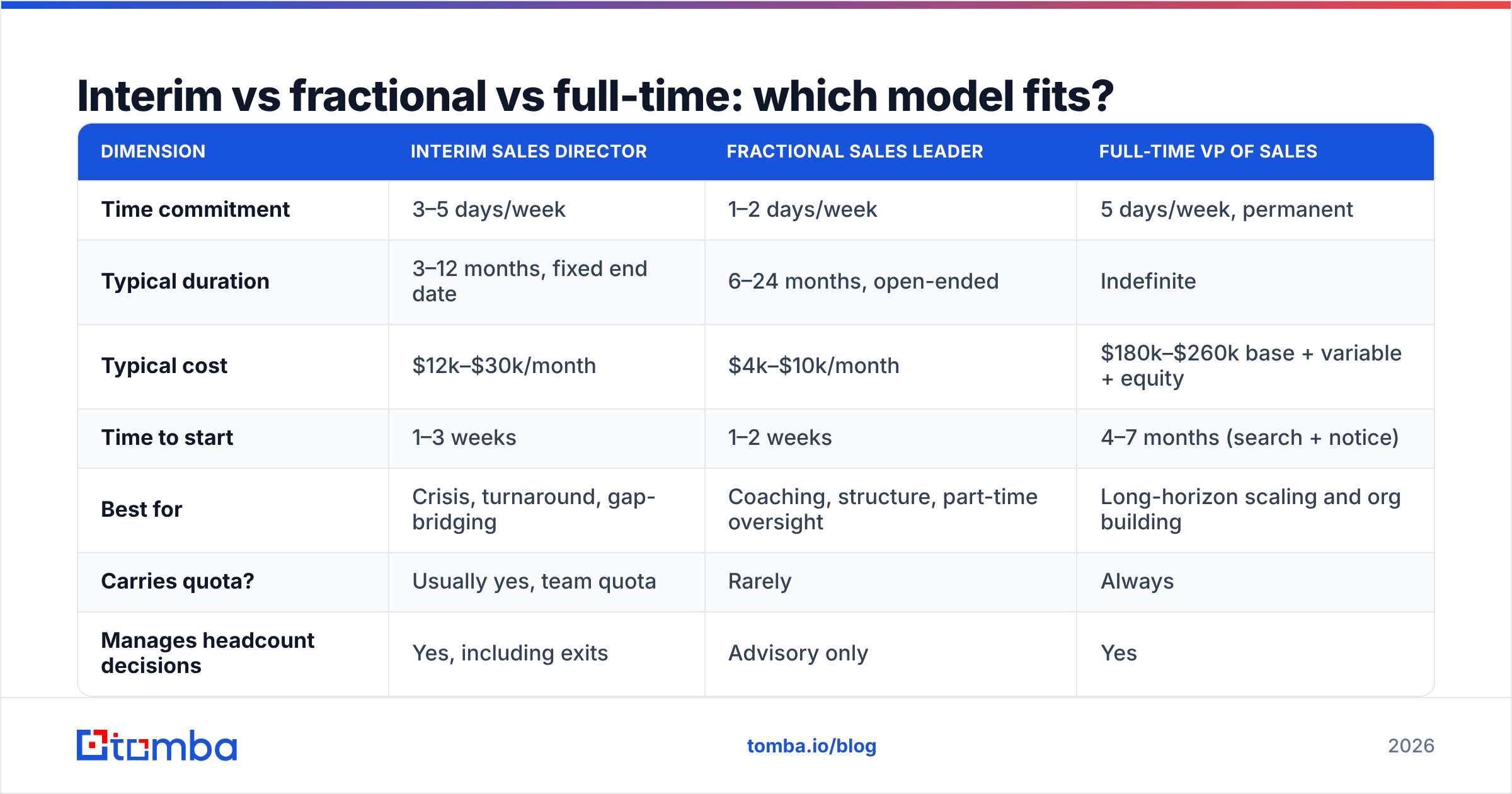
This is the decision that actually matters, and most companies conflate the three. Here is the honest comparison.
| Dimension | Interim Sales Director | Fractional Sales Leader | Full-Time VP of Sales |
|---|---|---|---|
| Time commitment | 3–5 days/week | 1–2 days/week | 5 days/week, permanent |
| Typical duration | 3–12 months, fixed end date | 6–24 months, open-ended | Indefinite |
| Typical cost | $12k–$30k/month | $4k–$10k/month | $180k–$260k base + variable + equity |
| Time to start | 1–3 weeks | 1–2 weeks | 4–7 months (search + notice) |
| Best for | Crisis, turnaround, gap-bridging | Coaching, structure, part-time oversight | Long-horizon scaling and org building |
| Carries quota? | Usually yes, team quota | Rarely | Always |
| Manages headcount decisions | Yes, including exits | Advisory only | Yes |
| Equity | None | Occasionally small | Standard |
| Main failure mode | Leaves before adoption sticks | Too thin to change behaviour | 18-month ramp, then churn |
Read that table twice. The trap is hiring fractional when you have an interim problem. If your team has no manager, is missing quota by 40%, and the board is asking questions, one day a week of wise counsel will not fix it. Someone has to sit in the pipeline review, listen to calls, and fire the rep who has not closed anything in two quarters.
The reverse trap is equally costly. If your sales team is fundamentally healthy and you just need senior pattern-matching, paying $25k a month for a full-time interim is waste. Buy two days a week.
When should you NOT hire an interim sales director?#
Be honest about these:
- Your product has no repeatable value proposition yet. No sales leader, interim or permanent, can sell what has not found product-market fit. You will burn six figures learning that.
- The founder will not actually hand over control. If every pricing decision still routes through the CEO, the interim becomes an expensive pipeline administrator. This is the single most common reason engagements fail.
- You need the person to also be the rep. Interim directors lead; they do not carry an individual quota of 40 outbound calls a day. If you need a closer, hire a senior AE at half the price.
- You want them to fix a data problem. More on this below, because it deserves its own section.
- The budget only covers eight weeks. Nothing meaningful changes in eight weeks. You will pay for a diagnosis and then abandon the treatment.
What does an interim sales director actually cost in 2026?#
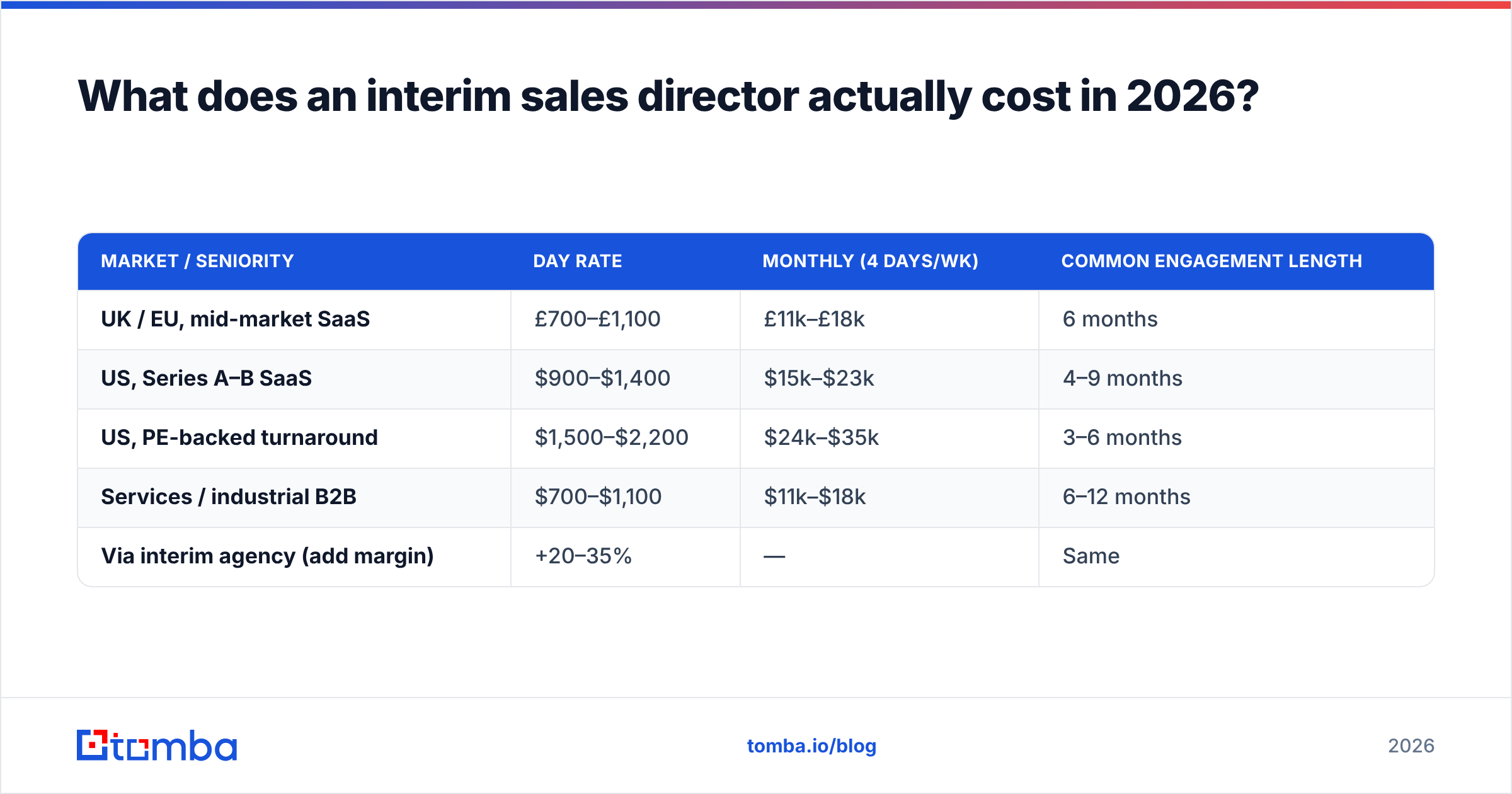
Rates vary by market and by how distressed the situation is. Turnaround work commands a premium because the risk of reputational damage is higher for the interim.
| Market / seniority | Day rate | Monthly (4 days/wk) | Common engagement length |
|---|---|---|---|
| UK / EU, mid-market SaaS | £700–£1,100 | £11k–£18k | 6 months |
| US, Series A–B SaaS | $900–$1,400 | $15k–$23k | 4–9 months |
| US, PE-backed turnaround | $1,500–$2,200 | $24k–$35k | 3–6 months |
| Services / industrial B2B | $700–$1,100 | $11k–$18k | 6–12 months |
| Via interim agency (add margin) | +20–35% | — | Same |
Two cost notes people miss. First, interim contractors carry no benefits, no equity dilution, no severance risk, and no 12-month ramp — so the fully loaded comparison to a permanent VP is closer than the headline day rate suggests. Second, agency margin is real. Going direct through a network or an operator community typically saves 25%, at the cost of doing your own reference checks.
Compare that to the cost of not hiring: a mid-market team of six reps drifting leaderless for two quarters will typically miss plan by 25–40% and lose one or two of its best performers to competitors who have managers. That loss dwarfs $80k of interim fees.
What should an interim sales director do in the first 90 days?#
A good interim follows a predictable arc. If your candidate cannot describe something like this in the interview, they are improvising.
- Days 1–14 — Diagnose, don't act. Listen to 20+ recorded calls, interview every rep individually, pull two years of closed-won and closed-lost data, and sit in on customer conversations. Write a written diagnosis. No org changes yet.
- Days 15–30 — Fix the pipeline's truthfulness. Most pipelines in a struggling team are 30–50% fiction. Re-stage everything against exit criteria, kill zombie deals, and produce a forecast the CEO can actually take to the board. This is usually the moment the number gets worse before it gets better. That is a good sign.
- Days 31–45 — Re-define the ICP and the target list. Which segments closed fastest, churned least, and paid most? Then rebuild the target account list against that definition — which is a data exercise, not a strategy exercise. Clean contact enrichment at this stage determines whether the next 60 days produce meetings or bounce reports.
- Days 46–60 — Install the operating cadence. Weekly pipeline review with a fixed agenda, one-to-ones with a coaching structure, a deal desk for anything non-standard, and a single source of truth for the forecast. Cadence beats charisma.
- Days 61–90 — Make the people calls and document the playbook. By now the interim knows who can hit quota with coaching and who cannot. Exits happen here, not in week two. And everything they know goes into a written playbook — because they are leaving.
The playbook deliverable is non-negotiable. An interim who leaves without documentation has rented you performance rather than sold you capability.
Why do most interim engagements actually fail?#
Not because the interim was weak. Because the data underneath them was.
An interim sales director's entire value comes from making decisions faster than your team could alone — which segment to attack, which rep to keep, which deals are real. Every one of those decisions is computed on top of your CRM. If 35% of your contact records have stale job titles, if half your outbound list bounces, if the same account exists four times under different spellings, then the interim is doing high-quality reasoning over low-quality inputs. Garbage in, confident garbage out.
Gartner's sales research has consistently found that seller productivity losses trace back to time spent on non-selling activity — much of which is research, list-building, and data cleanup that should never have reached a rep's desk. HubSpot's sales benchmarks show the same pattern from the other direction: teams with clean, enriched CRM records forecast more accurately and ramp new reps faster.
So before the interim starts, do three things:
- Deduplicate and verify the existing database. Run every contact through an email verifier so the interim's first outbound test is measuring messaging, not list decay.
- Fill the gaps in the accounts that matter. A target list of 300 named accounts with 40% missing contacts is a 120-account list. Use domain search to complete the decision-maker map per account before the engagement starts.
- Agree on what "pipeline" means. One definition, written down, with stage exit criteria. Half of forecast disputes are vocabulary disputes.
Do this and the interim spends their expensive days on judgement instead of janitorial work.
How do you measure whether the interim is working?#
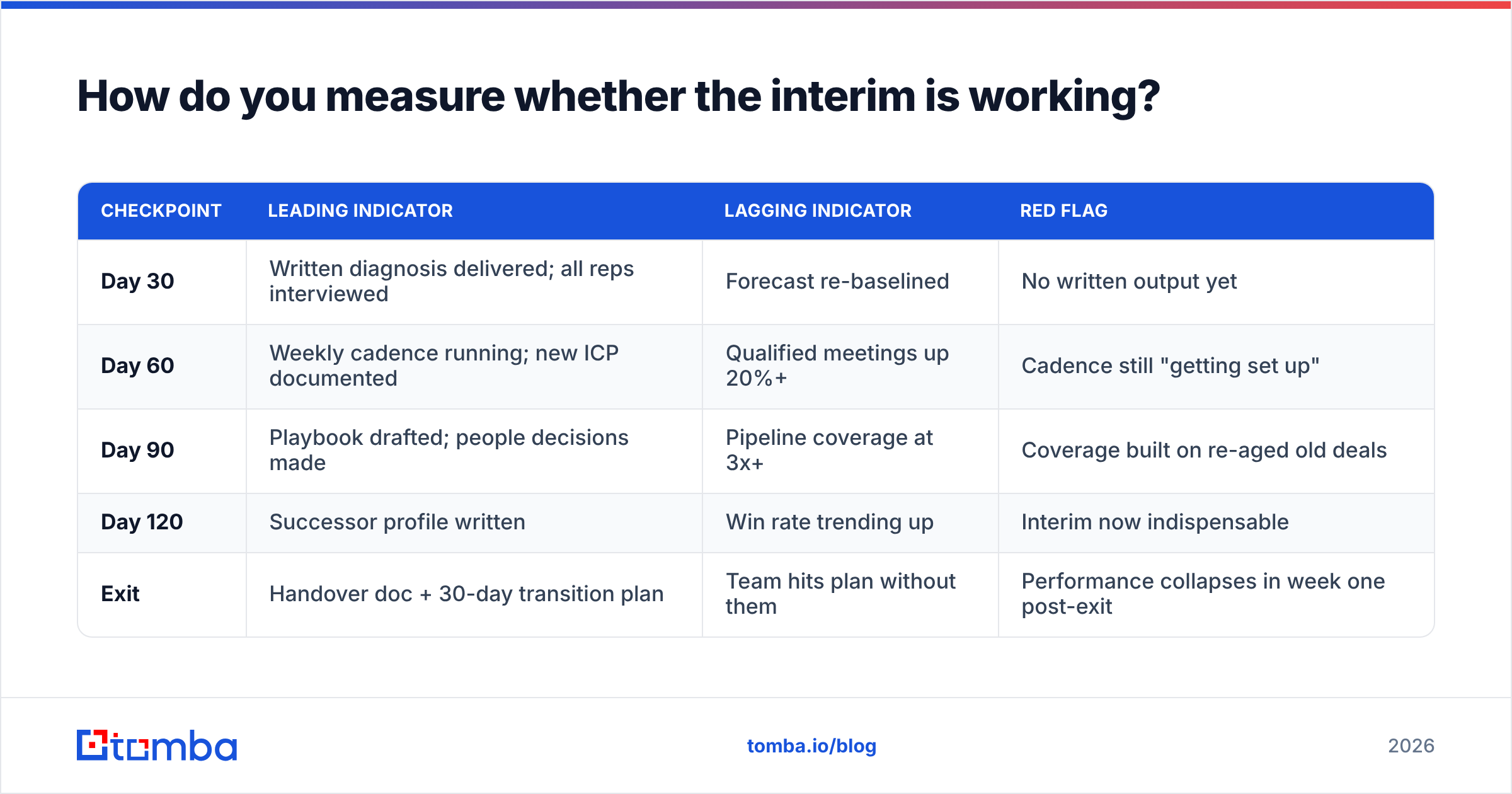
Set the scorecard before day one. Interim engagements that end badly almost always ended without agreed success criteria.
| Checkpoint | Leading indicator | Lagging indicator | Red flag |
|---|---|---|---|
| Day 30 | Written diagnosis delivered; all reps interviewed | Forecast re-baselined | No written output yet |
| Day 60 | Weekly cadence running; new ICP documented | Qualified meetings up 20%+ | Cadence still "getting set up" |
| Day 90 | Playbook drafted; people decisions made | Pipeline coverage at 3x+ | Coverage built on re-aged old deals |
| Day 120 | Successor profile written | Win rate trending up | Interim now indispensable |
| Exit | Handover doc + 30-day transition plan | Team hits plan without them | Performance collapses in week one post-exit |
That last row is the real test. An interim who leaves and everything falls apart did not build a system — they personally carried the number for six months. That is a very expensive contractor, not a leader.
How do you find and vet an interim sales director?#
Sources, roughly in order of quality-to-cost:
- Your investors' operator networks. Highest signal, fastest, usually free to access. VCs and PE firms keep benches of interims precisely for this.
- Specialist interim agencies. Fast and pre-vetted, with a 20–35% margin attached. Worth it if you have no network and need someone in two weeks.
- Operator communities and peer referrals. Pavilion, RevGenius, and similar communities are dense with people who have done exactly this.
- Marketplaces and review platforms. Check the vendor and consultant listings on G2 for the tooling side, and reference-check every candidate independently regardless of source.
Vetting questions that separate operators from consultants:
- "Walk me through the last time you fired someone in an interim role. How did you decide, and how did the team react?"
- "What did your predecessor's forecast say in month one, and what did yours say in month two?" (You want to hear the number went down.)
- "Show me a playbook you wrote for a previous client." (Redacted is fine. No artifact is not.)
- "What did you not fix, and why?" (Good interims triage ruthlessly and say so.)
- "Who did you hand over to, and can I speak to them?" The successor is the most useful reference you will ever take.
Reference-check the successor and the CEO, not the recruiter. And write the exit into the contract on day one — end date, handover deliverables, and a defined transition period. Ambiguity about the end date is how a six-month engagement quietly becomes an eighteen-month one at contractor rates.
Interim sales director or fix the system first?#
Here is the uncomfortable conclusion: if your problem is leadership, hire the interim. If your problem is inputs, an interim will only tell you what you already suspect, at $20k a month.
A useful test. Ask your best rep a single question: "If we doubled the number of qualified, correctly-targeted conversations you had next month, would you close more?" If the answer is an obvious yes, you have a pipeline-supply problem, and the cheapest fix is better targeting and cleaner data — not a new leader. If the answer is "no, I'd drop balls, our process falls over," you have a leadership and process problem, and an interim will earn their fee several times over.
Most mid-market companies have both. The order matters: fix the data, then hire the interim, so the expensive person spends their fixed window on judgement calls rather than on discovering that half the CRM is wrong.
Give your interim leader something real to work with. Before day one of any engagement, build them a target list that actually connects — verified decision-maker emails, complete account coverage, and no bounce-driven surprises in week three. Tomba's Email Finder finds and verifies professional email addresses by name, domain, or company, so your next sales leader inherits a pipeline they can trust instead of a spreadsheet they have to rebuild. Start free with 25 searches a month, or see full Tomba pricing — plans begin at $49/mo.
Related guides#
// get started
Find, verify and enrich your first contacts today
Start on the free plan with 25 searches a month, then scale when your team is ready.
Free plan · No credit card required · GDPR & CCPA
// about the author