What Is an Internal Champion? The 2026 B2B Sales Guide
A friendly contact is not an internal champion. Here is how to tell the difference, how to arm the real one, and how to stress-test them before you commit the deal to your forecast.
TL;DR
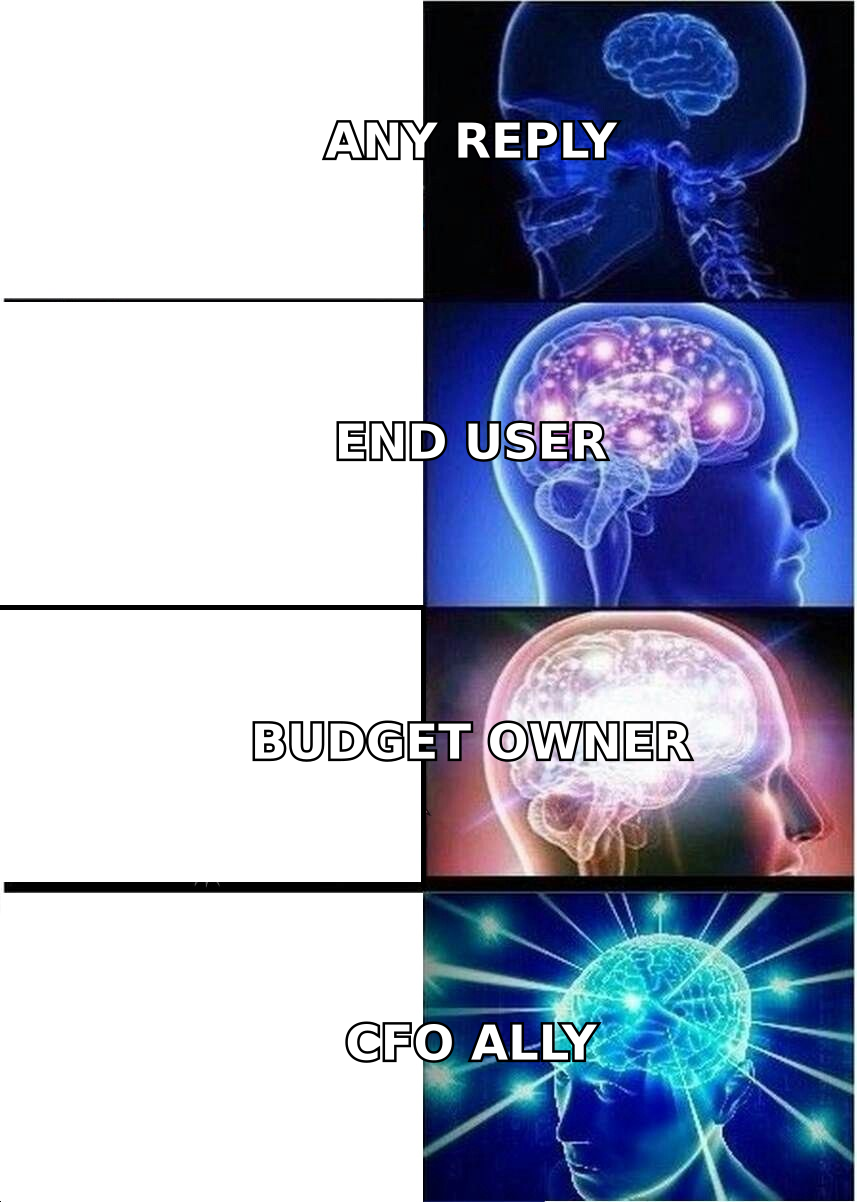
- An internal champion is someone inside the buying organization who sells your deal when you are not in the room — and who takes on personal risk to do it. Enthusiasm alone does not qualify.
- Most reps confuse a coach (gives you information) with a champion (spends political capital). That mistake is the single most common cause of a deal slipping from "verbal yes" to "no decision."
- A real champion passes three tests: access to power, willingness to advocate under scrutiny, and something to personally gain if you win.
- Buying groups now average 6–10 people. One champion is not enough — you need a champion plus two or three credible relationships around them.
- You cannot build a champion you have not contacted. Finding the right named humans — not a generic info@ inbox — is the first mechanical step, and it is the one most teams skip.
What is an internal champion in B2B sales?#
An internal champion is a person inside your prospect's company who actively advocates for your solution in meetings you will never attend.
Think of it like applying for a mortgage. The loan officer who answers your questions is helpful, but they do not approve anything. The person who walks your file into the credit committee and says "I vouch for this one" is putting their own judgment on the line. That second person is your champion. The first is a coach.
The distinction matters because of what happens when friction shows up. Every deal eventually hits an objection you are not present for: a security review flags something, finance asks why this line item exists, a rival vendor's rep drops a competitive one-pager. A coach forwards you the bad news. A champion argues back before you ever hear about it.
Three things define a genuine internal champion:
- They have something to gain. A promotion, a metric they own, a fire they need put out, a reputation for bringing in good tools. Altruism is not a motive; consequences are.
- They spend capital. They will put their name on an internal email, book a meeting with their boss, or defend the budget line. If they will not do any of these, they are a friendly source, not a champion.
- They have access. Not necessarily authority — access. A director who can get 15 minutes with the CFO beats a VP who never talks to finance.
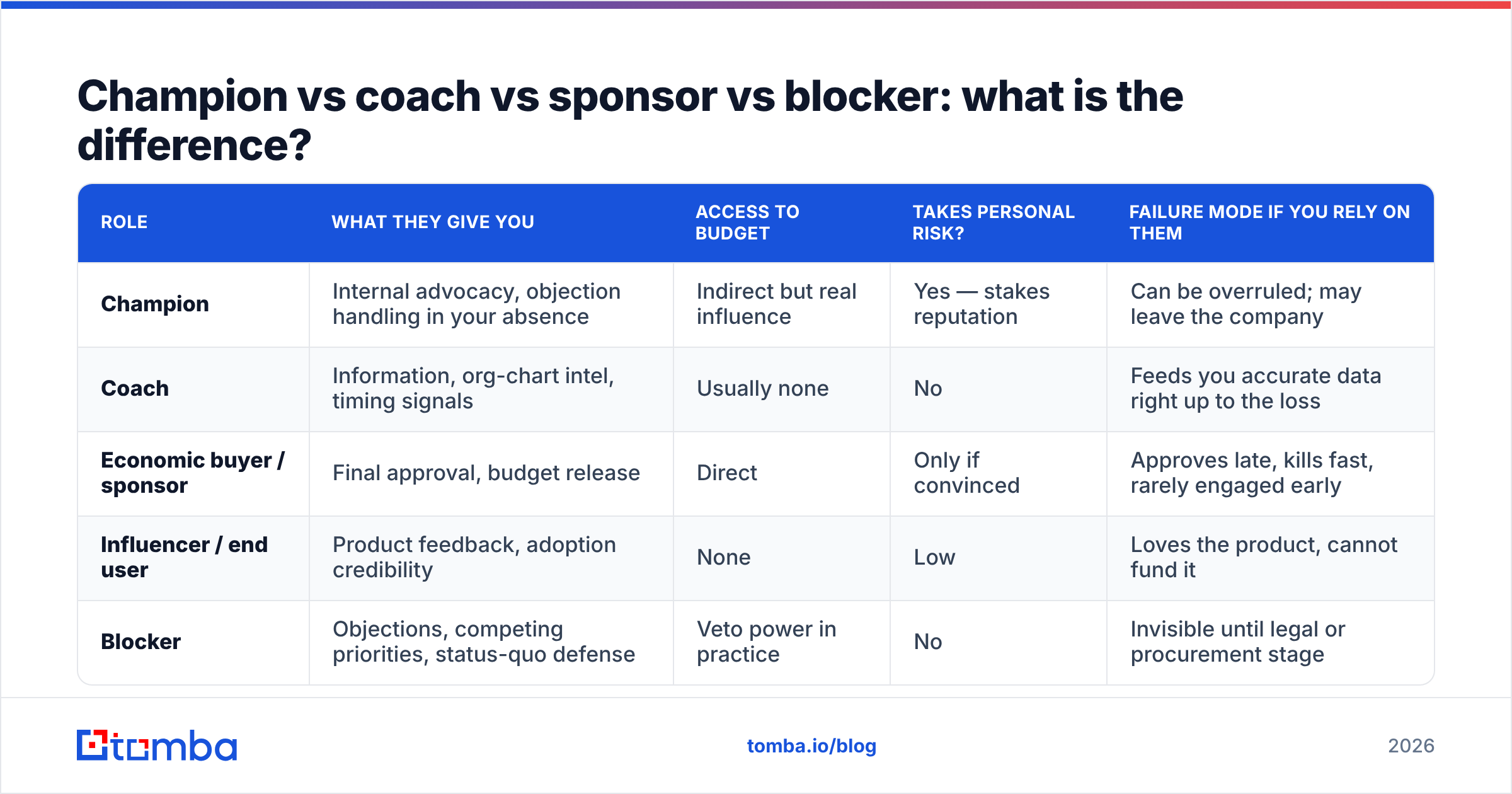
Champion vs coach vs sponsor vs blocker: what is the difference?#
Most pipeline reviews go sideways because everyone uses these four words interchangeably. Here is the distinction that actually predicts outcomes.
| Role | What they give you | Access to budget | Takes personal risk? | Failure mode if you rely on them |
|---|---|---|---|---|
| Champion | Internal advocacy, objection handling in your absence | Indirect but real influence | Yes — stakes reputation | Can be overruled; may leave the company |
| Coach | Information, org-chart intel, timing signals | Usually none | No | Feeds you accurate data right up to the loss |
| Economic buyer / sponsor | Final approval, budget release | Direct | Only if convinced | Approves late, kills fast, rarely engaged early |
| Influencer / end user | Product feedback, adoption credibility | None | Low | Loves the product, cannot fund it |
| Blocker | Objections, competing priorities, status-quo defense | Veto power in practice | No | Invisible until legal or procurement stage |
The pattern to notice: a coach is safe for the person playing that role. They give you the truth, cost themselves nothing, and quietly watch the deal die. That is why your best-informed contact is often not your best champion.
Gartner's research on the B2B buying journey has been consistent for years on this: buyers spend the overwhelming majority of their evaluation time away from vendors, in internal discussion. Whatever happens in those conversations is decided by the people in the room, not by your deck.
How do you tell a real champion from a friendly contact?#
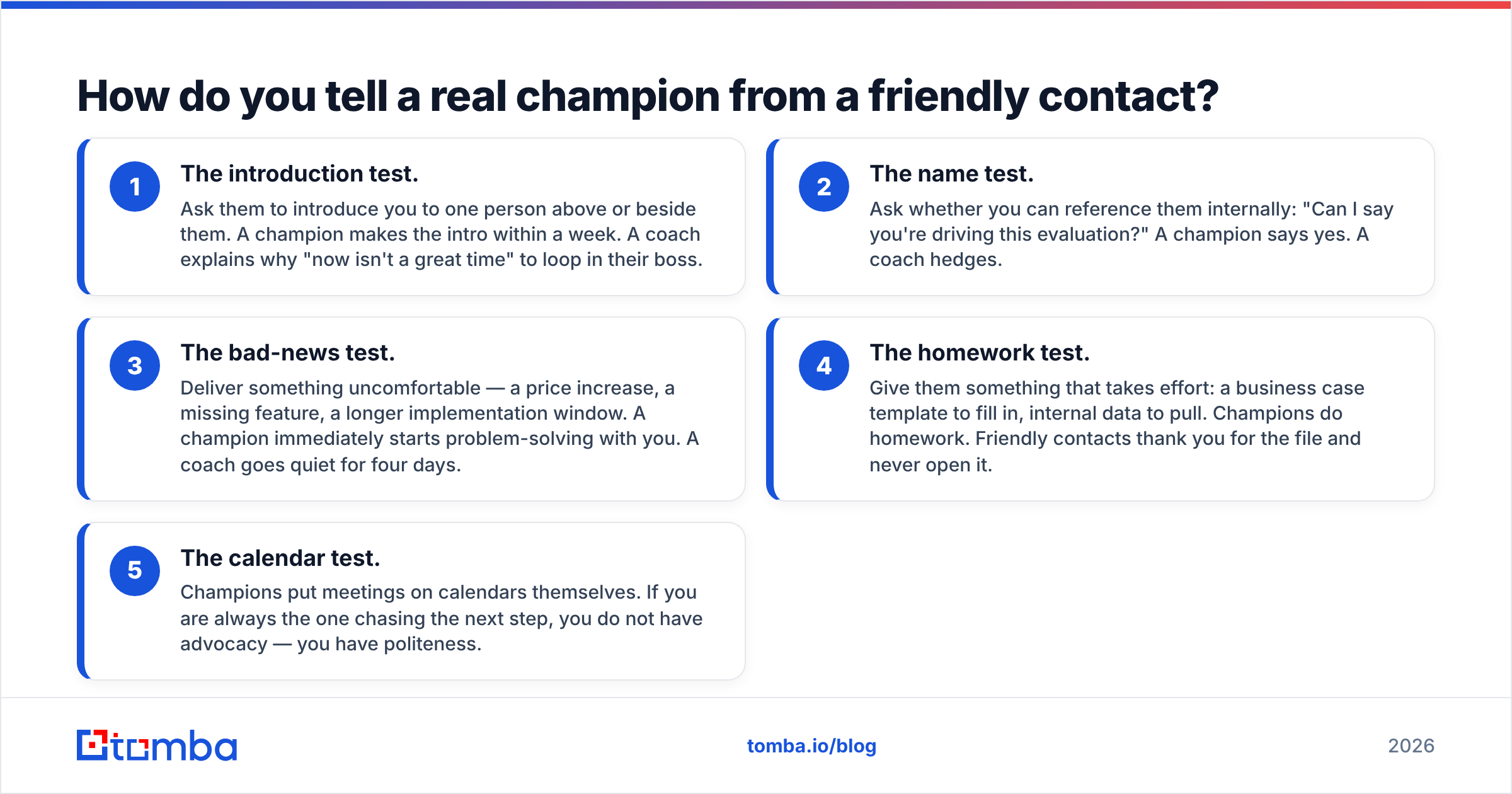
Run these five tests. A contact who fails more than one is a coach you are mislabeling.
- The introduction test. Ask them to introduce you to one person above or beside them. A champion makes the intro within a week. A coach explains why "now isn't a great time" to loop in their boss.
- The name test. Ask whether you can reference them internally: "Can I say you're driving this evaluation?" A champion says yes. A coach hedges.
- The bad-news test. Deliver something uncomfortable — a price increase, a missing feature, a longer implementation window. A champion immediately starts problem-solving with you. A coach goes quiet for four days.
- The homework test. Give them something that takes effort: a business case template to fill in, internal data to pull. Champions do homework. Friendly contacts thank you for the file and never open it.
- The calendar test. Champions put meetings on calendars themselves. If you are always the one chasing the next step, you do not have advocacy — you have politeness.
None of these require a confrontation. They are ordinary asks that happen to be diagnostic.
Why do deals with a strong internal champion still fail?#
Because a single champion is a single point of failure, and the failure modes are predictable.
They leave. Tenure in B2B software roles is short. If your entire deal sits on one person and they change jobs in month four of a six-month cycle, you restart from zero with no relationship equity.
They get overruled. A champion with enthusiasm but no political weight loses to a CFO's spending freeze. You did not lose to a competitor; you lost to an org chart you never mapped.
They oversell internally. An overcommitted champion promises outcomes your product cannot deliver on the timeline they claimed. The deal closes, the rollout disappoints, and your renewal is dead before it starts.
They were never a champion. This is the most common one. The contact was enthusiastic, responsive, and genuinely liked the product — and had zero intention of spending capital on it. Enthusiasm is cheap. Advocacy is not.
Procurement arrives late. Even a strong champion is often powerless once a procurement team applies a standardized vendor process. The champion's job at that stage is to pre-warn you and to pre-frame you internally, which they can only do if you gave them the ammunition early.
How do you actually find and build an internal champion?#
The workflow is mechanical, and it starts earlier than most reps think — before the first call, not after the demo.
Step 1 — Map the buying group before you reach out. Identify the likely roles: the person who feels the pain daily, the person who owns the metric, the person who owns the budget, and the person who will run security or procurement review. You are looking for four job titles, not four names yet.
Step 2 — Get the contact data for those roles. This is the step teams skip and then blame on "the market being slow." You cannot multi-thread an account whose people you cannot reach. Pull the named contacts by company with a domain search, then confirm the addresses are deliverable with an email verifier before a single sequence starts. Bouncing off a VP's inbox burns the one first impression you had.
Step 3 — Open with the pain owner, not the budget owner. Budget owners delegate discovery. Pain owners have discovery. Start with the person whose week is worse because of the problem you solve.
Step 4 — Convert interest into risk-taking, incrementally. Do not ask a new contact to champion you. Ask for something small — a 20-minute technical call, a review of a one-page summary, an internal forward. Each completed ask increases their investment. Champions are built through a ladder of small commitments, not a single big ask.
Step 5 — Add relationships, do not replace them. Multi-threading is not going around your champion. It is going with them: "Who else should see this so nothing gets stuck later?" Framed that way, expanding the circle looks like professionalism, not an end-run.
Step 6 — Keep enriching as the deal moves. Org charts change mid-cycle. Running contact enrichment on the account periodically catches the new VP who arrived in month three and now owns the budget line you have been chasing.
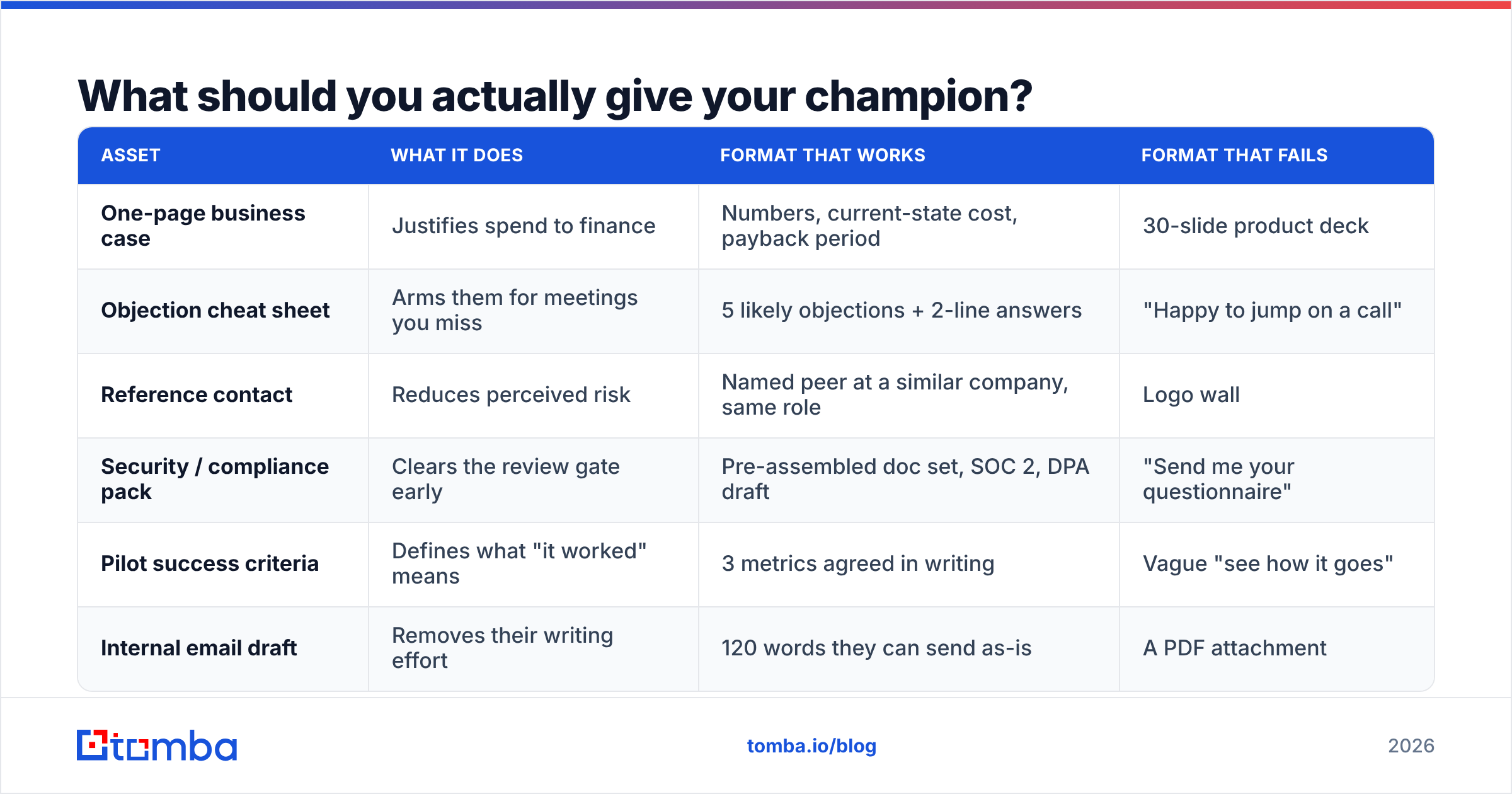
What should you actually give your champion?#
Give them things they can forward without editing. Every asset you hand a champion should survive being pasted into an internal Slack thread with zero context from you.
| Asset | What it does | Format that works | Format that fails |
|---|---|---|---|
| One-page business case | Justifies spend to finance | Numbers, current-state cost, payback period | 30-slide product deck |
| Objection cheat sheet | Arms them for meetings you miss | 5 likely objections + 2-line answers | "Happy to jump on a call" |
| Reference contact | Reduces perceived risk | Named peer at a similar company, same role | Logo wall |
| Security / compliance pack | Clears the review gate early | Pre-assembled doc set, SOC 2, DPA draft | "Send me your questionnaire" |
| Pilot success criteria | Defines what "it worked" means | 3 metrics agreed in writing | Vague "see how it goes" |
| Internal email draft | Removes their writing effort | 120 words they can send as-is | A PDF attachment |
That last row does more work than people expect. A champion is busy. The gap between "I should tell my boss about this" and actually doing it is usually a blank email draft. Write it for them.
HubSpot's sales research library is worth a look for benchmark data on how many touches and stakeholders a typical B2B cycle now involves — the numbers make the case for arming your champion better than any argument will.
How do you stress-test a champion before your forecast call?#
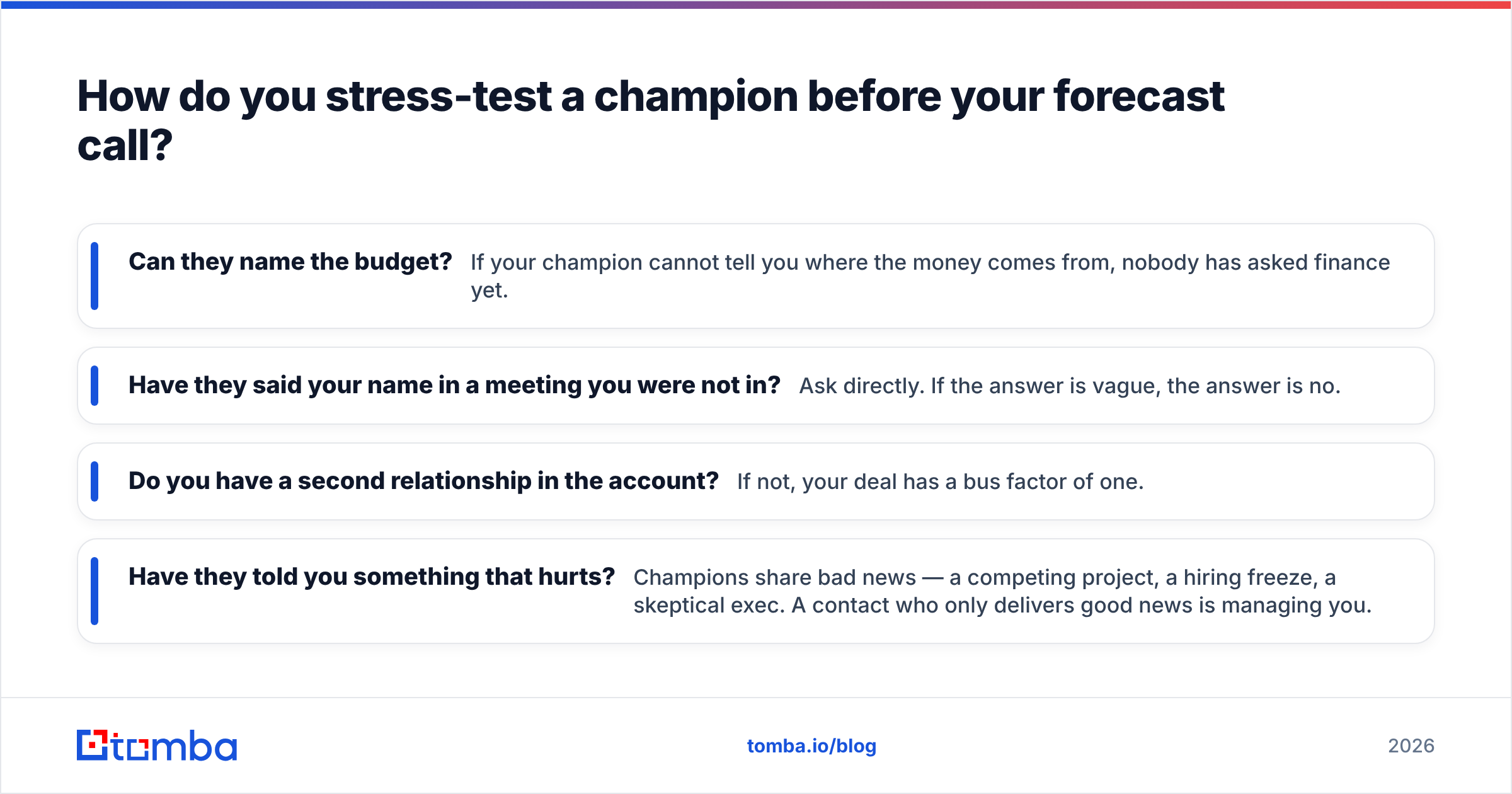
Score the relationship before you commit the number. Four questions, honest answers:
- Can they name the budget? If your champion cannot tell you where the money comes from, nobody has asked finance yet.
- Have they said your name in a meeting you were not in? Ask directly. If the answer is vague, the answer is no.
- Do you have a second relationship in the account? If not, your deal has a bus factor of one.
- Have they told you something that hurts? Champions share bad news — a competing project, a hiring freeze, a skeptical exec. A contact who only delivers good news is managing you.
Forecast confidence should scale with those answers, not with how pleasant the last call felt. Deals die between calls, and improving your win rate usually has less to do with your pitch and more to do with whether anyone was defending you on a Tuesday afternoon when the CFO asked, "do we really need this?"
One more discipline worth adopting: when a champion leaves the company mid-cycle, treat it as a fire drill, not a footnote. Find where they went — they are often your warmest lead at the new employer — and immediately rebuild inside the old account with the people you multi-threaded earlier. Reps who run reverse email lookup on a departed contact routinely turn a lost deal into two live ones.
What does good champion management look like week to week?#
- Weekly: one substantive touch that gives value, not one that asks for status.
- Every stage change: a new asset they can forward, matched to whoever is next in the process.
- Monthly: one new relationship added to the account.
- Always: written mutual action plan, with their name next to the internal steps and yours next to the vendor steps.
The mutual action plan is the quiet winner here. It converts a private opinion ("I think we'll do this in Q3") into a shared document with dates. Champions who co-author a plan behave differently from champions who nod at a timeline, because the document makes their commitment visible to their own colleagues.
Where does the work actually start?#
With names and working inboxes. You cannot build an internal champion in an account where you are still emailing a shared support alias, and you cannot multi-thread a buying group whose VP-level contacts you have never located. Every framework above assumes you can reach four or five specific humans at a target company — that assumption is where most of these plans quietly break.
Start by building the contact map. Use the Tomba Email Finder to pull verified, named contacts by company and role so your champion strategy has actual people attached to it. The free tier covers 25 searches a month if you want to test it against a handful of open opportunities first; paid plans start at $49/mo, with full Tomba pricing published if you need bulk volume or API access for your CRM. Map the buying group, verify the addresses, then go earn the advocate.
Related guides#
// get started
Find, verify and enrich your first contacts today
Start on the free plan with 25 searches a month, then scale when your team is ready.
Free plan · No credit card required · GDPR & CCPA
Get the Tomba newsletter
Product and data updates
// about the author