International Go To Market Strategy: A 2026 Playbook for B2B
Most international expansions fail on execution, not ambition. Here's how to score markets, choose an entry model, localize past translation, and build outbound data that survives a new region.
TL;DR
- An international go to market strategy is a market-by-market operating plan — scoring, entry model, pricing, compliance, and channel — not a translated version of your domestic playbook.
- Score candidate markets on four hard inputs: reachable accounts, willingness to pay, competitive density, and cost to serve. Pick one. Two at most.
- Your entry model (digital-first, partner/reseller, local hire, or acquisition) determines 80% of your cost curve. Choose it before you hire anyone.
- Localization fails when it stops at language. Payment methods, procurement norms, invoicing, and reply timing matter more than a translated homepage.
- Contact data is where most expansions quietly break: US-built lists have 30–60% coverage gaps in DACH, Nordics, and Japan, and bounce rates blow up sender reputation on day one.
What is an international go to market strategy?#
An international go to market strategy is the specific plan for how you acquire, serve, and retain customers in a market where your brand, network, and data coverage all start at zero.
Think of it like opening a second restaurant in a different city. The recipes carry over. The supplier relationships, the rent math, the lunch-rush timing, the health inspector, and the customers' idea of "expensive" do not. Teams that treat expansion as a copy-paste of the domestic motion are usually optimizing the recipe while the wrong supplier delivers late.
Formally, go-to-market strategy covers the segment you target, the value proposition you lead with, the channels you use, the pricing you set, and the sales motion that closes. The international version adds four variables that domestic GTM never forces you to answer:
- Market selection — which country or region first, and on what evidence.
- Entry model — how much fixed cost you commit before proof.
- Regulatory posture — what you legally cannot do in outbound, data handling, and contracting.
- Data coverage — whether you can actually reach the buyers you've decided to target.
Skip any one and the other three stop mattering.
How do you choose which market to enter first?#
Score markets on evidence you already have, not on TAM slides. Four inputs, weighted, ranked:
- Reachable accounts, not total accounts. A market with 40,000 target companies where you can source verified contacts for 6,000 is a 6,000-account market. Run a coverage test before committing — pull 200 target domains and measure how many yield valid, role-matched contacts.
- Inbound signal you're already getting. Check your CRM and web analytics for the country breakdown of trials, demo requests, and support tickets. Unpaid demand is the cheapest possible proof.
- Willingness to pay, benchmarked locally. Compare local competitor list prices, not your US price converted at spot rate. Software budgets per seat vary 2–3x across Western Europe alone.
- Cost to serve. Support-hours overlap, contract language, local entity requirements, VAT/tax registration, payment rails. A market four time zones away doubles your support headcount before it doubles revenue.
- Competitive density and incumbency. A market with one entrenched local player and no international challenger is usually better than one with eight fragmented vendors and heavy local loyalty.
Weight these to a single score, then stack-rank. The output should be uncomfortable — if three markets tie, your scoring inputs are too soft.

Which market entry model fits your stage?#
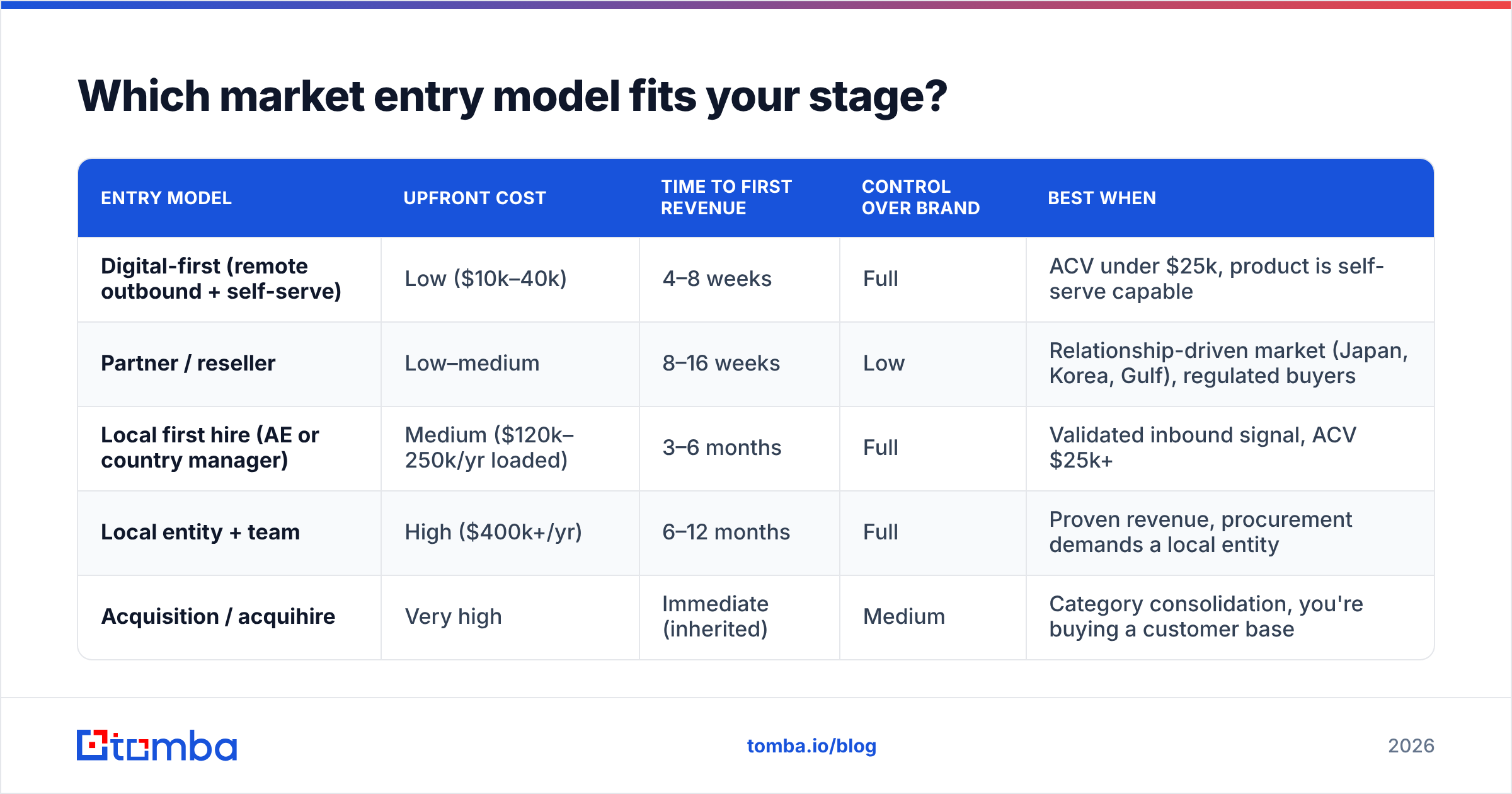
The entry model is the highest-leverage decision in the entire plan, because it sets your fixed cost before you have any revenue proof. Here's how the four common models compare:
| Entry model | Upfront cost | Time to first revenue | Control over brand | Best when |
|---|---|---|---|---|
| Digital-first (remote outbound + self-serve) | Low ($10k–40k) | 4–8 weeks | Full | ACV under $25k, product is self-serve capable |
| Partner / reseller | Low–medium | 8–16 weeks | Low | Relationship-driven market (Japan, Korea, Gulf), regulated buyers |
| Local first hire (AE or country manager) | Medium ($120k–250k/yr loaded) | 3–6 months | Full | Validated inbound signal, ACV $25k+ |
| Local entity + team | High ($400k+/yr) | 6–12 months | Full | Proven revenue, procurement demands a local entity |
| Acquisition / acquihire | Very high | Immediate (inherited) | Medium | Category consolidation, you're buying a customer base |
Most B2B SaaS companies under $20M ARR should start digital-first and only graduate to a local hire after a market clears a revenue threshold you set in advance — say, $250k in committed ARR sourced remotely. Writing that threshold down before you enter is the whole point. It's what stops you from hiring a country manager to rescue a market that never had demand.
Gartner's sales research has been consistent on this for years: B2B buyers spend the majority of their journey outside vendor conversations, which means a digital-first entry is far more viable now than it was when field sales was the only door.
What does localization actually mean beyond translation?#
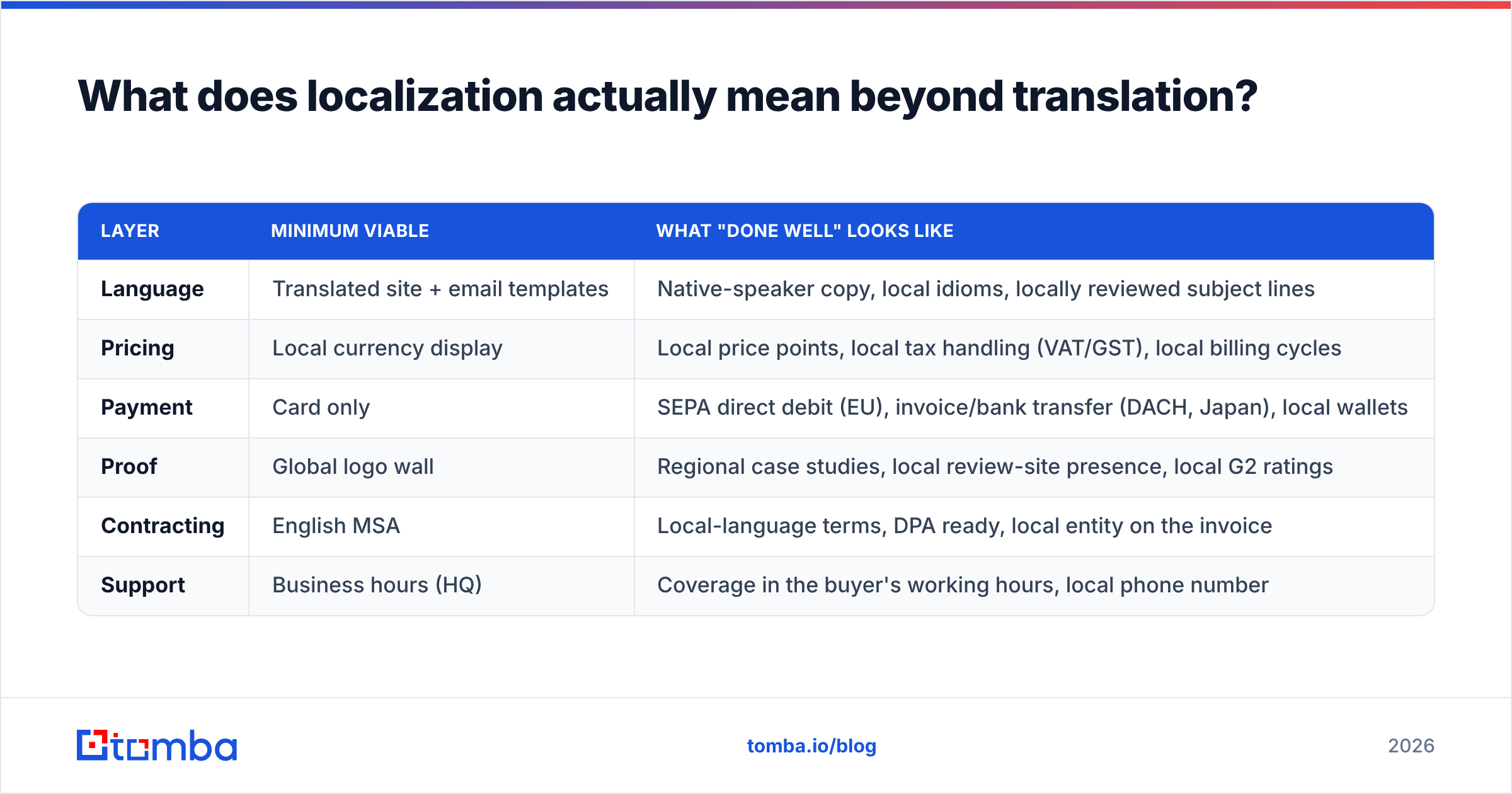
Translation is the smallest part. Localization is everything that makes a buyer believe you operate in their market rather than visiting it.
| Layer | Minimum viable | What "done well" looks like |
|---|---|---|
| Language | Translated site + email templates | Native-speaker copy, local idioms, locally reviewed subject lines |
| Pricing | Local currency display | Local price points, local tax handling (VAT/GST), local billing cycles |
| Payment | Card only | SEPA direct debit (EU), invoice/bank transfer (DACH, Japan), local wallets |
| Proof | Global logo wall | Regional case studies, local review-site presence, local G2 ratings |
| Contracting | English MSA | Local-language terms, DPA ready, local entity on the invoice |
| Support | Business hours (HQ) | Coverage in the buyer's working hours, local phone number |
Two specifics that punch above their weight:
Invoicing and procurement. In Germany, France, and Japan, procurement will often reject a foreign-entity invoice outright or delay it 60+ days. A payment method mismatch kills more deals at the finish line than positioning ever does.
Proof density. A buyer in Stockholm does not care about your San Francisco logos. Three Nordic customers beat thirty American ones. Sequence your first ten deals to become regional proof — discount for logo rights if you have to.
Is your contact data ready for a new market?#
This is the failure point almost nobody plans for. Your existing data stack was built and tuned on domestic contacts. Move it to a new region and three things break at once: coverage drops, formats change, and bounce rates spike.
Concretely:
- Email format conventions differ.
firstname.lastname@dominates the US and UK. DACH companies usef.lastname@and heavy abbreviation. Japanese companies frequently use department-level aliases instead of individual addresses. A permutation-based guesser tuned on US patterns produces garbage outside it. - Umlauts, accents, and transliteration.
Müllerbecomesmueller,muller, ormllerdepending on the company's mail policy. Guess wrong and you bounce. - Catch-all prevalence is higher in Europe. Many EU mid-market companies run catch-all domains, which means standard SMTP verification returns "accept-all" and tells you nothing. You need a catch-all verifier that scores deliverability probability rather than returning an unusable "unknown."
- Coverage is uneven by source. LinkedIn-scraped data skews toward markets with high LinkedIn penetration. In Japan, Germany, and much of Southern Europe, LinkedIn coverage of mid-level buyers is materially thinner than in the US or UK.
The practical sequence before you send a single email in a new market:
- Run a coverage test. Take 200 representative target domains and run domain search against them. Measure the percentage returning role-matched contacts. Under 40% and your market selection needs revisiting, not your sequence copy.
- Detect the format per company, don't assume it. Pattern detection per domain is cheaper than a damaged sending domain.
- Verify everything, twice. Run the full list through an email verifier before import, then re-verify anything older than 90 days. Contact churn in a new region is invisible to you because you have no local network to catch it.
- Enrich for local context. Company size bands, local industry codes (NACE in the EU, not NAICS), and language preference should live on the record. Data enrichment that only returns US-centric firmographics will mis-segment your entire pipeline.
- Warm a separate sending domain per region. Different recipients, different ISP mix, different reputation history. Don't gamble your domestic domain on an untested list.
If you'd rather buy than build a first list, both Tomba and specialist providers like BookYourData offer region-filtered B2B contacts — Tomba if you want live API-verified lookups wired into your own workflow, BookYourData if you want a pre-packaged, filterable purchase. Either way, verify on ingest. Vendor-stated accuracy and your actual bounce rate are different numbers.

What compliance rules change when you go international?#
Outbound legality is not uniform, and the differences are strict enough to reshape your channel mix.
- EU/EEA — GDPR. B2B cold email is generally permissible under legitimate interest, but you need a documented balancing test, a clear opt-out in every message, a lawful basis for how you sourced the data, and a DPA with your vendors. Germany applies a stricter interpretation than most member states.
- Canada — CASL. Consent-based and heavily enforced, with meaningful fines. Implied consent from a published business address exists but is narrow and time-limited.
- UK — PECR + UK GDPR. Corporate subscribers get more latitude than individuals; sole traders and partnerships are treated closer to individuals.
- Brazil — LGPD. GDPR-shaped, with local supervisory enforcement ramping up.
- Japan — APPI. Direct outbound is legal but culturally low-yield; introductions and partners outperform cold sequences by a wide margin.
Two operational takeaways. First, keep source provenance on every contact record — where it came from and when. If a regulator or a prospect asks, "how did you get this?", "our vendor had it" is not an answer. Providers that publish their data sources make this audit trivially easy; opaque ones make it a liability.
Second, suppression lists must be global and instant. An unsubscribe in one region that doesn't propagate to your other sending domains is the most common compliance failure in multi-region outbound.
How should you structure the first 90 days?#
- Days 1–14 — Prove reachability. Coverage test on 200 domains. Set up a regional sending domain and start warmup. Localize your top three sequences with a native speaker, not a translation API.
- Days 15–45 — Run a controlled outbound test. 300–500 verified contacts, three ICP variants, one channel. You are measuring reply rate and meeting rate against your domestic baseline — not revenue yet.
- Days 46–75 — Interview every reply. Positive and negative. The goal is to learn the local objection set: pricing expectation, procurement path, incumbent vendor, data residency questions. This is your actual product-market-fit signal.
- Days 76–90 — Decide with a pre-committed rule. Meeting rate within 60% of domestic baseline plus at least two qualified opportunities → invest further. Below that → the market goes back in the queue and you test the next one.
Ninety days and a fixed decision rule beat eighteen months of "we're still building brand awareness."
What metrics tell you a market is actually working?#
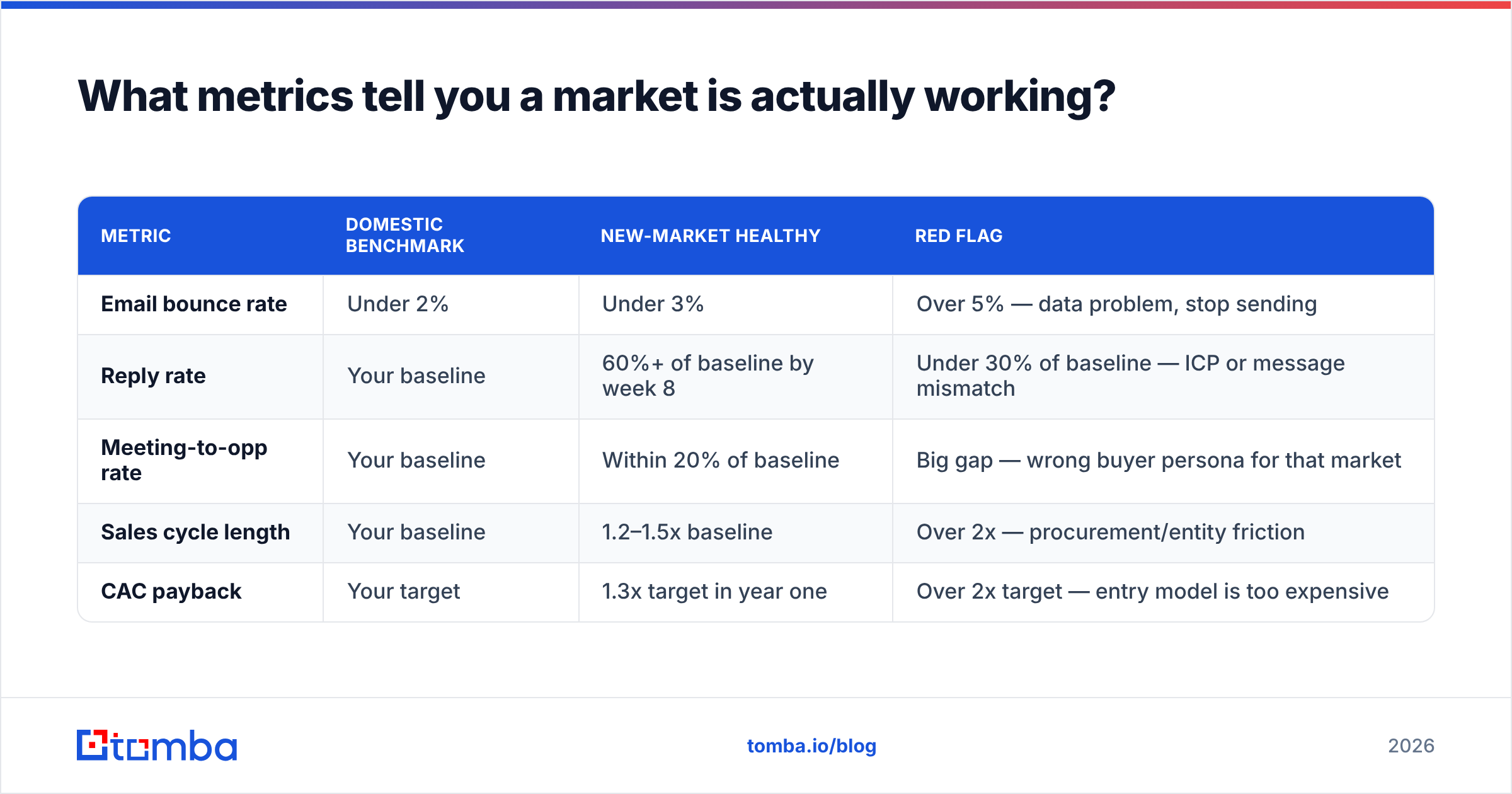
| Metric | Domestic benchmark | New-market healthy | Red flag |
|---|---|---|---|
| Email bounce rate | Under 2% | Under 3% | Over 5% — data problem, stop sending |
| Reply rate | Your baseline | 60%+ of baseline by week 8 | Under 30% of baseline — ICP or message mismatch |
| Meeting-to-opp rate | Your baseline | Within 20% of baseline | Big gap — wrong buyer persona for that market |
| Sales cycle length | Your baseline | 1.2–1.5x baseline | Over 2x — procurement/entity friction |
| CAC payback | Your target | 1.3x target in year one | Over 2x target — entry model is too expensive |
Track bounce rate first. It's the earliest and cheapest signal, and it tells you whether you have a data problem or a demand problem — two failures that look identical from a pipeline dashboard but need completely different fixes.
What are the most common international GTM mistakes?#
- Entering three markets at once. Attention is the scarce resource. Three half-funded markets produce three ambiguous results.
- Hiring a country manager before demand proof. You've now spent $200k to discover something a $5k outbound test would have told you in six weeks.
- Converting US pricing at spot rate. Currency conversion is not pricing strategy. Price to local willingness to pay and local competitor anchors.
- Reusing the domestic sending domain. One bad regional list and your domestic pipeline goes with it.
- Treating data coverage as a procurement detail. It's a market-viability input. If you can't reach buyers, nothing downstream matters.
- No exit rule. Decide in advance what "this isn't working" looks like, or sunk cost will decide for you.
Where should you start?#
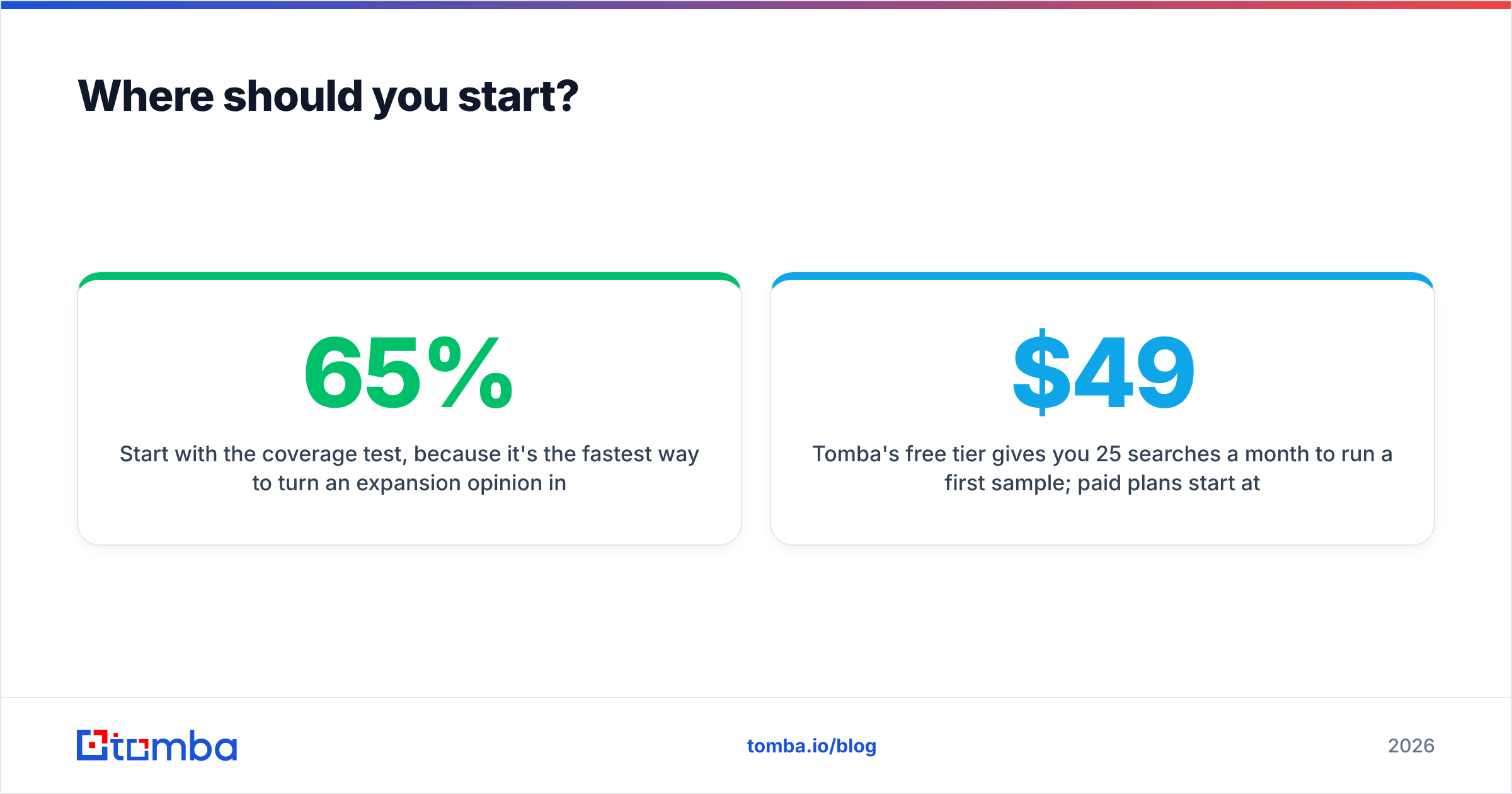
Start with the coverage test, because it's the fastest way to turn an expansion opinion into a number. Pull your 200 target domains in the candidate market, run them through Tomba Email Finder and the verifier, and read the hit rate. If 65% of those domains return valid, role-matched contacts, you have a reachable market and a list to test with. If it's 25%, you've saved yourself a quarter and a headcount.
Tomba's free tier gives you 25 searches a month to run a first sample; paid plans start at $49/mo for Starter, $99/mo for Growth, and $249/mo for Pro, with full Tomba pricing published per tier. The Tomba API wires the same finder, verifier, and enrichment calls straight into your CRM so every new-market record lands verified, sourced, and segmented instead of arriving as a spreadsheet nobody trusts. Test the market before you fund it.
Related guides#
// get started
Find, verify and enrich your first contacts today
Start on the free plan with 25 searches a month, then scale when your team is ready.
Free plan · No credit card required · GDPR & CCPA
Get the Tomba newsletter
Product and data updates
// about the author