International Sales: How to Expand B2B Revenue Across Borders
Most B2B teams treat international sales as a copy-paste of their domestic motion. It isn't. Here's the data, timing, pricing, and compliance playbook that actually travels across borders.
TL;DR
- International sales fails most often on data and compliance, not on product-market fit. Your EU, LATAM, and APAC contact records decay faster and carry stricter consent rules than your US list.
- Pick one beachhead market and prove a repeatable motion before you add a second. Teams that launch three regions at once usually under-resource all three.
- Localization is not translation. Currency, payment terms, buying-committee size, and legal entity requirements move the needle more than a translated landing page.
- Budget 9-18 months to payback in a new market. Deals in Germany and Japan routinely run 1.4-2x the cycle length of comparable US deals.
- Build your outbound list with verified, region-aware data — a catch-all-heavy European domain list will torch your sender reputation within two weeks.
What is international sales in a B2B context?#
International sales is the practice of selling your product to buyers outside your home market, with a motion adapted to each market's data availability, legal constraints, buying culture, and currency. That last half of the sentence is where teams go wrong.
Think of it like electrical plugs. Your product is the appliance; it works fine. But every country has a different socket, a different voltage, and a few have brownouts. You don't redesign the appliance — you build the right adapter and check the voltage before you plug in. Most failed expansions are teams jamming a US two-prong plug into a German socket and concluding the appliance is broken.
Concretely, an international sales motion has five layers you must adapt:
- Data layer — where you source contact records, how you verify them, and which consent basis you rely on. GDPR, Canada's CASL, and Brazil's LGPD each define "legitimate interest" differently.
- Message layer — value props ranked by local pain, not by your headquarters' roadmap. Cost-reduction leads in Southern Europe; compliance and risk lead in DACH; speed and scale lead in the US.
- Commercial layer — pricing in local currency, local payment terms (net 60 is normal in France and Italy), invoicing entity, and tax treatment.
- Channel layer — direct rep, inside sales from a hub, reseller, or marketplace. Japan and Korea still reward partner-led motions far more than the US does.
- Support layer — timezone coverage, local-language onboarding, and a human who can answer a procurement questionnaire in the buyer's language.
Skip any one of these and the other four compensate poorly.

Which market should you enter first?#
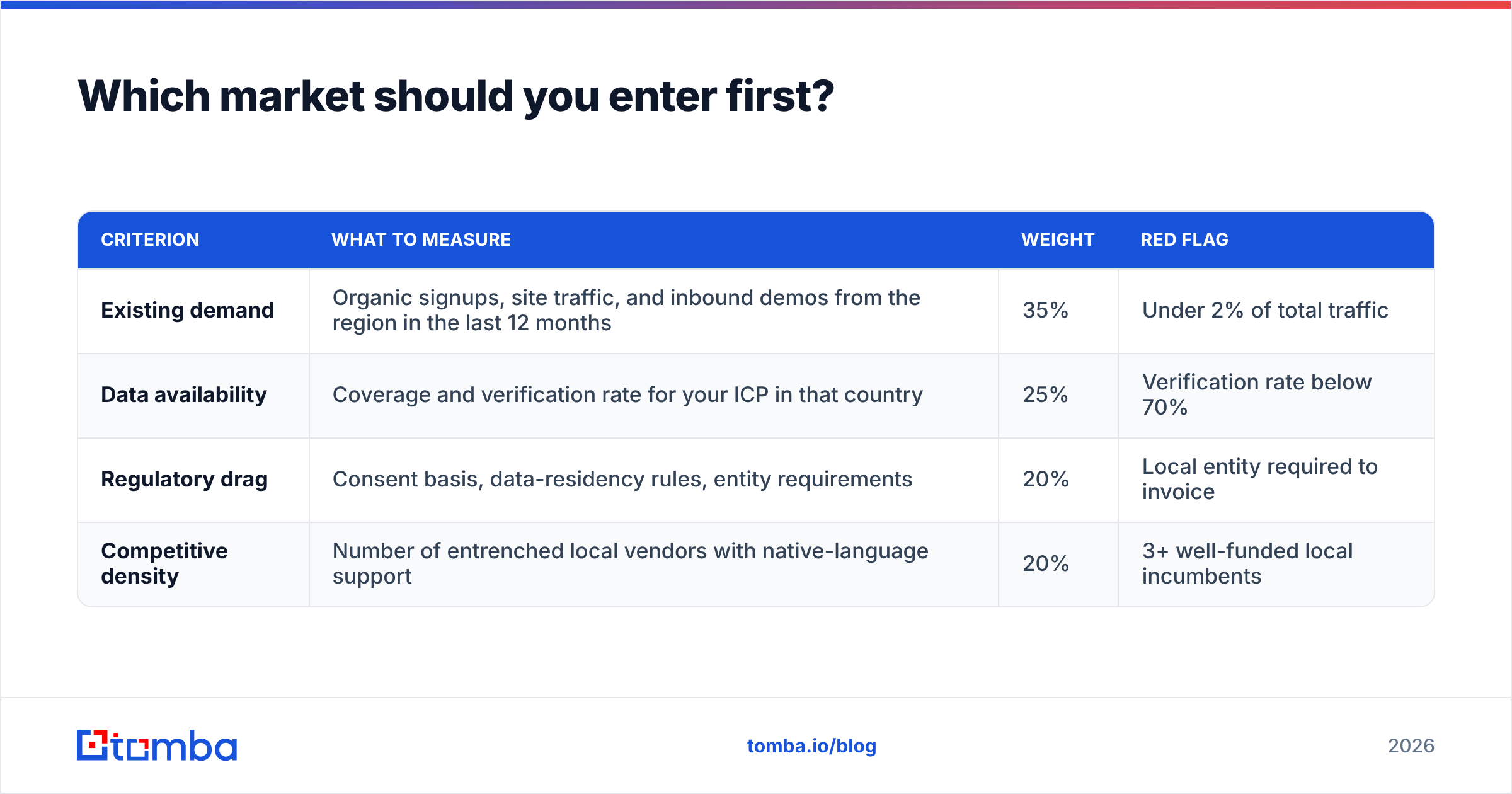
Rank candidate markets on four variables and stop arguing about it in a spreadsheet forever. The honest answer is usually the market where you already see inbound signups you've been ignoring.
Here's the scoring frame most expansion teams converge on:
| Criterion | What to measure | Weight | Red flag |
|---|---|---|---|
| Existing demand | Organic signups, site traffic, and inbound demos from the region in the last 12 months | 35% | Under 2% of total traffic |
| Data availability | Coverage and verification rate for your ICP in that country | 25% | Verification rate below 70% |
| Regulatory drag | Consent basis, data-residency rules, entity requirements | 20% | Local entity required to invoice |
| Competitive density | Number of entrenched local vendors with native-language support | 20% | 3+ well-funded local incumbents |
Applying this usually collapses a 12-country shortlist to two or three realistic options. The UK, Netherlands, and Nordics score high for English-first US companies: high English-language business fluency, strong data coverage, and mature B2B SaaS buying habits. Germany and France score lower on speed but higher on contract size. Japan scores lowest on speed and highest on retention once you land.
One rule that saves money: do not enter a market you cannot staff with at least one native speaker within six months. Buying committees in DACH and Japan will quietly deprioritize a vendor whose only support option is English-language email at 3 a.m. local time.
Why does contact data break when you cross borders?#
Because the sourcing assumptions that work domestically stop holding. Three things change at once.
Email patterns diversify. The first.last@ convention dominates US SaaS, but European mid-market companies use initial.lastname@, lastname@, and internal-ID formats far more often. Guessing a pattern from a handful of known contacts produces a much higher bounce rate outside the US. Run a proper company email pattern check per domain rather than assuming.
Catch-all domains are more common. Many European corporates route all mail to a single gateway, which means standard SMTP verification returns "accept-all" and tells you nothing. If you treat those as valid, you send into a void and your bounce metrics lie to you. You need a catch-all verifier that goes beyond a basic SMTP handshake, or you need to exclude those domains from cold sequences entirely.
Consent law changes what "a lead" even means. Under GDPR, B2B cold email can often be justified under legitimate interest — but the bar involves relevance to the recipient's professional role, a clear opt-out, and documented sourcing. The ICO's guidance on direct marketing is the practical reference for the UK; individual EU member states layer their own ePrivacy implementations on top. France's CNIL, for instance, is stricter about personal-format addresses than about role addresses.
The operational consequence: your international list needs a higher verification standard than your domestic one, not a lower one. Teams often do the opposite, buying a cheap bulk European list precisely because they're less confident in the market — and then burning a sending domain to learn the lesson.
Run every cross-border list through email verification before it touches a sequence, and prefer data enrichment that returns the source of each record so you can document your lawful basis if a recipient asks.
How do buying cycles differ by region?#
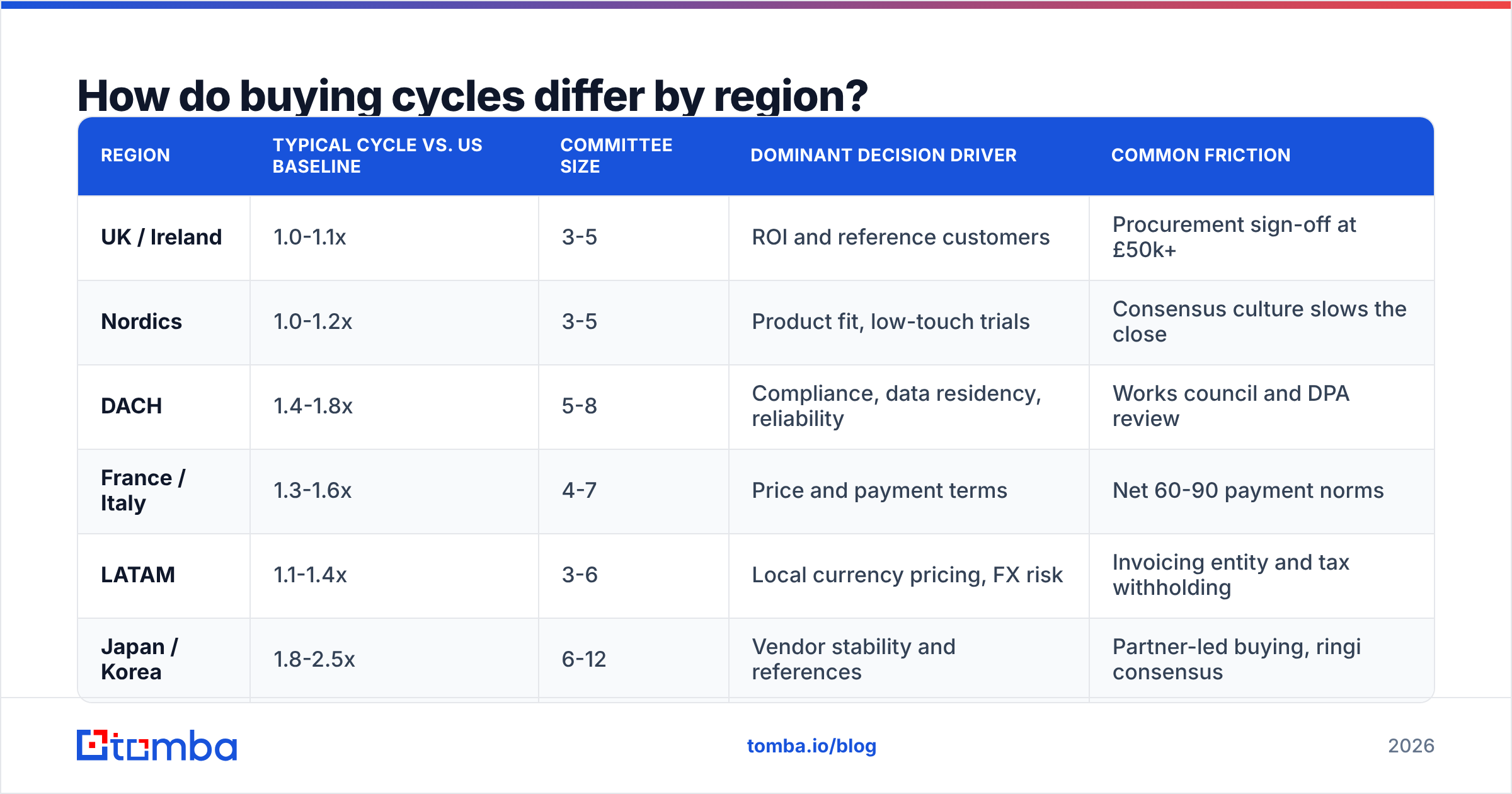
Materially, and in ways that wreck your forecast if you model every region on US benchmarks. Here's what mid-market B2B SaaS teams typically observe:
| Region | Typical cycle vs. US baseline | Committee size | Dominant decision driver | Common friction |
|---|---|---|---|---|
| UK / Ireland | 1.0-1.1x | 3-5 | ROI and reference customers | Procurement sign-off at £50k+ |
| Nordics | 1.0-1.2x | 3-5 | Product fit, low-touch trials | Consensus culture slows the close |
| DACH | 1.4-1.8x | 5-8 | Compliance, data residency, reliability | Works council and DPA review |
| France / Italy | 1.3-1.6x | 4-7 | Price and payment terms | Net 60-90 payment norms |
| LATAM | 1.1-1.4x | 3-6 | Local currency pricing, FX risk | Invoicing entity and tax withholding |
| Japan / Korea | 1.8-2.5x | 6-12 | Vendor stability and references | Partner-led buying, ringi consensus |
Two implications. First, your ramp assumptions for a new-market rep should be longer than domestic — 9 months to full productivity in DACH is realistic where 5 months works in the US. Second, your pipeline coverage ratio should be regionally adjusted; a 3x coverage target that works for US new business often needs to be 4x in markets where deals stall in legal review.
Gartner's research on B2B buying behavior consistently finds larger, more distributed buying groups than sellers assume — and that pattern intensifies in consensus-driven markets.
What does a localized outbound sequence actually look like?#
Not a translated version of your US sequence. Here is what changes, in order of impact:
- Send time and cadence. August is dead in France, Italy, and Spain. Mid-December through early January is dead almost everywhere in Europe, and Golden Week plus Obon remove significant selling weeks in Japan. Compress your quarters accordingly.
- Formality register. German business email defaults to surname-and-title address. Opening with "Hey Thomas" from an unknown vendor reads as sloppy, not friendly. Dutch and Nordic buyers sit at the opposite end and find excessive formality stiff.
- Proof selection. Reference customers must be regionally recognizable. A logo wall of US mid-market SaaS companies converts poorly in Milan. One local logo beats ten foreign ones.
- Claim calibration. "10x your pipeline" reads as noise in DACH and Japan. Specific, bounded claims with a methodology note land far better.
- Opt-out and identity. Include a plain unsubscribe line and your legal entity details. This is a compliance requirement in much of the EU and it also measurably reduces spam complaints.
- Channel mix. LinkedIn outreach carries disproportionate weight in the Nordics, Benelux, and Brazil. Phone still outperforms email for first contact in Italy, Spain, and much of LATAM — which means you need B2B phone numbers, not just addresses.

How should you price and invoice across borders?#
Price in local currency wherever the market expects it, and accept that this creates FX exposure you have to manage rather than avoid. Quoting USD into the eurozone signals that you are not serious about the market, and it pushes FX risk onto the buyer — who will price that risk into the negotiation.
Practical checklist:
- Currency: EUR and GBP pricing pages are table stakes for European expansion. JPY matters in Japan; BRL and MXN matter in LATAM.
- Payment terms: Net 30 is a US norm. Expect to concede net 60 in France and Italy, and build it into cash-flow planning rather than treating every request as a negotiation loss.
- Tax: VAT reverse-charge for B2B EU sales, GST in APAC markets, and withholding tax in several LATAM countries. Get an accountant involved before the first invoice, not after.
- Entity: You can often sell into a market before incorporating there, but some enterprise procurement processes require a local invoicing entity. Know the threshold at which this blocks deals for your ICP.
- Contract language: Many DACH and Japanese enterprises require a local-language contract or at minimum a local-language summary. Budget legal translation.
Avoid uniform global price parity. A flat worldwide price generally means you are leaving money on the table in high-willingness-to-pay markets and pricing yourself out of high-volume ones. Regional pricing tiers are normal practice and buyers expect them.
What tooling stack supports international sales?#
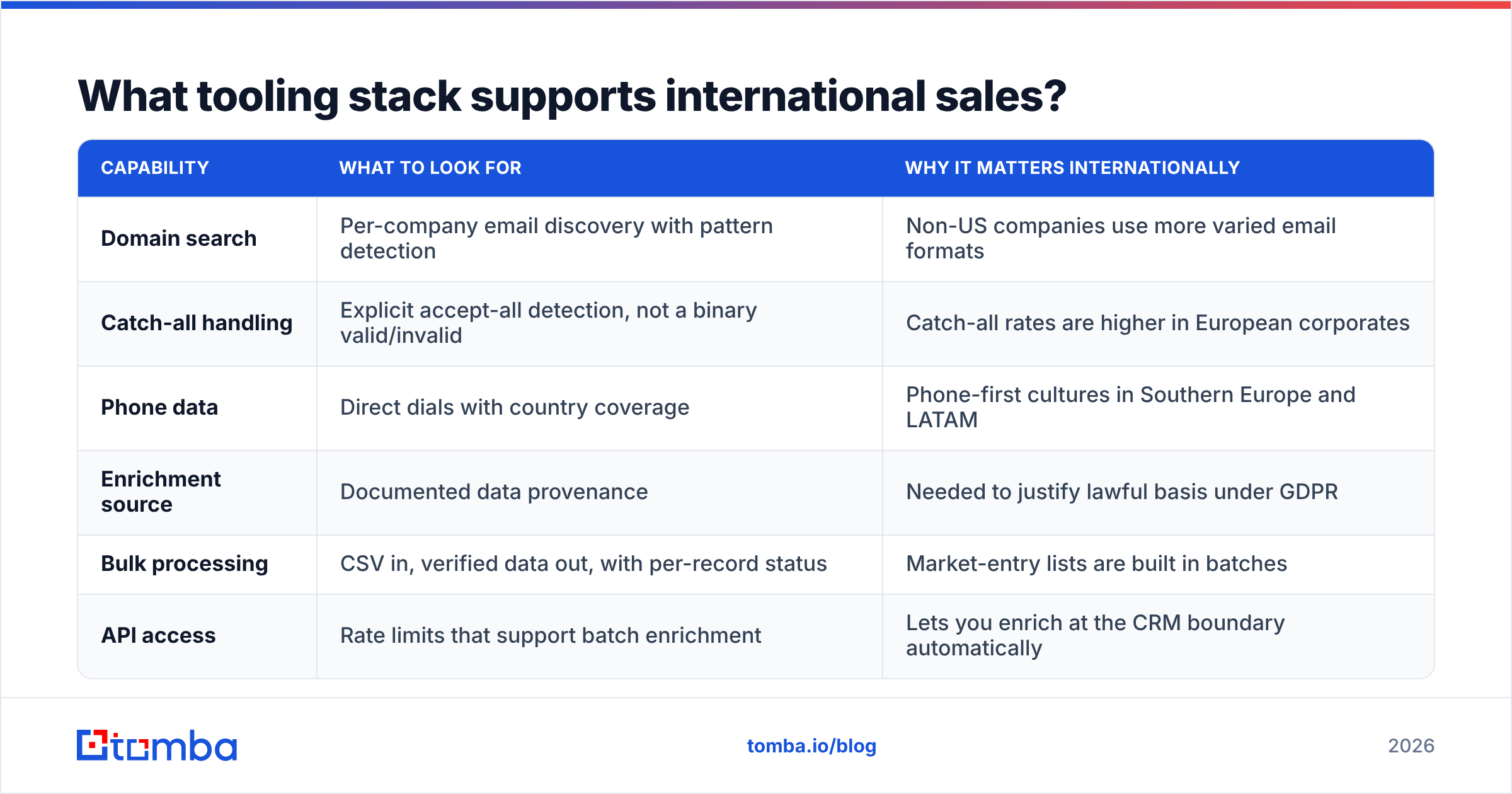
You need four capabilities: region-aware contact data, verification that handles non-US mail infrastructure, enrichment that returns firmographics for non-US registries, and a CRM that can model multi-currency deals.
On the data side, the practical test is coverage plus verification rate in your specific target countries — not global record counts. A provider claiming 500 million contacts is meaningless if 80% are US-based and the European records are three years stale. Ask any vendor for a sample of 200 records in your target country and measure the verified rate yourself.
Several vendors serve different slices of this well. BookYourData is a solid option when you want pre-built, filterable lists with country-level targeting and prefer to buy records outright rather than run searches. Tomba is a better fit when you want to build lists domain-by-domain from companies you have already researched, with verification and pattern detection in the same workflow. Broader platforms like Apollo bundle data with sequencing, which suits teams that want one system of record but tend to cost more per verified contact.
| Capability | What to look for | Why it matters internationally |
|---|---|---|
| Domain search | Per-company email discovery with pattern detection | Non-US companies use more varied email formats |
| Catch-all handling | Explicit accept-all detection, not a binary valid/invalid | Catch-all rates are higher in European corporates |
| Phone data | Direct dials with country coverage | Phone-first cultures in Southern Europe and LATAM |
| Enrichment source | Documented data provenance | Needed to justify lawful basis under GDPR |
| Bulk processing | CSV in, verified data out, with per-record status | Market-entry lists are built in batches |
| API access | Rate limits that support batch enrichment | Lets you enrich at the CRM boundary automatically |
For the build-a-list workflow, domain search plus bulk verification is usually cheaper per usable contact than buying large prospect databases you then have to clean. Tomba pricing starts with a free tier at 25 searches per month, Starter at $49/mo, Growth at $99/mo, and Pro at $249/mo — which makes it inexpensive to test data quality in a new country before committing to an annual contract with a larger vendor.
How do you measure whether a market is working?#
Set market-entry metrics that are different from your steady-state metrics. In year one, the question is not "did we hit quota" — it is "does this market behave the way we modeled."
Track these, in this order:
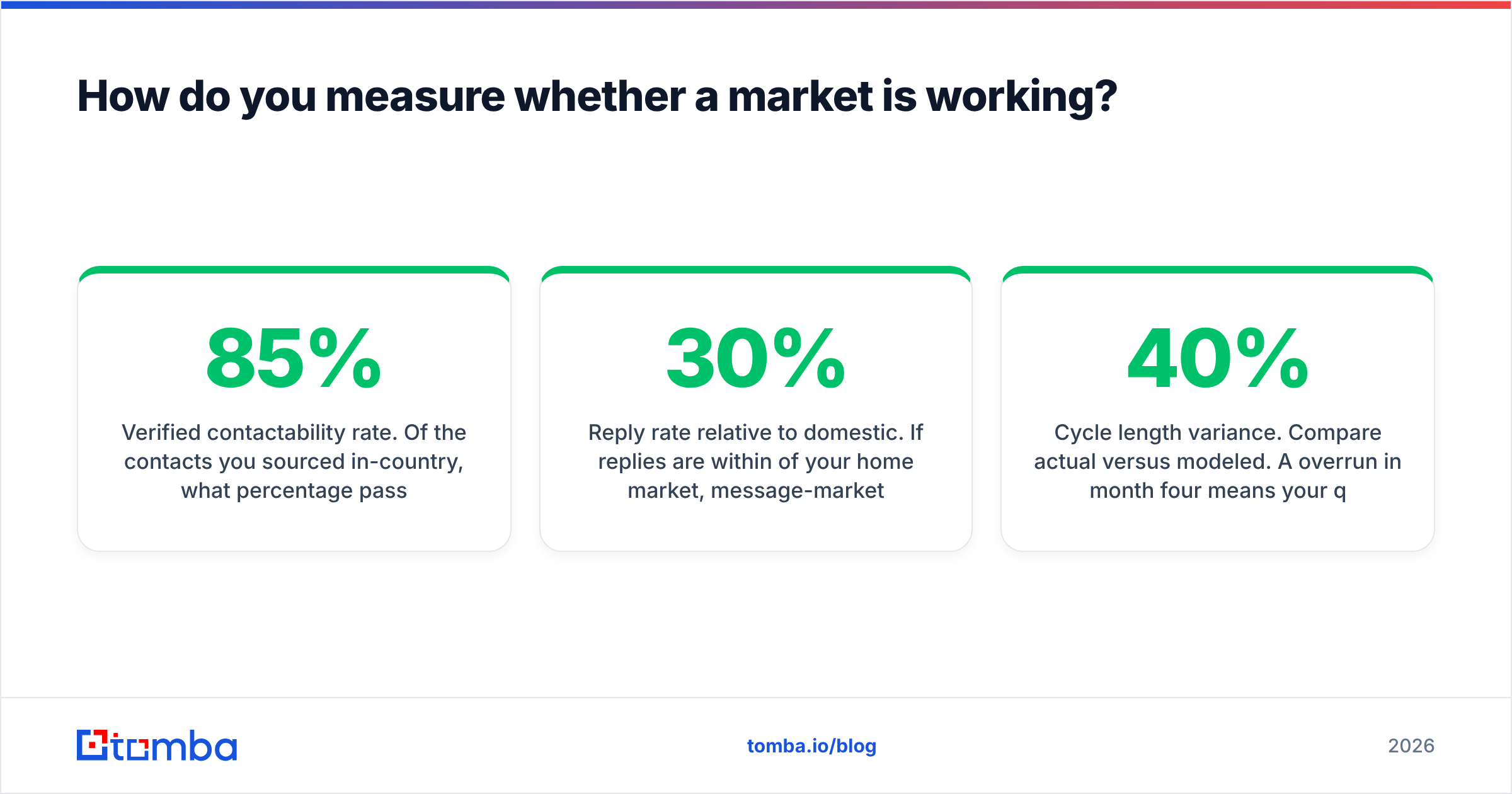
- Verified contactability rate. Of the contacts you sourced in-country, what percentage passed verification and did not bounce? Below 85% and your data source is wrong for that market.
- Reply rate relative to domestic. If replies are within 30% of your home market, message-market fit is close. If they are a third of domestic, your positioning is off, not your list.
- Stage-2 conversion. Discovery-to-qualified-opportunity is the cleanest early signal of ICP match. Volume metrics upstream lie; this one doesn't.
- Cycle length variance. Compare actual versus modeled. A 40% overrun in month four means your quota and hiring plan are already wrong.
- Win rate against local incumbents. If you lose consistently to one local vendor, that is a product or proof gap, not a sales-execution gap.
Give a market four full quarters before judging it. Two quarters is enough to see whether the data and messaging work; it is not enough to see whether deals close, because the longest cycles in your target region will not have completed yet.
What are the most common international sales mistakes?#
- Hiring a country manager before proving the motion. An expensive local leader with no validated playbook spends year one inventing one. Validate from a hub first, then hire.
- Using one sending domain for all regions. Region-specific bounce and complaint patterns will contaminate your domestic sender reputation. Separate domains per region are cheap insurance.
- Translating the website but not the sales collateral. Buyers convert on the landing page and then get a US-English security questionnaire response. That gap kills more deals than the homepage wins.
- Ignoring local competitors in the deal review. If you never log the local vendor you lost to, your win/loss analysis is fiction.
- Applying a single global quota model. Quotas that ignore cycle-length differences guarantee attrition in your slowest, highest-value markets.
- Treating compliance as a legal checkbox. In practice it is a data-sourcing constraint that determines which contacts you can even put in a sequence.
Ready to build your first cross-border list?#
Start with one target country, a list of 200 companies that match your ICP, and a verification standard you actually enforce. The Tomba Email Finder handles the part most teams get wrong first — finding and verifying real contacts at non-US domains, with pattern detection and catch-all handling built in, on a free tier that lets you test data quality in your target market before you spend a cent. Get the data layer right, and the other four layers of international sales become solvable problems instead of expensive guesses.
Related guides#
Ready to find emails that actually work?
Join 150,000+ professionals who stopped guessing and started sending. Free credits on signup — no credit card required.
Get the Tomba newsletter
Practical outbound tactics and product updates — once every two weeks.
About the author