Interseller Pricing, Reviews, Pros and Cons (2026 Guide)
Interseller bundles sourcing, email finding, and sequencing into one seat-priced product. Here's what it actually costs in 2026, what reviewers praise and complain about, and when a cheaper stack wins.
TL;DR
- Interseller is a sourcing-plus-outreach tool built for recruiters: it finds personal and work emails from LinkedIn profiles, then runs multi-step sequences and syncs to your ATS. It was acquired by Greenhouse and now sits inside that ecosystem.
- Interseller pricing is seat-based and quote-driven. Publicly reported figures land around $100 per user per month on annual terms, with no free tier and no self-serve credit pack.
- Reviewers consistently praise the ATS sync, the Chrome extension, and how little setup it takes. The recurring complaints are price at scale, contact coverage outside tech/US roles, and limited flexibility if you only need data.
- If you need sequencing plus sourcing plus ATS sync in one seat, the bundle earns its price. If you mostly need accurate emails to feed an existing sequencer or CRM, a credit-based email finder costs a fraction of it.
- The honest verdict: Interseller is a good recruiting product with sales-tool pricing. Run the per-usable-contact math before you sign an annual seat count.
What is Interseller and who is it actually for?#
Interseller is a contact-sourcing and email-automation platform aimed squarely at recruiters and staffing agencies. The workflow it was designed around is narrow and well executed: you browse LinkedIn or a job board, click the extension, Interseller resolves a personal or work email for that profile, drops the person into a sequence, and writes the activity back to your ATS or CRM so nobody double-touches the same candidate.
That last part matters more than it sounds. Most email-finding tools stop at "here is an address." Interseller stops at "this candidate is now in a 5-touch sequence, deduplicated against your existing pipeline, and logged in Greenhouse." The company was acquired by Greenhouse, which explains why the ATS integration story is stronger than the raw data story.
Who it fits:
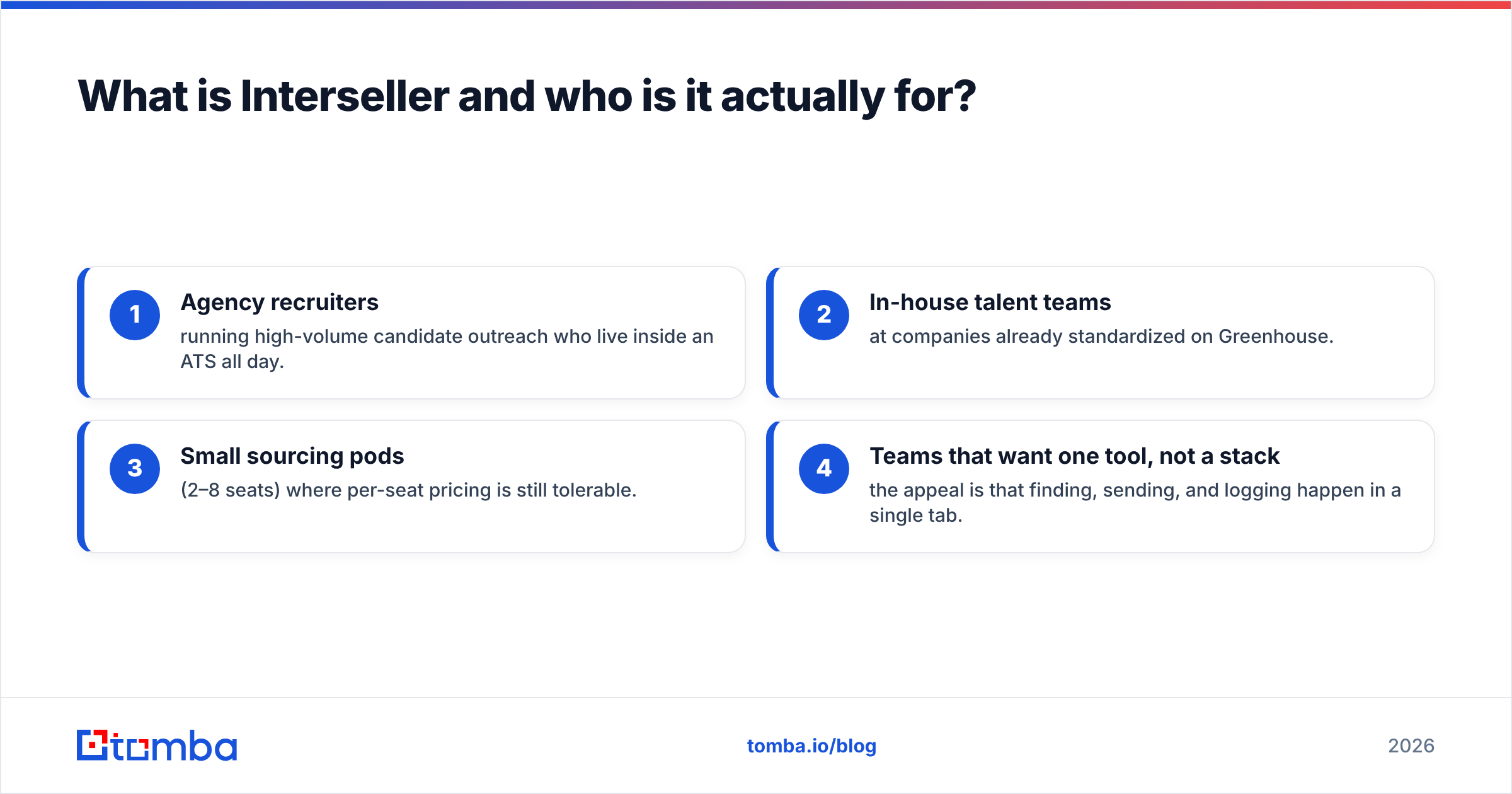
- Agency recruiters running high-volume candidate outreach who live inside an ATS all day.
- In-house talent teams at companies already standardized on Greenhouse.
- Small sourcing pods (2–8 seats) where per-seat pricing is still tolerable.
- Teams that want one tool, not a stack — the appeal is that finding, sending, and logging happen in a single tab.
Who it does not fit: anyone who needs bulk data enrichment, anyone doing B2B sales rather than recruiting, and anyone whose volume is spiky enough that paying for idle seats hurts.

How much does Interseller pricing cost in 2026?#
Interseller does not publish a self-serve price list the way most data vendors do. Pricing is quoted per seat, on annual commitment, and typically includes a platform or onboarding component for larger teams. The figures below reflect what buyers and review sites have consistently reported rather than a published rate card — treat them as a planning range, and get your own quote from interseller.io before budgeting.
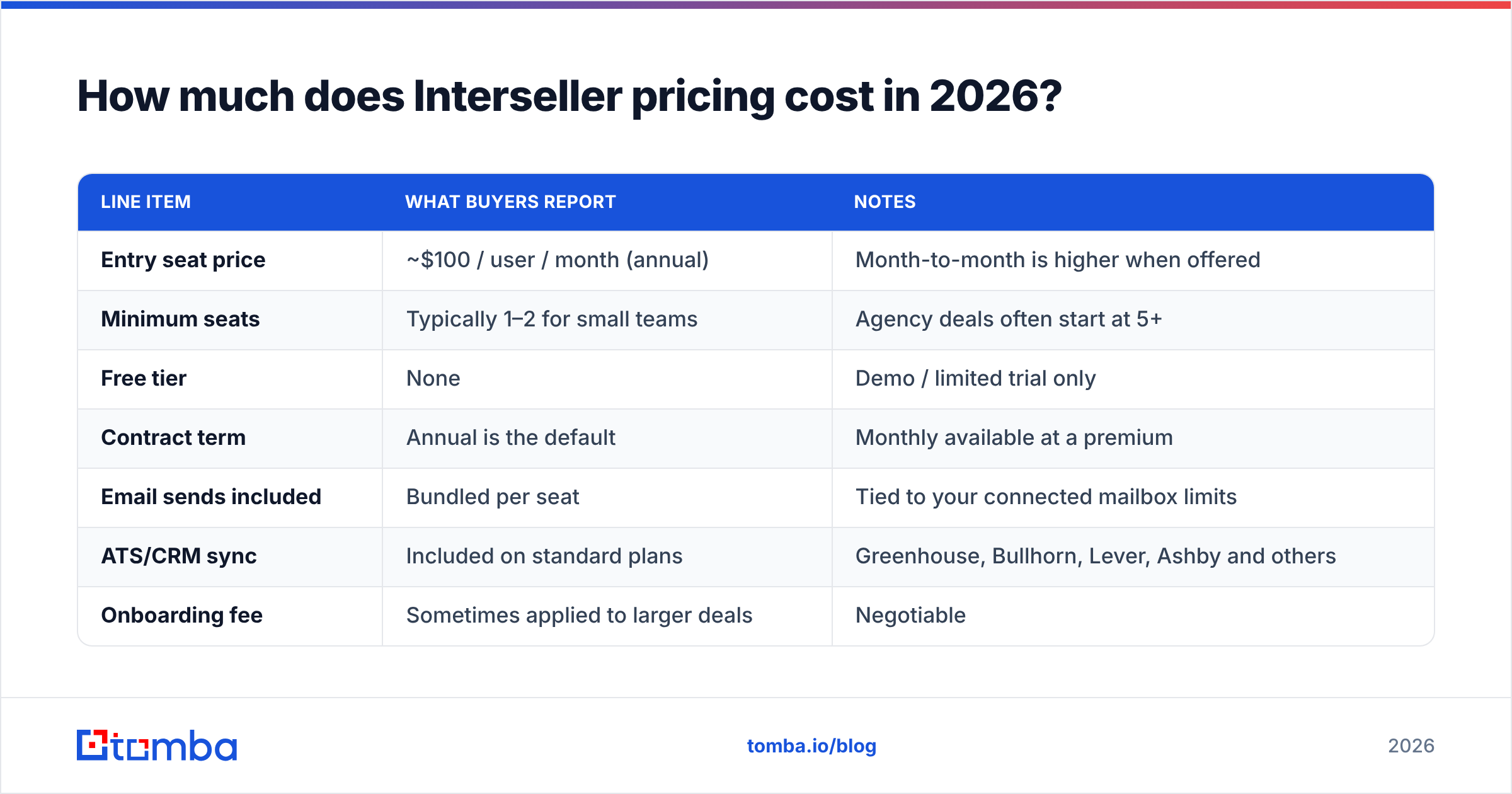
| Line item | What buyers report | Notes |
|---|---|---|
| Entry seat price | ~$100 / user / month (annual) | Month-to-month is higher when offered |
| Minimum seats | Typically 1–2 for small teams | Agency deals often start at 5+ |
| Free tier | None | Demo / limited trial only |
| Contract term | Annual is the default | Monthly available at a premium |
| Email sends included | Bundled per seat | Tied to your connected mailbox limits |
| ATS/CRM sync | Included on standard plans | Greenhouse, Bullhorn, Lever, Ashby and others |
| Onboarding fee | Sometimes applied to larger deals | Negotiable |
The practical translation: a three-person sourcing pod is looking at roughly $3,600 per year, and a ten-seat agency team is in the $12,000/year neighborhood before negotiation. That is not outrageous for recruiting software, but it is a different order of magnitude from credit-based data tools, where the same team might spend $1,200/year total.
What drives the real cost up?#
- Idle seats. Seat pricing punishes uneven usage. A recruiter who sources hard for six weeks and then runs interviews for six weeks costs the same as one who sources daily.
- Annual lock-in. You commit before you know your true contact-find rate on your specific candidate profiles.
- Stacking. Many teams still pay separately for a B2B database, a verification tool, or a sales sequencer for the non-recruiting side of the business. Interseller replaces one layer, not the whole stack.
- No overflow pricing. There is no cheap way to run a one-off 5,000-contact project without adding seats.
What do Interseller reviews actually say?#
Aggregate sentiment across G2 and Capterra is positive but narrow: users who match the intended workflow rate it highly, and users who wandered in from adjacent use cases rate it poorly. That split is the single most useful signal in the reviews.
What reviewers consistently praise:
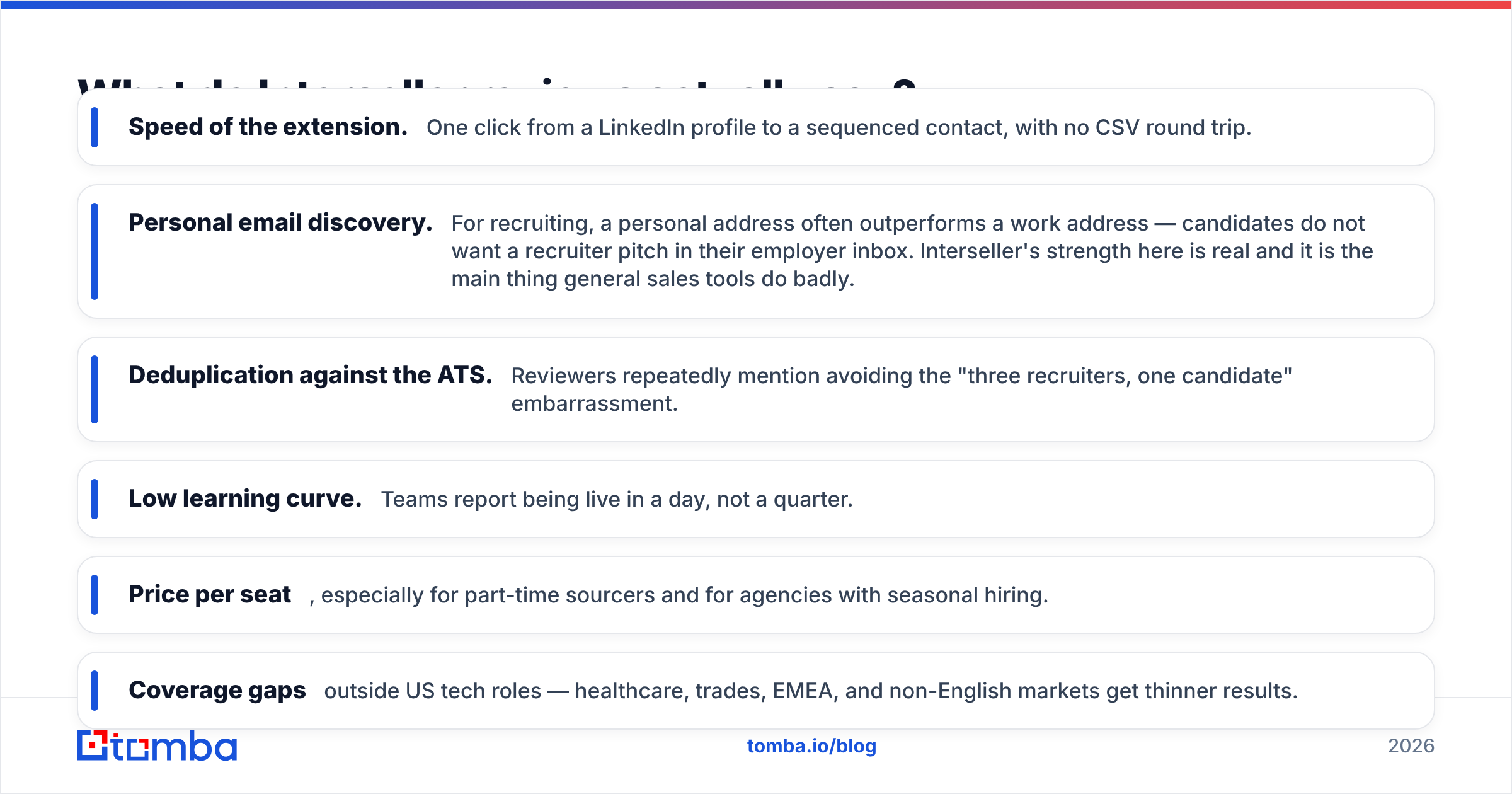
- Speed of the extension. One click from a LinkedIn profile to a sequenced contact, with no CSV round trip.
- Personal email discovery. For recruiting, a personal address often outperforms a work address — candidates do not want a recruiter pitch in their employer inbox. Interseller's strength here is real and it is the main thing general sales tools do badly.
- Deduplication against the ATS. Reviewers repeatedly mention avoiding the "three recruiters, one candidate" embarrassment.
- Low learning curve. Teams report being live in a day, not a quarter.
What reviewers consistently complain about:
- Price per seat, especially for part-time sourcers and for agencies with seasonal hiring.
- Coverage gaps outside US tech roles — healthcare, trades, EMEA, and non-English markets get thinner results.
- Sequencing depth is basic compared to dedicated sales engagement platforms. It sends email well; it is not an omnichannel orchestration engine.
- Reporting is functional rather than analytical. Teams that want cohort-level sourcing analytics end up exporting.
- Limited flexibility as a data source. There is no comfortable path to "just give me 10,000 verified emails via API this month."
What are the pros and cons of Interseller?#
Here is the balanced view, stripped of vendor language.
Pros
- Genuinely integrated workflow — find, sequence, and log without leaving one interface. That saves real minutes per candidate, and minutes compound at recruiting volume.
- Personal-email strength — the one area where a recruiting-first tool beats a sales-first tool outright.
- Strong ATS coverage — Greenhouse, Bullhorn, Lever, and others sync bidirectionally, which is rarer than vendors admit.
- Fast onboarding — low configuration burden, sensible defaults, minimal admin overhead.
- Reply detection and auto-stop — sequences halt cleanly when a candidate responds, which protects your sender reputation.
Cons
- No free tier and no public pricing — you cannot validate fit before a sales conversation, which is a real friction point in 2026.
- Seat model punishes uneven usage — you pay for capacity, not consumption.
- Narrow use case — buy it for B2B sales prospecting and you will feel the gaps within a month.
- Data coverage varies sharply by vertical and geography — test your actual ICP before committing.
- Hard to use as infrastructure — limited appetite for API-first, high-volume, programmatic enrichment.
How accurate is Interseller's contact data?#
Accuracy is where the buying decision usually turns, and it is also where vendors are most slippery. The number that matters is not "accuracy rate" in isolation — it is usable contacts per dollar: hit rate multiplied by deliverability, divided by what you paid.

Interseller performs well on the profiles it was built for — US-based, English-speaking, digitally visible candidates in tech and adjacent sectors. Outside that band, hit rates drop, and because pricing is per seat rather than per credit, a low hit rate does not reduce your bill. That is the structural risk of seat pricing: you absorb the cost of misses. Credit-based tools invert that — a miss costs you nothing or is refunded.
Three things to test during any trial, regardless of vendor:
- Hit rate on 200 real profiles from your actual req list, not a curated sample.
- Bounce rate after sending, which is the only honest verification of a "verified" flag. Run the addresses through an independent email verifier before your first send.
- Catch-all handling. Ask explicitly how the tool classifies catch-all domains. Many vendors quietly count them as valid, which inflates accuracy claims and wrecks your bounce rate later.
How does Interseller compare to alternatives in 2026?#
Interseller competes in two directions at once: against recruiting platforms with sourcing built in, and against pure data tools that cost far less but do less.

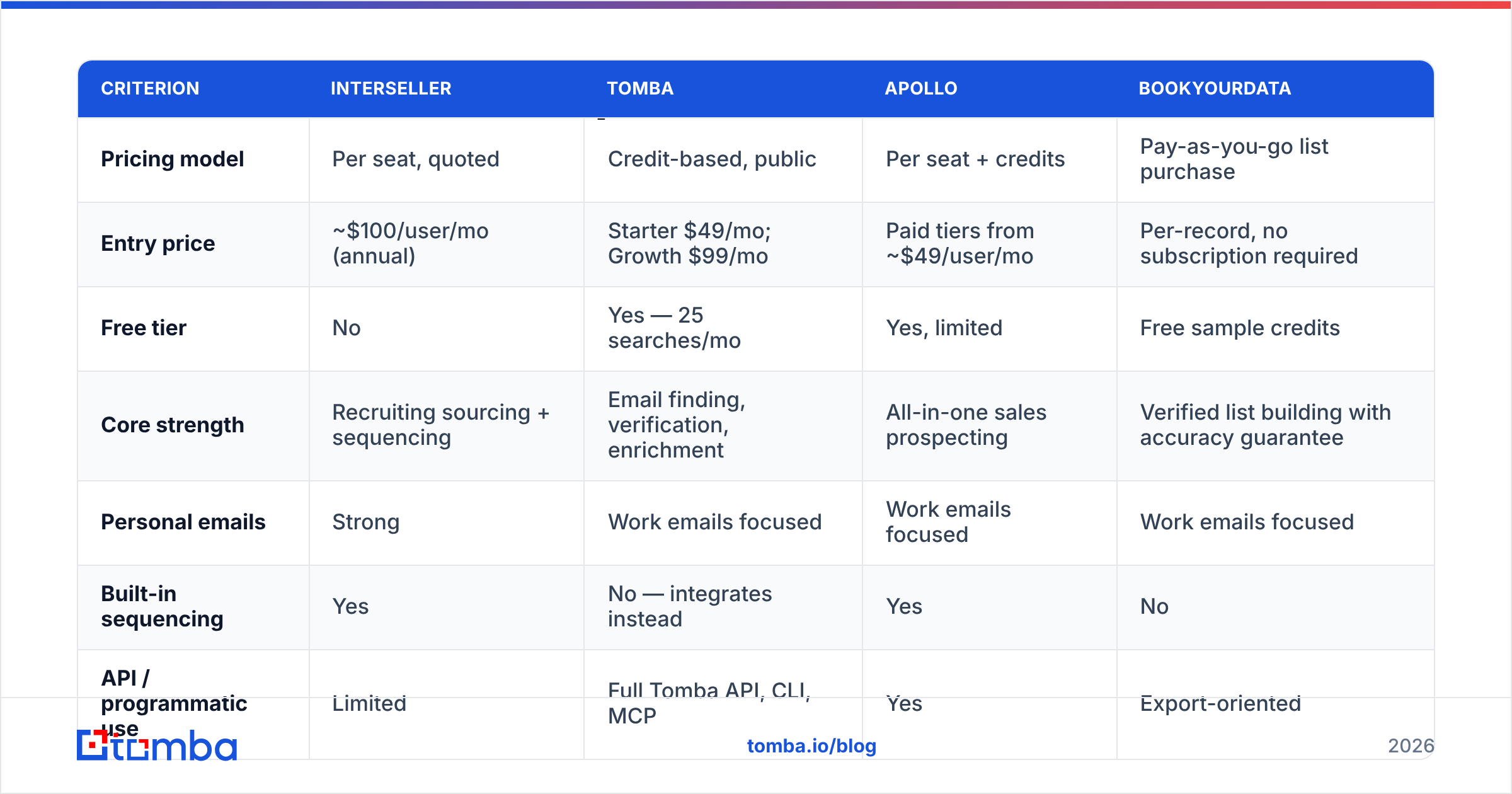
| Criterion | Interseller | Tomba | Apollo | BookYourData |
|---|---|---|---|---|
| Pricing model | Per seat, quoted | Credit-based, public | Per seat + credits | Pay-as-you-go list purchase |
| Entry price | ~$100/user/mo (annual) | Starter $49/mo; Growth $99/mo | Paid tiers from ~$49/user/mo | Per-record, no subscription required |
| Free tier | No | Yes — 25 searches/mo | Yes, limited | Free sample credits |
| Core strength | Recruiting sourcing + sequencing | Email finding, verification, enrichment | All-in-one sales prospecting | Verified list building with accuracy guarantee |
| Personal emails | Strong | Work emails focused | Work emails focused | Work emails focused |
| Built-in sequencing | Yes | No — integrates instead | Yes | No |
| API / programmatic use | Limited | Full Tomba API, CLI, MCP | Yes | Export-oriented |
| ATS sync | Yes (Greenhouse, Bullhorn, Lever) | Via CRM integrations | CRM-focused | Via export |
| Best for | Recruiters inside an ATS | Teams that want accurate data at low cost | Sales teams wanting one bundle | Teams buying targeted lists outright |
A few honest readings of that table:
- Interseller wins on workflow, not on data economics. If the sequencing and ATS sync are load-bearing for your team, the seat price buys something real.
- Tomba wins on cost per verified contact. Tomba pricing is transparent and credit-based — Free at 25 searches/month, Starter at $49/mo, Growth at $99/mo, Pro at $249/mo — so you pay for output, not for chairs. You supply your own sequencer.
- Apollo wins on breadth for B2B sales but is not a recruiting tool; see the Apollo alternative comparison if that is your actual decision.
- BookYourData wins when you want the list, not the software — a solid choice for teams that prefer buying verified records outright rather than renting seats.

Is Interseller worth it for your team?#
Answer three questions and the decision usually makes itself.
1. Do you need sequencing, or just data? If your outreach already runs through Gmail, Outreach, Lemlist, or your ATS's native mailer, you are paying twice for sending. Buy data at credit prices and keep your sequencer.
2. Is your usage steady or spiky? Steady daily sourcing across a fixed headcount favors seats. Project-based, seasonal, or campaign-driven work favors credits, because you can spend $99 in a heavy month and $0 in a quiet one.
3. How wide is your candidate profile? Narrow, US-centric, tech-heavy sourcing plays to Interseller's coverage strengths. Global, multi-vertical, or non-English sourcing needs a broader data layer underneath — and often more than one source.
A pattern worth considering: keep a small number of Interseller seats for the recruiters who genuinely live in the sequencing workflow, and handle bulk, exploratory, or non-recruiting contact discovery with a credit-based tool and a bulk email finder run. That hybrid usually costs less than expanding seats and gives you a second data source to cross-check hit rates against.
The one thing not to do is sign a ten-seat annual contract off a demo. Ask for a pilot on your own req list, measure usable contacts per dollar, and make the vendor prove the number on profiles you actually source.
Where should you start?#
If your bottleneck is sending and tracking, Interseller is a legitimate answer and the seat price is defensible. If your bottleneck is finding accurate, verified addresses without a five-figure annual commitment — which is the more common situation — start with the data layer and keep the tools you already have.
The Tomba Email Finder gives you work emails by domain, name, or company with built-in verification, a free tier at 25 searches per month to test coverage on your own list, and paid plans from $49/mo with no seat minimums and no annual lock-in. Run 200 of your real prospects through it, check the bounce rate, and compare the cost per usable contact against whatever quote you have on the table. That single test will tell you more than any review page — including this one.
Related guides#
// get started
Find, verify and enrich your first contacts today
Start on the free plan with 25 searches a month, then scale when your team is ready.
Free plan · No credit card required · GDPR & CCPA
// about the author