Interseller vs Leadzen.ai: Which B2B Contact Tool Wins in 2026?
Interseller is a sourcing sequencer built for recruiters. Leadzen.ai is a real-time lead intelligence engine strongest in India. Here is how they actually differ on data, pricing, and outreach — plus when neither is the right buy.
TL;DR
- Interseller is a sourcing-and-sequencing tool built for recruiters. It finds contact data and sends the email sequence from your own inbox. It was acquired by Greenhouse in 2021 and is now sold as part of that ecosystem, which means seat-based pricing and a sales conversation instead of a self-serve checkout.
- Leadzen.ai is a lead intelligence platform, not an outreach tool. Its strength is real-time search and enrichment across B2B and B2C records, with unusually deep coverage of the Indian market and INR-denominated credit packs.
- They compete less than the "vs" framing suggests. Interseller wins if you need one seat that sources, writes, sends, and syncs to an ATS. Leadzen.ai wins if you need volume lookups in India/APAC and already own a sending stack.
- Both get expensive per verified contact. If all you actually need is accurate email addresses piped into a sequencer you already pay for, a dedicated email finder at $49/mo does that job for a fraction of either.
- Whichever you pick, verify before you send. Neither platform's raw output should hit your primary domain unvalidated.
What are Interseller and Leadzen.ai, exactly?#
They solve different halves of the same problem, which is why buyers keep landing on this comparison and leaving confused.
Interseller launched in 2016 in New York as a tool for agency recruiters who were tired of stitching together a sourcing extension, a spreadsheet, and a mail-merge. You click a profile, Interseller resolves a personal or work email, drops the person into a drip sequence, and sends it from your connected mailbox. It then writes activity back to your ATS or CRM. Greenhouse acquired it in 2021, and the product has since been positioned as sourcing automation inside a broader hiring suite.
Leadzen.ai comes at it from the data side. It is a lead intelligence engine — search by name, company, domain, phone, or filter combination, and it returns enriched records in real time rather than serving a static cached table. Its differentiator is geography: coverage of Indian companies, founders, and mid-market decision makers is genuinely strong in a category where most US-built vendors thin out badly east of Dubai.
Here is the cleanest way to hold the difference in your head:
- Primary job. Interseller = find and send. Leadzen.ai = find and enrich, then hand off.
- Core buyer. Interseller = staffing and recruiting teams. Leadzen.ai = sales, marketing, and growth teams, disproportionately India-based or India-targeting.
- Data emphasis. Interseller leans on personal emails and candidate-side records. Leadzen.ai leans on company firmographics, mobile numbers, and B2B/B2C hybrid records.
- Pricing model. Interseller = per seat, quoted. Leadzen.ai = credit packs, priced in INR.
- Where it ends. Interseller ends at a reply in your inbox. Leadzen.ai ends at a CSV or an API payload.
If you are evaluating both, you are probably really asking: do I want one tool that does the whole motion adequately, or two tools that each do half of it well?
How do Interseller and Leadzen.ai compare head to head?#
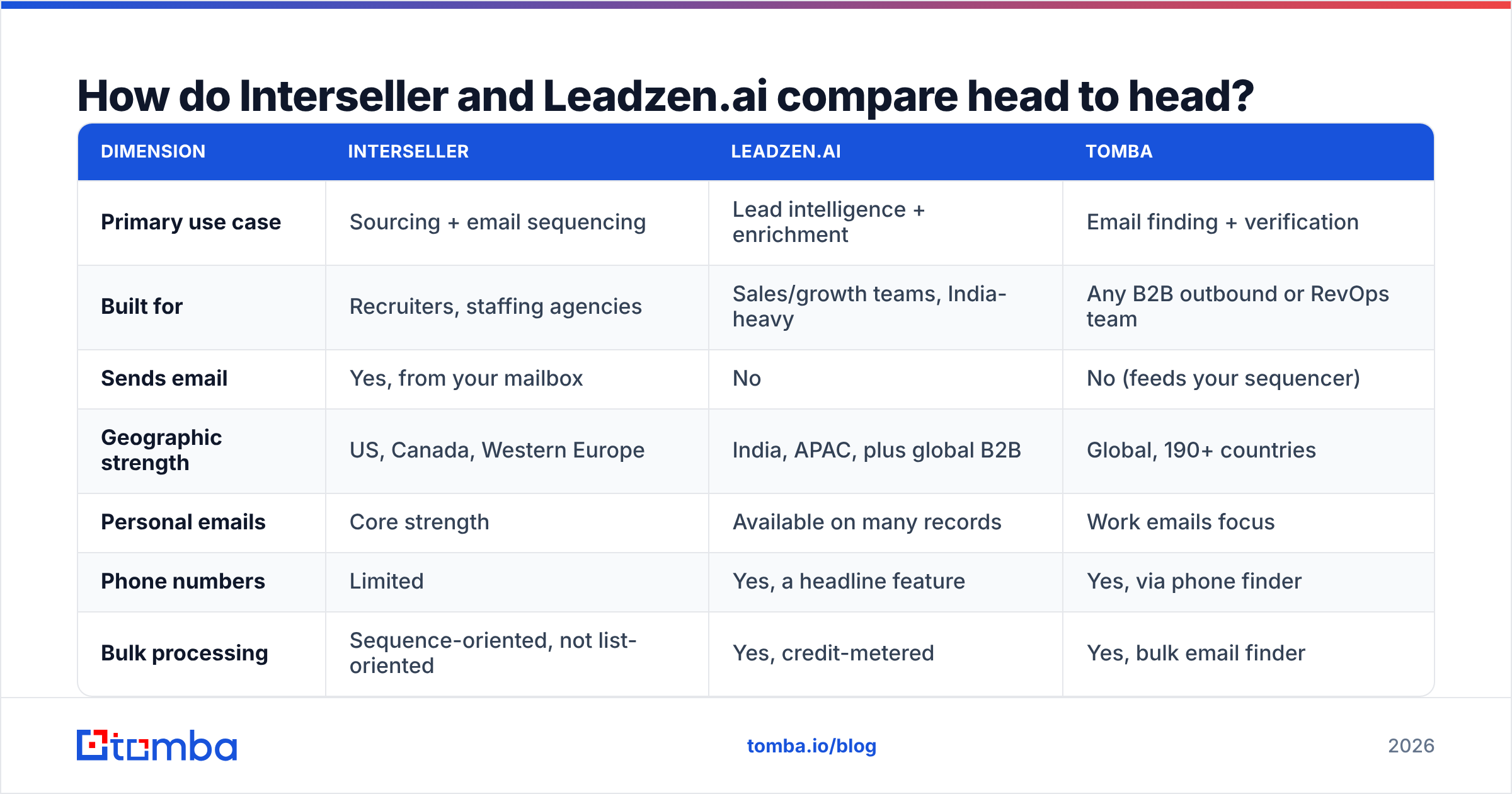
| Dimension | Interseller | Leadzen.ai | Tomba |
|---|---|---|---|
| Primary use case | Sourcing + email sequencing | Lead intelligence + enrichment | Email finding + verification |
| Built for | Recruiters, staffing agencies | Sales/growth teams, India-heavy | Any B2B outbound or RevOps team |
| Sends email | Yes, from your mailbox | No | No (feeds your sequencer) |
| Geographic strength | US, Canada, Western Europe | India, APAC, plus global B2B | Global, 190+ countries |
| Personal emails | Core strength | Available on many records | Work emails focus |
| Phone numbers | Limited | Yes, a headline feature | Yes, via phone finder |
| Bulk processing | Sequence-oriented, not list-oriented | Yes, credit-metered | Yes, bulk email finder |
| Verification built in | Basic, pre-send | Basic | Dedicated verifier + catch-all handling |
| API access | Limited, partner-oriented | Yes | Yes, full email finder API |
| Free tier | Trial only | Trial credits | 25 searches/mo, no card |
| Entry price | Seat-based, quoted (historically ~$100/user/mo) | INR credit packs, confirm current rates | $49/mo Starter |
Two caveats on that table. First, Interseller stopped publishing granular self-serve tiers after the Greenhouse acquisition, so anything you read quoting an exact monthly figure is a historical data point, not a live quote — book the demo. Second, Leadzen.ai's plans are credit-metered and change with promotions; the shape of the pricing (packs, not seats) matters more than any specific number you'll see in a listicle.

Whose data is actually more accurate?#
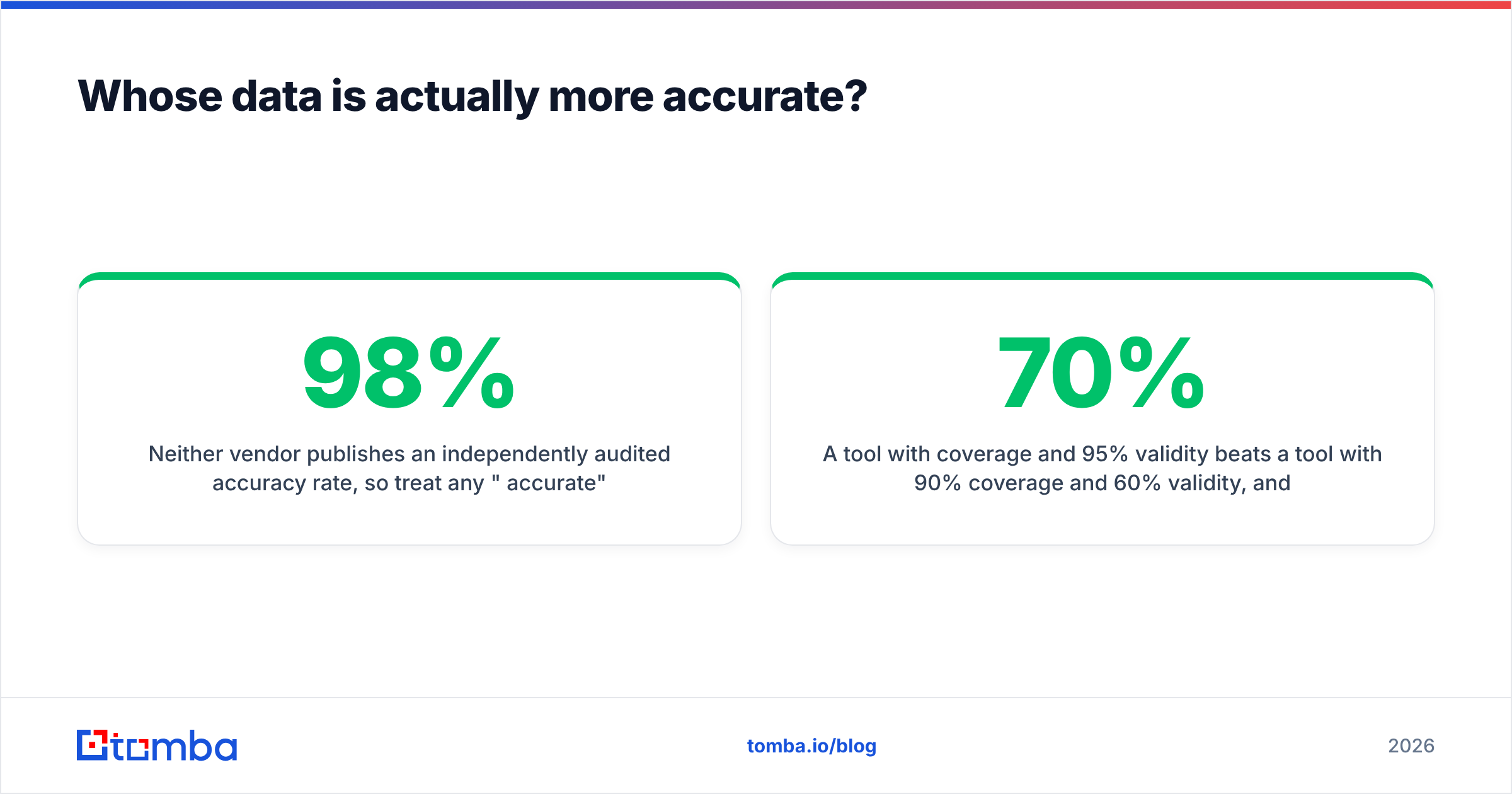
Neither vendor publishes an independently audited accuracy rate, so treat any "98% accurate" claim from either side — or from any vendor in this category — as marketing until you test it on your own list.
What you can reason about is where each one is likely to be right:
- Interseller is optimized for finding a human who may not want to be found at work — a candidate. That pushes it toward personal addresses and toward patterns scraped from professional profiles. On US and Western European tech candidates, hit rates are respectable. On non-English-speaking mid-market companies, they fall off.
- Leadzen.ai is optimized for breadth of record types. If your ICP is an Indian SaaS founder, a Tier-2 manufacturer's procurement head, or a D2C marketing lead in Bengaluru, it will very often have a record where Apollo or ZoomInfo returns nothing. Outside that core, coverage is more ordinary.
The practical move is the same either way: run a 200-contact sample through each tool, then push every result through an independent email verifier before you count the hit rate. Vendors tend to score their own output as "valid" generously, and catch-all domains are where the self-reported numbers quietly break. A catch-all accepts everything at the SMTP layer, so a naive check marks it deliverable when it may well bounce or land in a black hole.
Measure three things on the sample, not one:
- Coverage rate — what percentage of your list returned any contact at all.
- Validity rate — of those returned, what percentage survives independent verification.
- Net cost per usable contact — total spend divided by the contacts that passed both gates. This is the only number that should influence the purchase.
A tool with 70% coverage and 95% validity beats a tool with 90% coverage and 60% validity, and it isn't close once your sender reputation is priced in.
How does pricing compare in practice?#
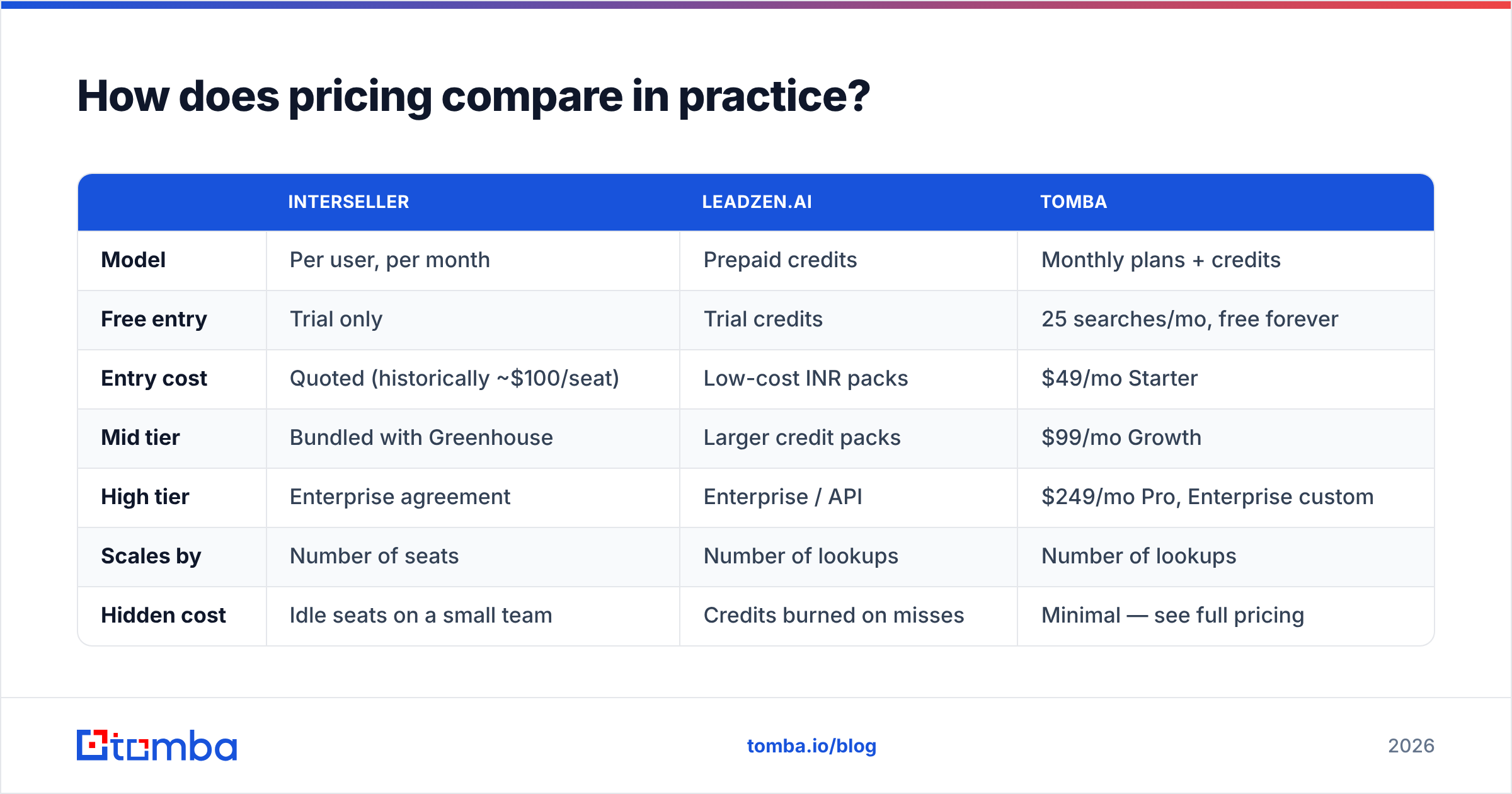
| Interseller | Leadzen.ai | Tomba | |
|---|---|---|---|
| Model | Per user, per month | Prepaid credits | Monthly plans + credits |
| Free entry | Trial only | Trial credits | 25 searches/mo, free forever |
| Entry cost | Quoted (historically ~$100/seat) | Low-cost INR packs | $49/mo Starter |
| Mid tier | Bundled with Greenhouse | Larger credit packs | $99/mo Growth |
| High tier | Enterprise agreement | Enterprise / API | $249/mo Pro, Enterprise custom |
| Scales by | Number of seats | Number of lookups | Number of lookups |
| Hidden cost | Idle seats on a small team | Credits burned on misses | Minimal — see full pricing |
Seat-based pricing is the quiet budget killer for small teams. If two of your five recruiters do 80% of the sourcing, you are still paying for five. Credit models have the opposite failure mode: a bad search burns credits whether or not it returns anything usable, so sloppy filtering costs real money.
Ask both vendors the same three questions before you sign:
- Do failed lookups consume credits? The answer materially changes your effective price.
- Do unused credits roll over, and for how long?
- What is the exit path for my data — full CSV export, or hostage-taking?
Buyer reviews on G2 are a useful sanity check here, particularly the one- and two-star reviews, where contract and credit-expiry complaints surface long before they show up in a demo.
Is Interseller still worth it if you are not a recruiter?#
Mostly no, and that's not a criticism — it's positioning.
Interseller's entire design assumes the recruiting motion: one-to-one outreach, personal email addresses, ATS write-back, and a sequence that dies the moment someone replies. If you run a sales team, you will notice the gaps fast. Deal-stage syncing, multi-channel steps, A/B testing at scale, and the kind of deliverability tooling that modern cold email requires are all thinner than in a purpose-built sales engagement platform. Teams that outgrow it usually move to a dedicated sequencer and keep a separate data source — which is the same architecture we recommend below.
Where Interseller genuinely shines: a small agency where the recruiter is also the closer, and every tool switch costs an hour a week. One login, one workflow, contact data and sending in the same pane. That convenience is the product.
Is Leadzen.ai the right call outside India?#
It depends entirely on how much of your ICP sits in its strong zone.
If 60%+ of your target accounts are Indian or APAC, Leadzen.ai is one of the few tools that will meaningfully out-cover the big American databases, and it will do it at a price those vendors can't match. That is a real edge and worth paying for.
If your ICP is North American or European, you are buying a general-purpose lookup tool and comparing it against a very crowded field. At that point, coverage on your specific segment — not the marketing page — decides it. Run the sample.
Also note what it does not do: Leadzen.ai will not send your emails, warm your domain, or manage reply handling. Budget for a sequencer on top, and remember that the enrichment tool's quality is what determines your bounce rate, not the sequencer's.

When should you skip both and use a dedicated email finder?#
When outreach volume is the constraint and you already own the sending stack.
A lot of teams land on the Interseller vs Leadzen.ai comparison because they need contact data, and both tools happen to bundle it with something else — sequencing on one side, a broad intelligence layer on the other. If you already pay for Instantly, Smartlead, Outreach, HubSpot, or Lemlist, you are about to buy a second sending engine you'll never turn on, or an enrichment layer far broader than your use case.
The leaner architecture is three specialized parts:
- Find — resolve work emails by name and domain, or pull every addressable contact at an account with domain search.
- Verify — validate every address, including catch-all domains, before it enters a sequence.
- Send — use the sequencer you already pay for, on a properly warmed domain.
Tomba covers the first two. The free tier gives you 25 searches a month with no card, which is enough to run the sample test described earlier against both Interseller and Leadzen.ai. Paid plans start at $49/mo, with $99/mo and $249/mo tiers as volume grows, and an API plus Chrome extension, Google Sheets, and CRM integrations so the data lands where your team already works.
The honest trade-off: Tomba will not source candidates from social profiles the way Interseller does, and it will not hand you an Indian founder's personal mobile number the way Leadzen.ai sometimes will. It does one job — accurate B2B email data at a predictable price — and stays out of the rest of your stack.
Which one should you choose?#
Match the tool to the bottleneck, not to the feature list.
- Choose Interseller if you are a recruiting or staffing team that wants sourcing, sequencing, and ATS sync in one seat, and you can absorb per-seat pricing across a small, active team.
- Choose Leadzen.ai if your ICP is concentrated in India or APAC, you need phone numbers alongside emails, and you already have an outreach platform running.
- Choose neither if your real problem is "I need more verified work emails, cheaply, into a sequencer I already pay for." That is a data problem, and paying platform prices to solve it is how outbound budgets quietly double.
- Choose a hybrid — this is what most mature teams end up doing — by keeping a specialist data source for volume and adding a niche tool only where coverage genuinely fails.
Before committing to any annual contract, run the 200-contact sample on both, verify the output independently, and compare net cost per usable contact. That single exercise will tell you more than every review page combined.
Ready to test your own list? Start with the Tomba Email Finder — 25 free searches a month, no card required, and every result verified before it reaches your sequencer. Run it side by side with whichever platform you're evaluating, then let the bounce rate pick the winner.
Related guides#
// get started
Find, verify and enrich your first contacts today
Start on the free plan with 25 searches a month, then scale when your team is ready.
Free plan · No credit card required · GDPR & CCPA
// about the author