Interzoid Pricing, Reviews, Pros and Cons: 2026 Buyer's Guide
Interzoid sells data-matching and validation APIs by the call. Here is what that pricing model really costs at scale, what reviewers praise, where it falls short, and which stack actually fits your job.
TL;DR
- Interzoid is a data-quality API company, not a contact database. You buy matching, standardization, and validation calls — not leads.
- Pricing is consumption-based: you pay per API call, in tiers, across several separate endpoints. That is cheap at low volume and gets loud at scale.
- The standout feature is the "similarity key" approach to fuzzy matching, which lets you dedupe company names and people names directly in SQL.
- The main cons are thin public review volume, per-API fragmentation, and the fact that it cleans data you already have rather than finding data you don't.
- If your real problem is "our contact records are wrong or missing," a verification-plus-sourcing stack solves more of it than a matching API does.
What is Interzoid, and what do you actually buy?#
Interzoid sells cloud data-quality APIs. The core idea is record linkage: taking two versions of the same real-world entity — "International Business Machines," "IBM Corp.," "I.B.M." — and deciding they are the same thing. That problem is old, formally studied, and genuinely hard; the academic framing is record linkage, and most CRMs handle it badly.
What Interzoid gives you is a set of REST endpoints, each solving one slice:
- Company name matching — generates a similarity key so "Acme Inc" and "ACME, Incorporated" collapse to one bucket.
- Full name matching — same trick for people, tolerant of nicknames, initials, and ordering.
- Address and city/state/zip standardization — normalizes messy postal data into a consistent shape.
- Email validation — syntax, domain, and mailbox-level checks on an address you already hold.
- Global phone number standardization — normalizes international formats into something comparable.
There are also delivery options beyond raw REST: marketplace listings, cloud connectors that run matching against a database or warehouse table, and SDK wrappers. The official product documentation is the source of truth for the current endpoint list, and it changes more often than review sites reflect.
The critical framing, before you look at a single price: Interzoid is a cleanup tool. It improves records you already own. It does not go find the head of procurement at a company you just added to your target list. That distinction drives every buying decision below.
How does Interzoid pricing work?#
Interzoid prices on consumption, and the structure matters more than any single number because the numbers move. Here is the shape of it:
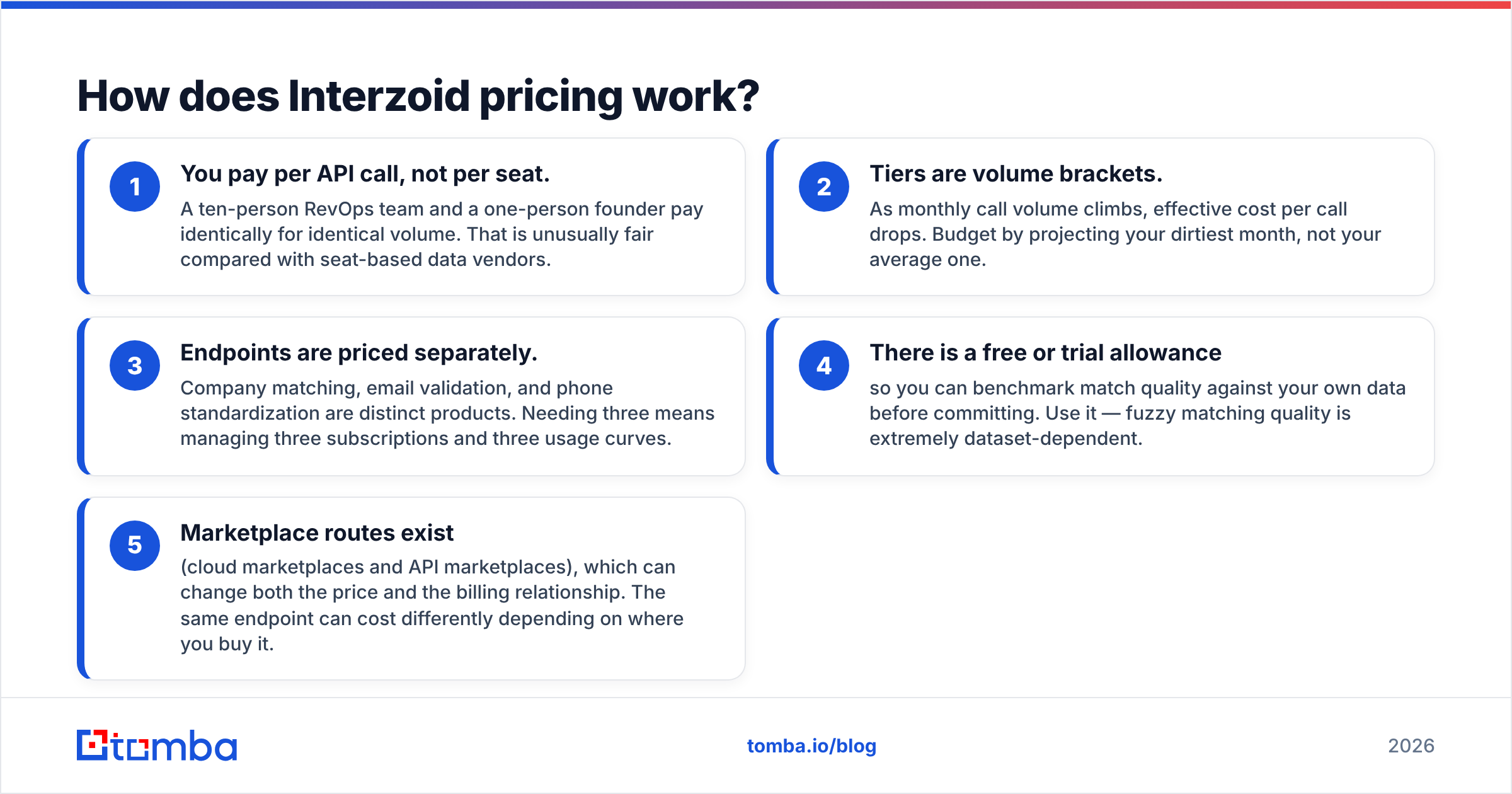
- You pay per API call, not per seat. A ten-person RevOps team and a one-person founder pay identically for identical volume. That is unusually fair compared with seat-based data vendors.
- Tiers are volume brackets. As monthly call volume climbs, effective cost per call drops. Budget by projecting your dirtiest month, not your average one.
- Endpoints are priced separately. Company matching, email validation, and phone standardization are distinct products. Needing three means managing three subscriptions and three usage curves.
- There is a free or trial allowance so you can benchmark match quality against your own data before committing. Use it — fuzzy matching quality is extremely dataset-dependent.
- Marketplace routes exist (cloud marketplaces and API marketplaces), which can change both the price and the billing relationship. The same endpoint can cost differently depending on where you buy it.
Because published rates shift and marketplace listings diverge, do not trust a number you read in a blog post — including this one. Pull your quoted rate from the vendor, then run the model in the next section against it.

What does Interzoid actually cost per 1,000 records?#
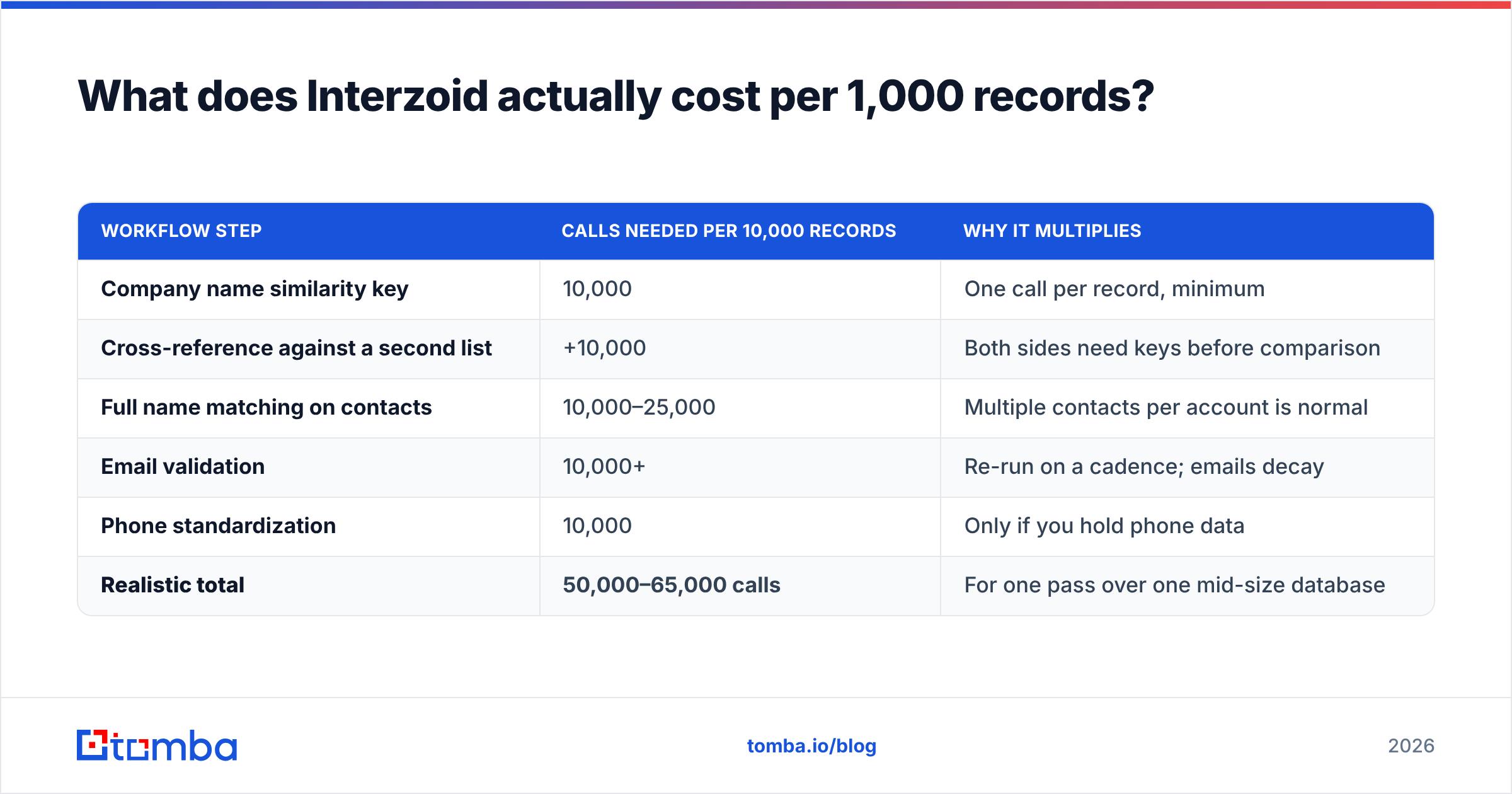
Here is the part most pricing reviews skip. A per-call API looks cheap until you count the calls a real workflow needs. Take a routine job: you have 10,000 CRM company records, you want them deduped, and you want the contact emails on them checked.
| Workflow step | Calls needed per 10,000 records | Why it multiplies |
|---|---|---|
| Company name similarity key | 10,000 | One call per record, minimum |
| Cross-reference against a second list | +10,000 | Both sides need keys before comparison |
| Full name matching on contacts | 10,000–25,000 | Multiple contacts per account is normal |
| Email validation | 10,000+ | Re-run on a cadence; emails decay |
| Phone standardization | 10,000 | Only if you hold phone data |
| Realistic total | 50,000–65,000 calls | For one pass over one mid-size database |
Two conclusions fall out of that table. First, per-call pricing rewards you for being selective — score which records actually matter before you spray calls at everything. Second, a "cheap" per-call rate multiplied by five endpoints is not a cheap program. Multiply your quoted rate by 50,000 and compare that against a flat-rate alternative before you decide Interzoid is the budget option.
The other cost nobody quotes you is engineering time. These are APIs, not applications. Someone has to write the loop, handle retries, store the keys, and decide what a match threshold means for your business. Budget a week of developer time for a first real integration, and ongoing maintenance after that.
What do Interzoid reviews say?#
Honest answer: there are not many of them, and that is itself a finding.
Interzoid has a presence on the major software review platforms, but the review counts sit far below what you'd see for enterprise data-quality suites or mainstream enrichment vendors. Cross-check current ratings on G2 before you buy, and read the dates — a handful of reviews from three years ago tells you less than you think about the product today.
The themes that do recur in public feedback and developer commentary:
- Praise for the matching logic. The similarity-key approach is genuinely clever and produces usable results without training a model.
- Praise for simplicity. The APIs are straightforward, well-documented, and easy to call from a script or a warehouse job.
- Praise for responsiveness. Small-vendor support tends to mean a real person answers, and reviewers notice.
- Criticism around scope. Buyers who expected an all-in-one data platform found a toolkit instead.
- Criticism around ecosystem. Fewer native integrations than the big platforms, so you build the glue yourself.
Thin review volume is not a red flag on its own — plenty of good niche tools are under-reviewed. But it does mean you cannot outsource your evaluation to the crowd. Run the trial against your actual records.
What are the pros of Interzoid?#
Fuzzy matching that works without ML infrastructure. You don't need a data science team or a vector database. You call an endpoint, you get a key, you group by the key. For a RevOps person with SQL skills, this is a legitimately elegant solution to account deduplication.
Consumption pricing with no seat tax. If your usage is spiky — a quarterly database cleanup rather than continuous processing — you pay for the spikes and nothing in between. Most enterprise data-quality vendors would sell you an annual contract for the same job.
Warehouse- and database-native options. Running matching where the data already lives, instead of exporting to CSV and back, removes an entire class of errors and compliance headaches.
Narrow scope, done properly. There is something to be said for a vendor that does entity matching and doesn't try to also be your sequencer, dialer, and CRM.
Genuinely low commitment to evaluate. A free tier plus per-call billing means the cost of finding out whether it works on your data is close to zero.
What are the cons of Interzoid?#
It cleans; it does not source. This is the big one. If a contact record in your CRM has a stale email or no email at all, matching and standardization cannot fix it. No amount of normalization recovers an address that changed when the person switched jobs. You need a sourcing layer — an email finder or a data enrichment pass — to close that gap.
Per-API fragmentation adds overhead. Five endpoints means five usage lines to monitor, five rate limits to respect, and five places for a budget surprise to hide.
Developer-first, not operator-first. There is no polished workspace where a non-technical SDR manager runs a dedupe job and reviews the results. Someone writes code. If your team can't, factor in contractor cost.
Price opacity relative to flat-rate tools. "It depends on volume" is honest but it makes forecasting harder than "$99 a month."
Limited ecosystem pull. Fewer off-the-shelf connectors into the CRMs and sequencers your team actually uses, compared with larger platforms.
How does Interzoid compare to the alternatives?#
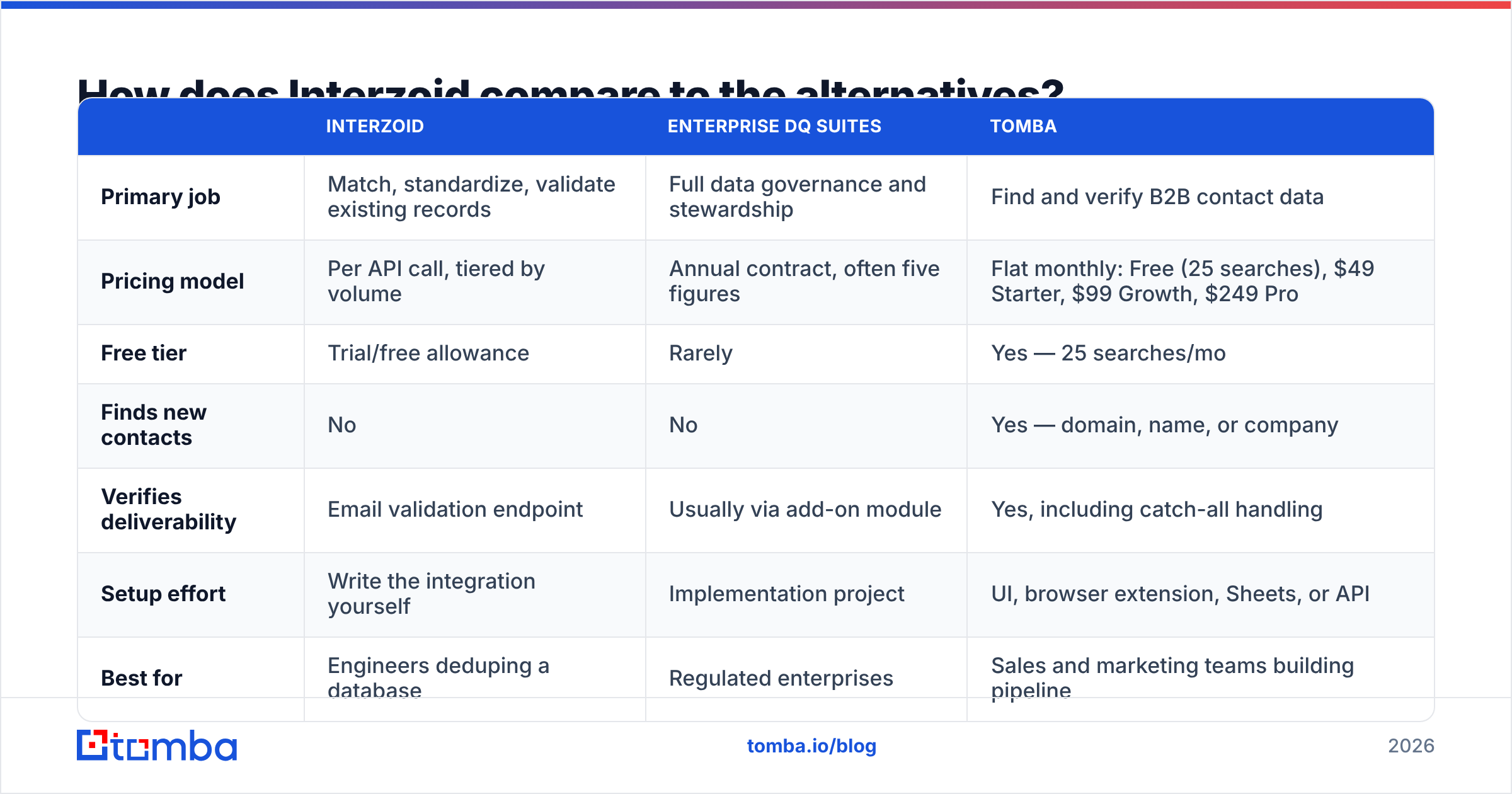
The honest comparison is not "Interzoid vs a competitor" — it's "which layer of the data problem are you solving?" Most teams need two layers and buy one.
| Interzoid | Enterprise DQ suites | Tomba | |
|---|---|---|---|
| Primary job | Match, standardize, validate existing records | Full data governance and stewardship | Find and verify B2B contact data |
| Pricing model | Per API call, tiered by volume | Annual contract, often five figures | Flat monthly: Free (25 searches), $49 Starter, $99 Growth, $249 Pro |
| Free tier | Trial/free allowance | Rarely | Yes — 25 searches/mo |
| Finds new contacts | No | No | Yes — domain, name, or company |
| Verifies deliverability | Email validation endpoint | Usually via add-on module | Yes, including catch-all handling |
| Setup effort | Write the integration yourself | Implementation project | UI, browser extension, Sheets, or API |
| Best for | Engineers deduping a database | Regulated enterprises | Sales and marketing teams building pipeline |
| Worst for | Non-technical sales teams | Small teams on a budget | Address standardization and postal cleanup |
Read that table as a division of labor, not a scoreboard. Interzoid is better at collapsing "Acme Inc" and "ACME Incorporated" into one account than any contact-data vendor is. A contact-data vendor is better at telling you that the VP of Engineering on that account now uses a different address. Those are different products because they are different problems.
Who should buy Interzoid — and who shouldn't?#
Buy it if: you have a database with tens of thousands of records, visible duplicate accounts, someone on the team who writes SQL or Python, and a mandate to fix data quality at the source. The per-call model will be cheaper than an enterprise DQ contract, and the matching quality will beat whatever fuzzy-match plugin your CRM ships with.
Don't buy it if: your actual complaint is "we don't have enough good contacts to email." That is a sourcing and verification problem wearing a data-quality costume. Spending on matching APIs will produce a beautifully deduplicated list of records you still can't reach.
Buy both if: you're running outbound at volume. Dedupe the accounts, then source and verify the people. Run the sourcing layer through a bulk email finder so the enrichment happens in batches rather than one record at a time, and re-check deliverability on a cadence with an email verifier — because contact decay is continuous, not a one-time cleanup.
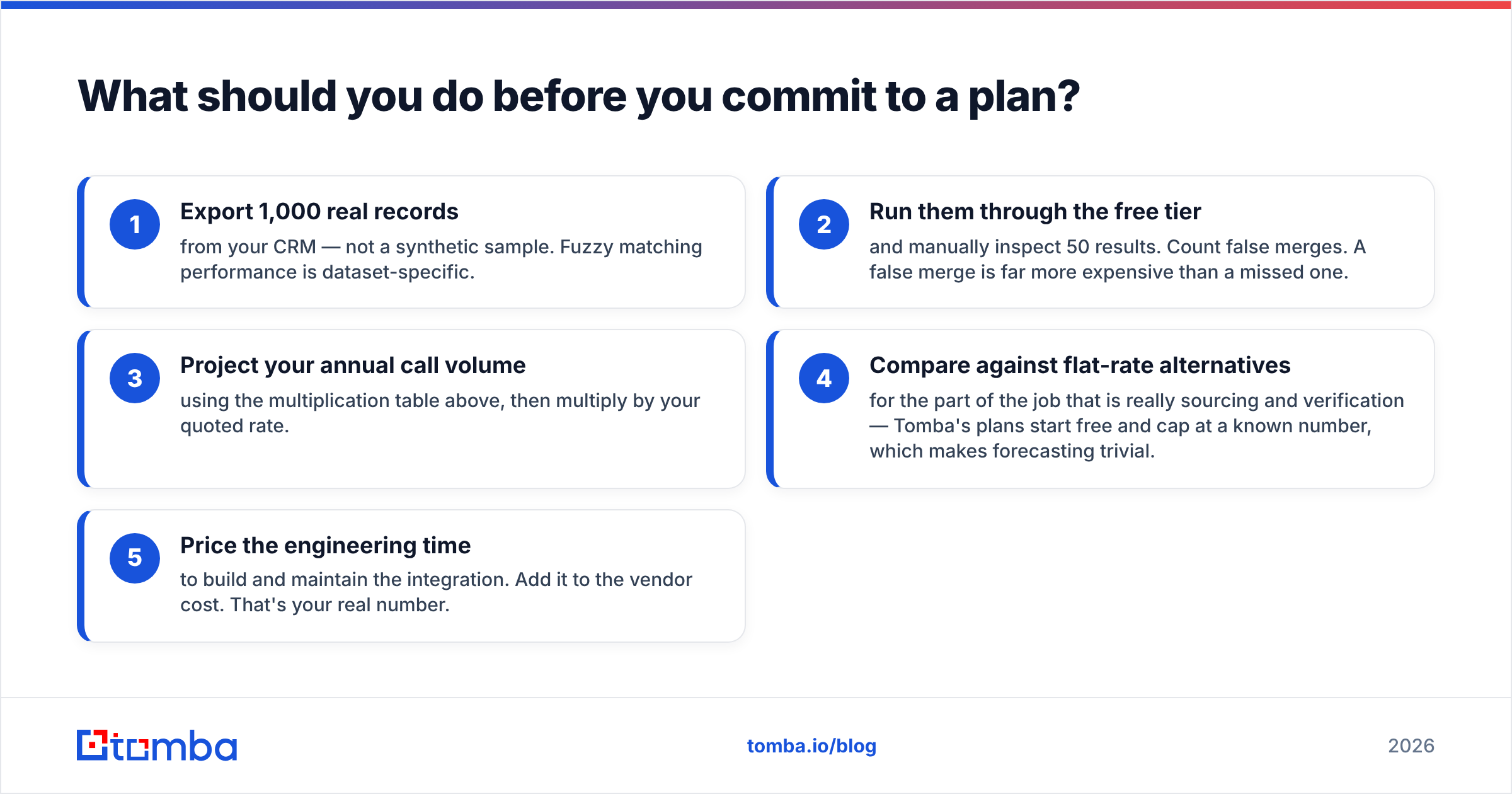
What should you do before you commit to a plan?#
Run this sequence, in order, before any purchase:
- Export 1,000 real records from your CRM — not a synthetic sample. Fuzzy matching performance is dataset-specific.
- Run them through the free tier and manually inspect 50 results. Count false merges. A false merge is far more expensive than a missed one.
- Project your annual call volume using the multiplication table above, then multiply by your quoted rate.
- Compare against flat-rate alternatives for the part of the job that is really sourcing and verification — Tomba's plans start free and cap at a known number, which makes forecasting trivial.
- Price the engineering time to build and maintain the integration. Add it to the vendor cost. That's your real number.
Most teams that do this exercise discover their spend splits roughly 20/80 between cleaning records and finding new ones. Budget accordingly.
The bottom line#
Interzoid is a well-built, fairly priced toolkit for a narrow and genuinely difficult problem. If entity matching is your bottleneck, it earns its cost. If your bottleneck is empty or stale contact fields — which, for most sales and marketing teams, it is — you're buying a great answer to the wrong question.
If the gap in your database is missing or outdated contacts rather than duplicates, start with the Tomba Email Finder. Search by domain, name, or company, verify deliverability before you send, and work from the free tier's 25 monthly searches to see whether the coverage holds on your target accounts — then scale to a flat $49/mo Starter plan with no per-call math to forecast.
Related guides#
// get started
Find, verify and enrich your first contacts today
Start on the free plan with 25 searches a month, then scale when your team is ready.
Free plan · No credit card required · GDPR & CCPA
// about the author