Intro Email Sample: 12 Templates That Actually Get Replies
Most intro emails die in the first two lines. Here are 12 intro email samples for cold, warm, referral, and inbound situations, plus the structure, subject lines, and follow-up cadence that make them work.
TL;DR
- A good intro email sample is short (50-125 words), leads with a reason you are writing to them specifically, and asks for one small thing.
- The five intro email types (cold, referral, mutual connection, inbound follow-up, event) need different structures. Sending a cold template into a warm situation wastes your best asset.
- Subject lines under 40 characters and written in lowercase-ish plain language beat "Quick question" and anything with an emoji.
- Two follow-ups spaced 3 and 7 days out roughly double total replies. Five follow-ups mostly generate unsubscribes.
- None of it matters if the address bounces. Verify before you send, every time.
What is an intro email, and when does it actually work?#
An intro email is the first message you send to someone who has no existing relationship with you, or a very thin one. It has exactly one job: earn a reply. Not close a deal, not book a demo, not explain your product. Earn a reply.
That distinction is where most drafts go wrong. People write intro emails like mini pitch decks, and the recipient bails somewhere in paragraph two. The message is judged in about three seconds on a phone screen, where roughly 40 characters of subject line and the first 90 characters of body text are all that render in the preview.
Intro emails work when three things are true at once:
- The recipient is plausibly a fit (right role, right company size, right moment).
- You can name a specific reason you are writing to them rather than 400 people.
- The ask is small enough that saying yes is cheaper than deleting.
Break any one of those and reply rates fall off a cliff. Break all three and you are sending spam with better grammar.
What does a strong intro email sample look like line by line?#
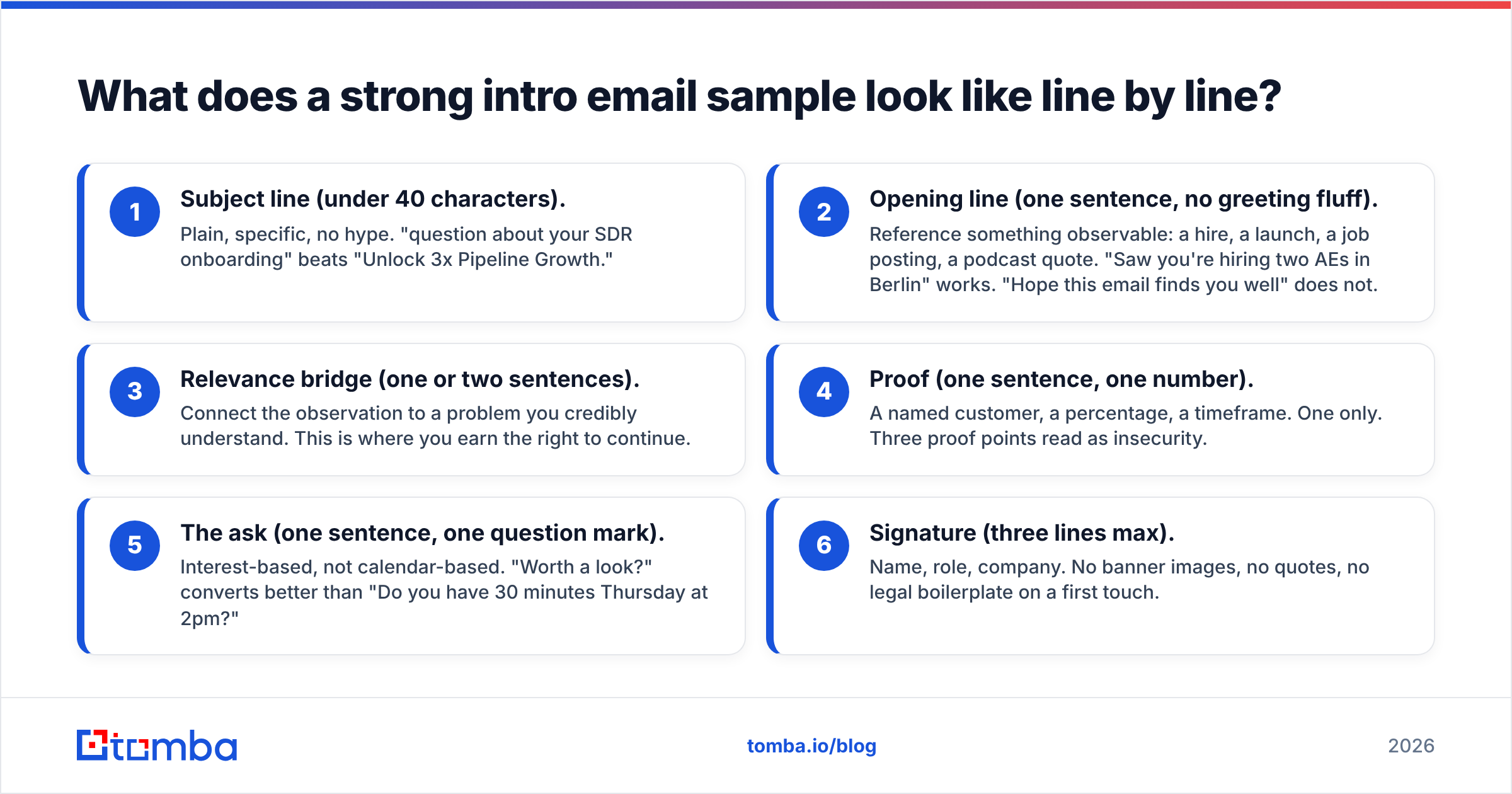
Every high-performing intro email I have seen dissects into the same six parts. Use this as a checklist before you hit send.
- Subject line (under 40 characters). Plain, specific, no hype. "question about your SDR onboarding" beats "Unlock 3x Pipeline Growth."
- Opening line (one sentence, no greeting fluff). Reference something observable: a hire, a launch, a job posting, a podcast quote. "Saw you're hiring two AEs in Berlin" works. "Hope this email finds you well" does not.
- Relevance bridge (one or two sentences). Connect the observation to a problem you credibly understand. This is where you earn the right to continue.
- Proof (one sentence, one number). A named customer, a percentage, a timeframe. One only. Three proof points read as insecurity.
- The ask (one sentence, one question mark). Interest-based, not calendar-based. "Worth a look?" converts better than "Do you have 30 minutes Thursday at 2pm?"
- Signature (three lines max). Name, role, company. No banner images, no quotes, no legal boilerplate on a first touch.
Total: 50 to 125 words. If you are over 150, you have written a second email and glued it on.

Which type of intro email should you send?#
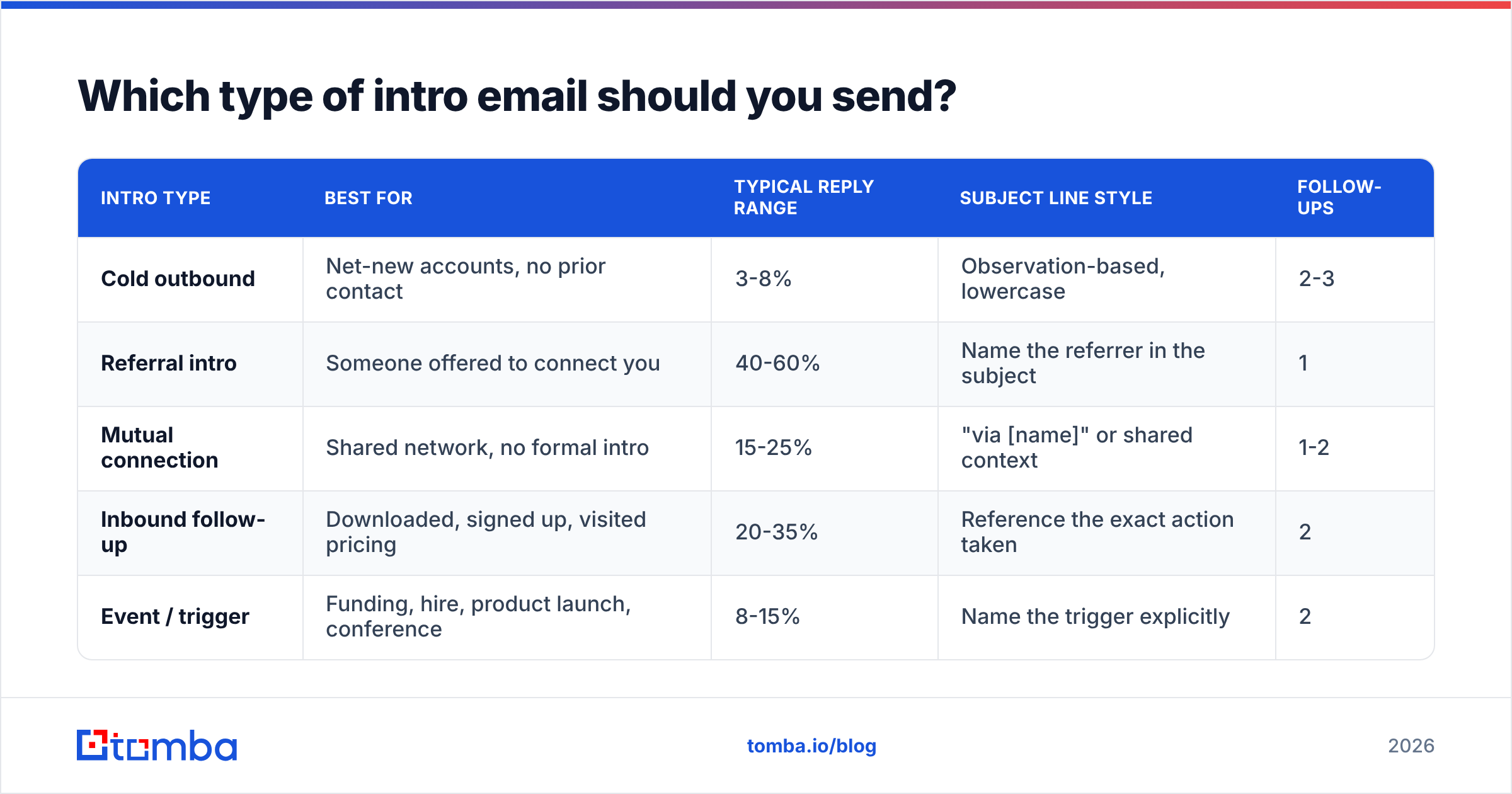
Not every first touch is cold. Matching the template to the situation matters more than the wording inside it.
| Intro type | Best for | Typical reply range | Subject line style | Follow-ups |
|---|---|---|---|---|
| Cold outbound | Net-new accounts, no prior contact | 3-8% | Observation-based, lowercase | 2-3 |
| Referral intro | Someone offered to connect you | 40-60% | Name the referrer in the subject | 1 |
| Mutual connection | Shared network, no formal intro | 15-25% | "via [name]" or shared context | 1-2 |
| Inbound follow-up | Downloaded, signed up, visited pricing | 20-35% | Reference the exact action taken | 2 |
| Event / trigger | Funding, hire, product launch, conference | 8-15% | Name the trigger explicitly | 2 |
The gap between a cold intro at 5% and a referral intro at 50% is not the copy. It is the context. Spend your energy manufacturing warmer contexts before you spend it A/B testing verbs.
What are the best intro email samples for cold outreach?#
These are structural templates. Replace every bracket, and cut anything that does not survive the "would a stranger care?" test.
1. The job-posting trigger
Subject: your 3 open SDR roles
Hi [Name] — saw you're hiring three SDRs in Q1. Usually that means the current team is spending more time on list building than calling. We cut research time per rep from ~90 minutes a day to about 15 at [Company]. Worth a quick look before the new hires ramp?
2. The observation opener
Subject: question about your pricing page
Hi [Name], your pricing page moved to usage-based last month but the docs still show seat tiers. Small thing, but it's the kind of mismatch that kills self-serve conversion. We help [role] teams catch this stuff. Want the two other gaps I noticed?
3. The competitor-adjacent
Subject: switching off [Competitor]
[Name] — three [industry] teams moved off [Competitor] to us this quarter, all for the same reason: credit rollover. If that's not a pain for you, ignore this. If it is, I can send the migration notes.
4. The one-metric email
Subject: 22% of your list is dead
Hi [Name], ran a sample check on a public [Company] list and about 22% of the addresses were undeliverable. That's the kind of thing that quietly drags your sender reputation down. Want the full breakdown?
5. The direct ask
Subject: worth 2 minutes?
[Name], I'll be blunt — we build [thing] for [role] at [company type]. Companies like [Customer] use it to [outcome]. No idea if that's relevant to you. Is it?
6. The shared-content hook
Subject: your point on [topic]
Hi [Name], your comment on [podcast/post] about [specific idea] matched something we see constantly. We ended up building [thing] around it. Curious whether you've solved it internally already — have you?
What intro email samples work for warm and referral situations?#
Warm intros need less persuasion and more speed. Get to the point and make the referrer look good.
7. Referral intro
Subject: [Referrer] suggested I reach out
Hi [Name], [Referrer] mentioned you're rebuilding the outbound motion at [Company] and thought this might be useful. We do [one line]. Happy to just send a short teardown of your current setup instead of meeting — whichever is easier.
8. Mutual connection, no formal intro
Subject: via [Mutual]
[Name] — we both know [Mutual] from [context]. She mentioned your team is dealing with [problem]. That's most of what we do. Open to a 10-minute conversation, or should I send something over email first?
9. Inbound follow-up
Subject: the [asset name] you downloaded
Hi [Name], you grabbed the [asset] on Tuesday. Page 4 is the part most people actually use — the [specific thing]. Anything in there you want walked through? Happy to answer by email.
10. Post-event
Subject: [Event] — the [topic] conversation
[Name], we talked briefly at [Event] about [specific thing you discussed]. You said [their words]. I dug up the benchmark I mentioned. Want me to send it?
11. New-role congratulations
Subject: congrats on the [role] move
Hi [Name], congrats on the move to [Company]. First 90 days is usually when the tooling audit happens. If [category] is on that list, I can send a one-page comparison with no pitch attached. Useful?
12. The re-approach after silence
Subject: closing the loop
[Name] — I've emailed twice about [topic] and heard nothing, which usually means the timing is off or I got the wrong person. Either is fine. Should I follow up in Q3, or point this at someone else on your team?
That last one is the highest-ROI template in the set. It gives a graceful exit, which is exactly why people answer it.
What subject lines should you pair with an intro email?#
Subject lines carry more weight than the body, because the body never gets read otherwise. Rules that hold up:
- Under 40 characters. Mobile clients truncate past that.
- Lowercase or sentence case. Title Case Reads Like Marketing.
- No brackets, no emoji, no "RE:" fakery. The last one damages trust permanently when discovered.
- Name a noun from their world. "your 3 open SDR roles" contains their reality. "Quick question" contains nothing.
If you want to pressure-test variants before a send, run them through a subject line tester or a subject line generator and keep the shortest option that still says something concrete.
Why do most intro emails fail before anyone reads them?#
Because the address was wrong, the domain was unauthenticated, or both. Copy is the third-most-common failure point, not the first.
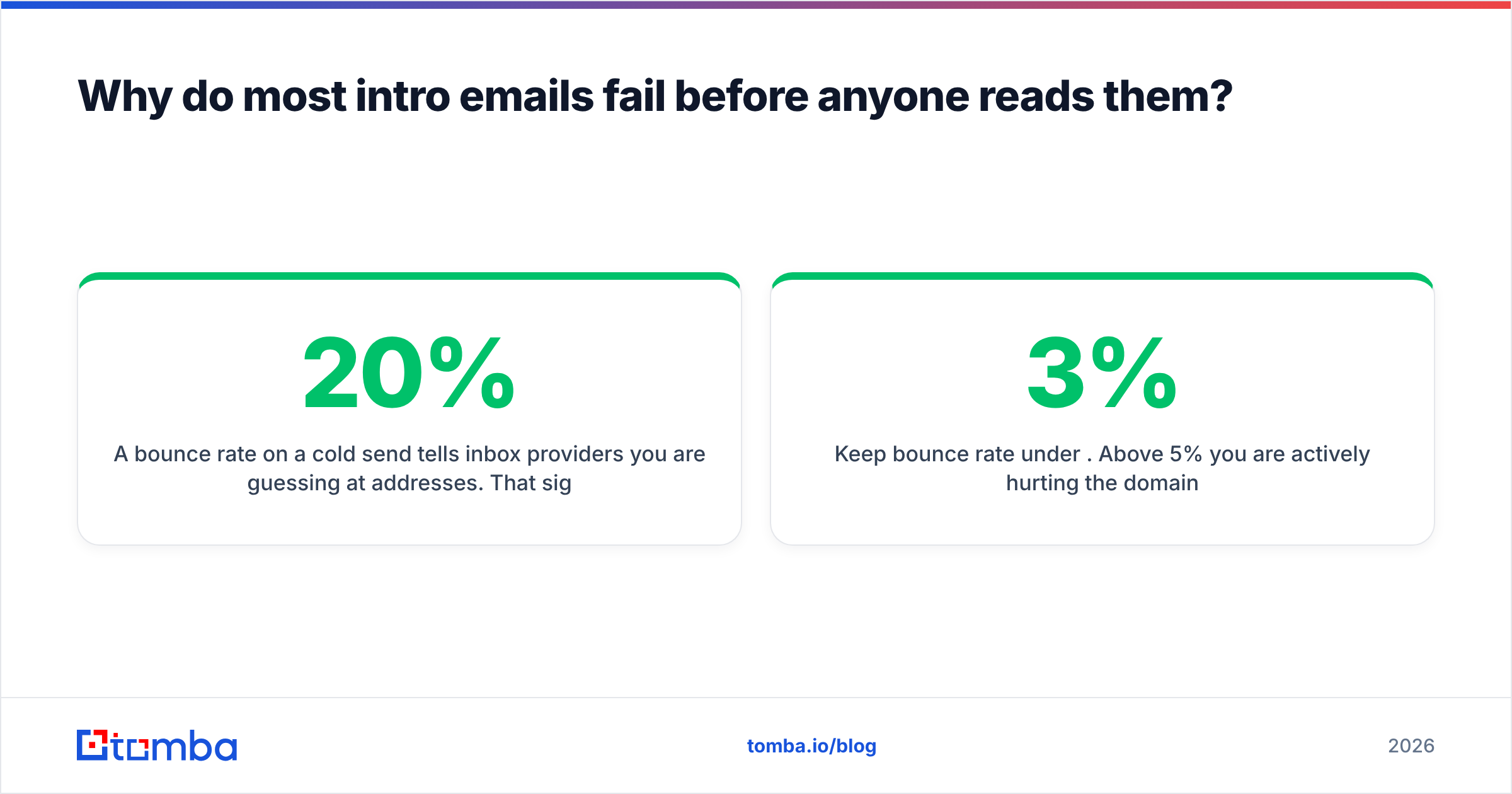
A 20% bounce rate on a cold send tells inbox providers you are guessing at addresses. That signal compounds: your sender reputation drops, your next campaign lands in Promotions, and a perfectly good intro email sample gets blamed for a data problem.
Fix the boring layer first:
- Verify every address before sending, not after. A good email verifier catches syntax errors, dead mailboxes, role accounts, and spam traps.
- Keep bounce rate under 3%. Above 5% you are actively hurting the domain.
- Warm new domains for at least three weeks before volume sending.
- Strip tracking pixels from first-touch emails. They are a measurable deliverability tax for a metric (open rate) that Apple Mail Privacy Protection already broke.

How many follow-ups should an intro email get?#
Two for cold, one for warm. Spaced at day 3 and day 8.
The data across most public benchmark sets, including what vendors publish on G2 and what HubSpot's sales research has shown for years, points the same direction: reply volume roughly doubles between touch one and touch three, then flattens hard. Touches four through seven add noise, unsubscribes, and spam complaints far faster than they add meetings.
Each follow-up should add something. A new angle, a new proof point, a different ask. "Bumping this to the top of your inbox" is not a follow-up, it is a confession that you had nothing to say.
Structure the sequence like this:
- Day 0: the intro email. One ask.
- Day 3: one new piece of information, three sentences, same ask phrased differently.
- Day 8: the graceful exit (template 12 above).
Then stop. Come back in a quarter with a genuinely new trigger.
How do you scale intro emails without sounding like a robot?#
Personalization does not have to mean manual research per contact. It means every email contains at least one variable that could only apply to that recipient.
Practical version: build your list by role and trigger rather than by scraping everything at a domain. Pull contacts with a domain search filtered to the departments that own your problem, enrich them with a title and seniority, then write one template per segment with two trigger variables. Ten segments beat one thousand individually-written emails you will never finish.
For reference on the broader discipline and where permission-based sending laws apply, the email marketing overview on Wikipedia is a reasonable neutral primer, and Gartner's sales research covers how buying groups actually process unsolicited outreach (badly, and in committees).
A workable stack for most teams:
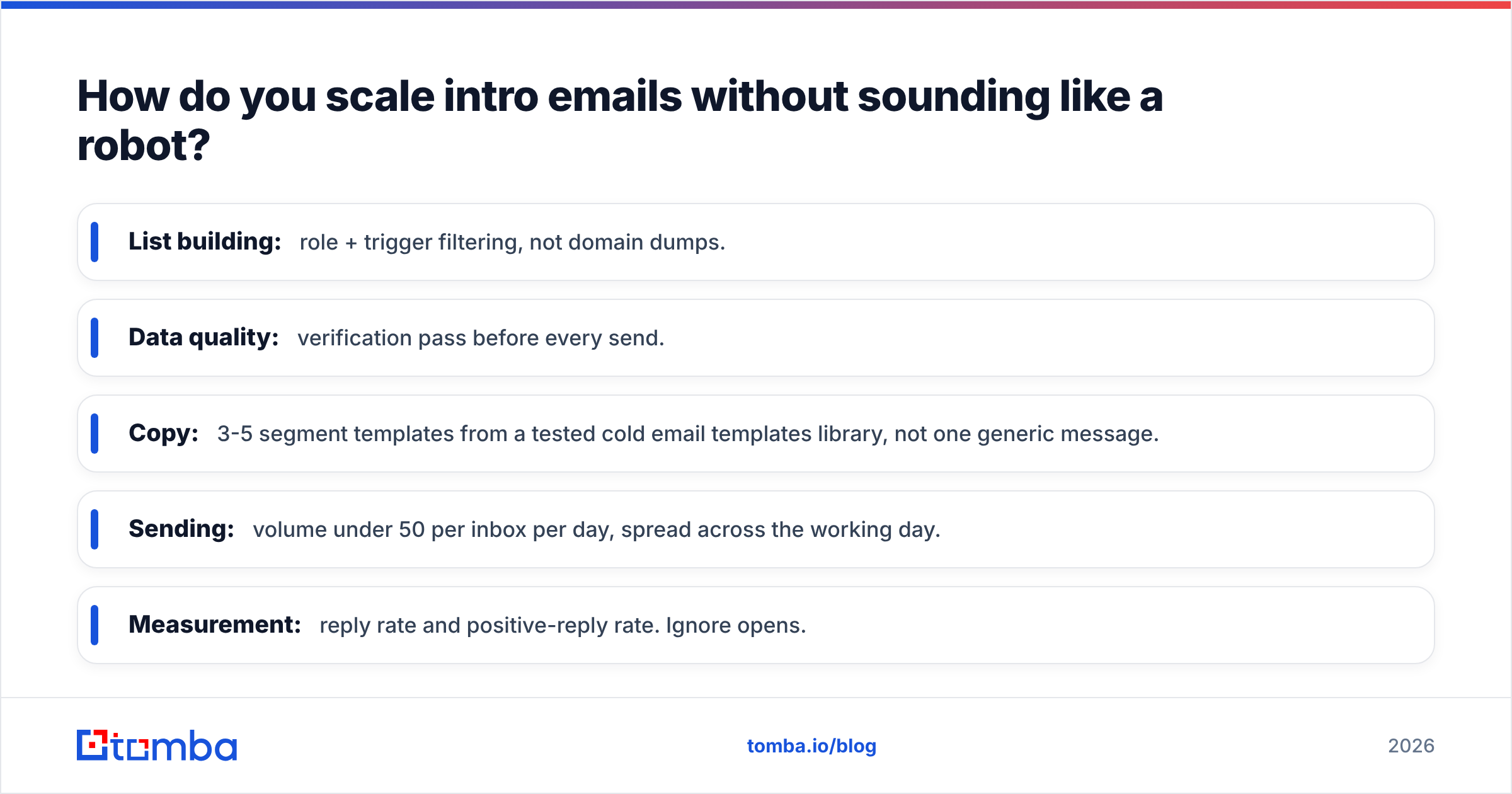
- List building: role + trigger filtering, not domain dumps.
- Data quality: verification pass before every send.
- Copy: 3-5 segment templates from a tested cold email templates library, not one generic message.
- Sending: volume under 50 per inbox per day, spread across the working day.
- Measurement: reply rate and positive-reply rate. Ignore opens.
Where should you start?#
Pick three templates from this page that match situations you are actually in this week. Rewrite the brackets. Cut 20% of the words. Send to a verified list.
The verification part is not optional, and it is the step teams skip most. If your intro email sample is strong but your data is guesswork, you are testing copy against noise. Run your list through the Tomba Email Finder to source addresses by name and domain with a confidence score attached, verify them in bulk, and send into inboxes that actually exist. The free tier covers 25 searches a month, and paid plans start at $49/mo — enough to find out whether your templates work before you commit budget to them.
Related guides#
// get started
Find, verify and enrich your first contacts today
Start on the free plan with 25 searches a month, then scale when your team is ready.
Free plan · No credit card required · GDPR & CCPA
// about the author