Intro Meeting Subject Line: 40 Examples That Get Replies
Most intro meeting requests die in the subject line, not the pitch. Here are 40 intro meeting subject lines that get opened, the four formats that consistently work, and the phrases that quietly route you to Promotions.
TL;DR
- An intro meeting subject line has one job: earn three seconds of attention on a phone screen. It is not where you pitch.
- The four formats that consistently work are context + ask, referral name, specific observation, and plain calendar language. Everything else is decoration.
- Keep it to 3-7 words. Mobile clients cut most subject lines at roughly 35-45 characters, so front-load the useful part.
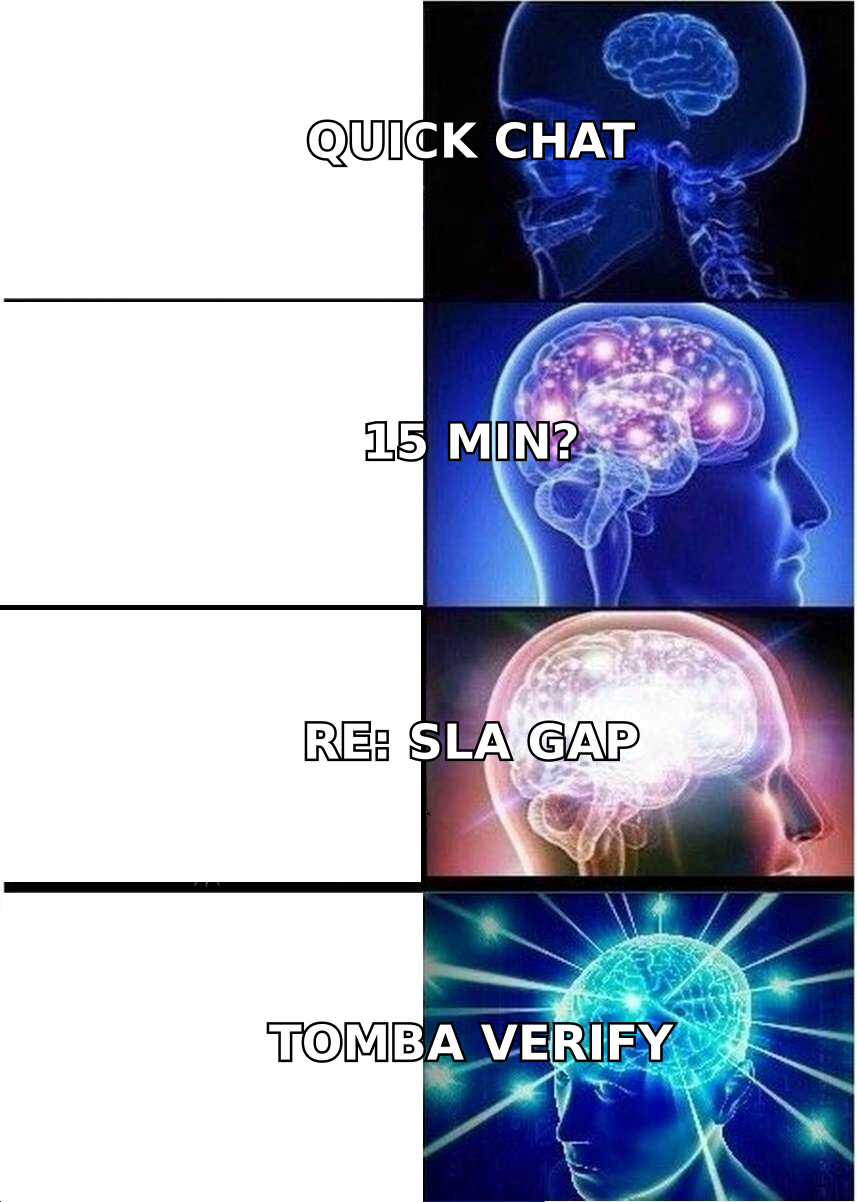
- "Quick chat", "Touching base", and "Exploring synergies" are dead weight. They signal a template, and templates get archived.
- Subject lines only matter if the email lands in the inbox. A bounced or catch-all address makes the best copy in the world irrelevant — verify before you send.
What is an intro meeting subject line?#
An intro meeting subject line is the header on the first email you send asking a stranger — or a near-stranger — for a short call. It shows up alongside 60 other unread messages, and your recipient decides in under three seconds whether to open, ignore, or archive it.
Think of it like the label on a package left at someone's door. Nobody reads the shipping manifest. They read the return address and the one line that says what's inside. If the label says "URGENT — OPEN NOW" with no sender they recognise, it goes in the pile. If it says "the replacement part you asked about", it gets opened.
That framing matters because most people write intro meeting subject lines as if they were headlines. They aren't. Headlines compete for attention in a feed where the reader is browsing. Subject lines compete for attention in an inbox where the reader is triaging. Browsing rewards intrigue. Triage rewards clarity.
Why do most intro meeting subject lines get ignored?#
Three reasons, in order of how much damage they do.
They're generic enough to have been sent to 5,000 people. "Quick question" is the single most overused opener in B2B email. Buyers have been trained to read it as "a rep is about to ask for 15 minutes." The response rate on a subject line that reads as templated is barely distinguishable from zero at most seniority levels.
They front-load the wrong words. Gmail on iOS shows roughly the first 35-40 characters of a subject line. If your subject is "Following up on my previous note about a potential partnership between our companies", the recipient sees "Following up on my previous note ab…" — which is content-free.
They try to sell. A subject line that promises a 40% pipeline lift is making a claim the reader has no reason to believe from someone they've never heard of. Claims in subject lines trigger skepticism; specifics trigger curiosity. Sales teams that track this closely — the kind of behaviour Gartner's sales research documents in buyer-engagement studies — consistently find that buyers filter aggressively on perceived relevance before they filter on offer quality.
What makes an intro meeting subject line work?#
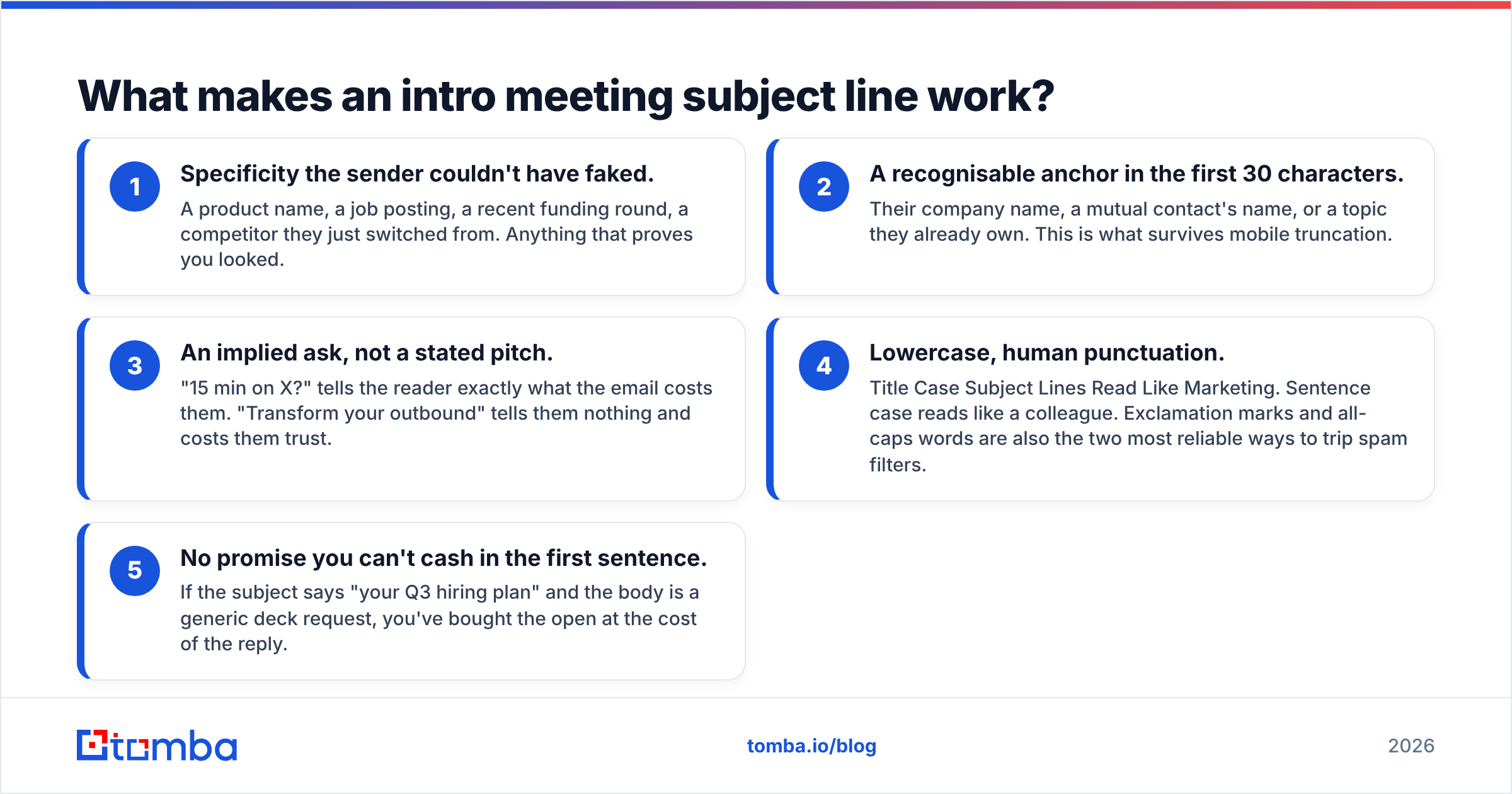
Five attributes separate the subject lines that get opened from the ones that get swiped away. Use them as a checklist before every send.
- Specificity the sender couldn't have faked. A product name, a job posting, a recent funding round, a competitor they just switched from. Anything that proves you looked.
- A recognisable anchor in the first 30 characters. Their company name, a mutual contact's name, or a topic they already own. This is what survives mobile truncation.
- An implied ask, not a stated pitch. "15 min on X?" tells the reader exactly what the email costs them. "Transform your outbound" tells them nothing and costs them trust.
- Lowercase, human punctuation. Title Case Subject Lines Read Like Marketing. Sentence case reads like a colleague. Exclamation marks and all-caps words are also the two most reliable ways to trip spam filters.
- No promise you can't cash in the first sentence. If the subject says "your Q3 hiring plan" and the body is a generic deck request, you've bought the open at the cost of the reply.
Which intro meeting subject line formats perform best?#
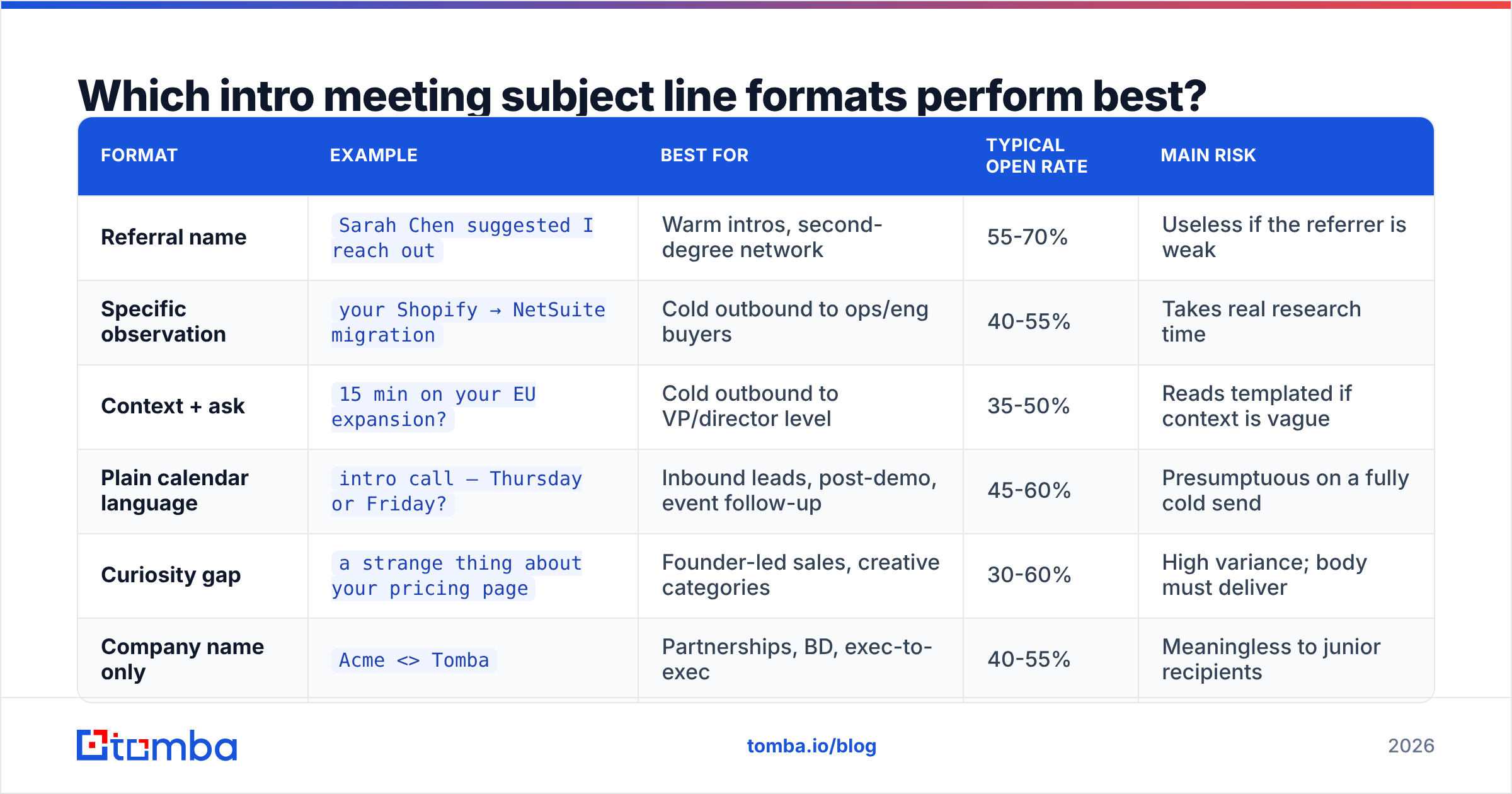
Here's how the main formats compare in practice. Open-rate ranges below reflect what well-targeted B2B outbound teams typically report on verified lists — treat them as directional benchmarks, not guarantees, because list quality moves these numbers more than wording does.
| Format | Example | Best for | Typical open rate | Main risk |
|---|---|---|---|---|
| Referral name | Sarah Chen suggested I reach out |
Warm intros, second-degree network | 55-70% | Useless if the referrer is weak |
| Specific observation | your Shopify → NetSuite migration |
Cold outbound to ops/eng buyers | 40-55% | Takes real research time |
| Context + ask | 15 min on your EU expansion? |
Cold outbound to VP/director level | 35-50% | Reads templated if context is vague |
| Plain calendar language | intro call — Thursday or Friday? |
Inbound leads, post-demo, event follow-up | 45-60% | Presumptuous on a fully cold send |
| Curiosity gap | a strange thing about your pricing page |
Founder-led sales, creative categories | 30-60% | High variance; body must deliver |
| Company name only | Acme <> Tomba |
Partnerships, BD, exec-to-exec | 40-55% | Meaningless to junior recipients |
The pattern is consistent: formats that carry information beat formats that carry emotion. The only exception is the referral name, which works because it carries social proof — the strongest information of all.
What are the best intro meeting subject lines by scenario?#
Forty examples, grouped by the situation you're actually in. Swap the bracketed parts for real details; a template used as-is is just a generic subject line with extra steps.
Cold outbound to a senior buyer
15 min on [specific initiative]?question about [their tool] at [Company][Company] + [your category] — worth 15 min?your [job posting title] postingre: [Company]'s move to [platform]noticed [Company] is hiring 3 SDRs[competitor] → [Company]: quick questionidea for [Company]'s [specific metric]
Warm intro or referral
[Referrer] said we should talkintro from [Referrer] — 15 min?[Referrer] mentioned your [project]following [Referrer]'s suggestion[Referrer] + [Company] + mevia [Referrer]: [one-word topic]
Inbound lead who filled a form
your [product] trial — 15 min?thanks for downloading [asset] — quick call?[First name], next step on [product]answers to your [topic] questionsre: your demo requestpicking up where the form left off
Post-event or conference follow-up
booth 412 at [Event] — the [topic] chat[Event] follow-up: the [topic] questionwe spoke about [topic] at [Event]nice meeting you at [Event] — Thursday?the thing I promised to send you[Event] recap + 15 min next week?
Re-engaging a stalled or cold contact
still a priority at [Company]?closing the loop on [topic][Company]'s [initiative] — any movement?should I stop emailing?revisiting [topic] after [trigger event]new [feature] since we last spoke
Partnership, BD, or peer-to-peer
[Your company] <> [Their company]partnership idea — 20 min?our customers keep asking about [their product]integration questionco-marketing on [shared topic]?comparing notes on [shared challenge][shared customer] brought us togetherone question about your [API/roadmap/channel program]
If you want to pressure-test variants before a send, run them through a subject line tester to catch length problems and spam-trigger words, or generate a batch with a subject line generator and then cut the ones that could apply to any company.
Should you put the meeting length in the subject line?#
Yes, when the meeting is the ask. No, when the email is the ask.
"15 min" and "20 min" work because they price the request. The reader's objection to a meeting request is almost never "I don't care about this topic" — it's "I don't have time for whatever this turns into." Naming a small, bounded number pre-answers that.
Where it backfires: on a genuinely cold first touch to a C-level recipient, "15 min?" can read as presumptuous, because you're asking for calendar time before establishing why you're worth any. In that case, lead with the observation and put the time ask in the body's last line instead.
A useful rule: if you have a referral, a trigger event, or a prior conversation, name the time in the subject. If you have none of those, earn it in the body first.
How long should an intro meeting subject line be?#
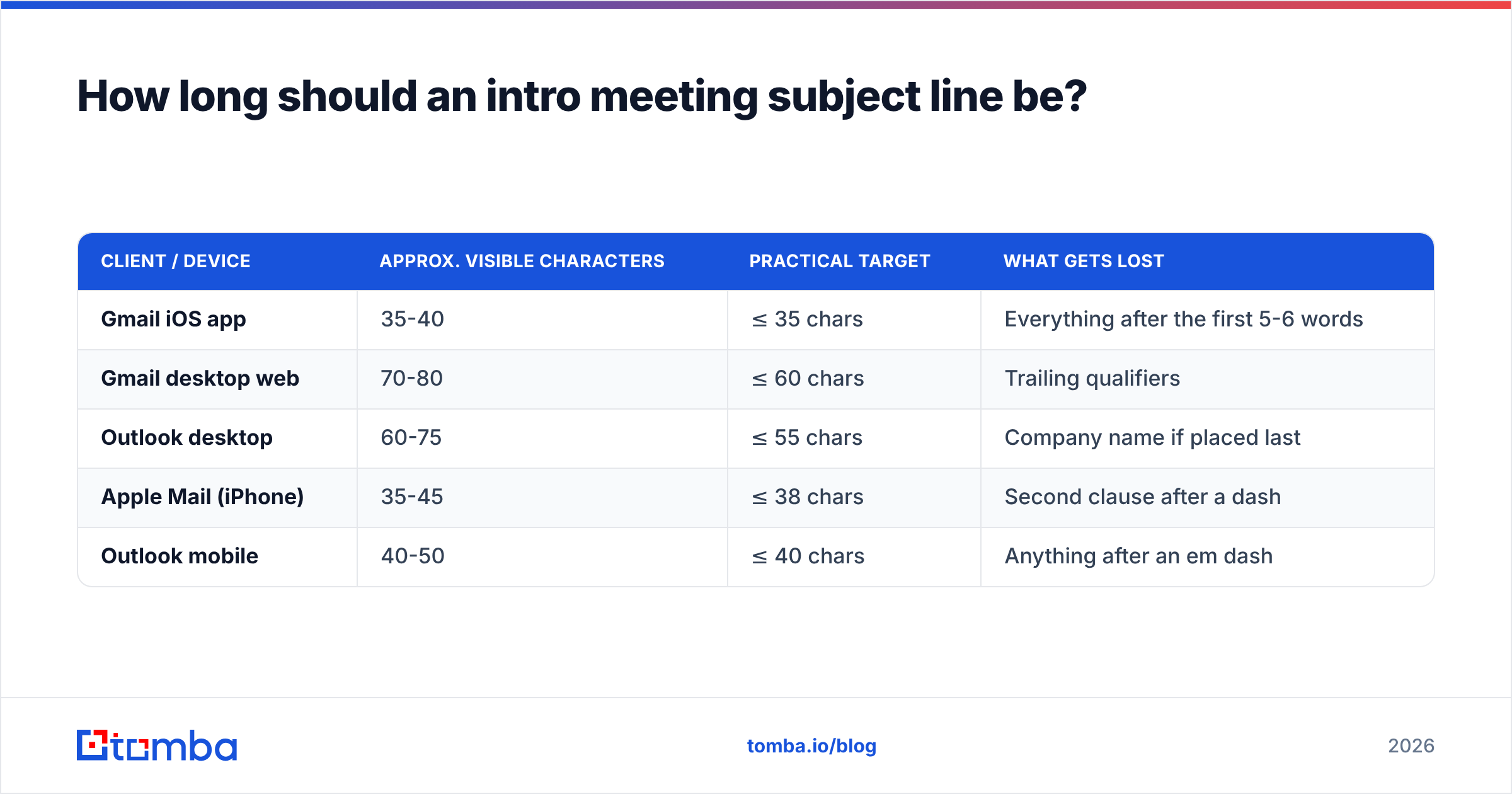
Short enough to survive truncation on the device your buyer actually uses. Here's where the cut usually lands.
| Client / device | Approx. visible characters | Practical target | What gets lost |
|---|---|---|---|
| Gmail iOS app | 35-40 | ≤ 35 chars | Everything after the first 5-6 words |
| Gmail desktop web | 70-80 | ≤ 60 chars | Trailing qualifiers |
| Outlook desktop | 60-75 | ≤ 55 chars | Company name if placed last |
| Apple Mail (iPhone) | 35-45 | ≤ 38 chars | Second clause after a dash |
| Outlook mobile | 40-50 | ≤ 40 chars | Anything after an em dash |
Three to seven words is the safe zone. That's not a style preference — it's the intersection of every mobile client's truncation point. Anything past word eight is written for you, not for the reader.
Do intro meeting subject lines matter more than deliverability?#
No, and it isn't close. This is the part most subject-line articles skip.
A subject line can only influence behaviour if the message reaches a primary inbox belonging to a real person who still works there. Three failure modes kill more intro meetings than bad copy ever will:
- Invalid addresses. B2B contact data decays at roughly 25-30% per year as people change roles. A list you scraped in January is meaningfully wrong by June.
- Bounce-driven reputation damage. Sustained hard-bounce rates above 2-3% push mailbox providers to route your whole domain to spam. At that point every subject line you write underperforms, and you'll wrongly blame the copy.
- Catch-all domains. An address that "accepts everything" isn't validated. It may route to a black hole, and it will quietly inflate your apparent delivery rate while your reply rate flatlines.
The fix is unglamorous: verify before you send. Run addresses through an email verifier to strip invalids, and use a catch-all verifier to decide which accept-all domains are worth the risk. Teams that clean their list first routinely see open rates jump 10-20 points without changing a single word of copy — because the denominator was lying to them.
For a broader view of how deliverability, timing, and sequencing interact, HubSpot's sales blog and Salesforce's blog both publish ongoing benchmark data worth reading against your own numbers.
How do you test intro meeting subject lines without burning your list?#
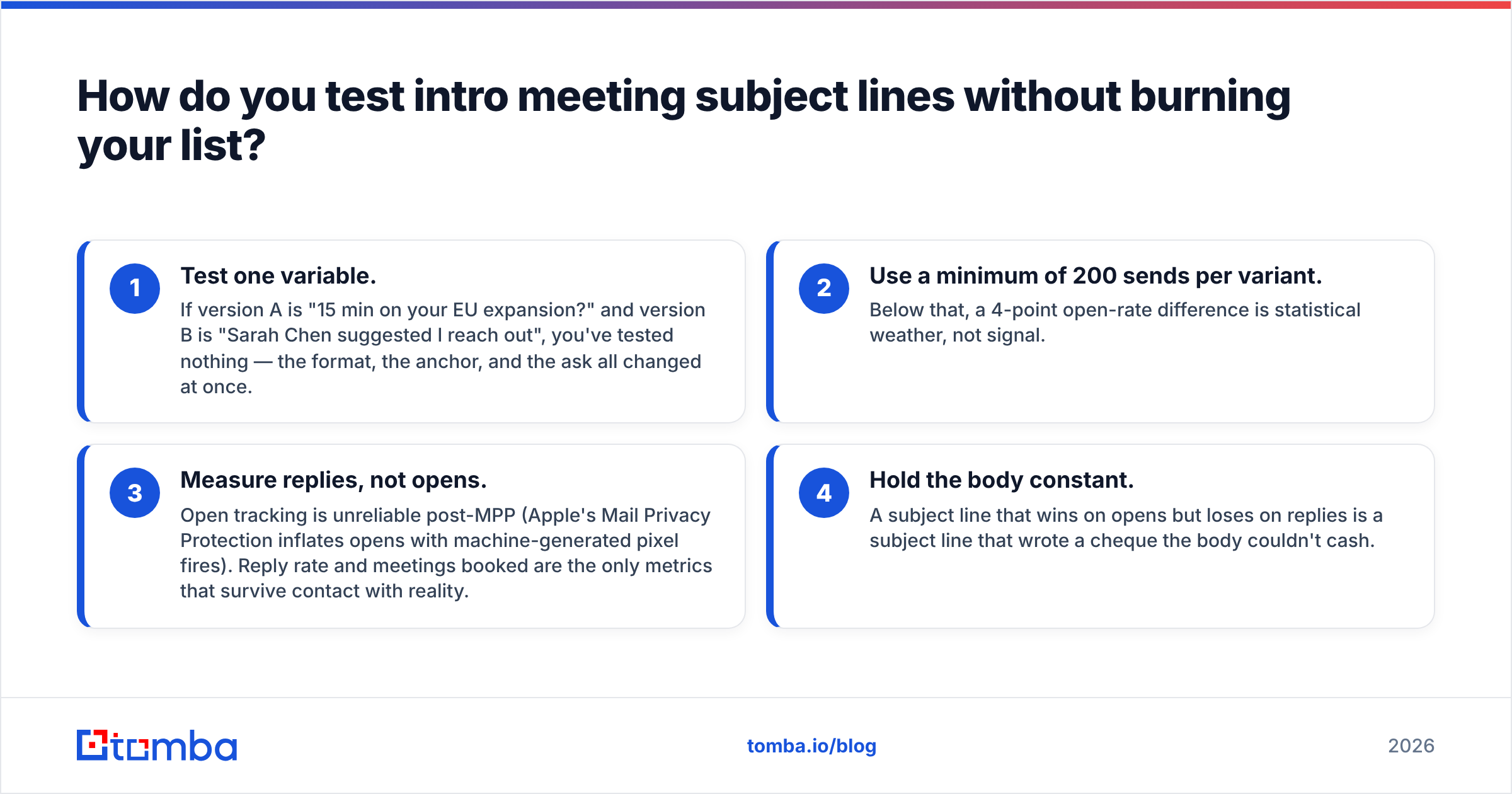
Testing subject lines is where most teams generate noise instead of learning. Four rules keep the data honest.
- Test one variable. If version A is "15 min on your EU expansion?" and version B is "Sarah Chen suggested I reach out", you've tested nothing — the format, the anchor, and the ask all changed at once.
- Use a minimum of 200 sends per variant. Below that, a 4-point open-rate difference is statistical weather, not signal.
- Measure replies, not opens. Open tracking is unreliable post-MPP (Apple's Mail Privacy Protection inflates opens with machine-generated pixel fires). Reply rate and meetings booked are the only metrics that survive contact with reality.
- Hold the body constant. A subject line that wins on opens but loses on replies is a subject line that wrote a cheque the body couldn't cash.
Run each test for a full week. Send-day effects are large enough to swamp small copy differences, and a Tuesday-vs-Friday artifact will masquerade as a subject-line insight if you don't control for it.
Which intro meeting subject lines should you retire?#
These stopped working and now actively signal "mass send":
- "Quick question" / "Quick chat" / "Quick call"
- "Touching base" / "Checking in" / "Circling back"
- "Exploring synergies" / "Strategic partnership opportunity"
- "Are you the right person?"
- "[First Name], Don't Miss This"
- Anything in ALL CAPS, or with more than one emoji
- "RE:" or "FW:" on an email that is neither a reply nor a forward — this is a trust violation, and sophisticated buyers notice immediately
The last one deserves emphasis. Fake-thread subject lines produce a short-term open bump and a long-term reputation cost, both with the recipient and with spam filters that increasingly flag the pattern. Comparison and review platforms like G2 are full of reviews from teams that ran this tactic and watched reply quality collapse.
Where should you start?#
Pick three scenarios from the list above that match your actual pipeline, write five variants each, and cut any variant that could be sent unchanged to a different company. What's left is your test set.
Then fix the input. A great intro meeting subject line sent to an address that bounced is worth exactly zero meetings. Use the Tomba Email Finder to source verified professional addresses by name and domain, so the copy you spent an afternoon on actually lands where a human will read it. The free tier covers 25 searches a month if you want to test the workflow before committing; paid plans start at $49/mo on Tomba pricing, and the same verification runs through the Tomba API if you'd rather wire it into your sequencer directly.
Write fewer subject lines. Send them to better addresses. That's the whole game.
Related guides#
// get started
Find, verify and enrich your first contacts today
Start on the free plan with 25 searches a month, then scale when your team is ready.
Free plan · No credit card required · GDPR & CCPA
// about the author