9 Best Introdex Alternatives in 2026 for B2B Contact Data
Introdex is fine until you need volume, verification, or an API. Here are nine Introdex alternatives compared on match rate, real cost per verified contact, and which team size each one actually fits.
TL;DR
- Most teams leave Introdex for one of three reasons: not enough volume on the entry plan, no built-in verification step, or no usable API for their own workflows.
- The nine alternatives below split into three buckets — email-finding engines (Tomba, Findymail, ContactOut), all-in-one prospecting suites (Apollo, Clay, Wiza), and database/list vendors (BookYourData, RocketReach, Lusha).
- The only number that matters is cost per verified, non-bouncing contact — not the sticker price per month and not the raw credit count.
- Per-seat pricing punishes small teams that share one prospecting workflow. Flat credit pools (Tomba, BookYourData, Findymail) usually win below 10 reps.
- If you want a direct swap with an API, bulk processing, and verification in the same pass, start with the Tomba Email Finder free tier before you pay anyone.
What is Introdex, and why are teams looking for alternatives?#
Introdex sits in the lightweight end of the B2B contact-discovery market: you look up a person or a company, it returns a work email and some firmographic context, and you push that into your sequencer or CRM. That is a real job, and for a solo founder doing twenty lookups a week it's often enough.
The friction shows up later. Think of it like a kitchen knife set that came with your apartment — perfectly usable until you start cooking for forty people every night. The complaints that push teams to look for Introdex alternatives are consistent:
- Volume ceilings. Entry plans in this category typically cap you in the low hundreds of lookups. Two reps running real outbound burn that in a week.
- No verification in the same pass. A found email is a hypothesis. Unless the tool runs SMTP-level checks and flags catch-all domains, you're shipping bounce risk straight into your sending domain.
- Thin API surface. If you can't call it from a script, a Google Sheet, or a workflow tool, someone on your team is doing copy-paste for a living.
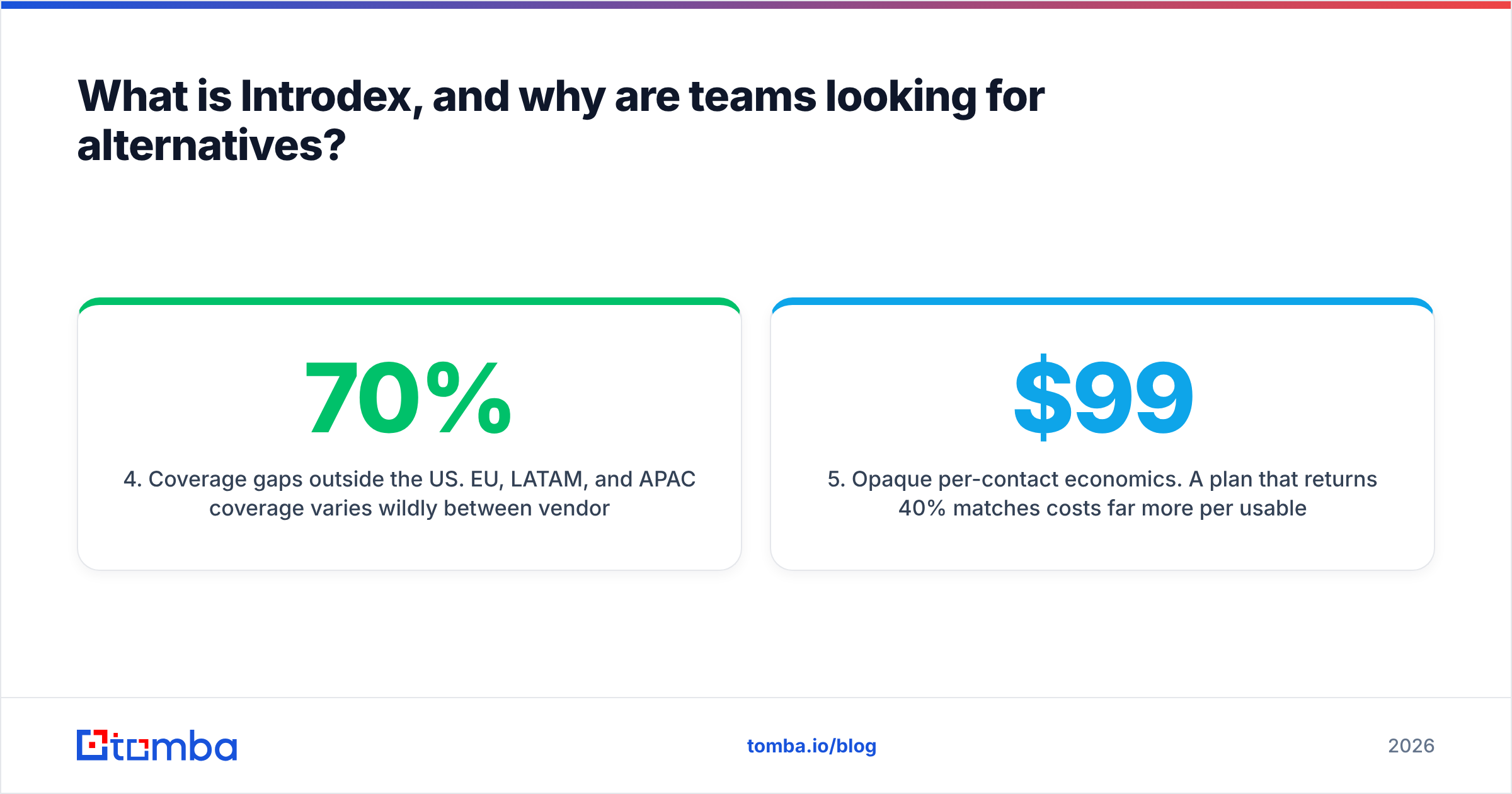
- Coverage gaps outside the US. EU, LATAM, and APAC coverage varies wildly between vendors, and a 70% match rate in North America can collapse to 35% in Germany.
- Opaque per-contact economics. A $99 plan that returns 40% matches costs far more per usable contact than a $49 plan that returns 75%.
Introdex publishes limited plan detail publicly and changes it periodically, so check its current pricing page before you compare — the point of this article is the evaluation framework, not a snapshot that rots in three months.
What should you actually compare in an Introdex alternative?#
Ignore feature-count marketing. Five variables decide whether a tool is cheaper or more expensive than what you have now:
- Match rate on your ICP, not theirs. Take 100 real prospects from your CRM — your industries, your geographies, your seniority mix — and run them through every trial. Vendor-published match rates are measured on datasets that flatter the vendor.
- Bounce rate after verification. Anything above 3% on a cold domain is a deliverability problem. Under 2% is what a tool with a real email verifier in the pipeline should deliver.
- Catch-all handling. Roughly a third of B2B domains accept all mail, so a naive SMTP check returns "valid" for every address including garbage. Ask specifically how the vendor scores catch-alls — a dedicated catch-all verifier is the difference between a usable list and a coin flip.
- Pricing shape: per-seat vs. credit pool. Per-seat licensing makes sense when every rep works their own book in the UI. Credit pools make sense when one ops person enriches for the whole team. Most sub-20-person companies are the second case and pay for the first.
- API and bulk throughput. Can you enrich 10,000 rows overnight without a human in the loop? A bulk email finder and a documented REST API turn a lookup tool into infrastructure.

Write those five down as columns before you open a single trial. Then the comparison takes an afternoon instead of a quarter.
Which Introdex alternatives are worth testing in 2026?#
Here's the shortlist, grouped by what they're actually good at rather than by how loudly they market.
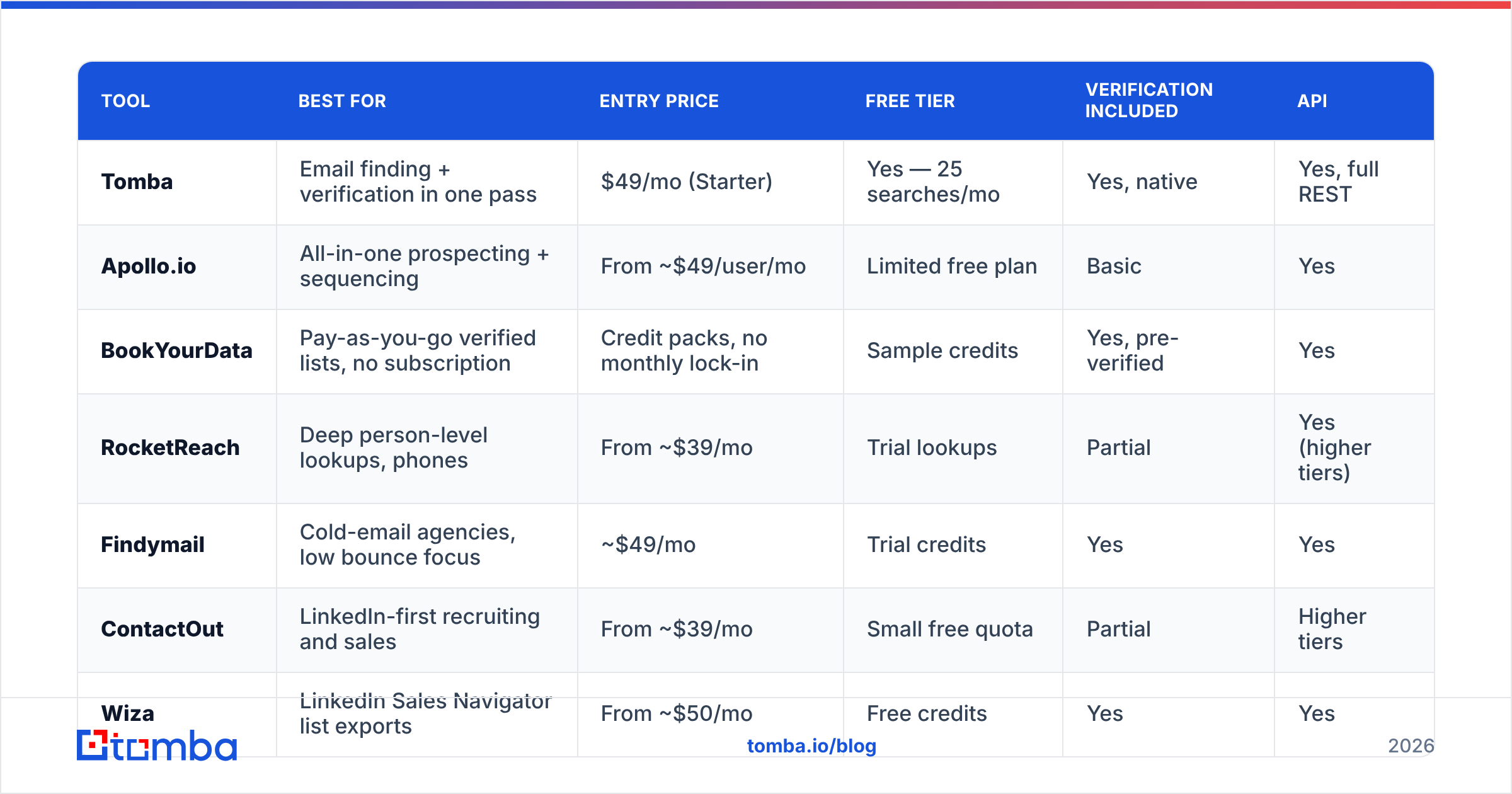
| Tool | Best for | Entry price | Free tier | Verification included | API |
|---|---|---|---|---|---|
| Tomba | Email finding + verification in one pass | $49/mo (Starter) | Yes — 25 searches/mo | Yes, native | Yes, full REST |
| Apollo.io | All-in-one prospecting + sequencing | From ~$49/user/mo | Limited free plan | Basic | Yes |
| BookYourData | Pay-as-you-go verified lists, no subscription | Credit packs, no monthly lock-in | Sample credits | Yes, pre-verified | Yes |
| RocketReach | Deep person-level lookups, phones | From ~$39/mo | Trial lookups | Partial | Yes (higher tiers) |
| Findymail | Cold-email agencies, low bounce focus | ~$49/mo | Trial credits | Yes | Yes |
| ContactOut | LinkedIn-first recruiting and sales | From ~$39/mo | Small free quota | Partial | Higher tiers |
| Wiza | LinkedIn Sales Navigator list exports | From ~$50/mo | Free credits | Yes | Yes |
| Clay | Custom enrichment waterfalls | ~$149/mo (Starter) | Free plan | Via providers | Yes |
| Lusha | Quick browser-extension grabs | From ~$36/user/mo | Free credits | Basic | Higher tiers |
List prices are as published at the time of writing and change often — treat the table as a shape, not a quote, and confirm on each vendor's own pricing page.

Tomba — the closest like-for-like swap#
Tomba does the same core job as Introdex (name or domain in, work email out) and adds the parts most people end up bolting on later: verification, catch-all scoring, domain search for mapping every published address at a company, phone lookup, and enrichment. Pricing is a flat credit pool — Free (25 searches/mo), Starter $49/mo, Growth $99/mo, Pro $249/mo, Enterprise custom — so a three-person team doesn't pay three times for one workflow. See the full breakdown on Tomba pricing.
Where it wins: flat pricing, native verification, a real API plus CLI, Sheets, Excel, and Chrome integrations. Where it doesn't: it's not a sequencer. If you want finding, sending, and CRM in one bill, look at Apollo or Clay.
Apollo.io — the suite play#
Apollo bundles a large contact database with sequencing, dialing, and basic CRM. If your team is large enough that consolidating four tools into one saves real money, it's a rational move.
Where it wins: one vendor, one bill, huge database, strong filtering. Where it doesn't: per-seat pricing scales fast, data freshness on long-tail contacts is inconsistent, and the free tier's export limits catch people out. If that's your objection, the Apollo alternative comparison goes deeper.
BookYourData — buy the list, skip the subscription#
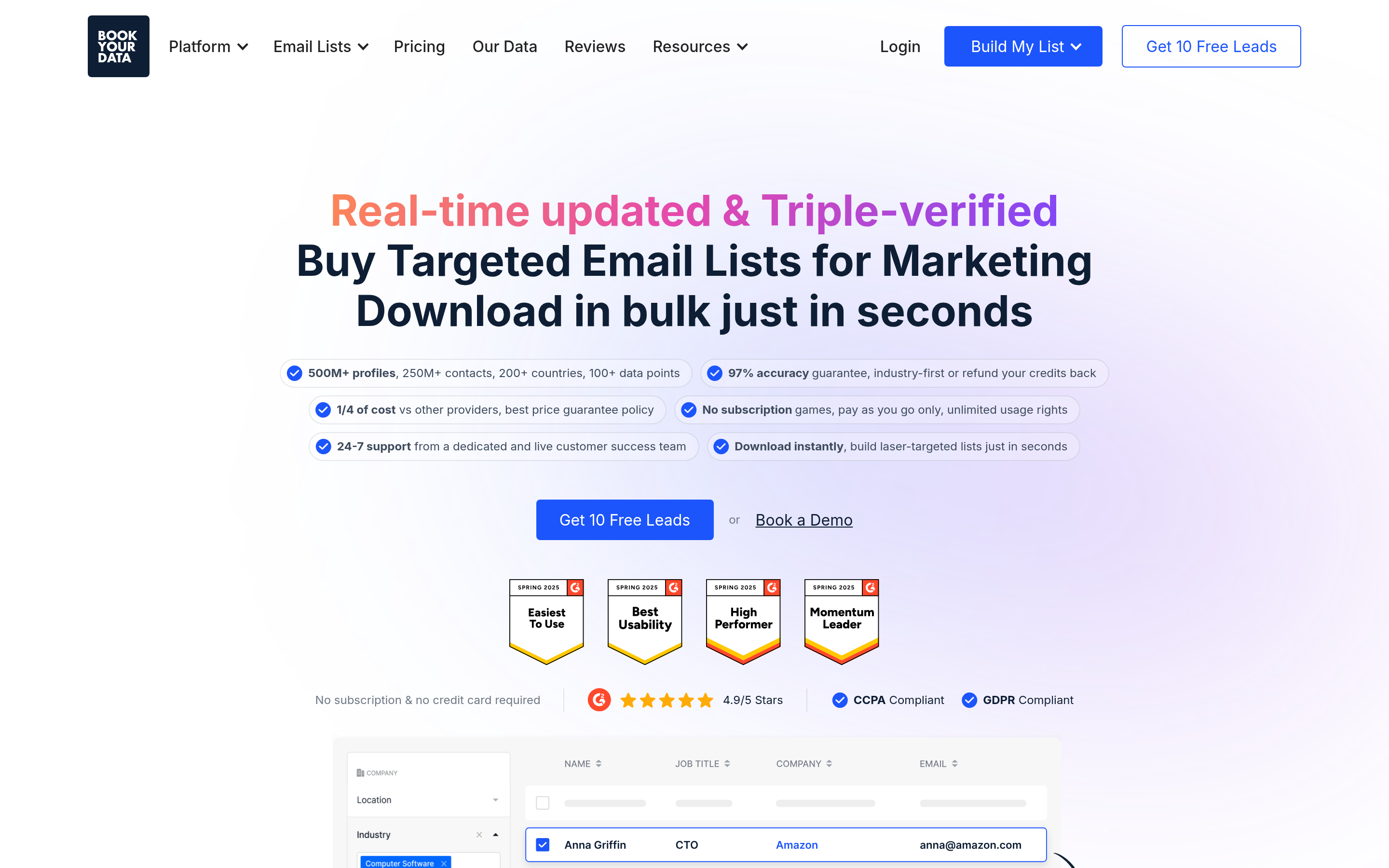
BookYourData takes a different approach: you build and buy a pre-verified list with pay-as-you-go credits instead of renting a seat. For campaign-based teams — an agency running one vertical push per quarter — that model is genuinely cleaner than paying monthly for a tool you touch twice a year. It's a solid, well-regarded option and a fair pick when your buying pattern is bursty rather than continuous.
Where it wins: no subscription lock-in, verified-on-delivery lists, straightforward credit math. Where it doesn't: it's list-first rather than workflow-first, so if you need continuous real-time enrichment inside a product or CRM, pair it with an API-native tool.
RocketReach — person-first lookups#
RocketReach is strong when you already know the human and need their contact details, including mobile numbers. Recruiters and executive-search teams like it for that reason.
Where it wins: person-level depth, phone coverage. Where it doesn't: monthly lookup caps get expensive at volume; see the RocketReach alternative page for the head-to-head.
Findymail, ContactOut, Wiza — the specialists#
Findymail optimizes hard for low bounce rates and is popular with cold-email agencies. ContactOut is LinkedIn-native and dominant in recruiting workflows. Wiza exists to turn Sales Navigator searches into clean, verified CSVs. Each is excellent at one motion and mediocre outside it. If your entire process lives in LinkedIn, a LinkedIn finder workflow or one of these specialists will beat a generalist.
Clay and Lusha — opposite ends#
Clay is a waterfall orchestrator: it calls many providers in sequence and keeps the first good answer. Powerful, but it's a platform you have to learn, and the provider credits are an extra cost on top. Lusha is the opposite — a fast browser extension for grabbing a contact mid-browse, with per-seat pricing that suits individual reps more than ops teams.
How accurate are these tools, really?#
Accuracy claims in this category are close to useless because nobody publishes their test set. What you can do is measure the two numbers that map to money: match rate (percentage of your input rows that return an address at all) and bounce rate (percentage of returned addresses that fail on send).

A worked example, because the arithmetic surprises people. Say you need 1,000 usable contacts:
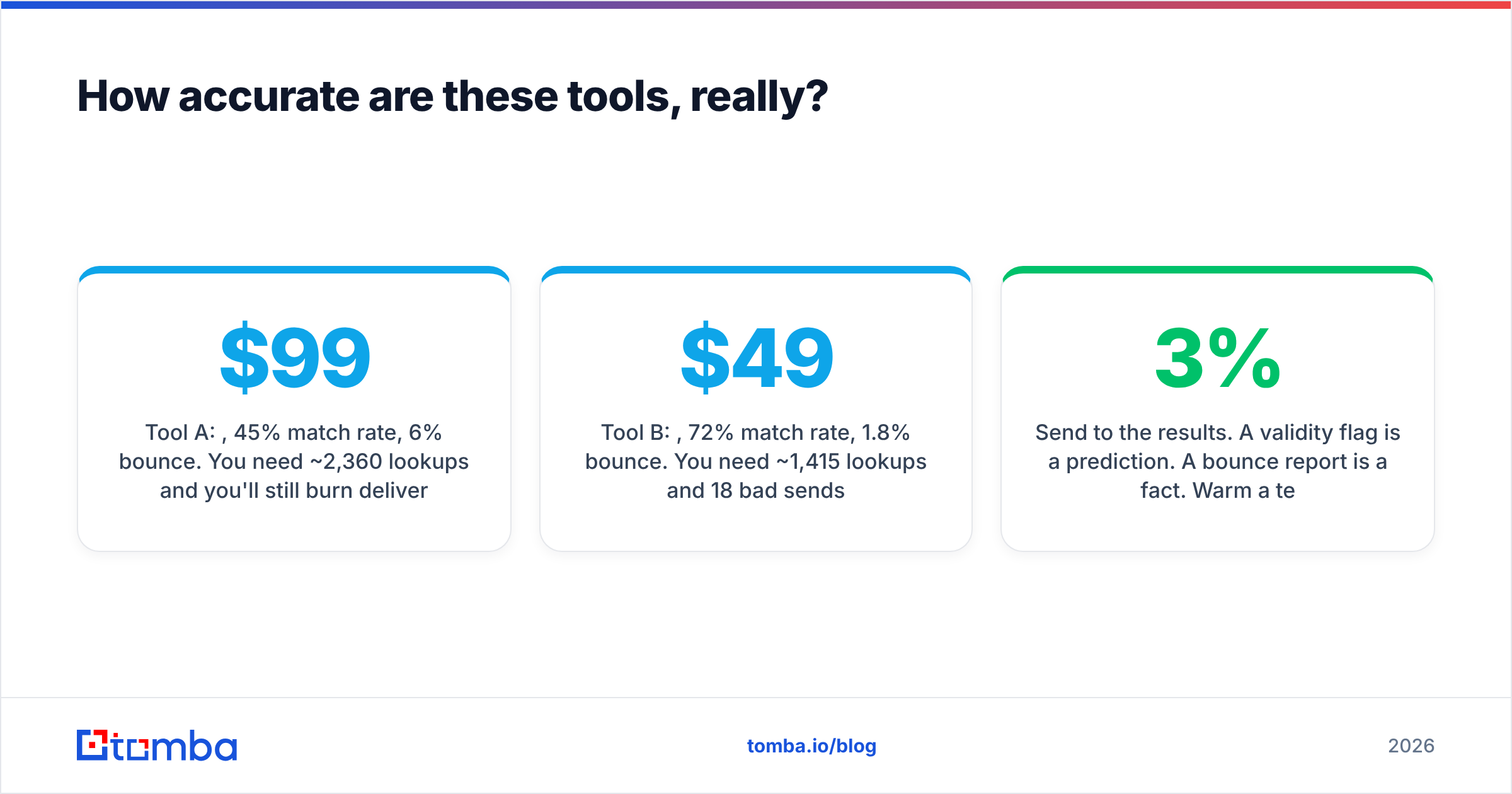
- Tool A: $99/mo, 45% match rate, 6% bounce. You need ~2,360 lookups and you'll still burn deliverability on 60 bad sends.
- Tool B: $49/mo, 72% match rate, 1.8% bounce. You need ~1,415 lookups and 18 bad sends.
Tool B is half the sticker price and roughly a third of the real cost per usable contact. This is why "cheapest plan" and "cheapest tool" are almost never the same answer — and why any alternative without verification baked in should be scored as more expensive than its price tag suggests.
Two practical rules when you run your own test:
- Use 100+ rows. Below that, variance swamps the signal.
- Send to the results. A validity flag is a prediction. A bounce report is a fact. Warm a test inbox, send a small batch, and count. Anything above 3% and you're one campaign away from a sender reputation problem.
Is Tomba a good Introdex alternative for your team?#
Honest answer: it depends on whether your bottleneck is finding contacts or contacting them.
If the bottleneck is finding and cleaning data, Tomba is the straightforward swap. You get the email finder, verification, catch-all scoring, domain search, phone lookup, and enrichment under one flat credit pool, plus a documented API, a CLI, and native Sheets/Excel/Airtable integrations. A three-person team on Growth at $99/mo pays $99/mo — not $99 times three.
If the bottleneck is sending, sequencing, and pipeline management, a data tool alone won't fix it. Pair a finder with a dedicated sequencer, or buy a suite and accept the per-seat cost.

One more filter worth applying: does the vendor tell you where the data comes from? Provenance matters for GDPR/CCPA posture and for predicting coverage gaps. Tomba documents its data sources publicly; so do a handful of others. Vendors that won't answer the question are the ones to be careful with — and if compliance is part of your evaluation, the definitions in a B2B glossary are a faster starting point than a legal review.
Are there free Introdex alternatives that actually work?#
Free tiers in this category are sampling mechanisms, not plans. That's fine — use them as sampling mechanisms.
- Tomba Free: 25 searches/month, full feature access. Enough to run a 25-row ICP accuracy test before you spend anything.
- Apollo free plan: generous on credits, restrictive on exports. Good for browsing, awkward for building a list.
- Vendor trial credits (Findymail, Wiza, ContactOut, Lusha): usually 10–50 lookups. Enough for a smell test, not a benchmark.
- Free utilities: a company email pattern checker or an email permutator will get you a plausible address for a single high-value target. They guess; they don't verify. Never send a campaign off permutated addresses.
Peer review sites are worth ten minutes before you commit — cross-check what you find against G2's lead intelligence category, reading the 3-star reviews rather than the 5-star ones. That's where the real limitations get written down.
How do you migrate off Introdex without losing anything?#
Treat it as a four-step swap, not a big-bang cutover:
- Export everything first. Pull your full contact history out of Introdex as CSV before you cancel. Access usually ends the day the subscription does.
- Re-verify the export. Contact data decays roughly 2–3% per month as people change jobs, so a twelve-month-old list is meaningfully stale. Run it through a bulk verifier and delete the failures instead of migrating them.
- Deduplicate before import. Overlapping exports from two tools will create duplicate CRM records that quietly wreck your reporting. A remove duplicates pass takes two minutes.
- Run both tools for two weeks. Same input rows into both, compare match rate and bounce rate on your actual ICP, then cancel the loser. Two weeks of double-paying is cheap insurance against picking wrong.
If you're wiring the new tool into a CRM, do the integration before you migrate the data — a HubSpot integration or a Salesforce sync configured up front saves you from importing the same records twice. For a deeper primer on how contact data is structured and why format matters, the email address fundamentals are a useful five-minute read for whoever owns your data hygiene.
Which Introdex alternative should you pick?#
Short version, by situation:
- Solo founder, under 200 lookups/month: Tomba Free or Starter. Don't buy a suite.
- 2–10 person sales team, shared prospecting workflow: Tomba Growth or BookYourData credit packs. Avoid per-seat pricing at this size.
- Cold-email agency running multiple client domains: Findymail or Tomba, with verification mandatory on every list.
- Recruiting team living in LinkedIn: ContactOut or Wiza.
- RevOps team building custom enrichment logic: Clay for orchestration, or the Tomba API if you'd rather own the pipeline yourself.
- 20+ reps who want one vendor for finding and sending: Apollo, with eyes open about per-seat cost.
The meta-advice is simpler than any of these picks: run the 100-row test. Every vendor in this list will give you enough free credits to do it, and the result will contradict at least one assumption you walked in with.
Ready to test a replacement?#
Start with the Tomba Email Finder free tier — 25 searches a month, no card required, with verification and catch-all scoring included so the addresses you get back are already scored before they hit your sequencer. Run your own 100-prospect ICP list through it alongside whatever you're using now, compare the match rate and the bounce rate, and let the numbers decide. If it wins, Starter is $49/mo with a flat credit pool your whole team shares; if it doesn't, you've spent nothing and you know more than you did this morning.
Related guides#
// get started
Find, verify and enrich your first contacts today
Start on the free plan with 25 searches a month, then scale when your team is ready.
Free plan · No credit card required · GDPR & CCPA
// about the author