How to Introduce Yourself to a Customer via Email in 2026
Most self-introduction emails fail in the first two lines. Here is the structure, the templates, the subject lines, and the timing that actually earn a reply from a new or inherited customer.
TL;DR
- An introduction email is not an announcement. It earns attention by naming a reason the recipient already cares about, then gets out of the way.
- The four intro scenarios (cold prospect, inherited account, warm referral, post-purchase handoff) need different structures. Using a cold-email format on an inherited account is why half of those emails die.
- Keep the first send under 120 words, with one ask and one link. Every extra paragraph measurably lowers reply rate.
- Subject lines that reference the account, the referrer, or the specific change beat clever wordplay. "Taking over your account, Sarah" beats "A quick hello!"
- None of it matters if the address bounces. Verify before you send, and personalize the first line with something only a human would have found.
What counts as introducing yourself to a customer via email?#
Any first written contact where the recipient does not yet have a working mental model of who you are. That covers more ground than most reps assume:
You may be a new SDR emailing someone who has never heard of your company. You may be an account manager inheriting 40 accounts after a reorg. You may be following up on a referral from a mutual contact. You may be the onboarding specialist assigned after a deal closed last week.
All four are "introduction emails," and all four fail for the same underlying reason when they fail: the writer treats the email as being about themselves. The recipient's first unconscious question is never "who are you?" It is "why is this in my inbox and what does it cost me?"
That reframe is the whole discipline. Your name, title, and tenure are context, not content. The content is the reason you are useful to this specific person this specific week.
Why do most self-introduction emails get ignored?#
Four predictable failures, in rough order of how much damage they do.
The email leads with the sender. "My name is Marcus and I'm the new Regional Account Director for the Northeast territory at Acme Solutions, where I've spent the last six years..." Nobody finishes that sentence. The recipient has already decided the email is administrative and archived it.
The ask is vague or absent. "Let me know if you ever need anything!" is not an ask, it is a way of avoiding one. It transfers all the work to the recipient, who has no reason to do it. A specific, small, dated ask ("15 minutes Thursday or Friday to walk through your renewal timeline?") converts several times better than an open door.
The email is too long. Introduction emails routinely run 250 to 400 words because the writer is nervous and over-explains. Nervousness reads as low status. Confidence is short.
The address is wrong or stale. This one is invisible, which makes it the worst. A message that bounces, lands in a shared alias nobody monitors, or reaches someone who left the company eight months ago produces exactly the same silence as a badly written email, so teams keep rewriting copy that was never the problem. Before you blame your writing, confirm the address resolves. A quick pass through an email verifier separates copy problems from data problems in about ten seconds.
What should an introduction email actually contain?#
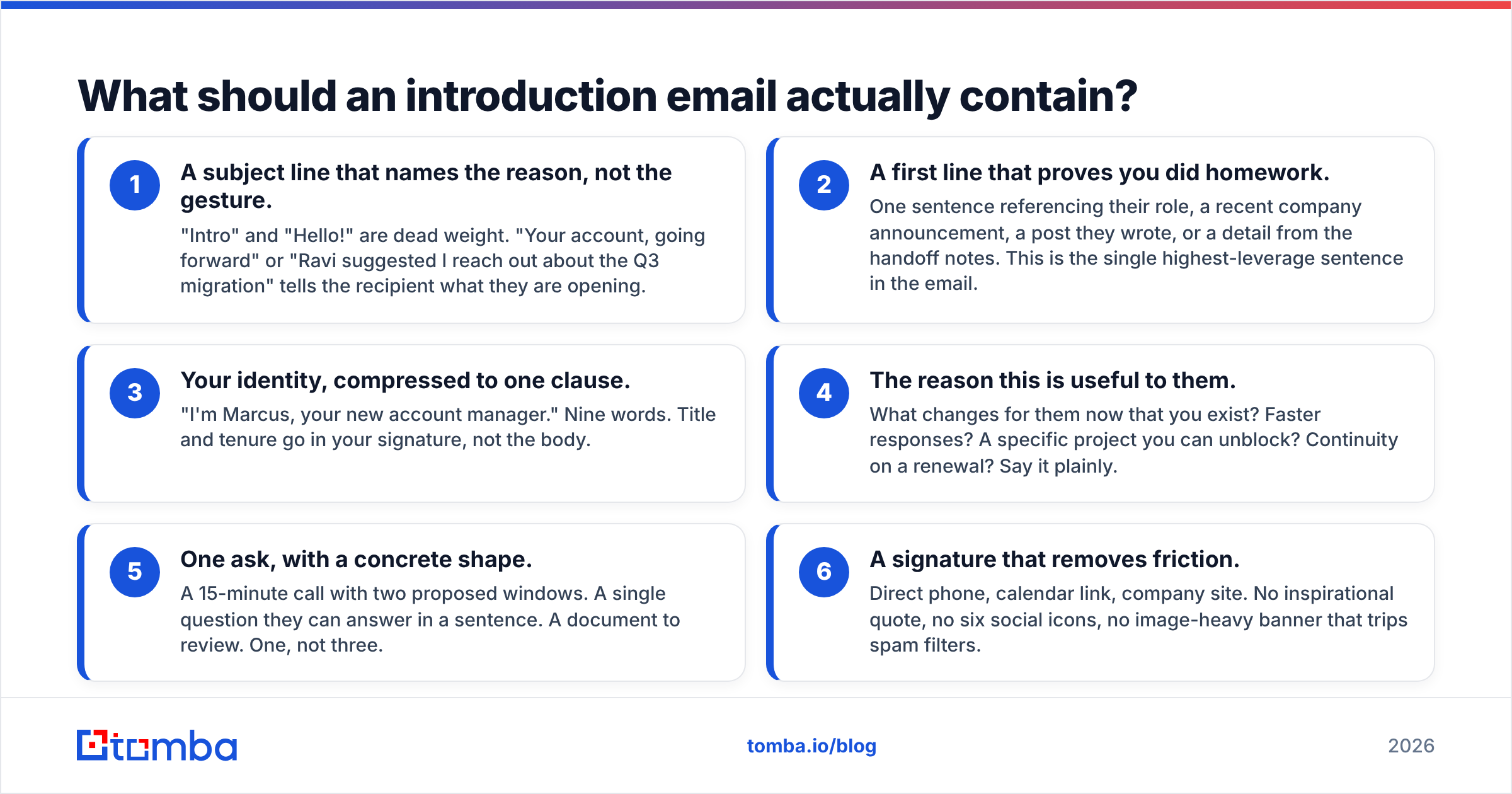
Six components, in this order. Cut anything that does not fit one of these slots.
- A subject line that names the reason, not the gesture. "Intro" and "Hello!" are dead weight. "Your account, going forward" or "Ravi suggested I reach out about the Q3 migration" tells the recipient what they are opening.
- A first line that proves you did homework. One sentence referencing their role, a recent company announcement, a post they wrote, or a detail from the handoff notes. This is the single highest-leverage sentence in the email.
- Your identity, compressed to one clause. "I'm Marcus, your new account manager." Nine words. Title and tenure go in your signature, not the body.
- The reason this is useful to them. What changes for them now that you exist? Faster responses? A specific project you can unblock? Continuity on a renewal? Say it plainly.
- One ask, with a concrete shape. A 15-minute call with two proposed windows. A single question they can answer in a sentence. A document to review. One, not three.
- A signature that removes friction. Direct phone, calendar link, company site. No inspirational quote, no six social icons, no image-heavy banner that trips spam filters.
That structure fits comfortably in 90 to 130 words. If yours is longer, you have added explanation that the recipient did not request.
Which introduction format fits your situation?#
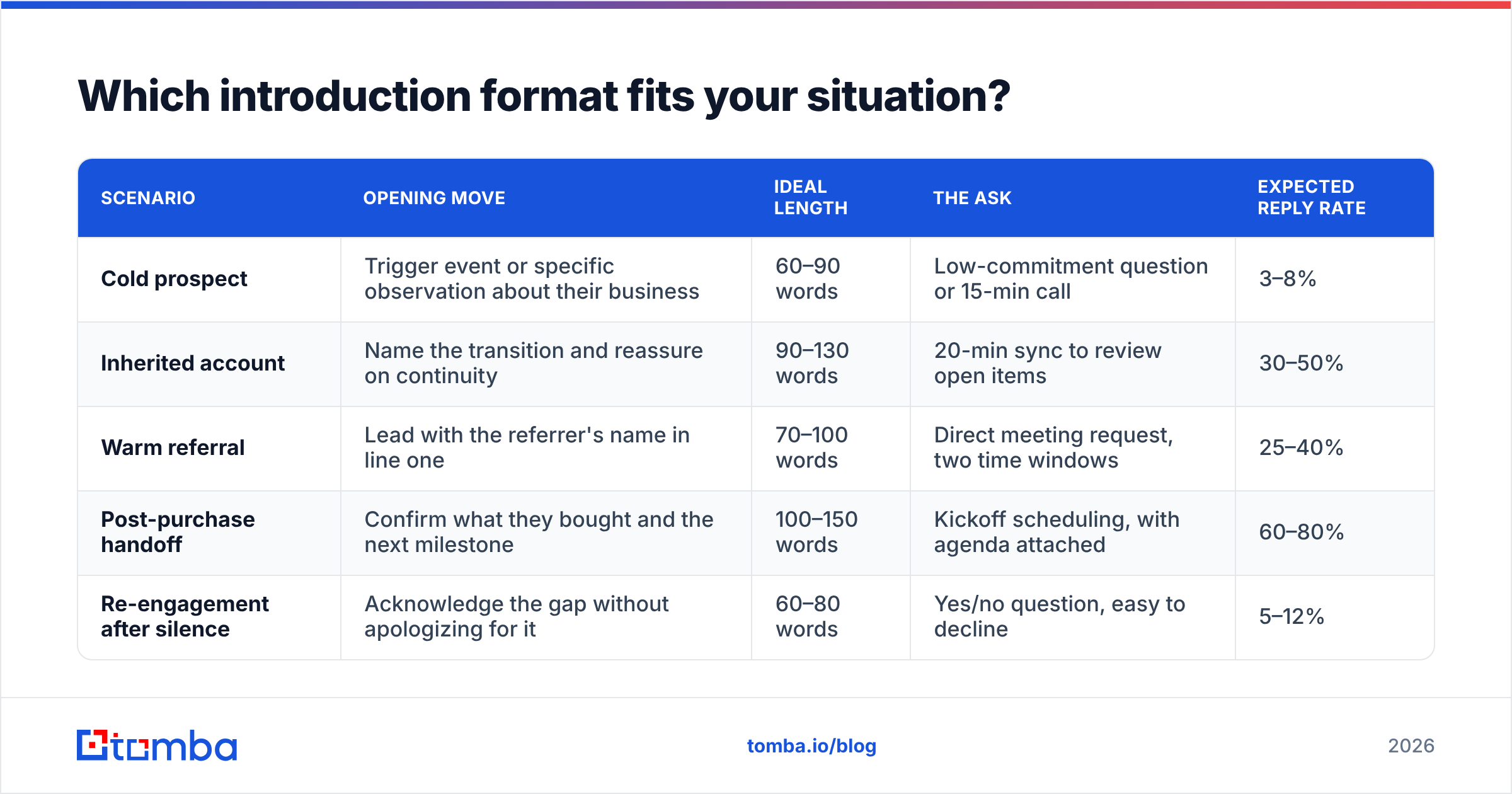
The four scenarios differ on tone, length, and how aggressive the ask can be. Treating them identically is the most common structural mistake.
| Scenario | Opening move | Ideal length | The ask | Expected reply rate |
|---|---|---|---|---|
| Cold prospect | Trigger event or specific observation about their business | 60–90 words | Low-commitment question or 15-min call | 3–8% |
| Inherited account | Name the transition and reassure on continuity | 90–130 words | 20-min sync to review open items | 30–50% |
| Warm referral | Lead with the referrer's name in line one | 70–100 words | Direct meeting request, two time windows | 25–40% |
| Post-purchase handoff | Confirm what they bought and the next milestone | 100–150 words | Kickoff scheduling, with agenda attached | 60–80% |
| Re-engagement after silence | Acknowledge the gap without apologizing for it | 60–80 words | Yes/no question, easy to decline | 5–12% |
Two things fall out of that table. First, warm contexts tolerate (and reward) a direct meeting ask, while cold contexts punish it. Second, reply-rate expectations differ by an order of magnitude, so judging a cold intro campaign against inherited-account numbers will make a healthy campaign look broken.
What do good introduction emails look like in practice?#
Cold prospect, trigger-based:
Subject: Your new Berlin office
Hi Jonas,
Saw the Berlin expansion announcement last week. Congrats.
I'm Elena at Northbridge. We work with ops teams opening a second EU entity, usually around the payroll and compliance scramble in month one.
Worth 15 minutes to compare notes on what the first 90 days looked like for two similar teams? Thursday or Friday afternoon works on my end.
Elena
Eighty-one words. The homework is in line one, the identity is one clause, the value claim is specific to his exact situation, and the ask is small and dated.
Inherited account:
Subject: Taking over your account, Priya
Hi Priya,
I'm Marcus, your new account manager at Northbridge. Dana moved to our enablement team last month and handed me your notes.
Two things I already know from them: the API rate-limit issue from March is still open, and your renewal lands in November. I've pulled the ticket history on the first one and will have an answer by Wednesday regardless of whether we talk.
Would a 20-minute call next week help? I'd rather learn your priorities from you than from a handoff doc.
Marcus
This one earns its extra length because it does something no generic intro can: it proves the transition did not lose information. That is the only fear an inherited customer actually has.
Warm referral:
Subject: Ravi Menon suggested I reach out
Hi Tom,
Ravi Menon mentioned you're rebuilding the reporting stack this quarter and thought a conversation might be useful.
I run partnerships at Northbridge. We handled the same migration for Ravi's team last spring, and the messy part was historical data mapping, not the tooling.
Free Tuesday 2pm or Wednesday 10am?
Sofia
The referrer's name goes in the subject line and line one. Borrowed trust decays fast, so spend it immediately.
How do you write a subject line that actually gets opened?#
Subject lines for introductions follow a narrower set of rules than general cold email, because the recipient has no prior relationship to trade on.
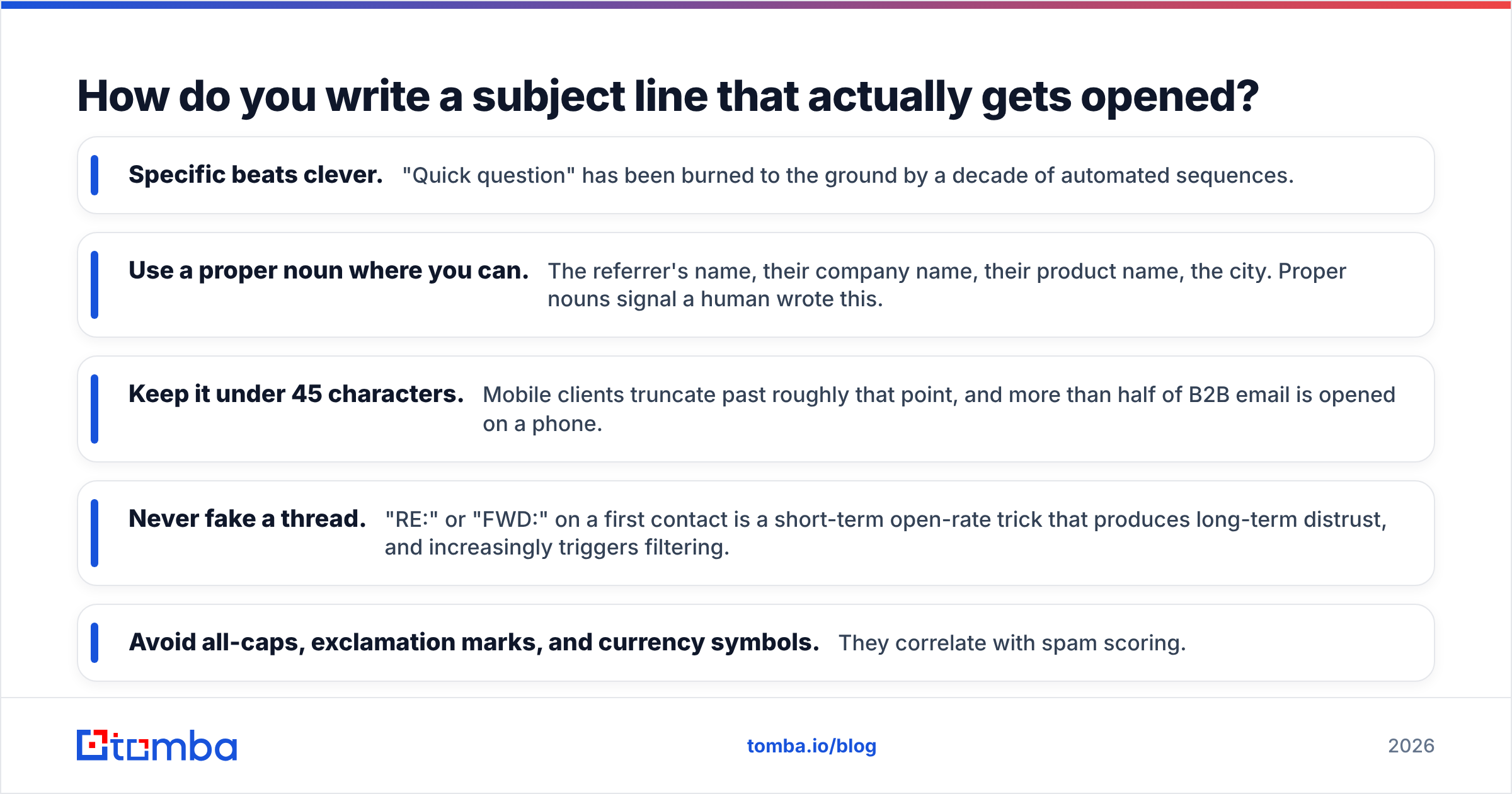
- Specific beats clever. "Quick question" has been burned to the ground by a decade of automated sequences.
- Use a proper noun where you can. The referrer's name, their company name, their product name, the city. Proper nouns signal a human wrote this.
- Keep it under 45 characters. Mobile clients truncate past roughly that point, and more than half of B2B email is opened on a phone.
- Never fake a thread. "RE:" or "FWD:" on a first contact is a short-term open-rate trick that produces long-term distrust, and increasingly triggers filtering.
- Avoid all-caps, exclamation marks, and currency symbols. They correlate with spam scoring.
If you are testing variants at volume, run them through a subject line tester before the send rather than burning list volume to learn what a static analyzer could have told you. HubSpot's sales resource library and Gartner's sales research both document the same pattern: relevance signals in the subject line outperform curiosity gaps for first-touch B2B contact, and the gap has widened as buyers got more filtered.

Does timing and follow-up change the outcome?#
Yes, and more than copy does at the margins.
Send window. Tuesday through Thursday, 7–9am or 1–3pm in the recipient's local time, remains the reliable band for B2B. Monday morning competes with weekend backlog; Friday afternoon competes with nothing because nobody is reading.
Follow-up cadence. For cold introductions, three touches over 12 days outperforms both one-and-done and aggressive seven-touch sequences. Day 1, day 4, day 12. Each follow-up must add something (a relevant case, a data point, a narrowed ask), never just "bumping this to the top of your inbox."
Inherited accounts are different. Follow up within 48 hours if there is no reply, by phone if you have a number, because silence there usually means the email never surfaced rather than disinterest. If you do not have a direct line, a phone finder closes that gap faster than asking around internally.
Know your baseline. If you do not track response rate per scenario, you cannot tell whether a rewrite helped. Segment the metric by the five scenarios in the table above, or the averages will hide everything useful.
What mistakes still kill otherwise good intro emails?#
Attachments on first contact. They depress deliverability and nobody opens them from a stranger. Link instead.
Three asks stacked. "Let me know if you want a demo, or I can send the case study, or we could just chat." Choice paralysis reads as low confidence. Pick one.
Apologizing for existing. "Sorry to bother you," "I know you're busy," "I'll be quick." Each one tells the reader their instinct to delete is correct.
Over-formality. "Dear Sir or Madam" and "I hope this email finds you well" are the textual equivalent of a fax cover sheet. Standard email etiquette in B2B has been conversational for fifteen years. Write like you would speak in a meeting.
Sending to a guess. firstname.lastname@company.com is a coin flip across most domains, and a bounce on your first contact damages sender reputation on exactly the domain you most want to reach. Confirm the pattern first. A domain search returns the verified format and the people who match your target role, which turns the guess into a fact.
How do you scale this without sounding automated?#
Personalization at volume comes from structure, not from writing each email by hand.
Build a template with two variable slots: the research line and the value claim. Everything else stays fixed. Then spend your research time filling only those two slots. Three minutes of real research per contact, applied to a fixed skeleton, produces email that reads handwritten at roughly ten times the throughput of writing from scratch.
The input to that process is a clean, current contact list. If your research time is being spent hunting for addresses instead of reading about the account, the ratio is inverted and your intro emails will show it.
Start with the address, not the adjectives. The best-written introduction email in your drafts folder is worth zero if it lands on a role alias, a departed employee, or a typo. Tomba's Email Finder resolves verified professional addresses by name and domain, with the verification step built into the same call, so the first message you send to a new customer actually arrives. The free tier covers 25 searches a month if you want to test it against a list you already trust; paid plans start at $49/mo on Tomba pricing when you are ready to run it across a territory.
Related guides#
Ready to find emails that actually work?
Join 150,000+ professionals who stopped guessing and started sending. Free credits on signup — no credit card required.
Get the Tomba newsletter
Practical outbound tactics and product updates — once every two weeks.
About the author