Introducing a Person via Email: Templates, Rules, Examples
Most email introductions fail before anyone replies — wrong context, wrong permission, wrong reply chain. Here is the double opt-in method, four copy-paste templates, and the etiquette that keeps both sides grateful instead of annoyed.
TL;DR
- Never make a live introduction without permission from both sides. The double opt-in — ask each person separately, then connect them — is the only format that protects your reputation.
- The intro email has one job: give each person enough context to say yes in under 15 seconds. Two sentences per person, one sentence on why now, one clear next step.
- Move yourself out of the thread on purpose. "Moving myself to BCC" is the single line that separates a professional intro from a cluttered reply-all.
- Forwardable blurbs beat long pitches. Write the paragraph your connector can copy-paste without editing, and your hit rate roughly doubles.
- If you are introducing someone to a person you found rather than a person you know, that is outreach, not an introduction — and it needs a verified address, not a guess.
What does "introducing a person via email" actually mean?#
An email introduction is a transfer of trust. You are lending your credibility to someone else so a stranger will take their meeting. That is the whole mechanic, and it explains every rule that follows.
There are three distinct situations people lump together, and they need different handling:
- The connector intro. You know two people. One wants to meet the other. You write the email that puts them in the same thread.
- The requested intro. Someone asks you for an introduction to a person in your network. You are doing them a favor, and you carry the downside risk if it goes badly.
- The self-introduction. You are emailing someone cold and introducing yourself. This is a different discipline — it is cold email, and pretending it is an "introduction" is exactly why so many of them get deleted.
This guide covers all three, but spends most of its time on the first two, because those are the ones where the etiquette actually matters and where most people get it wrong.
Why do most email introductions fail?#
They fail for reasons that have nothing to do with writing quality.
No permission was asked. The connector fires off a live intro with both parties CC'd. Now the recipient has to either take a meeting they never agreed to or reject someone publicly in front of a person they respect. Most people choose silence, which is the worst outcome for everyone.
The context is one-sided. The intro explains in detail why Person A wants to meet Person B, and says nothing about what Person B gets. Person B reads it as a sales request wearing a friendly hat.
The connector stays in the thread. Three emails later, everyone is still hitting reply-all, and the connector is getting calendar links they do not need.
The ask is vague. "You two should talk" gives nobody a next action. A thread with no next action dies in 48 hours.
The email address is wrong. This one is invisible until it is fatal. You introduce someone using an address you pulled from an old signature or guessed from a pattern, the message bounces, and the person on the other end never knows they were introduced. If you are working from anything other than a confirmed address, run it through an email verifier before you send. A bounced introduction is worse than no introduction — it burns the request and the goodwill in one shot.
What is the double opt-in intro, and should you always use it?#
Yes, effectively always. The double opt-in intro means you ask both people privately before you connect them. It costs you two short emails and eliminates almost every failure mode above.
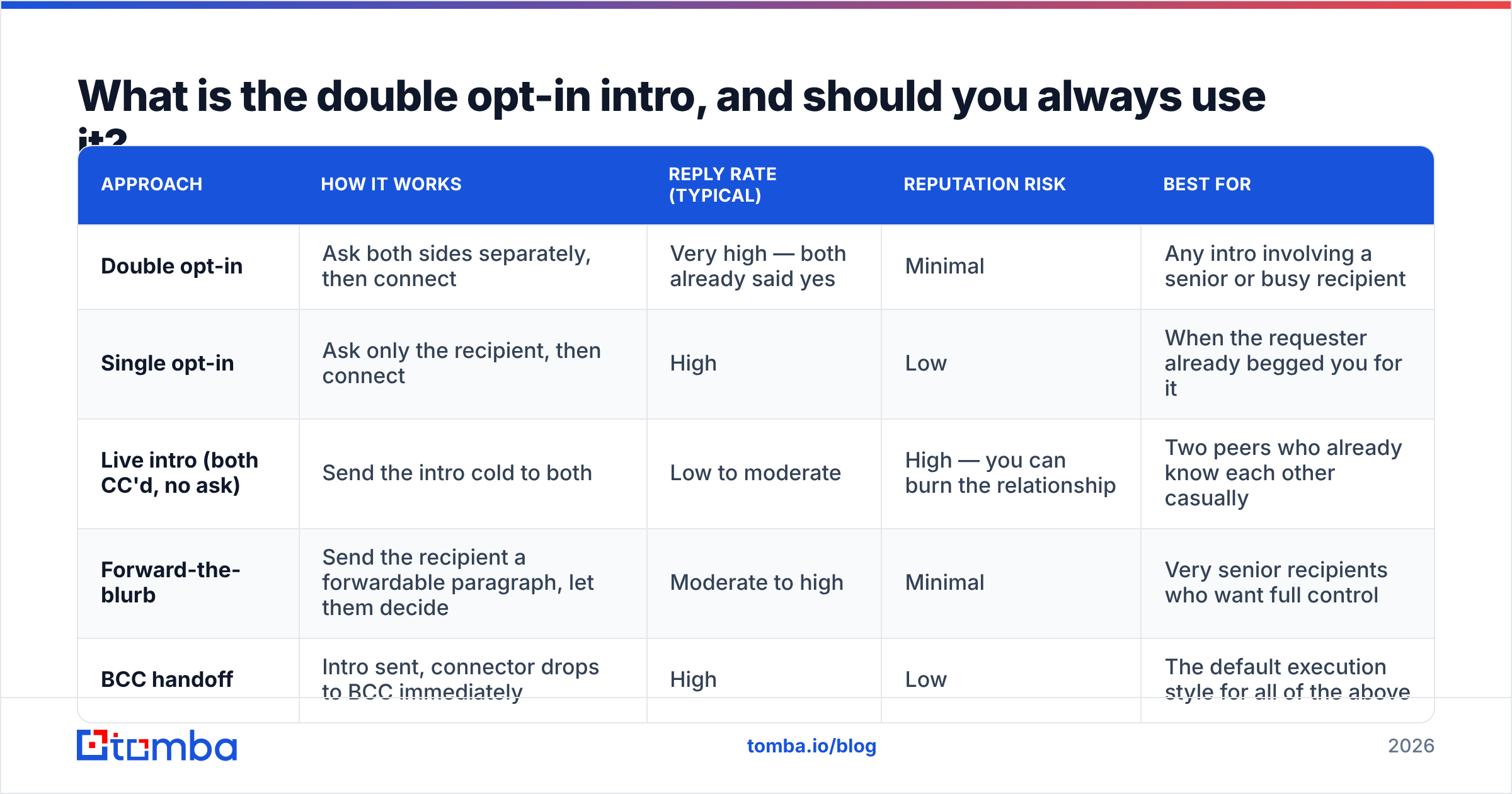
Here is how the common approaches compare in practice:
| Approach | How it works | Reply rate (typical) | Reputation risk | Best for |
|---|---|---|---|---|
| Double opt-in | Ask both sides separately, then connect | Very high — both already said yes | Minimal | Any intro involving a senior or busy recipient |
| Single opt-in | Ask only the recipient, then connect | High | Low | When the requester already begged you for it |
| Live intro (both CC'd, no ask) | Send the intro cold to both | Low to moderate | High — you can burn the relationship | Two peers who already know each other casually |
| Forward-the-blurb | Send the recipient a forwardable paragraph, let them decide | Moderate to high | Minimal | Very senior recipients who want full control |
| BCC handoff | Intro sent, connector drops to BCC immediately | High | Low | The default execution style for all of the above |
The double opt-in has a second benefit people miss: it gives you a graceful exit. If the recipient says no, nobody was publicly rejected. You tell the requester "not the right time on their end" and the relationship survives intact. A live intro gives you no such escape hatch.
The only real argument against double opt-in is speed. It adds a day, sometimes two. Accept the delay. A connection that arrives on Thursday with enthusiasm beats one that arrives Tuesday and gets ignored.
What goes into an introduction email that actually works?#
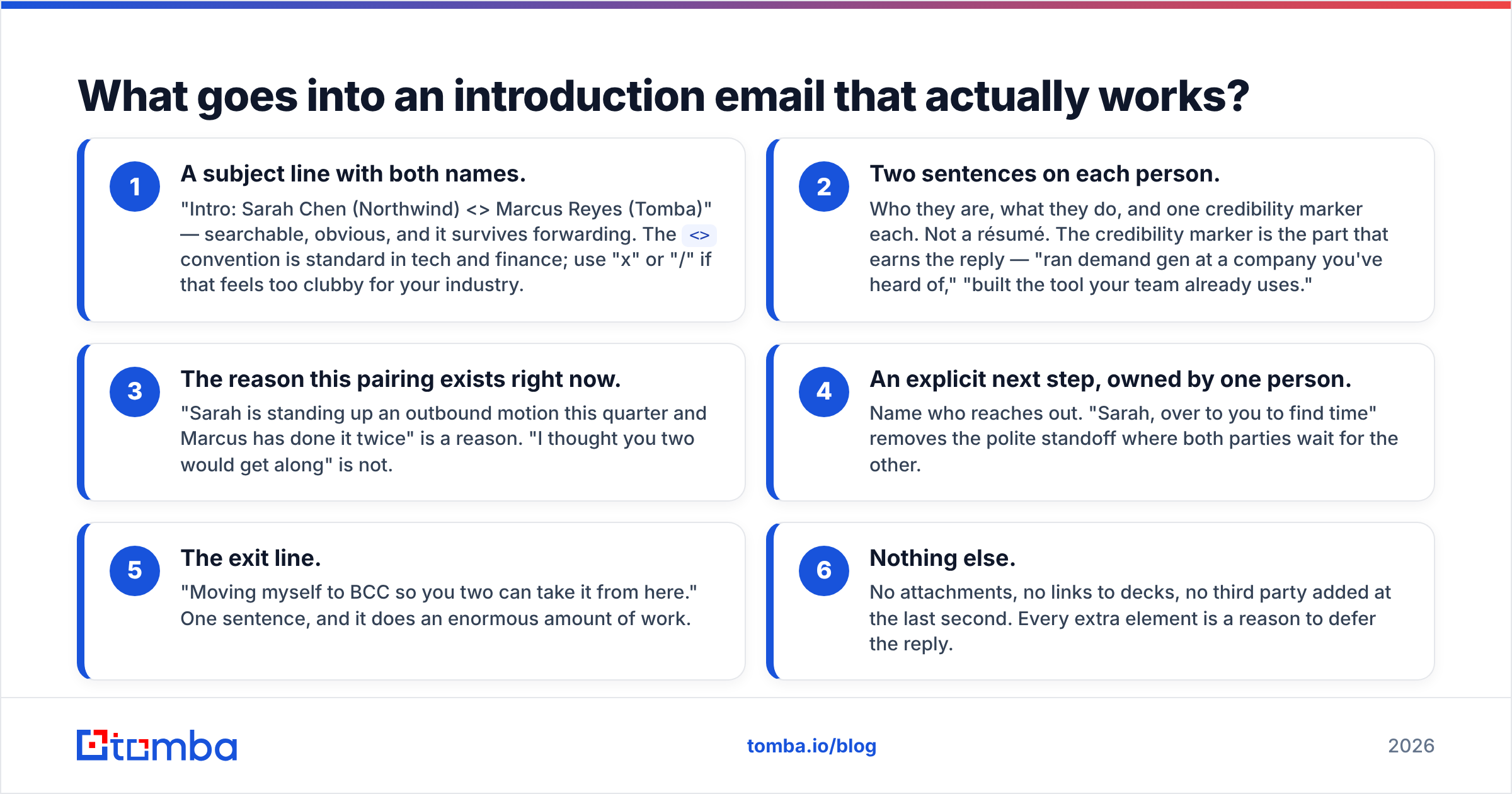
Six elements, in this order. Miss any of them and the thread stalls.
- A subject line with both names. "Intro: Sarah Chen (Northwind) <> Marcus Reyes (Tomba)" — searchable, obvious, and it survives forwarding. The
<>convention is standard in tech and finance; use "x" or "/" if that feels too clubby for your industry. - Two sentences on each person. Who they are, what they do, and one credibility marker each. Not a résumé. The credibility marker is the part that earns the reply — "ran demand gen at a company you've heard of," "built the tool your team already uses."
- The reason this pairing exists right now. "Sarah is standing up an outbound motion this quarter and Marcus has done it twice" is a reason. "I thought you two would get along" is not.
- An explicit next step, owned by one person. Name who reaches out. "Sarah, over to you to find time" removes the polite standoff where both parties wait for the other.
- The exit line. "Moving myself to BCC so you two can take it from here." One sentence, and it does an enormous amount of work.
- Nothing else. No attachments, no links to decks, no third party added at the last second. Every extra element is a reason to defer the reply.
Keep the whole thing under 150 words. The intro is a door, not a room.
What do the templates look like?#
Template 1 — The permission ask (send this first)#
To the recipient, before any live intro exists:
Subject: Quick ask — intro to Sarah Chen?

Hi Marcus,

Sarah Chen runs growth at Northwind (Series B, ~80 people). She's
building an outbound team from zero this quarter and asked who's
done it well. You were the first person I thought of.

She's not selling anything — she wants 20 minutes on how you
structured your first SDR pod.

Want me to connect you? Totally fine to say no, she'll never know
I asked.
That last line is the whole reason this works. It makes "no" cheap.
Template 2 — The live intro (after both said yes)#
Subject: Intro: Sarah Chen (Northwind) <> Marcus Reyes (Tomba)

Sarah, meet Marcus. He built Tomba's outbound function from one
rep to eleven and has strong opinions about what to do in the
first 90 days.

Marcus, meet Sarah. She's VP Growth at Northwind and is standing
up her first SDR pod this quarter — exactly the problem you
solved two years ago.

Sarah, over to you to find 20 minutes on Marcus's calendar.

Moving myself to BCC. Enjoy.
Note the symmetry. Each person gets the same weight, the same sentence count, the same respect. Lopsided intros read as favors, and favors create obligation nobody asked for.
Template 3 — The forwardable blurb (what the requester sends you)#
If you are the one asking for an introduction, do not make your connector write anything. Send them this:
Hi [Connector],

Would you be open to introducing me to Marcus at Tomba? Here's a
blurb you can forward as-is, edit, or ignore entirely:

---
Sarah runs growth at Northwind (Series B, 80 people). She's
hiring her first three SDRs in Q1 and wants 20 minutes on how
you structured your pod and what you'd do differently. No pitch,
no ask beyond the call.
---

And genuinely no pressure if it's not the right time.
Connectors say yes to forwardable blurbs at a much higher rate than to open-ended requests, for the obvious reason: you removed the work.
Template 4 — The self-introduction (cold, no mutual connection)#
Subject: Northwind's first SDR pod

Marcus — Sarah at Northwind. I read your teardown of the 90-day
SDR ramp and we're about to make most of the mistakes you listed.

Hiring three reps in January. Would 20 minutes be useful to you
in exchange for a look at our territory model? Happy to go first.

If not, the teardown alone was worth the email.
Be honest with yourself: this is cold outreach. It has no borrowed trust, so it has to earn attention with relevance and brevity. If you write a lot of these, a subject line generator and a hard 90-word cap will do more for your reply rate than any clever opener.
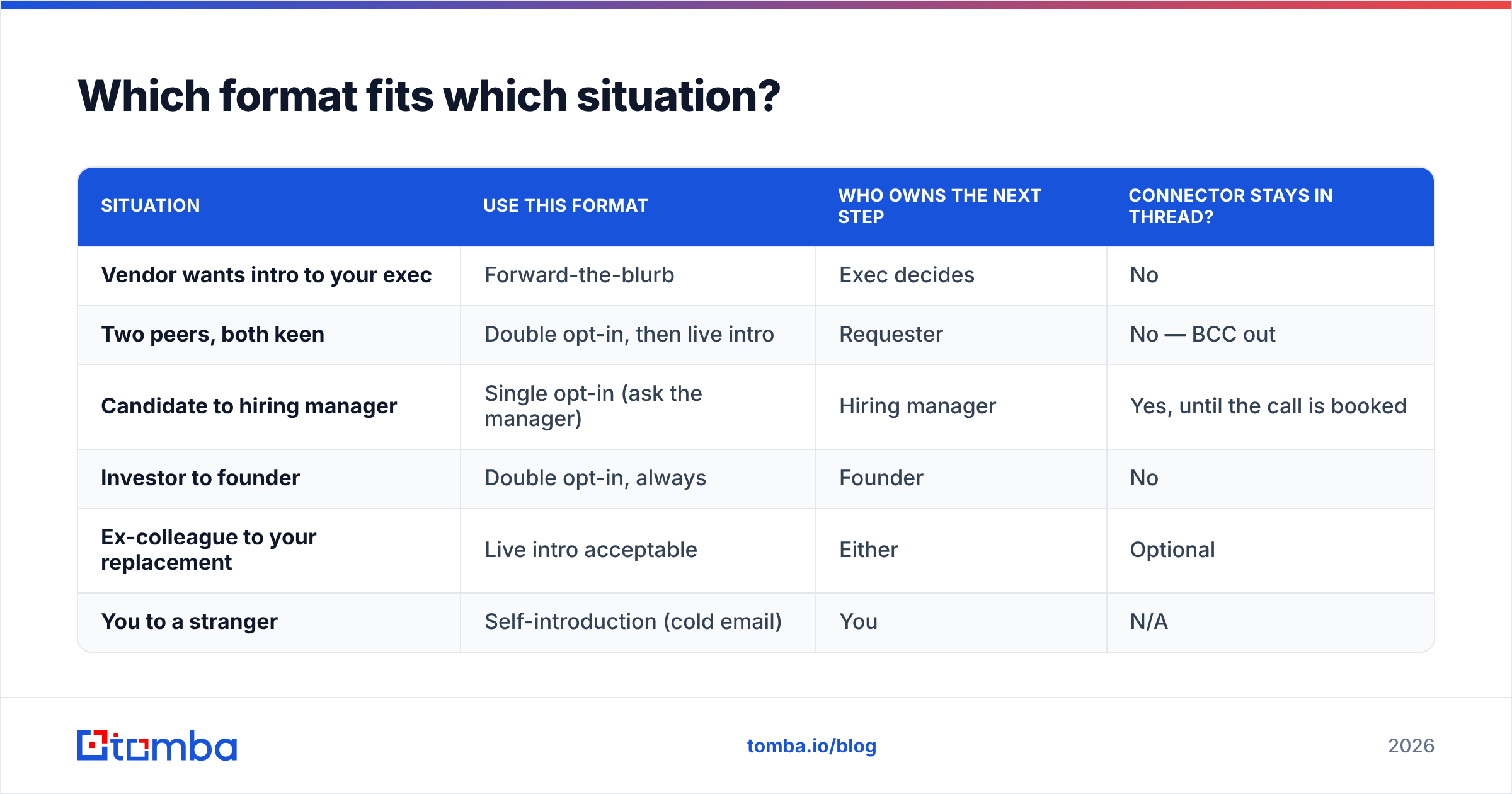
Which format fits which situation?#
| Situation | Use this format | Who owns the next step | Connector stays in thread? |
|---|---|---|---|
| Vendor wants intro to your exec | Forward-the-blurb | Exec decides | No |
| Two peers, both keen | Double opt-in, then live intro | Requester | No — BCC out |
| Candidate to hiring manager | Single opt-in (ask the manager) | Hiring manager | Yes, until the call is booked |
| Investor to founder | Double opt-in, always | Founder | No |
| Ex-colleague to your replacement | Live intro acceptable | Either | Optional |
| You to a stranger | Self-introduction (cold email) | You | N/A |
The pattern across every row: the more senior or busier the recipient, the more control you hand them before anything lands in their inbox.
What etiquette mistakes should you avoid?#
Do not BCC someone into an introduction thread. Blind carbon copy has exactly one legitimate use in introductions — moving yourself out after the handoff. Using it to quietly loop in a third party is the kind of thing that ends relationships when it surfaces, and it always surfaces.
Do not over-sell either side. Superlatives create expectations the first call cannot meet. "Best in the industry" sets a bar; "solved this exact problem at scale" sets a topic.
Do not introduce people to boost your own visibility. People can tell. Networking-for-networking's-sake intros are the reason many senior people have blanket "no unsolicited intros" policies, and the pattern is well documented across sales and RevOps communities — HubSpot's sales blog and Salesforce's blog both cover the reputational cost in depth.
Do not forget the follow-up. Two weeks later, send the requester one line: "Did that connect?" It takes five seconds and it tells you whether to keep making intros for that person. If the answer is consistently no, stop.
Do not send to an unverified address. Repeat offender, worth repeating. If you are introducing someone using an address you found rather than one you have corresponded with, confirm it first. A single bounce inside an introduction thread makes you look careless to both parties, and it quietly damages your sender reputation at the same time.
How do you introduce someone you found rather than someone you know?#
This comes up constantly in business development: your colleague needs to reach the head of partnerships at a target account, nobody has a warm path, and the "introduction" is really a first-touch email with a referral flavor.
Two things change.
First, the framing must be honest. "A colleague suggested I reach out" is fine if true. Inventing a mutual connection is a fast way to get blocked and, in some jurisdictions, a compliance problem.
Second, the data has to be right. You need the correct person, the correct role, and the correct address. Guessing firstname.lastname@ and hoping is not a strategy — patterns vary, aliases forward silently, and catch-all domains accept everything and deliver nothing. Use a domain search to see the real address pattern for the company and who currently holds the role, then verify before you send. That takes the guesswork out of the only variable you fully control.
For teams doing this at volume, the sequence is: find the right person, confirm the address, write a genuinely short note, follow up twice, stop. Anything longer than that is a sequence, not an introduction, and it should be labeled as such internally so your response rate numbers stay honest.
How should you respond when someone introduces you?#
Reply within 24 hours. Always. The connector spent social capital and is watching.
Structure the reply in four lines:
- Thank the connector by name, briefly.
- Move them to BCC yourself if they did not do it: "Moving [name] to BCC — thanks again."
- Say something specific about the other person that proves you did ten seconds of homework.
- Propose a concrete time or send a link. Do not ask "when works for you?" Offer two windows.
If you are not interested, still reply — to the connector privately, within a day, with a real reason. Silence after an introduction is the fastest way to stop receiving them.
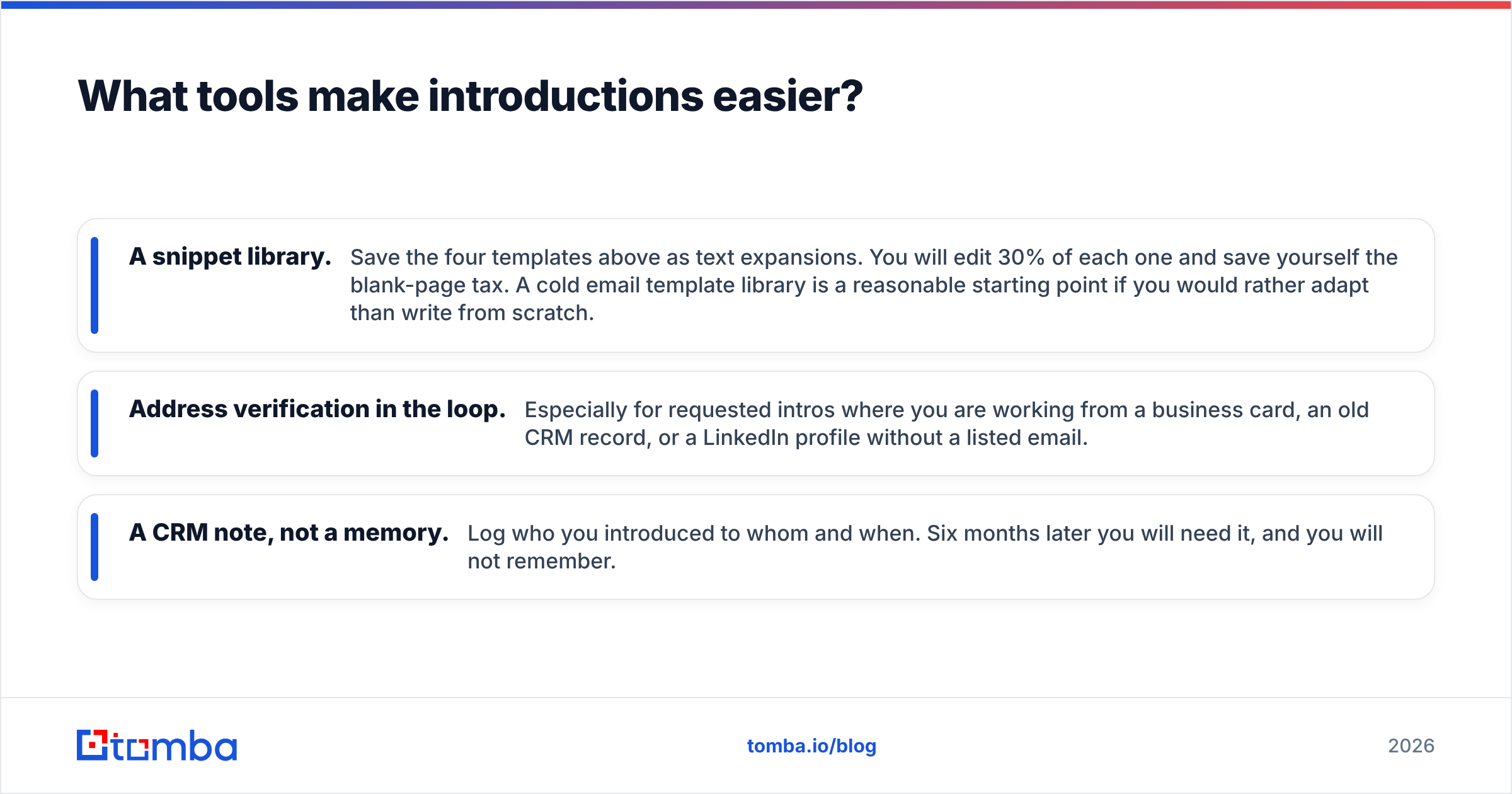
What tools make introductions easier?#
Not many are needed, honestly. A good intro is 120 words and a calendar link. But three things help when you are doing this weekly rather than occasionally:
- A snippet library. Save the four templates above as text expansions. You will edit 30% of each one and save yourself the blank-page tax. A cold email template library is a reasonable starting point if you would rather adapt than write from scratch.
- Address verification in the loop. Especially for requested intros where you are working from a business card, an old CRM record, or a LinkedIn profile without a listed email.
- A CRM note, not a memory. Log who you introduced to whom and when. Six months later you will need it, and you will not remember.
That is the entire stack. Anything more elaborate is usually a sign you are running outbound and calling it networking.
Where should you start?#
Pick your next introduction and run it through the double opt-in. Ask the recipient first, with the "she'll never know I asked" escape hatch. Then send the two-paragraph live intro with a named next step and a BCC exit. That single change will do more for your intro success rate than any amount of copy polish.
And when the introduction is actually outreach to someone you have not met, get the address right before you get the wording right. Tomba's Email Finder returns verified professional addresses by name and domain, with confidence scoring and source attribution so you know what you are sending to — free for 25 searches a month, $49/mo on Starter when you need volume. Check the full Tomba pricing if you are rolling it out to a team. A verified address will not write the introduction for you, but it guarantees the one you wrote actually arrives.
Related guides#
// get started
Find, verify and enrich your first contacts today
Start on the free plan with 25 searches a month, then scale when your team is ready.
Free plan · No credit card required · GDPR & CCPA
Get the Tomba newsletter
Product and data updates
// about the author