Introducing Yourself in an Email: 7 Templates That Work (2026)
Most self-introduction emails fail in the first seven words. Here is the anatomy, the templates, and the data checks that make a cold intro read like a reason to reply instead of a bio.
TL;DR
- Introducing yourself in an email is not a biography. It is a two-sentence trade: here is who I am, here is why that is useful to you, right now.
- The failure point is almost always the first line. "My name is X and I work at Y" tells the reader nothing they need, so they archive before sentence two.
- Match the format to the context. A cold sales intro, a referral intro, and a new-hire intro have different goals and different ideal lengths — one template does not cover all three.
- Keep it under 125 words, ask for one thing, and make the ask smaller than a meeting when the relationship is cold.
- None of the copy matters if the address bounces. Verify before you send — a 12% bounce rate on an intro campaign damages your sending domain faster than bad writing ever will.
What does "introducing yourself in an email" actually mean in 2026?#
It means earning a reply from someone who has no obligation to give you one.
That framing matters, because most people write self-introductions as if the reader already agreed to listen. They open with their name, their title, their company's mission statement, and three lines of credentials. The reader's inbox does not work that way. The first 40 characters of your preview text compete with 120 other unread messages, and your job title is not a competitive advantage there.
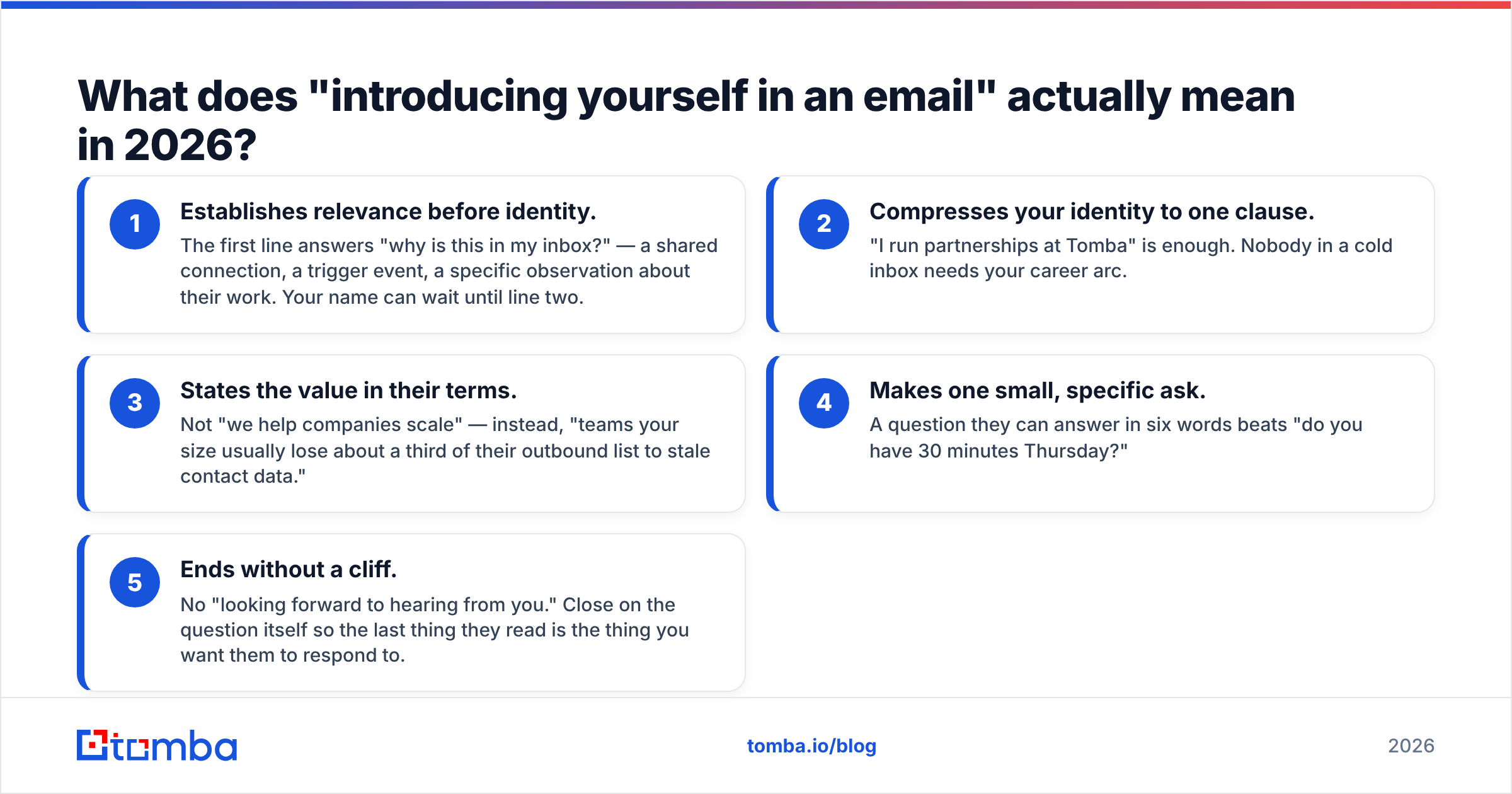
A working self-introduction email does three jobs in order:
- Establishes relevance before identity. The first line answers "why is this in my inbox?" — a shared connection, a trigger event, a specific observation about their work. Your name can wait until line two.
- Compresses your identity to one clause. "I run partnerships at Tomba" is enough. Nobody in a cold inbox needs your career arc.
- States the value in their terms. Not "we help companies scale" — instead, "teams your size usually lose about a third of their outbound list to stale contact data."
- Makes one small, specific ask. A question they can answer in six words beats "do you have 30 minutes Thursday?"
- Ends without a cliff. No "looking forward to hearing from you." Close on the question itself so the last thing they read is the thing you want them to respond to.
Those five parts are the whole anatomy. Everything else — the subject line, the signature, the timing — amplifies or wastes them.
Why do most self-introduction emails get ignored?#
Because they are written from the sender's point of view, and the reader can tell in under two seconds.
Here are the patterns that kill an intro before it starts:
- The résumé opener. "I'm a senior account executive with eight years of experience in..." The reader has not asked for a hiring decision.
- The false familiarity. "Hope this finds you well!" plus an emoji plus a first-name-only signature from someone they have never met. Warmth you have not earned reads as a script.
- The unclear ask. Three paragraphs that end with "let me know your thoughts." Thoughts on what? Ambiguity gets deferred, and deferred means deleted.
- The everything-at-once pitch. Intro, case study, pricing, calendar link, and a PDF attachment in one message. Each additional ask cuts the odds of any single one landing.
- The wrong person entirely. You wrote a perfect intro to a director who left the company 14 months ago.
That last one is worth sitting with. Copy quality is the variable everyone obsesses over, but contact quality is the variable that silently caps your results. If 20% of your list is wrong, your best-performing template still loses a fifth of its ceiling before a single word is read. Google's own sender guidelines treat repeated invalid recipients as a reputation signal, which means bad data does not just cost you replies — it costs you the inbox itself for everyone else on the list.
Which intro format fits which situation?#
The biggest mistake after "me first" writing is using a cold-outreach template for a warm context, or vice versa. A referral intro that opens with a trigger-event observation wastes the referral. A cold intro that assumes goodwill sounds delusional.
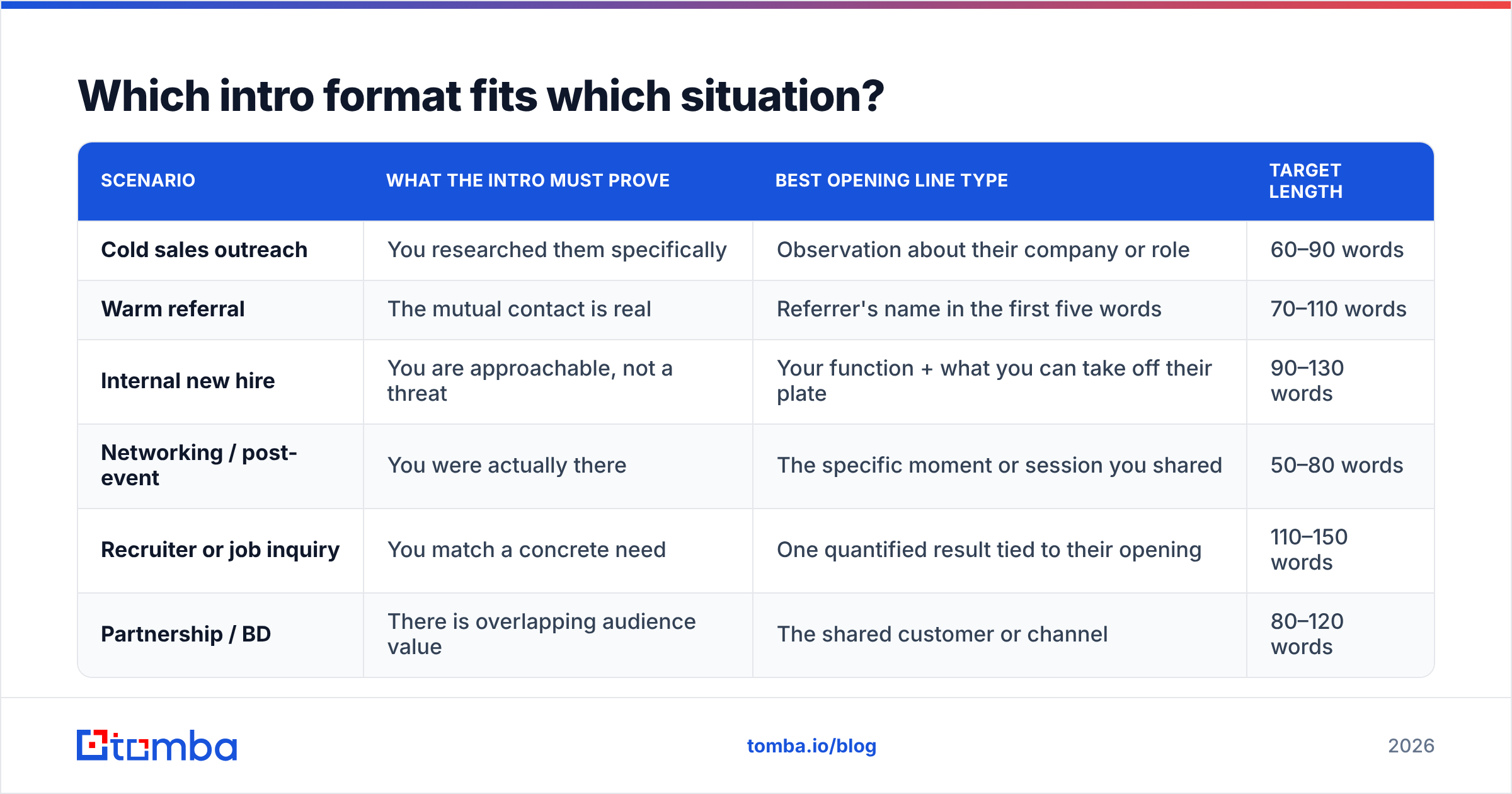
| Scenario | What the intro must prove | Best opening line type | Target length |
|---|---|---|---|
| Cold sales outreach | You researched them specifically | Observation about their company or role | 60–90 words |
| Warm referral | The mutual contact is real | Referrer's name in the first five words | 70–110 words |
| Internal new hire | You are approachable, not a threat | Your function + what you can take off their plate | 90–130 words |
| Networking / post-event | You were actually there | The specific moment or session you shared | 50–80 words |
| Recruiter or job inquiry | You match a concrete need | One quantified result tied to their opening | 110–150 words |
| Partnership / BD | There is overlapping audience value | The shared customer or channel | 80–120 words |
The pattern in that table: the colder the relationship, the shorter the email. Cold readers give you less attention, so the ask has to shrink to match. Warm contexts tolerate more words because the reader has already decided to read.
What should the subject line say?#
Say the thing, not a tease.
Self-introduction subject lines fail in two directions. They are either vague ("Quick question") — which pattern-matches to every automated sequence ever sent — or they are stuffed ("Introduction: Sarah Chen, VP Partnerships at Northwind Analytics, re: Q4 co-marketing"). Neither survives a mobile preview pane, which truncates around 35–40 characters on most devices.
Subject lines that hold up for an intro:
Ivan suggested I reach out— referral, name-first, unmistakableYour post on catch-all domains— proves you read somethingNew on the RevOps team — 2 questions— internal, sets expectation of brevityRe: your Series B— trigger event, no pitch impliedFrom Tuesday's panel— event follow-up, zero ambiguity
Avoid all-caps, avoid "URGENT," and avoid fake Re: prefixes on threads that never existed — that last one is the fastest way to get marked as spam by someone who would otherwise have replied. If you want to sanity-check variants before sending, run them through a subject line generator and then pressure-test the winners against your own inbox on a phone screen.
How do the three main intro approaches compare?#
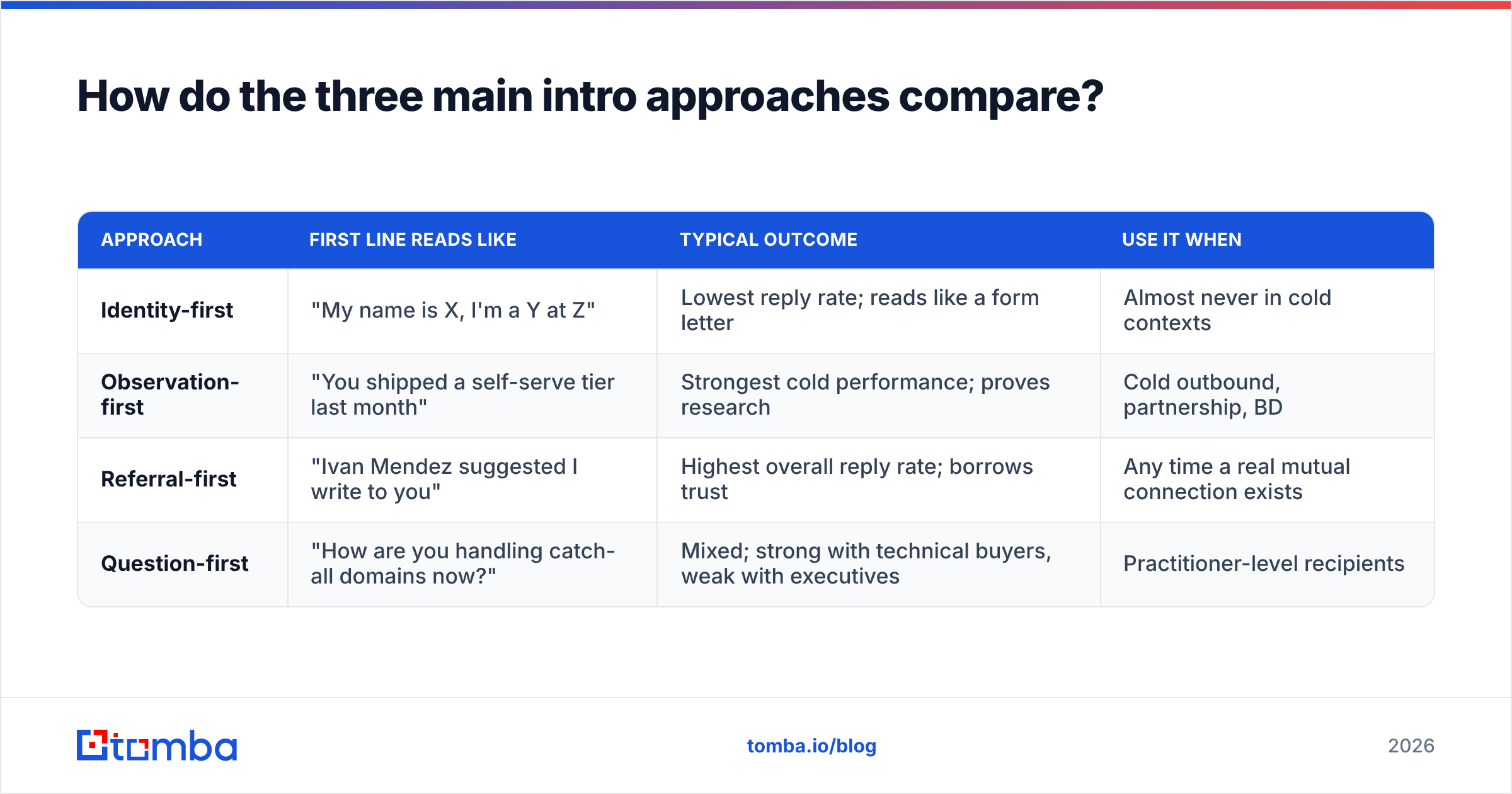
Most self-introduction emails fall into one of three structural styles. They are not equally effective, and the difference is not subtle.
| Approach | First line reads like | Typical outcome | Use it when |
|---|---|---|---|
| Identity-first | "My name is X, I'm a Y at Z" | Lowest reply rate; reads like a form letter | Almost never in cold contexts |
| Observation-first | "You shipped a self-serve tier last month" | Strongest cold performance; proves research | Cold outbound, partnership, BD |
| Referral-first | "Ivan Mendez suggested I write to you" | Highest overall reply rate; borrows trust | Any time a real mutual connection exists |
| Question-first | "How are you handling catch-all domains now?" | Mixed; strong with technical buyers, weak with executives | Practitioner-level recipients |
Two practical notes on reading that table. First, referral-first only works if the referral is real and verifiable — naming someone who will not vouch for you is a reputational grenade. Second, observation-first collapses the moment the observation is generic. "I noticed you're growing fast" is not an observation, it is a guess with punctuation.
What do the templates actually look like?#
Seven patterns, each stripped to the parts that do work.
1. Cold outreach to a prospect
Subject: your new self-serve tier
Saw you opened up self-serve last month without adding a sales-assist path. Teams that do that usually start seeing enterprise-shaped signups getting stuck in the free plan within a quarter.
I'm Amina, I work on outbound data at Tomba. We help RevOps teams spot which of those free accounts are actually buying committees.
Is that showing up for you yet, or too early to tell?
2. Warm referral
Subject: Ivan Mendez suggested I reach out
Ivan mentioned you rebuilt your lead routing last quarter and said we'd have a lot to talk about.
I'm Daniel — I run lifecycle at Northwind. We went through the same rebuild in March and made two decisions I'd probably reverse today.
Worth comparing notes for 15 minutes, or would a short write-up be more useful?
3. New team member, internal
Subject: New on the data team — 2 questions
Hi Priya — I joined Monday as a data engineer reporting to Sam, and I'll be owning the pipelines your dashboards read from.
Two things I'd like to get from you when you have ten minutes: which report breaks most often, and which one nobody actually uses anymore.
I'd rather fix the first and delete the second than guess. Free Thursday?
4. Networking after an event
Subject: from Tuesday's pricing panel
You made the point that discounting is a symptom of weak qualification, and it has been rattling around my head since.
I'm Leo, I run sales ops at Brightpath — I was the one who asked about annual prepay.
Are you writing that argument down anywhere? I'd read it.
5. Recruiter or job inquiry
Subject: re: your Senior RevOps Analyst opening
Your posting mentions untangling a Salesforce instance with six years of custom objects. I did exactly that at Corvin last year — cut the object count by 40% without losing a single historical report.
I'm Tomás. Nine years in RevOps, three of them cleaning up after fast growth.
Happy to send the teardown doc I wrote at the end of that project. Useful?
6. Partnership or co-marketing
Subject: we share about 60 customers
We keep running into your product inside the same accounts — mid-market ops teams who bought you for workflow and us for contact data.
I'm Rae, partnerships at Tomba. No integration pitch yet; I'm curious whether you're seeing the same overlap from your side.
Would a shared-account list be interesting to you?
7. Reconnecting after a long gap
Subject: four years later
We worked together on the Meridian migration in 2022 — I was the one who insisted on the staging environment nobody wanted to build.
I've since moved to Tomba, running data quality. Saw you're at Kestrel now and heading up ops.
No agenda. What are you working on that's actually interesting?
Notice what none of them include: an attachment, a calendar link, or the phrase "I wanted to reach out." You are reaching out. The email is the evidence.
Does the address matter more than the copy?#
Yes, and it is not close.
Think of it like a letter with perfect handwriting sent to a house that was demolished. The craft is irrelevant to the outcome. An intro email to j.smith@acme.com when the company actually uses john.smith@acme.com does not get a reply — it gets a bounce, and enough bounces get your domain throttled.
Three checks before an intro campaign leaves the building:
- Confirm the address exists. Run the list through an email verifier and drop anything that comes back invalid or risky. Aim to keep bounce rate under 2%.
- Confirm the person still holds the role. Titles rot faster than addresses. A quick data enrichment pass catches the director who became a VP somewhere else.
- Confirm the pattern when you had to guess. If you constructed the address from a naming convention, verify it rather than trusting the pattern — plenty of companies run two formats in parallel after an acquisition.
This is also where your measurement gets honest. If you track response rate against delivered messages rather than sent ones, you learn whether your template is weak or your list is. Those are entirely different problems with entirely different fixes, and teams conflate them constantly.
How do you know your intro email is working?#
Set the benchmark before you send, not after.
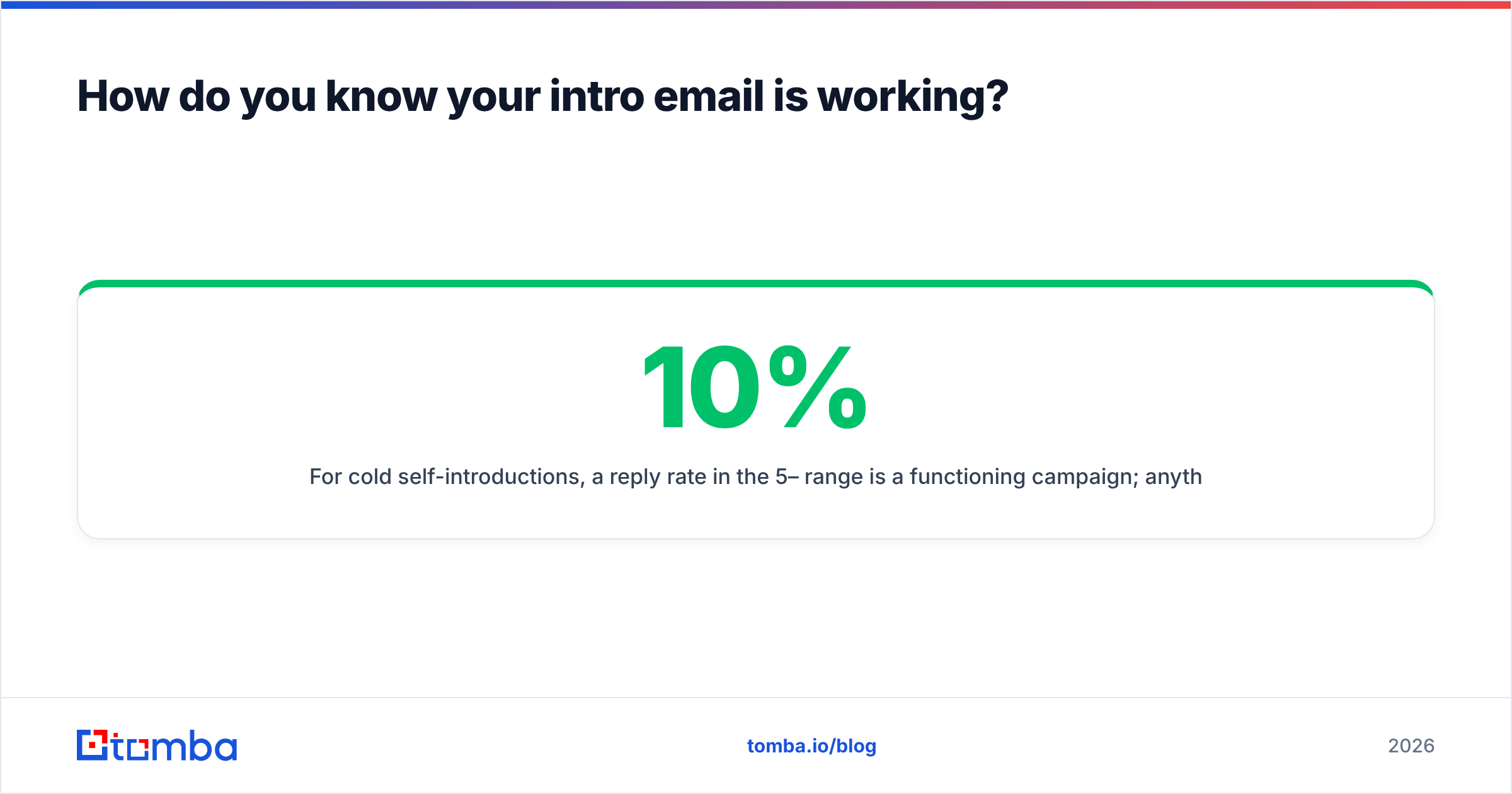
For cold self-introductions, a reply rate in the 5–10% range is a functioning campaign; anything above 15% usually means you found a genuinely sharp trigger event or you are working a warm-adjacent list. Referral intros should clear 40% or the referral was not as strong as you thought. Internal intros should approach 100% — if colleagues are not answering your first email, that is a culture signal, not a copy problem.
Track three things and nothing else at first:
- Bounce rate — a data problem. Fix with verification.
- Open rate — a subject line and sender-reputation problem. Fix with better subjects and warmed domains.
- Reply rate on delivered mail — a copy and targeting problem. Fix with the templates above.
Change one variable per test. Teams that rewrite the subject, the opener, and the ask simultaneously learn nothing from the result. Sales research outfits like Gartner and practitioner blogs like HubSpot's sales library publish enough baseline data to sanity-check your numbers, but your own list will always be the more reliable benchmark once you have 500 sends behind you.
What mistakes should you cut immediately?#
- Opening with your name instead of their context
- More than one ask per email
- Attachments in a first-contact message
- A calendar link before the reader has agreed there is something to discuss
- Any sentence containing "synergies," "circle back," or "touch base"
- Sending to a guessed address without verifying it
- Following up more than three times on an intro that has gone unanswered twice
That last one is a courtesy rule with a business benefit: aggressive follow-up on cold intros is one of the most reliable ways to generate spam complaints, and complaints compound across your whole domain.
Where should you start?#
Start with the list, then the template.
Write the observation-first version of your intro, keep it under 90 words, and make the ask a question the reader could answer from their phone at a stoplight. Then, before you send a single message, run the recipients through the Tomba Email Finder to confirm you have the right address for the right person at the right company — the free tier covers 25 searches a month if you just want to check your assumptions, and paid plans start at $49/mo when you are ready to run real volume. See Tomba pricing for the full breakdown.
A good introduction email is a small act of respect: you did the homework, you kept it short, and you asked for something answerable. Get the address right, and the writing finally gets to matter.
Related guides#
Ready to find emails that actually work?
Join 150,000+ professionals who stopped guessing and started sending. Free credits on signup — no credit card required.
Get the Tomba newsletter
Practical outbound tactics and product updates — once every two weeks.
About the author