Introduction by Email: How to Write Intros That Get Replies
Most introduction emails die in the first seven words. Here's the structure that works, five templates you can steal, and the deliverability checks that decide whether your intro is ever seen at all.
TL;DR
- An introduction by email is any first-contact message whose job is to earn one reply — not to close, pitch, or explain your whole company.
- Five distinct formats exist (cold intro, warm referral, double opt-in, self-introduction, and new-rep handover), and they need different lengths, subject lines, and asks.
- The winning structure is fixed: context line → relevance line → one specific ask → easy exit. Around 90–120 words total.
- Deliverability decides whether your copy is ever read. A single invalid address on a cold list damages the sender reputation of every intro you send that week.
- Verify the address before you write the email. Good copy sent to a dead inbox scores zero.
What is an introduction by email?#
An introduction by email is a first-contact message that establishes who you are, why you're writing to this specific person, and what tiny next step you want. That's it. It is not a pitch, not a product tour, and not a company overview.
Think of it like knocking on a neighbor's door for the first time. You don't lead with a 20-minute monologue about your life. You say your name, why you're standing there, and ask one small thing — do you know a good plumber? The relationship gets built later. Technically, the same constraint applies to email: the reader is deciding in about three seconds whether your message is relevant, and the only decision you're actually asking them to make is "reply or archive."
The failure mode is always the same. People treat the introduction email as a container for everything they want the prospect to eventually know. It gets long, it gets generic, it gets deleted.
Why do most introduction emails get ignored?#
Because they answer the sender's questions instead of the reader's.
The reader has exactly three questions when an unknown name appears in their inbox: Who is this? Why me? What do they want? Most intros answer question one at length, skip question two entirely, and make question three enormous ("do you have 30 minutes this week?").
There's also a mechanical reason that has nothing to do with copy. If your sending domain has a weak reputation, or your list contains addresses that bounce, your well-crafted introduction lands in spam and never gets scored on merit at all. Google's bulk sender guidelines are explicit about spam-rate thresholds, and they apply to small B2B senders too once volume creeps up.

So there are two separate battles. One is inbox placement. The other is attention. Losing either one produces identical results: silence.
What are the five types of introduction by email?#
They look similar and behave completely differently. Pick the right one before you write a word.
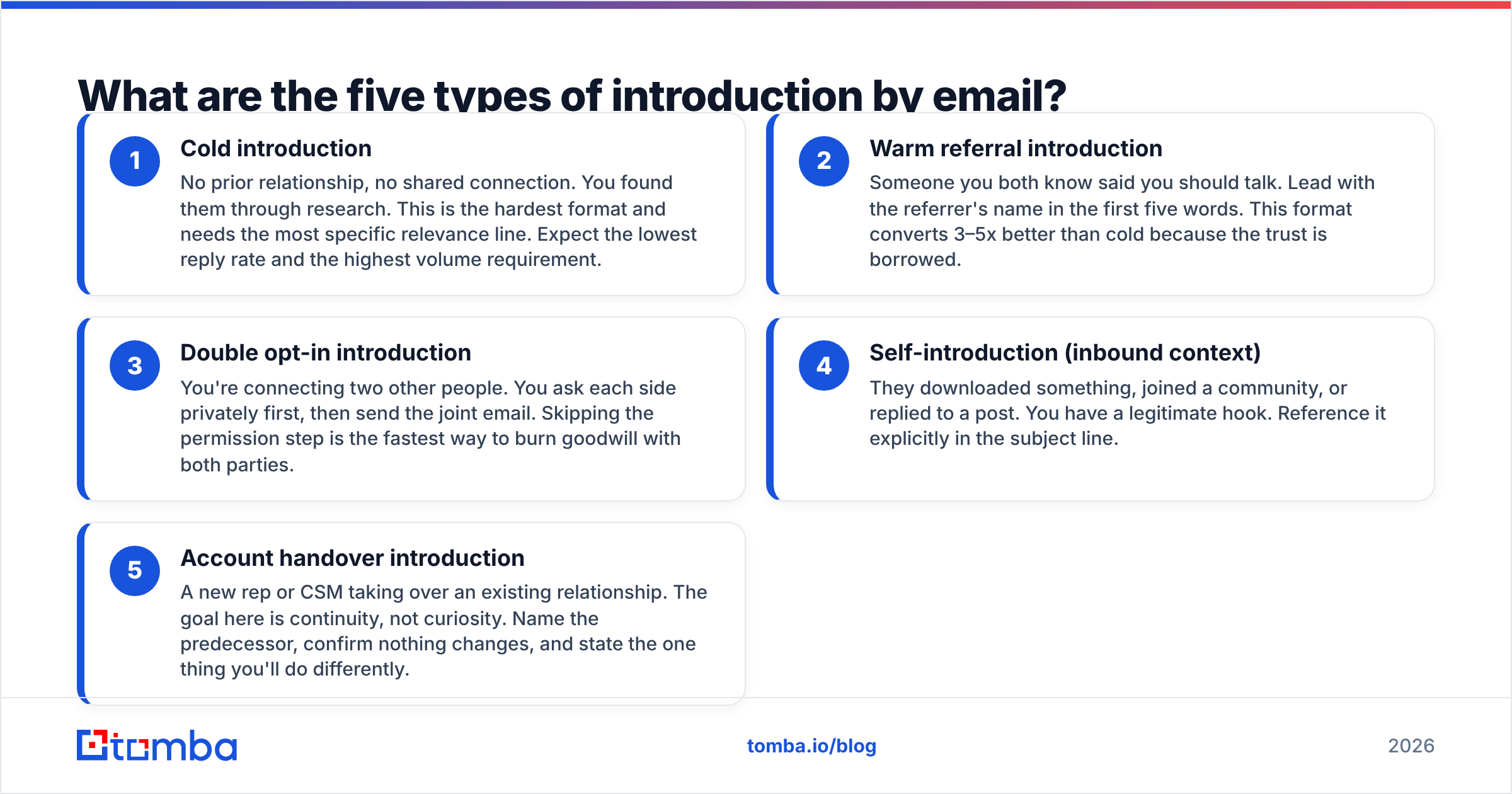
- Cold introduction — No prior relationship, no shared connection. You found them through research. This is the hardest format and needs the most specific relevance line. Expect the lowest reply rate and the highest volume requirement.
- Warm referral introduction — Someone you both know said you should talk. Lead with the referrer's name in the first five words. This format converts 3–5x better than cold because the trust is borrowed.
- Double opt-in introduction — You're connecting two other people. You ask each side privately first, then send the joint email. Skipping the permission step is the fastest way to burn goodwill with both parties.
- Self-introduction (inbound context) — They downloaded something, joined a community, or replied to a post. You have a legitimate hook. Reference it explicitly in the subject line.
- Account handover introduction — A new rep or CSM taking over an existing relationship. The goal here is continuity, not curiosity. Name the predecessor, confirm nothing changes, and state the one thing you'll do differently.
Mixing these up is the most common strategic error. A referral intro written in cold-email voice wastes the referral. A cold intro written in referral voice reads as manipulative.
How do the introduction types compare?#
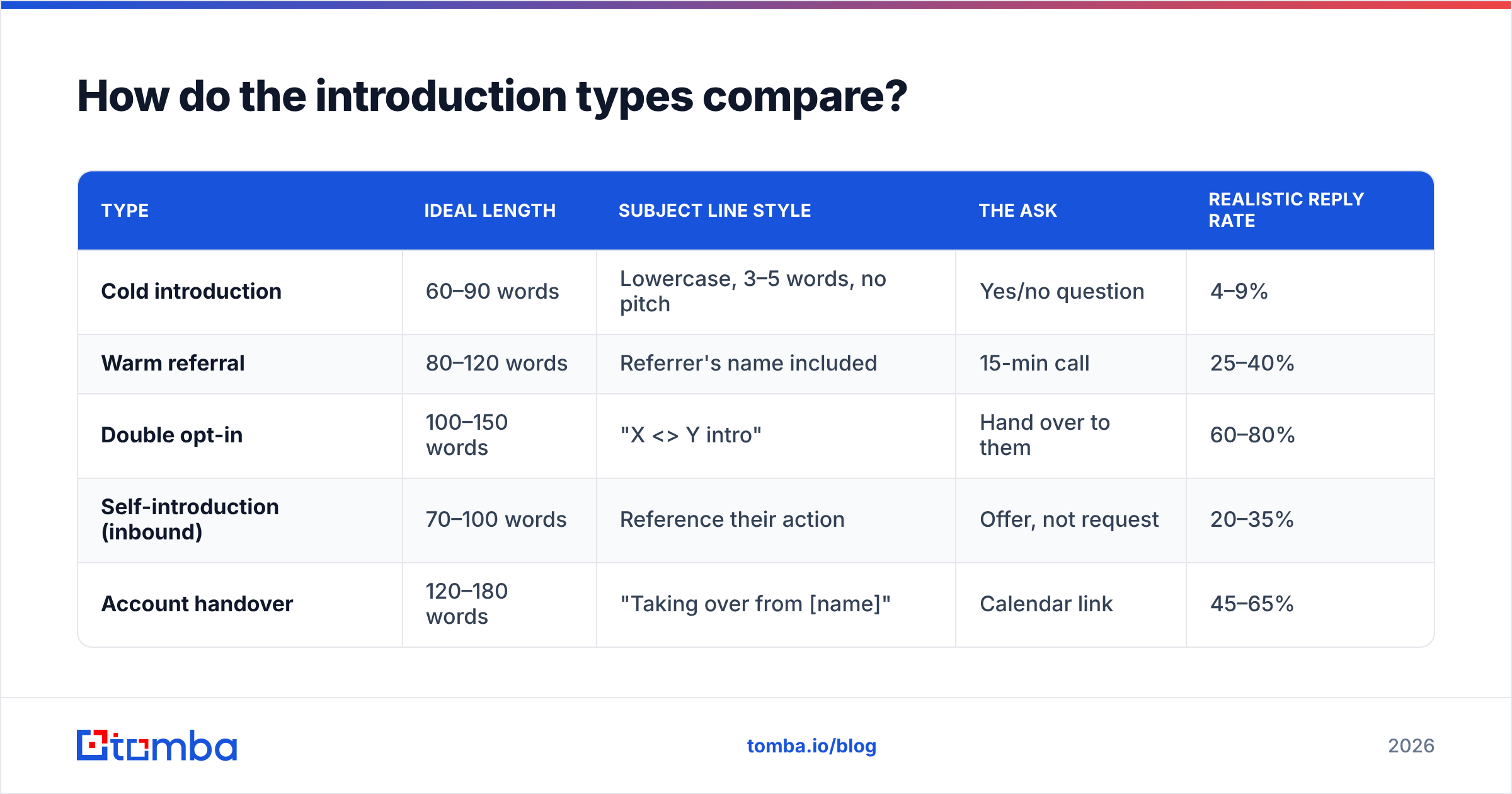
| Type | Ideal length | Subject line style | The ask | Realistic reply rate |
|---|---|---|---|---|
| Cold introduction | 60–90 words | Lowercase, 3–5 words, no pitch | Yes/no question | 4–9% |
| Warm referral | 80–120 words | Referrer's name included | 15-min call | 25–40% |
| Double opt-in | 100–150 words | "X <> Y intro" | Hand over to them | 60–80% |
| Self-introduction (inbound) | 70–100 words | Reference their action | Offer, not request | 20–35% |
| Account handover | 120–180 words | "Taking over from [name]" | Calendar link | 45–65% |
Those reply ranges assume verified addresses and a warmed domain. On an unverified list, cut every number roughly in half — bounced sends don't just fail individually, they degrade placement for the ones that would have landed.
What does the structure of a good introduction by email look like?#
Four lines. In this order.
Line 1 — Context. Why you are in their inbox right now. "Saw your post on procurement cycles" or "Maria at Northwind suggested I reach out." Never open with your own name and title; the signature already handles that.
Line 2 — Relevance. The bridge between their world and yours, stated as an observation about them, not a claim about you. Bad: "We help companies like yours reduce churn." Good: "You've hired three support leads in two months — usually that means ticket volume outpaced headcount."
Line 3 — The ask. One thing, answerable in a word. "Worth a look?" beats "Would you be open to a 30-minute discovery call to explore synergies?" Make the reply cost five seconds, not a calendar negotiation.
Line 4 — The exit. Give them an easy no. "If this isn't your area, happy to stop here." Counterintuitively, this raises replies, because it removes the fear that responding starts an unstoppable sequence.
Then stop. No P.S. stacking three more offers. No attached deck. No calendar embed on a cold intro.
What do working introduction email templates look like?#
Cold introduction:
Subject: quick question about [specific thing]
Hi [First name],
Saw [company] opened a second warehouse in Rotterdam last month — congrats.
When teams add a second site, order routing usually breaks before anyone notices. We fixed exactly that for [comparable company], cut mis-shipments by about a third.
Worth a quick look at how they did it?
If logistics isn't your side of the house, just say so and I'll leave you alone.
[Name]
Warm referral introduction:
Subject: [Referrer] said we should talk
Hi [First name],
[Referrer] mentioned you're rebuilding the outbound motion at [company] and said we'd have a useful conversation.
I ran the same rebuild at [company] last year — happy to share what worked and what wasted six weeks.
Free for 15 minutes Thursday or Friday?
[Name]
Double opt-in introduction (after both sides agree):
Subject: Sarah <> Daniel intro
Sarah — Daniel runs RevOps at Kestrel and just finished the CRM migration you asked about.
Daniel — Sarah leads growth at Palmer and is six weeks into the same project.
I'll step back and let you two take it from here.
[Name]
The double opt-in pattern comes from venture and advisory circles for a reason: asking permission before making an introduction protects everyone's time. HubSpot's sales blog has covered the mechanics of it for years, and the etiquette hasn't changed — you get consent, then you connect.

Does the email address matter more than the copy?#
Yes, more often than writers want to admit.
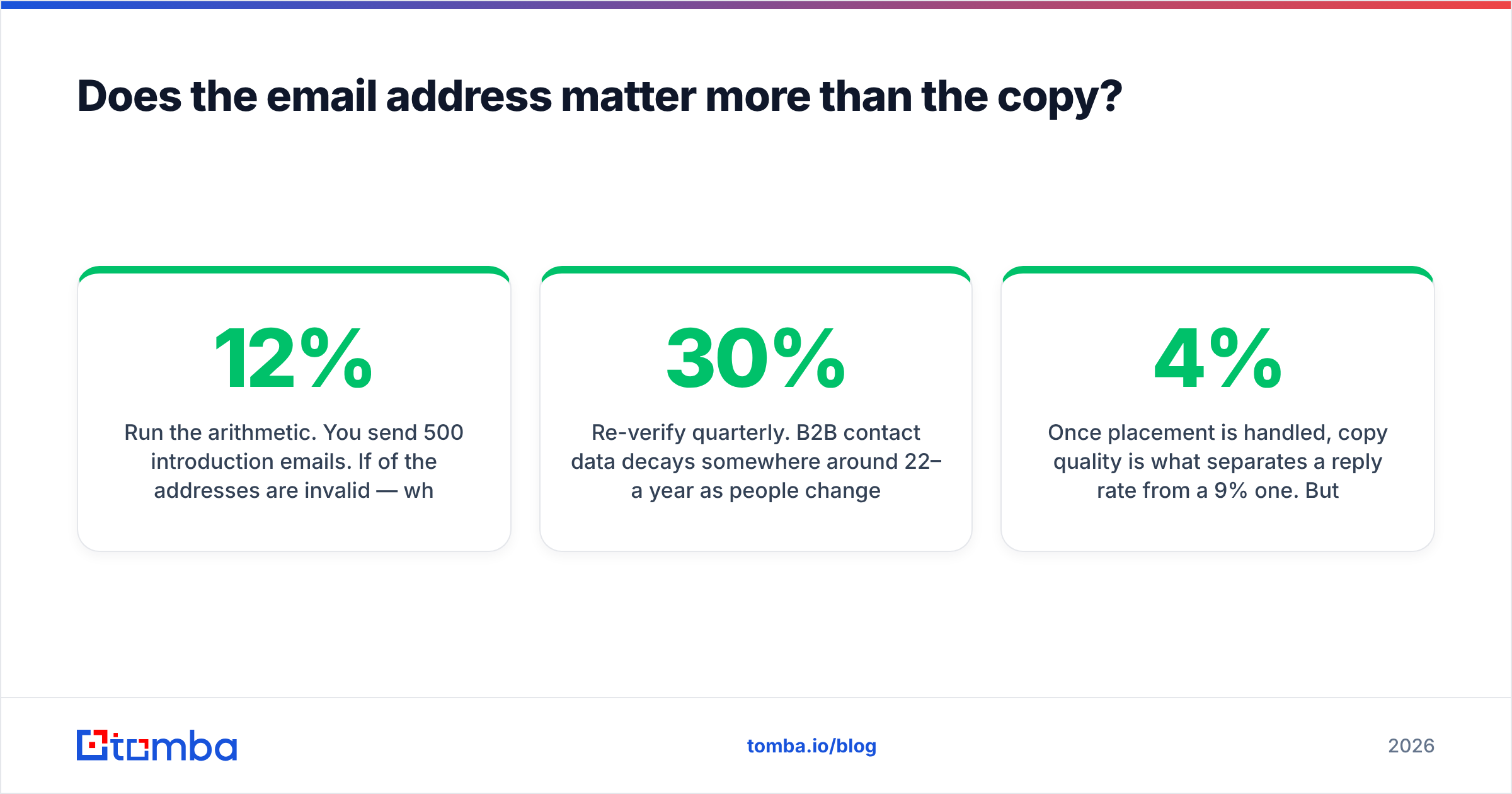
Run the arithmetic. You send 500 introduction emails. If 12% of the addresses are invalid — which is normal for a scraped or year-old list — you get 60 hard bounces. That bounce rate pushes you above the threshold where mailbox providers start filtering the rest of your domain's mail. Your remaining 440 perfectly-written intros now land in Promotions or Spam. The copy never gets a vote.
This is why address quality sits upstream of copywriting in any serious outbound process:
- Find the right person, not just the right domain. A domain search gives you every published address at a company plus its email pattern, so you can target the actual decision-maker rather than blasting info@.
- Confirm the address exists before you write. Running the list through an email verifier removes hard bounces, role accounts, and disposable domains ahead of the send.
- Treat catch-all domains as their own category. They accept everything at the SMTP layer and tell you nothing. Segment them, send lower volume, and watch engagement rather than bounce signals.
- Re-verify quarterly. B2B contact data decays somewhere around 22–30% a year as people change jobs. The intro you wrote in January is mailing a ghost by October.
Once placement is handled, copy quality is what separates a 4% reply rate from a 9% one. But the order matters — you can't A/B test your way out of a spam folder. Track your response rate alongside bounce rate, not in isolation, or you'll optimize the wrong variable for months.
How do you write the subject line?#
Short, lowercase, and specific to them. The subject line's only job is to make the first line get read.
| Subject line | Why it works or fails |
|---|---|
quick question about Rotterdam |
Specific, low-stakes, clearly human |
Maria suggested I reach out |
Borrows trust immediately |
Sarah <> Daniel intro |
Signals a connection, not a pitch |
Partnership Opportunity for [Company] |
Reads as templated mail merge |
Unlock 3x Pipeline Growth in 2026 |
Marketing voice; triggers filters |
Following up (on a first email) |
Dishonest — there's nothing to follow up on |
Avoid all-caps, exclamation marks, and the word "free" in a first-contact subject. Not because a filter automatically kills them, but because your reader has been trained by a decade of bad email to pattern-match them as noise.
The greeting deserves one line of thought too. "Dear Sir or Madam" signals you don't know who you're writing to — the entire history of the salutation in business correspondence is a slow march toward less formality, and B2B email has landed on plain "Hi [First name]." Use it and move on.
What mistakes kill an introduction by email?#
- Leading with yourself. "My name is X and I'm the Y at Z" is the single most common opening and the single weakest. Your signature covers it.
- Asking for 30 minutes from a stranger. The ask should be proportional to the relationship. First contact earns a yes/no question, not a calendar slot.
- Fake personalization. "Love what you're doing at [Company]" reads worse than no personalization, because it proves you spent zero seconds on research while pretending otherwise.
- Three asks in one email. Book a call, download the guide, and follow us on LinkedIn. Pick one. Every additional option lowers the odds of any action.
- Attachments on first contact. They hurt deliverability and nobody opens a PDF from a stranger.
- No exit. Without an easy out, cautious readers archive rather than engage.
- Sending to an unverified address. Covered above, and worth repeating: it's the only mistake on this list that damages every other email you send.
How do you know if your introductions are working?#
Measure three numbers, weekly, per segment:
Bounce rate should sit under 2%. Above that, stop sending and clean the list before you touch the copy. Reply rate is the real scoreboard for introductions — open rate has been unreliable since privacy protection started prefetching images, so don't build decisions on it. Positive reply share matters more than raw replies. Twenty "not interested" responses and two meetings is a different email than two of each.
Test one variable at a time and give each version at least 200 sends before you call a winner. Anything smaller is noise. Most teams rewrite the whole email after 40 sends, learn nothing, and repeat that cycle indefinitely.
If you want a faster starting point than a blank page, working from proven cold email templates and adapting the relevance line to each account beats writing from scratch every time — the structure is solved, the specificity is your job.
Start with an address that actually exists#
The best introduction email in your drafts folder is worthless if it's addressed to someone who left the company in 2024. Use the Tomba Email Finder to get the verified, current address for the specific person you researched — by name and domain, in bulk, or straight from the API. The free tier gives you 25 searches a month to test it, and paid plans start at $49/mo on Starter; full Tomba pricing scales to Growth at $99/mo and Pro at $249/mo when your volume grows.
Write the four lines. Send them to a real inbox. That's the whole game.
Related guides#
// get started
Find, verify and enrich your first contacts today
Start on the free plan with 25 searches a month, then scale when your team is ready.
Free plan · No credit card required · GDPR & CCPA
// about the author