How to Write an Introduction Email That Gets Replies in 2026
An introduction email gets about eight seconds to earn a reply. Here is the structure, the subject-line rules, the timing, and five templates that consistently beat generic "quick intro" fluff.
TL;DR
- An introduction email is a first-contact message whose only job is to earn a reply — not to close, not to demo, not to explain your whole company.
- The winning shape is consistent: a specific subject line, a first line about them, one sentence of relevance, one low-friction ask, and a signature. Roughly 50–120 words.
- Cold, referral, warm-inbound, and internal introductions need different openers and different asks. Using the cold template on a referral wastes the referral.
- Deliverability decides whether any of this matters. A bounced or catch-all address turns a great introduction email into a sender-reputation problem.
- Measure reply rate, not open rate. Open tracking has been unreliable since Apple Mail Privacy Protection; replies are the only honest signal.
What is an introduction email?#
An introduction email is the first message you send to someone who does not yet know you, sent with the goal of starting a conversation. That's the whole definition. It covers a cold prospecting email, a referral handoff ("Sarah suggested I reach out"), a new account manager announcing themselves, a founder emailing an investor, and a new hire introducing themselves to a cross-functional team.
Think of it like knocking on a neighbor's door the week you move in. You don't hand them a brochure about your career history. You say who you are, why you're standing there, and you leave fast enough that they're glad you came. The email version works the same way: identity, relevance, exit.
The mistake almost everyone makes is treating the introduction email as a pitch container. You stuff in the value prop, three customer logos, a calendar link, and a PS about your Series B. That message asks the reader to do fourteen things. A message that asks for one thing gets answered; a message that asks for fourteen gets archived.
Why do most introduction emails get ignored?#
Because they are about the sender. Open any ignored intro email and count the first words of each sentence — you'll usually find "I," "We," and "Our" leading four sentences out of five.
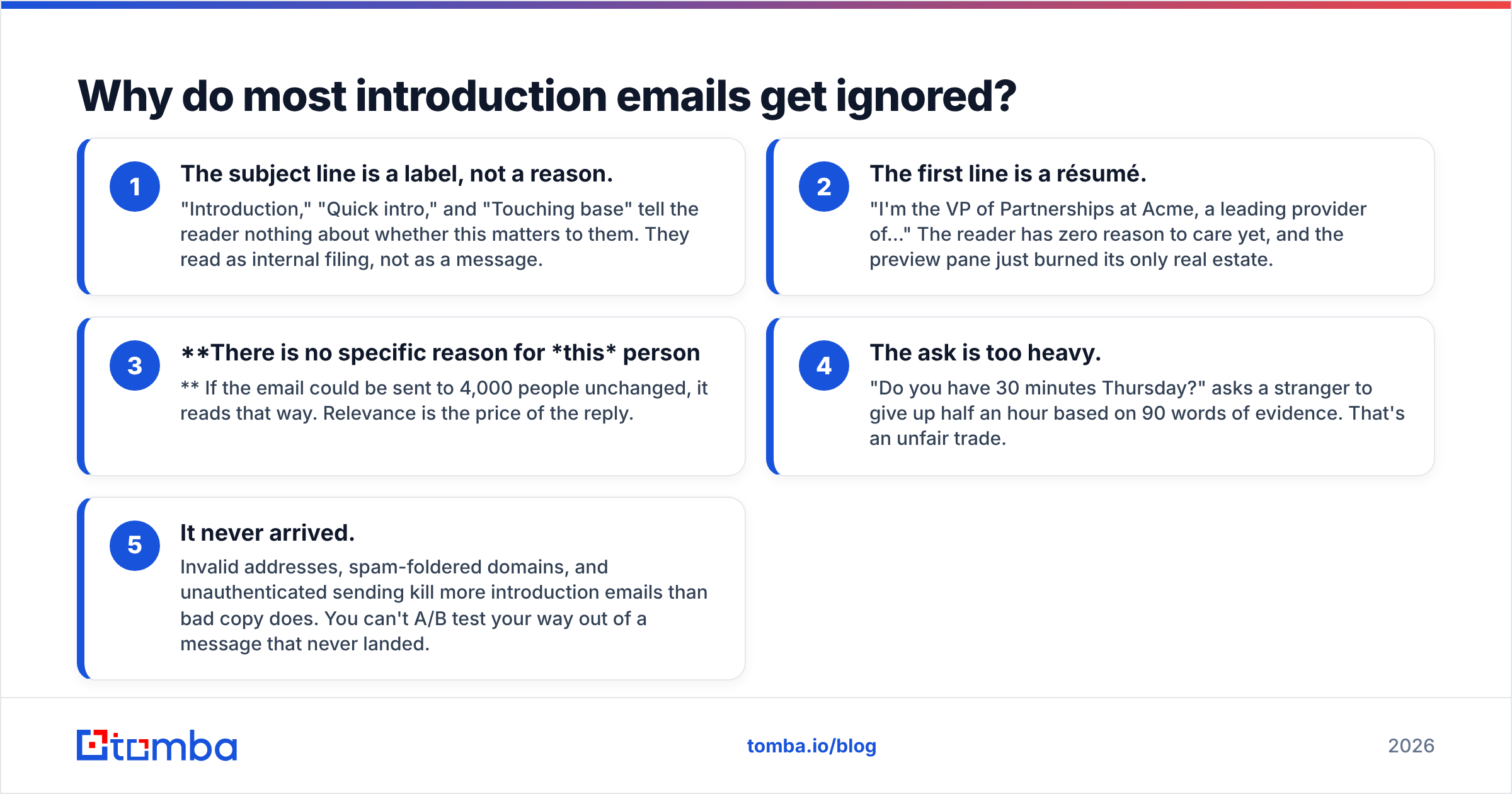
There are five recurring failure modes:
- The subject line is a label, not a reason. "Introduction," "Quick intro," and "Touching base" tell the reader nothing about whether this matters to them. They read as internal filing, not as a message.
- The first line is a résumé. "I'm the VP of Partnerships at Acme, a leading provider of…" The reader has zero reason to care yet, and the preview pane just burned its only real estate.
- There is no specific reason for this person. If the email could be sent to 4,000 people unchanged, it reads that way. Relevance is the price of the reply.
- The ask is too heavy. "Do you have 30 minutes Thursday?" asks a stranger to give up half an hour based on 90 words of evidence. That's an unfair trade.
- It never arrived. Invalid addresses, spam-foldered domains, and unauthenticated sending kill more introduction emails than bad copy does. You can't A/B test your way out of a message that never landed.

Fix one through four and your reply rate moves. Fix five and everything else starts working at all.
What does a high-performing introduction email look like?#
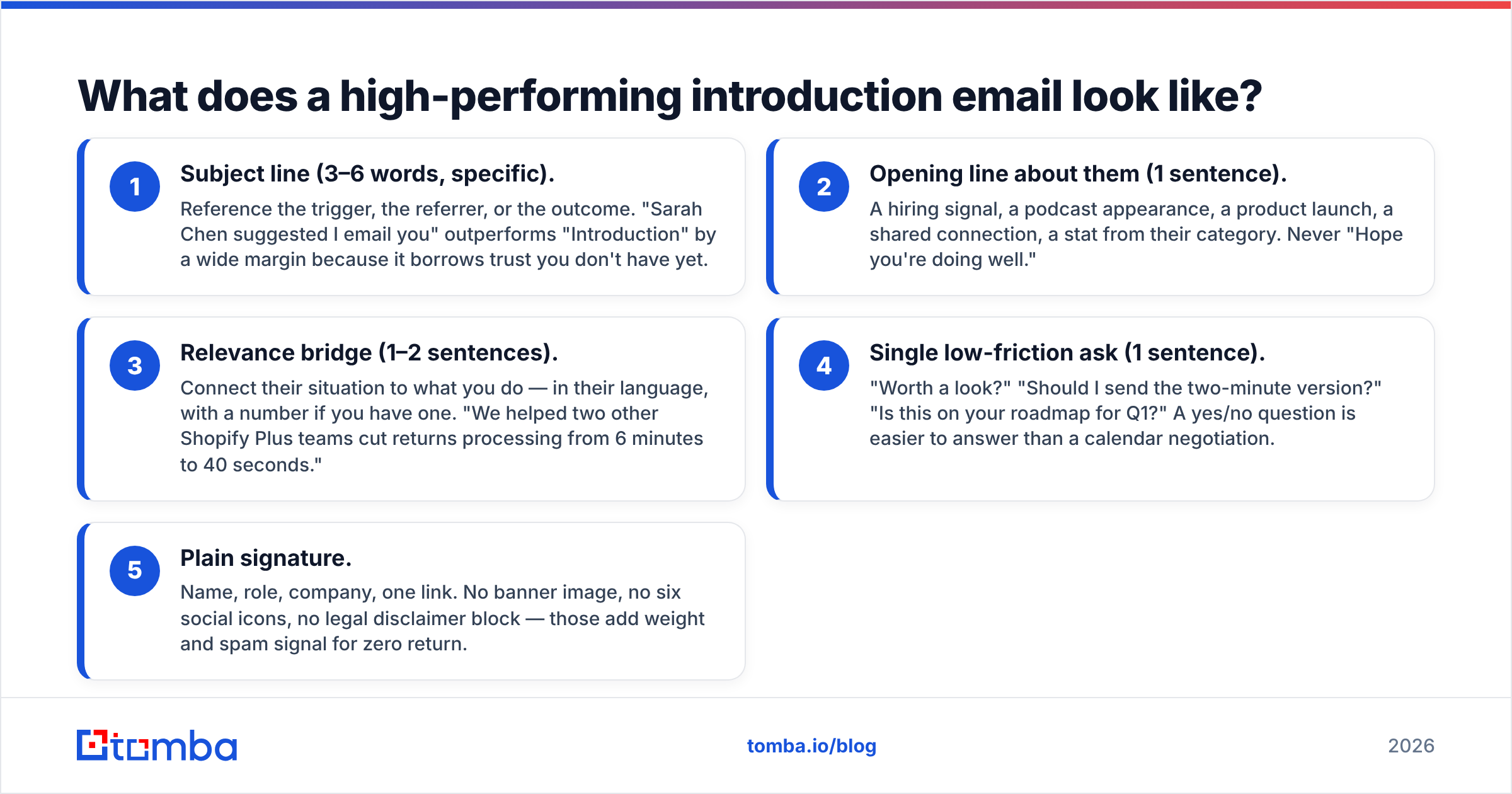
Every effective introduction email contains the same five components in roughly the same order. This is the structure worth memorizing:
- Subject line (3–6 words, specific). Reference the trigger, the referrer, or the outcome. "Sarah Chen suggested I email you" outperforms "Introduction" by a wide margin because it borrows trust you don't have yet.
- Opening line about them (1 sentence). A hiring signal, a podcast appearance, a product launch, a shared connection, a stat from their category. Never "Hope you're doing well."
- Relevance bridge (1–2 sentences). Connect their situation to what you do — in their language, with a number if you have one. "We helped two other Shopify Plus teams cut returns processing from 6 minutes to 40 seconds."
- Single low-friction ask (1 sentence). "Worth a look?" "Should I send the two-minute version?" "Is this on your roadmap for Q1?" A yes/no question is easier to answer than a calendar negotiation.
- Plain signature. Name, role, company, one link. No banner image, no six social icons, no legal disclaimer block — those add weight and spam signal for zero return.
Word count target: 50 to 120 words for cold, up to 150 for referral or internal introductions where context genuinely helps. Anything past 200 words is a document, and documents get read later, which means never.
Which type of introduction email should you send?#
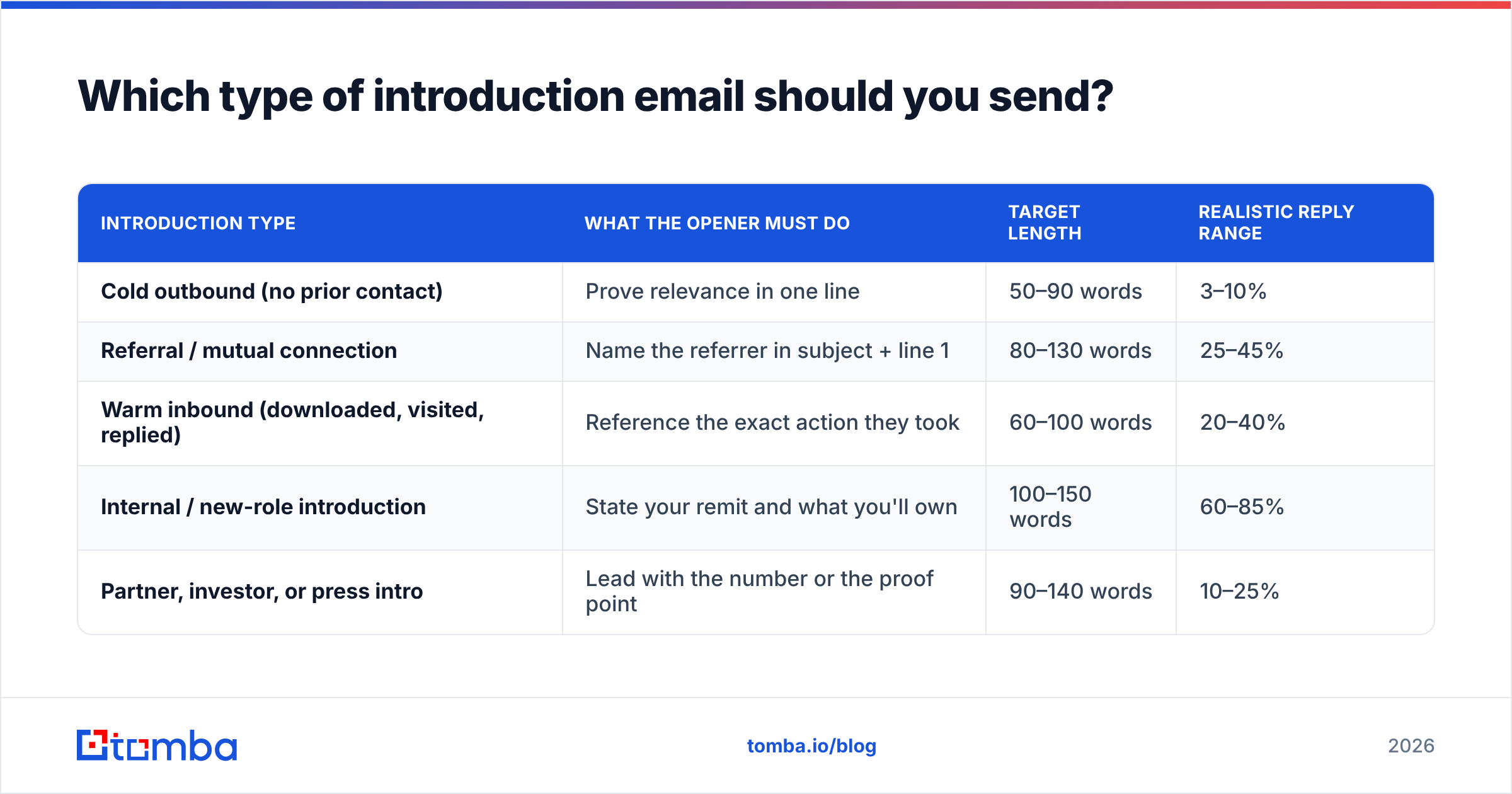
The template you pick should match the relationship, not your mood. Sending a cold-structured email to a warm referral throws away the single strongest asset you have — the referrer's name.
| Introduction type | What the opener must do | Target length | Realistic reply range |
|---|---|---|---|
| Cold outbound (no prior contact) | Prove relevance in one line | 50–90 words | 3–10% |
| Referral / mutual connection | Name the referrer in subject + line 1 | 80–130 words | 25–45% |
| Warm inbound (downloaded, visited, replied) | Reference the exact action they took | 60–100 words | 20–40% |
| Internal / new-role introduction | State your remit and what you'll own | 100–150 words | 60–85% |
| Partner, investor, or press intro | Lead with the number or the proof point | 90–140 words | 10–25% |
Treat these ranges as calibration, not guarantees. They shift with industry, seniority, list quality, and season — a CTO in December behaves nothing like a marketing manager in March. What holds across every row is the ordering: referral and warm beat cold by a factor of three to five, which is why finding a path in is usually a better investment than rewriting your cold copy for the ninth time. Track your own numbers against the response rate you're actually producing, not against a screenshot someone posted on LinkedIn.
What should the subject line actually say?#
Specific beats clever. The subject line's only job is to make the first line worth reading, and the first line's only job is to make the second worth reading.
Four patterns that hold up:
- Referral borrow: "Sarah Chen said to reach out" — highest performing subject line in B2B, full stop.
- Trigger reference: "your Series B + hiring 12 AEs" — proves you did homework in four words.
- Outcome question: "cutting onboarding from 3 weeks to 4 days?" — frames a result, not a product.
- Plain and human: "quick question about [specific process]" — works only if the specificity is real.
Avoid ALL CAPS, "Re:" fakery on a first email, emojis in B2B intros, and anything containing "free," "guarantee," or "act now." If you want a second opinion before sending, run the line through a subject line tester and check length on mobile — most inboxes truncate around 35–40 characters on a phone.
One more rule: your subject line and your first line should not repeat each other. That's two chances to earn attention, and duplicating wastes one.
What are five introduction email templates worth copying?#
1. Cold outbound, trigger-based
Subject: your 12 new AEs
Hi Maya — saw the 12 AE roles you posted this month. Teams scaling that fast usually hit a ramp problem around month two, when new reps burn through the warm list.
We build the outbound data layer for that exact moment — Gusto's SDR team went from 41% to 78% connect rate in six weeks.
Worth a look, or is ramp already handled?
— Adam, Acme
2. Referral introduction
Subject: Sarah Chen suggested I email you
Hi Dan — Sarah Chen mentioned you're rebuilding the RevOps stack this quarter and thought we should talk.
I run partnerships at Acme; we handle the enrichment layer between your CRM and your sequencer. Sarah's team cut manual research time by about nine hours a week.
Happy to send the two-minute version, or set up a call if it's easier. Which do you prefer?
— Adam
3. Warm inbound follow-up
Subject: the returns benchmark you downloaded
Hi Priya — you pulled our returns benchmark on Tuesday. The number most people react to is page 4: median Shopify Plus return takes 6.2 minutes of human time.
If that's roughly your reality, I can show you what the 40-second version looks like. Want it?
— Adam
4. New account manager introduction
Subject: your new point of contact at Acme
Hi Tom — I'm taking over as your account manager from Rachel, effective this week. She's briefed me on the Q3 migration and the reporting gap you flagged in August.
Two things I'd like to own immediately: the reporting fix, and a cleaner monthly summary. I'm free Thursday or Friday for 20 minutes to confirm priorities — either work?
— Adam
5. Internal cross-team introduction
Subject: new on the data team — what I'll own
Hi all — I joined Monday as a senior data engineer. I'll own the pipeline reliability work and the attribution model rebuild.
If you've been waiting on a dashboard, send it my way; I'm triaging the backlog this week. Calendar is open for 15-minute intros.
— Adam
Adapt the specificity, never the structure. If you want more starting points, there's a broader library of cold email templates worth borrowing from, and HubSpot's sales blog keeps a steady stream of teardown examples if you want outside reference points.
How do you make sure the introduction email actually lands?#
This is the part copywriting advice skips, and it's the part that determines outcomes.
Three things to get right before you hit send:
Authenticate the sending domain. SPF, DKIM, and DMARC are non-negotiable in 2026 — Google and Yahoo both enforce authentication and complaint-rate thresholds for bulk senders, and the requirements are documented plainly in Google's sender guidelines. Unauthenticated mail from a new domain is the fastest route to the spam folder.
Verify every address before the first send. A hard bounce on a first-contact email is a double loss: the message is gone, and your bounce rate climbs toward the threshold where mailbox providers start filtering everything you send. Run addresses through an email verifier first, and treat catch-all domains as a separate bucket rather than assuming they're valid — a catch-all verifier will tell you whether the mailbox behind the accept-all MX actually exists.
Warm the sending identity. A brand-new domain sending 300 introduction emails on day one behaves, statistically, exactly like a spammer. Ramp from 20–30 per day over two to four weeks, keep replies flowing, and separate cold sending from your primary company domain.
Keep the message light. No tracking pixels you don't need, no image-heavy signature, no attachment on first contact, one link maximum. Each of those is a small spam-score cost, and they compound.
How should you follow up without being annoying?#
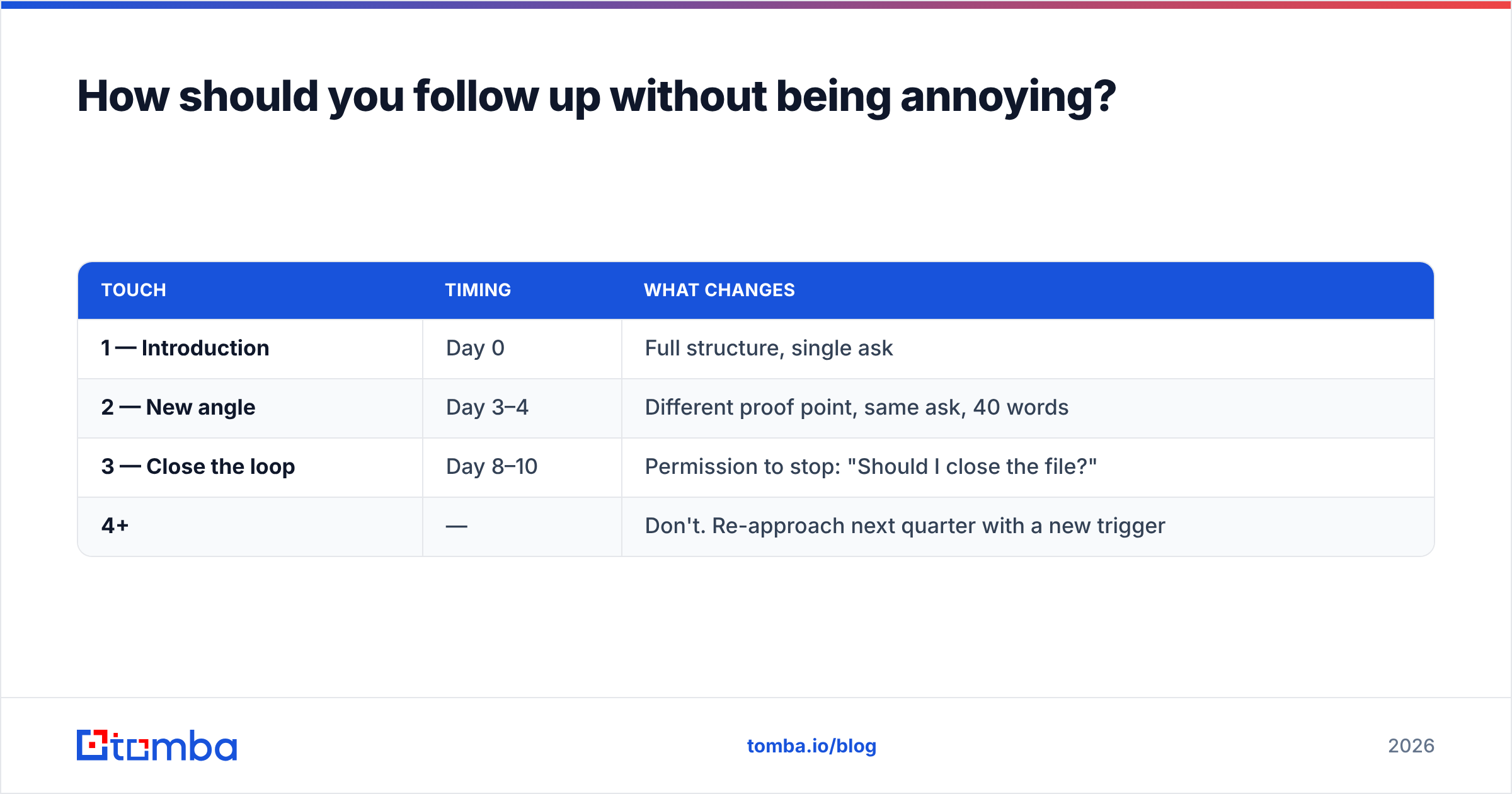
Two follow-ups, spaced 3–4 business days apart, then stop. That's the pattern that maximizes replies without generating complaints.
| Touch | Timing | What changes |
|---|---|---|
| 1 — Introduction | Day 0 | Full structure, single ask |
| 2 — New angle | Day 3–4 | Different proof point, same ask, 40 words |
| 3 — Close the loop | Day 8–10 | Permission to stop: "Should I close the file?" |
| 4+ | — | Don't. Re-approach next quarter with a new trigger |
The third message works because it's genuinely easy to answer. "Should I close the file on this?" gets a "yes, thanks" or a "no, actually — timing was just bad." Both are useful. Silence isn't.
Never send a follow-up that says only "bumping this" or "just checking in." That message adds zero information and signals that your time is worth less than theirs. Every follow-up should carry something new: a different angle, a relevant piece of news, a shorter ask.
What should you measure?#
Reply rate, positive reply rate, and bounce rate. In that order.
Open rate has been structurally unreliable since Apple Mail Privacy Protection started pre-fetching images in 2021, and the inflation is bad enough that optimizing for it actively misleads teams. Analyst coverage of B2B buyer behavior — Gartner's sales research is a reasonable starting point — consistently points the same direction: buyers self-educate long before they respond, so the metric that matters is whether they choose to engage, not whether a pixel fired.
Set your baseline honestly. If your cold introduction email sits at 4% reply and 1% positive reply, that's normal, not broken. Improvement comes from list quality first, relevance second, and copy third — in that order of impact. Rewriting the subject line on a bad list is rearranging furniture in a house with no roof. If you want a broader primer on the mechanics behind all of this, the email marketing overview on Wikipedia is a decent neutral grounding in how the channel evolved and why the rules tightened.
Start with an address that exists#
The best introduction email in the world fails against a guessed address. Before you spend another hour on subject-line variants, make sure the message has somewhere to land: use the Tomba Email Finder to pull verified, source-backed professional addresses by name and domain, then send with a bounce rate you can defend. The free tier covers 25 searches a month, Starter runs $49/mo, and Growth is $99/mo if you're sending at volume — enough to test whether your introduction email is a copy problem or a data problem before you commit to either answer.
Related guides#
// get started
Find, verify and enrich your first contacts today
Start on the free plan with 25 searches a month, then scale when your team is ready.
Free plan · No credit card required · GDPR & CCPA
// about the author