Introduction Email as New Point of Contact: 2026 Guide
Taking over someone else's accounts is the riskiest email you will send all quarter. Here is the structure, timing, and templates that keep a handover from costing you the renewal.
TL;DR
- An introduction email as new point of contact is a handover message, not a prospecting email. The reader already bought something. Your job is continuity, not persuasion.
- The single highest-leverage variable is who sends it. A warm handoff from the outgoing rep lifts reply rates far more than any subject line rewrite.
- Lead with what stays the same (the contract, the roadmap, the open ticket), not with your own bio. Nobody asked for your bio.
- Roughly 20-30% of your inherited CRM contacts have changed jobs since the record was created. Verify addresses before you send, or your "reintroduction" lands in a bounce log.
- Send within 48 hours of the account change, ask for one 15-minute call, and follow up exactly twice. Then stop.
What is an introduction email as new point of contact?#
It is the email you send when ownership of a relationship changes hands: a new account executive inherits a book, a customer success manager rotates territories, an agency reassigns a client lead, or a company reorganizes after an acquisition.
Think of it like a new family doctor taking over a retiring one's patients. You are not selling the practice again. The patient already chose it. What they want to know in the first thirty seconds is: do you have my chart, do I have to repeat my history, and is anything about my treatment changing?
That framing changes almost every writing decision. A cold outreach email earns attention by creating interest. A handover email earns attention by removing anxiety. The customer's real question is not "who are you?" It is "is this going to cost me time?"
Get that wrong and the downside is asymmetric. A cold email that flops costs you nothing. A handover email that flops signals instability at exactly the moment a customer is most open to a competitor's call. Churn risk spikes around account-owner changes, which is why enterprise CS teams treat the transition as a formal process rather than a courtesy note.
Why do most account-handover emails get ignored?#
Four reasons, in order of how much damage they do.
It reads like a cold pitch. The moment you open with "I'd love to connect and learn about your goals," you have told an existing customer that you know nothing about them. They already told someone your goals. Twice.
It centers the sender. Three paragraphs of résumé, one line about the account. The customer does not care that you spent six years in fintech. They care that their Q4 integration deadline is still on track.
It arrives cold, with no internal warm-up. If the customer's first notice that their contact changed is your email, you have made an internal staffing decision into their problem. Warm handoffs — where the outgoing owner introduces you before you write — consistently outperform self-introductions because the trust transfers with the referral.
It goes to a dead address. This is the boring failure mode nobody audits. B2B contact data decays fast: people change roles, companies rebrand domains, and the champion who signed your contract two years ago may be at a different company entirely. If your handover email bounces, you do not get a second chance from a customer who never knew you existed.
Before you write a word, run the inherited contact list through an email verifier and, for the records that fail, use domain search to find who currently holds the role. A handover sequence sent to a stale list does not just underperform. It generates bounces against a sending domain you will use for that account for years.
What should the email actually contain?#
Six components, in this order. The order matters more than the wording.
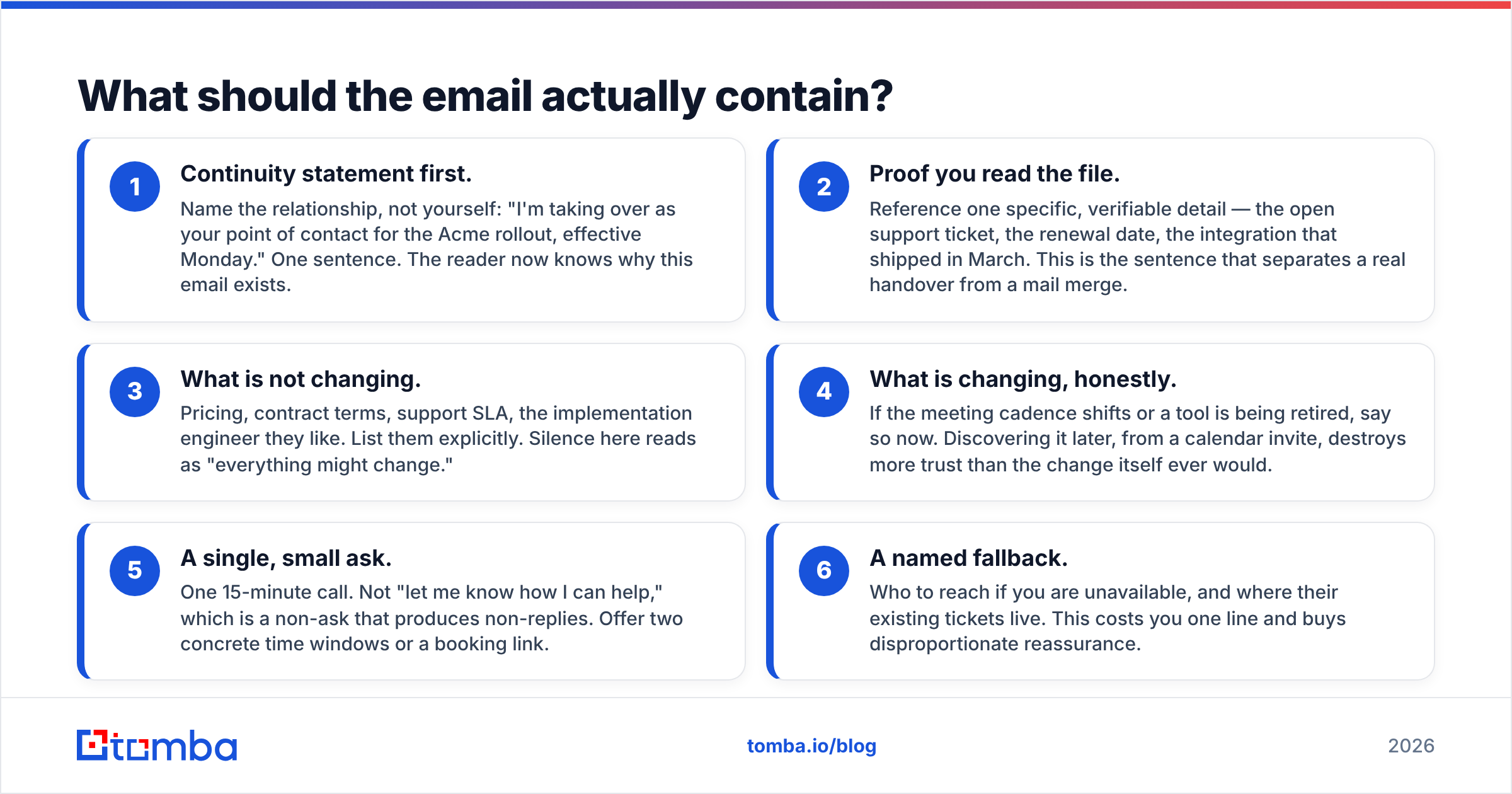
- Continuity statement first. Name the relationship, not yourself: "I'm taking over as your point of contact for the Acme rollout, effective Monday." One sentence. The reader now knows why this email exists.
- Proof you read the file. Reference one specific, verifiable detail — the open support ticket, the renewal date, the integration that shipped in March. This is the sentence that separates a real handover from a mail merge.
- What is not changing. Pricing, contract terms, support SLA, the implementation engineer they like. List them explicitly. Silence here reads as "everything might change."
- What is changing, honestly. If the meeting cadence shifts or a tool is being retired, say so now. Discovering it later, from a calendar invite, destroys more trust than the change itself ever would.
- A single, small ask. One 15-minute call. Not "let me know how I can help," which is a non-ask that produces non-replies. Offer two concrete time windows or a booking link.
- A named fallback. Who to reach if you are unavailable, and where their existing tickets live. This costs you one line and buys disproportionate reassurance.
Notice what is missing: no company boilerplate, no "we're excited about the future," no attachment. Under 150 words is a reasonable ceiling for the first message.
Should the outgoing rep introduce you, or should you introduce yourself?#
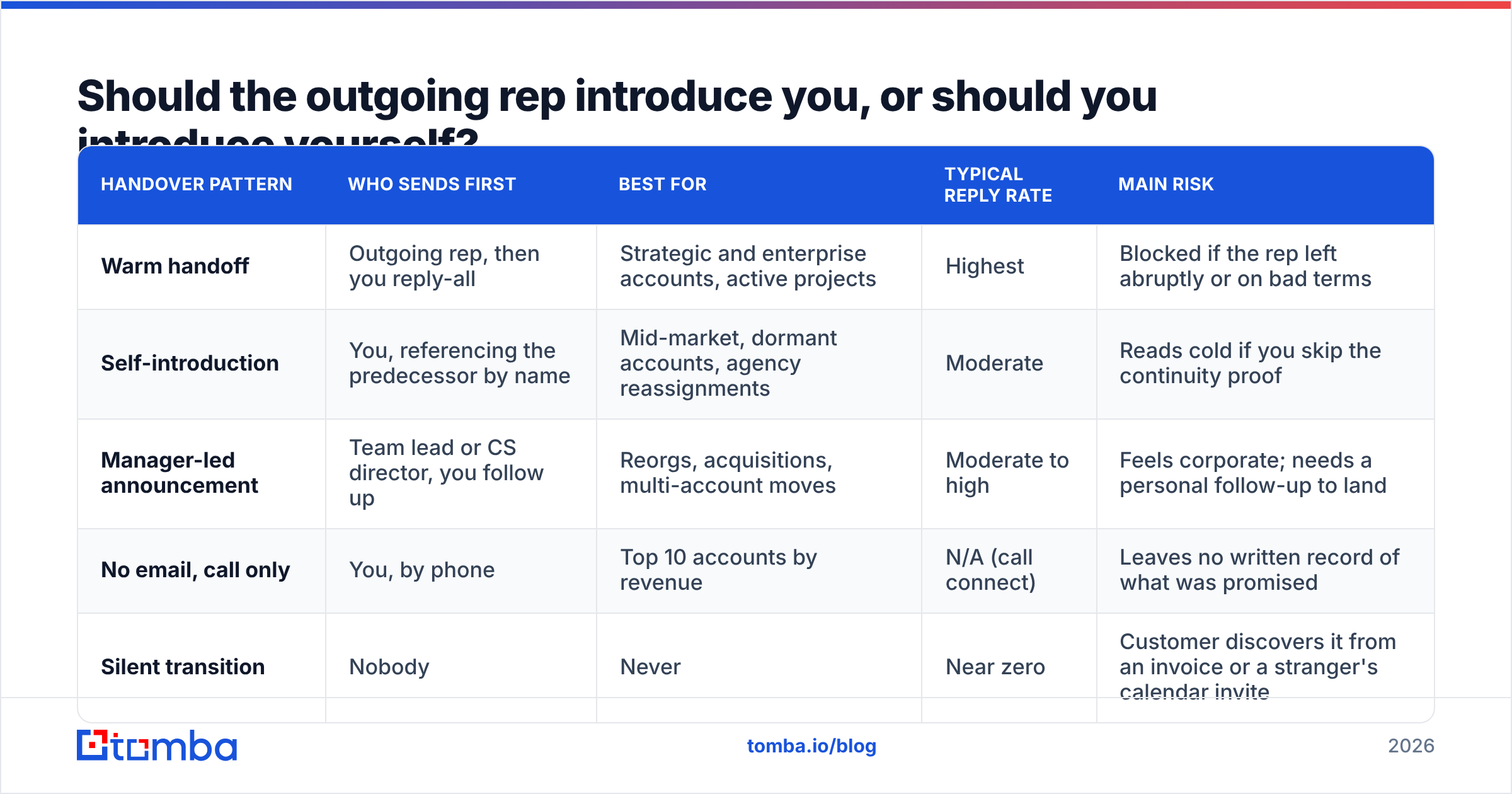
Both work. They work in different situations, and the wrong choice is expensive. Here is how the three common handover patterns compare in practice.
| Handover pattern | Who sends first | Best for | Typical reply rate | Main risk |
|---|---|---|---|---|
| Warm handoff | Outgoing rep, then you reply-all | Strategic and enterprise accounts, active projects | Highest | Blocked if the rep left abruptly or on bad terms |
| Self-introduction | You, referencing the predecessor by name | Mid-market, dormant accounts, agency reassignments | Moderate | Reads cold if you skip the continuity proof |
| Manager-led announcement | Team lead or CS director, you follow up | Reorgs, acquisitions, multi-account moves | Moderate to high | Feels corporate; needs a personal follow-up to land |
| No email, call only | You, by phone | Top 10 accounts by revenue | N/A (call connect) | Leaves no written record of what was promised |
| Silent transition | Nobody | Never | Near zero | Customer discovers it from an invoice or a stranger's calendar invite |
The pattern to default to: warm handoff for anything above your median account value, self-introduction for the long tail, and a phone call for the accounts whose loss would show up in a board deck.
One practical note on warm handoffs. The outgoing rep should send from their own mailbox, copy you, and use a subject line the customer will recognize from prior threads. Replying inside an existing thread preserves context and dodges the spam-filter penalty that new-thread cold sends attract.
What do the templates look like?#
Three templates covering the common cases. Adapt the specifics; keep the skeleton.
Template 1 — Warm handoff (sent by the outgoing owner)
Subject: Re: Acme Q3 rollout — introducing Dana
Hi Priya,
After three years on your account I'm moving to our EMEA team, and Dana Okafor is taking over as your point of contact from Monday.
I've walked Dana through the Q3 rollout, the open SSO ticket (#4412), and your December renewal. Nothing about your contract or support terms changes.
Dana, over to you. Priya has been the best kind of demanding customer and you're inheriting a good one.
Thanks for everything, Priya.
Template 2 — Self-introduction (no warm handoff available)
Subject: Taking over from Marcus on your account
Hi Priya,
I'm Dana, your new point of contact at Northwind following Marcus's move to our partnerships team.
I've read through your account: the SSO ticket from August is still open with engineering, and your renewal sits on 14 December. Your pricing, SLA, and implementation contact all stay exactly as they are.
Could I take 15 minutes on Thursday or Friday to confirm I have your priorities right for the next quarter? If something is already off track, I'd rather hear it now than at renewal.
Either way, my direct line is below and Sofia on support covers me when I'm out.
Template 3 — Reorg or acquisition announcement follow-up
Subject: What changes for you after the Northwind–Cascade merger (short version)
Hi Priya,
You got the formal announcement last week. Here's the part that affects you specifically: nothing in your contract changes before renewal, your support queue moves to the Cascade portal on 1 October, and I'm your point of contact for all of it.
One 15-minute call to walk through the portal move? I'll send the migration checklist either way.
If you want a broader starting library rather than writing from scratch, Tomba's free cold email templates collection covers adjacent scenarios you will hit in the same week, and HubSpot's sales blog keeps a running set of handover and re-engagement examples worth stealing structure from.
How should you time and sequence the handover?#
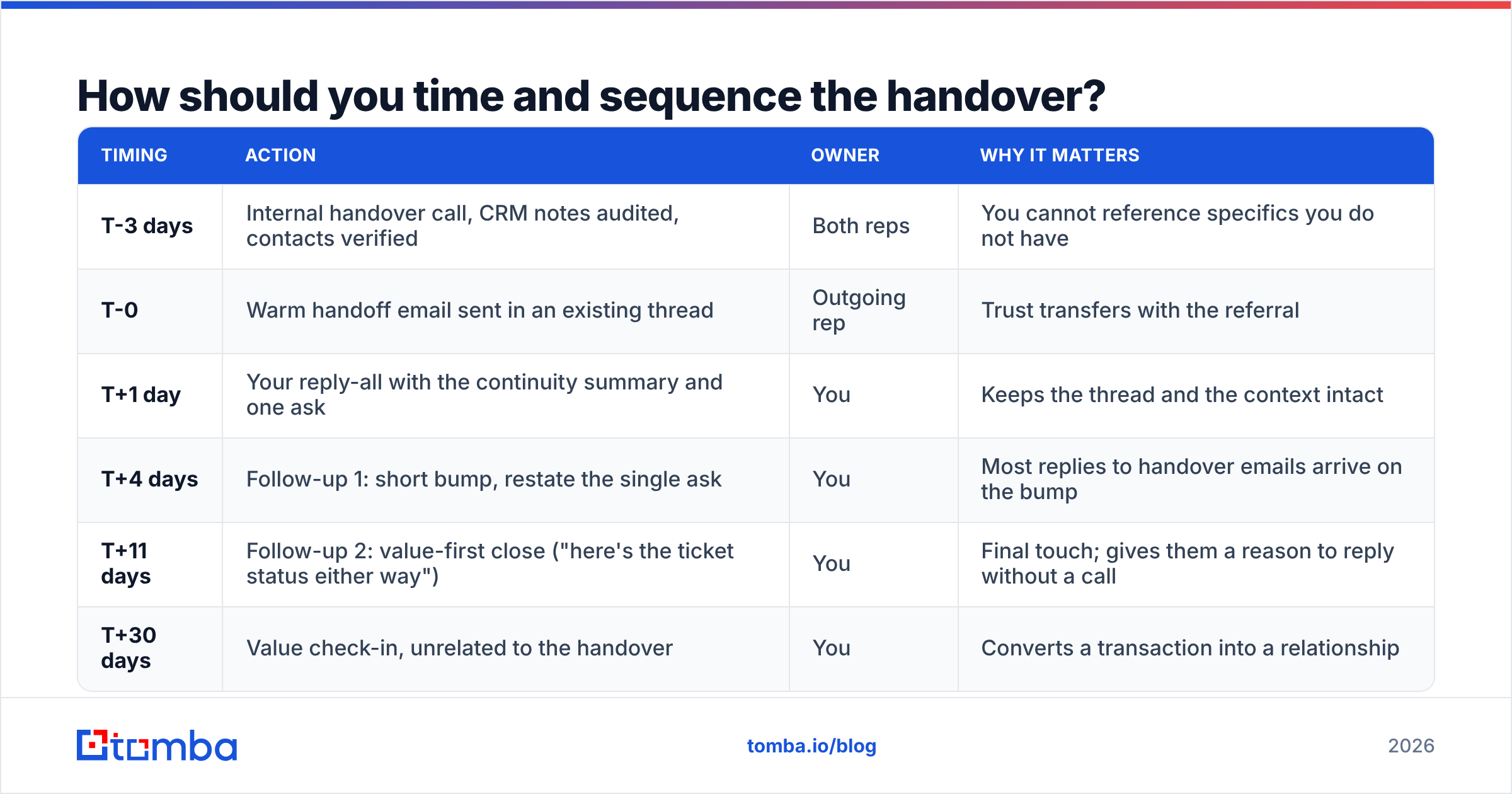
Speed matters more than polish. A rough email on day one beats an immaculate one on day ten, because the gap is where the customer's imagination lives.
| Timing | Action | Owner | Why it matters |
|---|---|---|---|
| T-3 days | Internal handover call, CRM notes audited, contacts verified | Both reps | You cannot reference specifics you do not have |
| T-0 | Warm handoff email sent in an existing thread | Outgoing rep | Trust transfers with the referral |
| T+1 day | Your reply-all with the continuity summary and one ask | You | Keeps the thread and the context intact |
| T+4 days | Follow-up 1: short bump, restate the single ask | You | Most replies to handover emails arrive on the bump |
| T+11 days | Follow-up 2: value-first close ("here's the ticket status either way") | You | Final touch; gives them a reason to reply without a call |
| T+30 days | Value check-in, unrelated to the handover | You | Converts a transaction into a relationship |
Stop at two follow-ups. This is an existing customer, not a prospect. A third bump on a handover email reads as needy and costs you standing you will need at renewal.
What if the contact has already left the company?#
Assume some of them have. The average B2B contact record degrades meaningfully every year, and inherited books are older than average by definition. Three moves, in order:
- Verify before sending. Bulk-check the inherited list so you know which addresses are valid, risky, or catch-all before you burn sender reputation. Tomba's bulk verify handles a full book in one pass.
- Find the replacement, not just the address. When a champion has moved on, you need whoever now owns the budget. An email finder keyed on the company domain plus the likely job title gets you there faster than scrolling LinkedIn.
- Enrich the record while you are in there. Title, seniority, and department decide whether your handover email is a courtesy note or a genuine re-sell. Contact enrichment fills those gaps so the CRM you hand to the next owner is better than the one you inherited.
If the champion is gone and the account has gone quiet, do not send a handover email at all. Send a re-engagement email. They are different messages, and pretending a lapsed relationship is an ongoing one is the fastest way to get marked as spam by someone who does not remember your company.
What metrics tell you the handover actually worked?#
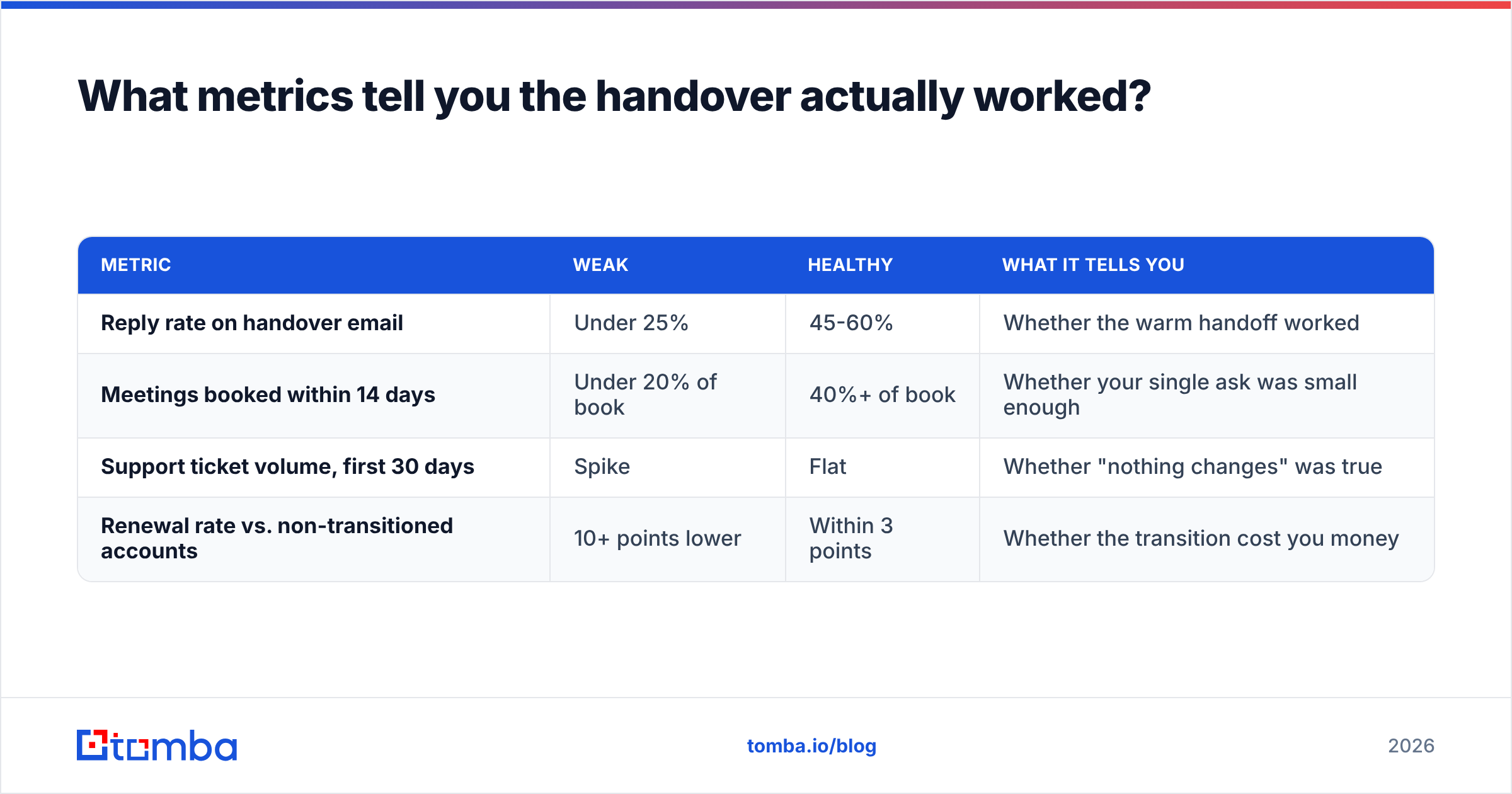
Reply rate is the obvious one and the least useful on its own. Track these four together.
| Metric | Weak | Healthy | What it tells you |
|---|---|---|---|
| Reply rate on handover email | Under 25% | 45-60% | Whether the warm handoff worked |
| Meetings booked within 14 days | Under 20% of book | 40%+ of book | Whether your single ask was small enough |
| Support ticket volume, first 30 days | Spike | Flat | Whether "nothing changes" was true |
| Renewal rate vs. non-transitioned accounts | 10+ points lower | Within 3 points | Whether the transition cost you money |
That last row is the one to put in front of your manager. If transitioned accounts renew ten points below the rest of the book, the handover process is a revenue problem, not an email-copy problem, and no subject line will fix it. Research bodies like Gartner have been making that argument about buyer effort for years: friction introduced by the seller's internal changes gets charged to the seller at renewal.
What are the five mistakes that cost the most?#
- Opening with your résumé. Cut the first paragraph of your draft. It is almost always about you. The email usually improves.
- Vague asks. "Let me know if you need anything" produces nothing. One question, one time window.
- Over-promising to win the room. New owners feel pressure to prove value fast and commit to a roadmap item they cannot deliver. You will own that promise at renewal.
- Skipping the internal handover. If you cannot name one specific detail about the account, you are not ready to send. Read the notes, the tickets, and the last three email threads.
- Sending to unverified addresses. Bounces on an existing customer domain are worse than bounces on a cold list, because that domain is one you need deliverable for the next three years. Protect sender reputation as a standing habit, not a campaign-level one.
How do you make this repeatable across a whole book?#
Turn it into a checklist your team runs identically every time: verify contacts, audit CRM notes, warm handoff, reply-all continuity email, two bumps, 30-day value check-in. Store the templates where reps will actually find them, and log the four metrics above per transitioned account so you can tell a copy problem from a process problem.
The teams that do this well treat account transitions like deploys: rehearsed, logged, and reversible. The teams that do it badly find out at renewal.
Start with clean contact data. The best-written introduction email as new point of contact is worthless if it lands in a bounce log. Run your inherited book through the Tomba Email Finder to confirm who currently holds each role and which addresses are still live. The free tier covers 25 searches a month if you just want to sanity-check a handful of key accounts, and paid plans start at $49/mo on Tomba pricing when you are transitioning a full territory. Verify first, then write.
Related guides#
// get started
Find, verify and enrich your first contacts today
Start on the free plan with 25 searches a month, then scale when your team is ready.
Free plan · No credit card required · GDPR & CCPA
// about the author