How to Write an Introduction Email for a Business Proposal (2026)
A proposal is only read if the email in front of it earns the click. Here is what to write, what to cut, how long it should be, and the mistakes that quietly kill reply rates.
TL;DR
- An introduction email for a business proposal is not the proposal. Its only job is to earn a reply or a click, so keep it between 90 and 150 words.
- Lead with the reason you are writing to this company, not with your company history. Credentials belong in paragraph three, if at all.
- Do not attach a PDF on the first touch. Attachments drag down deliverability and give the reader an excuse to postpone. Offer the proposal, do not force it.
- Warm intros, cold intros, and RFP responses need three different structures. Using the cold template on an RFP reply reads as lazy and usually loses the deal.
- Verify every address before you send. A proposal that bounces was never a proposal, and repeated bounces damage the sending domain you will need for the next 200 prospects.
What is an introduction email for a business proposal?#
It is the short message that carries a proposal to a decision-maker who has not yet agreed to read one. Think of it as the handshake before the meeting, not the meeting itself. You are not closing anything in this email. You are buying twelve seconds of attention and converting them into one of three outcomes: a reply, a booked call, or a click on a link to the full document.
That distinction matters because most people write the email as a compressed version of the proposal. They summarize scope, pricing, timelines, and team bios in four dense paragraphs, then wonder why nothing comes back. The proposal answers how. The introduction email answers why should I spend any time on this at all.
A business proposal is a formal, structured document that usually runs 5 to 40 pages. Nobody opens one on a phone at 8:40 a.m. between meetings. They open a 120-word email, decide whether the sender understands their problem, and either forward it internally or archive it. Your email is the filter, and you are the one who built it.
Why do most proposal introduction emails get ignored?#
Seven failure patterns account for the overwhelming majority of silence. They are worth naming because each one has a specific fix.
- Opening with yourself. "We are a full-service agency founded in 2014 with offices in three countries" tells the reader nothing they can act on. Open with the observation that made you reach out.
- No identifiable trigger. If the email would read identically to 400 other companies, it will perform like a mass email, because it is one. A funding round, a job posting, a new product page, a compliance deadline — pick something dated and real.
- Attaching the proposal immediately. A 6 MB PDF from an unknown sender is a spam-filter magnet and a psychological burden. It also tells the reader you did the work before you understood their problem.
- Asking for too much. "Do you have 45 minutes on Thursday?" is a big ask from a stranger. "Worth a look?" is a small one, and small asks get answered.
- Sending to the wrong person. Proposals routed to a generic inbox or a departed employee die silently. Role changes are the single most common reason a well-written email gets no response.
- Unverified addresses. Bounces are invisible to the sender who does not check, and corrosive to the sending domain over time.
- No follow-up plan. Roughly half of all proposal replies arrive after the first message. If you send once and move on, you are leaving the easier half of your pipeline on the table.
What should an introduction email for a business proposal contain?#
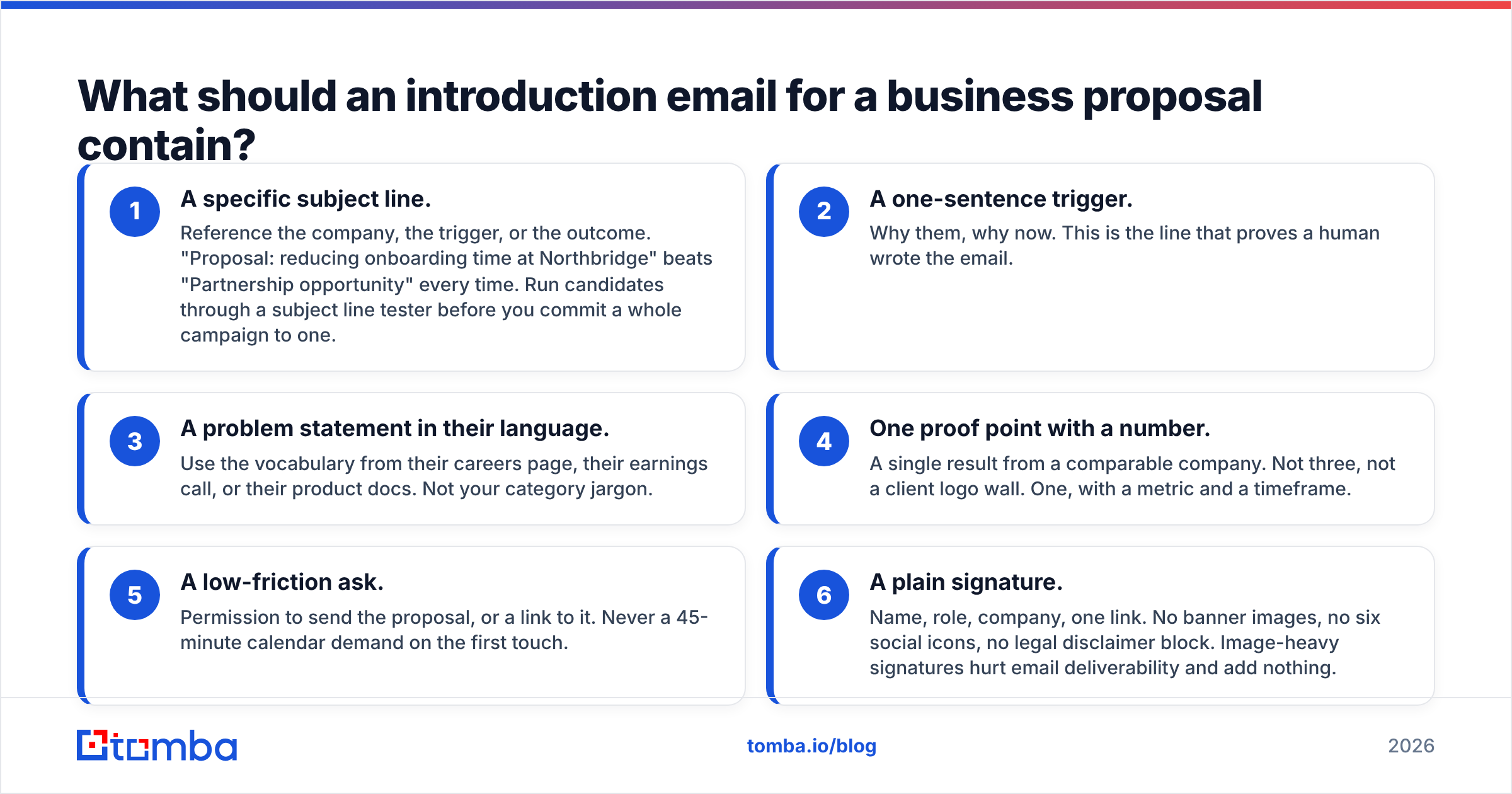
Six components, in this order. Each one earns the next line of attention.
- A specific subject line. Reference the company, the trigger, or the outcome. "Proposal: reducing onboarding time at Northbridge" beats "Partnership opportunity" every time. Run candidates through a subject line tester before you commit a whole campaign to one.
- A one-sentence trigger. Why them, why now. This is the line that proves a human wrote the email.
- A problem statement in their language. Use the vocabulary from their careers page, their earnings call, or their product docs. Not your category jargon.
- One proof point with a number. A single result from a comparable company. Not three, not a client logo wall. One, with a metric and a timeframe.
- A low-friction ask. Permission to send the proposal, or a link to it. Never a 45-minute calendar demand on the first touch.
- A plain signature. Name, role, company, one link. No banner images, no six social icons, no legal disclaimer block. Image-heavy signatures hurt email deliverability and add nothing.
If you strip every sentence that does not belong to one of those six jobs, most drafts lose 40 percent of their length and gain their reply rate back.
How do cold, warm, and RFP proposal intros differ?#
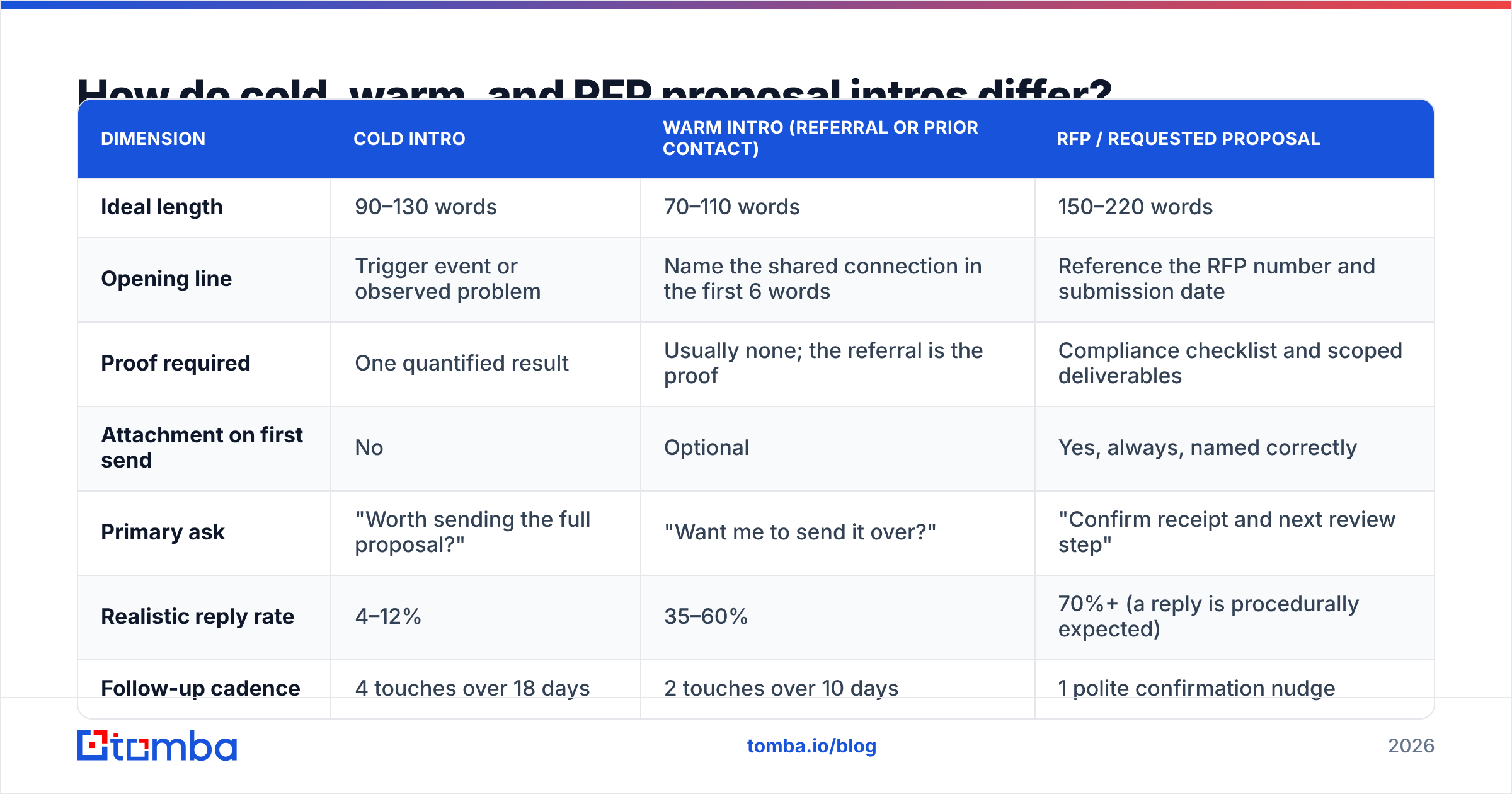
Three situations, three structures. Sending the wrong one is a common and expensive mistake.
| Dimension | Cold intro | Warm intro (referral or prior contact) | RFP / requested proposal |
|---|---|---|---|
| Ideal length | 90–130 words | 70–110 words | 150–220 words |
| Opening line | Trigger event or observed problem | Name the shared connection in the first 6 words | Reference the RFP number and submission date |
| Proof required | One quantified result | Usually none; the referral is the proof | Compliance checklist and scoped deliverables |
| Attachment on first send | No | Optional | Yes, always, named correctly |
| Primary ask | "Worth sending the full proposal?" | "Want me to send it over?" | "Confirm receipt and next review step" |
| Realistic reply rate | 4–12% | 35–60% | 70%+ (a reply is procedurally expected) |
| Follow-up cadence | 4 touches over 18 days | 2 touches over 10 days | 1 polite confirmation nudge |
| Biggest failure mode | Generic trigger | Burying the referral name | Missing a stated requirement |
The pattern to notice: the warmer the context, the shorter the email and the more direct the ask. Cold emails need to earn the right to be relevant. RFP responses need to prove procedural competence. Confusing the two produces either a cold email that reads like a compliance document or an RFP response that reads like a pitch.
What does a good introduction email actually look like?#
Here is a cold version, at 118 words.
Subject: Onboarding drop-off at Northbridge
Hi Dana,
I saw Northbridge posted three implementation-specialist roles last month. Usually that means onboarding volume is outgrowing the team rather than the process being broken.
We worked with Calder Logistics on the same shape of problem last year. They cut time-to-first-value from 31 days to 18 without adding headcount, mostly by restructuring the first two customer touchpoints.
I have put together a short proposal for how that would map to your implementation flow, including a rough 90-day sequence and what it would cost.
Want me to send it over?
Best,
Ilias
Partnerships, Corvid Systems
Notice what is missing. No company boilerplate. No "I hope this email finds you well." No pricing. No attachment. One number, one comparable, one small question. The entire email is a permission request, and permission requests are cheap to grant.
The warm version is shorter still:
Subject: Marta suggested I reach out
Hi Dana,
Marta Reyes mentioned you are rebuilding the implementation process this quarter. She thought the work we did with her team on onboarding sequencing might be relevant.
I have a short proposal drafted with a 90-day plan and costs. Want me to send it?
Best,
Ilias
Seventy-one words. The referral does the work that four paragraphs of proof would otherwise have to do. If you have a warm path, use it and get out of the way. Bank your longer-form writing for the proposal itself, or start from a tested structure in a cold email templates library rather than a blank page.
Should you attach the proposal to the first email?#
No, with two exceptions: a formal RFP response, and a prospect who explicitly asked for it in writing.
Three reasons. First, mail filters treat unsolicited attachments from unrecognized senders with suspicion, and a single PDF can be the difference between the inbox and the promotions tab. Second, a 20-page document is a commitment, and commitments get deferred. "I will read this properly later" is where proposals go to die. Third, sending the full document before a conversation means you priced and scoped a project based on assumptions you never tested. When the prospect replies with "this is not quite what we need," you have burned your one shot at a first impression.
The better sequence is: earn permission, ask two or three scoping questions on the reply, then send a proposal that reflects the answers. It takes one extra day and it roughly doubles the acceptance rate in most teams that measure it. Sales research groups including Gartner have documented the same underlying pattern for years: buyers reward sellers who reduce the effort required to evaluate them.
How do you make sure the email actually reaches the right inbox?#
Writing is the visible half. Delivery is the half that quietly decides whether any of the writing mattered.
Start with the address. Proposal outreach tends to target senior roles, and senior roles change companies faster than anyone updates a CRM. An address you exported eight months ago has a meaningful chance of being dead. Run every list through an email verifier before a proposal send, not after. If you are building the list from scratch, a domain search will return the current contacts and email pattern for a company in one query, which is faster and far more accurate than guessing at firstname.lastname@.
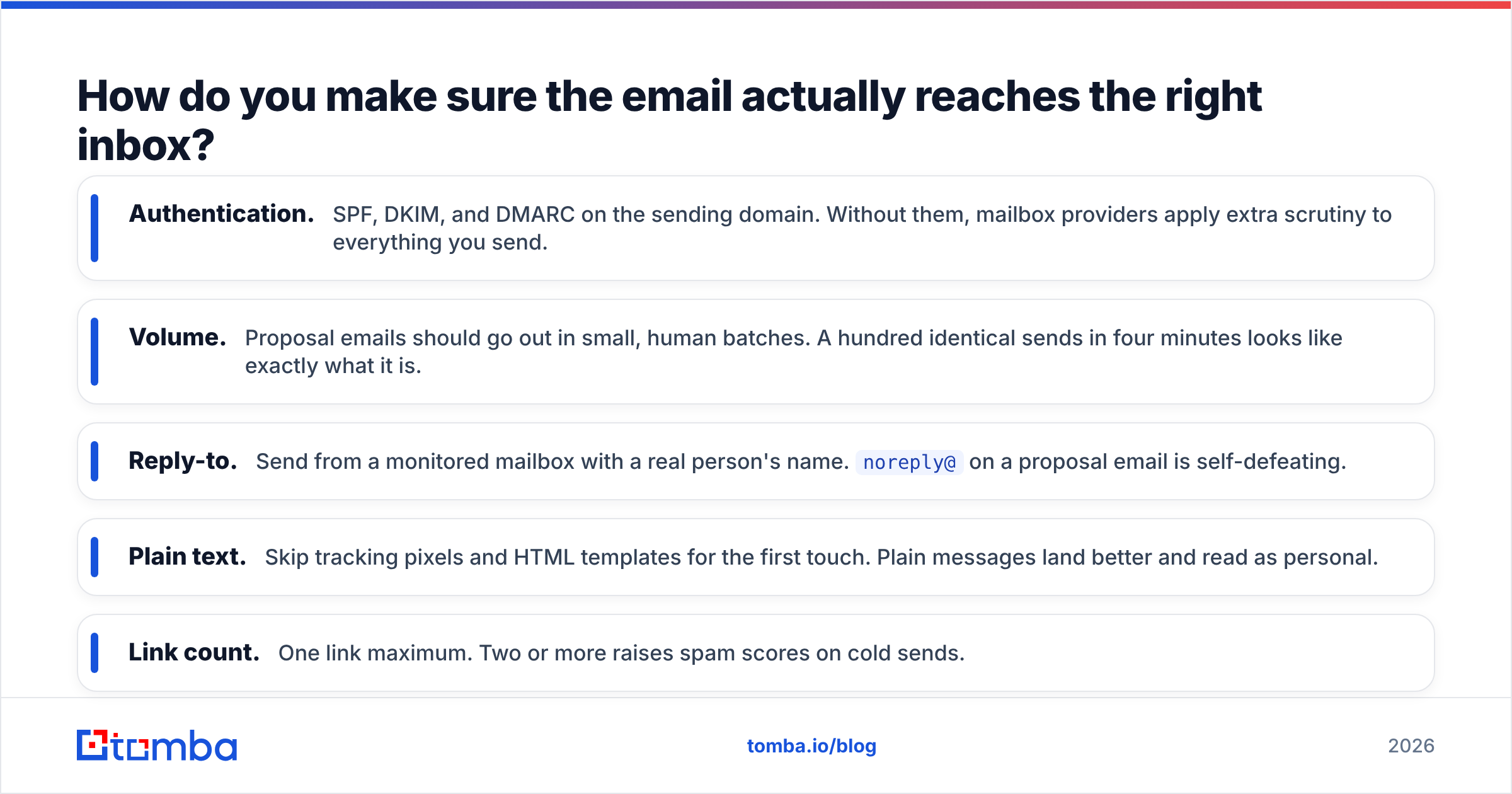
Then check the mechanics:
- Authentication. SPF, DKIM, and DMARC on the sending domain. Without them, mailbox providers apply extra scrutiny to everything you send.
- Volume. Proposal emails should go out in small, human batches. A hundred identical sends in four minutes looks like exactly what it is.
- Reply-to. Send from a monitored mailbox with a real person's name.
noreply@on a proposal email is self-defeating. - Plain text. Skip tracking pixels and HTML templates for the first touch. Plain messages land better and read as personal.
- Link count. One link maximum. Two or more raises spam scores on cold sends.
None of this is glamorous, and all of it compounds. A team with a clean domain and verified lists will get 2 to 3 times the delivered volume of a team with neither, sending the exact same copy.
What follow-up cadence works for proposal emails?#
Silence after a proposal intro is normal, not a rejection. Build the sequence in advance so you are not improvising a guilt-tinged "just bumping this" on day four.
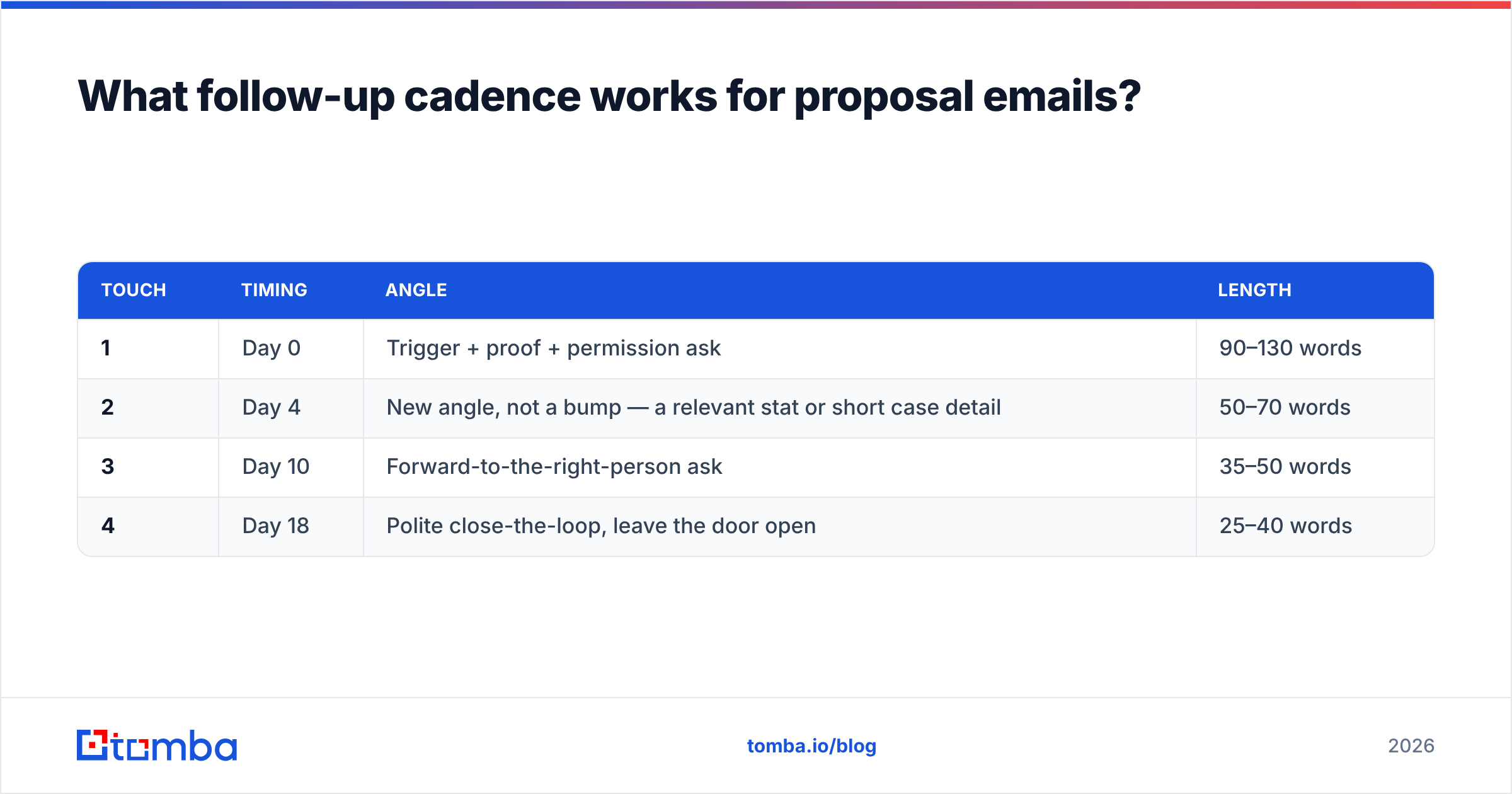
| Touch | Timing | Angle | Length |
|---|---|---|---|
| 1 | Day 0 | Trigger + proof + permission ask | 90–130 words |
| 2 | Day 4 | New angle, not a bump — a relevant stat or short case detail | 50–70 words |
| 3 | Day 10 | Forward-to-the-right-person ask | 35–50 words |
| 4 | Day 18 | Polite close-the-loop, leave the door open | 25–40 words |
Touch three is the underused one. "If this sits with someone else on your team, happy to send it to them instead" converts surprisingly well, because it costs the reader almost nothing and it removes the awkwardness of declining. Touch four should genuinely close the loop. Emails that end with "I will stop reaching out here, but the offer stands" get a meaningful number of replies precisely because they remove pressure.
Track outcomes at the sequence level, not the email level. The metric that matters is replies per 100 delivered, and you should be comparing it to your own baseline rather than to a benchmark from someone else's industry. Practical guidance on sequencing from publishers like HubSpot is a reasonable starting point, but your own numbers after 300 sends are worth more than any published average.
How do you know if your proposal intro is working?#
Four numbers, in order of usefulness.
- Delivered rate. Should sit above 97 percent. Below that, the list is the problem, not the copy.
- Reply rate. The real success metric. For cold proposal intros, 4 to 12 percent is a normal healthy band.
- Proposal-sent rate. What share of replies convert into permission to send the document. If replies are high but this is low, your positioning is attracting curiosity rather than intent.
- Proposal-to-meeting rate. If people accept the proposal and then go quiet, the problem has moved downstream into the document itself, not the email.
Change one variable at a time. Subject line one week, opening line the next. Teams that rewrite the entire email every fortnight learn nothing, because they can never attribute the change.
Where should you start?#
Rewrite one email today. Take your current proposal intro, cut every sentence that is about you rather than them, and see what survives. Most drafts drop to half length and read better for it. Then fix the list, because the best-written email in your pipeline is worth nothing if it lands in a mailbox that was deactivated in March.
That is where Tomba's Email Finder fits. Give it a name and a company domain and it returns the current professional address with a confidence score, so your proposal reaches the person who can actually approve it. The free tier covers 25 searches a month if you just want to clean up a short list, and paid plans start at $49/mo on the Starter tier — full Tomba pricing is on the site. Get the address right, keep the email short, and let the proposal do the rest of the work.
Related guides#
Ready to find emails that actually work?
Join 150,000+ professionals who stopped guessing and started sending. Free credits on signup — no credit card required.
Get the Tomba newsletter
Practical outbound tactics and product updates — once every two weeks.
About the author