How to Write an Introduction Email to a Client (2026 Guide)
Most client introduction emails read like a resume and get archived in four seconds. Here is the structure, the subject-line rules, four ready templates, and the reply-rate benchmarks that tell you whether yours is working.
TL;DR
- An introduction email to a client has one job: earn a second message. Not explain your company, not list credentials, not book a 45-minute "discovery call" from a standing start.
- The four situations people lump together — cold prospect, new signed client, account handoff, and referral intro — need four different structures. Using the cold template on a signed client is why onboarding emails feel robotic.
- The highest-performing intros run 75–125 words, name one specific observation about the recipient, and end with a low-commitment question.
- Reply rate is the only metric that matters here. Open rate is unreliable post-MPP, and click rate is meaningless on an email with no link.
- Before you write anything, make sure the address is real. A perfect intro email to a bounced address is a 0% reply rate with extra steps.
What is an introduction email to a client?#
An introduction email to a client is the first written contact between you and a person who either is, or could become, a paying customer. It sets the relationship's default temperature.
Think of it like the first ten seconds of a house viewing. Nobody decides to buy in ten seconds, but plenty of people decide not to. Your intro email works the same way: it rarely closes anything, and it very reliably disqualifies you if it's generic, long, or obviously templated.
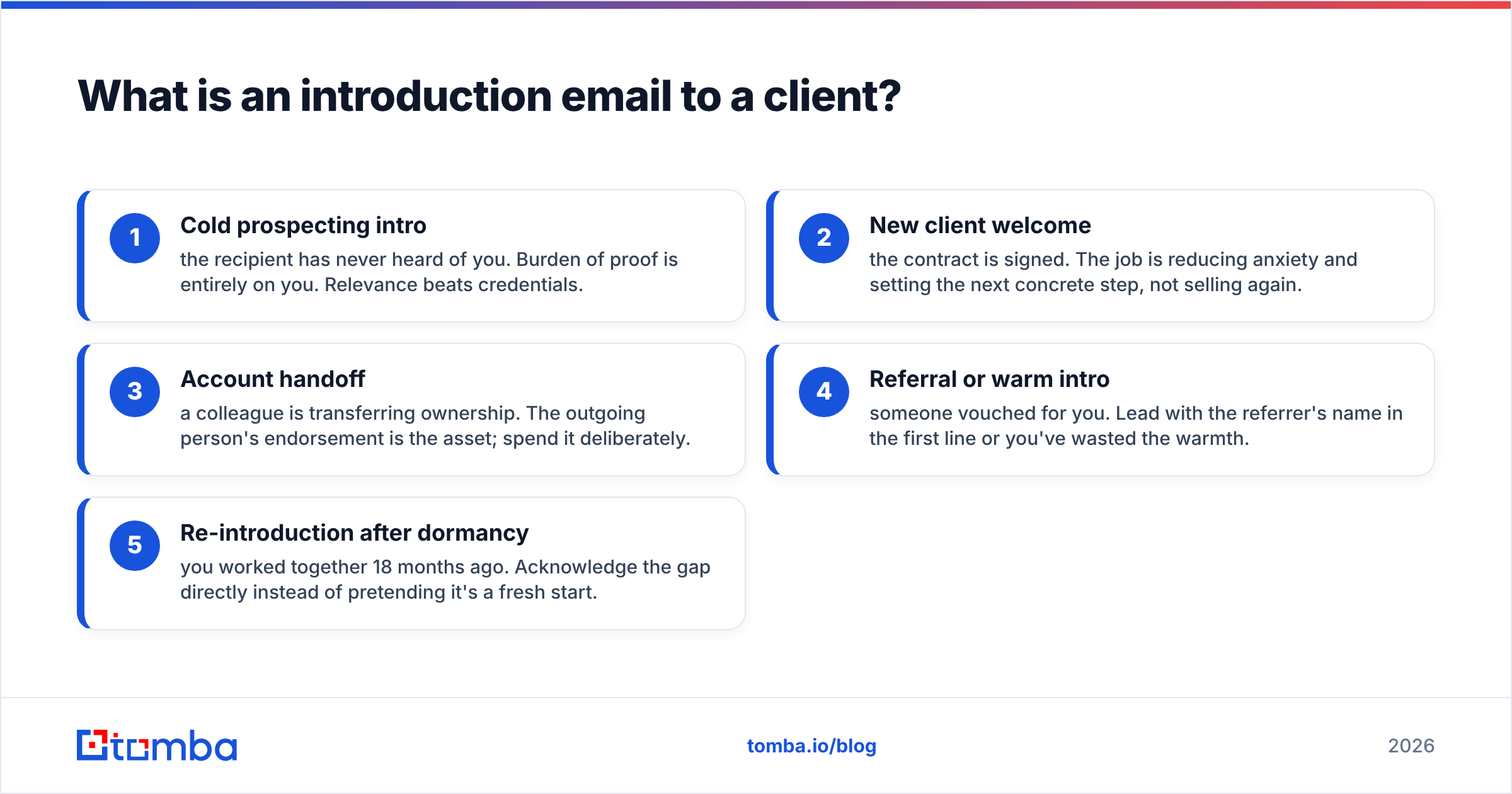
Four distinct scenarios get filed under the same label, and treating them identically is the most common mistake:
- Cold prospecting intro — the recipient has never heard of you. Burden of proof is entirely on you. Relevance beats credentials.
- New client welcome — the contract is signed. The job is reducing anxiety and setting the next concrete step, not selling again.
- Account handoff — a colleague is transferring ownership. The outgoing person's endorsement is the asset; spend it deliberately.
- Referral or warm intro — someone vouched for you. Lead with the referrer's name in the first line or you've wasted the warmth.
- Re-introduction after dormancy — you worked together 18 months ago. Acknowledge the gap directly instead of pretending it's a fresh start.
Everything below assumes you know which of those five you're writing. If you don't, stop and decide first; the structure changes.
Why do most introduction emails get ignored?#
Because they're written from the sender's point of view. The typical first draft opens with "I'm [name], [title] at [company], and we help companies like yours…" — three clauses about you before a single word about the reader.
The failure modes are predictable:
- Front-loaded self-description. The first 40 characters render in the mobile preview pane. If they're your job title, you've spent your best real estate on the least interesting fact in the email.
- The unearned meeting ask. "Do you have 30 minutes Thursday?" from a stranger is a request for roughly $75 of someone's time in exchange for nothing.
- Fake personalization. "I loved your recent post!" with no reference to what the post said is worse than no personalization, because it signals automation and dishonesty.
- Length. Anything past about 150 words gets deferred, and deferred means never.
- Multiple asks. Book a call, download the guide, follow us on LinkedIn. Every additional option lowers the odds of the first one.
There's also a quieter failure: the email never arrived. Spam placement and hard bounces are invisible to the sender unless you're checking. A message that lands in the junk folder produces exactly the same dashboard silence as a message the prospect read and hated, which is why people tune copy for months while the real problem is list quality or authentication.
What are the four types of client introduction emails?#
Different context, different structure, different success metric. Here's how they compare:
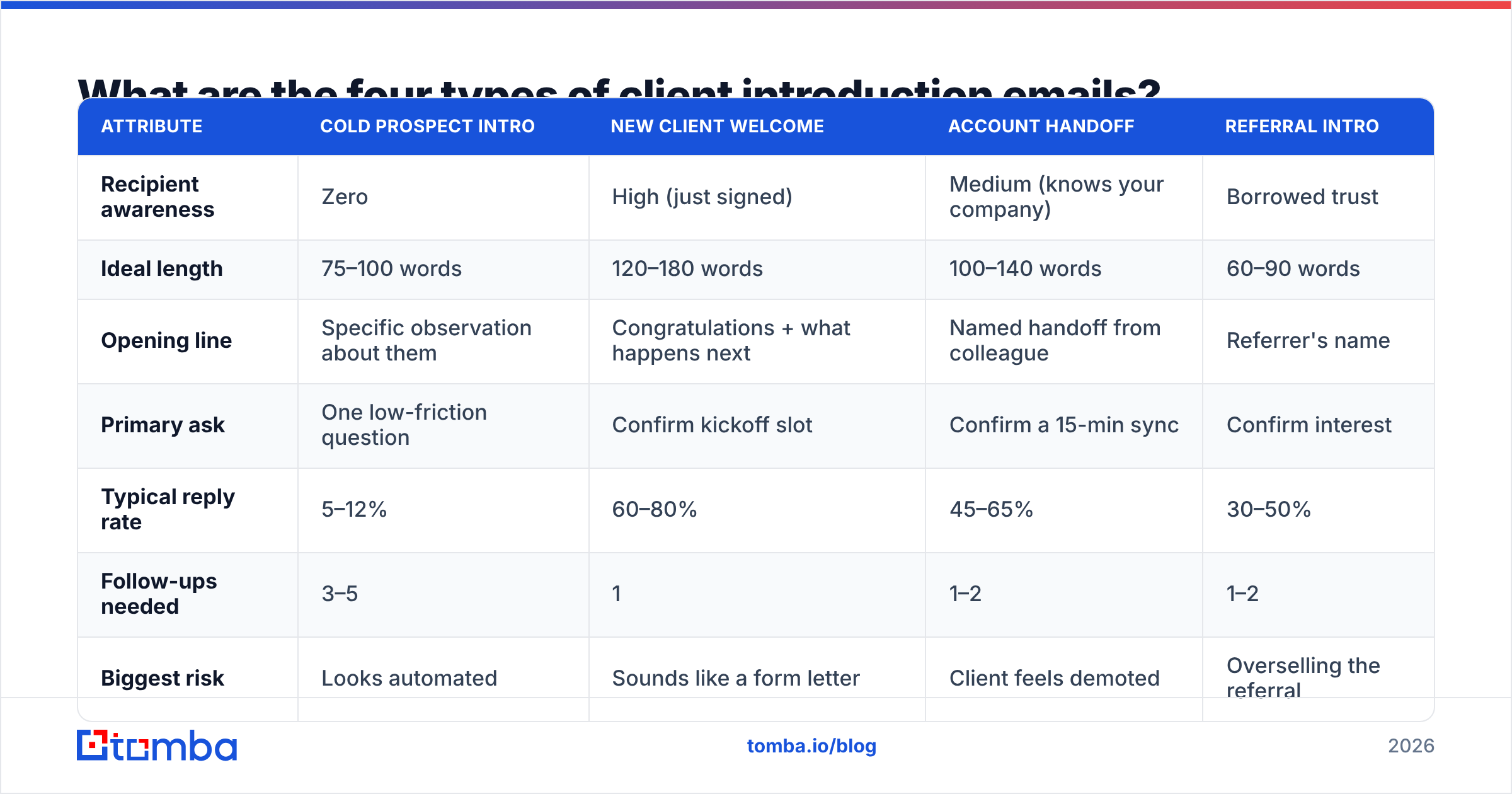
| Attribute | Cold prospect intro | New client welcome | Account handoff | Referral intro |
|---|---|---|---|---|
| Recipient awareness | Zero | High (just signed) | Medium (knows your company) | Borrowed trust |
| Ideal length | 75–100 words | 120–180 words | 100–140 words | 60–90 words |
| Opening line | Specific observation about them | Congratulations + what happens next | Named handoff from colleague | Referrer's name |
| Primary ask | One low-friction question | Confirm kickoff slot | Confirm a 15-min sync | Confirm interest |
| Typical reply rate | 5–12% | 60–80% | 45–65% | 30–50% |
| Follow-ups needed | 3–5 | 1 | 1–2 | 1–2 |
| Biggest risk | Looks automated | Sounds like a form letter | Client feels demoted | Overselling the referral |
| Send timing | Tue–Thu, 7–9am local | Within 2 hours of signature | Before the contract renewal window | Within 24h of the intro |
The reply-rate ranges are directional, drawn from what B2B teams typically report across outbound tooling; your vertical and list quality move them considerably. Enterprise IT security sits at the bottom of the cold range, niche professional services near the top.
Notice that the cold column is the only one where the expected reply rate is under 50%, and it's the one most guides write about. If you're onboarding a client who already paid you and your welcome email gets a 40% response, the email is broken — not the market.
What does a high-performing introduction email actually contain?#
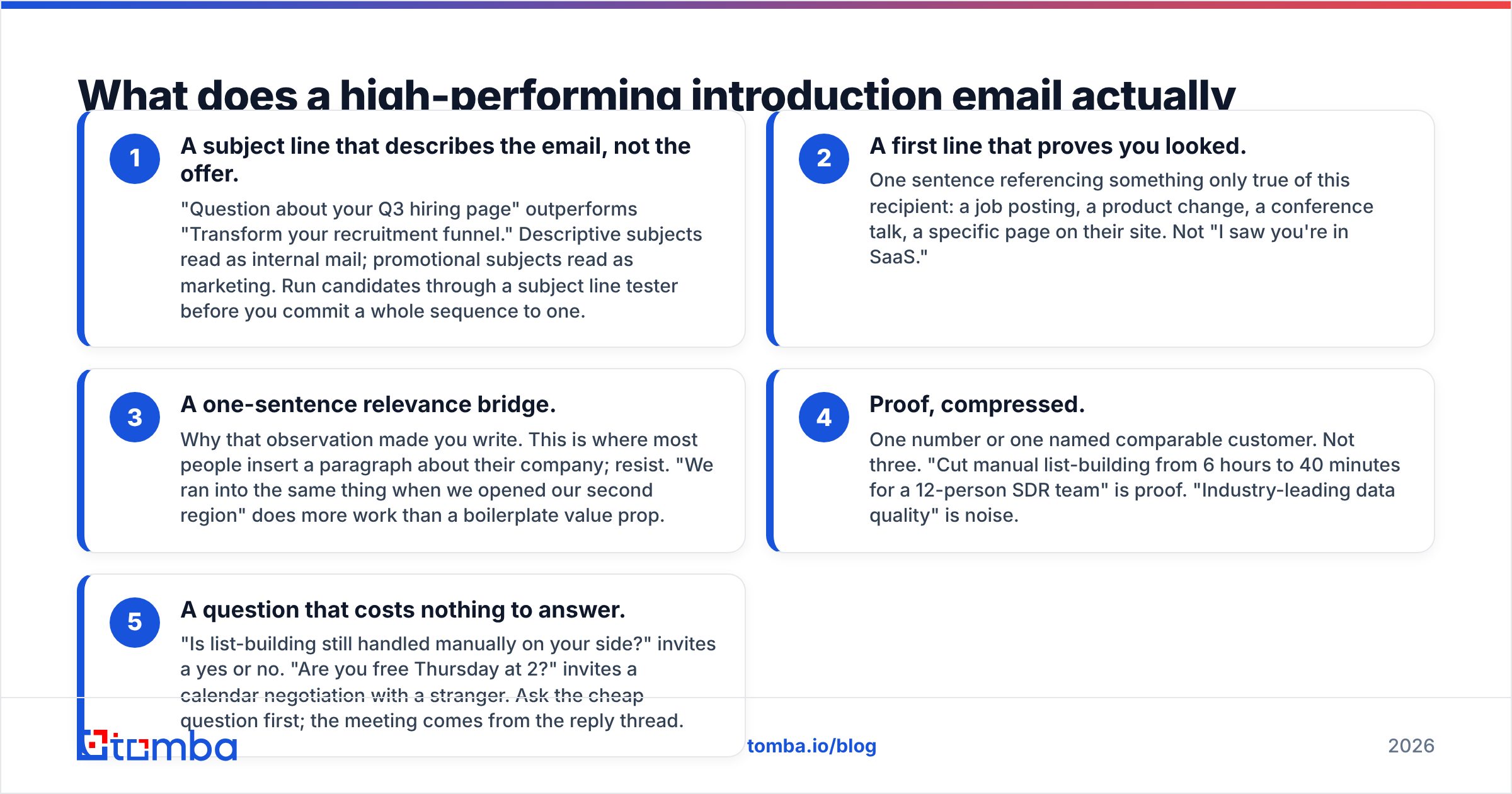
Five components, in this order. Drop any one and the email degrades in a specific, diagnosable way.
- A subject line that describes the email, not the offer. "Question about your Q3 hiring page" outperforms "Transform your recruitment funnel." Descriptive subjects read as internal mail; promotional subjects read as marketing. Run candidates through a subject line tester before you commit a whole sequence to one.
- A first line that proves you looked. One sentence referencing something only true of this recipient: a job posting, a product change, a conference talk, a specific page on their site. Not "I saw you're in SaaS."
- A one-sentence relevance bridge. Why that observation made you write. This is where most people insert a paragraph about their company; resist. "We ran into the same thing when we opened our second region" does more work than a boilerplate value prop.
- Proof, compressed. One number or one named comparable customer. Not three. "Cut manual list-building from 6 hours to 40 minutes for a 12-person SDR team" is proof. "Industry-leading data quality" is noise.
- A question that costs nothing to answer. "Is list-building still handled manually on your side?" invites a yes or no. "Are you free Thursday at 2?" invites a calendar negotiation with a stranger. Ask the cheap question first; the meeting comes from the reply thread.
A useful test: delete your company name and your job title from the draft. If the email still makes sense and still sounds like it was written to one person, it's ready. If it collapses, you wrote a brochure.
What does a cold introduction email to a prospective client look like?#
Subject: your Boston office rollout

Hi Dana,

Saw the three AE roles you posted for the Boston office last week —
looks like the east coast push is real.

When we opened a second region, our SDRs lost most of week one
rebuilding target lists by hand for the new territory.

One team we work with cut that from ~6 hours a week to about 40
minutes by pulling verified contacts straight into their CRM.

Is territory list-building still manual on your side, or have you
already solved it?

— Sam
Ninety-one words. One observation, one bridge, one proof point, one yes/no question. No attachment, no calendar link, no "circling back" language.
The follow-up matters as much as the opener. Research summarized by HubSpot's sales blog consistently shows a large share of replies arriving after the first message, so a single-touch intro leaves most of the response on the table. Three to five touches spaced across two weeks is standard practice; the second touch should add new information rather than ask "just bumping this."
How do you write a welcome email to a newly signed client?#
Completely different job. This person already bought. The anxiety window between signature and first value is where churn risk is highest, so the email exists to collapse uncertainty.
Subject: kickoff — what happens this week

Hi Priya,

Contract's countersigned, and you're set up. Here's the short version
of the next seven days:

• Today: your workspace is live, login is in the email below this one
• Wednesday: 30-min kickoff with me and Alex (your CSM)
• Friday: first data pull runs, you'll get the summary by email

I'm your direct line for anything commercial. Alex owns the day-to-day
and answers faster than I do.

Wednesday 10am or 2pm — which works?

— Sam
Two rules for this one. First, name a human being for each responsibility; "our support team" is where questions go to die. Second, give a dated sequence, not a vague promise of "onboarding materials shortly."
How do you handle an account handoff introduction?#
The outgoing owner should send it, not the incoming one. A handoff announced by the new person reads as an unannounced demotion. A handoff announced by the trusted existing contact transfers credibility.
Subject: introducing Alex — taking over your account

Hi Priya,

Starting next month I'm moving to the enterprise team, and Alex
Moreno is taking over your account.

Alex has run the three accounts closest to yours in setup for the
past two years, including the multi-region rollout you asked about
in June. He already has your full history, so you won't be
re-explaining anything.

I've cc'd him. He'll suggest a 15-minute intro this week — I'll stay
on the thread through the end of the month in case anything
needs me.

— Sam
The load-bearing sentence is "you won't be re-explaining anything." Client-side, the fear in every handoff is re-onboarding a stranger. Kill that fear explicitly.
Does your introduction email actually reach the client?#
This is the part that gets skipped, and it silently caps everything above. Three checks, in order of impact.
Verify the address before sending. Hard bounces above roughly 2% start damaging sender reputation, and mailbox providers apply that damage to your whole domain, not just one campaign. Running your list through an email verifier removes invalids, role accounts, and known traps before they cost you anything. For domains that accept everything, a dedicated catch-all verifier is the difference between a guess and a deliverable address.
Authenticate the sending domain. SPF, DKIM, and DMARC are table stakes since Google and Yahoo tightened bulk-sender requirements. If you can't confirm all three are passing, no amount of copy editing will fix your reply rate.
Warm the mailbox before volume. A brand-new domain sending 300 intros on day one is a spam signal regardless of content. Ramp over three to four weeks.
Only after those three are clean does copy testing tell you anything real. Optimizing a subject line while 18% of your list is invalid is measuring noise.
How do you find the right person to introduce yourself to?#
Getting the email right is downstream of getting the recipient right. A flawless intro to the wrong title is a wasted send, and in most B2B orgs the person who feels the pain and the person who owns the budget are two different people.
Practical sequence: identify the company, identify the role that owns the outcome you affect, then resolve that person to a verified address. A domain search returns the contacts and email pattern for a company in one step, which beats guessing at firstname.lastname@ and hoping. When you're working from a LinkedIn list instead of a domain list, a LinkedIn finder closes the gap between profile and inbox.
Two disciplines worth keeping: log the source of every address, and re-verify anything older than 90 days. B2B contact data decays at roughly 2–3% per month through job changes alone, which means a list you built last quarter is meaningfully worse today than when you exported it.
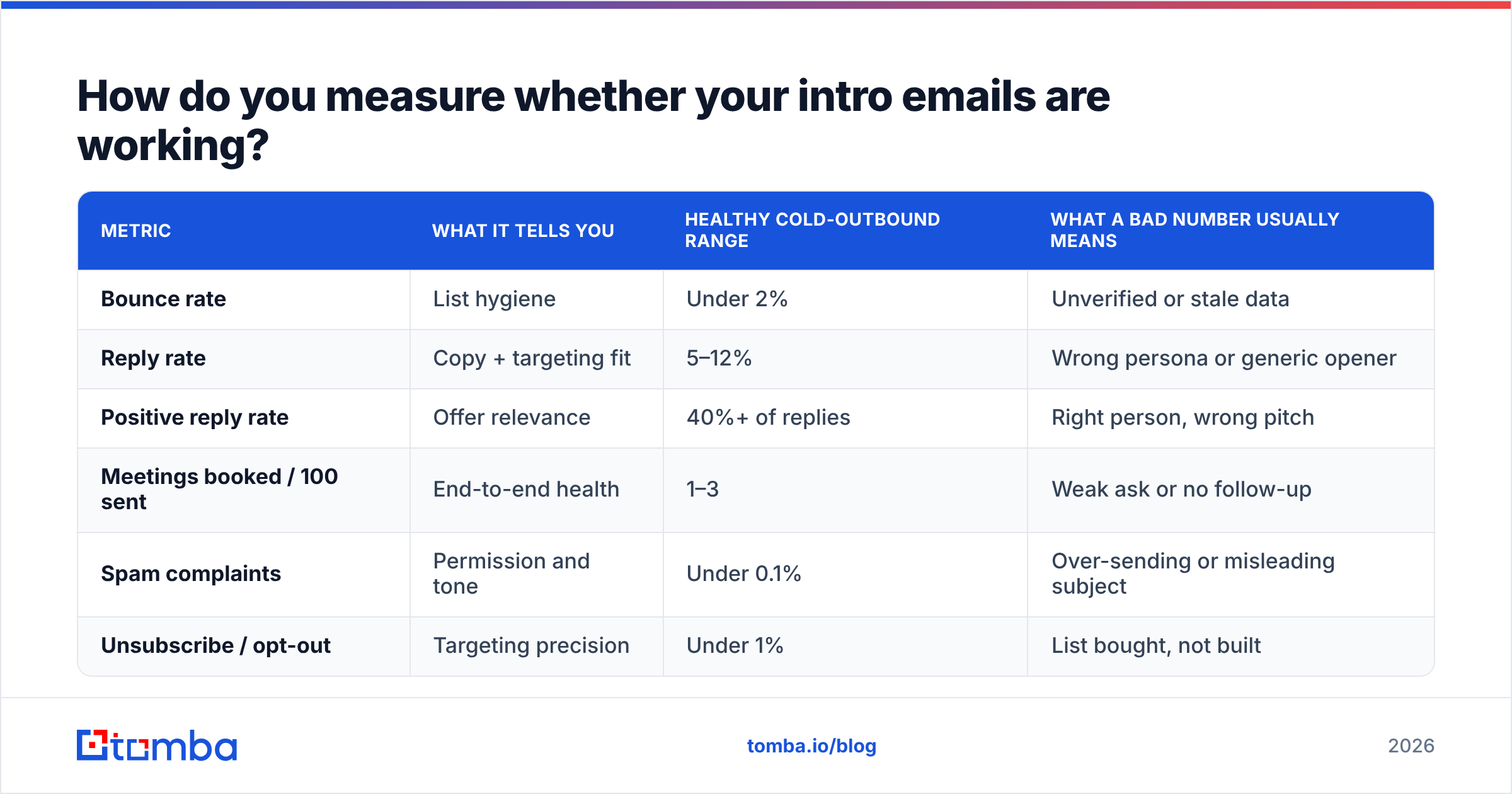
How do you measure whether your intro emails are working?#
| Metric | What it tells you | Healthy cold-outbound range | What a bad number usually means |
|---|---|---|---|
| Bounce rate | List hygiene | Under 2% | Unverified or stale data |
| Reply rate | Copy + targeting fit | 5–12% | Wrong persona or generic opener |
| Positive reply rate | Offer relevance | 40%+ of replies | Right person, wrong pitch |
| Meetings booked / 100 sent | End-to-end health | 1–3 | Weak ask or no follow-up |
| Spam complaints | Permission and tone | Under 0.1% | Over-sending or misleading subject |
| Unsubscribe / opt-out | Targeting precision | Under 1% | List bought, not built |
Open rate is deliberately absent. Apple Mail Privacy Protection pre-fetches images, which inflates opens for a large slice of any B2B list. Treat it as a directional signal at best, never as a success criterion. Track response rate instead, and segment it by persona so you can tell whether a weak week was a copy problem or a targeting problem.
Run one variable at a time. Change the subject line or the opening line or the ask, hold the rest constant, and give each variant at least 200 sends before you read the result. Anything smaller is coin-flipping. Sales-methodology research from firms like Gartner consistently points the same direction: buyers reward specificity and punish volume, and testing at a scale too small to detect that gets you nowhere.
What should you do next?#
Write the email second. Build the list first.
Start with the accounts where your observation in line one would be genuinely specific — a hiring signal, a product launch, a new office. Resolve each to a named person and a verified address, then write 90 words that could only have been sent to them.
Tomba's Email Finder handles the first half of that: find professional email addresses by domain, name, or company, with verification built into the same workflow so your bounce rate stays under control from the first send. The free tier includes 25 searches a month if you want to test the approach on a handful of target accounts before committing; paid plans start at $49/month, with full Tomba pricing laid out per tier. Get the addresses right, and the copy advice above finally has something to act on.
Related guides#
// get started
Find, verify and enrich your first contacts today
Start on the free plan with 25 searches a month, then scale when your team is ready.
Free plan · No credit card required · GDPR & CCPA
// about the author