Introduction Email to Client Subject Line: 30 That Get Opened
The first email you send a new client is judged in about four words. Here are 30 tested introduction subject lines, the formats that beat them, and the openers that quietly kill your reply rate.
TL;DR
- An introduction email to a client is judged on roughly four visible words in a mobile inbox. Write the subject line for that preview, not for your own sense of politeness.
- Context beats cleverness. "Intro from [Your Company] re: [their project]" outperforms "Quick question" almost every time in a first-touch client email.
- Keep it between 3 and 7 words, front-load the identifying noun, and never use a question you would not answer yourself.
- Warm intros, cold intros, post-signature onboarding intros, and referral intros need four different subject-line formats. Using one template for all four is the most common mistake.
- A great subject line on a wrong or dead address still gets you nothing. Verify the address before you obsess over the words.
What makes an introduction email to client subject line different from a cold email subject line?#
The difference is permission, and it changes everything about the words you choose.
A cold email subject line has one job: buy three seconds of attention from someone who has no reason to give it. It leans on curiosity, pattern interruption, and brevity because it has nothing else. An introduction email to a client — a signed client, a referred prospect, a warm inbound lead, a contact handed over from another rep — starts with a thread of existing context. Your subject line's job is not to manufacture intrigue. It is to retrieve that context instantly so the recipient knows which box to file you in.
Think of it like a name tag at a conference. A cold email is shouting across the room. An introduction email is walking up with your badge already visible. The badge does not need to be witty. It needs to be legible.
That single reframe fixes most bad intro subject lines. "Quick question" is a shout. "Intro — Tomba + Acme onboarding" is a badge.
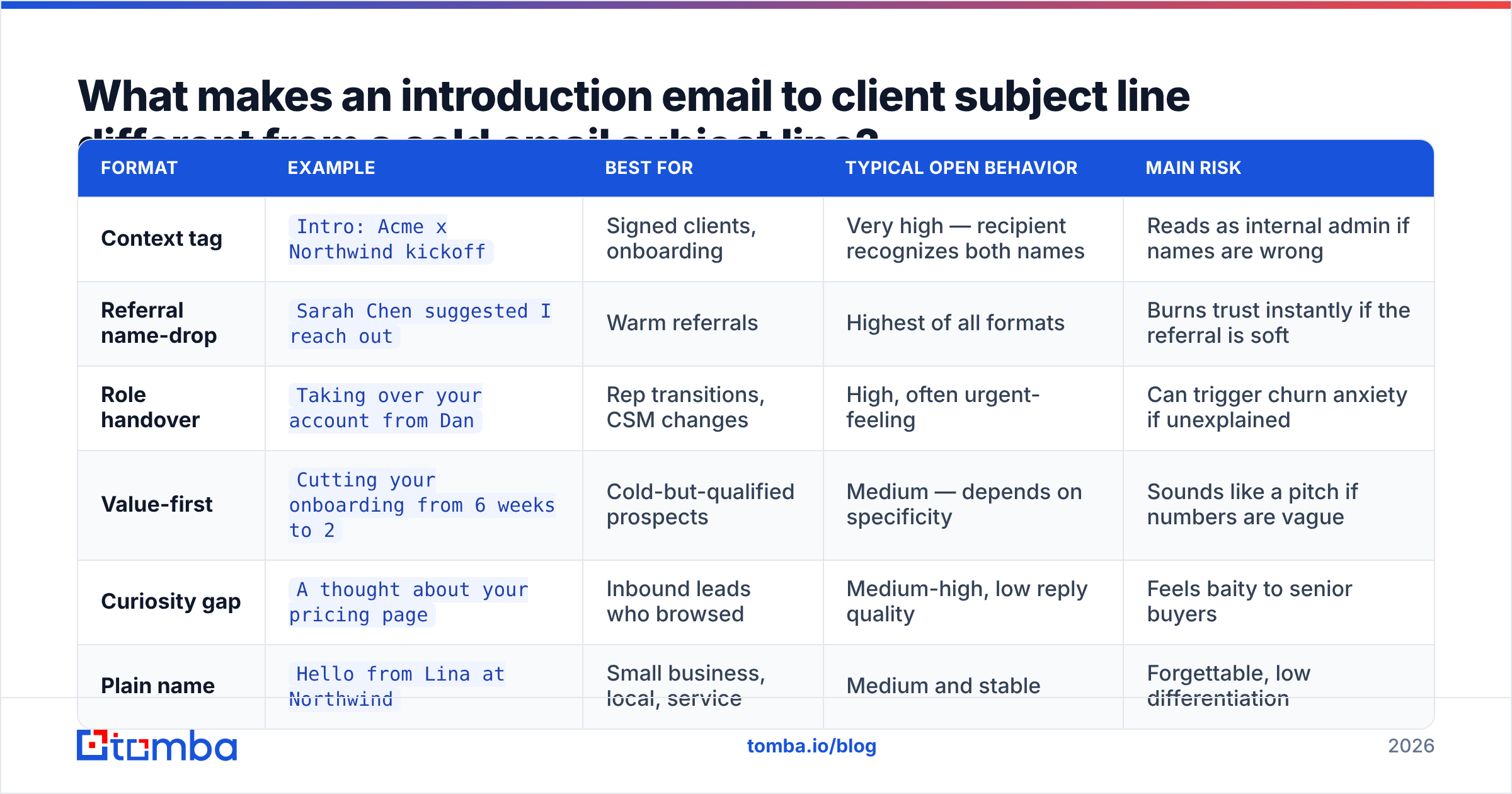
Here is how the major first-touch formats actually compare:
| Format | Example | Best for | Typical open behavior | Main risk |
|---|---|---|---|---|
| Context tag | Intro: Acme x Northwind kickoff |
Signed clients, onboarding | Very high — recipient recognizes both names | Reads as internal admin if names are wrong |
| Referral name-drop | Sarah Chen suggested I reach out |
Warm referrals | Highest of all formats | Burns trust instantly if the referral is soft |
| Role handover | Taking over your account from Dan |
Rep transitions, CSM changes | High, often urgent-feeling | Can trigger churn anxiety if unexplained |
| Value-first | Cutting your onboarding from 6 weeks to 2 |
Cold-but-qualified prospects | Medium — depends on specificity | Sounds like a pitch if numbers are vague |
| Curiosity gap | A thought about your pricing page |
Inbound leads who browsed | Medium-high, low reply quality | Feels baity to senior buyers |
| Plain name | Hello from Lina at Northwind |
Small business, local, service | Medium and stable | Forgettable, low differentiation |
Notice that the two highest-performing formats — context tag and referral name-drop — contain zero persuasion. They are pure identification. That is the pattern worth internalizing before you look at a single template.
What rules does every client introduction subject line have to follow?#
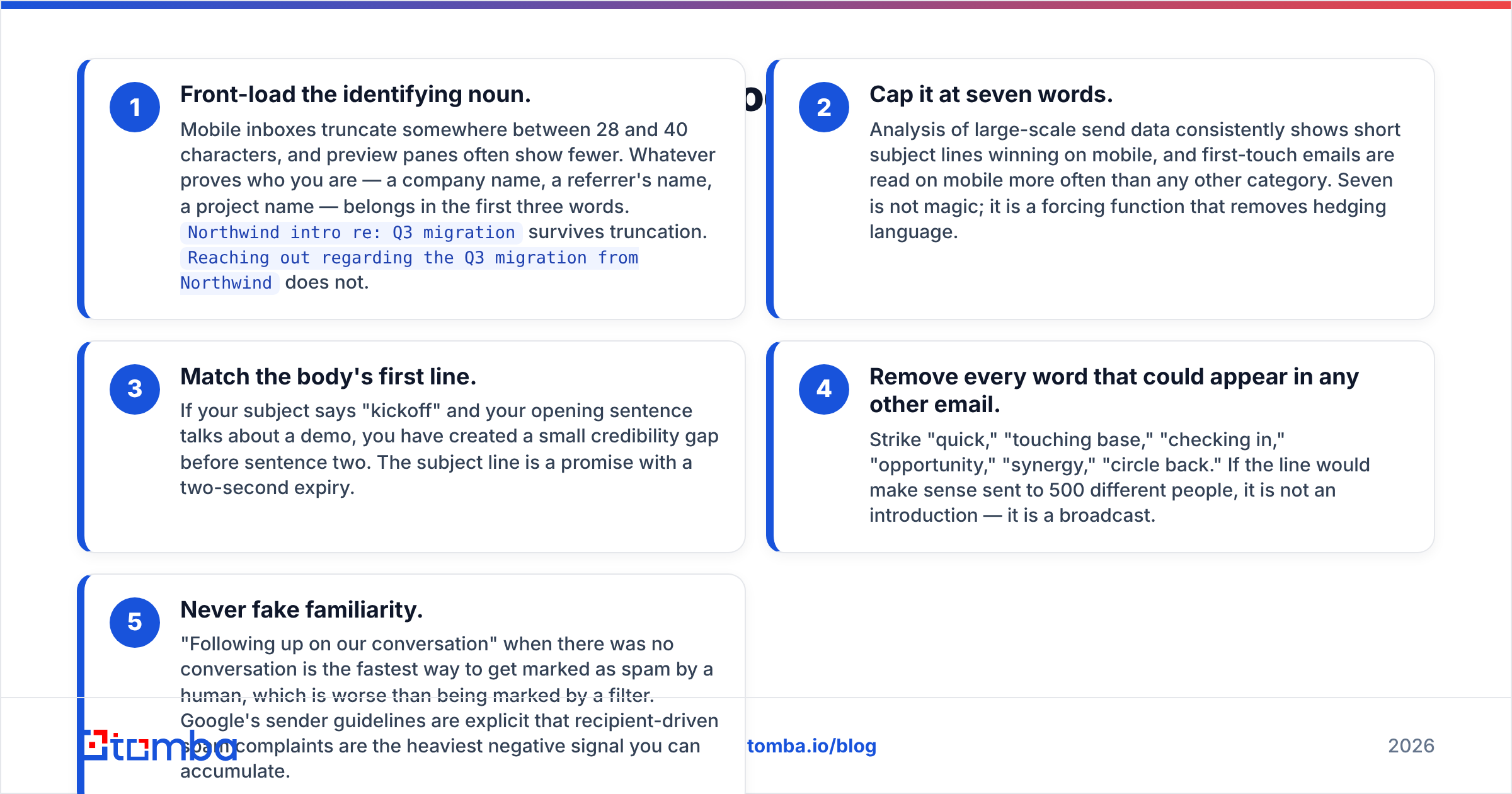
Five constraints do most of the work. Apply them in order.
- Front-load the identifying noun. Mobile inboxes truncate somewhere between 28 and 40 characters, and preview panes often show fewer. Whatever proves who you are — a company name, a referrer's name, a project name — belongs in the first three words.
Northwind intro re: Q3 migrationsurvives truncation.Reaching out regarding the Q3 migration from Northwinddoes not. - Cap it at seven words. Analysis of large-scale send data consistently shows short subject lines winning on mobile, and first-touch emails are read on mobile more often than any other category. Seven is not magic; it is a forcing function that removes hedging language.
- Match the body's first line. If your subject says "kickoff" and your opening sentence talks about a demo, you have created a small credibility gap before sentence two. The subject line is a promise with a two-second expiry.
- Remove every word that could appear in any other email. Strike "quick," "touching base," "checking in," "opportunity," "synergy," "circle back." If the line would make sense sent to 500 different people, it is not an introduction — it is a broadcast.
- Never fake familiarity. "Following up on our conversation" when there was no conversation is the fastest way to get marked as spam by a human, which is worse than being marked by a filter. Google's sender guidelines are explicit that recipient-driven spam complaints are the heaviest negative signal you can accumulate.
Those five rules eliminate maybe 80% of the subject lines people actually send. What remains is usually short, specific, and slightly boring — which is exactly right for a first client touch.

What are 30 introduction email subject lines that actually get opened?#
Grouped by scenario, because the scenario determines the format. Swap the brackets for real specifics — a subject line with an unfilled placeholder is worse than no email at all.
Newly signed client / onboarding intro
Intro: [Your Company] x [Their Company]Your [Product] kickoff — next steps[Your Name] here, your [Role] at [Company]Welcome aboard, [First Name]Kickoff call — 3 things to decide firstYour onboarding plan, one page[Their Company] launch: week one
Referral or mutual connection
[Referrer Name] suggested we talk[Referrer Name] said you're rebuilding [system]Intro via [Referrer Name]Passing along what [Referrer] mentioned[Referrer] thought this was relevant
Account handover / new rep
Taking over your [Company] accountNew point of contact at [Company][Previous Rep] handed me your accountSame team, new name — [Your Name]Your account, now with me
Warm inbound lead
Following your [Product] trialYou downloaded [Asset] — here's the restAbout the [Feature] question you askedYour demo request, answeredRe: your note on [Topic]
Cold but qualified prospect
[Their Company]'s [specific problem]Idea for [Their Company]'s [department]Noticed [Company] is hiring [Role][Competitor] switched to this in [Month]Two lines on [Their Metric]
Service businesses and agencies
[Your Company] — proposal for [Project][Their Company] website audit, attachedQuote for [Specific Job], no obligation
Run your favorites through a subject line tester before you commit them to a sequence. A 30-second check for spam trigger words and truncation length costs less than a burned first impression, and it catches the mobile-clipping problem that reads fine on your desktop monitor.
How long should an introduction subject line be, exactly?#
Three to seven words, roughly 28 to 50 characters. Below three words you usually lose the identifying noun; above seven you start hedging.
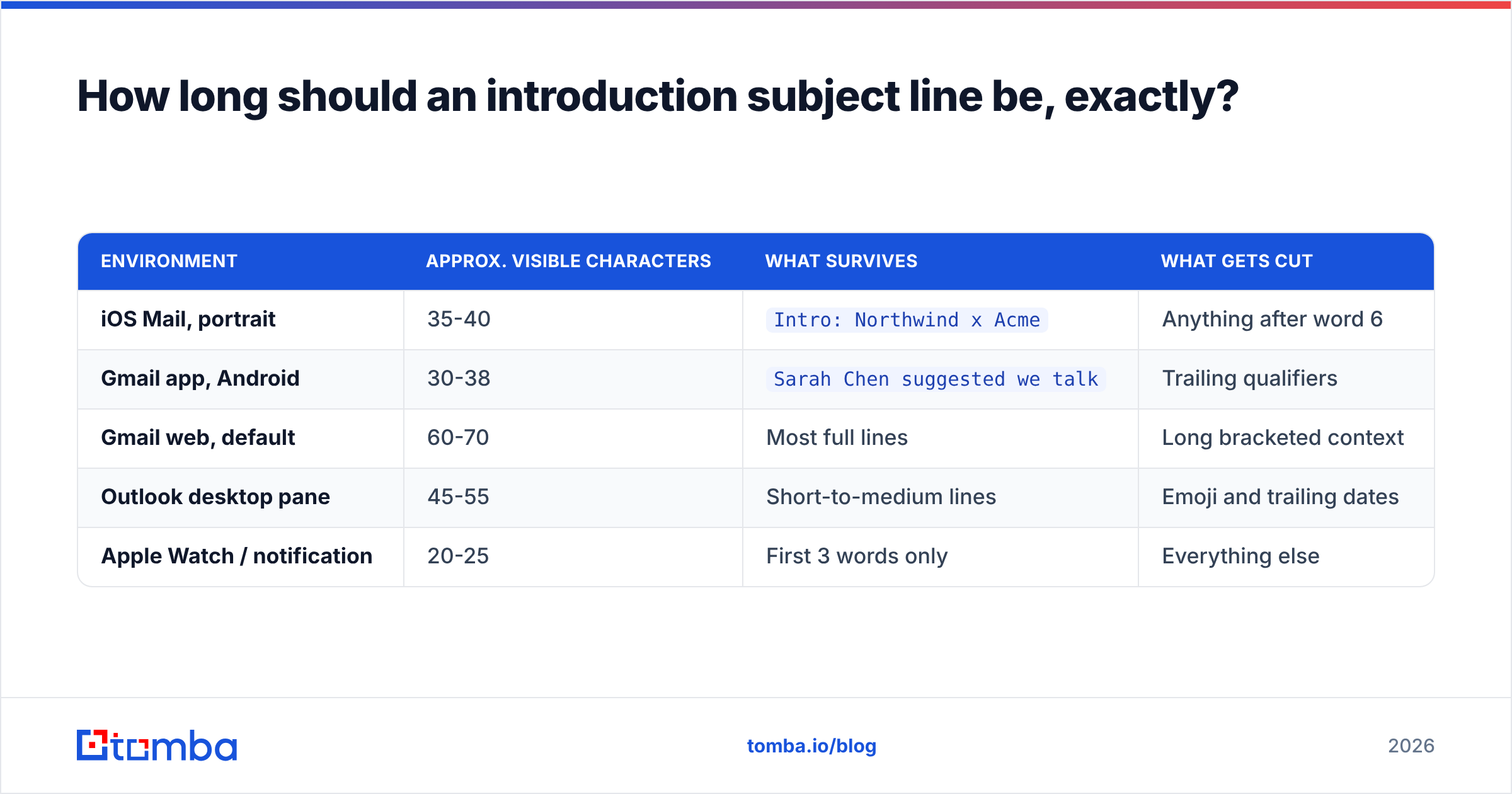
The character limit matters more than the word count because clients read on phones. Here is what actually survives across clients:
| Environment | Approx. visible characters | What survives | What gets cut |
|---|---|---|---|
| iOS Mail, portrait | 35-40 | Intro: Northwind x Acme |
Anything after word 6 |
| Gmail app, Android | 30-38 | Sarah Chen suggested we talk |
Trailing qualifiers |
| Gmail web, default | 60-70 | Most full lines | Long bracketed context |
| Outlook desktop pane | 45-55 | Short-to-medium lines | Emoji and trailing dates |
| Apple Watch / notification | 20-25 | First 3 words only | Everything else |
The watch row is the one people ignore. If your line still communicates something at 22 characters, it will work everywhere. That is the real test.
One more length note: a subject line that is too polished can hurt. Lowercase, slightly unfinished lines like quick intro — northwind often outperform title-cased marketing lines in first-touch client email, because they pattern-match to a colleague rather than a campaign. Do not overcorrect into sloppiness, but do not write like a billboard either.
What kills open rates on a first client email?#
Five things, in descending order of damage.
Sending to an unverified address. This is not a copywriting problem, but it dominates the outcome. A first-touch campaign to a list with 12% dead addresses will generate bounces that degrade your domain reputation before your best subject line ever gets a fair test. Run addresses through an email verifier first, then measure copy. Testing subject lines on a dirty list produces numbers you cannot trust.
Fake urgency. "Urgent," "ASAP," "Action required," and "Time sensitive" on a first contact read as manipulative, because they are. You have no standing to declare urgency on someone else's calendar yet.
Re: and Fwd: fakery. Prefixing an intro with Re: to imply an earlier thread is a short-term open-rate boost and a long-term trust destruction. Senior buyers spot it immediately.
Generic personalization tokens that misfire. Hi {FirstName} rendering as Hi {FirstName} is the classic, but the subtler version is a company name pulled from a stale database — writing to the acquired brand instead of the parent. HubSpot's ongoing marketing statistics research has tracked personalization as a consistent lift, but the lift inverts when the data is wrong.
All-caps or emoji in B2B first touch. Consumer email tolerates both. A first email to a business client does not. Mailchimp's benchmark data shows wide variance by industry, and professional services sits at the conservative end.

Should you A/B test introduction subject lines, and how?#
Yes, but only if you have the volume to learn anything — and most intro campaigns do not.
The statistical floor is roughly 300 sends per variant before a 2-3 point open-rate difference means anything. Below that, you are reading noise. If your intro emails go out 20 at a time to hand-picked accounts, skip formal testing and do this instead:
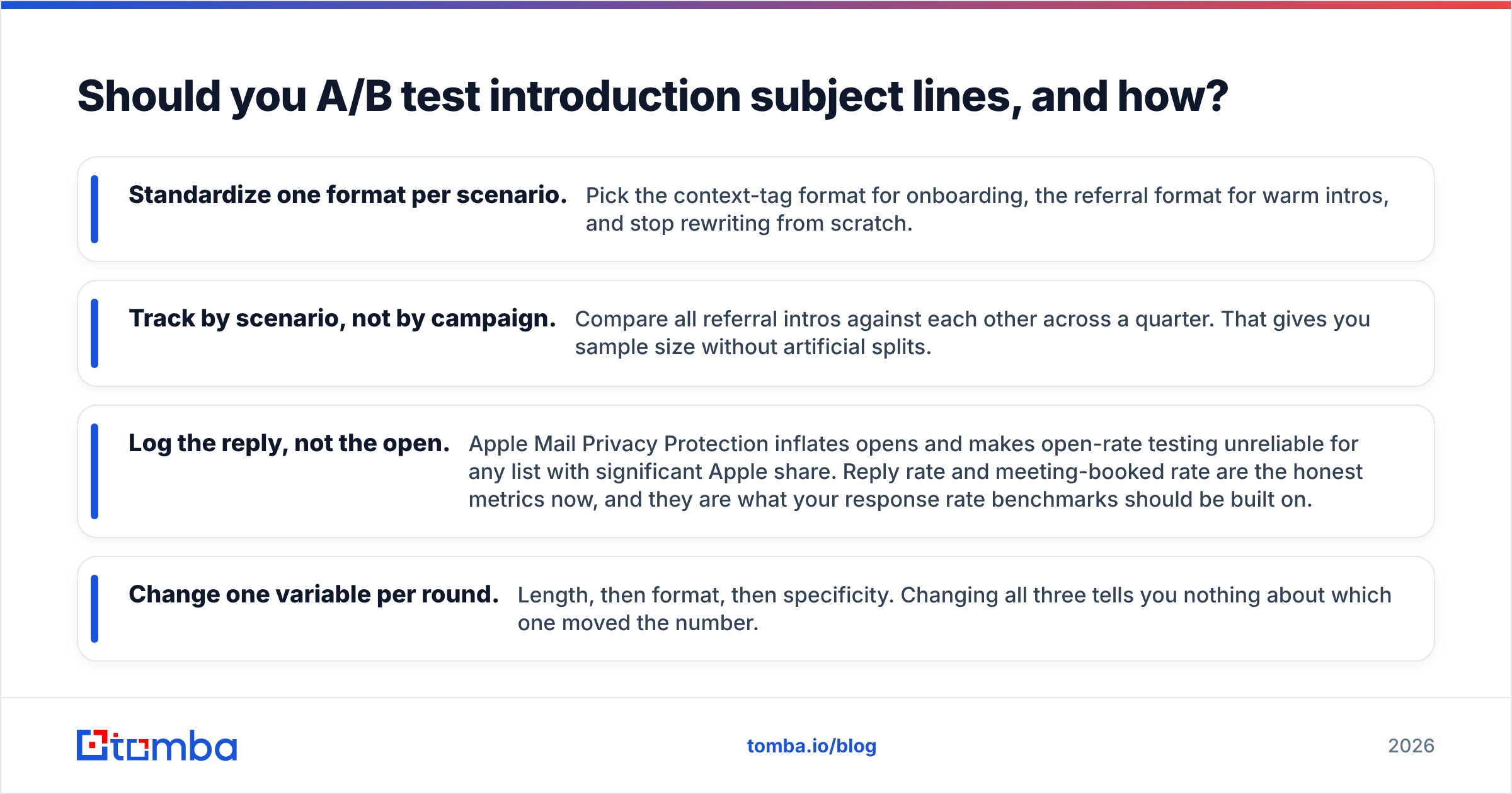
- Standardize one format per scenario. Pick the context-tag format for onboarding, the referral format for warm intros, and stop rewriting from scratch.
- Track by scenario, not by campaign. Compare all referral intros against each other across a quarter. That gives you sample size without artificial splits.
- Log the reply, not the open. Apple Mail Privacy Protection inflates opens and makes open-rate testing unreliable for any list with significant Apple share. Reply rate and meeting-booked rate are the honest metrics now, and they are what your response rate benchmarks should be built on.
- Change one variable per round. Length, then format, then specificity. Changing all three tells you nothing about which one moved the number.
If you do have volume, the highest-leverage test is not wording at all — it is whether the subject contains a proper noun the recipient recognizes. Proper-noun-present versus proper-noun-absent is usually a larger swing than any two clever phrasings.
What should the first line of the body say?#
The subject line's only real job is to get the preview text read, and the preview text is your first body line. Treat them as one unit.
Bad pairing:
Subject: Intro: Northwind x Acme
Body: Hi Dana, I hope this email finds you well.
The subject earned a look and the body immediately spent it on filler. Better:
Subject: Intro: Northwind x Acme
Body: Dana — I'm running your migration. Three decisions before Tuesday.
Specific, scannable, and it confirms the subject's promise in eight words. If you strip the greeting and the first sentence still makes sense, you have written it correctly. For more patterns, a library of cold email templates is a faster starting point than a blank page, as long as you rewrite the specifics rather than sending them as shipped.
Which subject line should you use for your next client intro?#
Answer three questions and the format picks itself:
- Does the recipient know a name you can use? Use the referral or context-tag format.
- Do they know your company but not you? Use the role handover or onboarding format.
- Do they know neither? You are not writing an introduction email, you are writing a cold email — use value-first and keep expectations calibrated accordingly.
The last case is where most "introduction email" advice goes wrong. Calling a cold email an introduction does not make it warm, and a subject line that pretends otherwise gets caught.
Get the address right before you get the words right#
Every point above assumes your email lands in a real inbox belonging to the right person. That assumption breaks more often than most teams measure — job changes, acquisitions, and format changes rot B2B contact data at roughly 2-3% per month.
Tomba's Email Finder resolves a name and company domain into a verified professional address, with the source evidence attached so you know why a result is trusted. The free tier covers 25 searches a month if you just want to sanity-check a handful of target accounts; paid plans start at $49/mo and scale to bulk lookups through the Tomba API when your intro volume grows past manual work. Write the seven-word subject line — then make sure it has somewhere real to land.
Related guides#
// get started
Find, verify and enrich your first contacts today
Start on the free plan with 25 searches a month, then scale when your team is ready.
Free plan · No credit card required · GDPR & CCPA
Get the Tomba newsletter
Product and data updates
// about the author