Introductory Meeting: How to Run One That Books Round Two
Most introductory meetings die because the rep treats 25 minutes like a demo slot. Here is the agenda, the prep checklist, the questions, and the follow-up that actually earn a second call.
TL;DR
- An introductory meeting is a 20-30 minute first conversation whose only job is to decide, together, whether a real evaluation is worth anyone's time. It is not a demo and not a full discovery call.
- The single biggest failure mode is scope creep: a rep books "15 minutes to introduce ourselves" and then runs a 60-minute product tour. Buyers punish this by ghosting.
- Send an agenda in the calendar invite. No-show and reschedule rates drop measurably when the invite says what will happen and how long it will take.
- Ask four qualifying questions, not fourteen. You are testing for a problem, a timeline, a budget owner, and a next step — everything else belongs in discovery.
- The meeting is won or lost before it starts: accurate contact data, five minutes of research, and a confirmed decision-maker beat any amount of on-call charisma.
What is an introductory meeting?#
An introductory meeting is the first live conversation between a seller and a prospect, usually 20 to 30 minutes, where both sides establish context and decide whether to continue. Think of it as the handshake at the door — not the dinner. You find out who the other person is, why they opened the door, and whether you should be invited further in.
In B2B pipeline terms, it sits between "responded to outreach" and "qualified opportunity." Nothing is sold here. The deliverable of a successful introductory meeting is a scheduled next step with a named agenda, not a signed contract or even a proposal.
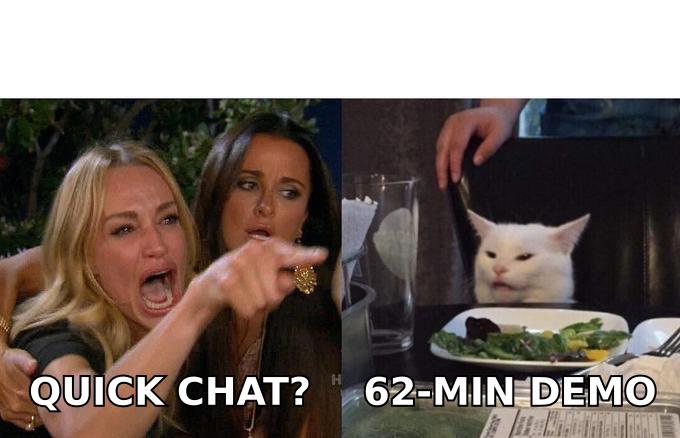
The confusion starts because sales teams use four or five names for adjacent calls — intro call, chemistry call, discovery, qualification call, demo — and then run all of them the same way. That sameness is why buyers block calendar time so reluctantly. If every "quick intro" turns into a 45-minute slide deck, the rational response is to stop accepting them.
How is an introductory meeting different from a discovery call or demo?#
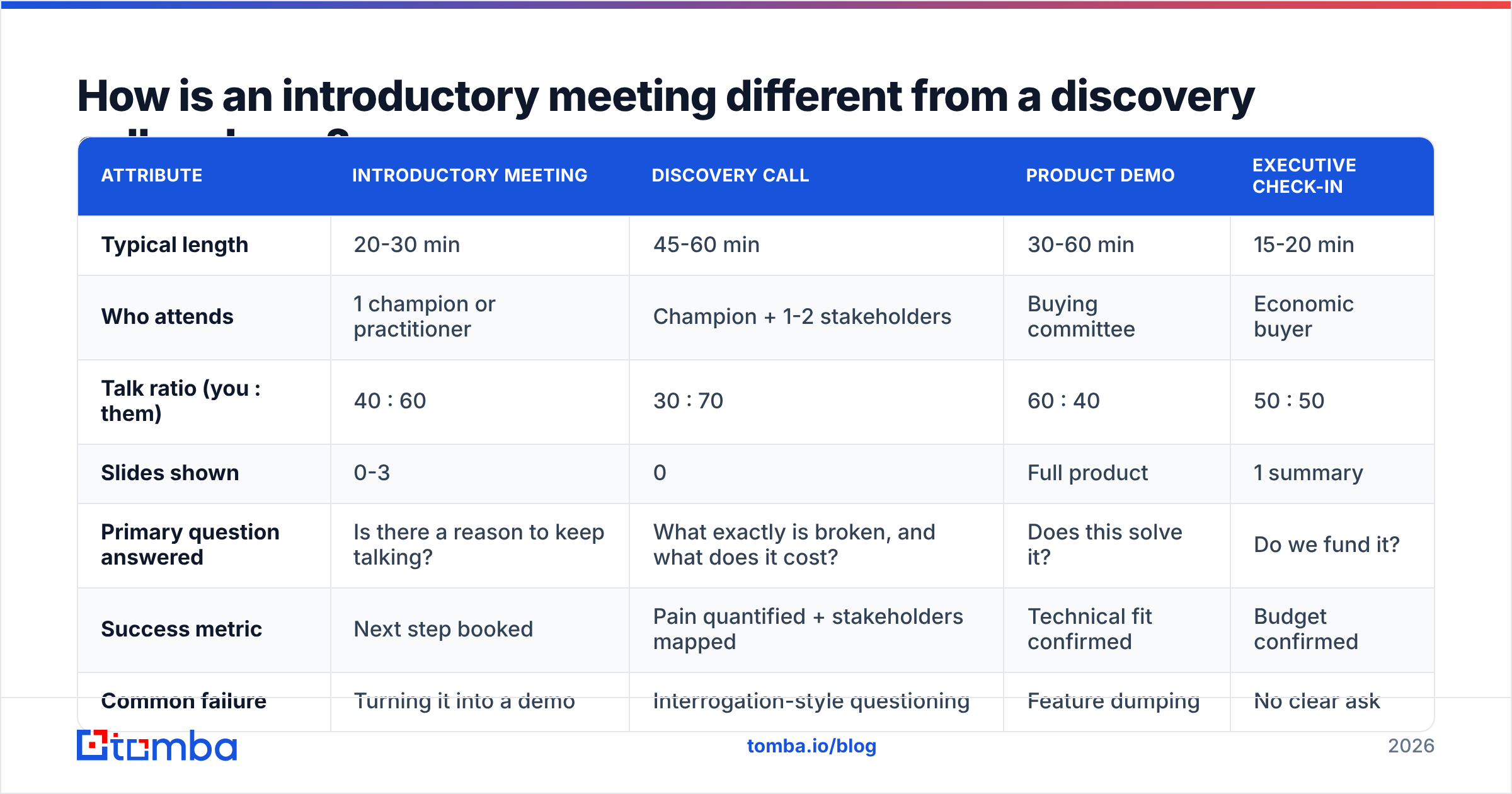
The distinction is about decision rights. An introductory meeting decides whether to evaluate. A discovery call decides what to evaluate. A demo decides whether the thing works. Collapsing them wastes the buyer's attention on details they have not yet agreed to care about.
| Attribute | Introductory meeting | Discovery call | Product demo | Executive check-in |
|---|---|---|---|---|
| Typical length | 20-30 min | 45-60 min | 30-60 min | 15-20 min |
| Who attends | 1 champion or practitioner | Champion + 1-2 stakeholders | Buying committee | Economic buyer |
| Talk ratio (you : them) | 40 : 60 | 30 : 70 | 60 : 40 | 50 : 50 |
| Slides shown | 0-3 | 0 | Full product | 1 summary |
| Primary question answered | Is there a reason to keep talking? | What exactly is broken, and what does it cost? | Does this solve it? | Do we fund it? |
| Success metric | Next step booked | Pain quantified + stakeholders mapped | Technical fit confirmed | Budget confirmed |
| Common failure | Turning it into a demo | Interrogation-style questioning | Feature dumping | No clear ask |
The table is not academic. If your calendar invite says "intro call" and your behavior says "demo," you have broken an implicit contract in the first two minutes, and everything after that runs uphill.
What should the agenda of an introductory meeting look like?#
Use a fixed structure. Improvisation feels authentic to the rep and feels disorganized to the buyer. Six blocks, 25 minutes:
- Frame and permission (2 minutes). State the purpose and the end time out loud: "I have us down for 25 minutes. My goal is to understand what prompted you to take this call and, if it makes sense, agree on a next step. If it doesn't make sense, I'll say so." This single sentence does more for trust than any rapport-building small talk.
- Their context first (8 minutes). Ask them to describe the current process before you describe anything. You are listening for the trigger event — a new hire, a missed target, a tool renewal, a funding round.
- Your relevance, compressed (4 minutes). Two sentences on what you do, then one concrete example of a company that looked like theirs. No slide deck. No founding story.
- Qualification, four questions (6 minutes). Problem, impact, timeline, process. Covered in detail below.
- Mutual fit check (3 minutes). Say out loud whether you think there is a fit, and where you are unsure. Reps skip this because it risks disqualifying the deal. Skipping it is how you accumulate a pipeline of ghosts.
- Next step, booked live (2 minutes). Open the calendar on the call. "Next step" without a date on a calendar is a polite no.
Notice what is missing: pricing deep-dives, competitor comparisons, security questionnaires, and integration matrices. Those are real questions, and they belong to a later meeting with the people who own those answers.
How do you prepare for an introductory meeting in ten minutes?#
Preparation is where most of the outcome is determined, and ten focused minutes is enough if you know what to look for.
- Confirm the person, not just the company. Check the title, the tenure, and whether they actually own the problem you sell into. A practitioner who has been in seat three weeks cannot sponsor a purchase; a VP who has been there six years can.
- Find one trigger. A funding announcement, a job posting for a role adjacent to your product, a new executive hire, a public product launch. One specific, verifiable trigger beats generic research.
- Verify the contact details you have. If your invite bounced or your reminder went to a dead address, the meeting is already at risk. A quick pass through an email verifier before you send the invite costs seconds and prevents the most avoidable no-show there is.
- Map the likely committee. Use a domain search to see who else sits in the relevant function. You are not going to email them yet — you want to know the shape of the org so your qualification questions land.
- Write your two-sentence relevance statement. Rehearse it. If you cannot explain what you do in two sentences, you will spend eight minutes of a twenty-five minute meeting explaining it badly.
- Decide your disqualification criteria in advance. Write down, before the call, the two facts that would make you walk away. This is the discipline that keeps forecasts honest.
For context on how buying committees have expanded, Gartner's sales research has been tracking the multi-stakeholder B2B purchase for years; the practical takeaway is that your single contact is almost never the whole decision.
What questions should you ask in an introductory meeting?#
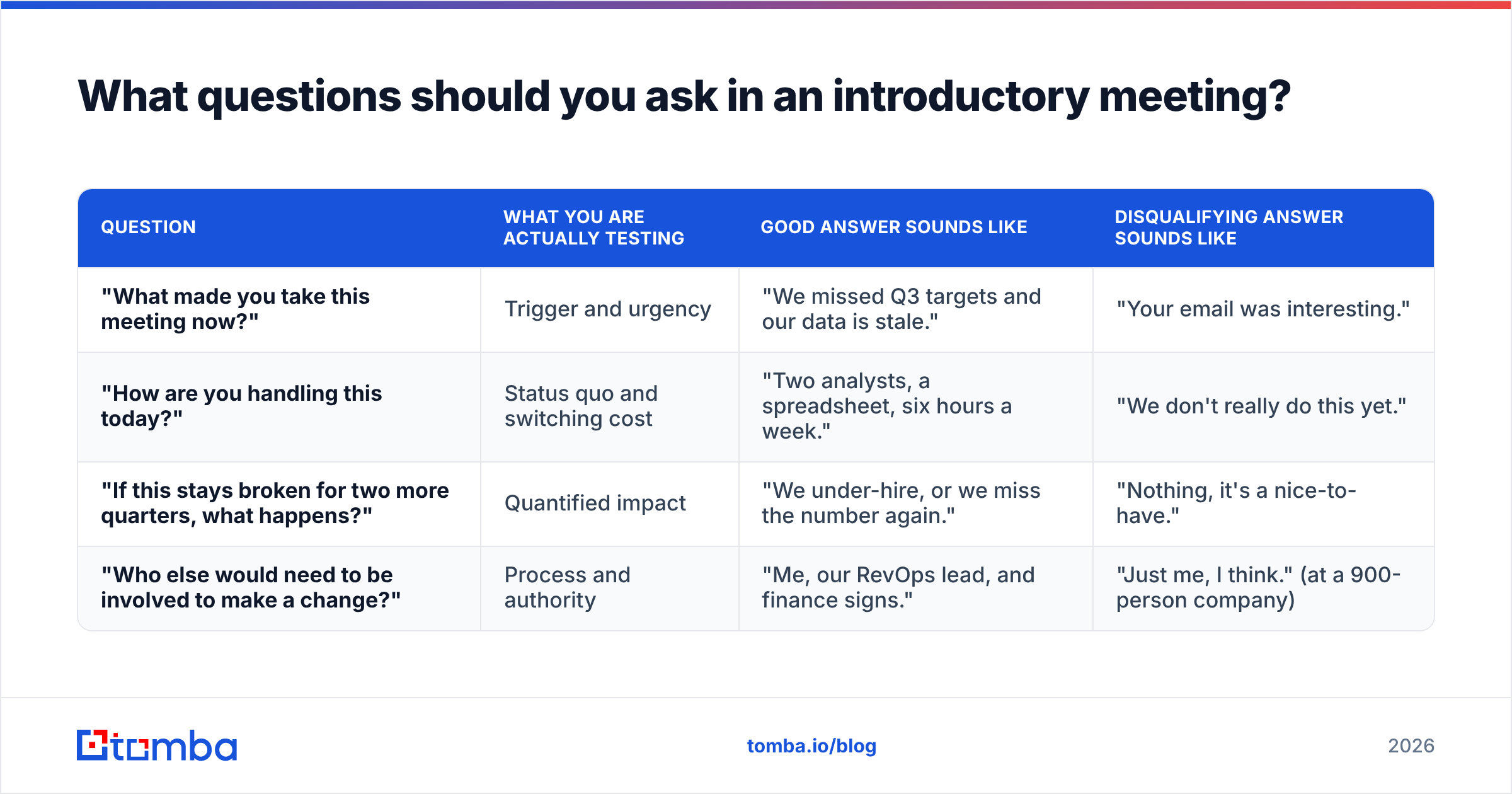
Four. Not fourteen. Each one is designed to produce a fact you can write in the CRM, not a feeling.
| Question | What you are actually testing | Good answer sounds like | Disqualifying answer sounds like |
|---|---|---|---|
| "What made you take this meeting now?" | Trigger and urgency | "We missed Q3 targets and our data is stale." | "Your email was interesting." |
| "How are you handling this today?" | Status quo and switching cost | "Two analysts, a spreadsheet, six hours a week." | "We don't really do this yet." |
| "If this stays broken for two more quarters, what happens?" | Quantified impact | "We under-hire, or we miss the number again." | "Nothing, it's a nice-to-have." |
| "Who else would need to be involved to make a change?" | Process and authority | "Me, our RevOps lead, and finance signs." | "Just me, I think." (at a 900-person company) |
Resist the urge to add a fifth. Each additional question costs you roughly ninety seconds and moves the call one step closer to an interrogation. HubSpot's sales team has written extensively about discovery question frameworks if you want a deeper library — just don't deploy the whole library in a first call.
One more principle: ask the impact question before the authority question. Prospects answer "who else is involved" honestly once they have already admitted the problem costs them something. Asked cold, it reads as a credit check.
Why do introductory meetings fail?#
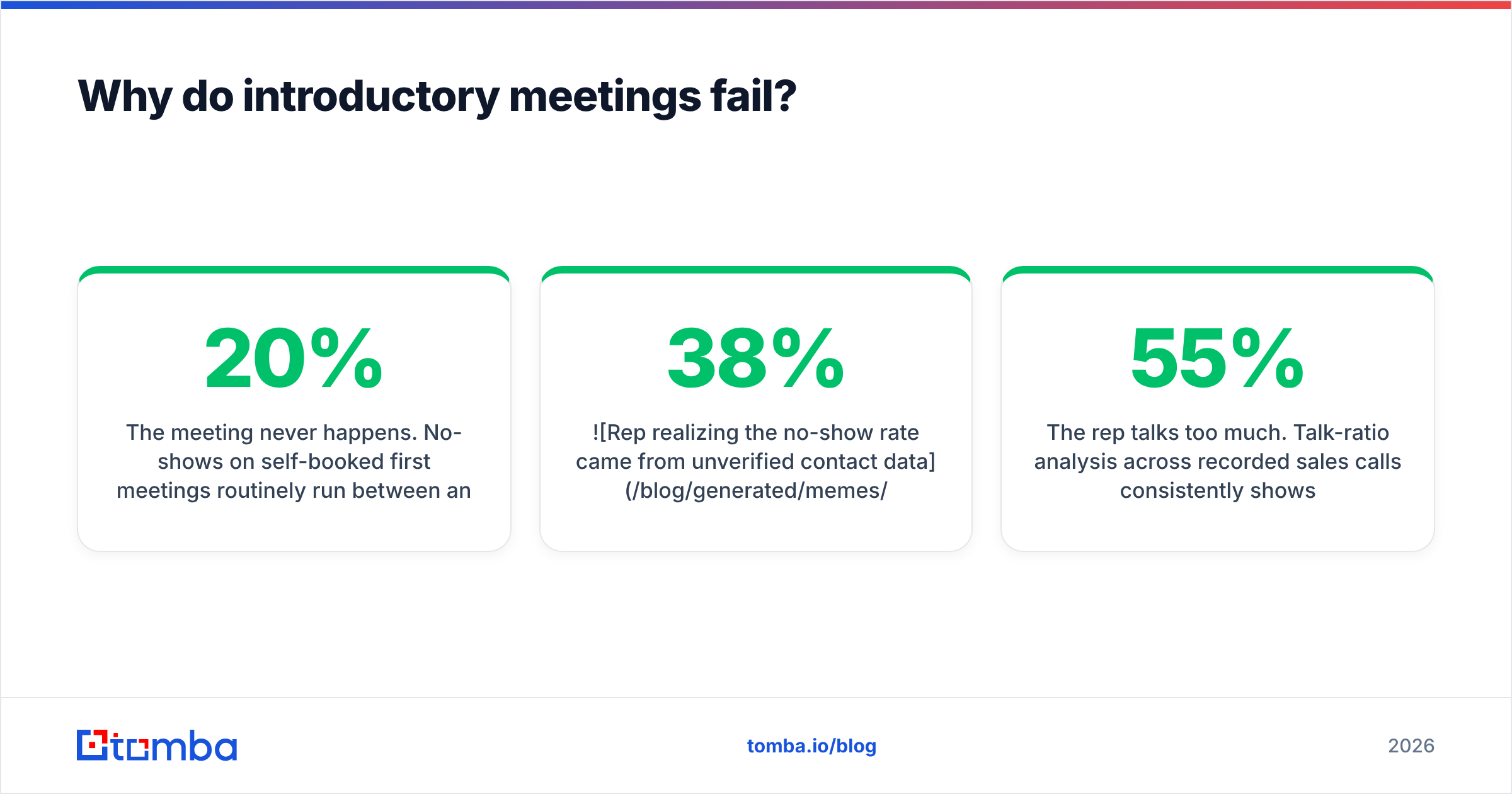
Three reasons, in descending order of frequency.
The meeting never happens. No-shows on self-booked first meetings routinely run between 20% and 40% depending on channel and lead source. Cold-sourced meetings no-show far more than inbound ones. The fixes are unglamorous: a confirmation the day before, a calendar invite with a real agenda, a mobile number for the reminder, and — critically — an email address that actually delivers. If you are booking from cold outreach, a bulk email finder pass plus verification on the whole list will do more for your show rate than any reminder-sequence tweak.
The rep talks too much. Talk-ratio analysis across recorded sales calls consistently shows that first meetings where the rep speaks more than about 55% of the time convert to a second meeting at a meaningfully lower rate. The 40:60 target in the table above is not a personality preference; it is a measurement.
No next step is booked live. "I'll send over some times" is where pipeline goes to die. Every hour between the end of the call and the next calendar hold, the probability of a second meeting decays. Book it on the call, on screen, with the prospect watching.
A fourth, quieter failure: the rep refuses to disqualify. A first meeting that ends in a clean "this isn't a fit, here's who I'd look at instead" is a better outcome than a vague follow-up that clogs your pipeline for two quarters.
What should the follow-up look like?#
Send it within two hours, while the conversation is still the freshest thing in their inbox. Keep it to four elements:
- What you heard, in their words, three bullets maximum. This is the part that builds credibility — it proves you listened rather than presented.
- What you agreed, including the specific next step and who is attending.
- One useful thing, unrelated to buying: a benchmark, a relevant article, an intro to someone. This is the only part of the email that is generous rather than transactional.
- The calendar link or confirmation, already accepted.
Do not attach a deck. Do not attach pricing unless they asked. Do not cc four colleagues they have never met. The follow-up email to an introductory meeting is a receipt, not a proposal.
If the meeting produced new names — the RevOps lead, the finance approver — that is the moment to enrich them properly rather than guessing at addresses. Running those names through data enrichment before the second meeting means your multi-threaded invite lands with everyone, not just the champion who is already sold.
How do you measure introductory meetings?#
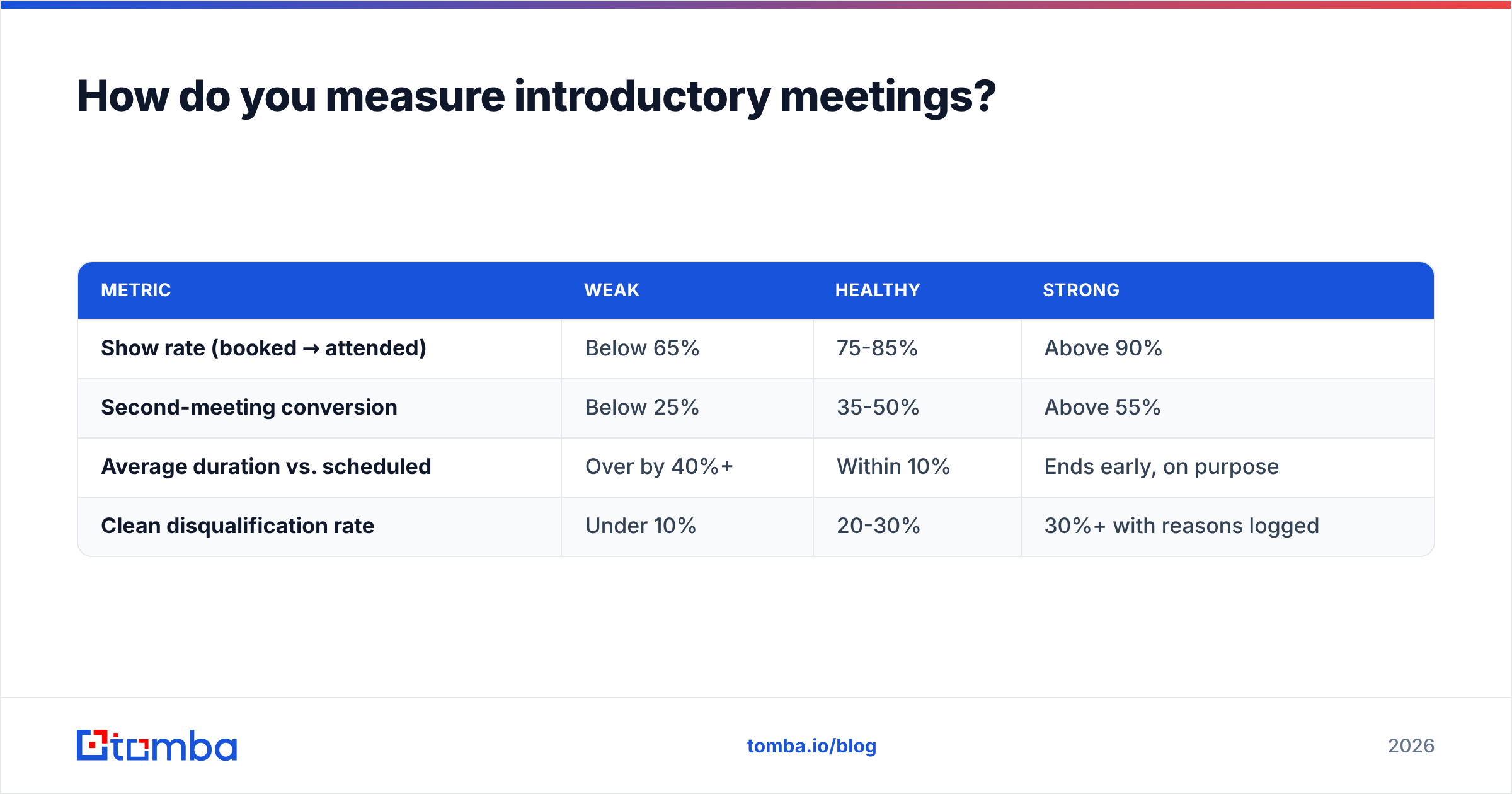
Track four numbers per rep, per month:
| Metric | Weak | Healthy | Strong |
|---|---|---|---|
| Show rate (booked → attended) | Below 65% | 75-85% | Above 90% |
| Second-meeting conversion | Below 25% | 35-50% | Above 55% |
| Average duration vs. scheduled | Over by 40%+ | Within 10% | Ends early, on purpose |
| Clean disqualification rate | Under 10% | 20-30% | 30%+ with reasons logged |
That last row surprises people. A team that disqualifies almost nobody in first meetings is not good at selling — it is bad at deciding. Healthy disqualification is what makes the rest of the forecast trustworthy, a point Salesforce's sales resources make repeatedly in their pipeline-hygiene guidance.
Duration is the sneakiest metric. If your 25-minute intros consistently run 45 minutes, you are either not qualifying or you are demoing. Both show up later as stalled deals.
What does a good introductory meeting actually sound like?#
Compressed to its bones: you open by naming the time and the purpose. You ask what prompted the call and then stay quiet for longer than feels comfortable. You spend four minutes on relevance, using one story about a company that looks like theirs. You ask your four questions and write down the answers verbatim. You say plainly whether you think there is a fit. You book the next step on screen. You end at minute 23 and give them two minutes back.
Ending early is a status move. It tells the buyer that you run tight meetings and that their time is a real constraint, not a formality. It is also the single easiest behavioral change on this list.
Ready to stop losing first meetings to bad contact data?#
The best-run introductory meeting in the world cannot fix an invite that went to a dead mailbox or a champion who never had budget authority. Get the input right and the meeting gets easier. Tomba's Email Finder gives you verified professional addresses by name and domain, so your invites land, your reminders arrive, and the person on the other end of the call is the one who can actually say yes. Start free with 25 searches a month, or move to the $49/mo Starter plan when your calendar gets busy — see Tomba pricing for the full breakdown.
Related guides#
// get started
Find, verify and enrich your first contacts today
Start on the free plan with 25 searches a month, then scale when your team is ready.
Free plan · No credit card required · GDPR & CCPA
// about the author