7 Best Intuned Alternatives in 2026 for Browser Automation
Intuned is solid browser-automation infrastructure, but it is not the only option, or the cheapest. Here are seven alternatives ranked by cost, reliability, and how much engineering they actually save you.
TL;DR
- Intuned is a managed Playwright-based platform for building browser automations and data-extraction jobs, with hosted browsers, auth-session handling, proxies, scheduling, and monitoring baked in.
- Most teams shop for Intuned alternatives for three reasons: usage-based costs that scale badly, wanting an open-source escape hatch, or realizing they only needed structured data, not a browser.
- Browserbase, Browserless, Steel, Apify, Bright Data, and Firecrawl each solve a different slice of the problem. Picking the wrong slice is what makes migrations expensive.
- If the data you are scraping is B2B contact data (emails, job titles, phone numbers), a dedicated data API is cheaper, faster, and far more legally boring than running headless Chrome.
- Decision rule: automation of a logged-in workflow → Browserbase or Steel. Marketplace of ready-made scrapers → Apify. Page-to-markdown for LLMs → Firecrawl. Contact data → skip the browser entirely.
What is Intuned, and who is it actually for?#
Intuned is browser-automation infrastructure for developers. You write Playwright-flavored TypeScript, and Intuned runs it on managed headless browsers with the annoying parts handled for you: authenticated session storage and refresh, proxy rotation, retries, scheduling, run history, and monitoring. You can read their positioning on the Intuned site.
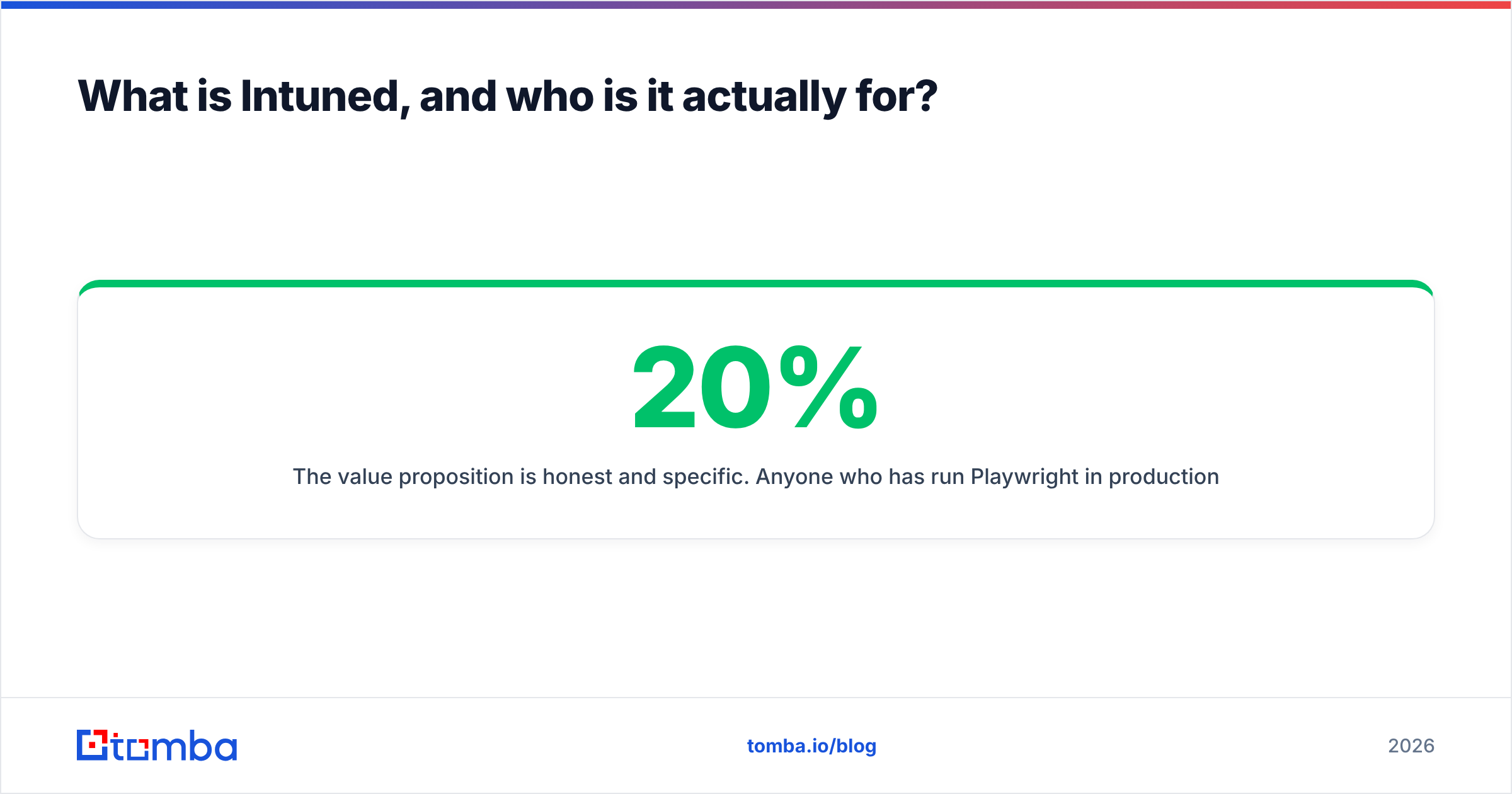
The value proposition is honest and specific. Anyone who has run Playwright in production knows the script is 20% of the work. The other 80% is session expiry at 3am, IP blocks, memory leaks in long-running containers, and a scheduler nobody owns. Intuned sells you out of that 80%.
That makes it a strong fit for one shape of problem: repeated, authenticated, deep-in-the-app extraction. Think pulling invoices out of a vendor portal every night, syncing data from a SaaS tool with no API, or automating a partner dashboard that will never ship a REST endpoint.
It is a weaker fit when your actual need is simpler than that. A lot of teams adopt browser infrastructure because scraping was the first tool they reached for, then spend a year maintaining bots to collect data someone else already sells as a clean API response.
Why do teams look for Intuned alternatives?#
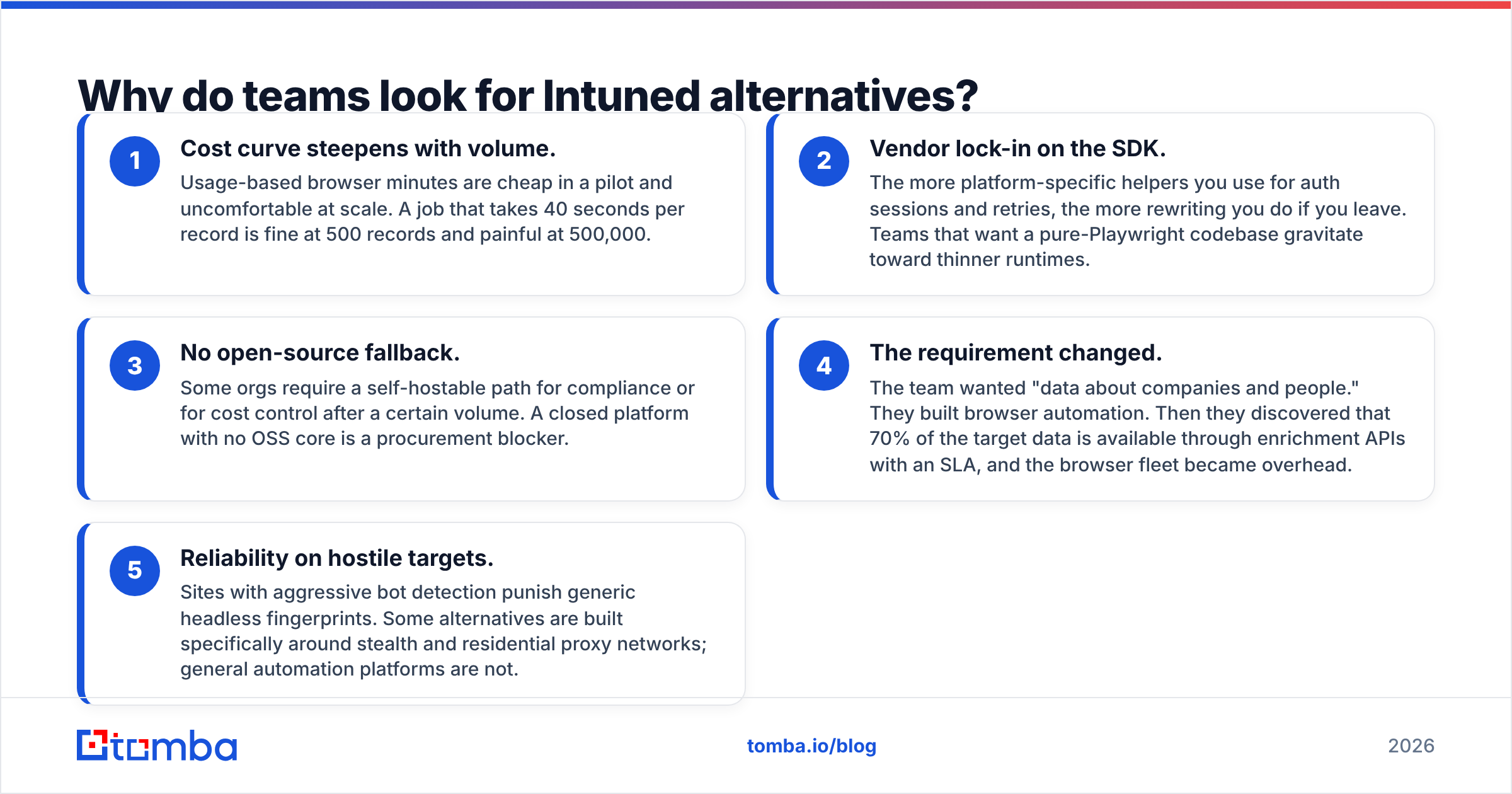
Four patterns come up repeatedly when engineering teams start evaluating replacements:
- Cost curve steepens with volume. Usage-based browser minutes are cheap in a pilot and uncomfortable at scale. A job that takes 40 seconds per record is fine at 500 records and painful at 500,000.
- Vendor lock-in on the SDK. The more platform-specific helpers you use for auth sessions and retries, the more rewriting you do if you leave. Teams that want a pure-Playwright codebase gravitate toward thinner runtimes.
- No open-source fallback. Some orgs require a self-hostable path for compliance or for cost control after a certain volume. A closed platform with no OSS core is a procurement blocker.
- The requirement changed. The team wanted "data about companies and people." They built browser automation. Then they discovered that 70% of the target data is available through enrichment APIs with an SLA, and the browser fleet became overhead.
- Reliability on hostile targets. Sites with aggressive bot detection punish generic headless fingerprints. Some alternatives are built specifically around stealth and residential proxy networks; general automation platforms are not.
What should you compare in an Intuned alternative?#
Do not compare on price per browser-hour first. Compare on these, in this order:
- Job shape. One-off crawls, scheduled authenticated runs, and real-time on-demand fetches have almost nothing in common operationally. Pick the tool built for your shape.
- Auth and session handling. Can it store, refresh, and reuse logged-in sessions, including 2FA flows? This is the single most expensive thing to rebuild yourself.
- Anti-bot posture. Stealth fingerprinting, residential vs datacenter proxies, and CAPTCHA handling. Cheap datacenter IPs on a protected target is a false economy.
- Escape hatch. Is the runtime standard Playwright/CDP, so you can lift and shift? Is there an open-source core you could self-host if pricing changes?
- Total cost per useful record. Browser minutes plus proxy bandwidth plus engineering hours divided by records you actually keep. This number frequently favors buying the data outright.
- Legal and compliance surface. Scraping logged-in third-party platforms carries terms-of-service risk that a licensed B2B database does not.
How do the main Intuned alternatives compare?#
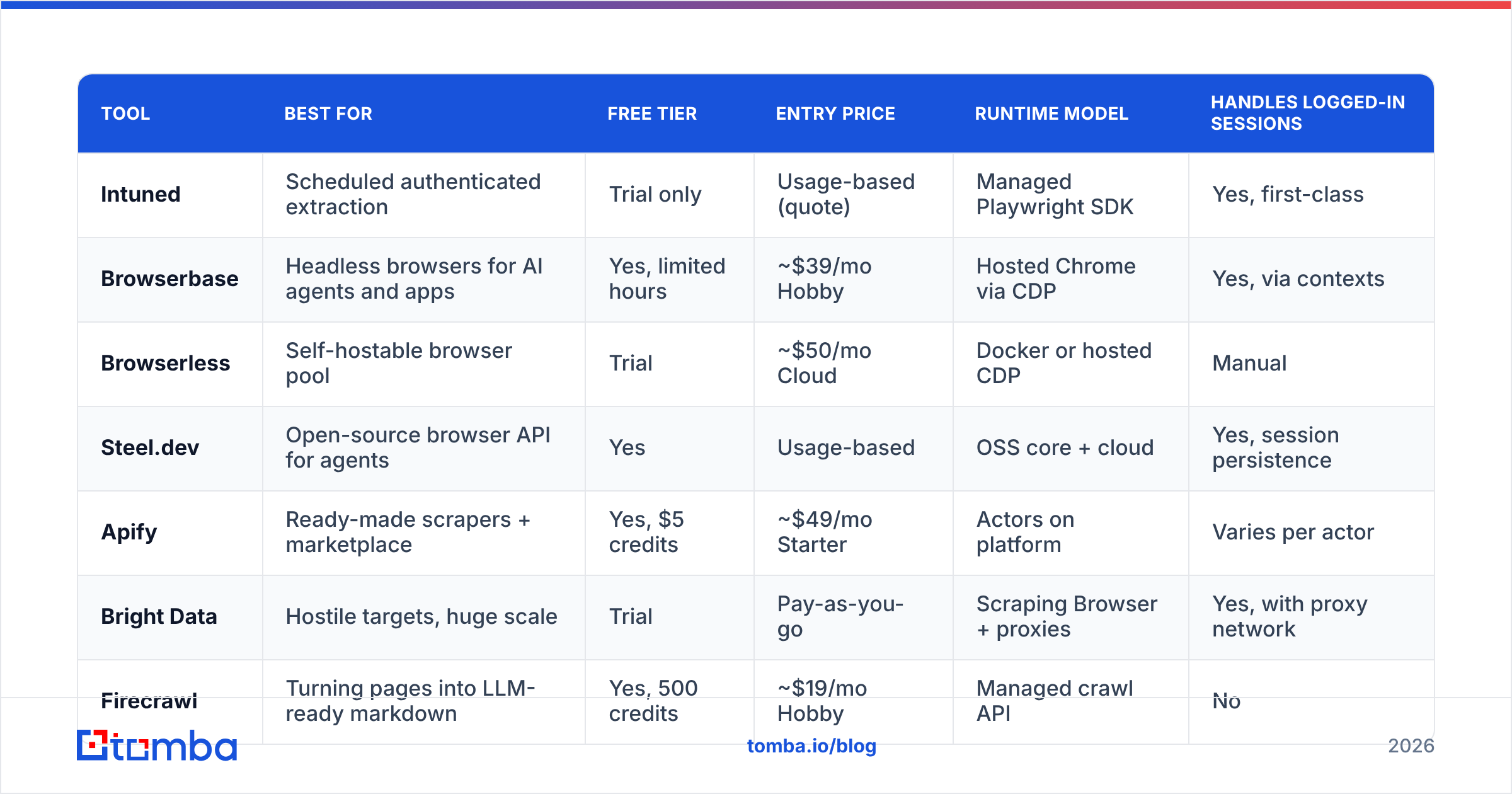
Prices below reflect publicly listed plans as of early 2026 and shift often. Verify with each vendor before you commit budget.
| Tool | Best for | Free tier | Entry price | Runtime model | Handles logged-in sessions |
|---|---|---|---|---|---|
| Intuned | Scheduled authenticated extraction | Trial only | Usage-based (quote) | Managed Playwright SDK | Yes, first-class |
| Browserbase | Headless browsers for AI agents and apps | Yes, limited hours | ~$39/mo Hobby | Hosted Chrome via CDP | Yes, via contexts |
| Browserless | Self-hostable browser pool | Trial | ~$50/mo Cloud | Docker or hosted CDP | Manual |
| Steel.dev | Open-source browser API for agents | Yes | Usage-based | OSS core + cloud | Yes, session persistence |
| Apify | Ready-made scrapers + marketplace | Yes, $5 credits | ~$49/mo Starter | Actors on platform | Varies per actor |
| Bright Data | Hostile targets, huge scale | Trial | Pay-as-you-go | Scraping Browser + proxies | Yes, with proxy network |
| Firecrawl | Turning pages into LLM-ready markdown | Yes, 500 credits | ~$19/mo Hobby | Managed crawl API | No |
| Tomba | B2B contact and company data | Yes, 25 searches/mo | $49/mo Starter | REST API, no browser | N/A, licensed data |
Browserbase#
The closest philosophical match for teams building agentic products. Browserbase gives you hosted Chrome instances you drive over CDP with Playwright, Puppeteer, or Selenium, plus session recording, contexts for persisted logins, and a stealth mode. It is thinner than Intuned: less opinionated orchestration, more raw infrastructure. Choose it if you want to own your scheduling and retry logic and just not run browsers.
Browserless#
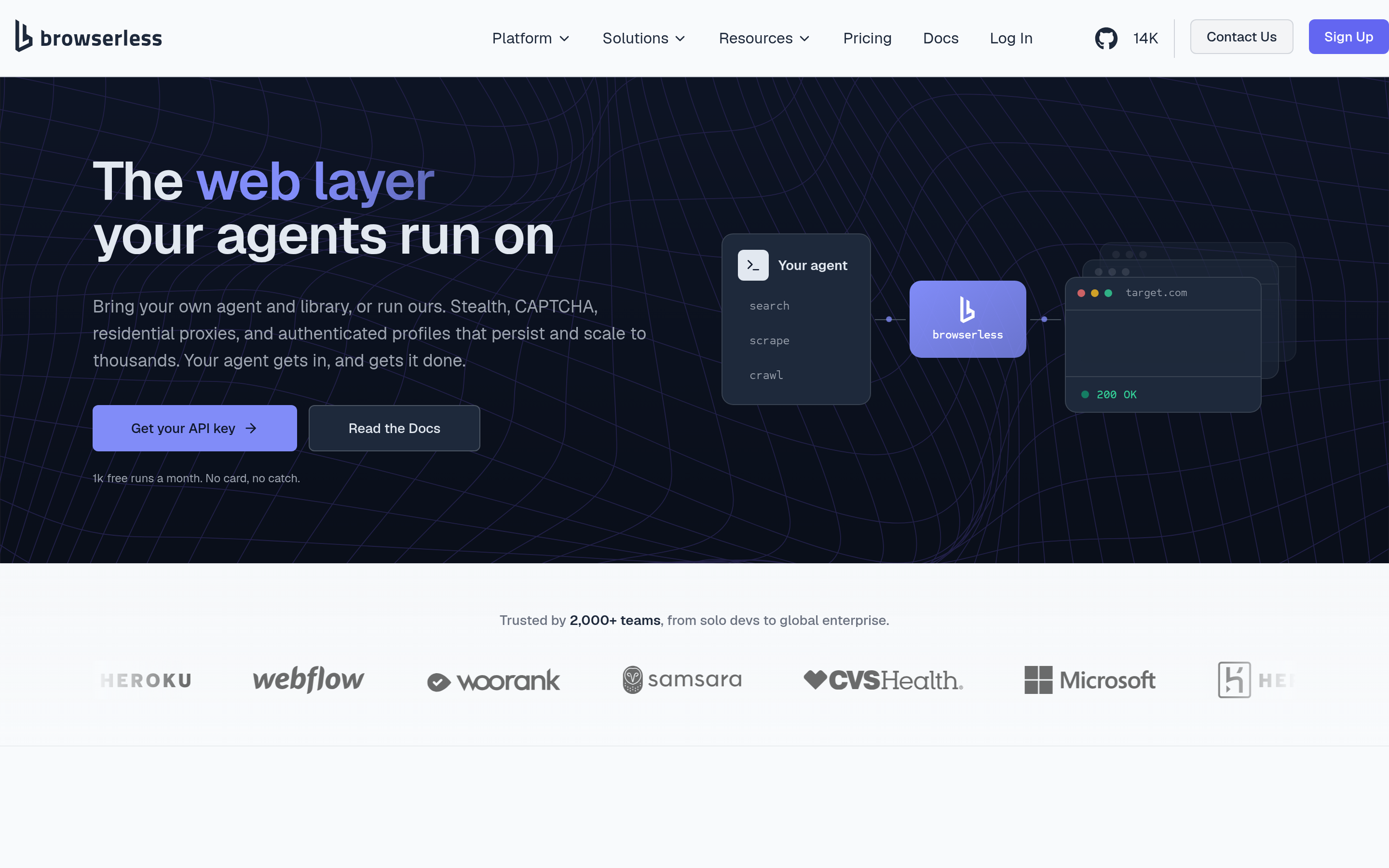
The pragmatic option when procurement wants a self-host path. Browserless is a battle-tested browser pool you can run in Docker on your own infrastructure or consume as a hosted endpoint. You get connection pooling, timeouts, and health management. You do not get session orchestration, scheduling, or a monitoring UI, so budget for that.
Steel.dev#
An open-source browser API purpose-built for AI agents. Session persistence, proxying, and CAPTCHA support, with the core available to self-host. Younger and smaller than the others, which cuts both ways: fast iteration, thinner track record. Good fit if "must be open source" is a hard requirement.
Apify#
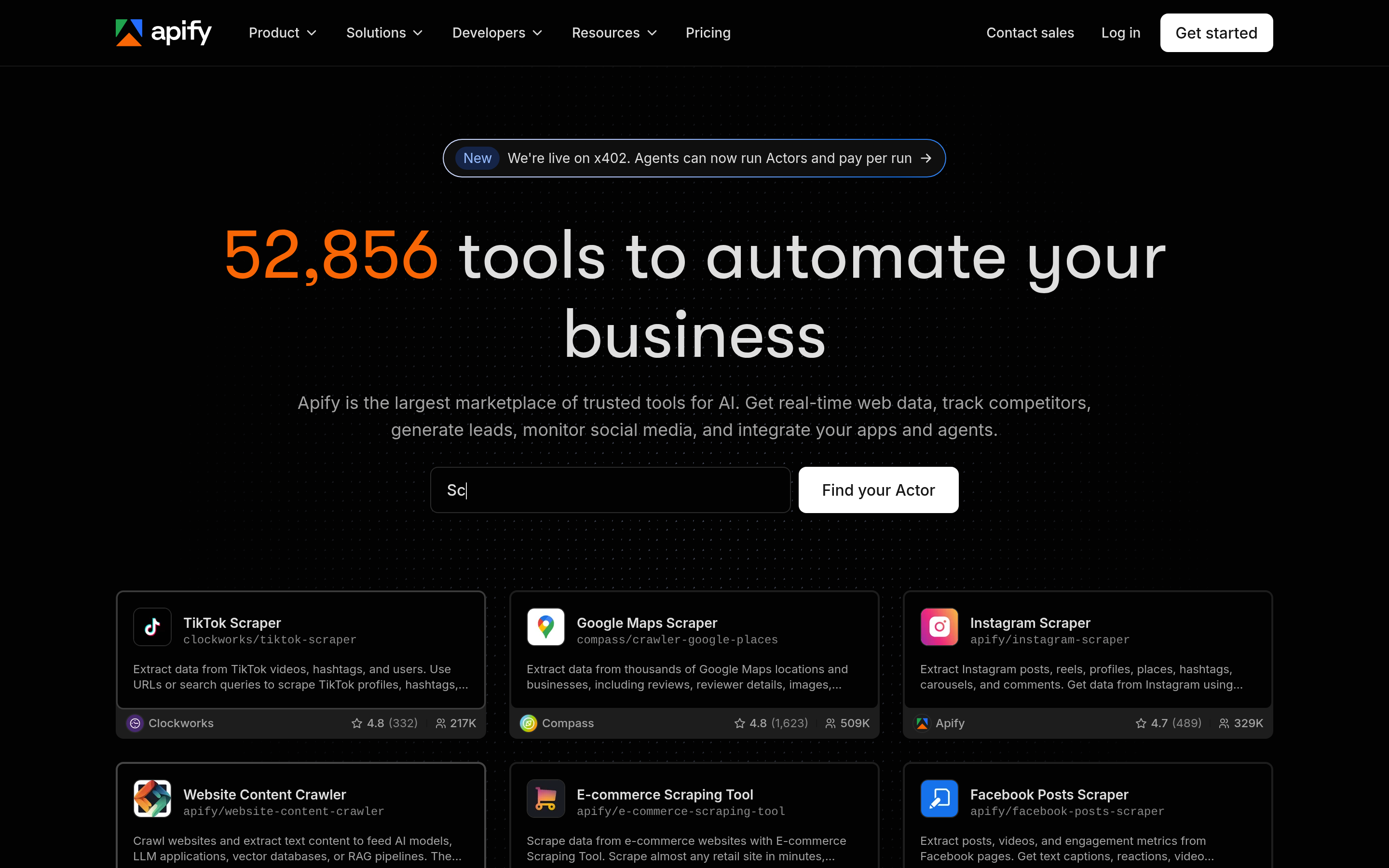
Different category, frequently the right answer anyway. Apify is a marketplace plus runtime: thousands of pre-built Actors for common targets, so you often skip writing a scraper entirely. Storage, scheduling, proxies, and webhooks are included. The tradeoff is that third-party Actors are maintained by third parties, so quality varies and a popular target's Actor can break for days.
Bright Data#
The heavyweight for targets that fight back. A very large residential and mobile proxy network, a Scraping Browser product that handles fingerprinting and CAPTCHA solving, and pre-collected datasets. It is more expensive and more complex than a pure automation platform, and it is overkill if your targets are cooperative. Compliance review takes longer here, so start it early.
Firecrawl#
Not a browser-automation platform at all, but it replaces one for a large share of use cases. Firecrawl crawls a site and returns clean markdown or structured JSON, which is exactly what you want if the downstream consumer is an LLM or a RAG index. If your "automation" is really "read these 4,000 public pages and give me text," this is dramatically cheaper than running Chrome.
Is a browser even the right tool for B2B contact data?#
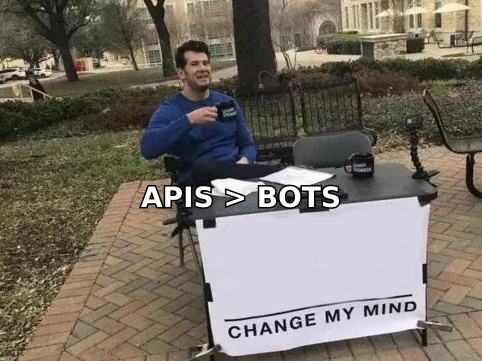
Usually not, and this is the most common expensive mistake in the category.
A lot of Intuned deployments start as a go-to-market project: find companies matching a profile, get the right people at those companies, get their work emails and phone numbers, push into the CRM. Someone scopes it as a scraping problem because the source everyone thinks of is a social network, and social networks have no public API for this.
Then the real costs arrive. Accounts get restricted. Selectors change. Output needs deduplication and normalization. Email addresses are guessed rather than verified, so bounce rates climb, sender reputation degrades, and the outbound program that justified the project underperforms. You now employ an engineer to maintain a bot fleet whose output actively hurts email deliverability.
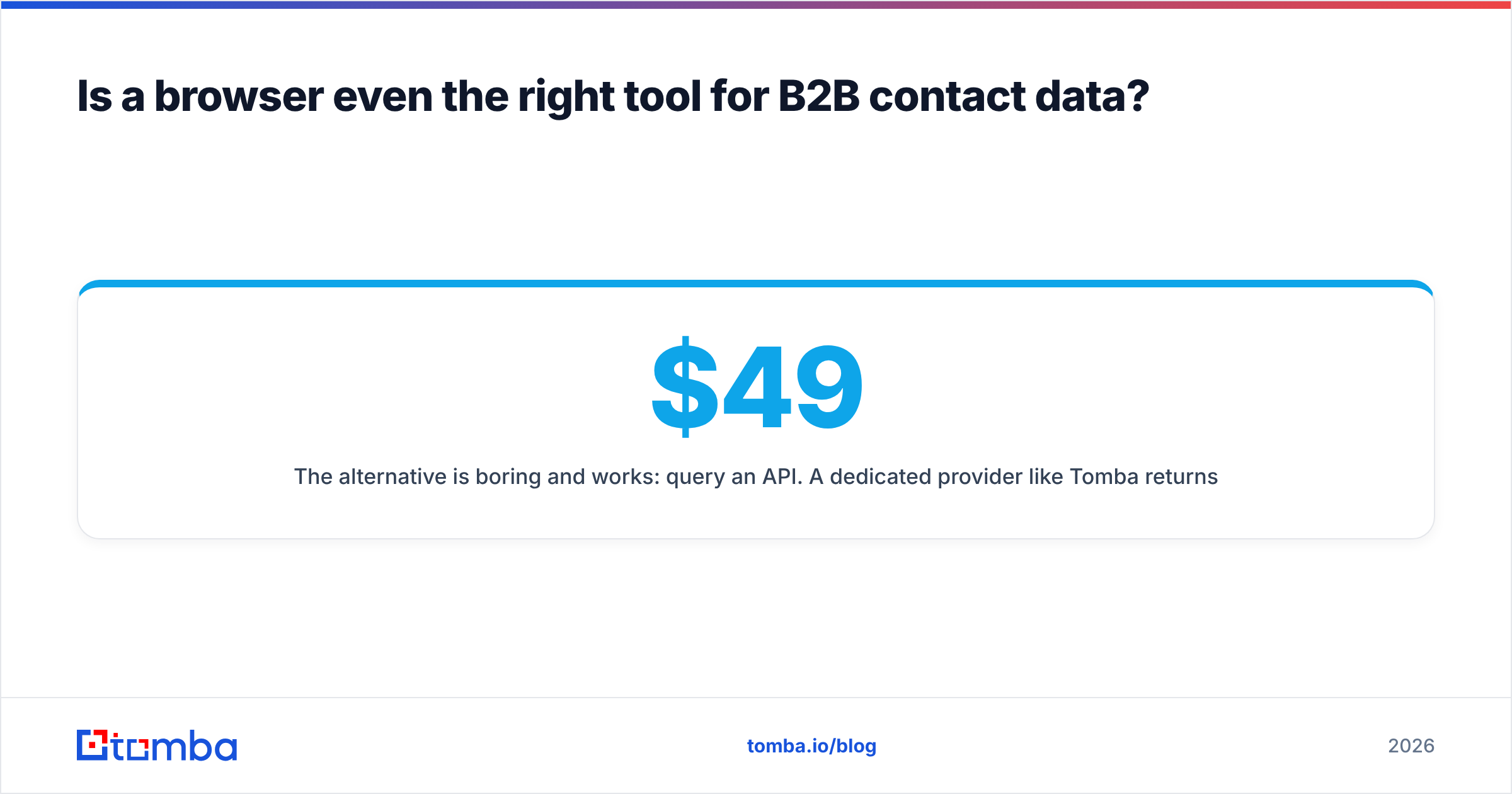
The alternative is boring and works: query an API. A dedicated provider like Tomba returns verified work emails from a domain and a name, does domain search across a company, and runs SMTP-level email verification before anything reaches your sequencer. No browsers, no proxies, no fingerprinting, no account bans. Tomba's Free tier covers 25 searches a month, Starter is $49/mo, Growth $99/mo, and Pro $249/mo, which for most teams is less than one engineer-day of scraper maintenance.
Peers worth knowing in this lane: BookYourData sells pre-built, verified B2B lists if you would rather buy a targeted static dataset than query an API, and it is a genuinely strong option when your ICP is stable and you want volume up front. Clearbit-style enrichment providers cover firmographic attributes. All of them beat a homemade browser bot for contact data specifically.
The honest boundary: if the data you need lives behind a login inside a system you control or are contractually entitled to access, and no API exists, browser automation is the correct answer and you should pick from the list above. If you need people and company data that a data vendor already licenses, buy it.
Which Intuned alternative should you pick?#
Match the tool to the job, not to the feature list:
- Nightly authenticated extraction from vendor portals → stay on Intuned or move to Browserbase with your own scheduler. The session management is what you are paying for.
- AI agents that need to drive a real browser in real time → Browserbase or Steel. Latency and session persistence dominate.
- A target that already has a maintained Actor → Apify. Do not rewrite what exists.
- Hostile, high-scale, heavily protected targets → Bright Data, with legal review booked before the pilot.
- Public pages into markdown for an LLM → Firecrawl. Cheapest path by a wide margin.
- Must self-host for compliance → Browserless or Steel.
- B2B emails, phones, and company attributes → a data API such as Tomba, plus bulk verification before send.
One more cost note. When you model the switch, model cost per kept record, not cost per run. Browser platforms bill for time spent, including the runs that fail, the retries, and the pages that turn out to be empty. API providers bill per successful lookup. On a 100,000-contact build, that difference is usually larger than the sticker-price gap between any two vendors on this list. If you want third-party signal on vendor reliability before you commit, the category reviews on G2 are more useful than vendor case studies.
What does a sane migration look like?#
Keep it to four steps and one week:
- Inventory your jobs by shape: authenticated-scheduled, public-crawl, real-time-agent, contact-data. Most teams find one or two jobs in the last bucket that should never have been browser jobs.
- Move the contact-data jobs to an API first. Fastest cost reduction, lowest risk, no browser rewrite.
- Port one representative browser job to your shortlisted platform and run both in parallel for a week. Compare success rate, not just cost.
- Decide on the escape hatch before you migrate the rest. Standard Playwright over CDP means the next migration is a config change instead of a quarter of work.
Start with the data you can just buy#
If any part of your Intuned workload is finding work emails, job titles, or company contacts, pull that out of your browser fleet this week. It is the piece with the clearest replacement, the fastest payback, and the least maintenance.
Run a few target domains through the Tomba Email Finder on the free tier and compare the results against what your scrapers return today, on both coverage and bounce rate. If the API wins, you have just deleted a class of infrastructure you never wanted to own, and you can spend your browser budget on the automations that genuinely require a browser.
Related guides#
// get started
Find, verify and enrich your first contacts today
Start on the free plan with 25 searches a month, then scale when your team is ready.
Free plan · No credit card required · GDPR & CCPA
Get the Tomba newsletter
Product and data updates
// about the author