Investment Banking Cold Email Templates That Get Replies in 2026
Most banking cold emails die because they pitch before they prove relevance. Here are 7 templates - sell-side, buy-side, sponsor coverage, and coffee chats - plus the cadence and data checks behind them.
TL;DR
- An investment banking cold email template only works if the first line proves you know something specific about the recipient's mandate, portfolio, or last transaction. Everything else is formatting.
- Keep the body under 120 words. Bankers and their gatekeepers triage on mobile between meetings; a scrolling wall of text is an instant archive.
- Never attach a deck or a teaser to a first touch. Offer it, don't send it — attachments from unknown senders get stripped, quarantined, or flagged internally.
- Deliverability is half the battle. A 2% bounce rate on a 400-contact banking list will damage your sending domain long before it damages your pipeline.
- Expect 4-9% reply rates on a tight, verified list of 150 relevant contacts. Expect under 1% on a 5,000-name blast, no matter how good the copy is.
What makes an investment banking cold email different?#
The audience is different, so the copy has to be different.
A SaaS buyer reads maybe 60 emails a day. A managing director at a mid-market bank, a corp dev lead, or a private equity associate reads several hundred — and a large share of those are inbound pitches from other bankers, brokers, data vendors, and recruiters. They have built ruthless pattern-matching reflexes. Subject lines with "quick question," "touching base," or "partnership opportunity" get deleted without being opened.
Three structural realities shape the format:
- Compressed attention. Most reads happen on a phone, standing up, between a diligence call and a committee meeting. Your email needs to be readable in one screen with no scrolling.
- Relevance is binary. A banker either covers your sector or doesn't. A sponsor either buys at your size or doesn't. There is no partial fit, and no amount of charm rescues a mismatch.
- Reputation is the currency. Finance runs on referrals and reputation. A sloppy, obviously mail-merged email doesn't just fail — it lightly damages how that person perceives your firm for the next 18 months.
That last point is why volume-first outbound backfires here more than in almost any other vertical. Fewer, sharper emails to correctly identified people outperform mass sends by a wide margin.
Who are you actually emailing?#
"Investment banking cold email" covers at least five distinct jobs-to-be-done, and the template changes for each. Sort your list before you write a word.
- Sell-side origination — you are a banker emailing a founder or CEO about a potential exit. The hook is a comparable transaction and a valuation data point, not your league table position.
- Buy-side and sponsor coverage — you are emailing a PE or family office associate about a live or upcoming process. The hook is fit with their stated thesis, check size, and sector.
- Vendor / service outreach into banks — you sell data, software, or advisory services to the bank itself. The hook is a workflow cost: hours lost in diligence, CIM prep, or comp screening.
- Recruiting and coffee-chat outreach — you are a student or lateral candidate emailing an analyst, associate, or VP. The hook is a shared, verifiable connection plus a small, easy ask.
- Capital raise / IR outreach — you are a company or fund emailing allocators. The hook is track record and a specific, non-generic reason for the fit.
Each of those gets a different first line, a different ask, and a different follow-up cadence. Mixing them into one sequence is the single most common reason banking outreach flatlines.

What does a good investment banking cold email template look like?#
Here are working skeletons. Fill the brackets with something you actually researched — if you can't, you have the wrong contact, not the wrong template.
Template 1 — Sell-side origination (banker to founder)#
Subject: [Competitor] at 4.1x — comp for [Company]?
[First name] — [Competitor] sold to [Acquirer] last month at roughly 4.1x revenue. We ran the comp set for [vertical] and [Company] screens above the median on gross retention, which is the metric that drove the premium in that deal.
Not pitching a process. If you're 12-24 months from thinking about an exit, the prep work starts now and there are two or three things worth fixing in the financials first.
Worth 20 minutes?
[Name], [Firm]
Why it works: it opens with a number the founder cares about, positions you as informed rather than hungry, and lowers the ask from "hire us" to "a conversation about timing."
Template 2 — Sponsor coverage (banker to PE associate)#
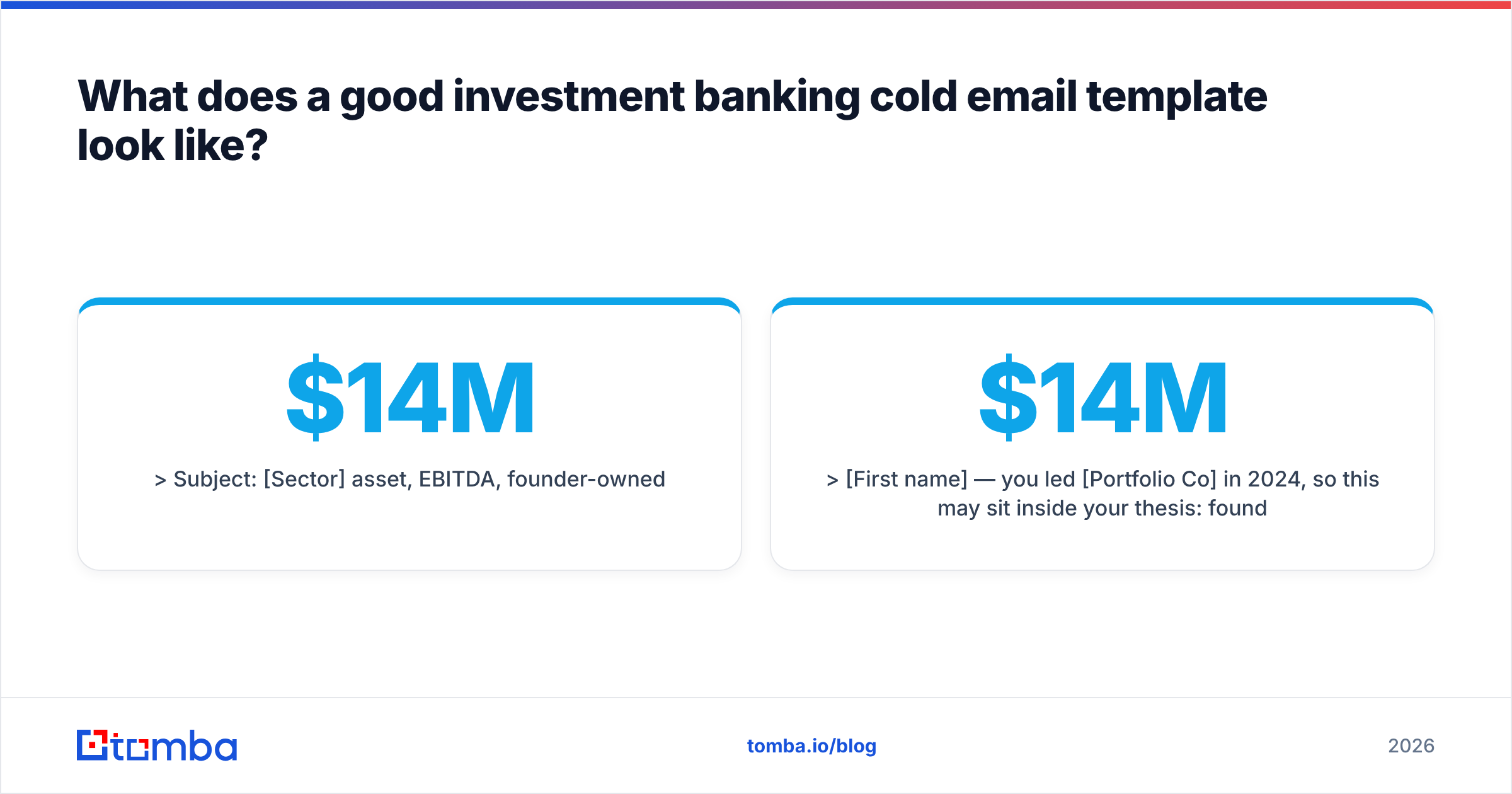
Subject: [Sector] asset, $14M EBITDA, founder-owned
[First name] — you led [Portfolio Co] in 2024, so this may sit inside your thesis: founder-owned [sector] business, $14M EBITDA, ~30% of revenue under multi-year contract, no institutional capital to date.
Process kicks off in [month]. Happy to send the teaser under NDA if it's a fit for the fund's current check size.
[Name], [Firm]
Why it works: the associate can qualify or disqualify in five seconds. The teaser is offered, not attached.
Template 3 — Vendor into a bank#
Subject: 6 hours per CIM on manual comp pulls
[First name] — most mid-market teams we talk to burn five to six analyst hours per CIM assembling comps and contact data by hand.
We cut that to under an hour for [Comparable Bank]'s coverage team. No deck attached — if the number sounds familiar, I'll send a two-minute walkthrough.
[Name]
Template 4 — Coffee chat (candidate to analyst)#
Subject: [University] '26 — 10 min on [Group]?
[First name] — I'm a [year] at [University] and saw you moved from [Prior Firm] to the [sector] group at [Bank]. I'm trying to understand how coverage work differs between the two before recruiting starts.
Would you have 10 minutes in the next two weeks? Happy to work around your calendar entirely.
[Name]
Template 5 — Re-engagement after silence#
Subject: Closing the loop on [Company]
[First name] — I've sent two notes on [topic] and haven't heard back, which usually means it's not a priority right now. Totally fair.
I'll stop here. If [trigger event] changes next year, my note from March is worth re-reading.
[Name]
The breakup email consistently earns replies in finance because it signals you respect their time, which almost nobody else in their inbox does. If you want more starting points across categories, the cold email templates library is a reasonable place to steal structure from.
Which template should you use for which situation?#
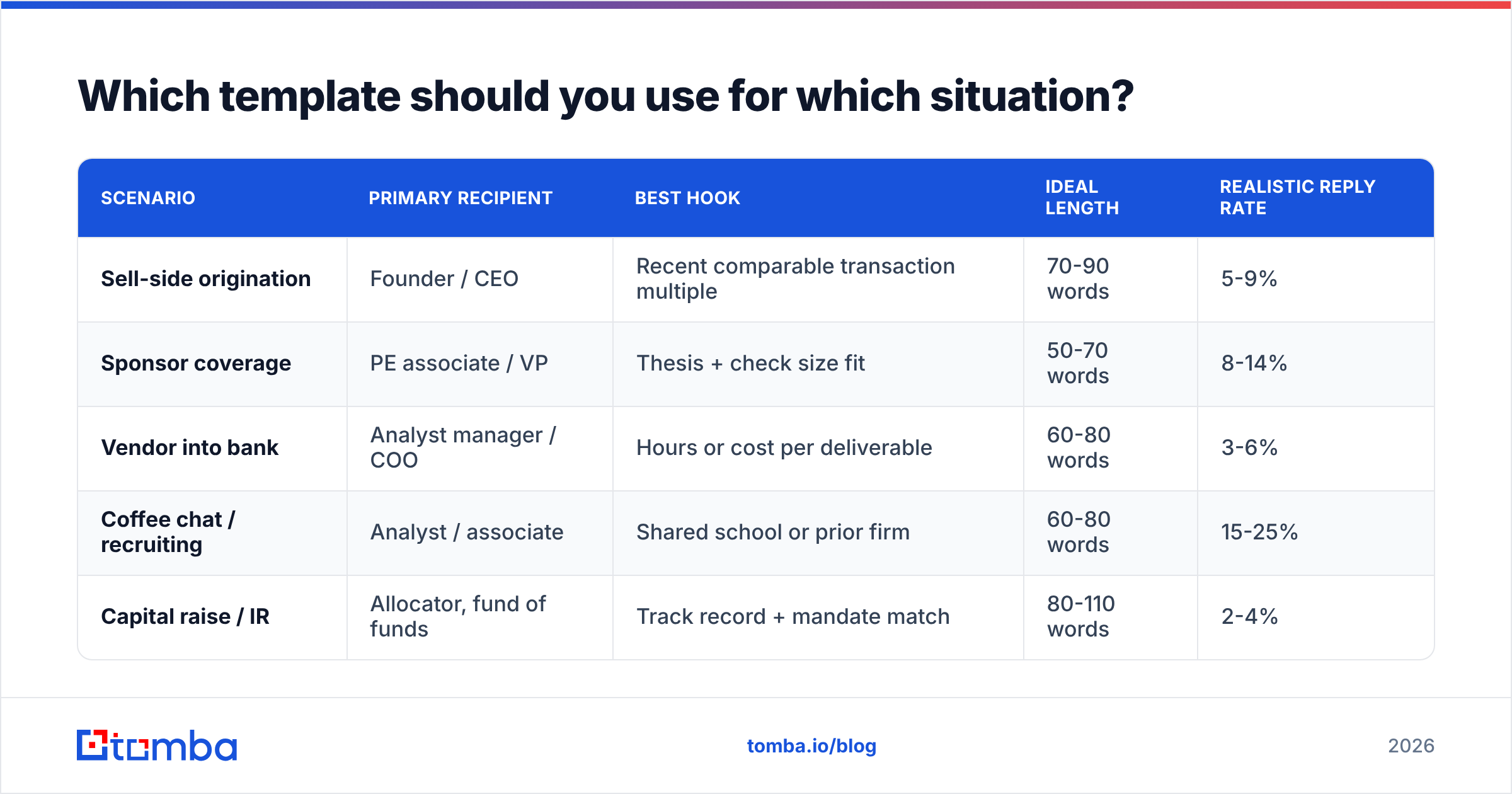
| Scenario | Primary recipient | Best hook | Ideal length | Realistic reply rate |
|---|---|---|---|---|
| Sell-side origination | Founder / CEO | Recent comparable transaction multiple | 70-90 words | 5-9% |
| Sponsor coverage | PE associate / VP | Thesis + check size fit | 50-70 words | 8-14% |
| Vendor into bank | Analyst manager / COO | Hours or cost per deliverable | 60-80 words | 3-6% |
| Coffee chat / recruiting | Analyst / associate | Shared school or prior firm | 60-80 words | 15-25% |
| Capital raise / IR | Allocator, fund of funds | Track record + mandate match | 80-110 words | 2-4% |
Two things stand out. Coffee-chat outreach converts far better than anything commercial, because the ask is small and the recipient was in your seat two years ago. And sponsor coverage beats sell-side origination, because associates are explicitly paid to source deal flow — you are helping them do their job.
How do you find and verify banker and sponsor emails?#
Copy is the easy part. The unglamorous part is building a list that doesn't bounce.
Banking contact data decays faster than almost any other vertical. Analyst and associate classes turn over annually, VPs lateral constantly, and firms rebrand after mergers. A list you scraped 10 months ago is likely 25-35% stale.
A practical workflow:
- Start from the firm, not the person. Run a domain search against the bank's or fund's website to see the live contact footprint and the dominant email pattern —
first.last@,flast@,first_initial+last@, and so on. - Resolve named targets individually. When you have a specific MD or associate from a deal announcement or a fund's team page, use an email finder to resolve name plus domain into a deliverable address rather than guessing the pattern.
- Verify before you send, every time. Run the full list through an email verifier. Finance domains are heavily catch-all configured, so treat "accept-all" results as a separate risk bucket and send to them at lower volume.
- Keep list sources diverse. Deal announcements, fund team pages, conference attendee lists, and reputable B2B data providers like BookYourData all produce different slices of the same market. Cross-referencing two sources beats trusting one.
- Cap daily volume per mailbox. 30-50 cold sends per inbox per day is a sane ceiling for this audience. Anything higher, and you are optimizing for spam folders.
The reason to be strict here is arithmetic. If 6% of your addresses are invalid, your bounce rate lands near 6%, which sits well above the 2% threshold most inbox providers treat as a spam signal. You then torch the domain reputation you need for the next campaign. HubSpot's cold email research makes the same point from the other direction: list quality moves reply rates more than subject-line tinkering does.
What subject lines actually get opened in banking?#
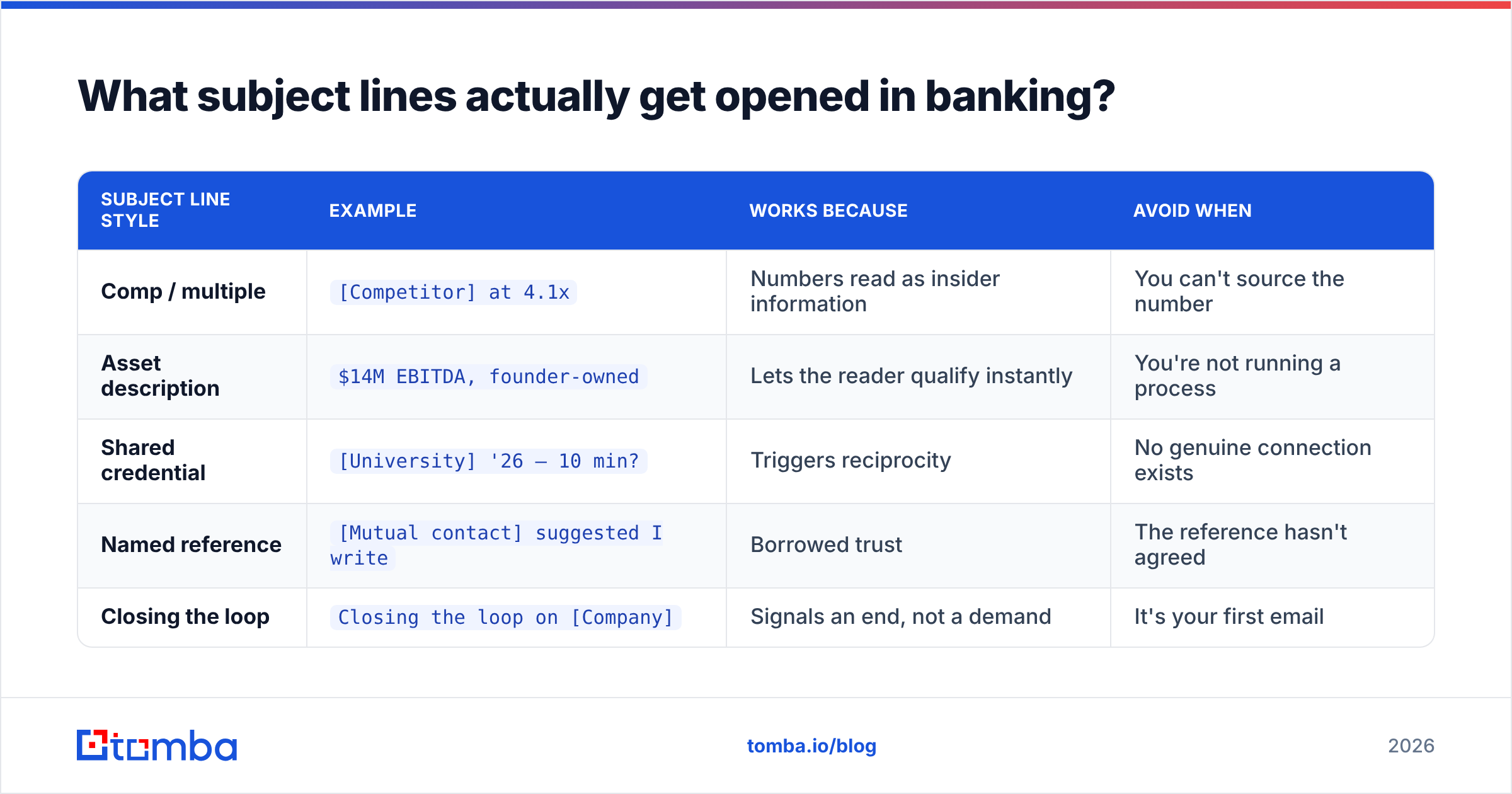
Short, specific, lowercase-friendly, and free of marketing verbs.
| Subject line style | Example | Works because | Avoid when |
|---|---|---|---|
| Comp / multiple | [Competitor] at 4.1x |
Numbers read as insider information | You can't source the number |
| Asset description | $14M EBITDA, founder-owned |
Lets the reader qualify instantly | You're not running a process |
| Shared credential | [University] '26 — 10 min? |
Triggers reciprocity | No genuine connection exists |
| Named reference | [Mutual contact] suggested I write |
Borrowed trust | The reference hasn't agreed |
| Closing the loop | Closing the loop on [Company] |
Signals an end, not a demand | It's your first email |
Skip emoji entirely. Skip "Re:" prefixes on emails that are not replies — it reads as a trick, and in a compliance-conscious industry, tricks get reported. If you want a second opinion on a line before sending, run it through a subject line tester and cut anything above eight words.
How many follow-ups, and on what cadence?#
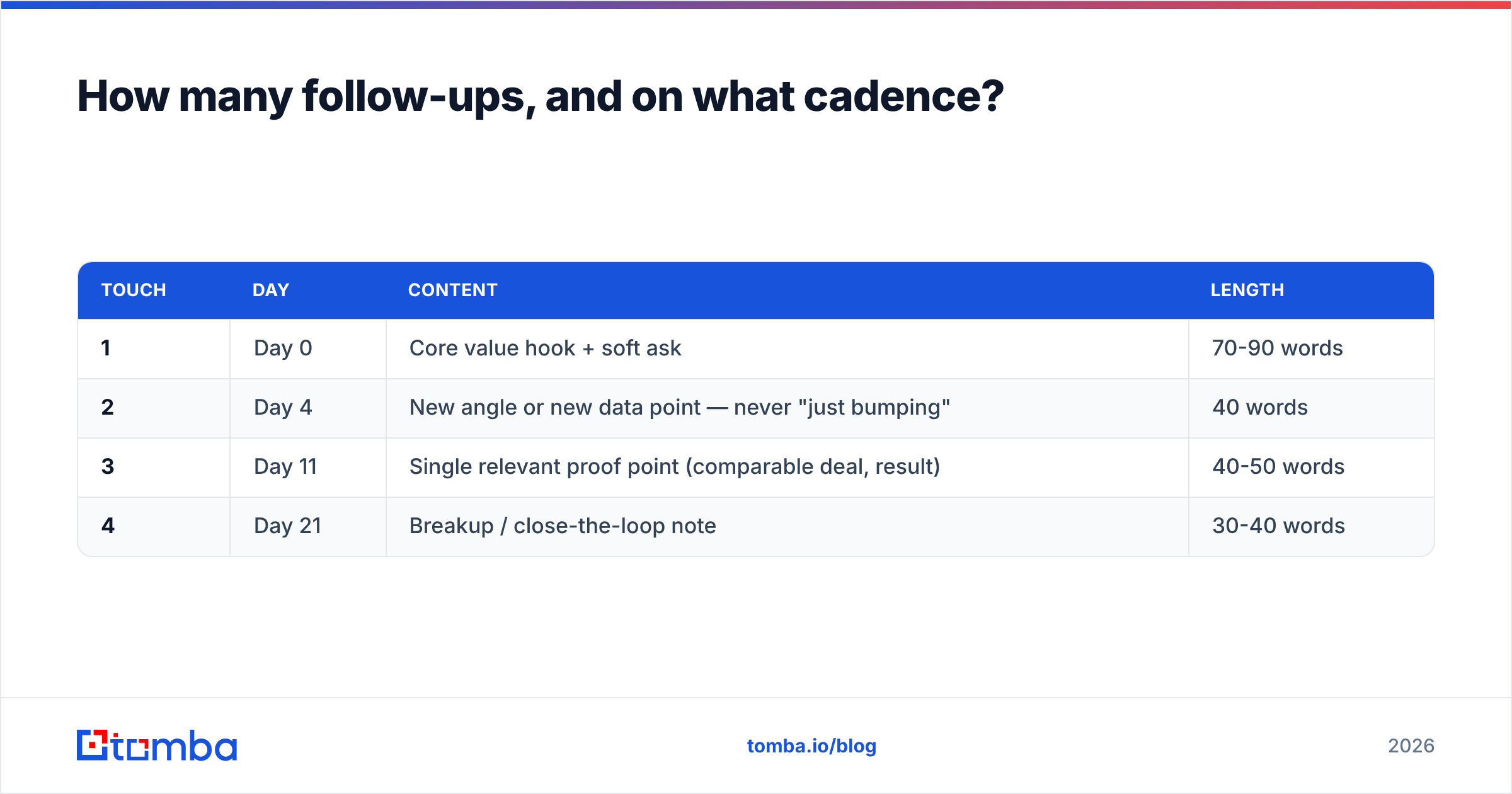
Three to four touches over roughly three weeks. Any more and you are training the recipient to ignore your domain.
| Touch | Day | Content | Length |
|---|---|---|---|
| 1 | Day 0 | Core value hook + soft ask | 70-90 words |
| 2 | Day 4 | New angle or new data point — never "just bumping" | 40 words |
| 3 | Day 11 | Single relevant proof point (comparable deal, result) | 40-50 words |
| 4 | Day 21 | Breakup / close-the-loop note | 30-40 words |
The rule that matters: each follow-up must carry new information. "Following up on my last email" is not information — it's a reminder that you already wasted their time once. A newly closed comparable transaction, a fresh sector data point, or a public announcement about their own firm all qualify.
What compliance and etiquette rules apply?#
This is the part most outbound playbooks skip, and it's the part that gets people in trouble.
- Regulated communications are archived. Registered representatives operate under retention and supervision rules enforced by bodies like FINRA. Assume every word you send is stored and reviewable.
- Never imply an existing relationship that doesn't exist. Writing "per our conversation" to someone you've never spoken to is not a growth hack; it's a misrepresentation, and in this industry it circulates.
- Don't send material non-public information cold. Deal details go out under an executed NDA, not in the body of a first-touch email.
- Include a real physical address and an unsubscribe path on commercial sends, per CAN-SPAM and equivalent rules. One line in the footer costs nothing.
- Public filings are fair research, not fair leverage. SEC EDGAR is a legitimate and underused source for identifying which firms just raised, filed, or registered — use it for targeting.
What are the most common mistakes?#
Leading with your firm. Nobody in this market cares about your league table ranking in the first sentence. They care whether you understand their situation.
Attaching the teaser to touch one. Attachments from unknown senders trigger filters and, at larger institutions, get stripped by security gateways before a human sees them.
Over-personalizing the wrong thing. Mentioning someone's marathon time from LinkedIn reads as surveillance. Mentioning their last portfolio add-on reads as competence. The line is: is this relevant to their work?
Sending from a brand-new domain. A domain registered three weeks ago with no warmup history has no reputation to lend you. Warm it for at least four weeks, and keep an eye on email deliverability basics — SPF, DKIM, DMARC — before the first campaign goes out.
Treating it as a numbers game. In most B2B verticals, doubling volume roughly doubles meetings. In banking, doubling volume roughly doubles complaints. The lever is targeting precision, not send count.
Where should you start?#
Pick one of the five scenarios above. Build a list of 100-150 genuinely relevant contacts — not 1,000. Write one template, personalize the first line individually for each contact, verify every address, and run the four-touch cadence. Measure replies, not opens; open tracking in finance is unreliable and increasingly blocked anyway.
If the list is right and the copy is honest, a 150-contact campaign should produce somewhere between six and fifteen real conversations. That's a quarter's worth of pipeline from two days of work.
The part you shouldn't do by hand is the data. Build your banking and sponsor list with the Tomba Email Finder, which resolves names and domains into deliverable addresses and flags catch-all domains before you send. The free tier covers 25 searches a month if you want to test a small batch first; paid plans start at $49/mo on Tomba pricing when you're ready to build the full coverage list.
Related guides#
// get started
Find, verify and enrich your first contacts today
Start on the free plan with 25 searches a month, then scale when your team is ready.
Free plan · No credit card required · GDPR & CCPA
// about the author