Investment Cold Calling Scripts That Book Meetings in 2026
Most investment cold calls die in the first eight seconds. Here are seven scripts that don't — plus the objection handling, compliance guardrails, and list-building work that makes any of them land.
TL;DR
- The script matters less than the first eight seconds. Investment prospects screen aggressively, so your opener has to prove you are not a boiler room in one sentence.
- Never lead with performance numbers. Lead with a reason you called this person, and let the product conversation happen on the second call.
- Seven scripts cover almost every investment scenario: referral bridge, trigger event, second opinion, dormant lead, liquidity event, advisor-to-advisor, and the voicemail.
- Five objections account for most hang-ups. Write responses in advance, rehearse them out loud, and stop improvising under pressure.
- A great script on a bad list still fails. Bad numbers, wrong titles, and stale contact data destroy more dials than weak wording ever will.
Why are investment cold calls harder than other cold calls?#
Because the person you are calling has been trained by decades of bad actors to assume you are one of them.
Selling SaaS, you interrupt someone's workflow. Selling investment products or advisory services, you interrupt someone's relationship with their own money — a subject where they already feel exposed, already suspect they are being taken advantage of, and have already received four similar calls this quarter. The prospect's default state is not indifference. It is suspicion.
Three structural things make the job different:
Regulation is a live wire. Broker-dealers and registered representatives operate under telemarketing rules that control when you can dial, what you must disclose, and how quickly you have to honor a do-not-call request. FINRA's telemarketing rule and the FTC's Telemarketing Sales Rule both apply, and the penalty for improvisation is not a lost deal — it is a compliance file.
Trust must be established before value. In most B2B calls, a compelling value proposition buys you a meeting. In investment sales, a compelling value proposition triggers alarm bells. "We returned 34% last year" is not a hook. It is a red flag.
The buying cycle is long and relational. A single cold call almost never produces a client. It produces permission to send something, permission to call again, or a fifteen-minute discovery meeting. Scripts that try to close on call one convert worse than scripts that try to earn call two.
That last point should reset your expectations for every script below. The target outcome of an investment cold call is a calendar entry, not a signature.
What does a compliant investment cold call actually sound like?#
Structurally, every effective investment cold calling script follows the same six-part spine. The wording changes; the spine does not.
- The identity line (5 seconds). Full name, firm name, and — where required — your registration status. State it plainly and early. Reps who mumble their firm name sound exactly like the people prospects are afraid of.
- The permission ask (5 seconds). "Did I catch you at a bad time?" or "Do you have thirty seconds?" You are not being polite for its own sake; you are transferring control, which lowers the defensive response.
- The reason for this call (10 seconds). Something specific to them: a referral, a liquidity event, a board appointment, a 13F filing, a job change. Generic calls get generic dismissals.
- The one-sentence relevance statement (10 seconds). What you do for people in their exact situation. No performance figures, no product names, no superlatives.
- The micro-commitment ask (10 seconds). A fifteen- or twenty-minute call at a specific time. Two options, both concrete. Never "sometime next week."
- The graceful exit (5 seconds). A pre-planned line for "no" that keeps the door open and honors any do-not-call request immediately, without argument.
Forty-five seconds, start to finish. If your script cannot be delivered in forty-five seconds, it is not a script — it is a monologue, and the prospect will end it for you.
Which investment cold calling script should you use?#
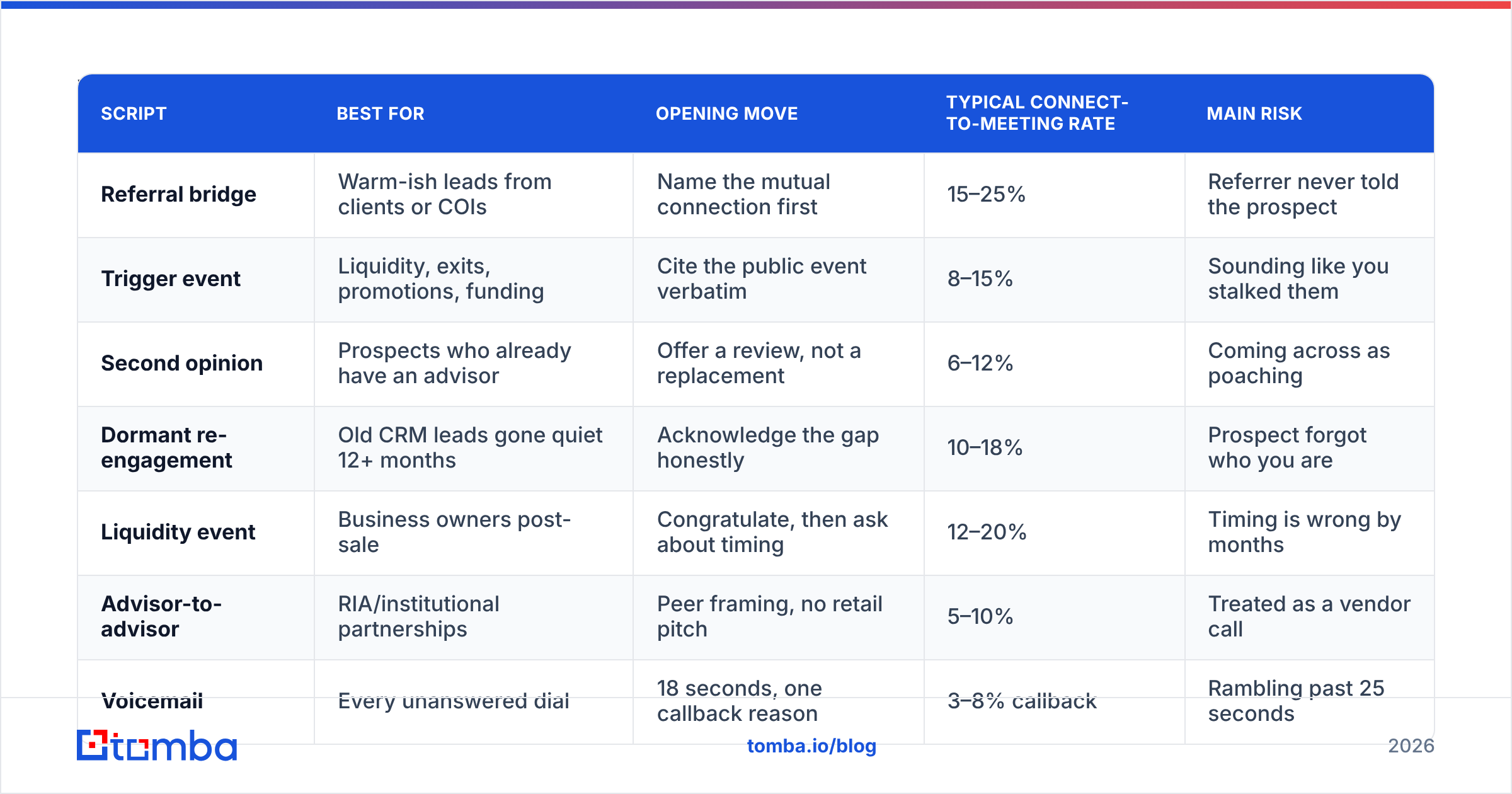
Pick by scenario, not by preference. The seven scripts below map to the seven situations that cover most advisory and institutional dialing.
| Script | Best for | Opening move | Typical connect-to-meeting rate | Main risk |
|---|---|---|---|---|
| Referral bridge | Warm-ish leads from clients or COIs | Name the mutual connection first | 15–25% | Referrer never told the prospect |
| Trigger event | Liquidity, exits, promotions, funding | Cite the public event verbatim | 8–15% | Sounding like you stalked them |
| Second opinion | Prospects who already have an advisor | Offer a review, not a replacement | 6–12% | Coming across as poaching |
| Dormant re-engagement | Old CRM leads gone quiet 12+ months | Acknowledge the gap honestly | 10–18% | Prospect forgot who you are |
| Liquidity event | Business owners post-sale | Congratulate, then ask about timing | 12–20% | Timing is wrong by months |
| Advisor-to-advisor | RIA/institutional partnerships | Peer framing, no retail pitch | 5–10% | Treated as a vendor call |
| Voicemail | Every unanswered dial | 18 seconds, one callback reason | 3–8% callback | Rambling past 25 seconds |
Rates above reflect what dialing teams commonly report for connected conversations, not per-dial rates. Your mileage varies with list quality more than with wording — a point we will come back to.
Script 1 — The referral bridge#
"Hi [Name], this is [Your name] with [Firm]. [Referrer] and I were talking last week about [specific topic], and your name came up — they mentioned you were [context]. Did they give you a heads up I'd call?
(pause, let them answer)
Fair enough. The short version: I work with [type of client] on [narrow problem], and [Referrer] thought there might be some overlap. I'm not going to pitch you anything on this call. I'd just like fifteen minutes to understand what you're working on. Would Thursday at 8:15 or Friday at 4:00 work better?"
Why it works: the mutual name does the trust-building your credentials cannot. The explicit "I'm not going to pitch you" removes the thing they are bracing for.
Script 2 — The trigger event#
"Hi [Name], [Your name] with [Firm] — I saw that [Company] closed [event] last month. Congratulations, that's a real milestone.
I called because I work with [role] going through exactly that transition, and there are usually two or three decisions that get made fast and are expensive to unwind later. I'm not going to cover them on a cold call. If it's useful, I'd like twenty minutes in the next couple of weeks. Worth a look?"
Why it works: the event proves the call is not random. The "expensive to unwind later" line creates urgency without promising a return.
Script 3 — The second opinion#
"Hi [Name], [Your name], [Firm]. I'll be direct — this is a cold call, and I'm guessing you already work with someone.
That's fine. Most of the people I end up working with came to me for a second set of eyes, not a replacement. Once a year I do a no-cost review of [specific area] — allocation, fee drag, tax placement. Some people find nothing. Some find something that pays for itself. Either way you keep your advisor. Open to twenty minutes?"
Why it works: naming the cold call defuses it. Explicitly not asking them to fire anyone removes the loyalty objection before it is raised.
Script 4 — The dormant re-engagement#
"Hi [Name], [Your name] from [Firm]. We spoke about eighteen months ago about [topic] and the timing wasn't right — you told me to circle back, and I'm a little late doing it.
Two things have changed since then: [change one] and [change two]. If neither is relevant, tell me and I'll close the file properly. If one is, I'd like fifteen minutes."
Why it works: honesty about the gap, plus a genuine offer to stop calling, which converts the "just say no" impulse into an actual decision.
Script 5 — The liquidity event#
"Hi [Name], [Your name] at [Firm]. Congratulations on the sale of [Company] — that's a lot of years in one transaction.
I called for one reason: most founders I talk to say the first ninety days after a close were the most disorienting part of the whole process, mostly because everyone shows up at once. I'm not asking for anything today. When you're ready to have a structured conversation, I'd like to be one of the two or three people you talk to. Can I check back in [month]?"
Why it works: it asks for a future slot instead of a present one. Post-liquidity prospects say no to everyone in month one and say yes to whoever is still polite in month four.
Script 6 — The advisor-to-advisor call#
"Hi [Name], [Your name] with [Firm] — I run [function] on the [team] side. This isn't a retail call.
We're seeing a lot of [trend] among RIAs in the [size] range, and we've built [capability] around it. I'd rather show you than describe it. Twenty minutes, screen share, and if it's not a fit I'll say so on the call. Does next week work?"
Why it works: peer framing and an explicit promise to disqualify yourself. Both signal that you are not running a volume play.
Script 7 — The voicemail#
"[Name], it's [Your name] at [Firm], [phone number]. Calling about [one specific, concrete reason]. I'll try you again Thursday morning — if it's easier, my number again is [phone number]. Thanks."
Eighteen seconds. Number twice, reason once, no pitch, and a stated callback time so the follow-up dial is expected rather than intrusive.
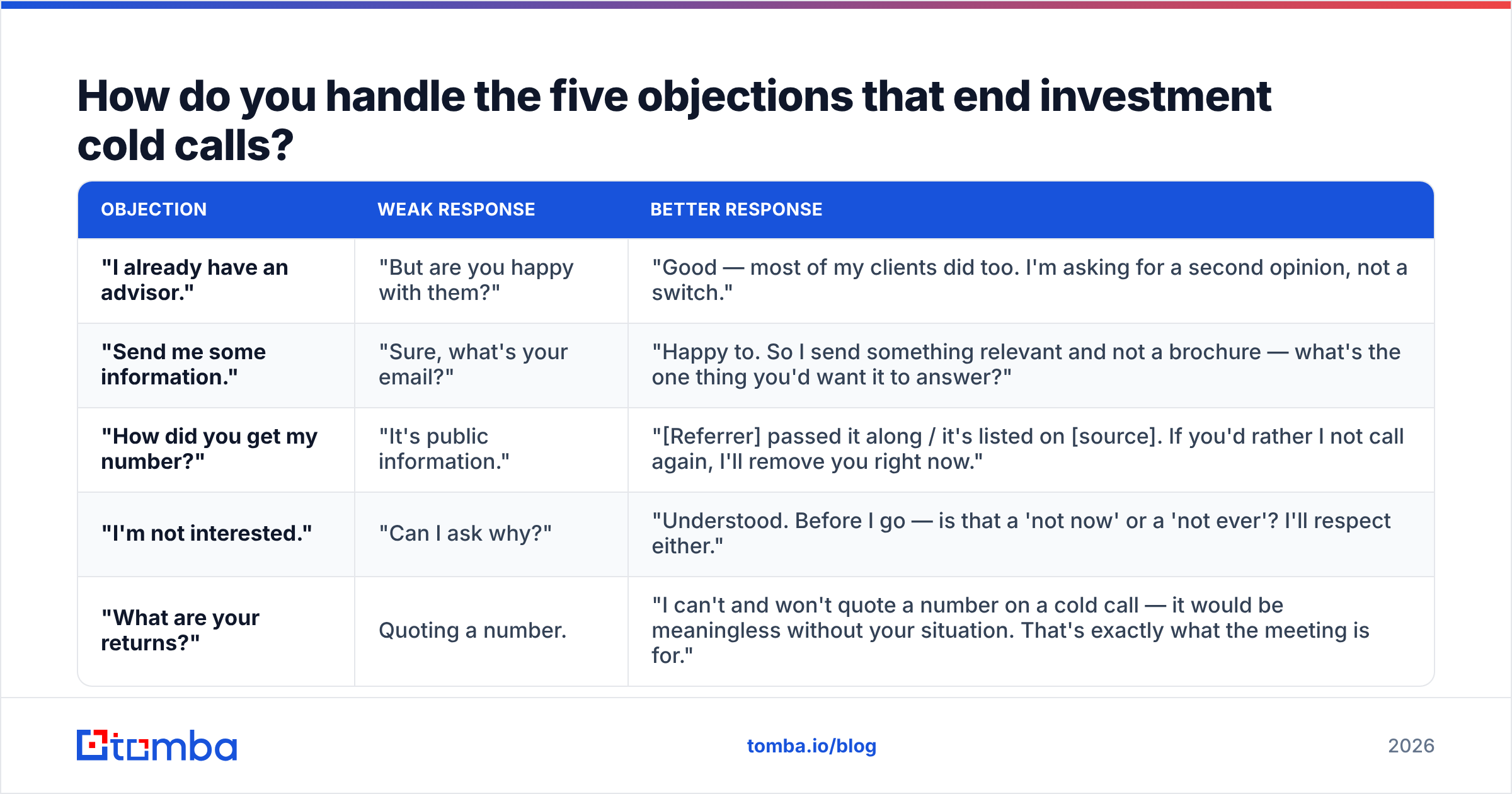
How do you handle the five objections that end investment cold calls?#
Write these before you dial. Reading a prepared line calmly beats improvising a brilliant one anxiously.
| Objection | Weak response | Better response |
|---|---|---|
| "I already have an advisor." | "But are you happy with them?" | "Good — most of my clients did too. I'm asking for a second opinion, not a switch." |
| "Send me some information." | "Sure, what's your email?" | "Happy to. So I send something relevant and not a brochure — what's the one thing you'd want it to answer?" |
| "How did you get my number?" | "It's public information." | "[Referrer] passed it along / it's listed on [source]. If you'd rather I not call again, I'll remove you right now." |
| "I'm not interested." | "Can I ask why?" | "Understood. Before I go — is that a 'not now' or a 'not ever'? I'll respect either." |
| "What are your returns?" | Quoting a number. | "I can't and won't quote a number on a cold call — it would be meaningless without your situation. That's exactly what the meeting is for." |
That last one is not just compliance theater. Refusing to quote performance on a cold call is the single strongest credibility signal available to you, because every boiler room in history has done the opposite.
Does your list matter more than your script?#
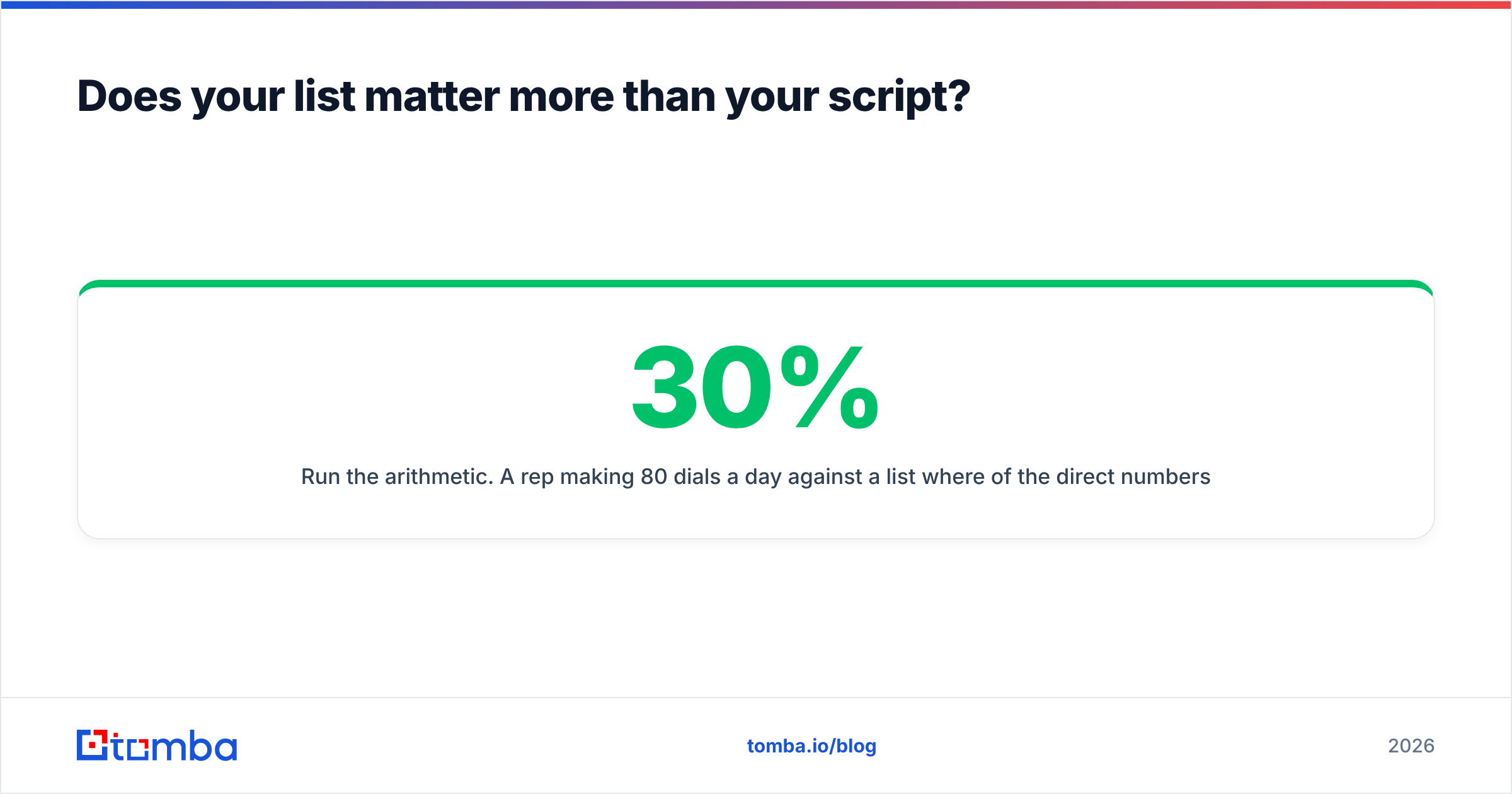
Yes, and it is not close.
Run the arithmetic. A rep making 80 dials a day against a list where 30% of the direct numbers are wrong, 15% of the contacts have changed roles, and 10% are on a do-not-call registry is burning roughly half the day on dials that could never have converted. No rewrite of your opener recovers those hours. Data quality is a gating factor, not an optimization.
Four things to fix before you touch the script:
- Verify the direct number. Switchboard numbers route to gatekeepers; mobile and direct-dial numbers route to the person. Run your list through a phone validator to strip disconnected and mistyped numbers before your dialer ever sees them.
- Confirm the person still holds the title. Investment prospects change firms constantly. A CFO who left nine months ago is a wasted dial and an embarrassing opener.
- Enrich with a reason to call. Funding rounds, filings, promotions, office moves. Contact enrichment turns a name and a number into a trigger-event script instead of a generic one.
- Build the email fallback in the same pass. Most cold calls do not connect. If you have a verified address ready when you hang up, the follow-up email goes out in ninety seconds instead of tomorrow — and the combination of a voicemail plus a same-day email lifts response rate materially over either channel alone.
For teams building lists from scratch, pairing a phone finder with a verified email source means one research pass produces both channels. That is the difference between a caller who dials 80 numbers and a caller who reaches 80 people over a week.
What compliance rules should be baked into your script?#
Treat these as non-negotiable script furniture, not as a legal appendix:
- Calling window. Keep dials inside the permitted local-time window for the prospect's number, not your own time zone.
- Registry scrubbing. Screen against the national registry and your firm's internal do-not-call list before every campaign, not once a quarter.
- Immediate honor. When someone asks not to be called again, the only correct response is confirmation and removal. No rebuttal, no "just one quick question."
- Disclosure. Name, firm, and purpose within the first few seconds. Every time.
- No performance promises. Nothing about returns, guarantees, or "safe" yields on a first call.
- Record retention. Log the outcome, the disclosure, and any opt-out request in your CRM the same day.
Your compliance department should sign off on the exact wording of any script you dial at volume. Get the approval in writing and version it — an approved script from 2023 is not an approved script today. General-purpose cold calling guidance from sources like HubSpot's sales blog is useful for technique, but it is not written for registered reps and should never override your firm's own policy.
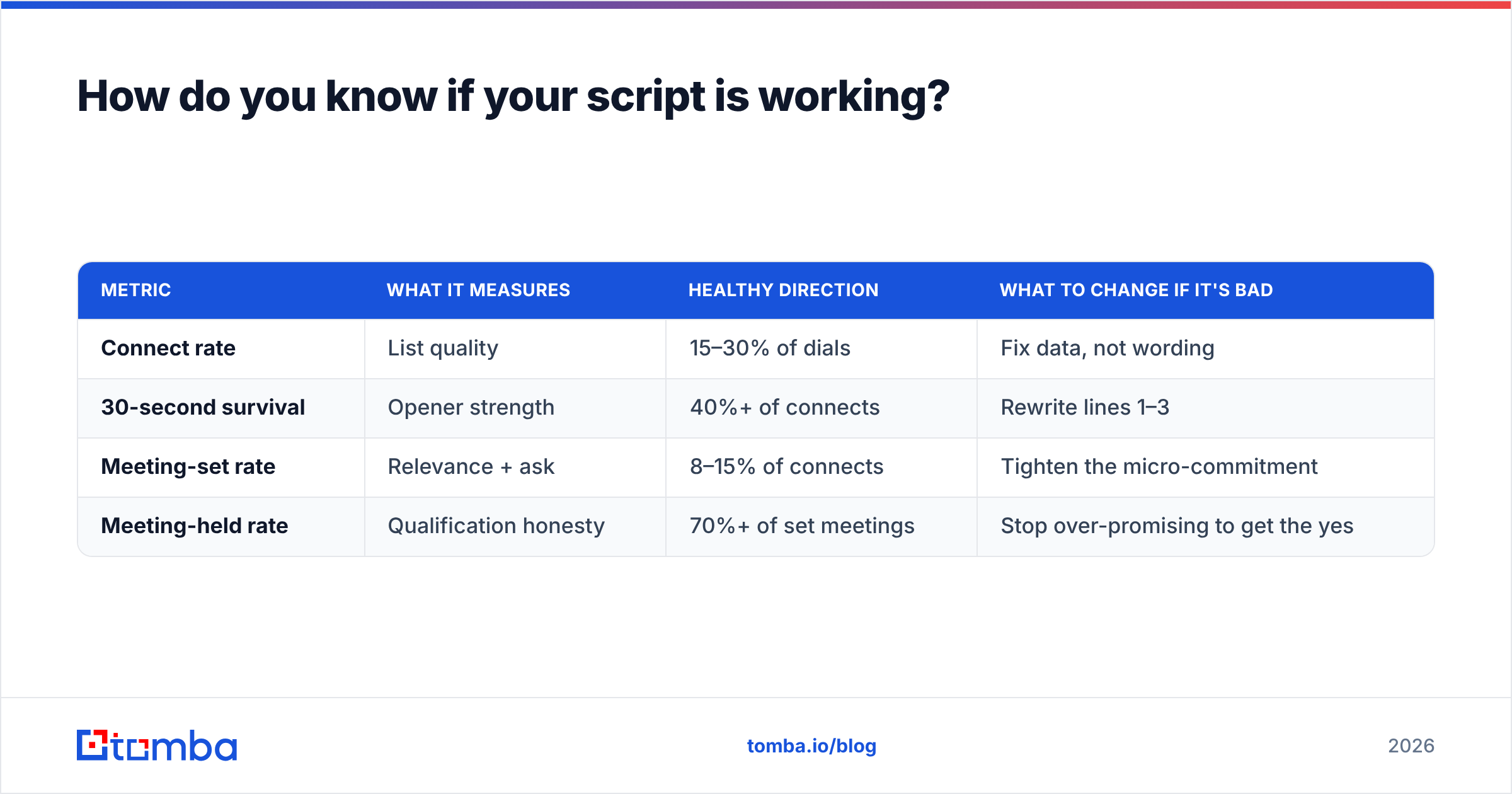
How do you know if your script is working?#
Stop tracking dials. Track the four numbers that actually move.
| Metric | What it measures | Healthy direction | What to change if it's bad |
|---|---|---|---|
| Connect rate | List quality | 15–30% of dials | Fix data, not wording |
| 30-second survival | Opener strength | 40%+ of connects | Rewrite lines 1–3 |
| Meeting-set rate | Relevance + ask | 8–15% of connects | Tighten the micro-commitment |
| Meeting-held rate | Qualification honesty | 70%+ of set meetings | Stop over-promising to get the yes |
The diagnostic power is in the sequence. Low connect rate with a strong 30-second survival means your script is fine and your list is broken. High connect rate with poor survival means the opposite. Most teams misdiagnose this and rewrite the script when they should have rebuilt the list.
Review recordings weekly, in pairs, with one specific line as the focus. "Everyone listen to your openers" produces nothing. "Everyone listen to how you handled 'send me information'" produces a fix.
Where should you start this week?#
Pick two scripts, not seven. Most advisory teams get the best results from the referral bridge and the trigger event, because both give you a specific, defensible reason for the call — which is the one thing that separates a professional dial from a boiler-room dial.
Then fix the list underneath them. Build a segment of 200 contacts where every direct number is validated, every title is current, and every record has a trigger you can name out loud in the first ten seconds. Dial that 200 before you dial anything else, and compare the numbers against last month's.
Ready to build that list? Start with the Tomba Email Finder to lock down verified contact data for every prospect on your call sheet, then layer on phone and enrichment data so every dial has a name, a number, and a reason. The free tier includes 25 searches a month to test your first segment, with Starter at $49/mo and Growth at $99/mo when you are ready to scale the desk.
Related guides#
// get started
Find, verify and enrich your first contacts today
Start on the free plan with 25 searches a month, then scale when your team is ready.
Free plan · No credit card required · GDPR & CCPA
// about the author