Investor Outreach in 2026: How to Email VCs and Get Replies
Most founders treat investor outreach like a mass cold email campaign — and get ignored. Here is the sourcing, sequencing, and email structure that actually books partner meetings in 2026.
TL;DR
- Investor outreach fails on targeting, not on writing. A list of 400 "VCs" scraped from a public database converts worse than 40 investors who have written a check into your stage, sector, and geography in the last 18 months.
- Warm intros still outperform cold email roughly 3–5x on reply rate, but cold works fine when the thesis match is obvious and the email is under 150 words.
- Partner-level email addresses are the bottleneck. Most funds publish a
info@or a contact form; you need the individual partner's address, which is where an email finder and pattern verification earn their keep. - Send from a real domain with proper authentication. A pitch that lands in Promotions or spam is indistinguishable from a pitch that was never sent.
- Three touches over 18 days, then stop. Investors keep a mental "founder who won't take a hint" list, and you do not want to be on it.
Investor outreach is prospecting with a different buyer. The mechanics — list building, contact discovery, personalization, sequencing, deliverability — are identical to B2B sales. What changes is that your prospect receives 60 pitches a week, has a public track record you can research in ten minutes, and makes decisions in partnership meetings you will never see.
This guide covers how to build the list, find the addresses, write the email, and follow up without burning the relationship.
What is investor outreach, and how is it different from cold sales email?#
Investor outreach is the process of identifying, contacting, and converting capital providers — angels, seed funds, venture firms, family offices, and strategic investors — into first meetings that lead to term sheets.
It looks like outbound sales but breaks three assumptions that outbound rests on:
- The buyer is not solving a pain. A VP of Sales buys because something hurts. An investor buys because they believe your company might return their fund. You cannot lead with pain relief; you lead with an unfair insight or traction that is hard to argue with.
- The volume ceiling is brutally low. There might be 120 funds on earth that invest in pre-seed vertical SaaS in your region. You cannot "send more" your way out of a bad list. Every name is finite and semi-permanent — you get one clean shot per fund per raise.
- Reputation compounds across the whole market. Sales prospects don't talk to each other. Investors do, constantly, in group chats and co-investor calls. A sloppy mass-BCC pitch circulates as a joke. That reputational spillover is the single biggest argument against spray-and-pray.
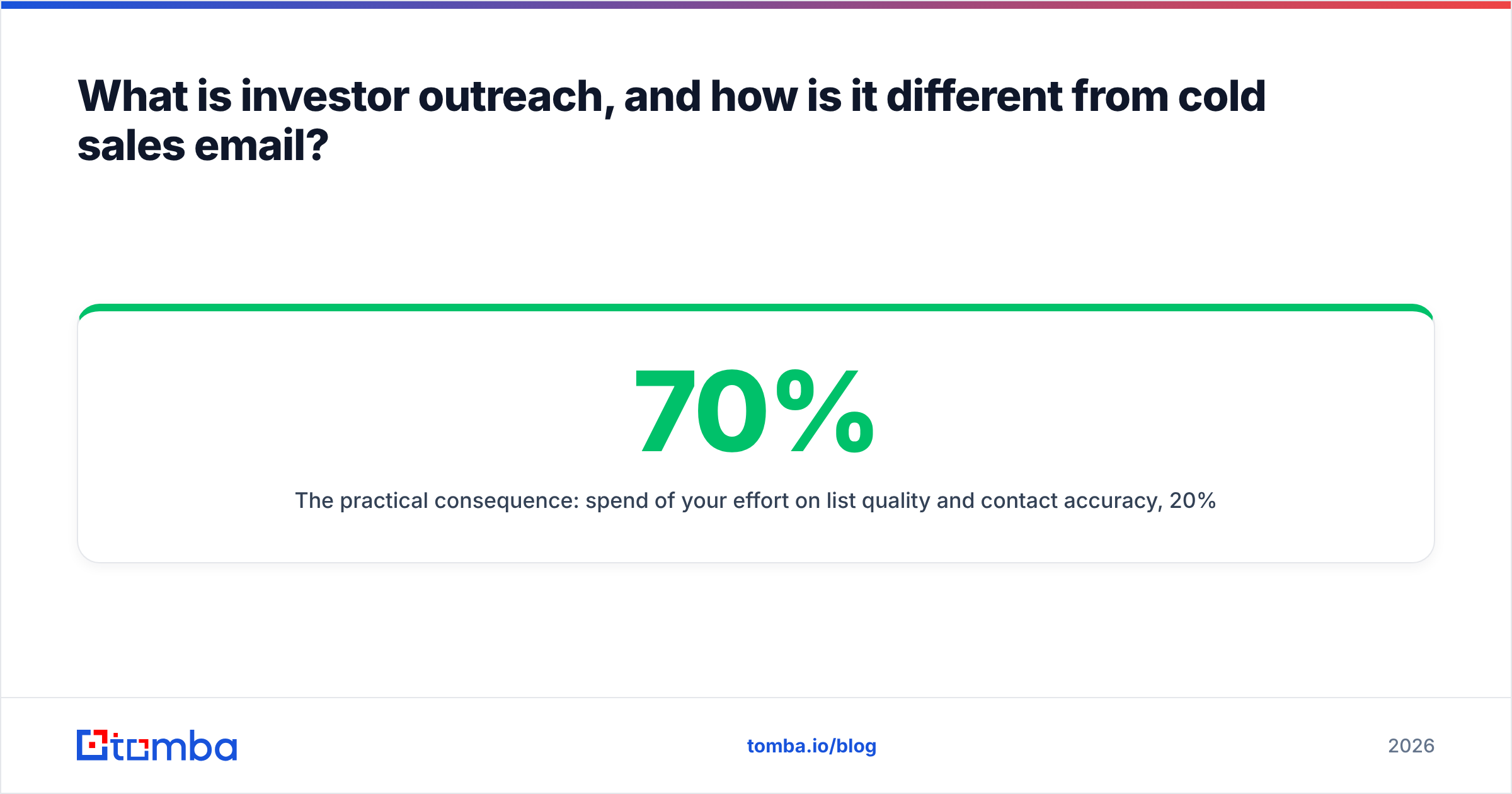
The practical consequence: spend 70% of your effort on list quality and contact accuracy, 20% on the email itself, and 10% on follow-up. Most founders invert that ratio.

How do you build an investor target list that is actually worth emailing?#
Start from checks written, not from fund websites. A fund's "what we invest in" page is marketing; its portfolio page and recent filings are evidence.
Work through these five filters in order, and drop anyone who fails one:
- Stage match. Did they lead or participate in a round at your exact stage in the last 18 months? A "seed to Series B" fund that has only done Series A for two years is a Series A fund.
- Sector match. Do they have at least two portfolio companies adjacent to your category? Adjacent is better than identical — identical means conflict.
- Check size match. If you are raising $1.5M and their typical first check is $8M, you are wasting both parties' time.
- Geography and structure. Some funds cannot invest outside a jurisdiction, cannot lead, or cannot do SAFEs. This is public information and it disqualifies fast.
- Individual partner match. Funds don't invest — partners do. Identify the specific partner who championed the closest comparable deal. That is your target, not the fund.
That last filter is where most lists collapse. You end up with a spreadsheet of 60–90 named humans rather than 400 firms, and that is the correct shape of an investor outreach list.
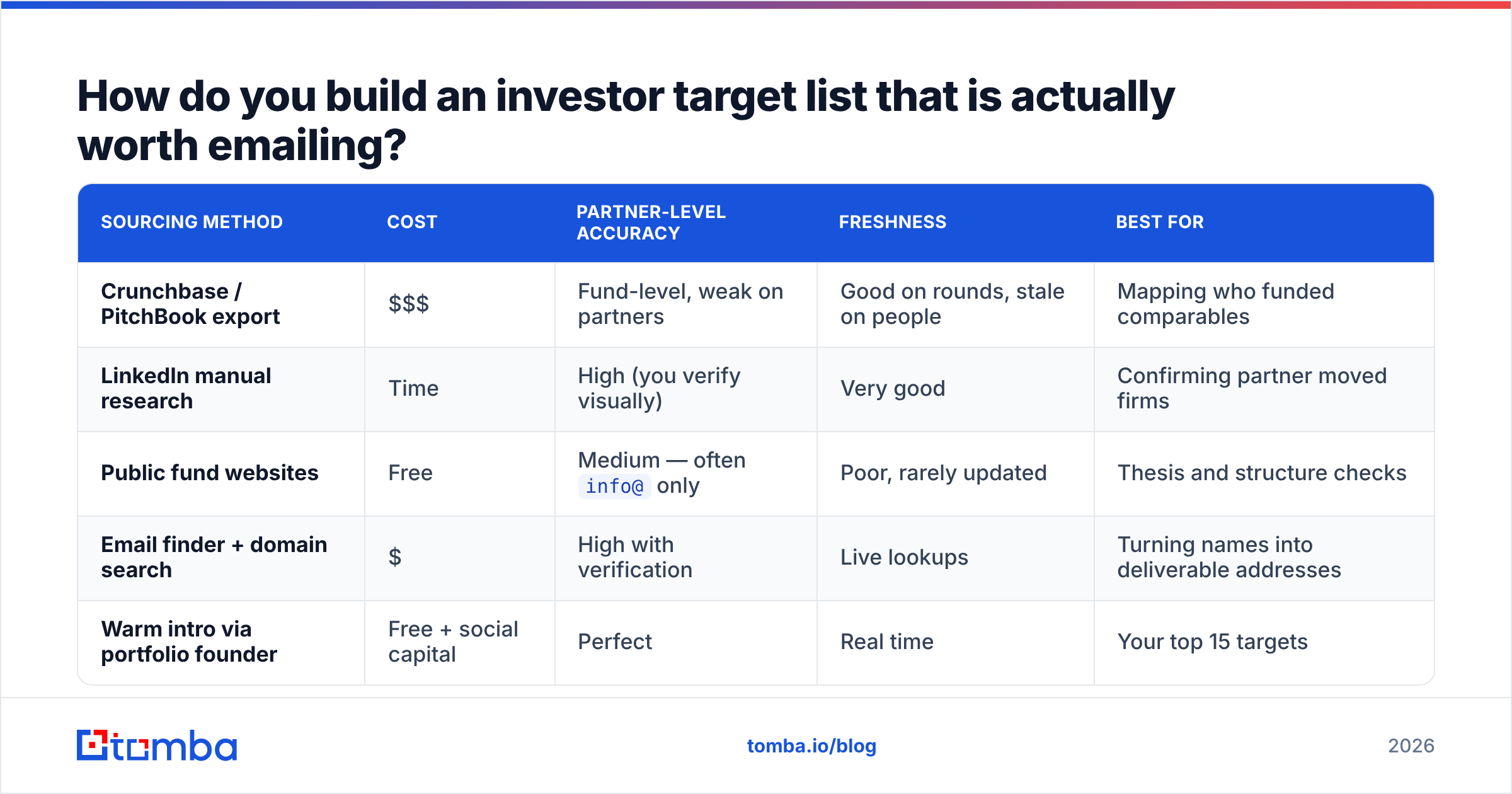
| Sourcing method | Cost | Partner-level accuracy | Freshness | Best for |
|---|---|---|---|---|
| Crunchbase / PitchBook export | $$$ | Fund-level, weak on partners | Good on rounds, stale on people | Mapping who funded comparables |
| LinkedIn manual research | Time | High (you verify visually) | Very good | Confirming partner moved firms |
| Public fund websites | Free | Medium — often info@ only |
Poor, rarely updated | Thesis and structure checks |
| Email finder + domain search | $ | High with verification | Live lookups | Turning names into deliverable addresses |
| Warm intro via portfolio founder | Free + social capital | Perfect | Real time | Your top 15 targets |
The workflow that holds up: build the named-partner list from portfolio research and LinkedIn, then run a domain search against each fund's domain to learn its email pattern, then resolve individual partners by name. Funds are small — 6 to 30 people — so a domain search often returns the entire investment team in one call, which doubles as a check on whether the partner you targeted is still there.
Why do investor emails bounce or vanish, and how do you fix it?#
Two different failures get confused here, and they need different fixes.
Failure one: the address is wrong. Venture firms churn partners constantly, use vanity domains, and frequently run catch-all servers that accept everything and deliver nothing. A catch-all domain will happily return "valid" for nonsense@fund.com. If your list shows a suspiciously perfect 100% validity rate, you are almost certainly looking at catch-alls, and a catch-all verifier is the only way to separate real mailboxes from black holes.
Failure two: the address is right and you still get filtered. This is a sender-side problem. Gmail and Microsoft tightened bulk sender requirements in 2024 and have kept ratcheting since; the current baseline, documented in Google's sender guidelines, is SPF, DKIM, and a DMARC policy on your sending domain, plus a spam complaint rate under 0.3%.
Fix the sender side before you touch a single investor:
- Authenticate the domain. Publish an SPF record, sign with DKIM, set DMARC to at least
p=nonewith reporting so you can see failures. - Send from a human mailbox.
sarah@yourcompany.com, notfounders@orhello@. Role addresses get filtered harder and read as less personal. - Never use a sequencer for investors. Mail-merge footers, tracking pixels, and unsubscribe links signal "you are on a list." Send from Gmail or Outlook directly. Investors notice; several have said publicly that a tracking pixel is an instant pass.
- Keep the volume sane. Fifteen to twenty-five manually sent emails a day from a domain with normal traffic looks like a founder working. Two hundred looks like a campaign.
- Verify before sending. Bounces from a young domain damage sender reputation fast. Run the list through an email verifier and drop anything that isn't confirmed deliverable.
One practical note on attachments: do not attach the deck to a cold email. Link it. Attachments trip filters, and a link lets you see engagement without a tracking pixel in the body.
What should a cold investor email actually say?#
Under 150 words, five components, no exceptions.
- Subject line with a specific hook. "Seed — [Category] — $40k MRR, 22% MoM" beats "Investment opportunity." Investors triage by subject; give them the triage data.
- One line of connection or reason-for-you. "You led [Portfolio Co]'s seed — we're attacking the same buyer from the data layer." This is the filter-passing sentence. If you cannot write it honestly, remove the investor from your list.
- What you do, in one sentence a non-expert understands. No jargon, no "AI-powered platform that leverages."
- The single most compelling number. Revenue, growth rate, retention, waitlist, pilot conversion — one metric, not a dashboard. If you have no numbers, substitute one hard-won insight the market doesn't have.
- A low-friction ask. "Worth 20 minutes?" or "Happy to send the deck." Not "Are you available Tuesday at 2, 3, or 4 PM ET?" — that presumes a decision they haven't made.
What to cut: the market-size paragraph, the team bios, the competitive landscape, the word "disrupt," and any sentence that starts with "In today's." Those belong in the deck, which is what the meeting is for.
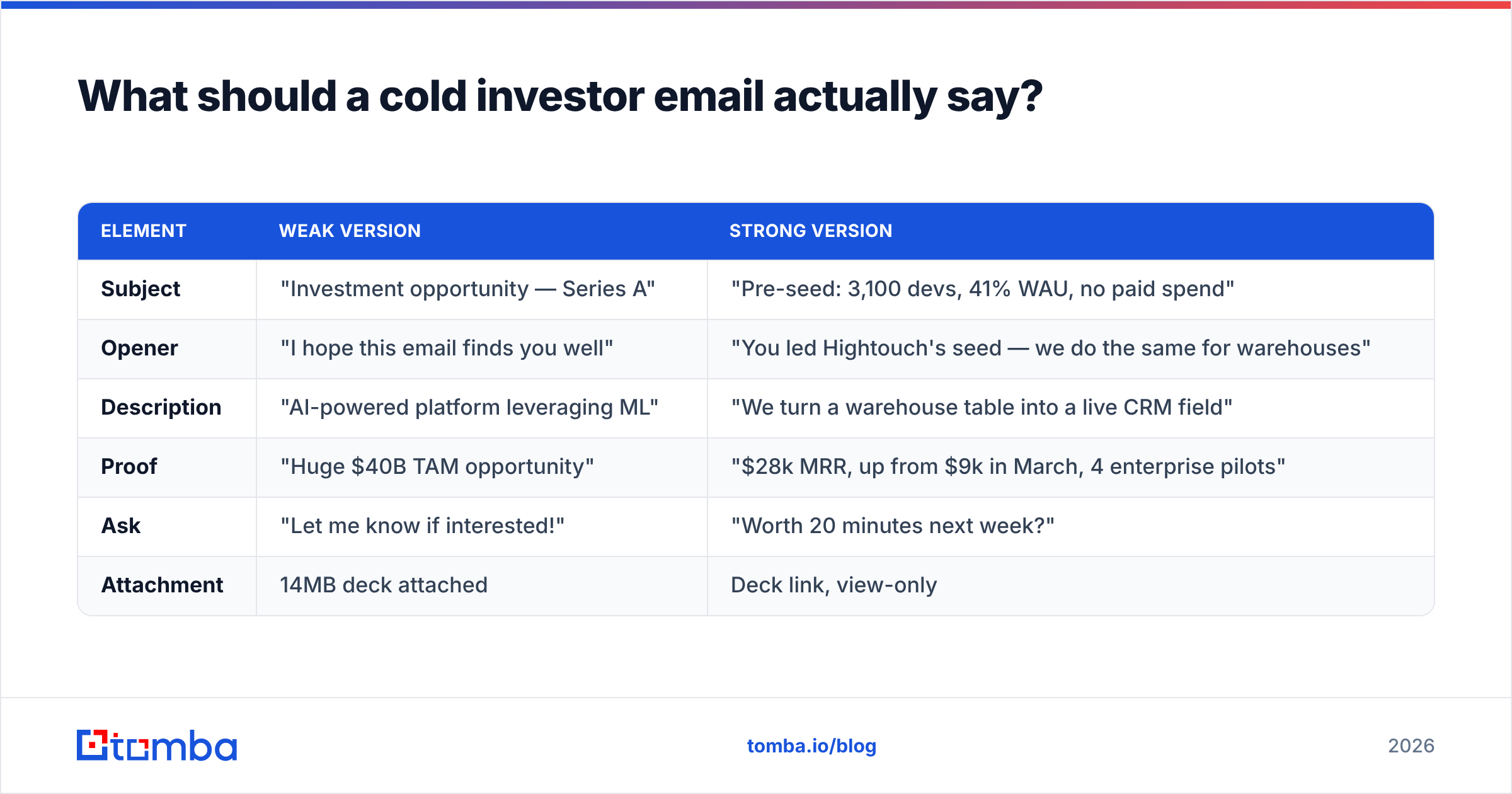
| Element | Weak version | Strong version |
|---|---|---|
| Subject | "Investment opportunity — Series A" | "Pre-seed: 3,100 devs, 41% WAU, no paid spend" |
| Opener | "I hope this email finds you well" | "You led Hightouch's seed — we do the same for warehouses" |
| Description | "AI-powered platform leveraging ML" | "We turn a warehouse table into a live CRM field" |
| Proof | "Huge $40B TAM opportunity" | "$28k MRR, up from $9k in March, 4 enterprise pilots" |
| Ask | "Let me know if interested!" | "Worth 20 minutes next week?" |
| Attachment | 14MB deck attached | Deck link, view-only |
Personalization has a floor and a ceiling. The floor is naming the specific portfolio company and thesis overlap — non-negotiable. The ceiling is roughly two sentences of research; beyond that you are performing effort rather than communicating, and investors read that as insecurity.
Are warm introductions still worth the effort in 2026?#
Yes, and the gap is not close. Warm intros still convert to first meetings at several times the rate of cold outreach, and they arrive pre-vetted by someone with skin in the game.
The mistake is treating "warm intro" as binary. There is a ladder:
- Portfolio founder intro. The best. A founder the partner already backed vouching for you carries real weight, because the founder is spending their own credibility.
- Co-investor intro. An angel or fund already on your cap table forwarding to a downstream lead. Strong, and it signals your existing backers believe in the next round.
- Operator intro. A well-known operator in the investor's network. Decent.
- Mutual LinkedIn connection. Weak unless the relationship is genuine. A 2nd-degree connection who has never spoken to either of you is functionally cold, and asking them for an intro burns a real relationship for a fake one.
- Cold. Fine when the thesis match is obvious. Better than a fake warm intro every time.
Practical approach: map your top 20 targets, then work backwards to find someone one hop away. Portfolio founders are the most reachable link — they were you eighteen months ago, they answer founder email, and their addresses follow ordinary company patterns you can resolve with a bulk email finder in a single pass. Write them a short, specific note asking whether they'd be comfortable making the intro, with a forwardable paragraph attached so they can pass it on without writing anything themselves.
Always send the forwardable blurb. Making someone compose your pitch is how intros die in a drafts folder.
How many times should you follow up with an investor?#
Three touches total, spread over roughly 18 days, then stop and move on.
- Day 0 — the initial email.
- Day 5 — a one-line bump with new information. Not "just circling back." Something changed: a customer signed, a metric moved, a notable angel committed. New information is the only legitimate reason for a second email.
- Day 14–18 — final note, explicitly closing the loop. "Closing our round in three weeks — happy to send an update if timing is better later. Either way, no hard feelings."
That third email does more work than founders expect. It signals momentum, it gives a graceful exit, and it frequently surfaces a real reason for the silence — wrong stage, portfolio conflict, or "check back at $50k MRR," which is actually useful information.
What not to do: LinkedIn DM plus email plus X reply plus a message to their assistant, all in one week. Multi-channel is standard practice in outbound sales strategy and actively counterproductive here. Two channels maximum, spaced out.
The strongest follow-up isn't a follow-up at all — it's the monthly investor update. Ask every investor who passed or went quiet whether they'd like to be on your update list. Most say yes. Six months of clean, honest updates showing a chart moving up-and-right does more than any sequence, and it turns a "no" into a warm inbound at your next raise. Several firms describe this as their most common source of re-engaged deals; NFX and other seed funds have written extensively about the update-as-fundraising-channel pattern.
What tools do you actually need for investor outreach?#
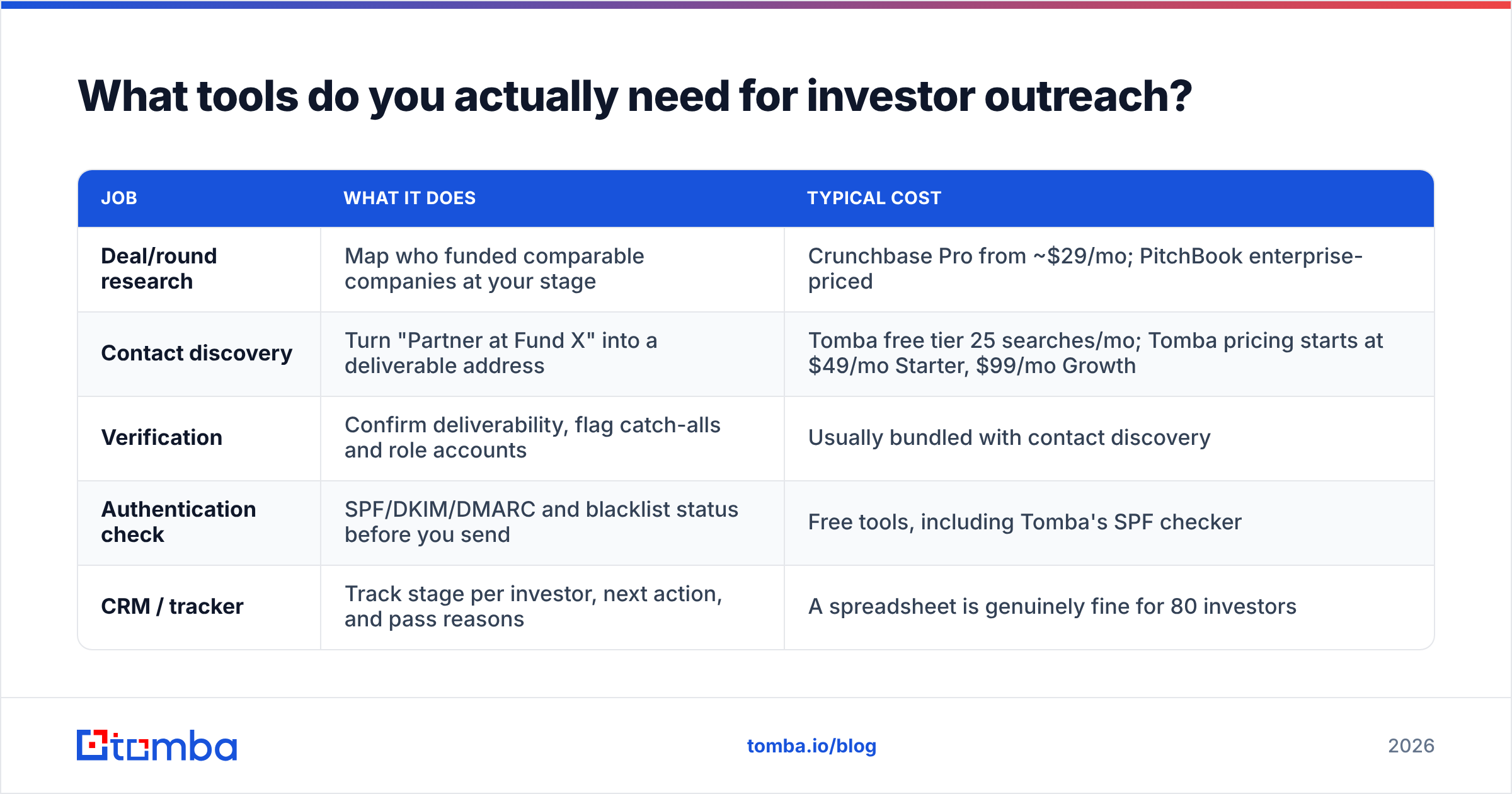
Less than you think. The stack has three jobs: find the right humans, get their working email address, and land in the inbox.
| Job | What it does | Typical cost |
|---|---|---|
| Deal/round research | Map who funded comparable companies at your stage | Crunchbase Pro from ~$29/mo; PitchBook enterprise-priced |
| Contact discovery | Turn "Partner at Fund X" into a deliverable address | Tomba free tier 25 searches/mo; Tomba pricing starts at $49/mo Starter, $99/mo Growth |
| Verification | Confirm deliverability, flag catch-alls and role accounts | Usually bundled with contact discovery |
| Authentication check | SPF/DKIM/DMARC and blacklist status before you send | Free tools, including Tomba's SPF checker |
| CRM / tracker | Track stage per investor, next action, and pass reasons | A spreadsheet is genuinely fine for 80 investors |
Skip the sequencer entirely. Skip the "AI investor matching" products that promise to introduce you to 500 relevant funds — they sell the same list to every founder, which is exactly the list every investor has learned to ignore. And be skeptical of any tool claiming a proprietary database of "verified VC emails"; partner turnover means those lists decay by roughly 20–30% a year, which is why live lookup against the fund's actual domain beats a static export. Vendor-neutral review sites like G2 are useful for sanity-checking claims before you pay for a year upfront.
For founders who prefer buying a pre-built list over building one, providers like BookYourData offer pay-as-you-go B2B contact data with verification guarantees, which can be a reasonable shortcut for adjacent categories — just re-verify anything older than a quarter before you send.
What does a realistic investor outreach funnel look like?#
Set expectations against numbers, not hope. For a competent seed founder with a real product and some traction:
- 80 qualified, partner-level targets
- ~30% reply rate on warm intros, ~8–12% on well-targeted cold
- 15–20 first meetings
- 5–8 second meetings or partner-meeting invites
- 1–3 term sheets
If your reply rate is under 5%, the problem is the list or the deliverability — not the copy. Check bounces first, then check whether the partners you emailed have actually written checks at your stage recently. If you are getting meetings but no second meetings, the problem is the story or the traction, and more outreach will not fix it.
Track pass reasons obsessively. Ten investors saying "too early" is a fundraise timing problem. Ten saying "I don't believe the market is big enough" is a positioning problem you can fix in a week and re-approach with next quarter.
Start with the list, not the letter#
The best investor email in the world sent to a partner who doesn't invest at your stage gets you nothing. Get the targeting right, resolve the real partner addresses, verify them, authenticate your domain, and then spend an hour on the copy.
If the bottleneck right now is turning a list of partner names into addresses that actually deliver, the Tomba Email Finder does that specific job — search by fund domain to pull the investment team, resolve individual partners by name, and verify deliverability before you send. The free tier covers 25 searches a month, which is enough to test the workflow on your top targets before committing to a plan.
Build the list this week. Send on Monday.
Related guides#
// get started
Find, verify and enrich your first contacts today
Start on the free plan with 25 searches a month, then scale when your team is ready.
Free plan · No credit card required · GDPR & CCPA
// about the author